University Case Study: Dynamic Software Methodologies & WIFI Project
VerifiedAdded on 2023/06/10
|24
|6850
|401
Case Study
AI Summary
This case study examines the challenges faced by Wood Intensive Furnishing Incorporated (WIFI), a hypermarket chain specializing in wooden furniture, in integrating its Online Sales Order System (OSO) with a new On-Time Order Delivery System (OTOD). The project, complicated by the weight of the items and the existing system's limitations, prompted WIFI to seek consultation from Dynamic Software Methodologies (DSM), a software consulting firm. The assignment details six tailoring activities DSM should consider, including open-source software development relationships, motivating project maturity, quantifying project characteristics, technical detail checks, maintaining the software life cycle, and integrating the OSO and OTOD systems. The case study also explores four main delivery requirements and provides a rationale for management strategies, along with recommendations for tailoring activities and a self-reflection on the topic, ultimately offering insights into effective software project management methodologies.

Running head: DYNAMIC SOFTWARE PROJECT MANAGEMENT METHODOLOGIES
Dynamic Software Project Management Methodologies
Name of the Student
Name of the University
Author Note
Dynamic Software Project Management Methodologies
Name of the Student
Name of the University
Author Note

Paraphrase This Document
Need a fresh take? Get an instant paraphrase of this document with our AI Paraphraser
1DYNAMIC SOFTWARE PROJECT MANAGEMENT METHODOLOGIES
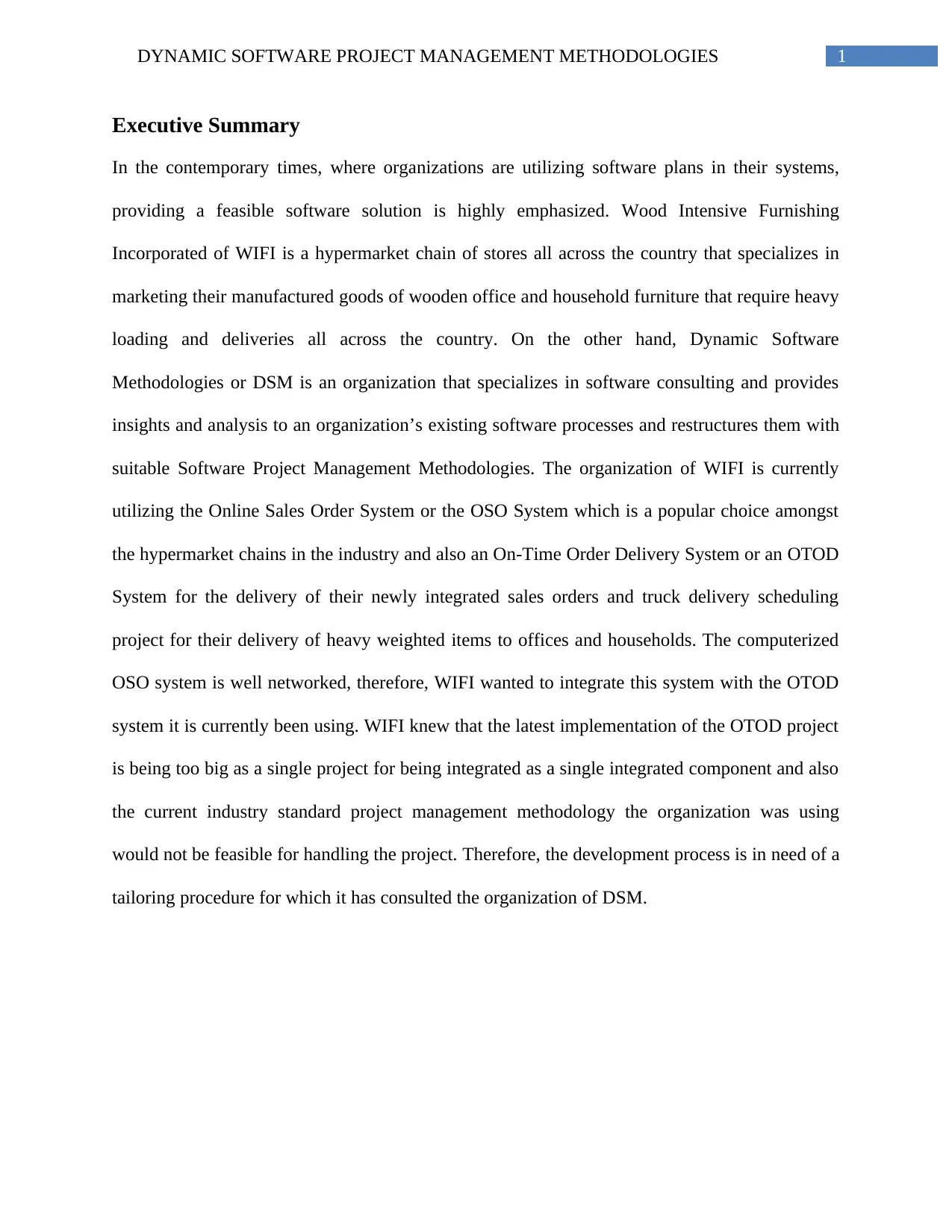
Executive Summary
In the contemporary times, where organizations are utilizing software plans in their systems,
providing a feasible software solution is highly emphasized. Wood Intensive Furnishing
Incorporated of WIFI is a hypermarket chain of stores all across the country that specializes in
marketing their manufactured goods of wooden office and household furniture that require heavy
loading and deliveries all across the country. On the other hand, Dynamic Software
Methodologies or DSM is an organization that specializes in software consulting and provides
insights and analysis to an organization’s existing software processes and restructures them with
suitable Software Project Management Methodologies. The organization of WIFI is currently
utilizing the Online Sales Order System or the OSO System which is a popular choice amongst
the hypermarket chains in the industry and also an On-Time Order Delivery System or an OTOD
System for the delivery of their newly integrated sales orders and truck delivery scheduling
project for their delivery of heavy weighted items to offices and households. The computerized
OSO system is well networked, therefore, WIFI wanted to integrate this system with the OTOD
system it is currently been using. WIFI knew that the latest implementation of the OTOD project
is being too big as a single project for being integrated as a single integrated component and also
the current industry standard project management methodology the organization was using
would not be feasible for handling the project. Therefore, the development process is in need of a
tailoring procedure for which it has consulted the organization of DSM.
Executive Summary
In the contemporary times, where organizations are utilizing software plans in their systems,
providing a feasible software solution is highly emphasized. Wood Intensive Furnishing
Incorporated of WIFI is a hypermarket chain of stores all across the country that specializes in
marketing their manufactured goods of wooden office and household furniture that require heavy
loading and deliveries all across the country. On the other hand, Dynamic Software
Methodologies or DSM is an organization that specializes in software consulting and provides
insights and analysis to an organization’s existing software processes and restructures them with
suitable Software Project Management Methodologies. The organization of WIFI is currently
utilizing the Online Sales Order System or the OSO System which is a popular choice amongst
the hypermarket chains in the industry and also an On-Time Order Delivery System or an OTOD
System for the delivery of their newly integrated sales orders and truck delivery scheduling
project for their delivery of heavy weighted items to offices and households. The computerized
OSO system is well networked, therefore, WIFI wanted to integrate this system with the OTOD
system it is currently been using. WIFI knew that the latest implementation of the OTOD project
is being too big as a single project for being integrated as a single integrated component and also
the current industry standard project management methodology the organization was using
would not be feasible for handling the project. Therefore, the development process is in need of a
tailoring procedure for which it has consulted the organization of DSM.
2DYNAMIC SOFTWARE PROJECT MANAGEMENT METHODOLOGIES
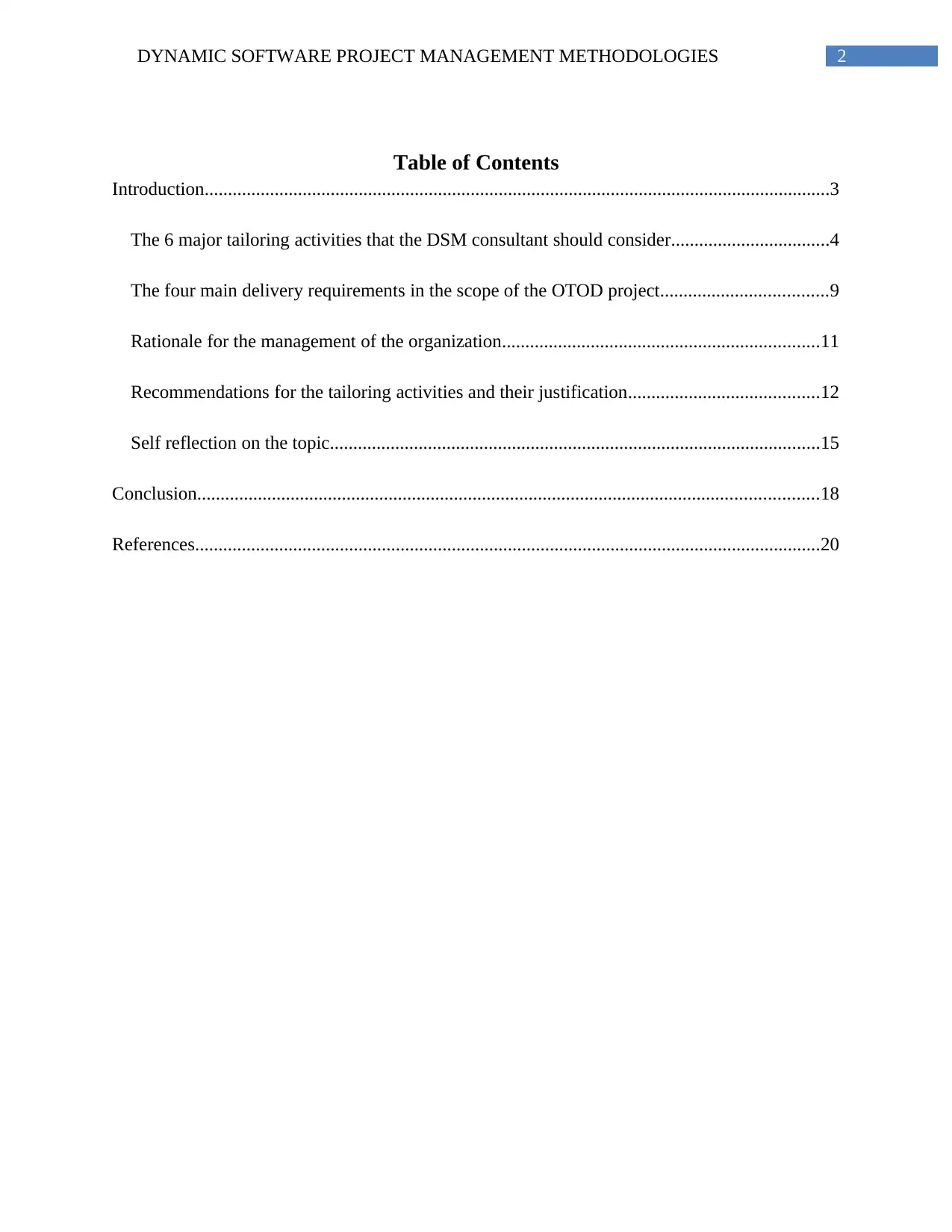
Table of Contents
Introduction......................................................................................................................................3
The 6 major tailoring activities that the DSM consultant should consider..................................4
The four main delivery requirements in the scope of the OTOD project....................................9
Rationale for the management of the organization....................................................................11
Recommendations for the tailoring activities and their justification.........................................12
Self reflection on the topic.........................................................................................................15
Conclusion.....................................................................................................................................18
References......................................................................................................................................20
Table of Contents
Introduction......................................................................................................................................3
The 6 major tailoring activities that the DSM consultant should consider..................................4
The four main delivery requirements in the scope of the OTOD project....................................9
Rationale for the management of the organization....................................................................11
Recommendations for the tailoring activities and their justification.........................................12
Self reflection on the topic.........................................................................................................15
Conclusion.....................................................................................................................................18
References......................................................................................................................................20
⊘ This is a preview!⊘
Do you want full access?
Subscribe today to unlock all pages.

Trusted by 1+ million students worldwide
3DYNAMIC SOFTWARE PROJECT MANAGEMENT METHODOLOGIES
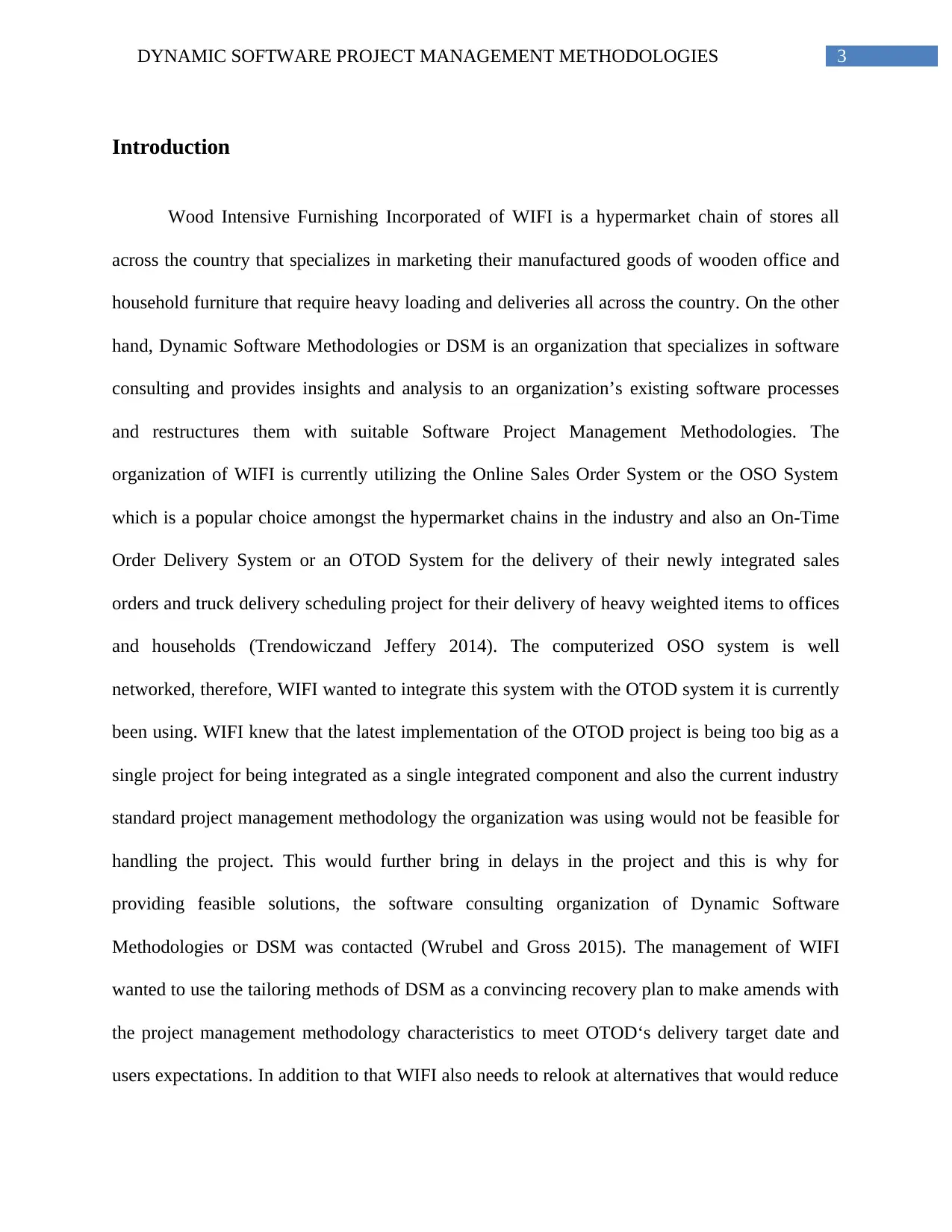
Introduction
Wood Intensive Furnishing Incorporated of WIFI is a hypermarket chain of stores all
across the country that specializes in marketing their manufactured goods of wooden office and
household furniture that require heavy loading and deliveries all across the country. On the other
hand, Dynamic Software Methodologies or DSM is an organization that specializes in software
consulting and provides insights and analysis to an organization’s existing software processes
and restructures them with suitable Software Project Management Methodologies. The
organization of WIFI is currently utilizing the Online Sales Order System or the OSO System
which is a popular choice amongst the hypermarket chains in the industry and also an On-Time
Order Delivery System or an OTOD System for the delivery of their newly integrated sales
orders and truck delivery scheduling project for their delivery of heavy weighted items to offices
and households (Trendowiczand Jeffery 2014). The computerized OSO system is well
networked, therefore, WIFI wanted to integrate this system with the OTOD system it is currently
been using. WIFI knew that the latest implementation of the OTOD project is being too big as a
single project for being integrated as a single integrated component and also the current industry
standard project management methodology the organization was using would not be feasible for
handling the project. This would further bring in delays in the project and this is why for
providing feasible solutions, the software consulting organization of Dynamic Software
Methodologies or DSM was contacted (Wrubel and Gross 2015). The management of WIFI
wanted to use the tailoring methods of DSM as a convincing recovery plan to make amends with
the project management methodology characteristics to meet OTOD‘s delivery target date and
users expectations. In addition to that WIFI also needs to relook at alternatives that would reduce
Introduction
Wood Intensive Furnishing Incorporated of WIFI is a hypermarket chain of stores all
across the country that specializes in marketing their manufactured goods of wooden office and
household furniture that require heavy loading and deliveries all across the country. On the other
hand, Dynamic Software Methodologies or DSM is an organization that specializes in software
consulting and provides insights and analysis to an organization’s existing software processes
and restructures them with suitable Software Project Management Methodologies. The
organization of WIFI is currently utilizing the Online Sales Order System or the OSO System
which is a popular choice amongst the hypermarket chains in the industry and also an On-Time
Order Delivery System or an OTOD System for the delivery of their newly integrated sales
orders and truck delivery scheduling project for their delivery of heavy weighted items to offices
and households (Trendowiczand Jeffery 2014). The computerized OSO system is well
networked, therefore, WIFI wanted to integrate this system with the OTOD system it is currently
been using. WIFI knew that the latest implementation of the OTOD project is being too big as a
single project for being integrated as a single integrated component and also the current industry
standard project management methodology the organization was using would not be feasible for
handling the project. This would further bring in delays in the project and this is why for
providing feasible solutions, the software consulting organization of Dynamic Software
Methodologies or DSM was contacted (Wrubel and Gross 2015). The management of WIFI
wanted to use the tailoring methods of DSM as a convincing recovery plan to make amends with
the project management methodology characteristics to meet OTOD‘s delivery target date and
users expectations. In addition to that WIFI also needs to relook at alternatives that would reduce
Paraphrase This Document
Need a fresh take? Get an instant paraphrase of this document with our AI Paraphraser
4DYNAMIC SOFTWARE PROJECT MANAGEMENT METHODOLOGIES
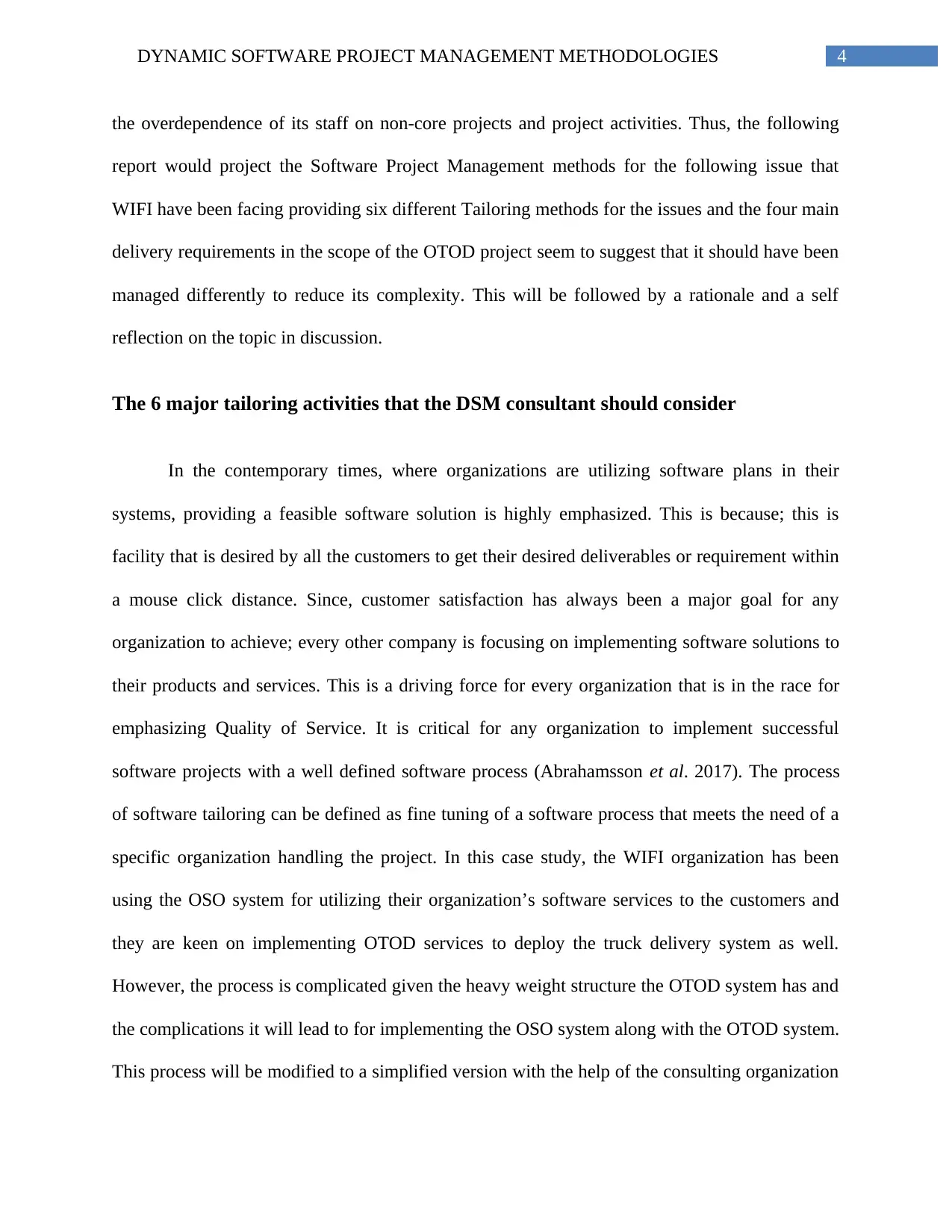
the overdependence of its staff on non-core projects and project activities. Thus, the following
report would project the Software Project Management methods for the following issue that
WIFI have been facing providing six different Tailoring methods for the issues and the four main
delivery requirements in the scope of the OTOD project seem to suggest that it should have been
managed differently to reduce its complexity. This will be followed by a rationale and a self
reflection on the topic in discussion.
The 6 major tailoring activities that the DSM consultant should consider
In the contemporary times, where organizations are utilizing software plans in their
systems, providing a feasible software solution is highly emphasized. This is because; this is
facility that is desired by all the customers to get their desired deliverables or requirement within
a mouse click distance. Since, customer satisfaction has always been a major goal for any
organization to achieve; every other company is focusing on implementing software solutions to
their products and services. This is a driving force for every organization that is in the race for
emphasizing Quality of Service. It is critical for any organization to implement successful
software projects with a well defined software process (Abrahamsson et al. 2017). The process
of software tailoring can be defined as fine tuning of a software process that meets the need of a
specific organization handling the project. In this case study, the WIFI organization has been
using the OSO system for utilizing their organization’s software services to the customers and
they are keen on implementing OTOD services to deploy the truck delivery system as well.
However, the process is complicated given the heavy weight structure the OTOD system has and
the complications it will lead to for implementing the OSO system along with the OTOD system.
This process will be modified to a simplified version with the help of the consulting organization
the overdependence of its staff on non-core projects and project activities. Thus, the following
report would project the Software Project Management methods for the following issue that
WIFI have been facing providing six different Tailoring methods for the issues and the four main
delivery requirements in the scope of the OTOD project seem to suggest that it should have been
managed differently to reduce its complexity. This will be followed by a rationale and a self
reflection on the topic in discussion.
The 6 major tailoring activities that the DSM consultant should consider
In the contemporary times, where organizations are utilizing software plans in their
systems, providing a feasible software solution is highly emphasized. This is because; this is
facility that is desired by all the customers to get their desired deliverables or requirement within
a mouse click distance. Since, customer satisfaction has always been a major goal for any
organization to achieve; every other company is focusing on implementing software solutions to
their products and services. This is a driving force for every organization that is in the race for
emphasizing Quality of Service. It is critical for any organization to implement successful
software projects with a well defined software process (Abrahamsson et al. 2017). The process
of software tailoring can be defined as fine tuning of a software process that meets the need of a
specific organization handling the project. In this case study, the WIFI organization has been
using the OSO system for utilizing their organization’s software services to the customers and
they are keen on implementing OTOD services to deploy the truck delivery system as well.
However, the process is complicated given the heavy weight structure the OTOD system has and
the complications it will lead to for implementing the OSO system along with the OTOD system.
This process will be modified to a simplified version with the help of the consulting organization
5DYNAMIC SOFTWARE PROJECT MANAGEMENT METHODOLOGIES
of DSM that will provide 6 tailoring methodologies to the organization of WIFI for
implementing feasible processed to merge the OSO and OTOD systems. Following would be the
suggested tailoring methodologies that DSM would suggest that the WIFI Company uses in their
software project management methodologies:
1. The relationship with the Open Source Software Development: Before reaching
any conclusions with the issues that the OSO system has it has to be made sure of what the
existing software WIFI Company has been using for their Open Source Software Development.
For this, the consulting team needs to clarify the characteristics of both the softwares the
company is using and the software that the company is willing to embark (Bass 2016). This has
to be done because one of the primary characteristic of any software should be providing the
freedom of the customers using the software. Ideally, these open source software should have the
following features:
Software usability for the customers as per their wish, not limiting them for any
choices they make.
The software must be at the customer’s disposal to fit the requirements. This
would include the fixing of bugs, adding of functionalities and reviewing the
software.
The software must be redistributed to other potential customers, which may be
free of cost or require minimal charges.
The users must have an access to the source code for any piece of the software.
If during the examining of these characteristics in the process of evaluation for the OSO
and OTOD system is found by the consulting company of DSM, then it would be a feasible
of DSM that will provide 6 tailoring methodologies to the organization of WIFI for
implementing feasible processed to merge the OSO and OTOD systems. Following would be the
suggested tailoring methodologies that DSM would suggest that the WIFI Company uses in their
software project management methodologies:
1. The relationship with the Open Source Software Development: Before reaching
any conclusions with the issues that the OSO system has it has to be made sure of what the
existing software WIFI Company has been using for their Open Source Software Development.
For this, the consulting team needs to clarify the characteristics of both the softwares the
company is using and the software that the company is willing to embark (Bass 2016). This has
to be done because one of the primary characteristic of any software should be providing the
freedom of the customers using the software. Ideally, these open source software should have the
following features:
Software usability for the customers as per their wish, not limiting them for any
choices they make.
The software must be at the customer’s disposal to fit the requirements. This
would include the fixing of bugs, adding of functionalities and reviewing the
software.
The software must be redistributed to other potential customers, which may be
free of cost or require minimal charges.
The users must have an access to the source code for any piece of the software.
If during the examining of these characteristics in the process of evaluation for the OSO
and OTOD system is found by the consulting company of DSM, then it would be a feasible
⊘ This is a preview!⊘
Do you want full access?
Subscribe today to unlock all pages.
Trusted by 1+ million students worldwide
6DYNAMIC SOFTWARE PROJECT MANAGEMENT METHODOLOGIES
option to utilize tailoring methodologies to emphasize the software developmental procedure
(Yang et al. 2017). This can also include the further studying of the bugs in the system, the
functionality of the software, the usability checking and the security associated with the use of
the software. The entire checking of the software for the open source software development may
however be made to develop less on the legal aspect of the matters. Nevertheless, the recognising
of the ownership of defined processes may be an important issue.
2. Motivating the maturity of the software project: The software model that WIFI
Company is keen on using for their truck order delivery is the OTOD system, which is a complex
system and can often turn out to pretty overwhelming. Thus, this indeed proves the fact that the
project system for the software development model is a bit immature compared to the ideal
software development processes. In this context, the consulting company can incorporate several
ways to the organization of WIFI and encourage them in raising the maturity levels of their
software processes (Pillat et al. 2015). The motivations that DSM can provide WIFI Company is
to increase the level of satisfaction for the employees, make the development process faster to
meet the deadlines, lower the cost of maintenance for the software, attempting less escalations,
making less defects in the system and agreeing better to the requirement of the clients according
to the feasibility of the organization.
3. Quantifying the characteristics of the project: A feasible software development is
characterised by a various features of that the software holds and the entire project for the
software development has several characteristics of the development process that follows an
ideal suite. For implementing the tailoring process, it needs to be found out what the
developmental process is being followed in the organization of WIFI and to further integrate the
software systems of the OSO and OTOD process if the organization is following the systematic
option to utilize tailoring methodologies to emphasize the software developmental procedure
(Yang et al. 2017). This can also include the further studying of the bugs in the system, the
functionality of the software, the usability checking and the security associated with the use of
the software. The entire checking of the software for the open source software development may
however be made to develop less on the legal aspect of the matters. Nevertheless, the recognising
of the ownership of defined processes may be an important issue.
2. Motivating the maturity of the software project: The software model that WIFI
Company is keen on using for their truck order delivery is the OTOD system, which is a complex
system and can often turn out to pretty overwhelming. Thus, this indeed proves the fact that the
project system for the software development model is a bit immature compared to the ideal
software development processes. In this context, the consulting company can incorporate several
ways to the organization of WIFI and encourage them in raising the maturity levels of their
software processes (Pillat et al. 2015). The motivations that DSM can provide WIFI Company is
to increase the level of satisfaction for the employees, make the development process faster to
meet the deadlines, lower the cost of maintenance for the software, attempting less escalations,
making less defects in the system and agreeing better to the requirement of the clients according
to the feasibility of the organization.
3. Quantifying the characteristics of the project: A feasible software development is
characterised by a various features of that the software holds and the entire project for the
software development has several characteristics of the development process that follows an
ideal suite. For implementing the tailoring process, it needs to be found out what the
developmental process is being followed in the organization of WIFI and to further integrate the
software systems of the OSO and OTOD process if the organization is following the systematic
Paraphrase This Document
Need a fresh take? Get an instant paraphrase of this document with our AI Paraphraser
7DYNAMIC SOFTWARE PROJECT MANAGEMENT METHODOLOGIES
approach (Campanelli and Parreiras 2015). To ensure this, there are several characteristics of the
developmental process that DSM needs to check for. These are as follows:
The size and complexity maintenance: In this developmental sub-process, there
are a lot of divisions that needs to be checked out on for the feasible software
development process (Fitzgerald and Stol 2014). This would be characterized by
the type of software product being developed, the documentation process
including the estimation of the number of pages the documentation of the entire
process would hold, the development team and the number of people designated
in it, the type of centralized or distributed system the software depends on, the
feasibility study, research system, operational system, the upgrade of the existing
system, the critical evaluation of the life cycle and safety measures taken, the
users and number of users accessing the software.
Formality maintenance: This phase of the developmental process is
characterized by the developmental requirements, the formal reviews and the
auditing system and the formal approval of the deliverables and the baselines of
the software.
Development Control Maintenance: This phase of the software development
phase is characterized by the required management visibility level, the
organization level and the access of acquirer organization.
4. Checking the technical detail of the software system: Before deciding the tailoring
process, the DSM organization needs to check the technical details of the existing software
system for WIFI Company and then needs to decide whether or not the integration of the OTOD
software system would be feasible for the process. The WIFI organization specializes in
approach (Campanelli and Parreiras 2015). To ensure this, there are several characteristics of the
developmental process that DSM needs to check for. These are as follows:
The size and complexity maintenance: In this developmental sub-process, there
are a lot of divisions that needs to be checked out on for the feasible software
development process (Fitzgerald and Stol 2014). This would be characterized by
the type of software product being developed, the documentation process
including the estimation of the number of pages the documentation of the entire
process would hold, the development team and the number of people designated
in it, the type of centralized or distributed system the software depends on, the
feasibility study, research system, operational system, the upgrade of the existing
system, the critical evaluation of the life cycle and safety measures taken, the
users and number of users accessing the software.
Formality maintenance: This phase of the developmental process is
characterized by the developmental requirements, the formal reviews and the
auditing system and the formal approval of the deliverables and the baselines of
the software.
Development Control Maintenance: This phase of the software development
phase is characterized by the required management visibility level, the
organization level and the access of acquirer organization.
4. Checking the technical detail of the software system: Before deciding the tailoring
process, the DSM organization needs to check the technical details of the existing software
system for WIFI Company and then needs to decide whether or not the integration of the OTOD
software system would be feasible for the process. The WIFI organization specializes in
8DYNAMIC SOFTWARE PROJECT MANAGEMENT METHODOLOGIES
delivering household and office wooden furniture, which are often heavy weighted and needs
truckloads to deliver the ordered items to the customers (Barricelli and Valtolina2015). In the
same way, it has been found that the OTOD software system is equally heavy weighted for the
organization to implement it in the existing software system. This would also require that the
customers get to use tailored software that meets all their requirements regarding the online sales
as well as the on-time delivery of the furniture.
5. Maintaining the software life cycle method: It is necessary that the account
information of software is made according to the software lifecycle model that took into account
the integration process that the organization of WIFI required. It needed to integrate both the
OSO system and the OTOD system, even when it was found that the OTOD model is heavy and
complicated for the system (Klepper et al. 2015). Therefore, the consulting organization of DSM
needs to look into the matter of how much time would the integration process take and what
would be the outcome of the budgeting plans when these two software systems would be
integrated with one another. It would only be acceptable if the tailoring process is applied after
considering this characteristic of the software development model.
6. The organization as a whole with legal implications: It is often found that the
hypermarket organization focuses on having software with an open process. However, since
these organizations cannot use a tailoring process all by themselves except for creating
frameworks, these processes cannot be initiated by the organizations like WIFI. Although, these
can be addressed as these companies provide the initial idea of the tailoring process (Sánchez-
Gordón and Moreno2014). Therefore, it can readily be said that the high level software
integration model and the tailoring process is a brainchild of an organization that wishes to use
integrated software systems. Therefore, for the tailoring process, it needs to be kept in mind that
delivering household and office wooden furniture, which are often heavy weighted and needs
truckloads to deliver the ordered items to the customers (Barricelli and Valtolina2015). In the
same way, it has been found that the OTOD software system is equally heavy weighted for the
organization to implement it in the existing software system. This would also require that the
customers get to use tailored software that meets all their requirements regarding the online sales
as well as the on-time delivery of the furniture.
5. Maintaining the software life cycle method: It is necessary that the account
information of software is made according to the software lifecycle model that took into account
the integration process that the organization of WIFI required. It needed to integrate both the
OSO system and the OTOD system, even when it was found that the OTOD model is heavy and
complicated for the system (Klepper et al. 2015). Therefore, the consulting organization of DSM
needs to look into the matter of how much time would the integration process take and what
would be the outcome of the budgeting plans when these two software systems would be
integrated with one another. It would only be acceptable if the tailoring process is applied after
considering this characteristic of the software development model.
6. The organization as a whole with legal implications: It is often found that the
hypermarket organization focuses on having software with an open process. However, since
these organizations cannot use a tailoring process all by themselves except for creating
frameworks, these processes cannot be initiated by the organizations like WIFI. Although, these
can be addressed as these companies provide the initial idea of the tailoring process (Sánchez-
Gordón and Moreno2014). Therefore, it can readily be said that the high level software
integration model and the tailoring process is a brainchild of an organization that wishes to use
integrated software systems. Therefore, for the tailoring process, it needs to be kept in mind that
⊘ This is a preview!⊘
Do you want full access?
Subscribe today to unlock all pages.
Trusted by 1+ million students worldwide
9DYNAMIC SOFTWARE PROJECT MANAGEMENT METHODOLOGIES
the organization’s criteria for the software integration are kept at priority besides all the other
requirements for the tailoring process.
Thus, in conclusion of the description of the above 6 activities of the proposals for a
tailoring process to be initiated in the organization of WIFI, it can be said that two of the
processes can be readily applied to the system for the software integration process. As the
consulting organization, DSM would like to specifically suggest that the two of the tailoring
activities that can be put forward feasibly for the modification of the software systems would be
(a) motivating the maturity of the software project and (b) checking the technical detail of the
software system.
This is because, before everything else, it is required that the software development
process meets the needs of the clients more than it meets the needs of the organization and
therefore it needs to mature with the client’s specifications. Again, for the software development
process, it needs to be specified that the requirements of the clients and the organization are
coordinating with the technical details of the software (O'Connor and Laporte 2014). Therefore,
as the consulting organization, DSM provides proper insights about the WIFI organization’s
requirements and suggests proper tailoring procedures associated with it for the integration of the
OSO and OTOD system software.
The four main delivery requirements in the scope of the OTOD project
Delivery requirements or deliverables of software are the descriptions of the services that
software must deliver to the users and the constraints under which it performs. WIFI felt that
OTOD’s integration component of the scope was too big as a single project and the industry
standard project management methodology it was currently using was not suitable to manage it.
the organization’s criteria for the software integration are kept at priority besides all the other
requirements for the tailoring process.
Thus, in conclusion of the description of the above 6 activities of the proposals for a
tailoring process to be initiated in the organization of WIFI, it can be said that two of the
processes can be readily applied to the system for the software integration process. As the
consulting organization, DSM would like to specifically suggest that the two of the tailoring
activities that can be put forward feasibly for the modification of the software systems would be
(a) motivating the maturity of the software project and (b) checking the technical detail of the
software system.
This is because, before everything else, it is required that the software development
process meets the needs of the clients more than it meets the needs of the organization and
therefore it needs to mature with the client’s specifications. Again, for the software development
process, it needs to be specified that the requirements of the clients and the organization are
coordinating with the technical details of the software (O'Connor and Laporte 2014). Therefore,
as the consulting organization, DSM provides proper insights about the WIFI organization’s
requirements and suggests proper tailoring procedures associated with it for the integration of the
OSO and OTOD system software.
The four main delivery requirements in the scope of the OTOD project
Delivery requirements or deliverables of software are the descriptions of the services that
software must deliver to the users and the constraints under which it performs. WIFI felt that
OTOD’s integration component of the scope was too big as a single project and the industry
standard project management methodology it was currently using was not suitable to manage it.
Paraphrase This Document
Need a fresh take? Get an instant paraphrase of this document with our AI Paraphraser
10DYNAMIC SOFTWARE PROJECT MANAGEMENT METHODOLOGIES
Project changes needed to be quickly handled to meet the project’s target date, else delays would
be experienced. WIFI’s senior management was now looking at opportunities to make some
changes to the OTOD systems and manage the 4 delivery areas in the scope above (Pacheco et
al. 2015). This is because there were too many deliverables or delivery requirements that the
OTOD system was to be integrated with the existing Online Sales Order or OSO system to
provide an efficient ‘after sales- delivery-service’ to its customers. The four delivery
requirements that were considered to be as important ‘after-sales service areas in its scope’ are as
follows:
The sales orders for bulky items must be delivered to customers within a 7-
Working-Day-Delivery-After-Sales or 7WDDAS target after it has been
processed by OTOD.
Appointment for deliveries is fixed by the customers when sales orders are
confirmed.
Zoning of truck delivery routes within the country must be incorporated into the
sales orders to assist the dispatch and routing of the trucks.
Each truck delivery route, by zones, must be pre-programmed into the GPS or
Global Positioning System by the OTOD system to assist in arriving at customer’s
exact location.
Based on these four deliverables, it could be seen that the process for the deliverables of
the software is becoming a very bulky project. This is why DSM had strategized to integrate the
system in such a way that these 4 tasks can be divided into further 3 possible sub-projects rather
than the 4 extended deliverables. This can be done by leaving the first two deliverables as it is
and grouping the zoning and the pre-programming of the delivery trucks within the country
Project changes needed to be quickly handled to meet the project’s target date, else delays would
be experienced. WIFI’s senior management was now looking at opportunities to make some
changes to the OTOD systems and manage the 4 delivery areas in the scope above (Pacheco et
al. 2015). This is because there were too many deliverables or delivery requirements that the
OTOD system was to be integrated with the existing Online Sales Order or OSO system to
provide an efficient ‘after sales- delivery-service’ to its customers. The four delivery
requirements that were considered to be as important ‘after-sales service areas in its scope’ are as
follows:
The sales orders for bulky items must be delivered to customers within a 7-
Working-Day-Delivery-After-Sales or 7WDDAS target after it has been
processed by OTOD.
Appointment for deliveries is fixed by the customers when sales orders are
confirmed.
Zoning of truck delivery routes within the country must be incorporated into the
sales orders to assist the dispatch and routing of the trucks.
Each truck delivery route, by zones, must be pre-programmed into the GPS or
Global Positioning System by the OTOD system to assist in arriving at customer’s
exact location.
Based on these four deliverables, it could be seen that the process for the deliverables of
the software is becoming a very bulky project. This is why DSM had strategized to integrate the
system in such a way that these 4 tasks can be divided into further 3 possible sub-projects rather
than the 4 extended deliverables. This can be done by leaving the first two deliverables as it is
and grouping the zoning and the pre-programming of the delivery trucks within the country
11DYNAMIC SOFTWARE PROJECT MANAGEMENT METHODOLOGIES
(Papadopoulos 2015). This is because, both of the activities involve incorporation of GPS or
Global Positioning System in the software process, however; both are from different perspective.
However, if these two tasks being similar in nature are put together, the software tailoring and
development process would be much less time consuming and this would also protect the
budgeting of the entire process. Thus as per the grouping of the sub-processes, the deliverables
of the software would be as follows:
Delivery of the orders: The sales orders for bulky items must be delivered to
customers within a 7- Working-Day-Delivery-After-Sales or 7WDDAS target
after it has been processed by OTOD.
Delivery appointments: Appointment for deliveries is fixed by the customers
when sales orders are confirmed.
Zoning of delivery trucks by Global Positioning System: This must be pre-
programmed into the GPS or Global Positioning System by the OTOD system to
assist through the customer’s exact location.
Rationale for the management of the organization
From the perspective of a project manager, it has been found that the project management
methodologies that WIFI uses for the software development process have proven to be quite
heavy weighted. This is because the OTOD software system that WIFI wanted to incorporate in
the existing OSO software system had been too complex a project to implement. Probably
because it had too many deliverables than required and this was not at all sub-grouped into
similar constraints.
(Papadopoulos 2015). This is because, both of the activities involve incorporation of GPS or
Global Positioning System in the software process, however; both are from different perspective.
However, if these two tasks being similar in nature are put together, the software tailoring and
development process would be much less time consuming and this would also protect the
budgeting of the entire process. Thus as per the grouping of the sub-processes, the deliverables
of the software would be as follows:
Delivery of the orders: The sales orders for bulky items must be delivered to
customers within a 7- Working-Day-Delivery-After-Sales or 7WDDAS target
after it has been processed by OTOD.
Delivery appointments: Appointment for deliveries is fixed by the customers
when sales orders are confirmed.
Zoning of delivery trucks by Global Positioning System: This must be pre-
programmed into the GPS or Global Positioning System by the OTOD system to
assist through the customer’s exact location.
Rationale for the management of the organization
From the perspective of a project manager, it has been found that the project management
methodologies that WIFI uses for the software development process have proven to be quite
heavy weighted. This is because the OTOD software system that WIFI wanted to incorporate in
the existing OSO software system had been too complex a project to implement. Probably
because it had too many deliverables than required and this was not at all sub-grouped into
similar constraints.
⊘ This is a preview!⊘
Do you want full access?
Subscribe today to unlock all pages.
Trusted by 1+ million students worldwide

1 out of 24


Your All-in-One AI-Powered Toolkit for Academic Success.
+13062052269
info@desklib.com
Available 24*7 on WhatsApp / Email
![[object Object]](/_next/static/media/star-bottom.7253800d.svg)
Unlock your academic potential
Copyright © 2020–2026 A2Z Services. All Rights Reserved. Developed and managed by ZUCOL.