Dynamic Strategy and Disruptive Innovation: Facebook Report
VerifiedAdded on 2019/09/23
|4
|875
|101
Report
AI Summary
This report provides a comprehensive stakeholder analysis of Facebook, as required for a Dynamic Strategy and Disruptive Innovation assessment. It begins with an introduction to Facebook, outlining its vision, mission, recent developments, challenges, and industry trends. The report then utilizes the stakeholder view model to identify and describe Facebook's key stakeholder groups, followed by an in-depth analysis of four selected stakeholders, examining their behavior, motives, and potential coalitions, applying the stakeholder framework discussed in the workshop. The analysis incorporates academic articles and books, adhering to a report format with an executive summary and table of contents, and follows Harvard referencing guidelines. The report aims to provide a critical analysis of Facebook's stakeholders, demonstrating an understanding of stakeholder analysis concepts and theories.
Page
1
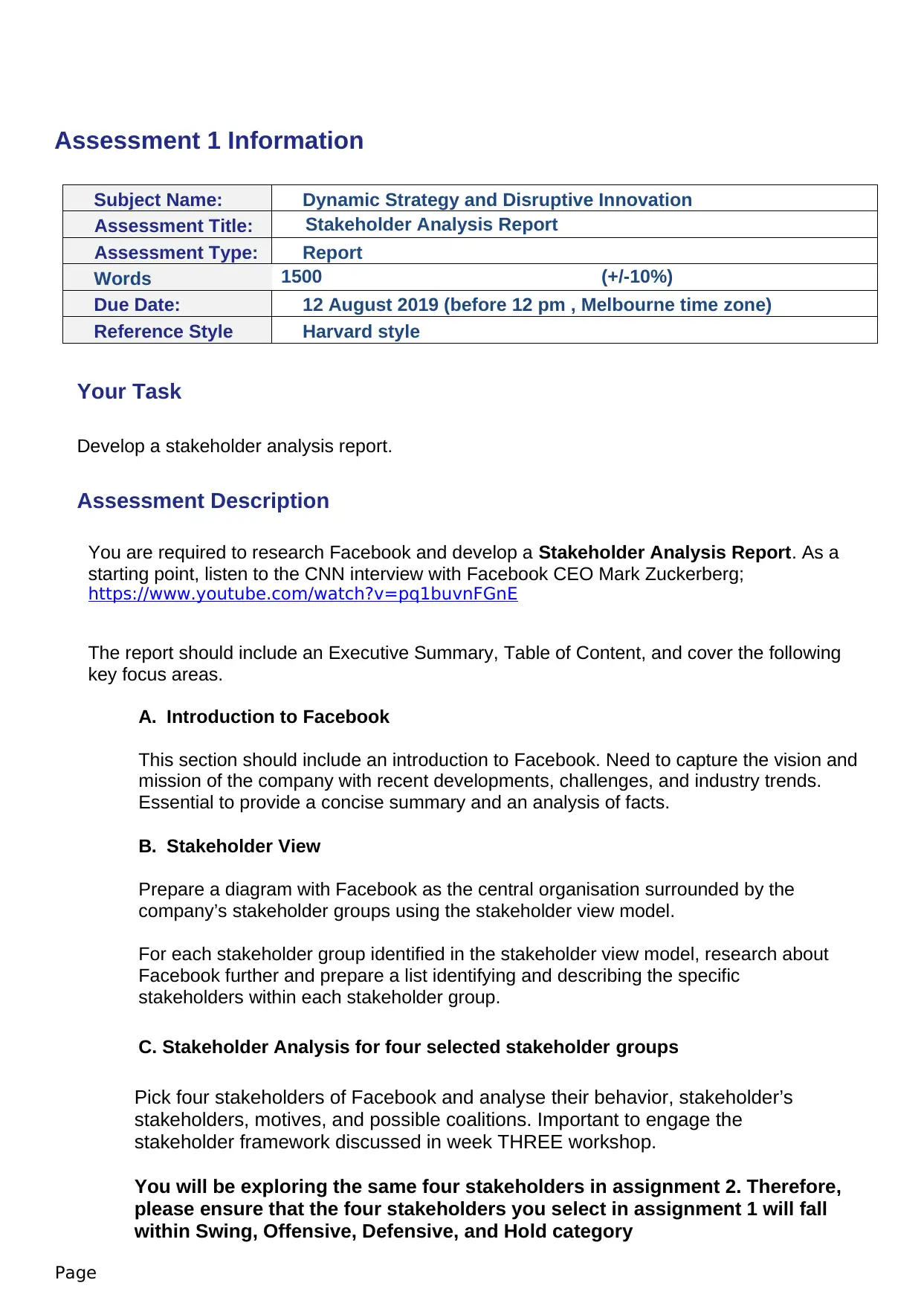
Assessment 1 Information
Subject Name: Dynamic Strategy and Disruptive Innovation
Assessment Title: Stakeholder Analysis Report
Assessment Type: Report
Words 1500 (+/-10%)
Due Date: 12 August 2019 (before 12 pm , Melbourne time zone)
Reference Style Harvard style
Your Task
Develop a stakeholder analysis report.
Assessment Description
You are required to research Facebook and develop a Stakeholder Analysis Report. As a
starting point, listen to the CNN interview with Facebook CEO Mark Zuckerberg;
https://www.youtube.com/watch?v=pq1buvnFGnE
The report should include an Executive Summary, Table of Content, and cover the following
key focus areas.
A. Introduction to Facebook
This section should include an introduction to Facebook. Need to capture the vision and
mission of the company with recent developments, challenges, and industry trends.
Essential to provide a concise summary and an analysis of facts.
B. Stakeholder View
Prepare a diagram with Facebook as the central organisation surrounded by the
company’s stakeholder groups using the stakeholder view model.
For each stakeholder group identified in the stakeholder view model, research about
Facebook further and prepare a list identifying and describing the specific
stakeholders within each stakeholder group.
C. Stakeholder Analysis for four selected stakeholder groups
Pick four stakeholders of Facebook and analyse their behavior, stakeholder’s
stakeholders, motives, and possible coalitions. Important to engage the
stakeholder framework discussed in week THREE workshop.
You will be exploring the same four stakeholders in assignment 2. Therefore,
please ensure that the four stakeholders you select in assignment 1 will fall
within Swing, Offensive, Defensive, and Hold category
1
Assessment 1 Information
Subject Name: Dynamic Strategy and Disruptive Innovation
Assessment Title: Stakeholder Analysis Report
Assessment Type: Report
Words 1500 (+/-10%)
Due Date: 12 August 2019 (before 12 pm , Melbourne time zone)
Reference Style Harvard style
Your Task
Develop a stakeholder analysis report.
Assessment Description
You are required to research Facebook and develop a Stakeholder Analysis Report. As a
starting point, listen to the CNN interview with Facebook CEO Mark Zuckerberg;
https://www.youtube.com/watch?v=pq1buvnFGnE
The report should include an Executive Summary, Table of Content, and cover the following
key focus areas.
A. Introduction to Facebook
This section should include an introduction to Facebook. Need to capture the vision and
mission of the company with recent developments, challenges, and industry trends.
Essential to provide a concise summary and an analysis of facts.
B. Stakeholder View
Prepare a diagram with Facebook as the central organisation surrounded by the
company’s stakeholder groups using the stakeholder view model.
For each stakeholder group identified in the stakeholder view model, research about
Facebook further and prepare a list identifying and describing the specific
stakeholders within each stakeholder group.
C. Stakeholder Analysis for four selected stakeholder groups
Pick four stakeholders of Facebook and analyse their behavior, stakeholder’s
stakeholders, motives, and possible coalitions. Important to engage the
stakeholder framework discussed in week THREE workshop.
You will be exploring the same four stakeholders in assignment 2. Therefore,
please ensure that the four stakeholders you select in assignment 1 will fall
within Swing, Offensive, Defensive, and Hold category
Paraphrase This Document
Need a fresh take? Get an instant paraphrase of this document with our AI Paraphraser

Page
2
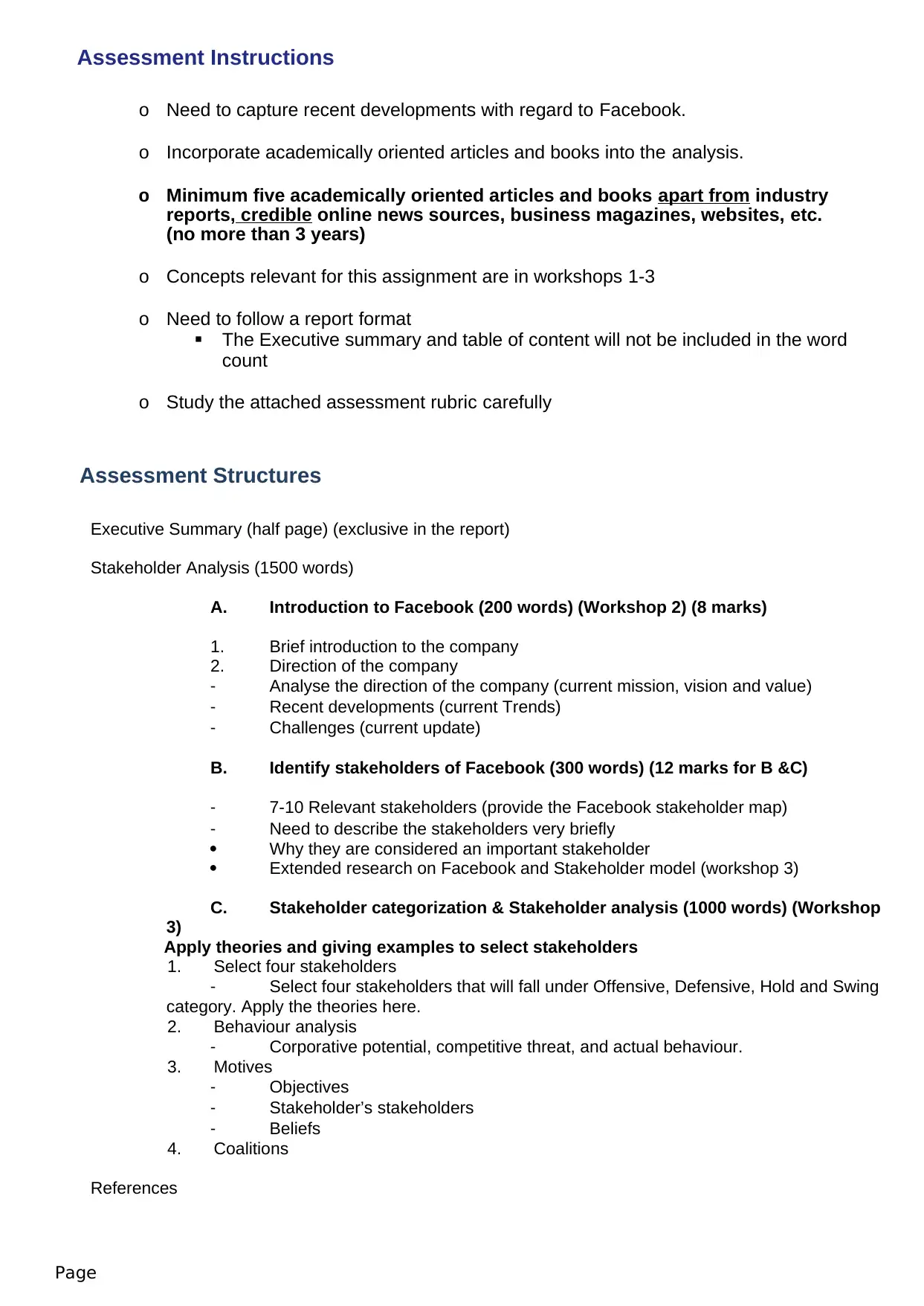
Assessment Instructions
o Need to capture recent developments with regard to Facebook.
o Incorporate academically oriented articles and books into the analysis.
o Minimum five academically oriented articles and books apart from industry
reports, credible online news sources, business magazines, websites, etc.
(no more than 3 years)
o Concepts relevant for this assignment are in workshops 1-3
o Need to follow a report format
The Executive summary and table of content will not be included in the word
count
o Study the attached assessment rubric carefully
Assessment Structures
Executive Summary (half page) (exclusive in the report)
Stakeholder Analysis (1500 words)
A. Introduction to Facebook (200 words) (Workshop 2) (8 marks)
1. Brief introduction to the company
2. Direction of the company
- Analyse the direction of the company (current mission, vision and value)
- Recent developments (current Trends)
- Challenges (current update)
B. Identify stakeholders of Facebook (300 words) (12 marks for B &C)
- 7-10 Relevant stakeholders (provide the Facebook stakeholder map)
- Need to describe the stakeholders very briefly
Why they are considered an important stakeholder
Extended research on Facebook and Stakeholder model (workshop 3)
C. Stakeholder categorization & Stakeholder analysis (1000 words) (Workshop
3)
Apply theories and giving examples to select stakeholders
1. Select four stakeholders
- Select four stakeholders that will fall under Offensive, Defensive, Hold and Swing
category. Apply the theories here.
2. Behaviour analysis
- Corporative potential, competitive threat, and actual behaviour.
3. Motives
- Objectives
- Stakeholder’s stakeholders
- Beliefs
4. Coalitions
References
2
Assessment Instructions
o Need to capture recent developments with regard to Facebook.
o Incorporate academically oriented articles and books into the analysis.
o Minimum five academically oriented articles and books apart from industry
reports, credible online news sources, business magazines, websites, etc.
(no more than 3 years)
o Concepts relevant for this assignment are in workshops 1-3
o Need to follow a report format
The Executive summary and table of content will not be included in the word
count
o Study the attached assessment rubric carefully
Assessment Structures
Executive Summary (half page) (exclusive in the report)
Stakeholder Analysis (1500 words)
A. Introduction to Facebook (200 words) (Workshop 2) (8 marks)
1. Brief introduction to the company
2. Direction of the company
- Analyse the direction of the company (current mission, vision and value)
- Recent developments (current Trends)
- Challenges (current update)
B. Identify stakeholders of Facebook (300 words) (12 marks for B &C)
- 7-10 Relevant stakeholders (provide the Facebook stakeholder map)
- Need to describe the stakeholders very briefly
Why they are considered an important stakeholder
Extended research on Facebook and Stakeholder model (workshop 3)
C. Stakeholder categorization & Stakeholder analysis (1000 words) (Workshop
3)
Apply theories and giving examples to select stakeholders
1. Select four stakeholders
- Select four stakeholders that will fall under Offensive, Defensive, Hold and Swing
category. Apply the theories here.
2. Behaviour analysis
- Corporative potential, competitive threat, and actual behaviour.
3. Motives
- Objectives
- Stakeholder’s stakeholders
- Beliefs
4. Coalitions
References

Page
3
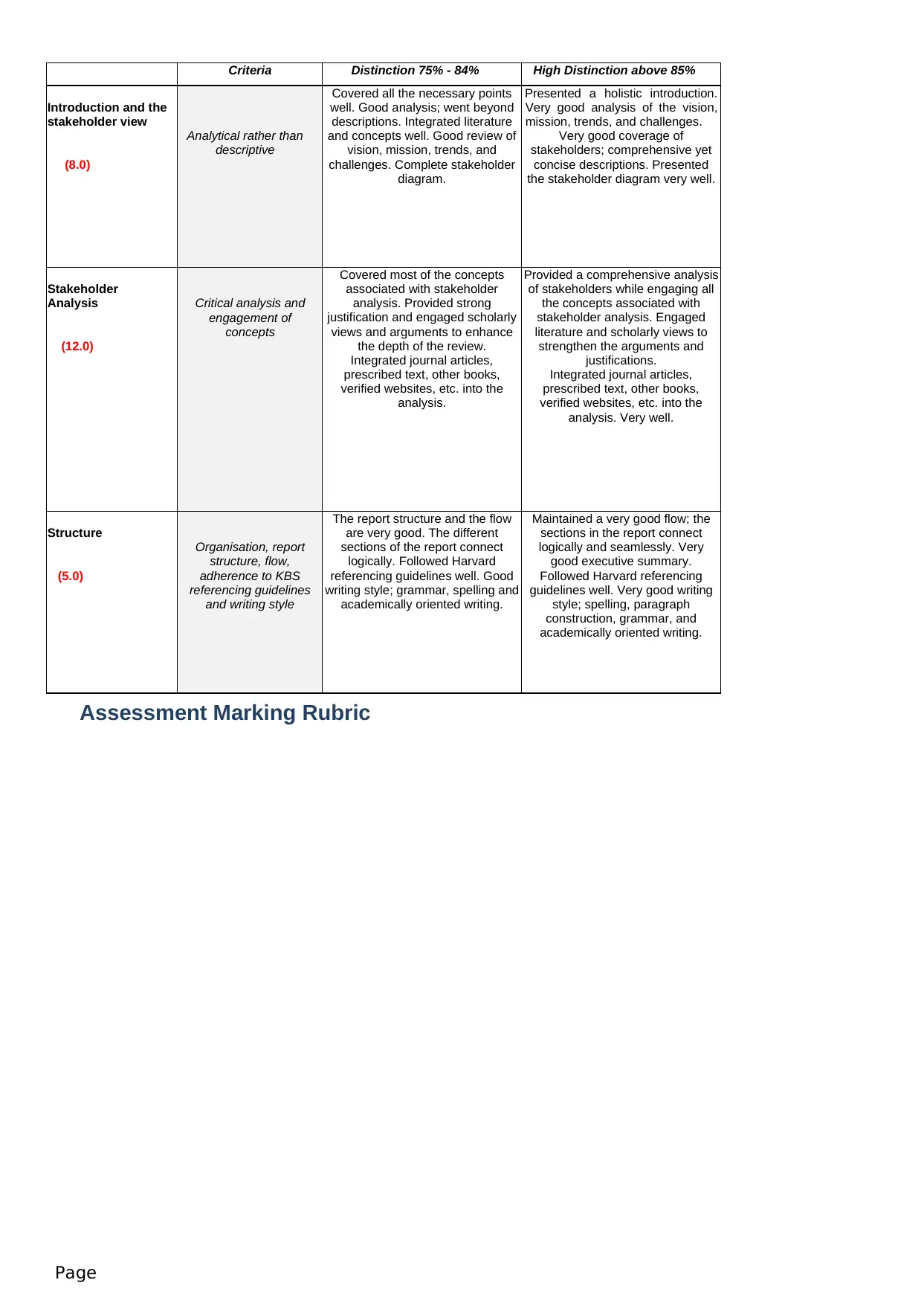
Criteria Distinction 75% - 84% High Distinction above 85%
Introduction and the
stakeholder view
(8.0)
Analytical rather than
descriptive
Covered all the necessary points
well. Good analysis; went beyond
descriptions. Integrated literature
and concepts well. Good review of
vision, mission, trends, and
challenges. Complete stakeholder
diagram.
Presented a holistic introduction.
Very good analysis of the vision,
mission, trends, and challenges.
Very good coverage of
stakeholders; comprehensive yet
concise descriptions. Presented
the stakeholder diagram very well.
Stakeholder
Analysis
(12.0)
Critical analysis and
engagement of
concepts
Covered most of the concepts
associated with stakeholder
analysis. Provided strong
justification and engaged scholarly
views and arguments to enhance
the depth of the review.
Integrated journal articles,
prescribed text, other books,
verified websites, etc. into the
analysis.
Provided a comprehensive analysis
of stakeholders while engaging all
the concepts associated with
stakeholder analysis. Engaged
literature and scholarly views to
strengthen the arguments and
justifications.
Integrated journal articles,
prescribed text, other books,
verified websites, etc. into the
analysis. Very well.
Structure
(5.0)
Organisation, report
structure, flow,
adherence to KBS
referencing guidelines
and writing style
The report structure and the flow
are very good. The different
sections of the report connect
logically. Followed Harvard
referencing guidelines well. Good
writing style; grammar, spelling and
academically oriented writing.
Maintained a very good flow; the
sections in the report connect
logically and seamlessly. Very
good executive summary.
Followed Harvard referencing
guidelines well. Very good writing
style; spelling, paragraph
construction, grammar, and
academically oriented writing.
Assessment Marking Rubric
3
Criteria Distinction 75% - 84% High Distinction above 85%
Introduction and the
stakeholder view
(8.0)
Analytical rather than
descriptive
Covered all the necessary points
well. Good analysis; went beyond
descriptions. Integrated literature
and concepts well. Good review of
vision, mission, trends, and
challenges. Complete stakeholder
diagram.
Presented a holistic introduction.
Very good analysis of the vision,
mission, trends, and challenges.
Very good coverage of
stakeholders; comprehensive yet
concise descriptions. Presented
the stakeholder diagram very well.
Stakeholder
Analysis
(12.0)
Critical analysis and
engagement of
concepts
Covered most of the concepts
associated with stakeholder
analysis. Provided strong
justification and engaged scholarly
views and arguments to enhance
the depth of the review.
Integrated journal articles,
prescribed text, other books,
verified websites, etc. into the
analysis.
Provided a comprehensive analysis
of stakeholders while engaging all
the concepts associated with
stakeholder analysis. Engaged
literature and scholarly views to
strengthen the arguments and
justifications.
Integrated journal articles,
prescribed text, other books,
verified websites, etc. into the
analysis. Very well.
Structure
(5.0)
Organisation, report
structure, flow,
adherence to KBS
referencing guidelines
and writing style
The report structure and the flow
are very good. The different
sections of the report connect
logically. Followed Harvard
referencing guidelines well. Good
writing style; grammar, spelling and
academically oriented writing.
Maintained a very good flow; the
sections in the report connect
logically and seamlessly. Very
good executive summary.
Followed Harvard referencing
guidelines well. Very good writing
style; spelling, paragraph
construction, grammar, and
academically oriented writing.
Assessment Marking Rubric
⊘ This is a preview!⊘
Do you want full access?
Subscribe today to unlock all pages.

Trusted by 1+ million students worldwide

Page
4
4
1 out of 4
Related Documents
Your All-in-One AI-Powered Toolkit for Academic Success.
+13062052269
info@desklib.com
Available 24*7 on WhatsApp / Email
Unlock your academic potential
Copyright © 2020–2026 A2Z Services. All Rights Reserved. Developed and managed by ZUCOL.