E-Commerce in Retail: Challenges, Solutions, and Strategies
VerifiedAdded on 2020/04/01
|17
|4652
|271
Report
AI Summary
This report provides a comprehensive analysis of e-commerce development within the retail sector, examining the evolution of online retailing and its impact on both businesses and consumers. It delves into the benefits of e-commerce, such as increased market reach and cost efficiencies, while also highlighting the significant challenges, including security threats, customer verification issues, and logistical complexities. The report investigates the problems associated with e-commerce, such as the rise of security breaches, customer returns, and the need for seamless integration across various operational systems. Furthermore, it proposes a range of solutions, including enhanced authentication methods, robust customer service strategies, and the adoption of innovative technologies like mobile apps and secure payment gateways. The research employs a mixed-methods approach, combining positivism and interpretivism to gain a holistic understanding of the issues and offer actionable recommendations for retail businesses seeking to optimize their e-commerce strategies. The project also includes a detailed conceptual framework, methodology, and project budget, providing a complete overview of the study.
E-Commerce in Retail 1
Problems of E-Commerce Development
in Retail Industries
Problems of E-Commerce Development
in Retail Industries

Paraphrase This Document
Need a fresh take? Get an instant paraphrase of this document with our AI Paraphraser
E-Commerce in Retail 2
Table of Contents
Introduction................................................................................................................................3
Problem Statement.....................................................................................................................3
Research Aims and Objectives...................................................................................................3
Research Aims.......................................................................................................................3
Research Objectives...............................................................................................................4
Research Questions....................................................................................................................4
Justification of the Project..........................................................................................................4
Outcome of the Research Project...............................................................................................5
Conceptual Framework..............................................................................................................5
E-Commerce Development in Retail.....................................................................................5
Benefits/Advantages of E-Commerce Development in Retail...............................................7
Problems/Challenges associated with E-Commerce Development in Retail.........................7
Solutions to Problems concerning E-Commerce Development in Retail..............................8
Methodology..............................................................................................................................9
Research Paradigm.................................................................................................................9
Research Technique.............................................................................................................10
Research Design...................................................................................................................10
Data Collection.....................................................................................................................11
Sampling..............................................................................................................................11
Data Analysis.......................................................................................................................12
Research Ethics....................................................................................................................13
Organization of the Study........................................................................................................13
Project Budget..........................................................................................................................14
Project Schedule.......................................................................................................................14
References................................................................................................................................17
Table of Contents
Introduction................................................................................................................................3
Problem Statement.....................................................................................................................3
Research Aims and Objectives...................................................................................................3
Research Aims.......................................................................................................................3
Research Objectives...............................................................................................................4
Research Questions....................................................................................................................4
Justification of the Project..........................................................................................................4
Outcome of the Research Project...............................................................................................5
Conceptual Framework..............................................................................................................5
E-Commerce Development in Retail.....................................................................................5
Benefits/Advantages of E-Commerce Development in Retail...............................................7
Problems/Challenges associated with E-Commerce Development in Retail.........................7
Solutions to Problems concerning E-Commerce Development in Retail..............................8
Methodology..............................................................................................................................9
Research Paradigm.................................................................................................................9
Research Technique.............................................................................................................10
Research Design...................................................................................................................10
Data Collection.....................................................................................................................11
Sampling..............................................................................................................................11
Data Analysis.......................................................................................................................12
Research Ethics....................................................................................................................13
Organization of the Study........................................................................................................13
Project Budget..........................................................................................................................14
Project Schedule.......................................................................................................................14
References................................................................................................................................17
E-Commerce in Retail 3
Introduction
The advent and growth of internet has significantly contributed in the growth of electronic
commerce and online retailing activity both along the Asian and other developed economies
of Europe and America. However, the same is also observed to account for the growth of
security issues that potentially affect the service potential of the e-commerce retail firms and
also the customer satisfaction levels (Crew & Brennan, 2014).
The research activity is divided along different parts like identification of the research
problem with also highlighting the research aims and objectives. Subsequently it also focuses
on conducting an empirical research while also formulating research methodologies for
carrying out the research activity. It would also focus on identification of the budget and time
required for accomplishment of the project.
Problem Statement
The development and growth of e-commerce and online retailing activities has contributed to
the generation of potential advantages for both the retail institutions on one hand while also
helped in servicing the needs of customers in a potential fashion thereby enhancing the level
of customer experiences and satisfaction. However, the retail institutions tend to suffer from a
growing level of security threat owing to the existence of unauthenticated purchasers or
customers and also in terms of growth of different types of online security leaks amounting to
growth of hacking activities, malware and virus intrusion and also the Denial of Service or
DOS attacks. The e-commerce and online retailing companies are thereby required to
continually innovate and develop on their security aspects for generation of effective services
to customers in an enhanced fashion (Paulos, 2015).
Research Aims and Objectives
Research Aims
The research is required to be constructed for understanding the fashion in which e-
commerce is incorporated in the activities of the retail institutions. It would thereby focus on
Introduction
The advent and growth of internet has significantly contributed in the growth of electronic
commerce and online retailing activity both along the Asian and other developed economies
of Europe and America. However, the same is also observed to account for the growth of
security issues that potentially affect the service potential of the e-commerce retail firms and
also the customer satisfaction levels (Crew & Brennan, 2014).
The research activity is divided along different parts like identification of the research
problem with also highlighting the research aims and objectives. Subsequently it also focuses
on conducting an empirical research while also formulating research methodologies for
carrying out the research activity. It would also focus on identification of the budget and time
required for accomplishment of the project.
Problem Statement
The development and growth of e-commerce and online retailing activities has contributed to
the generation of potential advantages for both the retail institutions on one hand while also
helped in servicing the needs of customers in a potential fashion thereby enhancing the level
of customer experiences and satisfaction. However, the retail institutions tend to suffer from a
growing level of security threat owing to the existence of unauthenticated purchasers or
customers and also in terms of growth of different types of online security leaks amounting to
growth of hacking activities, malware and virus intrusion and also the Denial of Service or
DOS attacks. The e-commerce and online retailing companies are thereby required to
continually innovate and develop on their security aspects for generation of effective services
to customers in an enhanced fashion (Paulos, 2015).
Research Aims and Objectives
Research Aims
The research is required to be constructed for understanding the fashion in which e-
commerce is incorporated in the activities of the retail institutions. It would thereby focus on
⊘ This is a preview!⊘
Do you want full access?
Subscribe today to unlock all pages.

Trusted by 1+ million students worldwide
E-Commerce in Retail 4
understanding the different benefits and problems concerning the application of e-commerce
in retailing. Further, it would also highlight on the different solutions that can be generated
thereof for addressing the problems concerning e-commerce application in retail.
Research Objectives
The objectives of the research activity are highlighted as under.
To understand the need for incorporating e-commerce in retail applications.
To reflect on the benefits concerning the application of e-commerce in retail.
To understand and evaluate on the problems concerning the incorporation of e-
commerce in the retail sphere.
To reflect on the potential solutions for addressing the problems concerning the
application of e-commerce in retail.
Research Questions
The research activity is required to address the different research questions that are reflected
as under.
What is the significance for incorporating e-commerce activity in retailing?
What are the essential problems associated with the application of e-commerce
application in retail activities?
What are the effective solutions that can be brought about for addressing the problems
concerning the application of e-commerce in retailing?
Justification of the Project
The project earns justification in that it aims in understanding the emergence and growth of
different security issues concerning the online retailing activities conducted by the different
e-commerce retailing institutions. The existence of gross security issues is observed to
significantly affect the efficiency and productivity of the retail institutions while it also tends
to affect the level of customer satisfaction and experience (Vallabhaneni, 2013). The research
project thus potentially focuses on understanding and reflecting on the different types of
security issues concerning online and electronic commerce while also focuses on generating
effective solutions thereof.
understanding the different benefits and problems concerning the application of e-commerce
in retailing. Further, it would also highlight on the different solutions that can be generated
thereof for addressing the problems concerning e-commerce application in retail.
Research Objectives
The objectives of the research activity are highlighted as under.
To understand the need for incorporating e-commerce in retail applications.
To reflect on the benefits concerning the application of e-commerce in retail.
To understand and evaluate on the problems concerning the incorporation of e-
commerce in the retail sphere.
To reflect on the potential solutions for addressing the problems concerning the
application of e-commerce in retail.
Research Questions
The research activity is required to address the different research questions that are reflected
as under.
What is the significance for incorporating e-commerce activity in retailing?
What are the essential problems associated with the application of e-commerce
application in retail activities?
What are the effective solutions that can be brought about for addressing the problems
concerning the application of e-commerce in retailing?
Justification of the Project
The project earns justification in that it aims in understanding the emergence and growth of
different security issues concerning the online retailing activities conducted by the different
e-commerce retailing institutions. The existence of gross security issues is observed to
significantly affect the efficiency and productivity of the retail institutions while it also tends
to affect the level of customer satisfaction and experience (Vallabhaneni, 2013). The research
project thus potentially focuses on understanding and reflecting on the different types of
security issues concerning online and electronic commerce while also focuses on generating
effective solutions thereof.
Paraphrase This Document
Need a fresh take? Get an instant paraphrase of this document with our AI Paraphraser
E-Commerce in Retail 5
Outcome of the Research Project
The research activity focuses on generating different outcomes associated with the
undertaking of the research project.
The conducting of the research project would contribute in understanding the different
types of e-commerce applications in retail
It would also help in understanding and reflecting on the different benefits and
challenges associated with the application of e-commerce in the retail sphere.
Finally, the research activity would also help in highlighting the different solutions
that can be brought about for reducing the impacts of e-commerce problems in retail
activities.
Conceptual Framework
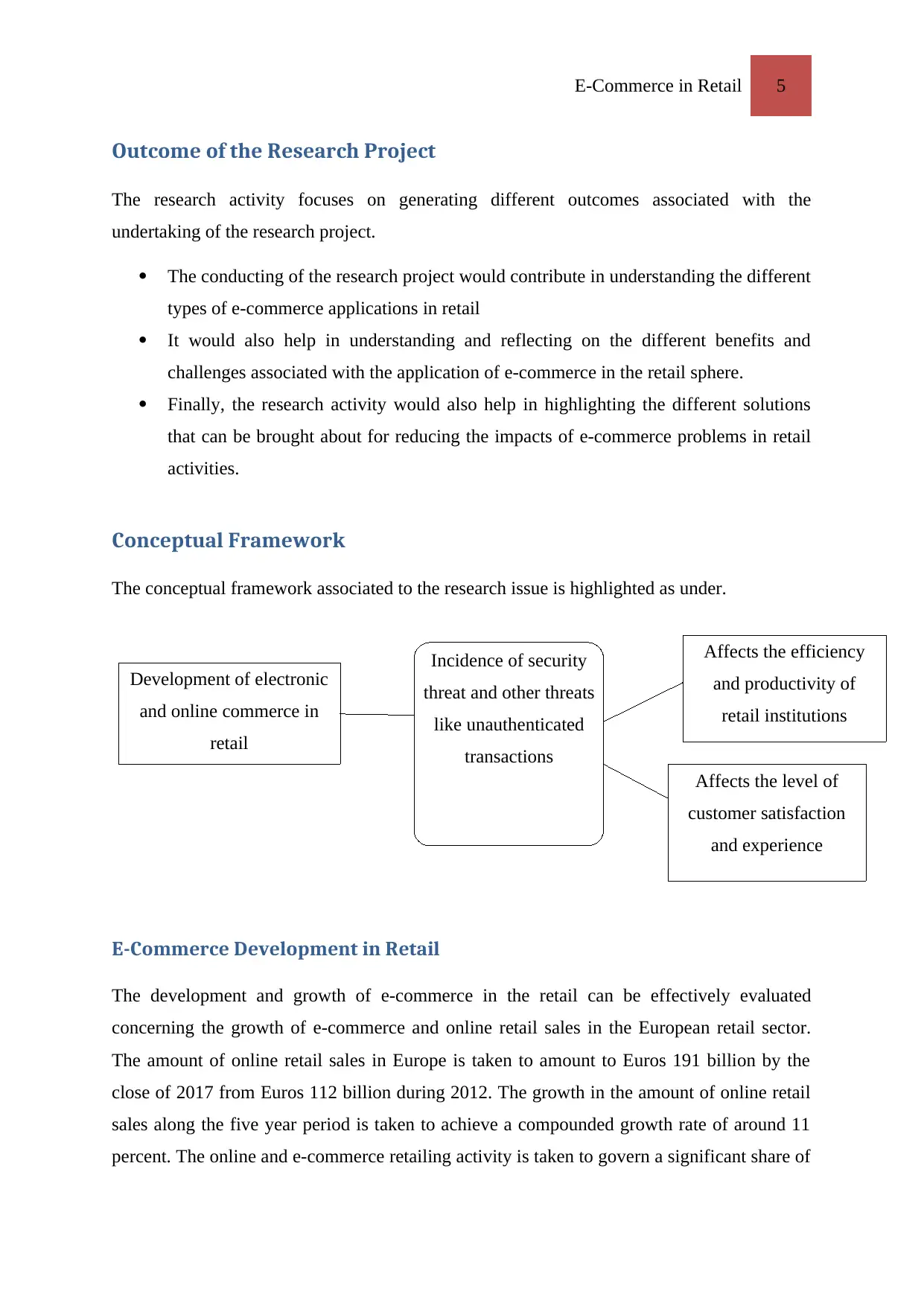
The conceptual framework associated to the research issue is highlighted as under.
E-Commerce Development in Retail
The development and growth of e-commerce in the retail can be effectively evaluated
concerning the growth of e-commerce and online retail sales in the European retail sector.
The amount of online retail sales in Europe is taken to amount to Euros 191 billion by the
close of 2017 from Euros 112 billion during 2012. The growth in the amount of online retail
sales along the five year period is taken to achieve a compounded growth rate of around 11
percent. The online and e-commerce retailing activity is taken to govern a significant share of
Development of electronic
and online commerce in
retail
Incidence of security
threat and other threats
like unauthenticated
transactions
Affects the efficiency
and productivity of
retail institutions
Affects the level of
customer satisfaction
and experience
Outcome of the Research Project
The research activity focuses on generating different outcomes associated with the
undertaking of the research project.
The conducting of the research project would contribute in understanding the different
types of e-commerce applications in retail
It would also help in understanding and reflecting on the different benefits and
challenges associated with the application of e-commerce in the retail sphere.
Finally, the research activity would also help in highlighting the different solutions
that can be brought about for reducing the impacts of e-commerce problems in retail
activities.
Conceptual Framework
The conceptual framework associated to the research issue is highlighted as under.
E-Commerce Development in Retail
The development and growth of e-commerce in the retail can be effectively evaluated
concerning the growth of e-commerce and online retail sales in the European retail sector.
The amount of online retail sales in Europe is taken to amount to Euros 191 billion by the
close of 2017 from Euros 112 billion during 2012. The growth in the amount of online retail
sales along the five year period is taken to achieve a compounded growth rate of around 11
percent. The online and e-commerce retailing activity is taken to govern a significant share of
Development of electronic
and online commerce in
retail
Incidence of security
threat and other threats
like unauthenticated
transactions
Affects the efficiency
and productivity of
retail institutions
Affects the level of
customer satisfaction
and experience
E-Commerce in Retail 6
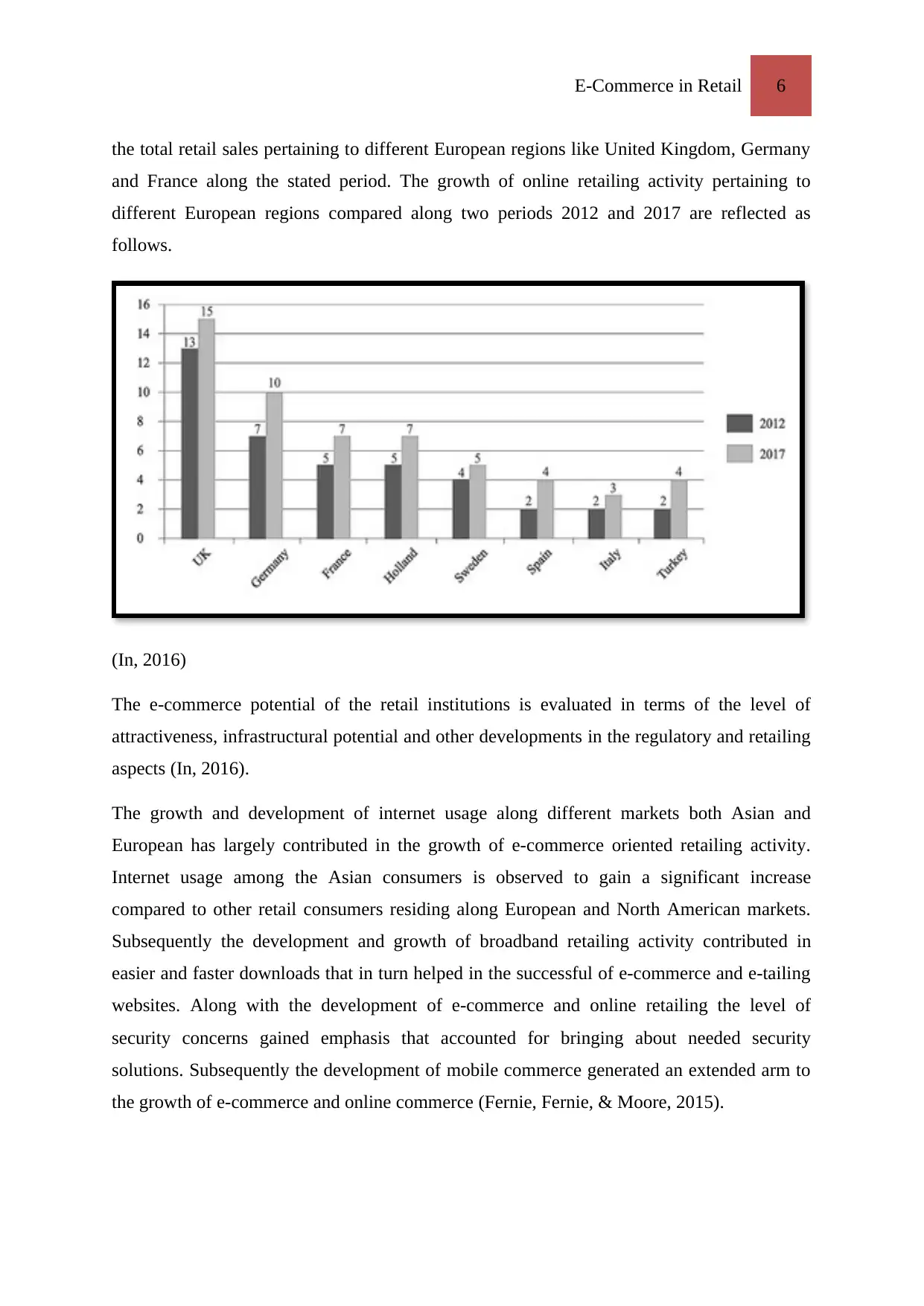
the total retail sales pertaining to different European regions like United Kingdom, Germany
and France along the stated period. The growth of online retailing activity pertaining to
different European regions compared along two periods 2012 and 2017 are reflected as
follows.
(In, 2016)
The e-commerce potential of the retail institutions is evaluated in terms of the level of
attractiveness, infrastructural potential and other developments in the regulatory and retailing
aspects (In, 2016).
The growth and development of internet usage along different markets both Asian and
European has largely contributed in the growth of e-commerce oriented retailing activity.
Internet usage among the Asian consumers is observed to gain a significant increase
compared to other retail consumers residing along European and North American markets.
Subsequently the development and growth of broadband retailing activity contributed in
easier and faster downloads that in turn helped in the successful of e-commerce and e-tailing
websites. Along with the development of e-commerce and online retailing the level of
security concerns gained emphasis that accounted for bringing about needed security
solutions. Subsequently the development of mobile commerce generated an extended arm to
the growth of e-commerce and online commerce (Fernie, Fernie, & Moore, 2015).
the total retail sales pertaining to different European regions like United Kingdom, Germany
and France along the stated period. The growth of online retailing activity pertaining to
different European regions compared along two periods 2012 and 2017 are reflected as
follows.
(In, 2016)
The e-commerce potential of the retail institutions is evaluated in terms of the level of
attractiveness, infrastructural potential and other developments in the regulatory and retailing
aspects (In, 2016).
The growth and development of internet usage along different markets both Asian and
European has largely contributed in the growth of e-commerce oriented retailing activity.
Internet usage among the Asian consumers is observed to gain a significant increase
compared to other retail consumers residing along European and North American markets.
Subsequently the development and growth of broadband retailing activity contributed in
easier and faster downloads that in turn helped in the successful of e-commerce and e-tailing
websites. Along with the development of e-commerce and online retailing the level of
security concerns gained emphasis that accounted for bringing about needed security
solutions. Subsequently the development of mobile commerce generated an extended arm to
the growth of e-commerce and online commerce (Fernie, Fernie, & Moore, 2015).
⊘ This is a preview!⊘
Do you want full access?
Subscribe today to unlock all pages.
Trusted by 1+ million students worldwide
E-Commerce in Retail 7
Benefits/Advantages of E-Commerce Development in Retail
The development and growth of electronic commerce and online retailing is evaluated to
generate potential benefits to customers. Customers earned benefits owing to the existence of
lower prices generated by retailers with also the generation of large number of product
choices. Similarly, the development and growth of online commerce and retailing also
contributed in helping the retail institutions gain effective access to foreign markets and in
gaining higher retail productivity. Growth and development of online retailing also accounted
for generation of sustainable and greener retailing with also the generation of optimized
solutions regarding delivery of products thereby benefiting the larger society. Similarly, the
advent of e-commerce and online retailing also helps in enhancing the competitive edge of
the retail institutions associated with the generation of effective customer services and also in
the generation of a seamless retailing platform enabling greater communication (Crew &
Brennan, 2014).
Development of online retailing activity potentially contributes in helping the customers earn
greater visibility to product catalogues while it also helps the retail institutions in generating
greater control over sales and purchases activity conducted through the use of the online
platform. Like customers the retailers can also earn cost advantages in terms of reduction in
level of inventory management costs while operating based on the online framework. Online
retailing activities also contribute in generation of increased brand awareness for the products
and services while also helping the retailers gain and evaluate information associated to
purchasing and shopping habits of customers (Management Association, 2017).
Problems/Challenges associated with E-Commerce Development in Retail
The development and use of electronic commerce activity in the retail sphere though tends to
reflect potential advantages yet it reflects the existence of potential challenges underlined as
follows.
The e-commerce companies suffer from increasing threat associated to the lack of effective
verification measures. The retail institutions only earn a limited amount of information
associated to customers for which they fail to ascertain the authenticity level of customers.
The same accounts for increased revenue losses for the e-commerce companies in cases
where the customers turn out to be false in nature (Wei, 2014).
Benefits/Advantages of E-Commerce Development in Retail
The development and growth of electronic commerce and online retailing is evaluated to
generate potential benefits to customers. Customers earned benefits owing to the existence of
lower prices generated by retailers with also the generation of large number of product
choices. Similarly, the development and growth of online commerce and retailing also
contributed in helping the retail institutions gain effective access to foreign markets and in
gaining higher retail productivity. Growth and development of online retailing also accounted
for generation of sustainable and greener retailing with also the generation of optimized
solutions regarding delivery of products thereby benefiting the larger society. Similarly, the
advent of e-commerce and online retailing also helps in enhancing the competitive edge of
the retail institutions associated with the generation of effective customer services and also in
the generation of a seamless retailing platform enabling greater communication (Crew &
Brennan, 2014).
Development of online retailing activity potentially contributes in helping the customers earn
greater visibility to product catalogues while it also helps the retail institutions in generating
greater control over sales and purchases activity conducted through the use of the online
platform. Like customers the retailers can also earn cost advantages in terms of reduction in
level of inventory management costs while operating based on the online framework. Online
retailing activities also contribute in generation of increased brand awareness for the products
and services while also helping the retailers gain and evaluate information associated to
purchasing and shopping habits of customers (Management Association, 2017).
Problems/Challenges associated with E-Commerce Development in Retail
The development and use of electronic commerce activity in the retail sphere though tends to
reflect potential advantages yet it reflects the existence of potential challenges underlined as
follows.
The e-commerce companies suffer from increasing threat associated to the lack of effective
verification measures. The retail institutions only earn a limited amount of information
associated to customers for which they fail to ascertain the authenticity level of customers.
The same accounts for increased revenue losses for the e-commerce companies in cases
where the customers turn out to be false in nature (Wei, 2014).
Paraphrase This Document
Need a fresh take? Get an instant paraphrase of this document with our AI Paraphraser
E-Commerce in Retail 8
Returns generated by customers account for increased amount of costs associated to shipment
and logistics. It also affects the brand value of the retail institutions.
Again, lack of effective integration between different systems like order management,
customer support, dispatch and also order tracking tends to affect the effectiveness of the
services provided to customers. It thereby affects the level of customer satisfaction and
experiences (Paulos, 2015).
The retail institutions involved in the generation of online retailing activity are observed to
suffer from a potential challenge owing to growth in the level of switching costs. It is
observed that around 86 percent of customers tend to shift from one e-commerce Company to
another in search for better and prompt services in a seamless setting, existence of large
number of product assortments and also existence of effective discounts.
The online retailing services are also observed to suffer from the incidence of potential
security threats owing to reduction of cyber security and growth of hacking activities like
teardrop attacks, attacks concerning brute force, plashing and also the Denial of Service
(DOS) attacks. The incidence of DOS attacks affects the normal operations and the server
(Rezaei, 2017).
Solutions to Problems concerning E-Commerce Development in Retail
The authentication issues concerning customers can be aptly addressed by the retail
institutions through the generation of textual and e-mail messages to them. Likewise the
generation of Interactive Voice Response (IVR) by the retail institutions can further enhance
the level of authentication in case of cash-on-delivery orders.
Development of an effective seamless platform contributes in helping the retail institutions
sustain potential relationship with logistics partners, vendor firms and customers. The same
helps in effective management of customer returns.
Incorporation of the right quality of customer servicing and customer management systems
potentially helps the retail institutions in sustaining effective relationship with the customers
and also in addressing their queries and complaints in an effective and responsive fashion
(Vallabhaneni, 2013).
Returns generated by customers account for increased amount of costs associated to shipment
and logistics. It also affects the brand value of the retail institutions.
Again, lack of effective integration between different systems like order management,
customer support, dispatch and also order tracking tends to affect the effectiveness of the
services provided to customers. It thereby affects the level of customer satisfaction and
experiences (Paulos, 2015).
The retail institutions involved in the generation of online retailing activity are observed to
suffer from a potential challenge owing to growth in the level of switching costs. It is
observed that around 86 percent of customers tend to shift from one e-commerce Company to
another in search for better and prompt services in a seamless setting, existence of large
number of product assortments and also existence of effective discounts.
The online retailing services are also observed to suffer from the incidence of potential
security threats owing to reduction of cyber security and growth of hacking activities like
teardrop attacks, attacks concerning brute force, plashing and also the Denial of Service
(DOS) attacks. The incidence of DOS attacks affects the normal operations and the server
(Rezaei, 2017).
Solutions to Problems concerning E-Commerce Development in Retail
The authentication issues concerning customers can be aptly addressed by the retail
institutions through the generation of textual and e-mail messages to them. Likewise the
generation of Interactive Voice Response (IVR) by the retail institutions can further enhance
the level of authentication in case of cash-on-delivery orders.
Development of an effective seamless platform contributes in helping the retail institutions
sustain potential relationship with logistics partners, vendor firms and customers. The same
helps in effective management of customer returns.
Incorporation of the right quality of customer servicing and customer management systems
potentially helps the retail institutions in sustaining effective relationship with the customers
and also in addressing their queries and complaints in an effective and responsive fashion
(Vallabhaneni, 2013).
E-Commerce in Retail 9
The e-commerce companies are required to operate in terms of involving the parameters of
innovation in their services and product portfolio such that the same helps in both attracting
and retaining potential customers. The development of apps for Smartphones and tabs
contribute in generation of a seamless environment for servicing consumer needs. Similarly,
the estimation of customer retention scores also contribute in effective understanding of the
feasibility of the customer servicing platforms and thereby in generating effective
recommendations thereof (Al-Hamami, 2014).
Incorporation of the Security Sockets Layer (SSL) acts as an effective multiple security
measure and two-factor level of authentication serves as a potential solution to the security
problem concerning e-commerce applications. Similarly, the incorporation of effective
payment options like credit cards and other alternative methods like Bitcoin and also
cryptocurrencies further contribute in reducing the level of threat emerging from vulnerability
of use of credit and debit cards (Ghosh, 2012).
Methodology
Research Paradigm
The research is to be conducted based on the employment of both Interpretivism and also the
use of Positivism research philosophy.
Employment of Interpretivism research paradigm requires the researcher for development of
unstructured or open ended questionnaires such that the same would contribute in generation
of in-depth inferences in a narrative and qualitative fashion. An elucidated understanding
would be gained based on the different problems associated with the e-commerce
incorporation in retail and also effective solutions to such. The inferences gained based on the
use of interpretivism research being elucidatory are qualitative in nature and would
potentially address the research objectives (Hussein, 2009).
The employment of Positivism research philosophy requires the researcher to focus on the
development of structured or close ended questionnaires such that the same contributes in the
generation of specific and quantitative inferences. Further, positivism research encourages the
researcher for incorporating statistical and other diagrammatic tests involving graphs and
The e-commerce companies are required to operate in terms of involving the parameters of
innovation in their services and product portfolio such that the same helps in both attracting
and retaining potential customers. The development of apps for Smartphones and tabs
contribute in generation of a seamless environment for servicing consumer needs. Similarly,
the estimation of customer retention scores also contribute in effective understanding of the
feasibility of the customer servicing platforms and thereby in generating effective
recommendations thereof (Al-Hamami, 2014).
Incorporation of the Security Sockets Layer (SSL) acts as an effective multiple security
measure and two-factor level of authentication serves as a potential solution to the security
problem concerning e-commerce applications. Similarly, the incorporation of effective
payment options like credit cards and other alternative methods like Bitcoin and also
cryptocurrencies further contribute in reducing the level of threat emerging from vulnerability
of use of credit and debit cards (Ghosh, 2012).
Methodology
Research Paradigm
The research is to be conducted based on the employment of both Interpretivism and also the
use of Positivism research philosophy.
Employment of Interpretivism research paradigm requires the researcher for development of
unstructured or open ended questionnaires such that the same would contribute in generation
of in-depth inferences in a narrative and qualitative fashion. An elucidated understanding
would be gained based on the different problems associated with the e-commerce
incorporation in retail and also effective solutions to such. The inferences gained based on the
use of interpretivism research being elucidatory are qualitative in nature and would
potentially address the research objectives (Hussein, 2009).
The employment of Positivism research philosophy requires the researcher to focus on the
development of structured or close ended questionnaires such that the same contributes in the
generation of specific and quantitative inferences. Further, positivism research encourages the
researcher for incorporating statistical and other diagrammatic tests involving graphs and
⊘ This is a preview!⊘
Do you want full access?
Subscribe today to unlock all pages.
Trusted by 1+ million students worldwide
E-Commerce in Retail 10
charts for generation and elucidation of quantitative inferences. It would contribute in
addressing the research hypotheses (Hammer, 2015).
Research Technique
In terms of research technique the research activity potentially focuses on the incorporation
of both inductive and deductive research techniques.
Incorporation of Inductive Research technique encourages the researcher to study a number
of different books, journals and other online articles available in association with the research
issue. The study of different literary sources contributes in the development of theoretical
models and aspects that in turn generates novel theories relating to the research issue.
Empirical research carried out through the study of theories and models contributes in
development of a conceptual model associated to the understanding of the problems and its
impacts regarding e-commerce applications in retail business (Gioia, Corley, & Hamilton,
2013).
Application of deductive research technique requires the researcher to develop research
hypotheses and thereby focus on the incorporation of quantitative research tools like
statistical and diagrammatic tools for proving the research hypotheses thus constructed. Use
of deductive research technique contributes in the generation of specific research inferences
(Cortina, Aguinis, & DeShon, 2017).
Research Design
The research activity associated with the understanding of the problems and the impact of
problems regarding e-commerce application in retail business is focused on being conducted
through the use of different types of research designs like secondary, primary and
triangulated research.
The employment of secondary research requires the researcher to study different secondary
literary sources like books, journals and other online articles associated to the research topic.
Application of secondary research helps the researcher to gain access to qualitative resources
in a timely fashion and also in a cost effective manner. It also helps in the gaining of
authentic and empirical inferences associated with the research issue (Parker, Morgeson, &
Johns, 2017).
charts for generation and elucidation of quantitative inferences. It would contribute in
addressing the research hypotheses (Hammer, 2015).
Research Technique
In terms of research technique the research activity potentially focuses on the incorporation
of both inductive and deductive research techniques.
Incorporation of Inductive Research technique encourages the researcher to study a number
of different books, journals and other online articles available in association with the research
issue. The study of different literary sources contributes in the development of theoretical
models and aspects that in turn generates novel theories relating to the research issue.
Empirical research carried out through the study of theories and models contributes in
development of a conceptual model associated to the understanding of the problems and its
impacts regarding e-commerce applications in retail business (Gioia, Corley, & Hamilton,
2013).
Application of deductive research technique requires the researcher to develop research
hypotheses and thereby focus on the incorporation of quantitative research tools like
statistical and diagrammatic tools for proving the research hypotheses thus constructed. Use
of deductive research technique contributes in the generation of specific research inferences
(Cortina, Aguinis, & DeShon, 2017).
Research Design
The research activity associated with the understanding of the problems and the impact of
problems regarding e-commerce application in retail business is focused on being conducted
through the use of different types of research designs like secondary, primary and
triangulated research.
The employment of secondary research requires the researcher to study different secondary
literary sources like books, journals and other online articles associated to the research topic.
Application of secondary research helps the researcher to gain access to qualitative resources
in a timely fashion and also in a cost effective manner. It also helps in the gaining of
authentic and empirical inferences associated with the research issue (Parker, Morgeson, &
Johns, 2017).
Paraphrase This Document
Need a fresh take? Get an instant paraphrase of this document with our AI Paraphraser
E-Commerce in Retail 11
Application of primary research requires the researcher to focus on the development of
unstructured and structured questionnaire sets for conducting of interviews and survey
respectively. The conducting of interviews associated to focus groups potentially contributes
in the generation of qualitative data and narrative inferences highlighting the perceptions of
the respondents regarding the research issue. Survey activity is conducted through surveying
a large population of respondents such that it helps in the generation of specific and
quantitative inferences that would help in addressing the research hypotheses. Conducting of
primary research though contributes in the generation of current inferences yet is observed to
be both costly in nature and also that which requires greater time (Venable, Pries-Heje, &
Baskerville, 2016).
Finally, the combination of both qualitative and quantitative research aspects reflects on the
application of triangulated research. The application of triangulated research contributes in
enhancing the quality of the research activity and generation of both elucidatory and specific
inferences associated with the research issue (Wolf & Floyd, 2013).
Data Collection
Data collection associated with the interview research activity requires the researcher to focus
on the incorporation of effective quality microphones and also pen and paper for collection of
interview transcripts associated to the research issue. Further, data collection associated to
interview based research also requires the development of unstructured questionnaire that
contributes in undertaking of interview of focused group respondents (Wright, Wahoush,
Gabel, & Jack, 2016).
Again, data collection associated to survey research activity requires the development of
structured questionnaire sets that would help in the conducting of survey and generation of
specific and quantitative research inferences. The structured questionnaire sets are distributed
through the use of physical and online mailing system and also through the use of survey
monkey as an online data collection tool (McCarthy, Wagner, & Sanders, 2017).
Sampling
The requirement for development of focused groups regarding the conducting of interview
requires the application of non-probability sampling styles like the convenience sampling
style for collection of sample respondents. The convenience sampling technique would
Application of primary research requires the researcher to focus on the development of
unstructured and structured questionnaire sets for conducting of interviews and survey
respectively. The conducting of interviews associated to focus groups potentially contributes
in the generation of qualitative data and narrative inferences highlighting the perceptions of
the respondents regarding the research issue. Survey activity is conducted through surveying
a large population of respondents such that it helps in the generation of specific and
quantitative inferences that would help in addressing the research hypotheses. Conducting of
primary research though contributes in the generation of current inferences yet is observed to
be both costly in nature and also that which requires greater time (Venable, Pries-Heje, &
Baskerville, 2016).
Finally, the combination of both qualitative and quantitative research aspects reflects on the
application of triangulated research. The application of triangulated research contributes in
enhancing the quality of the research activity and generation of both elucidatory and specific
inferences associated with the research issue (Wolf & Floyd, 2013).
Data Collection
Data collection associated with the interview research activity requires the researcher to focus
on the incorporation of effective quality microphones and also pen and paper for collection of
interview transcripts associated to the research issue. Further, data collection associated to
interview based research also requires the development of unstructured questionnaire that
contributes in undertaking of interview of focused group respondents (Wright, Wahoush,
Gabel, & Jack, 2016).
Again, data collection associated to survey research activity requires the development of
structured questionnaire sets that would help in the conducting of survey and generation of
specific and quantitative research inferences. The structured questionnaire sets are distributed
through the use of physical and online mailing system and also through the use of survey
monkey as an online data collection tool (McCarthy, Wagner, & Sanders, 2017).
Sampling
The requirement for development of focused groups regarding the conducting of interview
requires the application of non-probability sampling styles like the convenience sampling
style for collection of sample respondents. The convenience sampling technique would
E-Commerce in Retail 12
contribute in the generation of a sampling population encompassing around 20 managerial
respondents from the middle and higher managerial level in the retail industries. It would
help in the selection of managerial respondents in a random fashion from a larger population
of managerial respondents (Etikan, Musa, & Sunus, 2016).
Again, the sample population for the conducting of survey activity would require the use of
probability sampling styles like the stratified random sampling approach. The application of
stratified random sampling requires the researcher for collection of sample respondents in a
random fashion from two different strata sets like staffs and customers of retail institutions
and enterprises. A total of 100 respondents would be chosen from the two strata sets for the
generation of the survey population. Application of the stratified random sampling style
potentially helps in reduction of emergence of sampling errors as is observed in case of use of
simple random approach of sampling (Cekim & Kadilar, 2017).
Data Analysis
The collection of qualitative data sets associated to the research issue requires the researcher
to focus on the generation of codes through the identification of words and phrases that help
in highlighting different themes like ‘e-commerce’, ‘retail institutions and stores’,
‘application of e-commerce in retail’, ‘problems and benefits of e-commerce application in
retail’ and ‘solutions to problems regarding e-commerce application in retail’. Generation of
different codes rightly helps in evaluating relationship and association between the different
codes and thereby in finding qualitative correlation between such for addressing the research
objectives (Gioia, Corley, & Hamilton, 2013).
On the contrary, the collection of quantitative data sets associated to the research issue
requires the tabulation of the quantitative data sets in excel and thereby in incorporating
statistical and diagrammatic tools for gaining of needful inferences. A five point likert scale
is required to be developed associated with the different structured questionnaires such that
potential responses in the form of percentage of responses associated to the different themes
would be gained and tabulated in excel sheet for being subjected to statistical and
diagrammatic tools. The quantitative inferences thus gained would be reflected in the form of
charts and graphs for helping in effectively addressing the research objectives (Wright,
Wahoush, Gabel, & Jack, 2016).
contribute in the generation of a sampling population encompassing around 20 managerial
respondents from the middle and higher managerial level in the retail industries. It would
help in the selection of managerial respondents in a random fashion from a larger population
of managerial respondents (Etikan, Musa, & Sunus, 2016).
Again, the sample population for the conducting of survey activity would require the use of
probability sampling styles like the stratified random sampling approach. The application of
stratified random sampling requires the researcher for collection of sample respondents in a
random fashion from two different strata sets like staffs and customers of retail institutions
and enterprises. A total of 100 respondents would be chosen from the two strata sets for the
generation of the survey population. Application of the stratified random sampling style
potentially helps in reduction of emergence of sampling errors as is observed in case of use of
simple random approach of sampling (Cekim & Kadilar, 2017).
Data Analysis
The collection of qualitative data sets associated to the research issue requires the researcher
to focus on the generation of codes through the identification of words and phrases that help
in highlighting different themes like ‘e-commerce’, ‘retail institutions and stores’,
‘application of e-commerce in retail’, ‘problems and benefits of e-commerce application in
retail’ and ‘solutions to problems regarding e-commerce application in retail’. Generation of
different codes rightly helps in evaluating relationship and association between the different
codes and thereby in finding qualitative correlation between such for addressing the research
objectives (Gioia, Corley, & Hamilton, 2013).
On the contrary, the collection of quantitative data sets associated to the research issue
requires the tabulation of the quantitative data sets in excel and thereby in incorporating
statistical and diagrammatic tools for gaining of needful inferences. A five point likert scale
is required to be developed associated with the different structured questionnaires such that
potential responses in the form of percentage of responses associated to the different themes
would be gained and tabulated in excel sheet for being subjected to statistical and
diagrammatic tools. The quantitative inferences thus gained would be reflected in the form of
charts and graphs for helping in effectively addressing the research objectives (Wright,
Wahoush, Gabel, & Jack, 2016).
⊘ This is a preview!⊘
Do you want full access?
Subscribe today to unlock all pages.
Trusted by 1+ million students worldwide

1 out of 17


Related Documents


Your All-in-One AI-Powered Toolkit for Academic Success.
+13062052269
info@desklib.com
Available 24*7 on WhatsApp / Email
![[object Object]](/_next/static/media/star-bottom.7253800d.svg)
Unlock your academic potential
Copyright © 2020–2026 A2Z Services. All Rights Reserved. Developed and managed by ZUCOL.