Report: Economic Effect of Tightening Accounting Standards Analysis

Verified

Added on  2019/09/21

|5
|993
|402
Report
AI Summary
This report examines the economic effects of tightening accounting standards to restrict earnings management, as described by Ralf Ewert. The analysis explores the impact on both accounting and real earnings management, considering the role of standard setters. The report discusses the substitution effect, the equilibrium model, and the consequences of tighter standards, including increased costs and potential impacts on earnings quality. The author analyzes how tighter standards influence the value relevance of reported earnings and the interplay between accounting and real earnings management activities. The conclusion highlights the complex relationship between tightening standards and earnings management, emphasizing the need for careful consideration of unintended consequences and the importance of empirical research. The report also mentions the limitations of the analysis and suggests further research directions, including the integration of managerial incentives and a more comprehensive model. This report contributes to the understanding of the inferences of the contraction accounting standards on the quality information in the capital market, expected level of real and accounting earning management as well as the price of an expected earning management.
Document Page
Running Head: Economic Effect of Tightening Accounting Standards to Restrict Earnings Management
Economic effect of Tightening Accounting Standards to Restrict
Earnings Management
tabler-icon-diamond-filled.svg

Paraphrase This Document

Need a fresh take? Get an instant paraphrase of this document with our AI Paraphraser
Document Page
Economic Effect of Tightening Accounting Standards to Restrict Earnings Management 1
Summary
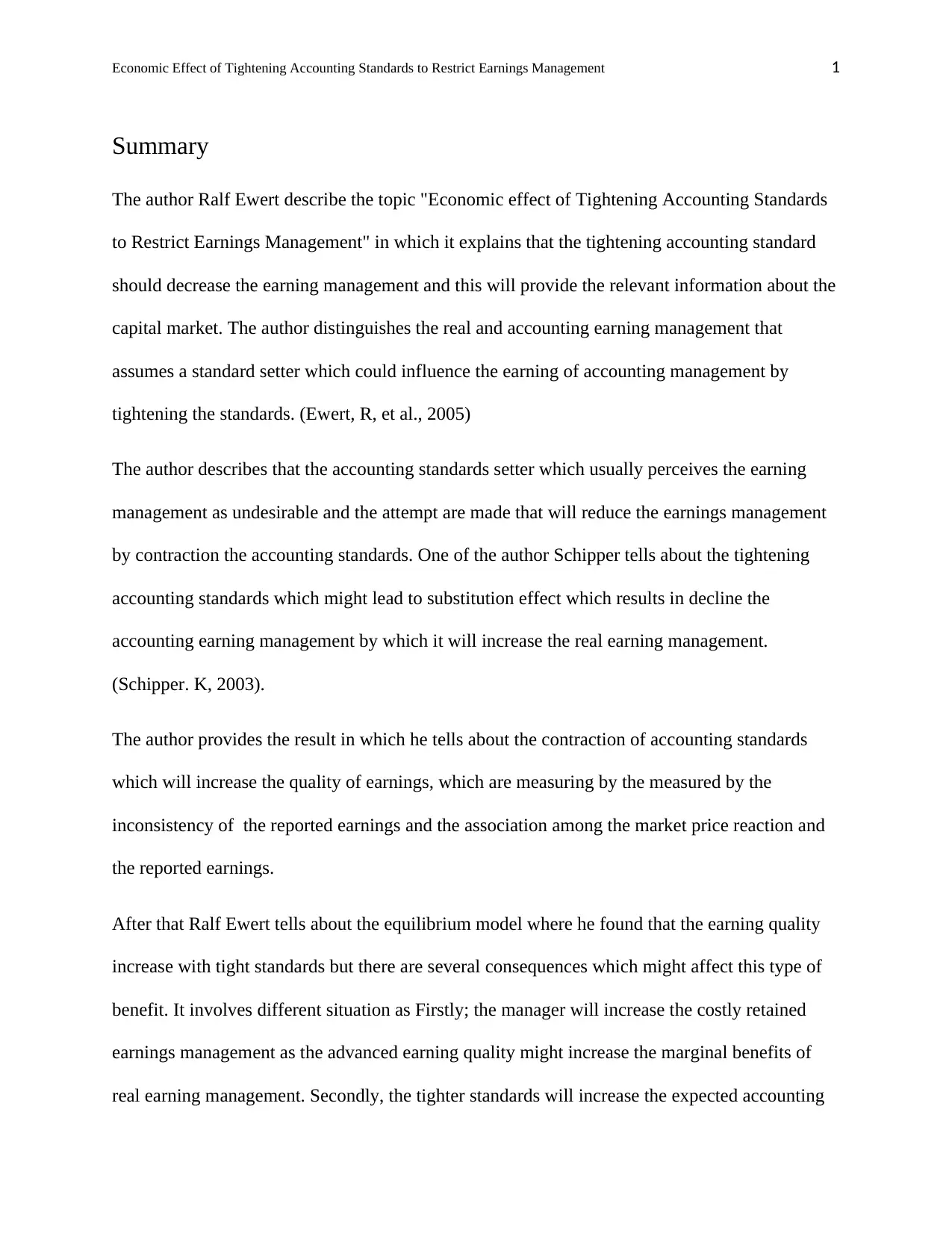
The author Ralf Ewert describe the topic "Economic effect of Tightening Accounting Standards
to Restrict Earnings Management" in which it explains that the tightening accounting standard
should decrease the earning management and this will provide the relevant information about the
capital market. The author distinguishes the real and accounting earning management that
assumes a standard setter which could influence the earning of accounting management by
tightening the standards. (Ewert, R, et al., 2005)
The author describes that the accounting standards setter which usually perceives the earning
management as undesirable and the attempt are made that will reduce the earnings management
by contraction the accounting standards. One of the author Schipper tells about the tightening
accounting standards which might lead to substitution effect which results in decline the
accounting earning management by which it will increase the real earning management.
(Schipper. K, 2003).
The author provides the result in which he tells about the contraction of accounting standards
which will increase the quality of earnings, which are measuring by the measured by the
inconsistency of the reported earnings and the association among the market price reaction and
the reported earnings.
After that Ralf Ewert tells about the equilibrium model where he found that the earning quality
increase with tight standards but there are several consequences which might affect this type of
benefit. It involves different situation as Firstly; the manager will increase the costly retained
earnings management as the advanced earning quality might increase the marginal benefits of
real earning management. Secondly, the tighter standards will increase the expected accounting
Document Page
Economic Effect of Tightening Accounting Standards to Restrict Earnings Management 2
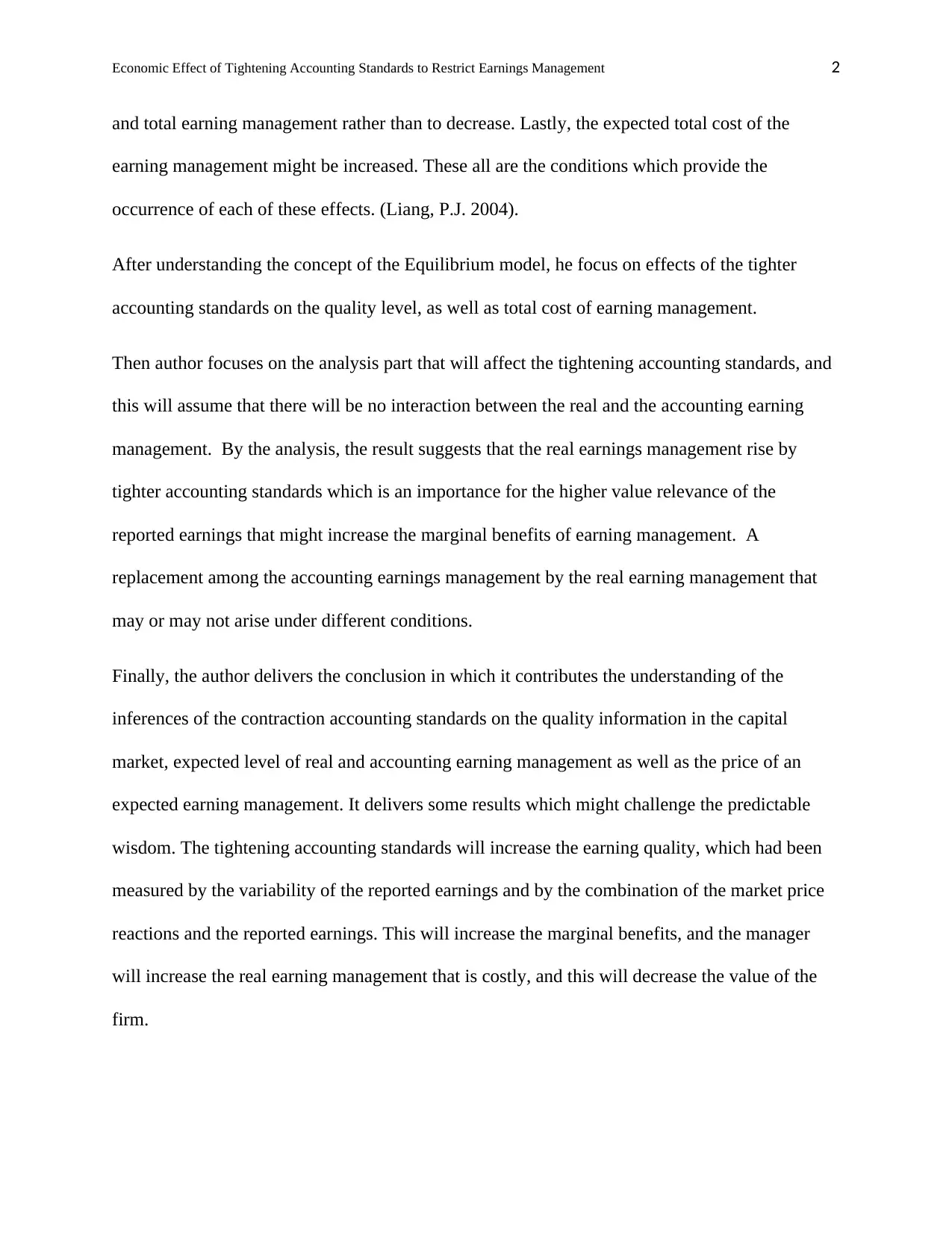
and total earning management rather than to decrease. Lastly, the expected total cost of the
earning management might be increased. These all are the conditions which provide the
occurrence of each of these effects. (Liang, P.J. 2004).
After understanding the concept of the Equilibrium model, he focus on effects of the tighter
accounting standards on the quality level, as well as total cost of earning management.
Then author focuses on the analysis part that will affect the tightening accounting standards, and
this will assume that there will be no interaction between the real and the accounting earning
management. By the analysis, the result suggests that the real earnings management rise by
tighter accounting standards which is an importance for the higher value relevance of the
reported earnings that might increase the marginal benefits of earning management. A
replacement among the accounting earnings management by the real earning management that
may or may not arise under different conditions.
Finally, the author delivers the conclusion in which it contributes the understanding of the
inferences of the contraction accounting standards on the quality information in the capital
market, expected level of real and accounting earning management as well as the price of an
expected earning management. It delivers some results which might challenge the predictable
wisdom. The tightening accounting standards will increase the earning quality, which had been
measured by the variability of the reported earnings and by the combination of the market price
reactions and the reported earnings. This will increase the marginal benefits, and the manager
will increase the real earning management that is costly, and this will decrease the value of the
firm.
Document Page
Economic Effect of Tightening Accounting Standards to Restrict Earnings Management 3
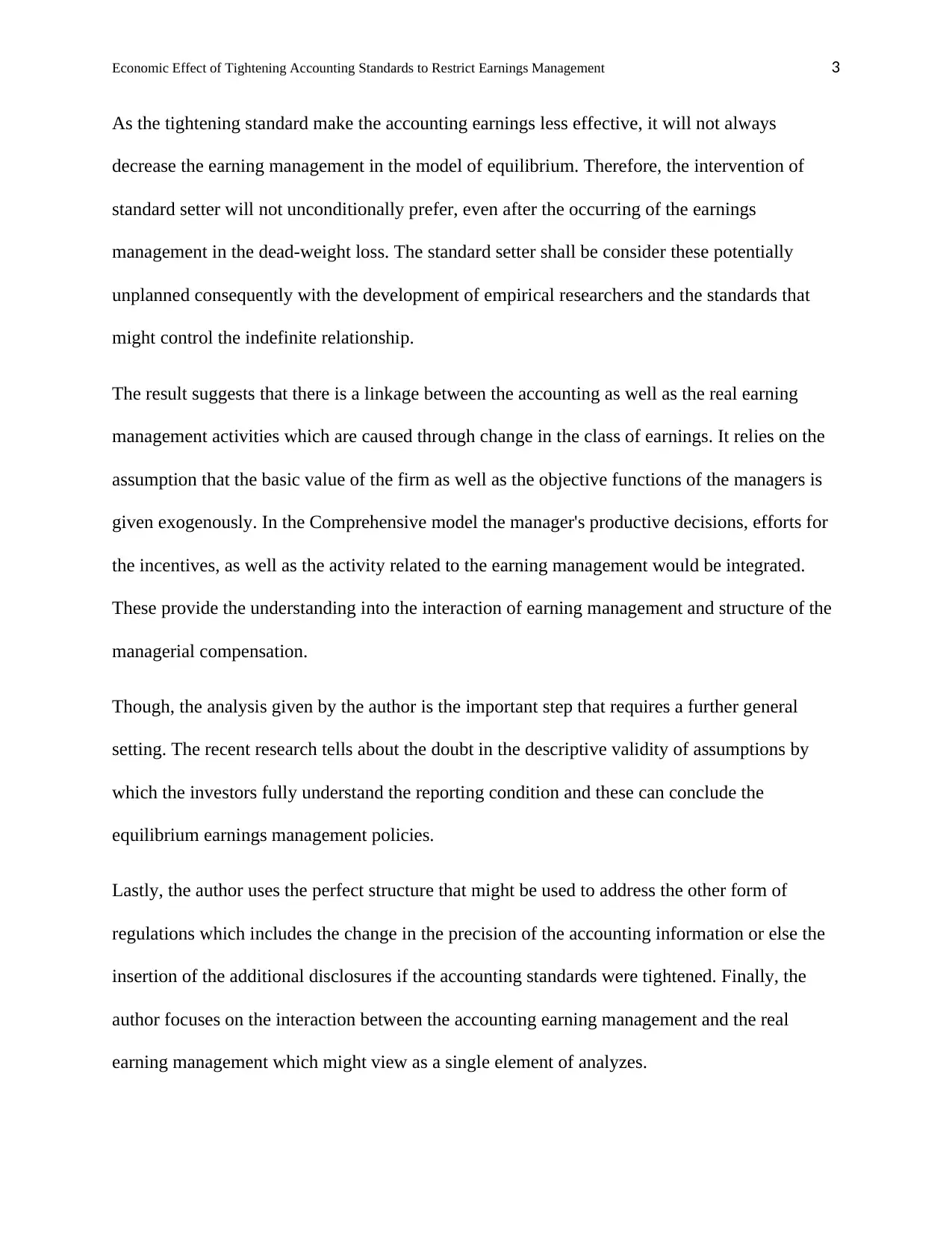
As the tightening standard make the accounting earnings less effective, it will not always
decrease the earning management in the model of equilibrium. Therefore, the intervention of
standard setter will not unconditionally prefer, even after the occurring of the earnings
management in the dead-weight loss. The standard setter shall be consider these potentially
unplanned consequently with the development of empirical researchers and the standards that
might control the indefinite relationship.
The result suggests that there is a linkage between the accounting as well as the real earning
management activities which are caused through change in the class of earnings. It relies on the
assumption that the basic value of the firm as well as the objective functions of the managers is
given exogenously. In the Comprehensive model the manager's productive decisions, efforts for
the incentives, as well as the activity related to the earning management would be integrated.
These provide the understanding into the interaction of earning management and structure of the
managerial compensation.
Though, the analysis given by the author is the important step that requires a further general
setting. The recent research tells about the doubt in the descriptive validity of assumptions by
which the investors fully understand the reporting condition and these can conclude the
equilibrium earnings management policies.
Lastly, the author uses the perfect structure that might be used to address the other form of
regulations which includes the change in the precision of the accounting information or else the
insertion of the additional disclosures if the accounting standards were tightened. Finally, the
author focuses on the interaction between the accounting earning management and the real
earning management which might view as a single element of analyzes.
tabler-icon-diamond-filled.svg

Paraphrase This Document

Need a fresh take? Get an instant paraphrase of this document with our AI Paraphraser
Document Page
Economic Effect of Tightening Accounting Standards to Restrict Earnings Management 4
References
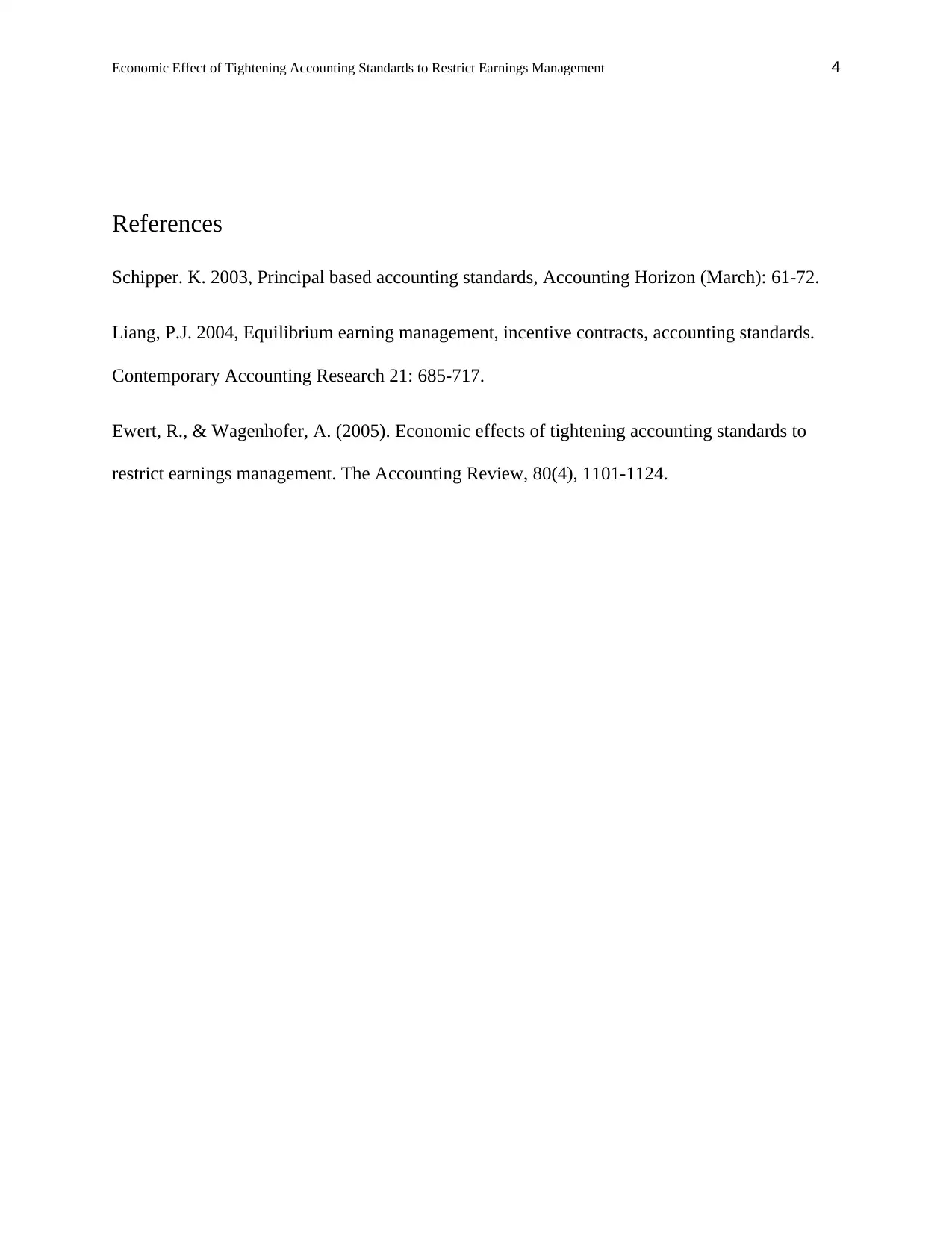
Schipper. K. 2003, Principal based accounting standards, Accounting Horizon (March): 61-72.
Liang, P.J. 2004, Equilibrium earning management, incentive contracts, accounting standards.
Contemporary Accounting Research 21: 685-717.
Ewert, R., & Wagenhofer, A. (2005). Economic effects of tightening accounting standards to
restrict earnings management. The Accounting Review, 80(4), 1101-1124.
chevron_up_icon
1 out of 5
circle_padding
hide_on_mobile
zoom_out_icon
[object Object]