Critical Appraisal: Economic Evaluation of a Healthcare Intervention
VerifiedAdded on 2023/06/14
|9
|2618
|167
Essay
AI Summary
This essay provides a critical appraisal of a published economic evaluation, focusing on the relationship between improved housing and asthma. It evaluates the cost-effectiveness of installing ventilation systems for asthma patients, referencing the CHARISMA trial, which studied housing modifications, including central heating, for children with moderate to severe asthma. The analysis considers the perspective of poor households and their health issues, examining a randomized controlled trial of better ventilation. The study found that tailored ventilation and heating improvements led to a 17% shift from severe to moderate asthma. Sensitivity analysis was used to evaluate basic assumptions, and the results were compared with other studies. The essay concludes by discussing the policies and implications of the study's findings, emphasizing the need for cost-effective techniques in public health interventions and the role of NICE in completing research before implementation.
ESSAY- CRITICAL
APPRAISAL OF A
PUBLISHED
ECONOMIC
EVALUATION
APPRAISAL OF A
PUBLISHED
ECONOMIC
EVALUATION

Paraphrase This Document
Need a fresh take? Get an instant paraphrase of this document with our AI Paraphraser
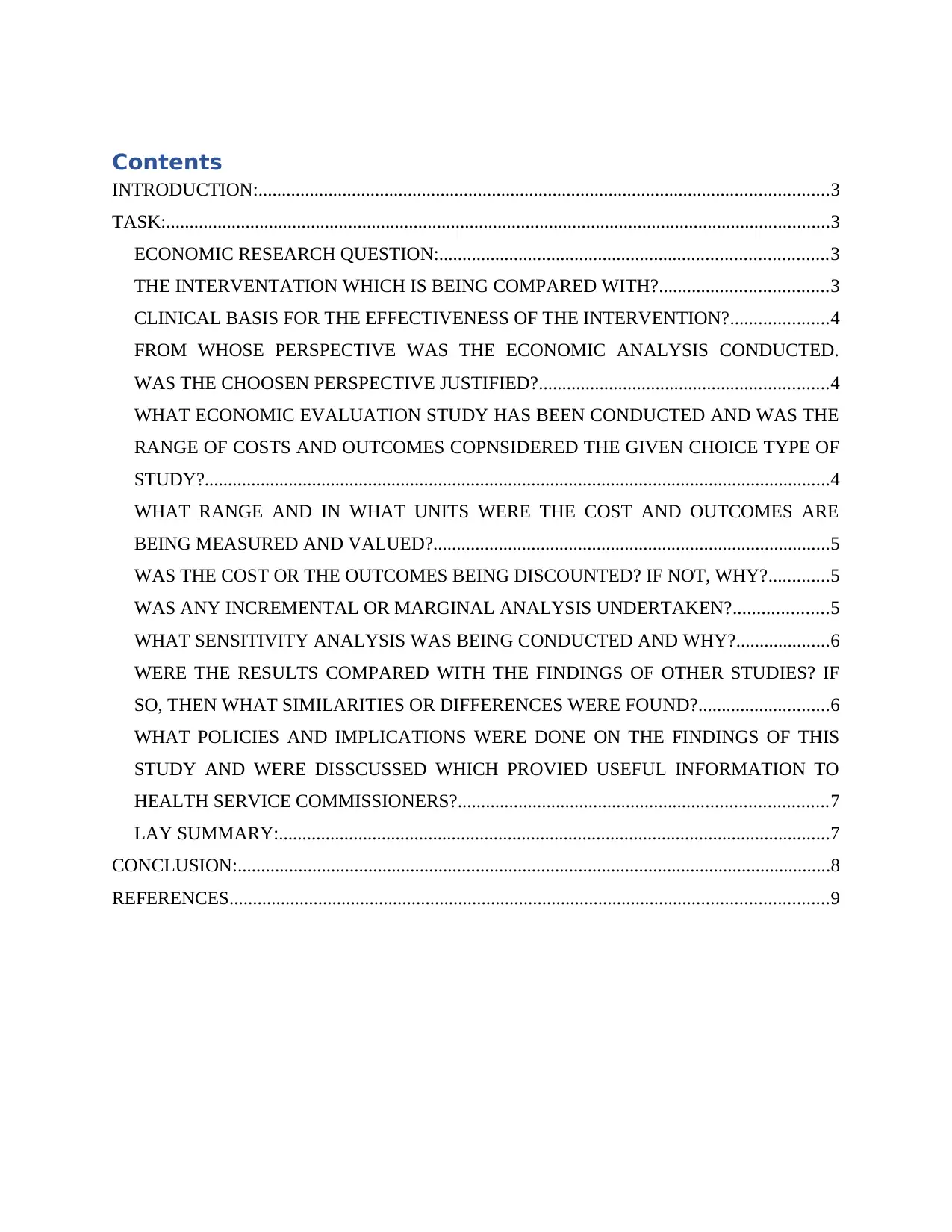
Contents
INTRODUCTION:..........................................................................................................................3
TASK:..............................................................................................................................................3
ECONOMIC RESEARCH QUESTION:...................................................................................3
THE INTERVENTATION WHICH IS BEING COMPARED WITH?....................................3
CLINICAL BASIS FOR THE EFFECTIVENESS OF THE INTERVENTION?.....................4
FROM WHOSE PERSPECTIVE WAS THE ECONOMIC ANALYSIS CONDUCTED.
WAS THE CHOOSEN PERSPECTIVE JUSTIFIED?..............................................................4
WHAT ECONOMIC EVALUATION STUDY HAS BEEN CONDUCTED AND WAS THE
RANGE OF COSTS AND OUTCOMES COPNSIDERED THE GIVEN CHOICE TYPE OF
STUDY?......................................................................................................................................4
WHAT RANGE AND IN WHAT UNITS WERE THE COST AND OUTCOMES ARE
BEING MEASURED AND VALUED?.....................................................................................5
WAS THE COST OR THE OUTCOMES BEING DISCOUNTED? IF NOT, WHY?.............5
WAS ANY INCREMENTAL OR MARGINAL ANALYSIS UNDERTAKEN?....................5
WHAT SENSITIVITY ANALYSIS WAS BEING CONDUCTED AND WHY?....................6
WERE THE RESULTS COMPARED WITH THE FINDINGS OF OTHER STUDIES? IF
SO, THEN WHAT SIMILARITIES OR DIFFERENCES WERE FOUND?............................6
WHAT POLICIES AND IMPLICATIONS WERE DONE ON THE FINDINGS OF THIS
STUDY AND WERE DISSCUSSED WHICH PROVIED USEFUL INFORMATION TO
HEALTH SERVICE COMMISSIONERS?...............................................................................7
LAY SUMMARY:......................................................................................................................7
CONCLUSION:...............................................................................................................................8
REFERENCES................................................................................................................................9
INTRODUCTION:..........................................................................................................................3
TASK:..............................................................................................................................................3
ECONOMIC RESEARCH QUESTION:...................................................................................3
THE INTERVENTATION WHICH IS BEING COMPARED WITH?....................................3
CLINICAL BASIS FOR THE EFFECTIVENESS OF THE INTERVENTION?.....................4
FROM WHOSE PERSPECTIVE WAS THE ECONOMIC ANALYSIS CONDUCTED.
WAS THE CHOOSEN PERSPECTIVE JUSTIFIED?..............................................................4
WHAT ECONOMIC EVALUATION STUDY HAS BEEN CONDUCTED AND WAS THE
RANGE OF COSTS AND OUTCOMES COPNSIDERED THE GIVEN CHOICE TYPE OF
STUDY?......................................................................................................................................4
WHAT RANGE AND IN WHAT UNITS WERE THE COST AND OUTCOMES ARE
BEING MEASURED AND VALUED?.....................................................................................5
WAS THE COST OR THE OUTCOMES BEING DISCOUNTED? IF NOT, WHY?.............5
WAS ANY INCREMENTAL OR MARGINAL ANALYSIS UNDERTAKEN?....................5
WHAT SENSITIVITY ANALYSIS WAS BEING CONDUCTED AND WHY?....................6
WERE THE RESULTS COMPARED WITH THE FINDINGS OF OTHER STUDIES? IF
SO, THEN WHAT SIMILARITIES OR DIFFERENCES WERE FOUND?............................6
WHAT POLICIES AND IMPLICATIONS WERE DONE ON THE FINDINGS OF THIS
STUDY AND WERE DISSCUSSED WHICH PROVIED USEFUL INFORMATION TO
HEALTH SERVICE COMMISSIONERS?...............................................................................7
LAY SUMMARY:......................................................................................................................7
CONCLUSION:...............................................................................................................................8
REFERENCES................................................................................................................................9
INTRODUCTION:
Economic evaluation can be defined as the process which involves the identification,
measurement and most importantly the valuation of all the inputs as well as the outputs of any
two alternative performances, but in a very systematic way. In addition to this, this also helps in
the comparative study analysis in a subsequent way of all the things discussed above. The main
purpose of economic evaluation in the study is however is to identify or to recognize the best
planned strategies or the best planned course of action which is based on true events and all the
evidences which are available at that particular point of time (Anthony and et. Al., 2022). In this
report however, the cost effectiveness analysis has been discussed.
TASK:
ECONOMIC RESEARCH QUESTION:
The main economic research question and the background of this essay are about the rigorous
economic research analysis and also the study of relationship between the improved
housing and the asthma. Basically the main aim of this essay is to identify or evaluate the cost
effective techniques of installing the ventilation systems for the asthma patients across the world
and in addition to this, the CHARISMA trial has also been studied which can be described as the
study that helps in improving housing modification which also includes the central heating in the
houses which is necessary to cure the asthma patients especially the children with both moderate
and serve asthma.
THE INTERVENTATION WHICH IS BEING COMPARED WITH?
Each local authority housing officer is being allotted to each child’s household which have the
task of improvements needs. The ventilation systems have been set up in every household’s roof
space. All the improvements are basically made to improve the central heating systems which
have also been installed in the houses (Chrousos and et. Al., 2022). The families however do not
have to pay for anything. The study about the population, inclusion, exclusion and
intervention is however being presented in the companion papers. The reports of the parents
and practices are not fully consistent and therefore both lead to the same conclusions and are cost
effective.
Economic evaluation can be defined as the process which involves the identification,
measurement and most importantly the valuation of all the inputs as well as the outputs of any
two alternative performances, but in a very systematic way. In addition to this, this also helps in
the comparative study analysis in a subsequent way of all the things discussed above. The main
purpose of economic evaluation in the study is however is to identify or to recognize the best
planned strategies or the best planned course of action which is based on true events and all the
evidences which are available at that particular point of time (Anthony and et. Al., 2022). In this
report however, the cost effectiveness analysis has been discussed.
TASK:
ECONOMIC RESEARCH QUESTION:
The main economic research question and the background of this essay are about the rigorous
economic research analysis and also the study of relationship between the improved
housing and the asthma. Basically the main aim of this essay is to identify or evaluate the cost
effective techniques of installing the ventilation systems for the asthma patients across the world
and in addition to this, the CHARISMA trial has also been studied which can be described as the
study that helps in improving housing modification which also includes the central heating in the
houses which is necessary to cure the asthma patients especially the children with both moderate
and serve asthma.
THE INTERVENTATION WHICH IS BEING COMPARED WITH?
Each local authority housing officer is being allotted to each child’s household which have the
task of improvements needs. The ventilation systems have been set up in every household’s roof
space. All the improvements are basically made to improve the central heating systems which
have also been installed in the houses (Chrousos and et. Al., 2022). The families however do not
have to pay for anything. The study about the population, inclusion, exclusion and
intervention is however being presented in the companion papers. The reports of the parents
and practices are not fully consistent and therefore both lead to the same conclusions and are cost
effective.
⊘ This is a preview!⊘
Do you want full access?
Subscribe today to unlock all pages.

Trusted by 1+ million students worldwide
CLINICAL BASIS FOR THE EFFECTIVENESS OF THE INTERVENTION?
The parent report of PedsQL is considered as the main outcomes of the cost effective study in
general. It is the quality of life which is being measured for the asthma patients including the
children. There is no technique which can help to analyse the asthma in young children and
hence the asthma specific measure was being chosen (Cui and et. Al., 2022).
From the point of view of public sector and the multi agencies, the cost effective analysis method
has been taken into consideration. The data for both secondary and the primary health care use
has also been collected with the asthma- related prescribing.
FROM WHOSE PERSPECTIVE WAS THE ECONOMIC ANALYSIS CONDUCTED. WAS
THE CHOOSEN PERSPECTIVE JUSTIFIED?
The perspective of this economic analysis is basically for the poor households and also their
health issues which can be recognised. This is the study which includes the cost- effectiveness
analysis which also includes the programs which are being randomised for the controlled trial of
better ventilation in the households of children which are being suffered with serve or minor
asthma. It has a repost which tailored all the ventilation and the heating centres and devices
which eventually leads in the shift of 17 percent from serve moderation to moderate intervention
of asthma. The chosen perspective is however justified properly.
WHAT ECONOMIC EVALUATION STUDY HAS BEEN CONDUCTED AND WAS THE
RANGE OF COSTS AND OUTCOMES COPNSIDERED THE GIVEN CHOICE TYPE
OF STUDY?
This programmatic analysis is basically integrated with the economic evaluation of tailored
improvement which includes the housing of children with serve or moderate asthma which is
more likely to be cost- effective and can be utilise the public resources. This however becomes a
rare result of proof by collaboration with local government and the NHS (Ferreira and et. Al.,
2022). Economic evaluation uses the sensitive analysis which helps to evaluate the basic
assumptions. Cost effectiveness is showed which helps in bootstrapped the costs and
acceptability curve can also be implemented by covering the range of cost effectiveness
The parent report of PedsQL is considered as the main outcomes of the cost effective study in
general. It is the quality of life which is being measured for the asthma patients including the
children. There is no technique which can help to analyse the asthma in young children and
hence the asthma specific measure was being chosen (Cui and et. Al., 2022).
From the point of view of public sector and the multi agencies, the cost effective analysis method
has been taken into consideration. The data for both secondary and the primary health care use
has also been collected with the asthma- related prescribing.
FROM WHOSE PERSPECTIVE WAS THE ECONOMIC ANALYSIS CONDUCTED. WAS
THE CHOOSEN PERSPECTIVE JUSTIFIED?
The perspective of this economic analysis is basically for the poor households and also their
health issues which can be recognised. This is the study which includes the cost- effectiveness
analysis which also includes the programs which are being randomised for the controlled trial of
better ventilation in the households of children which are being suffered with serve or minor
asthma. It has a repost which tailored all the ventilation and the heating centres and devices
which eventually leads in the shift of 17 percent from serve moderation to moderate intervention
of asthma. The chosen perspective is however justified properly.
WHAT ECONOMIC EVALUATION STUDY HAS BEEN CONDUCTED AND WAS THE
RANGE OF COSTS AND OUTCOMES COPNSIDERED THE GIVEN CHOICE TYPE
OF STUDY?
This programmatic analysis is basically integrated with the economic evaluation of tailored
improvement which includes the housing of children with serve or moderate asthma which is
more likely to be cost- effective and can be utilise the public resources. This however becomes a
rare result of proof by collaboration with local government and the NHS (Ferreira and et. Al.,
2022). Economic evaluation uses the sensitive analysis which helps to evaluate the basic
assumptions. Cost effectiveness is showed which helps in bootstrapped the costs and
acceptability curve can also be implemented by covering the range of cost effectiveness
Paraphrase This Document
Need a fresh take? Get an instant paraphrase of this document with our AI Paraphraser
households. Now almost 95% CI has been driven having cost- effectiveness in the curve for the
ICER.
WHAT RANGE AND IN WHAT UNITS WERE THE COST AND OUTCOMES ARE BEING
MEASURED AND VALUED?
MEASURENMENT OF COSTS:
The NHS which basically takes the healthcare costs or the expenditure which is basically
associated with the children hospital care treatments. The running cost of all the ventilation
systems has not been included as it is being taken in the perspective of the public sector. The
incremental cost- effectiveness was basically estimated by using almost 1000 replicators which
helped in generating the confidence intervals. They also generates a range of cost effectiveness
of the households in which possibly a bootstrapped holds almost 95 percent of the ICER and
from the acceptability curve (Imburgia and et. Al., 2022). These curves at initial level are being
used to show the probability which the intervention of cost effectiveness over the range from 0 to
600 Euros.
WAS THE COST OR THE OUTCOMES BEING DISCOUNTED? IF NOT, WHY?
It was being founded that the parents and practices which has the reports of the health issues of
the children are not always consistent and both the reports always have the conclusions which
are almost similar every time. All the national costs were basically obtained from the units of
Curtis and Netten which is the unit for health and social care which works as the department of
cost regulation for the health and social care. The discounting in the cost is not necessary as all
the members of the centres are only followed for 12 months and all the cost are in Euros
sterling from the year 2006 (Musharavati and et. Al., 2022).
WAS ANY INCREMENTAL OR MARGINAL ANALYSIS UNDERTAKEN?
ANALYSIS OF EFFECTS:
This analysis basically focused on the children randomised in the trial which included 177
children out of the total of 192. Fifteen children were excluded because of no follow up
ICER.
WHAT RANGE AND IN WHAT UNITS WERE THE COST AND OUTCOMES ARE BEING
MEASURED AND VALUED?
MEASURENMENT OF COSTS:
The NHS which basically takes the healthcare costs or the expenditure which is basically
associated with the children hospital care treatments. The running cost of all the ventilation
systems has not been included as it is being taken in the perspective of the public sector. The
incremental cost- effectiveness was basically estimated by using almost 1000 replicators which
helped in generating the confidence intervals. They also generates a range of cost effectiveness
of the households in which possibly a bootstrapped holds almost 95 percent of the ICER and
from the acceptability curve (Imburgia and et. Al., 2022). These curves at initial level are being
used to show the probability which the intervention of cost effectiveness over the range from 0 to
600 Euros.
WAS THE COST OR THE OUTCOMES BEING DISCOUNTED? IF NOT, WHY?
It was being founded that the parents and practices which has the reports of the health issues of
the children are not always consistent and both the reports always have the conclusions which
are almost similar every time. All the national costs were basically obtained from the units of
Curtis and Netten which is the unit for health and social care which works as the department of
cost regulation for the health and social care. The discounting in the cost is not necessary as all
the members of the centres are only followed for 12 months and all the cost are in Euros
sterling from the year 2006 (Musharavati and et. Al., 2022).
WAS ANY INCREMENTAL OR MARGINAL ANALYSIS UNDERTAKEN?
ANALYSIS OF EFFECTS:
This analysis basically focused on the children randomised in the trial which included 177
children out of the total of 192. Fifteen children were excluded because of no follow up
questionnaires. The purpose is that PedsQL have the full cost data that is available for all the 177
children.
ANALYSIS OF COSTS:
Asthma drugs are being prescribed in the health service units which were compared between the
intervention and the control groups. Therefore the cost effectiveness and the frequency of both
they were skewed, it was then compared with the cost of bootstrapping and the non-parametric
tests.
COST- EFFECTIVENESS ANALYSIS:
The trial uses a specific quality of life measures which includes the PedsQL. This analysis is the
study which basically helps to how the intervention which has been shifted from PedsQL to the
controlled groups which helps in relating the average cost of each child of the intervention (Salas
and et. Al., 2022).
WHAT SENSITIVITY ANALYSIS WAS BEING CONDUCTED AND WHY?
In economic evaluation, the sensitivity analysis is basically used to investigate how the
sensitivity findings work with the basic assumptions keeping in mind that those
assumptions vary. ICER was supposed to recalculate the test to understand that whether the
study on the findings fully depends on the building costs because the building costs also vary in
the United Kingdom. For example, London has higher findings than those in Northern Ireland. It
is conducted to find out the findings that would change in the main criteria of housing
improvements for the patients especially the children with moderate to serve asthma. The
equal division also helps in maximising the value of comparison and also offers a working
definition to treat the serve asthma.
WERE THE RESULTS COMPARED WITH THE FINDINGS OF OTHER STUDIES? IF SO,
THEN WHAT SIMILARITIES OR DIFFERENCES WERE FOUND?
The effectiveness is one of the first point in the results in which the distribution of PedsQL
with its scores are at the bottom line that are very much related to the control groups and
intervention and which also includes the cost- effectiveness of the distribution of costs. The
children.
ANALYSIS OF COSTS:
Asthma drugs are being prescribed in the health service units which were compared between the
intervention and the control groups. Therefore the cost effectiveness and the frequency of both
they were skewed, it was then compared with the cost of bootstrapping and the non-parametric
tests.
COST- EFFECTIVENESS ANALYSIS:
The trial uses a specific quality of life measures which includes the PedsQL. This analysis is the
study which basically helps to how the intervention which has been shifted from PedsQL to the
controlled groups which helps in relating the average cost of each child of the intervention (Salas
and et. Al., 2022).
WHAT SENSITIVITY ANALYSIS WAS BEING CONDUCTED AND WHY?
In economic evaluation, the sensitivity analysis is basically used to investigate how the
sensitivity findings work with the basic assumptions keeping in mind that those
assumptions vary. ICER was supposed to recalculate the test to understand that whether the
study on the findings fully depends on the building costs because the building costs also vary in
the United Kingdom. For example, London has higher findings than those in Northern Ireland. It
is conducted to find out the findings that would change in the main criteria of housing
improvements for the patients especially the children with moderate to serve asthma. The
equal division also helps in maximising the value of comparison and also offers a working
definition to treat the serve asthma.
WERE THE RESULTS COMPARED WITH THE FINDINGS OF OTHER STUDIES? IF SO,
THEN WHAT SIMILARITIES OR DIFFERENCES WERE FOUND?
The effectiveness is one of the first point in the results in which the distribution of PedsQL
with its scores are at the bottom line that are very much related to the control groups and
intervention and which also includes the cost- effectiveness of the distribution of costs. The
⊘ This is a preview!⊘
Do you want full access?
Subscribe today to unlock all pages.
Trusted by 1+ million students worldwide
mean which is being showed in the PedsQL was an improvement of 8.65 in the intervention
group and with the mean value of 1.58 in the control group.
The cost housing modification is also the result of this report. In this the officers access only
38 children which are in the need of both ventilation systems and the heating devices in their
households. The remaining total of 139 children which are again divided in the category of 69 in
the intervention group and the control group has a total of 70 children (Wei and et. Al., 2022).
Last are the health services which are being used by the children. There is basically no
difference in both the groups as the primary cost health costs in both the groups are almost
similar. But the costing in the secondary care is over 12 months which was lower but not as
compared to the intervention groups.
WHAT POLICIES AND IMPLICATIONS WERE DONE ON THE FINDINGS OF THIS
STUDY AND WERE DISSCUSSED WHICH PROVIED USEFUL INFORMATION TO
HEALTH SERVICE COMMISSIONERS?
The health economists were being challenged by Wanless in his reports by the task of producing
the cost effective techniques that can be used in the public health inventions. They are being
provided with the ventilation systems and heating devices in the house holds of children which
are suffering from moderate and severe asthma by CHARISMA. The findings of CHARISMA
are expectant and the department of NICE are in need to complete the research of all kinds
before offering it to any local community. NICE is also advised to complete the commission
research which will help them in measuring the utility of children which also helps in providing
information to the health service commissioners (Wu and et. Al., 2022).
LAY SUMMARY:
There are basically four types of economic evaluations techniques which one can use for the
analysis and the evaluation which are the economic impact analysis, programmatic cost analysis,
and the benefit cost analysis and the cost effectiveness analysis The research starts with a
question to find aspects of improved housing conditions in New Zealand and revolves around the
findings of rigorous economic research analysis and also the study of relationship between the
improved housing and the asthma. The research operates on a micro level and showed positive
relation between improvement in households and asthma. Completion of report showed a
group and with the mean value of 1.58 in the control group.
The cost housing modification is also the result of this report. In this the officers access only
38 children which are in the need of both ventilation systems and the heating devices in their
households. The remaining total of 139 children which are again divided in the category of 69 in
the intervention group and the control group has a total of 70 children (Wei and et. Al., 2022).
Last are the health services which are being used by the children. There is basically no
difference in both the groups as the primary cost health costs in both the groups are almost
similar. But the costing in the secondary care is over 12 months which was lower but not as
compared to the intervention groups.
WHAT POLICIES AND IMPLICATIONS WERE DONE ON THE FINDINGS OF THIS
STUDY AND WERE DISSCUSSED WHICH PROVIED USEFUL INFORMATION TO
HEALTH SERVICE COMMISSIONERS?
The health economists were being challenged by Wanless in his reports by the task of producing
the cost effective techniques that can be used in the public health inventions. They are being
provided with the ventilation systems and heating devices in the house holds of children which
are suffering from moderate and severe asthma by CHARISMA. The findings of CHARISMA
are expectant and the department of NICE are in need to complete the research of all kinds
before offering it to any local community. NICE is also advised to complete the commission
research which will help them in measuring the utility of children which also helps in providing
information to the health service commissioners (Wu and et. Al., 2022).
LAY SUMMARY:
There are basically four types of economic evaluations techniques which one can use for the
analysis and the evaluation which are the economic impact analysis, programmatic cost analysis,
and the benefit cost analysis and the cost effectiveness analysis The research starts with a
question to find aspects of improved housing conditions in New Zealand and revolves around the
findings of rigorous economic research analysis and also the study of relationship between the
improved housing and the asthma. The research operates on a micro level and showed positive
relation between improvement in households and asthma. Completion of report showed a
Paraphrase This Document
Need a fresh take? Get an instant paraphrase of this document with our AI Paraphraser
significant growth in quality-of-life score as it was 67, with a lower quartile of 56 and an upper
quartile of 79 where 12 months later; it was median score of 76, with a lower quartile of 64 and
an upper quartile of 87 indicating increase in life expectancy in asthmatic people by improved
housing (Yan and et. Al., 2022). The study went under the tailored requirements in terms of
ventilation and heating for children with asthma which successfully moved around 17% of
population from severe to mild asthma. The research included all sorts of cost and effective
analysis to get proven results in terms of cost-effective improvements which is essentially was
the primary goal of the research.
CONCLUSION:
In this respective report, it has been concluded that the cost effectiveness analysis has been
discussed. The main economic research is about the rigorous economic research analysis and
also the study of relationship between the improved housing and the asthma. To identify or
evaluate the cost effective techniques of installing the ventilation systems for the asthma patients
across the world.
quartile of 79 where 12 months later; it was median score of 76, with a lower quartile of 64 and
an upper quartile of 87 indicating increase in life expectancy in asthmatic people by improved
housing (Yan and et. Al., 2022). The study went under the tailored requirements in terms of
ventilation and heating for children with asthma which successfully moved around 17% of
population from severe to mild asthma. The research included all sorts of cost and effective
analysis to get proven results in terms of cost-effective improvements which is essentially was
the primary goal of the research.
CONCLUSION:
In this respective report, it has been concluded that the cost effectiveness analysis has been
discussed. The main economic research is about the rigorous economic research analysis and
also the study of relationship between the improved housing and the asthma. To identify or
evaluate the cost effective techniques of installing the ventilation systems for the asthma patients
across the world.
REFERENCES
Books and Journals
Anthony and et. Al., 2022. Multimodality noninvasive cardiovascular imaging for the evaluation
of coronary artery disease. In Cardiovascular and Coronary Artery Imaging (pp. 147-
170). Academic Press.
Chrousos and et. Al., 2022. Photoplethysmography (PPG)-determined heart rate variability
(HRV) and extracellular water (ECW) in the evaluation of chronic stress and
inflammation. Hormones, pp.1-8.
Cui and et. Al., 2022. Evaluation of the preventive effect of phage cocktails on turbot ascites and
its influence on main physiological indicators. Aquaculture, 547, p.737539.
Ferreira and et. Al., 2022. Polypropylene/wood powder composites: Evaluation of PP viscosity
in thermal, mechanical, thermomechanical, and morphological characters. Journal of
Thermoplastic Composite Materials, 35(1), pp.71-92.
Imburgia and et. Al., 2022. Evaluation of the safety of cefepime prolonged infusions in pediatric
patients with cystic fibrosis. Pediatric pulmonology.
Musharavati and et. Al., 2022. Multi-objective optimization of a biomass gasification to generate
electricity and desalinated water using Grey Wolf Optimizer and artificial neural
network. Chemosphere, 287, p.131980.
Salas and et. Al., 2022. A systematic comparative evaluation of machine learning classifiers and
discrete choice models for travel mode choice in the presence of response
heterogeneity. Expert Systems with Applications, p.116253.
Wei and et. Al., 2022. Potential evaluation of waste recycled aggregate concrete for structural
concrete aggregate from freeze-thaw environment. Construction and Building
Materials, 321, p.126291.
Wu and et. Al., 2022. A Multi-Source Information Fusion Evaluation Method for the Tunneling
Collapse Disaster Based on the Artificial Intelligence Deformation Prediction. Arabian
Journal for Science and Engineering, pp.1-19.
Yan and et. Al., 2022. Postoperative organ space infection (OSI) following appendectomy: early
term evaluation for pediatric population. Updates in Surgery, pp.1-7.
Books and Journals
Anthony and et. Al., 2022. Multimodality noninvasive cardiovascular imaging for the evaluation
of coronary artery disease. In Cardiovascular and Coronary Artery Imaging (pp. 147-
170). Academic Press.
Chrousos and et. Al., 2022. Photoplethysmography (PPG)-determined heart rate variability
(HRV) and extracellular water (ECW) in the evaluation of chronic stress and
inflammation. Hormones, pp.1-8.
Cui and et. Al., 2022. Evaluation of the preventive effect of phage cocktails on turbot ascites and
its influence on main physiological indicators. Aquaculture, 547, p.737539.
Ferreira and et. Al., 2022. Polypropylene/wood powder composites: Evaluation of PP viscosity
in thermal, mechanical, thermomechanical, and morphological characters. Journal of
Thermoplastic Composite Materials, 35(1), pp.71-92.
Imburgia and et. Al., 2022. Evaluation of the safety of cefepime prolonged infusions in pediatric
patients with cystic fibrosis. Pediatric pulmonology.
Musharavati and et. Al., 2022. Multi-objective optimization of a biomass gasification to generate
electricity and desalinated water using Grey Wolf Optimizer and artificial neural
network. Chemosphere, 287, p.131980.
Salas and et. Al., 2022. A systematic comparative evaluation of machine learning classifiers and
discrete choice models for travel mode choice in the presence of response
heterogeneity. Expert Systems with Applications, p.116253.
Wei and et. Al., 2022. Potential evaluation of waste recycled aggregate concrete for structural
concrete aggregate from freeze-thaw environment. Construction and Building
Materials, 321, p.126291.
Wu and et. Al., 2022. A Multi-Source Information Fusion Evaluation Method for the Tunneling
Collapse Disaster Based on the Artificial Intelligence Deformation Prediction. Arabian
Journal for Science and Engineering, pp.1-19.
Yan and et. Al., 2022. Postoperative organ space infection (OSI) following appendectomy: early
term evaluation for pediatric population. Updates in Surgery, pp.1-7.
⊘ This is a preview!⊘
Do you want full access?
Subscribe today to unlock all pages.
Trusted by 1+ million students worldwide

1 out of 9


Related Documents


Your All-in-One AI-Powered Toolkit for Academic Success.
+13062052269
info@desklib.com
Available 24*7 on WhatsApp / Email
![[object Object]](/_next/static/media/star-bottom.7253800d.svg)
Unlock your academic potential
Copyright © 2020–2026 A2Z Services. All Rights Reserved. Developed and managed by ZUCOL.