Economics Assignment: Bid-Rent Model Analysis in Sydney and Warsaw

Verified

Added on  2022/11/18

|7
|1380
|391
Report
AI Summary
This economics assignment report analyzes the bid-rent model in the context of Sydney and Warsaw. The report begins with an explanation of the bid-rent model and its application to the two cities, discussing the relationship between urban land uses and land values, and the tradeoff patterns between transportation costs, land prices, and land usage. The report then explores how land uses change with distance from the Central Business District (CBD) in both cities, considering factors such as income levels and open space costs. Furthermore, the report examines the relationship between population density and distance from the CBD, including a conceptual graph illustrating this relationship. The analysis draws on relevant economic theories and supporting references to explain the land use patterns and population densities in the selected cities. Finally, the report summarizes the key findings, emphasizing the negative relationship between distance from the CBD and population density, and the tradeoff relationship between land bid rent and other costs.

Document Page
Running Head: ECONOMICS 1
Economics Assignment
Institution Affiliation
Name
Date
tabler-icon-diamond-filled.svg

Paraphrase This Document

Need a fresh take? Get an instant paraphrase of this document with our AI Paraphraser
Document Page
ECONOMICS 2
(1) The chosen two cities are the Sydney and Warsaw
For the case of Sydney;
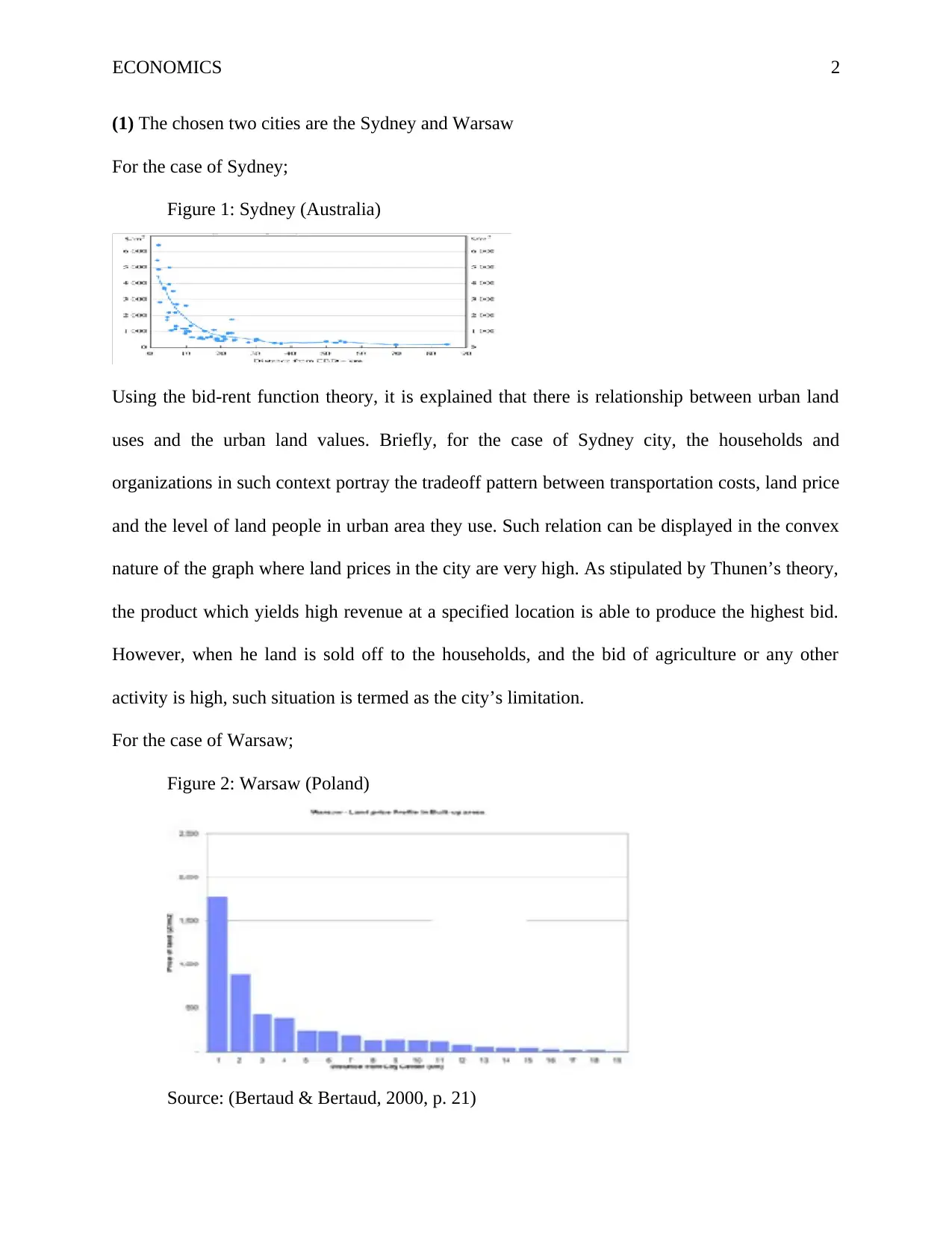
Figure 1: Sydney (Australia)
Using the bid-rent function theory, it is explained that there is relationship between urban land
uses and the urban land values. Briefly, for the case of Sydney city, the households and
organizations in such context portray the tradeoff pattern between transportation costs, land price
and the level of land people in urban area they use. Such relation can be displayed in the convex
nature of the graph where land prices in the city are very high. As stipulated by Thunen’s theory,
the product which yields high revenue at a specified location is able to produce the highest bid.
However, when he land is sold off to the households, and the bid of agriculture or any other
activity is high, such situation is termed as the city’s limitation.
For the case of Warsaw;
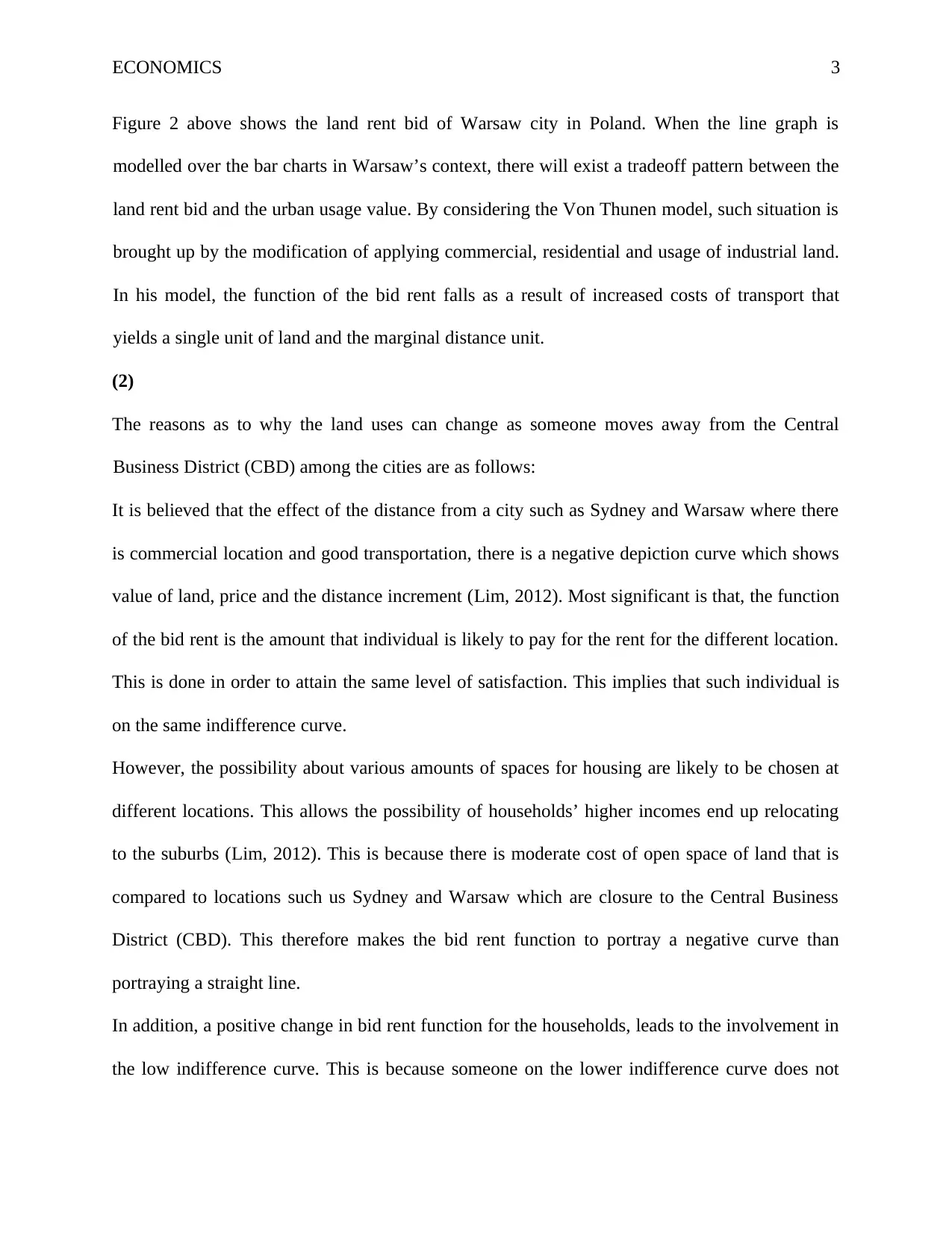
Figure 2: Warsaw (Poland)
Source: (Bertaud & Bertaud, 2000, p. 21)
Document Page
ECONOMICS 3
Figure 2 above shows the land rent bid of Warsaw city in Poland. When the line graph is
modelled over the bar charts in Warsaw’s context, there will exist a tradeoff pattern between the
land rent bid and the urban usage value. By considering the Von Thunen model, such situation is
brought up by the modification of applying commercial, residential and usage of industrial land.
In his model, the function of the bid rent falls as a result of increased costs of transport that
yields a single unit of land and the marginal distance unit.
(2)
The reasons as to why the land uses can change as someone moves away from the Central
Business District (CBD) among the cities are as follows:
It is believed that the effect of the distance from a city such as Sydney and Warsaw where there
is commercial location and good transportation, there is a negative depiction curve which shows
value of land, price and the distance increment (Lim, 2012). Most significant is that, the function
of the bid rent is the amount that individual is likely to pay for the rent for the different location.
This is done in order to attain the same level of satisfaction. This implies that such individual is
on the same indifference curve.
However, the possibility about various amounts of spaces for housing are likely to be chosen at
different locations. This allows the possibility of households’ higher incomes end up relocating
to the suburbs (Lim, 2012). This is because there is moderate cost of open space of land that is
compared to locations such us Sydney and Warsaw which are closure to the Central Business
District (CBD). This therefore makes the bid rent function to portray a negative curve than
portraying a straight line.
In addition, a positive change in bid rent function for the households, leads to the involvement in
the low indifference curve. This is because someone on the lower indifference curve does not
Document Page
ECONOMICS 4
enjoy and attain the maximum utilization of resources. This scenario can be seen when an
individual changes the location that is to say from Sydney and Warsaw to other suburbs. Such
incidence can happen when the household appeals that there is no any location that has function
of bid rent equal to the surpassed market rent.
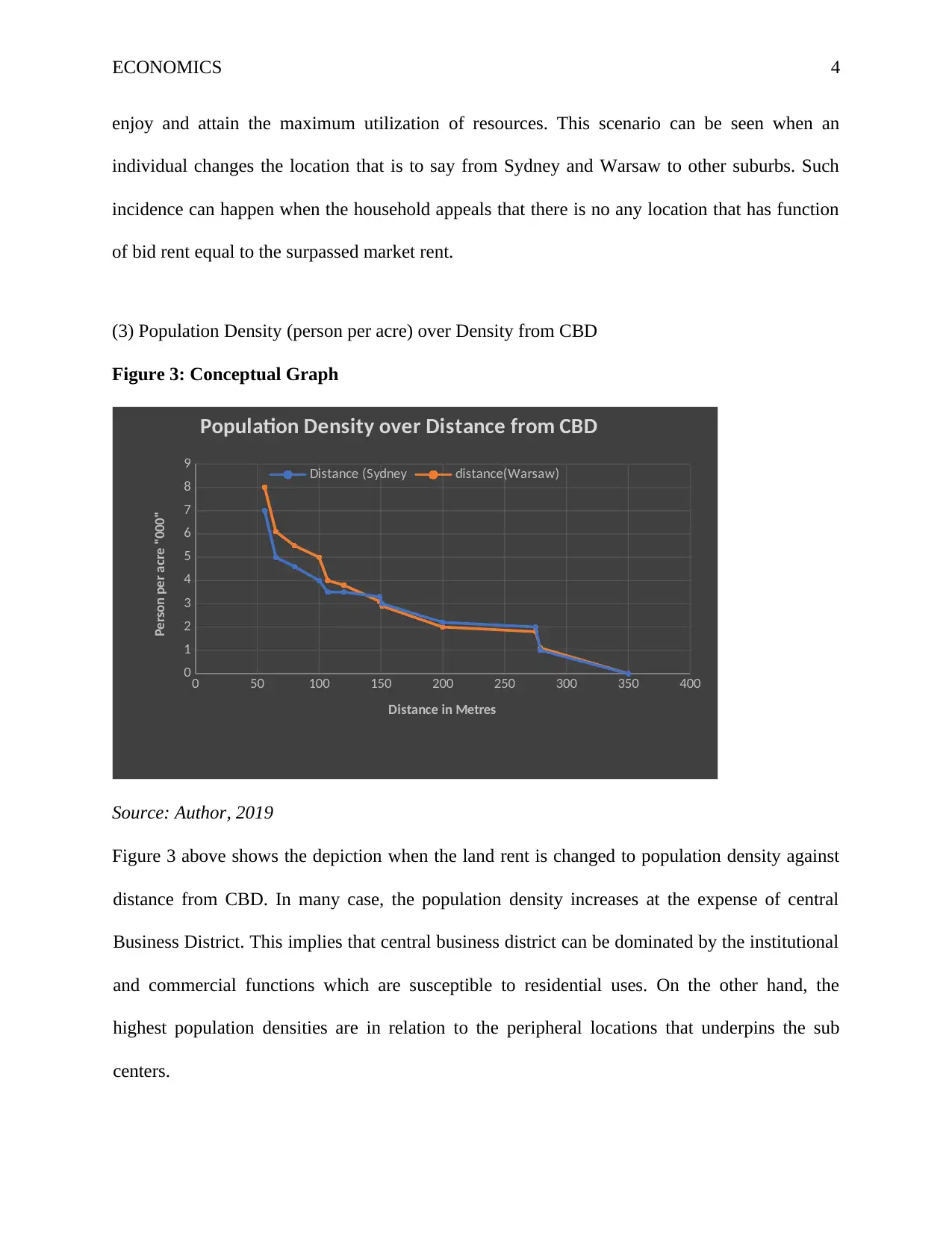
(3) Population Density (person per acre) over Density from CBD
Figure 3: Conceptual Graph
0 50 100 150 200 250 300 350 400
0
1
2
3
4
5
6
7
8
9
Population Density over Distance from CBD
Distance (Sydney distance(Warsaw)
Distance in Metres
Person per acre "000"
Source: Author, 2019
Figure 3 above shows the depiction when the land rent is changed to population density against
distance from CBD. In many case, the population density increases at the expense of central
Business District. This implies that central business district can be dominated by the institutional
and commercial functions which are susceptible to residential uses. On the other hand, the
highest population densities are in relation to the peripheral locations that underpins the sub
centers.
tabler-icon-diamond-filled.svg

Paraphrase This Document

Need a fresh take? Get an instant paraphrase of this document with our AI Paraphraser
Document Page
ECONOMICS 5
Others have higher densities at peripheral locations, underlining the presence of sub-centers. For
both cases (city of Sydney and Warsaw), the population densities decrease as the distance in
meters’ increases. This implies that there is a negative relationship between population density
and the distance from the CBD. In most case, there are differences in population densities’
gradients emanating from the cities in relation to the distances. In addition, the effect of the
distance from a city such as Sydney and Warsaw where there is commercial location and good
transportation, there is a negative depiction curve which shows value of land, price and the
distance increment. Most important thing is that, the function of the bid rent is the amount that
individual is likely to pay for the rent for the different location (Briassoulis, 2009). This is done
in order to attain the same level of satisfaction being derived from the services got from the
urban centers. It is evident from various theories that land usage cycles deviate from the
geographical and economic variables especially in cities. The theories try much to explain the
location behavior, as the location or distance deviates from urban areas, the population density
reduces as well (Kulish et al, 2011). This is because most of the people prefer staying in urban
areas because of commercial and administrative services. The population density in urban areas
increases no matter the increased costs being attached on services such as transport, housing
among others.
Summary of Discussion
In summary, it is evident that the effect of the distance from a city such as Sydney and Warsaw
where there is commercial location and good transportation, there is a negative depiction curve
which shows value of land, price and the distance increment. There are high population densities
in areas near urban centers due to the services confined in them. However, such cities have got
increased costs especially in land bid rent and transport costs as well as the commercial costs
Document Page
ECONOMICS 6
(Leslie & HUallacháin, 2016). Generally, there exist a tradeoff relationship between land bid
rent and other costs such as housing, transport arising from distance costs among others. By
considering the city surrounded by agricultural land, cities act as the markets whereby farmers
sell off their products. This is because agricultural land that surrounds the city is homogeneous.
This is because the products or services can be developed at any place as long as the resources to
formulate them are available.
Document Page
ECONOMICS 7
References
Bertaud, A., & Bertaud, M. A. (2000). The Spatial Development of Warsaw Metropolitan Area.
Washington DC: The World Bank.
Briassoulis, H. (2009). Analysis of Land Use Change: theoretical and Modeling Approaches Ph.D.
Thesis, University of the Aegean, Department of Geography, Lesvos, Greec
Kulish, M., Richards, A., & Gillitzer, C. (2011). Urban Structure and Housing Prices: Some Evidence
from Australian Cities. Reserve Bank of Australia
Leslie, T. F. & HUallacháin, B. Ó. (2016). Polycentric phoenix. Economic Geography,82(2), 167-192
Lim, H.S. (2012). A Study on the Relationship between Spatial Configuration and Land Prices, Journal
of Architectural Institute of Korea, Vol. 18, No.7, pp.133-141.
Tiwari, P., & Rastogi, A. (2010). What has been the impact of Special Economic Zones on Land and
Property Markets in Hyderabad. London: RICS.
chevron_up_icon
1 out of 7
circle_padding
hide_on_mobile
zoom_out_icon
[object Object]