ECON 705: Decisions within Market Power; Oligopoly Assignment

Verified

Added on  2023/06/15

|5
|932
|272
Homework Assignment
AI Summary
This ECON 705 assignment delves into market structures, strategic decisions, and oligopoly dynamics. It involves calculating equations for price, marginal revenue, average total cost, average variable cost, and marginal cost. The solution identifies the profit-maximizing price and quantity, calculates total profit, and assesses market competitiveness using the Lerner Index. It also addresses the incentives behind controlling licensing systems, differences between political and business rivalry, and strategic advertising decisions in an oligopoly setting, providing a comprehensive analysis of market behavior and strategic interactions. Desklib offers a wealth of similar solved assignments and past papers to aid students in their studies.
Document Page
ECON 705
Market Structures
STUDENT ID:
[Pick the date]
tabler-icon-diamond-filled.svg

Paraphrase This Document

Need a fresh take? Get an instant paraphrase of this document with our AI Paraphraser
Document Page
ECONOMICS
Question 1
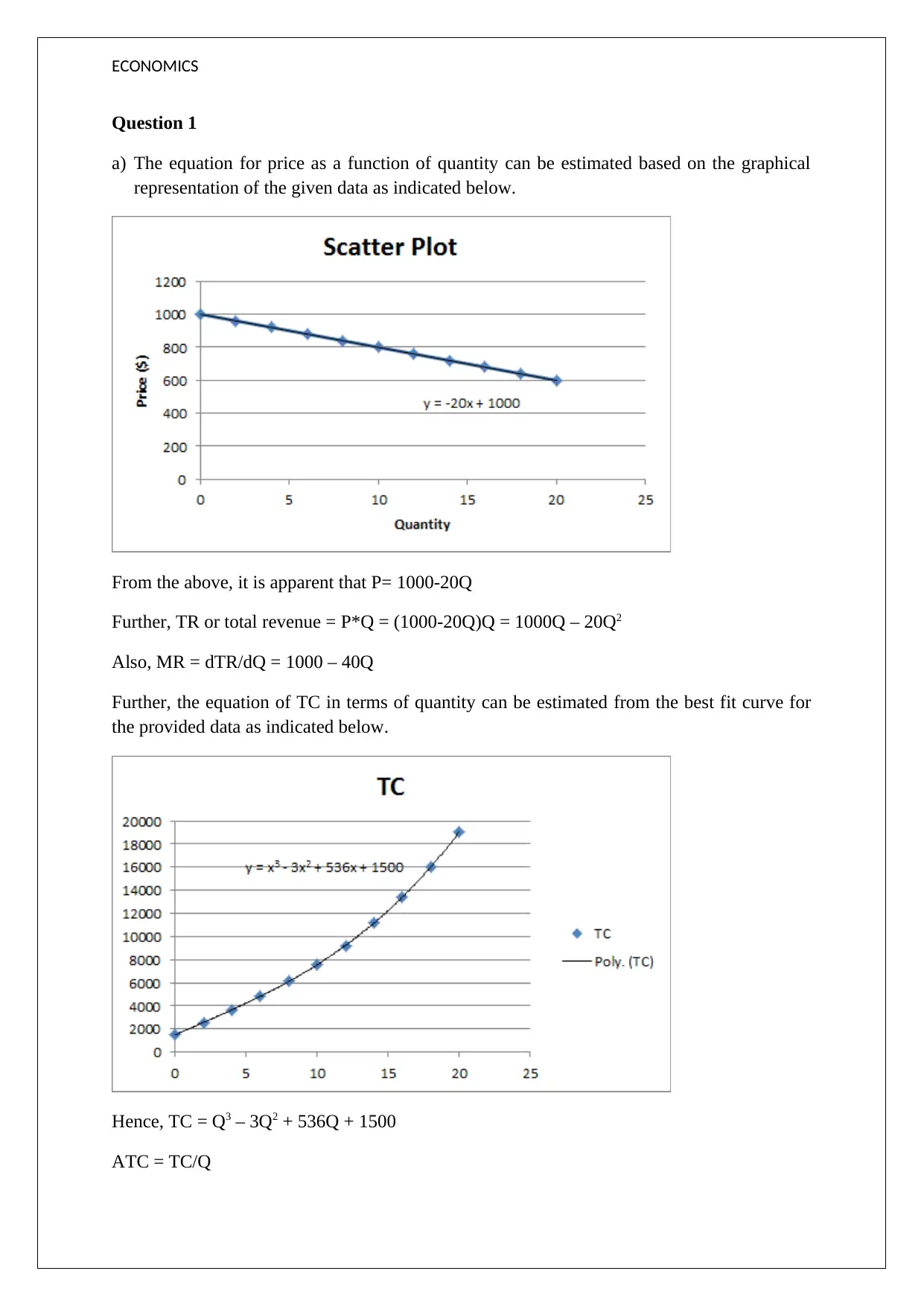
a) The equation for price as a function of quantity can be estimated based on the graphical
representation of the given data as indicated below.
From the above, it is apparent that P= 1000-20Q
Further, TR or total revenue = P*Q = (1000-20Q)Q = 1000Q – 20Q2
Also, MR = dTR/dQ = 1000 – 40Q
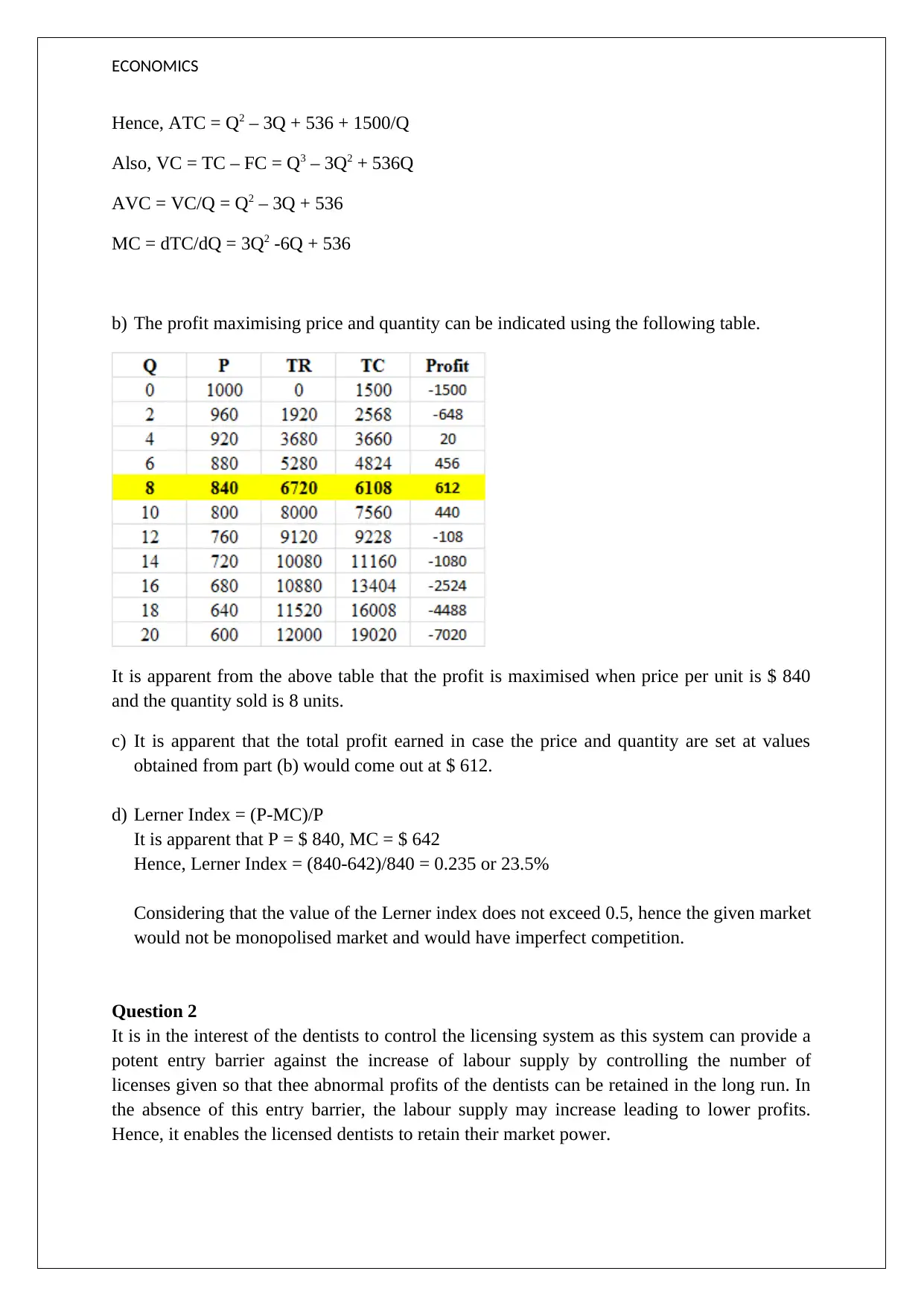
Further, the equation of TC in terms of quantity can be estimated from the best fit curve for
the provided data as indicated below.
Hence, TC = Q3 – 3Q2 + 536Q + 1500
ATC = TC/Q
Document Page
ECONOMICS
Hence, ATC = Q2 – 3Q + 536 + 1500/Q
Also, VC = TC – FC = Q3 – 3Q2 + 536Q
AVC = VC/Q = Q2 – 3Q + 536
MC = dTC/dQ = 3Q2 -6Q + 536
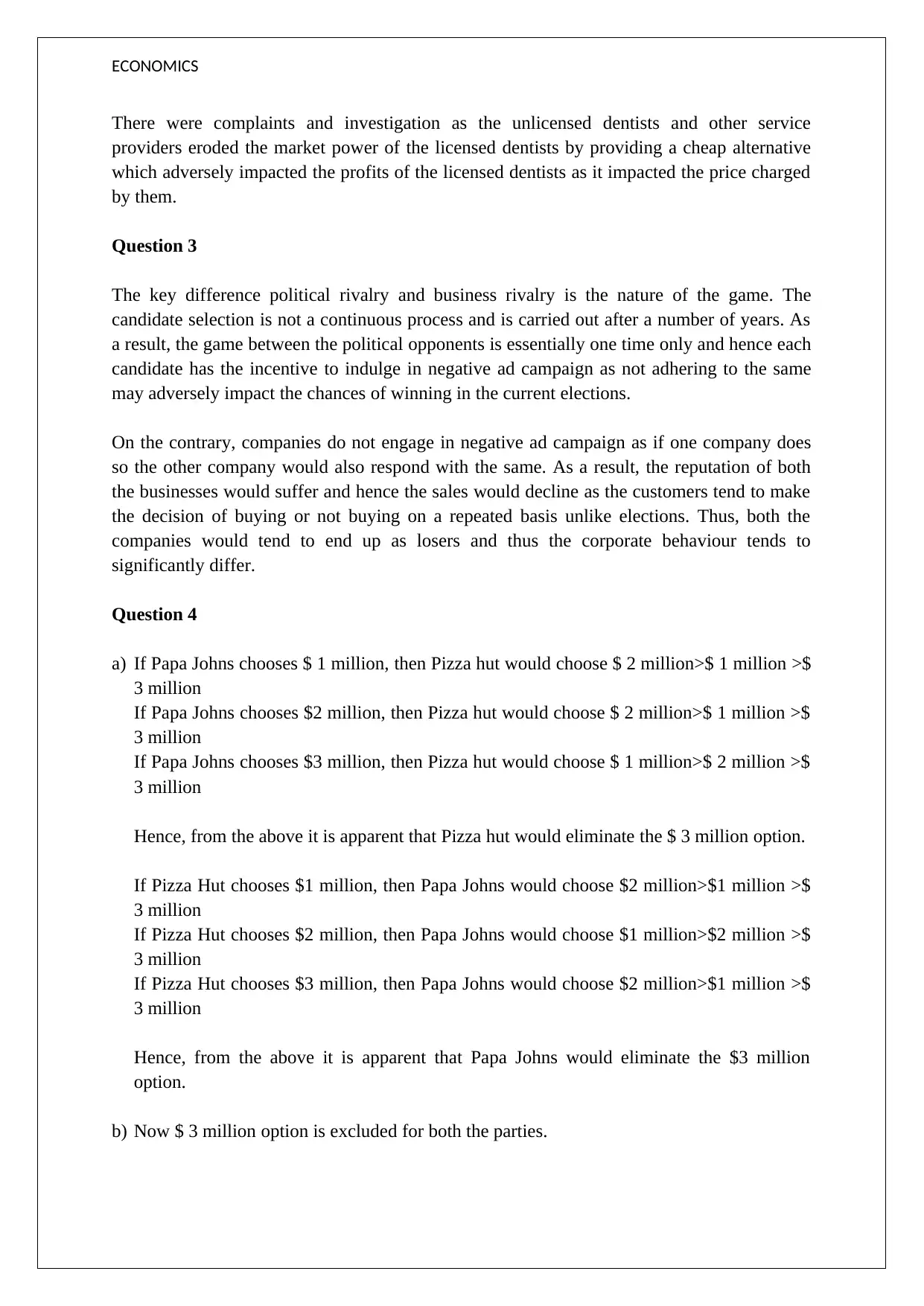
b) The profit maximising price and quantity can be indicated using the following table.
It is apparent from the above table that the profit is maximised when price per unit is $ 840
and the quantity sold is 8 units.
c) It is apparent that the total profit earned in case the price and quantity are set at values
obtained from part (b) would come out at $ 612.
d) Lerner Index = (P-MC)/P
It is apparent that P = $ 840, MC = $ 642
Hence, Lerner Index = (840-642)/840 = 0.235 or 23.5%
Considering that the value of the Lerner index does not exceed 0.5, hence the given market
would not be monopolised market and would have imperfect competition.
Question 2
It is in the interest of the dentists to control the licensing system as this system can provide a
potent entry barrier against the increase of labour supply by controlling the number of
licenses given so that thee abnormal profits of the dentists can be retained in the long run. In
the absence of this entry barrier, the labour supply may increase leading to lower profits.
Hence, it enables the licensed dentists to retain their market power.
Document Page
ECONOMICS
There were complaints and investigation as the unlicensed dentists and other service
providers eroded the market power of the licensed dentists by providing a cheap alternative
which adversely impacted the profits of the licensed dentists as it impacted the price charged
by them.
Question 3
The key difference political rivalry and business rivalry is the nature of the game. The
candidate selection is not a continuous process and is carried out after a number of years. As
a result, the game between the political opponents is essentially one time only and hence each
candidate has the incentive to indulge in negative ad campaign as not adhering to the same
may adversely impact the chances of winning in the current elections.
On the contrary, companies do not engage in negative ad campaign as if one company does
so the other company would also respond with the same. As a result, the reputation of both
the businesses would suffer and hence the sales would decline as the customers tend to make
the decision of buying or not buying on a repeated basis unlike elections. Thus, both the
companies would tend to end up as losers and thus the corporate behaviour tends to
significantly differ.
Question 4
a) If Papa Johns chooses $ 1 million, then Pizza hut would choose $ 2 million>$ 1 million >$
3 million
If Papa Johns chooses $2 million, then Pizza hut would choose $ 2 million>$ 1 million >$
3 million
If Papa Johns chooses $3 million, then Pizza hut would choose $ 1 million>$ 2 million >$
3 million
Hence, from the above it is apparent that Pizza hut would eliminate the $ 3 million option.
If Pizza Hut chooses $1 million, then Papa Johns would choose $2 million>$1 million >$
3 million
If Pizza Hut chooses $2 million, then Papa Johns would choose $1 million>$2 million >$
3 million
If Pizza Hut chooses $3 million, then Papa Johns would choose $2 million>$1 million >$
3 million
Hence, from the above it is apparent that Papa Johns would eliminate the $3 million
option.
b) Now $ 3 million option is excluded for both the parties.
tabler-icon-diamond-filled.svg

Paraphrase This Document

Need a fresh take? Get an instant paraphrase of this document with our AI Paraphraser
Document Page
ECONOMICS
Irrespective of choice made by Papa Johns, Pizza Hut would always choose $ 2 million so to
maximise the payoffs. As a result, a second round exclusion would be made by Pizza Hut
there eliminating $ 1 million option.
With regards to Papa Johns, no second round elimination would be there, as the maximum
payoff option would vary as per the choice exhibited by Pizza Hut.
c) It is apparent that Pizza Hut would choose only $ 2 million option and Papa Johns can
maximise the payoff by choose $ 1 million option. Hence, in case of simultaneous
advertising decision, Papa Johns would go with $ 1 million option while Pizza Hut would
go with a $ 2 million option.
chevron_up_icon
1 out of 5
circle_padding
hide_on_mobile
zoom_out_icon
[object Object]