University Economics ECON 416 Winter 2020 Assignment 1

Verified

Added on  2022/08/18

|10
|1124
|18
Homework Assignment
AI Summary
This economics assignment solution addresses several key concepts including cost benefit analysis, cost effectiveness, Pareto improvement, and market equilibrium. The assignment analyzes the relevance of cost benefit analysis in projects affecting human lives, comparing it with cost effectiveness. It differentiates between profit and loss analysis and cost benefit analysis, highlighting their respective uses in organizational decision-making. The solution also explores potential versus actual Pareto improvements, explaining their differences and applications. Furthermore, it delves into the controversies surrounding cost benefit analysis, discussing its assumptions and limitations, particularly in socially relevant projects. Finally, the assignment includes a market analysis problem, calculating equilibrium price and quantity, and illustrating market lines for a given product, along with net benefit calculations. The assignment is designed to meet the requirements of ECON 416, Winter 2020.
Document Page
Running head: ECONOMICS
Economics
Name of the Student:
Name of the University:
Authors Note:
tabler-icon-diamond-filled.svg

Paraphrase This Document

Need a fresh take? Get an instant paraphrase of this document with our AI Paraphraser
Document Page
1
ECONOMICS
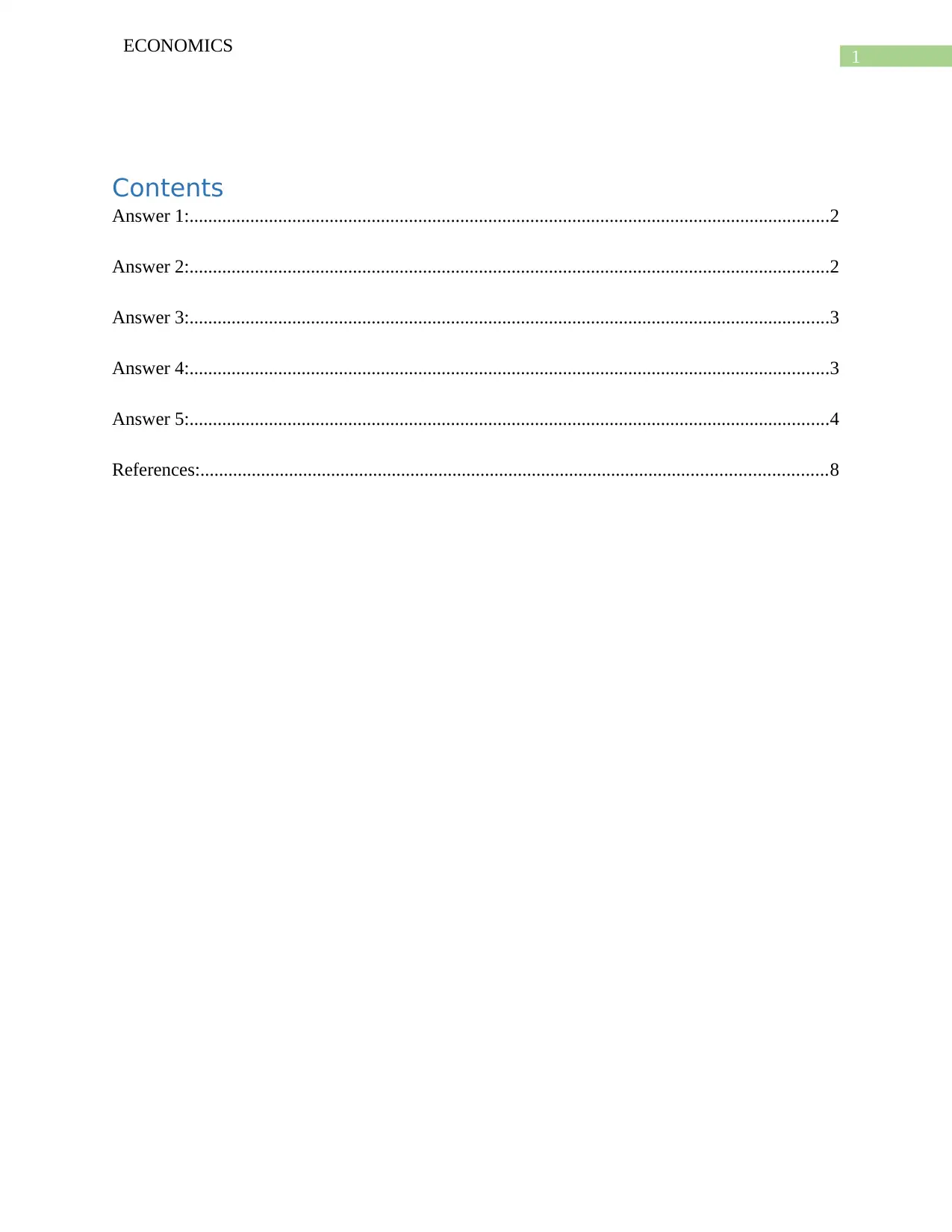
Contents
Answer 1:.........................................................................................................................................2
Answer 2:.........................................................................................................................................2
Answer 3:.........................................................................................................................................3
Answer 4:.........................................................................................................................................3
Answer 5:.........................................................................................................................................4
References:......................................................................................................................................8
Document Page
2
ECONOMICS
Answer 1:
Decision by using cost benefit analysis is not possible for projects which are related to human
lives. Thus, cost benefit analysis is not relevant in projects that directly affect the human lives
hence, cost benefit analysis is not useful for project A and project B. Cost effectiveness on the
other hand is useful for all types of project as it merely compares the cost and effectiveness
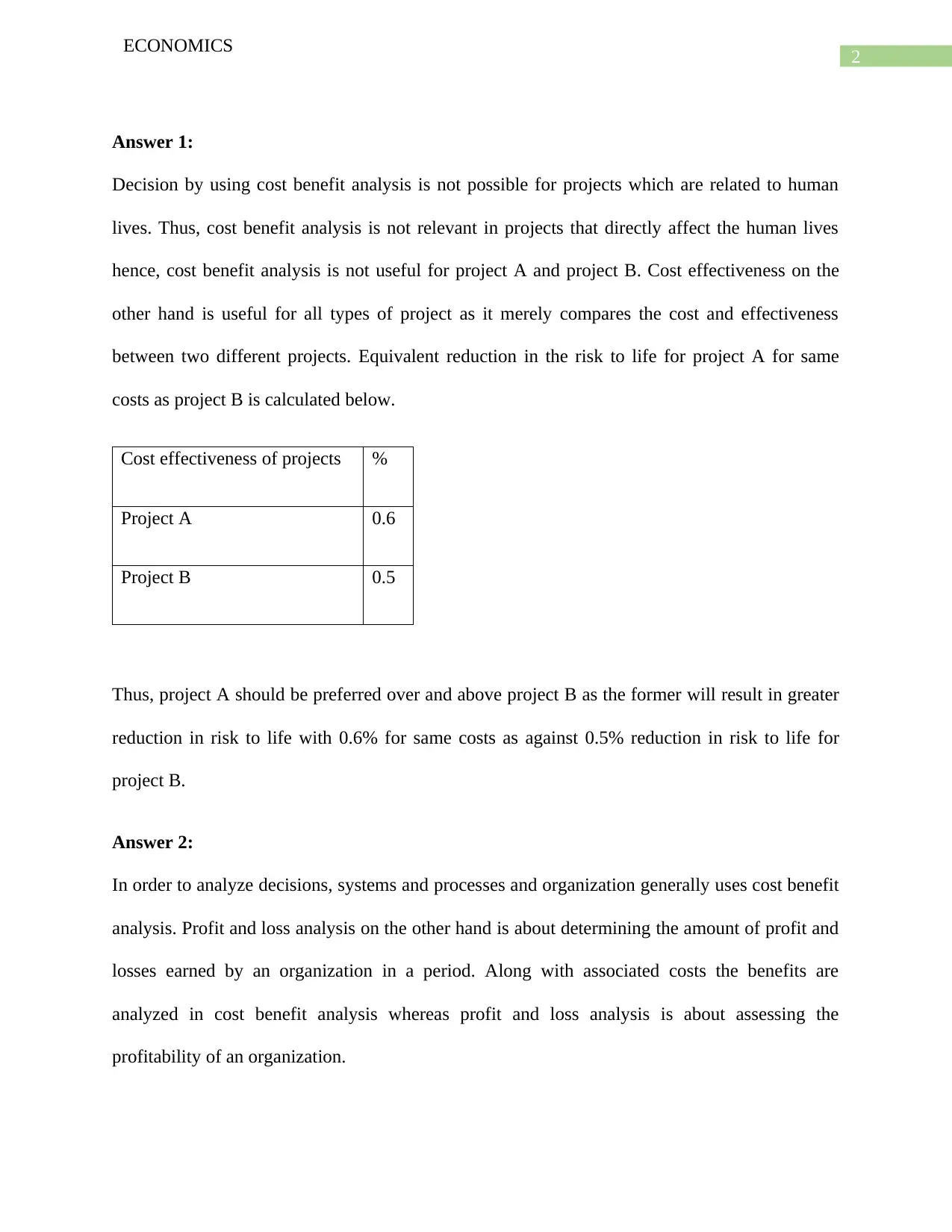
between two different projects. Equivalent reduction in the risk to life for project A for same
costs as project B is calculated below.
Cost effectiveness of projects %
Project A 0.6
Project B 0.5
Thus, project A should be preferred over and above project B as the former will result in greater
reduction in risk to life with 0.6% for same costs as against 0.5% reduction in risk to life for
project B.
Answer 2:
In order to analyze decisions, systems and processes and organization generally uses cost benefit
analysis. Profit and loss analysis on the other hand is about determining the amount of profit and
losses earned by an organization in a period. Along with associated costs the benefits are
analyzed in cost benefit analysis whereas profit and loss analysis is about assessing the
profitability of an organization.
Document Page
3
ECONOMICS
Profit and loss analysis is also quite similar to cost benefit analysis when it comes to the utility of
both the tools to the management of an organization. Profit and loss statement of an organization
contains the amount of revenue and expenditures of the organization. Management of an
organization uses profit and loss analysis to assess the operating effectiveness of the
organization. Estimating the amount of benefit earned from different costs is possible with the
help of cost benefit analysis.
Answer 3:
Potential Pareto improvement is about analyzing the overall growth and increase in wealth also
referred to as Kaldor-Hicks improvement. Pareto improvement, i.e. actual Pareto improvement
on the other hand refers to the allocation that harms none and at least a person is helped. Hence,
potential Pareto improvement is not an actual Pareto improvement as the probability of at least a
person unhappy with due to loss suffered from free trade is almost a certainty thus, there is a
significant difference between potential and actual Pareto improvement.
A Pareto improvement describes a policy change best to improve the social yardsticks to benefit
the society. As already mentioned that actual Pareto improvement is very different from potential
Pareto improvement however a policy change is best described with the use of the former than
the later (van der Klaauw 88-97).
Answer 4:
Cost benefit analysis has always been a subject of intense scrutiny with many economists have
voiced their concern over the effectiveness and usefulness of the process to the management for
decision making purpose. However, there is equally vocal support base to explain the utility if
the process for the management. Thus, cost benefit analysis has always been in controversy for
tabler-icon-diamond-filled.svg

Paraphrase This Document

Need a fresh take? Get an instant paraphrase of this document with our AI Paraphraser
Document Page
4
ECONOMICS
the sheer polarizing views of economists and management on the benefit and utility of the
system.
The critique of the system is on the matter of number of assumptions which are crucial to the
overall process. Cost benefit analysis is a process where the cost and associated benefits are
forecasted on the basis of available information about the current as well as future. Since, there is
no method to predict the future conditions with utmost certainty hence, number of assumptions
have to be made to calculate the cost benefit of a project. Thus, the efficiency of the system is
dependant to a large extent on the correct assumption of future condition. Further the cost benefit
analysis is not useful for projects that are socially relevant and not subjected to profit and loss
("Editorial, International Economics" 1-2). Thus, the reason for cost benefit analysis to be
extremely controversial is mainly due to the uncertainty that revolves around the process. Unlike
profit and loss analysis cost benefit analysis does not provide exact profit or loss expected to be
earned or incurred by an organization from a project rather it is merely about the estimating
expected benefit from a project along with cost incurred on the project. However, despite the
number of limitations and controversies surrounding the process the usefulness of the process to
the management is universally accepted. Using cost benefit analysis is extremely useful for
commercial projects. Projects which are not socially relevant will be assessed as far as the
expected benefits and costs are concerned by using the cost benefit analysis.
Answer 5:
Part a:
The following equation shall be used to calculate the market price and equilibrium quantity for
exchange x.
Document Page
5
ECONOMICS
50 - 0.5p=4p - 40
50-0.5p+0.5p=4p-40+0.5p
50-4.5p=4.5p-40
We get from the above,
-9p = 90
Adding 40 to both sides of the equation will give us the following scenario,
-9p +40 = 90 +40
-9P = 90
P = 90/9
P= 10
Thus, equilibrium price is $10 and the quantity is 40 units.
Part b:
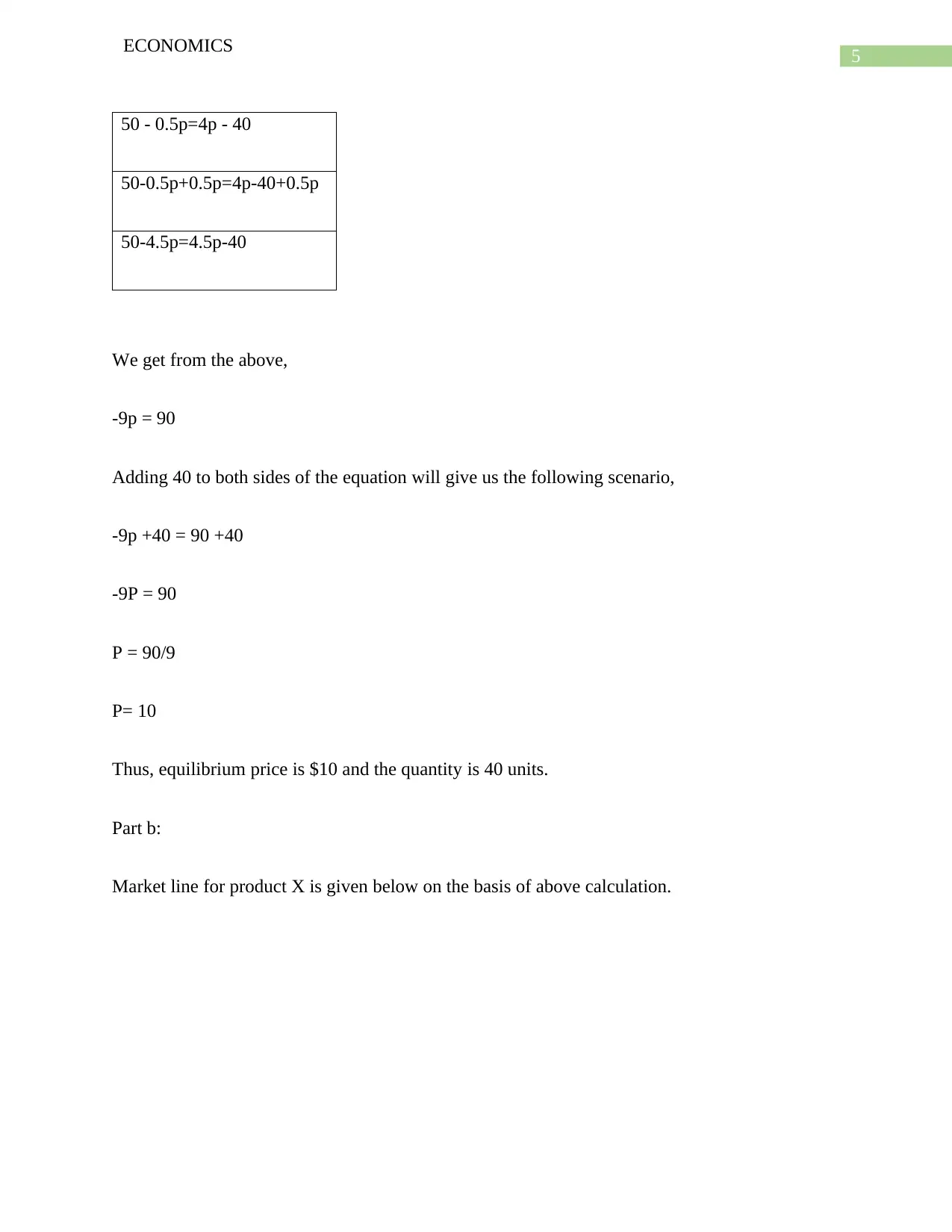
Market line for product X is given below on the basis of above calculation.
Document Page
6
ECONOMICS
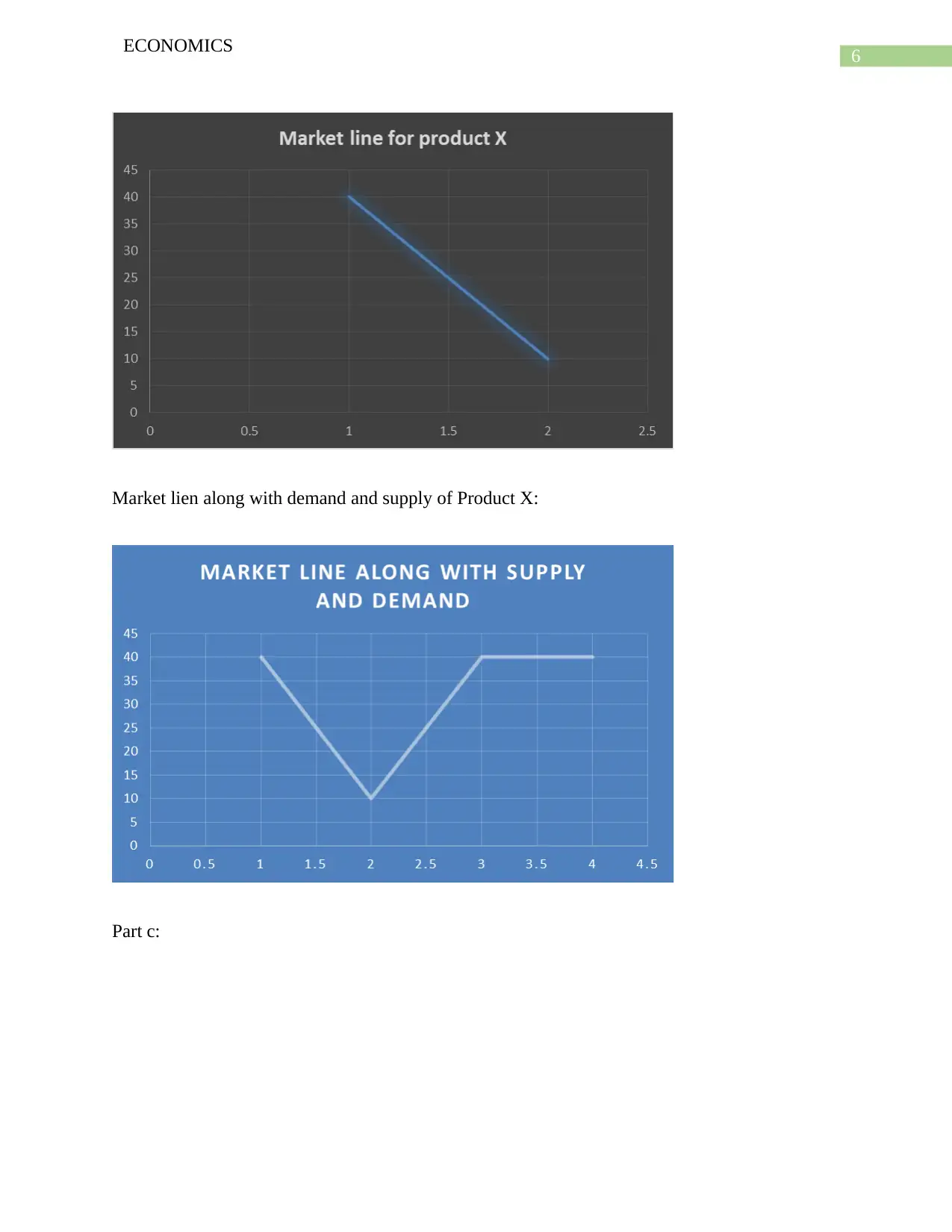
Market lien along with demand and supply of Product X:
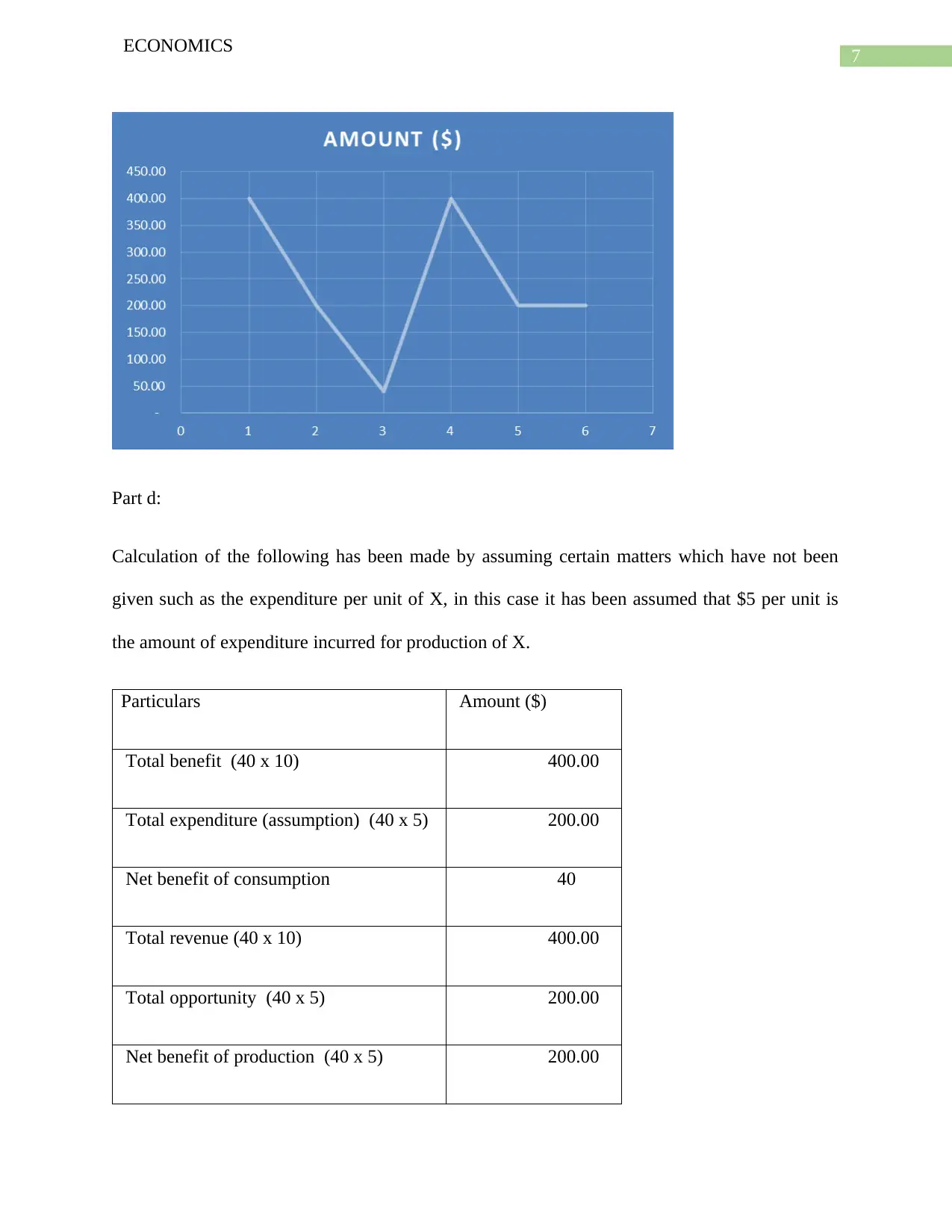
Part c:
tabler-icon-diamond-filled.svg

Paraphrase This Document

Need a fresh take? Get an instant paraphrase of this document with our AI Paraphraser
Document Page
7
ECONOMICS
Part d:
Calculation of the following has been made by assuming certain matters which have not been
given such as the expenditure per unit of X, in this case it has been assumed that $5 per unit is
the amount of expenditure incurred for production of X.
Particulars Amount ($)
Total benefit (40 x 10) 400.00
Total expenditure (assumption) (40 x 5) 200.00
Net benefit of consumption 40
Total revenue (40 x 10) 400.00
Total opportunity (40 x 5) 200.00
Net benefit of production (40 x 5) 200.00
Document Page
8
ECONOMICS
References:
"Editorial, International Economics." International Economics 160.17 (2019): 1-2. Web.
van der Klaauw, Bas. "From Micro Data To Causality: Forty Years Of Empirical Labor
Economics." Labour Economics 36.12 (2018): 88-97. Web.
Document Page
9
ECONOMICS
chevron_up_icon
1 out of 10
circle_padding
hide_on_mobile
zoom_out_icon
[object Object]