Economy, Efficiency, and Effectiveness: A Public Sector Analysis
VerifiedAdded on 2020/05/16
|20
|4697
|211
Report
AI Summary
This report delves into the interconnected concepts of economy, efficiency, and effectiveness, particularly within the context of public sector services, using HSE Ireland as a case study. It begins by defining economy, exploring traditional, modern, and mixed economic systems, and analyzing the impact of logistics, information technology, and external markets. The report then examines efficiency, differentiating between various types and their economic implications. Finally, it addresses effectiveness, including production efficiency. The analysis demonstrates the interrelation of these three concepts and their relevance in optimizing public service delivery. The report highlights how governments and organizations like HSE Ireland navigate economic systems, manage resources, and ensure effective service provision, contributing to the overall value of money and public welfare.
Running head: ECONOMY, EFFICIENCY AND EFFECTIVENESS
Economy, Efficiency and Effective
Name of the Student:
Name of the University:
Author Note:
Economy, Efficiency and Effective
Name of the Student:
Name of the University:
Author Note:

Paraphrase This Document
Need a fresh take? Get an instant paraphrase of this document with our AI Paraphraser
1
ECONOMY, EFFICIENCY AND EFFECTIVENESS
Executive Summary:
The words economy, efficiency and effectiveness are often used imprecisely or even
interchangeably. These words have superseded their literal meanings and today are used to
address diverse public services perspectives. The paper would shed on the manifold evolution
of these three words in fields of public sector services which governments provide to their
people either free of cost or at very low prices. The organisation taken to conduct the study is
HSE, Ireland. The paper would finally prove that these three words are interrelated and
achievement of one would also call for achievement of the next.
ECONOMY, EFFICIENCY AND EFFECTIVENESS
Executive Summary:
The words economy, efficiency and effectiveness are often used imprecisely or even
interchangeably. These words have superseded their literal meanings and today are used to
address diverse public services perspectives. The paper would shed on the manifold evolution
of these three words in fields of public sector services which governments provide to their
people either free of cost or at very low prices. The organisation taken to conduct the study is
HSE, Ireland. The paper would finally prove that these three words are interrelated and
achievement of one would also call for achievement of the next.
2
ECONOMY, EFFICIENCY AND EFFECTIVENESS
Table of Contents
Introduction:...............................................................................................................................3
Economy:...................................................................................................................................3
Traditional economy:.............................................................................................................4
Modern economies:................................................................................................................4
Integration and logistisation of economies:.......................................................................5
Informatization:..................................................................................................................5
External market impacts on flow of goods and services:...................................................5
Command economic system:.............................................................................................7
Market economic system:..................................................................................................8
Mixed economic system:....................................................................................................8
Findings from the discussions:.................................................................................................10
Efficiency:................................................................................................................................11
Types of efficiency:..................................................................................................................12
Efficiency in economic perspective:....................................................................................12
Effectiveness:...........................................................................................................................14
Production efficiency:..........................................................................................................14
Conclusion:..............................................................................................................................14
References:...............................................................................................................................16
Introduction:
ECONOMY, EFFICIENCY AND EFFECTIVENESS
Table of Contents
Introduction:...............................................................................................................................3
Economy:...................................................................................................................................3
Traditional economy:.............................................................................................................4
Modern economies:................................................................................................................4
Integration and logistisation of economies:.......................................................................5
Informatization:..................................................................................................................5
External market impacts on flow of goods and services:...................................................5
Command economic system:.............................................................................................7
Market economic system:..................................................................................................8
Mixed economic system:....................................................................................................8
Findings from the discussions:.................................................................................................10
Efficiency:................................................................................................................................11
Types of efficiency:..................................................................................................................12
Efficiency in economic perspective:....................................................................................12
Effectiveness:...........................................................................................................................14
Production efficiency:..........................................................................................................14
Conclusion:..............................................................................................................................14
References:...............................................................................................................................16
Introduction:
⊘ This is a preview!⊘
Do you want full access?
Subscribe today to unlock all pages.

Trusted by 1+ million students worldwide
3
ECONOMY, EFFICIENCY AND EFFECTIVENESS
The terms economy, efficiency and effectiveness are often used imprecisely
especially referring to value for money. This is because the implications of these terms
have transcended their technical meanings to apply to broader areas in the world. The same
applies to the words efficiency and effectiveness. The paper would show how these three
terms are used imprecisely especially while describing public contexts. The author would go
on to introduce the three terms namely, economy, efficiency and effectiveness in their literal
meaning and then go deeper into these terms to show the actual usage of them. The paper
would show the vast usage of these terms and how they have transcended their literal
meanings to serve broader public services perspectives. The researcher would discover that
these three words are interrelated and cannot be studied with each other. The organisation
considered to conduct the study is the Irish branch of HSE, HSE Ireland (hse.ie 2018).
Economy:
The term economy refers to areas of production of goods and services. The term is
used to mark areas of distribution or trading of goods and services. An economy is often
defined as a system which enables manufacture, distribution and consumption of goods. The
consumers in different economies enjoy services like public health and medical services for
subsidised costs. Thus, here economy acts a facility which enables circulation of financial
capital between the producers (public sector health service providers) and consumers. As
this definition points out that the term is not restricted within any specific country or
geographical area (Veleva et al. 2015). Economies have no specific physical boundaries as
they are systems which enable flow of money from, producers (health service providers)
to patients (consumers) all over the world. Audretsch, Lehmann and Wright (2014) argue
that the above discussion apparently points out that financial resources flow in the global
economy freely which is not true and feasible. The flow of financial resources in the global
ECONOMY, EFFICIENCY AND EFFECTIVENESS
The terms economy, efficiency and effectiveness are often used imprecisely
especially referring to value for money. This is because the implications of these terms
have transcended their technical meanings to apply to broader areas in the world. The same
applies to the words efficiency and effectiveness. The paper would show how these three
terms are used imprecisely especially while describing public contexts. The author would go
on to introduce the three terms namely, economy, efficiency and effectiveness in their literal
meaning and then go deeper into these terms to show the actual usage of them. The paper
would show the vast usage of these terms and how they have transcended their literal
meanings to serve broader public services perspectives. The researcher would discover that
these three words are interrelated and cannot be studied with each other. The organisation
considered to conduct the study is the Irish branch of HSE, HSE Ireland (hse.ie 2018).
Economy:
The term economy refers to areas of production of goods and services. The term is
used to mark areas of distribution or trading of goods and services. An economy is often
defined as a system which enables manufacture, distribution and consumption of goods. The
consumers in different economies enjoy services like public health and medical services for
subsidised costs. Thus, here economy acts a facility which enables circulation of financial
capital between the producers (public sector health service providers) and consumers. As
this definition points out that the term is not restricted within any specific country or
geographical area (Veleva et al. 2015). Economies have no specific physical boundaries as
they are systems which enable flow of money from, producers (health service providers)
to patients (consumers) all over the world. Audretsch, Lehmann and Wright (2014) argue
that the above discussion apparently points out that financial resources flow in the global
economy freely which is not true and feasible. The flow of financial resources in the global
Paraphrase This Document
Need a fresh take? Get an instant paraphrase of this document with our AI Paraphraser
4
ECONOMY, EFFICIENCY AND EFFECTIVENESS
economy is controlled by governments and international organisations to ensure that the
resources flow into the areas of further public benefits (Arvis et al. 2016). The governments
regulate the flow of money within their jurisdictions through various public service
organisations like apex banks and stock exchanges. The governments regulate the flow of
money within their jurisdiction to provide services to their people. For example HSE Ireland
is a public sector health service which works according to the directives of the European
Union on no gain or profit basis (hse.gov.uk 2018). This involvement of governments in the
welfare of people through public services adds value to the money flowing in the global
economy. These important roles of governments and international organisations have led to
use of the word economy and countries interchangeably. The following are the new
aspects of the word economy which is used in global scenario today:
Traditional economy:
Traditional economies are economies in which customs, traditional perceptions and
beliefs decide the production of goods and services in the economies. These factors even
decide the terms and manners the producers and consumers exchange goods and services.
The traditional economies are mostly restricted within rural areas where the medium of
exchange is not standardised (Edwards 2017). People exchange products of certain values
with products of equal values. This analysis shows that traditional economic systems are not
developed to allow large scale flow of goods. This purpose is served by modern economies
which are empowered with the infrastructure to allow and control flow of resources all round
the world.
Modern economies:
The term modern economy refers to economies which have the infrastructure to allow
global flows of money. The following are the salient features of modern economies:
ECONOMY, EFFICIENCY AND EFFECTIVENESS
economy is controlled by governments and international organisations to ensure that the
resources flow into the areas of further public benefits (Arvis et al. 2016). The governments
regulate the flow of money within their jurisdictions through various public service
organisations like apex banks and stock exchanges. The governments regulate the flow of
money within their jurisdiction to provide services to their people. For example HSE Ireland
is a public sector health service which works according to the directives of the European
Union on no gain or profit basis (hse.gov.uk 2018). This involvement of governments in the
welfare of people through public services adds value to the money flowing in the global
economy. These important roles of governments and international organisations have led to
use of the word economy and countries interchangeably. The following are the new
aspects of the word economy which is used in global scenario today:
Traditional economy:
Traditional economies are economies in which customs, traditional perceptions and
beliefs decide the production of goods and services in the economies. These factors even
decide the terms and manners the producers and consumers exchange goods and services.
The traditional economies are mostly restricted within rural areas where the medium of
exchange is not standardised (Edwards 2017). People exchange products of certain values
with products of equal values. This analysis shows that traditional economic systems are not
developed to allow large scale flow of goods. This purpose is served by modern economies
which are empowered with the infrastructure to allow and control flow of resources all round
the world.
Modern economies:
The term modern economy refers to economies which have the infrastructure to allow
global flows of money. The following are the salient features of modern economies:
5
ECONOMY, EFFICIENCY AND EFFECTIVENESS
Integration and logistisation of economies:
Stiglitz and Rosengard (2015) point out that, modern economies today are
characterised by massive logistization of resources between countries. The governments, the
suppliers, wholesalers and logistics companies today form strategies regarding movement of
goods and services between countries. For example, the public services like HSE Ireland
enable flow of medical services throughout Ireland to ensure access of Irish people to
treatment and healthy lives. The logistics arms of HSE transports medicines to the most
interior areas of Ireland to ensure that the patients can get access to these facilities easily.
Thus, the term economy in the global context can be referred to as networks controlled by
governments to enhance the value of money (Sini 2015).
Informatization:
Another salient feature of modern economies is use of information technology to
integrate and manage movement of goods and services. For example, the government of
Ireland can gain use its information network to gain information on the requirements for
medical aids in different regions in the country. The government then collaborates through
HSE, its health sector organisation working under public sector with other non-profit making
organisations to provide medical services in those areas (Lei, Mol and Shuai 2017). This
meeting demand and supply generates revenue in the global economy. Thus, it can be
inferred from the discussion that without informatization flow of goods, services and
financial resources are not possible.
External market impacts on flow of goods and services:
Modern economies are characterised by influences from external market like other
countries on the flows of goods, services and financial capital. The demand and supply of
goods services in one economy today influences the other. The economies today share
resources which allow economies to satisfy the shortage of supply of resources by acquiring
ECONOMY, EFFICIENCY AND EFFECTIVENESS
Integration and logistisation of economies:
Stiglitz and Rosengard (2015) point out that, modern economies today are
characterised by massive logistization of resources between countries. The governments, the
suppliers, wholesalers and logistics companies today form strategies regarding movement of
goods and services between countries. For example, the public services like HSE Ireland
enable flow of medical services throughout Ireland to ensure access of Irish people to
treatment and healthy lives. The logistics arms of HSE transports medicines to the most
interior areas of Ireland to ensure that the patients can get access to these facilities easily.
Thus, the term economy in the global context can be referred to as networks controlled by
governments to enhance the value of money (Sini 2015).
Informatization:
Another salient feature of modern economies is use of information technology to
integrate and manage movement of goods and services. For example, the government of
Ireland can gain use its information network to gain information on the requirements for
medical aids in different regions in the country. The government then collaborates through
HSE, its health sector organisation working under public sector with other non-profit making
organisations to provide medical services in those areas (Lei, Mol and Shuai 2017). This
meeting demand and supply generates revenue in the global economy. Thus, it can be
inferred from the discussion that without informatization flow of goods, services and
financial resources are not possible.
External market impacts on flow of goods and services:
Modern economies are characterised by influences from external market like other
countries on the flows of goods, services and financial capital. The demand and supply of
goods services in one economy today influences the other. The economies today share
resources which allow economies to satisfy the shortage of supply of resources by acquiring
⊘ This is a preview!⊘
Do you want full access?
Subscribe today to unlock all pages.
Trusted by 1+ million students worldwide
6
ECONOMY, EFFICIENCY AND EFFECTIVENESS
it from other economies. Similarly, the excess supply of goods and services can be
channelized into other economies (Schaltegger, Hansen and Lüdeke-Freund 2016).
Thus this integration between markets enables the consumers to obtain goods and
service even from foreign markets (Stiglitz and Rosengard 2015). For example, the public
services like HSE Ireland enable the people to consume medicines which manufactured in
other countries. Thus, it can be inferred that external market influences enable more efficient
circulation of goods and services like medicines and medical facilities respectively within
Ireland and ensuring of health development among the people (Lei, Mol and Shuai 2017).
The findings from the above discussion points out that unlike traditional economy, the
term economy in modern sense is more global in nature. The three characteristics of the
modern economy are presence of logistics as an important element of flow of goods and
services, the use of information technology in management of the global logistics
systems and global influences on the domestic markets (Gabaix and Maggiori 2015).
These attributes have become more relevant because they enable the governments to shift
goods like medical from one part of the country to another. For example, HSE Ireland
undertakes rescue operations and evacuation operations of the people during accidents like
fire and natural calamities. Thus the public service is heavily dependent on logistics and
availability of information during rescuing the victims (Lei, Mol and Shuai 2017). The most
notable characteristic of modern economies are that the manufacturing sector and service
sector obtain their human resources from the educational institutes. For example, HSE
acquires trained medical and paramedical staffs to treat patients from reputed medical
colleges. The modern economies can again be divided into the following types:
ECONOMY, EFFICIENCY AND EFFECTIVENESS
it from other economies. Similarly, the excess supply of goods and services can be
channelized into other economies (Schaltegger, Hansen and Lüdeke-Freund 2016).
Thus this integration between markets enables the consumers to obtain goods and
service even from foreign markets (Stiglitz and Rosengard 2015). For example, the public
services like HSE Ireland enable the people to consume medicines which manufactured in
other countries. Thus, it can be inferred that external market influences enable more efficient
circulation of goods and services like medicines and medical facilities respectively within
Ireland and ensuring of health development among the people (Lei, Mol and Shuai 2017).
The findings from the above discussion points out that unlike traditional economy, the
term economy in modern sense is more global in nature. The three characteristics of the
modern economy are presence of logistics as an important element of flow of goods and
services, the use of information technology in management of the global logistics
systems and global influences on the domestic markets (Gabaix and Maggiori 2015).
These attributes have become more relevant because they enable the governments to shift
goods like medical from one part of the country to another. For example, HSE Ireland
undertakes rescue operations and evacuation operations of the people during accidents like
fire and natural calamities. Thus the public service is heavily dependent on logistics and
availability of information during rescuing the victims (Lei, Mol and Shuai 2017). The most
notable characteristic of modern economies are that the manufacturing sector and service
sector obtain their human resources from the educational institutes. For example, HSE
acquires trained medical and paramedical staffs to treat patients from reputed medical
colleges. The modern economies can again be divided into the following types:
Paraphrase This Document
Need a fresh take? Get an instant paraphrase of this document with our AI Paraphraser
7
ECONOMY, EFFICIENCY AND EFFECTIVENESS
Command economic system:
A command economic system is a system where the resources are completely under
the control of centralised authorities like the governments. The governments in command
economies make strategies to control the logistization of goods and services within the
economy. These governments as a result have full control over the financial capital which is
generated by the flow of goods and services from producers to consumers (Dudin et al.
2014). The governments of command economies take the responsibilities of generating
employment and provide services to their people. The command economies do not
experience development of private sector industries and do not encourage entry of
multinational companies.
For example, in the below graph, there are two arbitrary countries, Country A and
Country B, both assumed to be command economies. Country A has 200 HSE nurses
compared to 100 HSE nurses in demand which means 100 nurses remain unutilised or
unemployed. Again, country B produces only 100 HSE nurses compared to 150 HSE nurses
demanded which means there exists of a deficit of 50 HSE nurses. This means in case of
country A 100 HSE nurses remain unemployed and in case of country B, the supply falls
short by 50 HSE nurses.
ECONOMY, EFFICIENCY AND EFFECTIVENESS
Command economic system:
A command economic system is a system where the resources are completely under
the control of centralised authorities like the governments. The governments in command
economies make strategies to control the logistization of goods and services within the
economy. These governments as a result have full control over the financial capital which is
generated by the flow of goods and services from producers to consumers (Dudin et al.
2014). The governments of command economies take the responsibilities of generating
employment and provide services to their people. The command economies do not
experience development of private sector industries and do not encourage entry of
multinational companies.
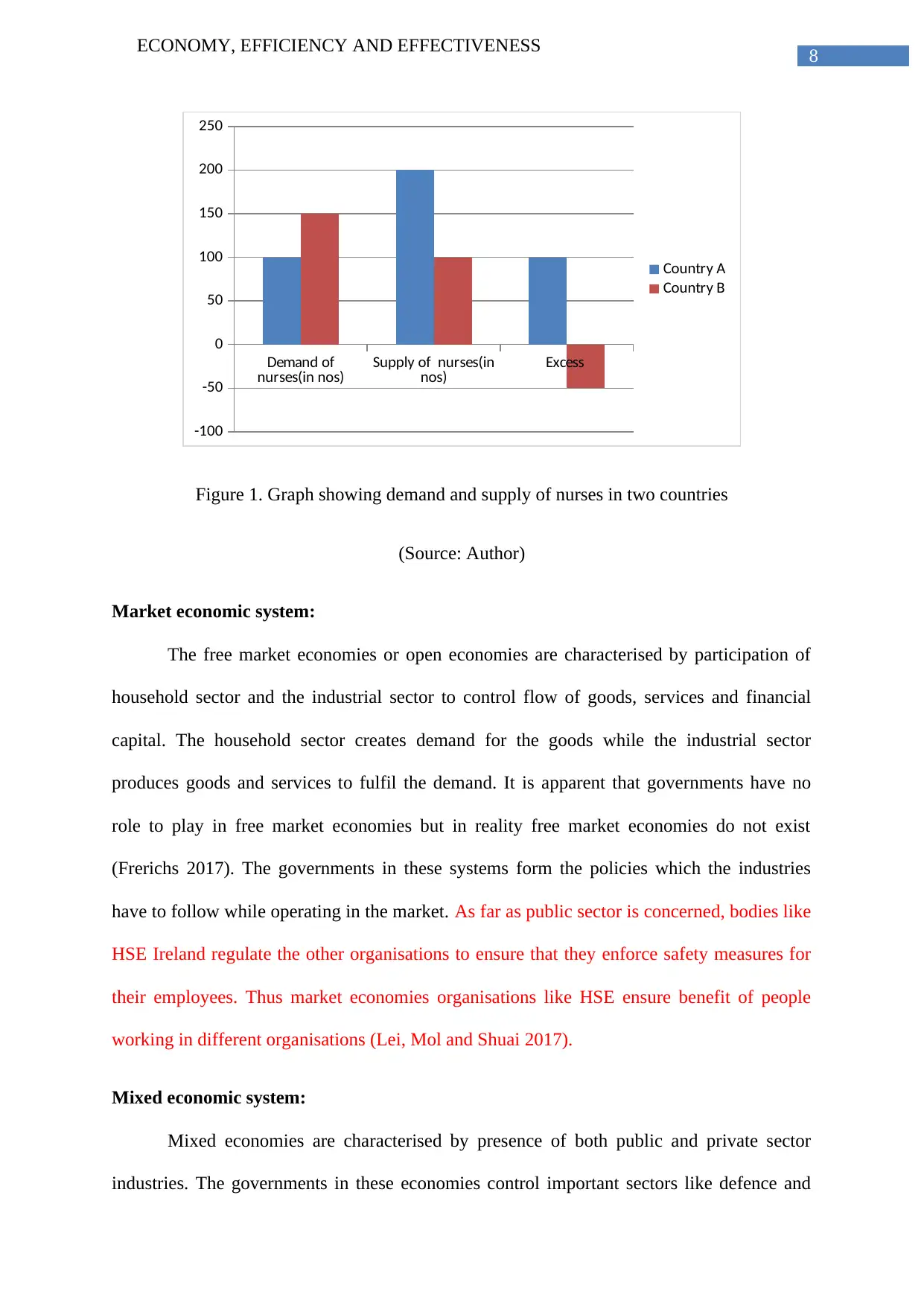
For example, in the below graph, there are two arbitrary countries, Country A and
Country B, both assumed to be command economies. Country A has 200 HSE nurses
compared to 100 HSE nurses in demand which means 100 nurses remain unutilised or
unemployed. Again, country B produces only 100 HSE nurses compared to 150 HSE nurses
demanded which means there exists of a deficit of 50 HSE nurses. This means in case of
country A 100 HSE nurses remain unemployed and in case of country B, the supply falls
short by 50 HSE nurses.
8
ECONOMY, EFFICIENCY AND EFFECTIVENESS
Demand of
nurses(in nos) Supply of nurses(in
nos) Excess
-100
-50
0
50
100
150
200
250
Country A
Country B
Figure 1. Graph showing demand and supply of nurses in two countries
(Source: Author)
Market economic system:
The free market economies or open economies are characterised by participation of
household sector and the industrial sector to control flow of goods, services and financial
capital. The household sector creates demand for the goods while the industrial sector
produces goods and services to fulfil the demand. It is apparent that governments have no
role to play in free market economies but in reality free market economies do not exist
(Frerichs 2017). The governments in these systems form the policies which the industries
have to follow while operating in the market. As far as public sector is concerned, bodies like
HSE Ireland regulate the other organisations to ensure that they enforce safety measures for
their employees. Thus market economies organisations like HSE ensure benefit of people
working in different organisations (Lei, Mol and Shuai 2017).
Mixed economic system:
Mixed economies are characterised by presence of both public and private sector
industries. The governments in these economies control important sectors like defence and
ECONOMY, EFFICIENCY AND EFFECTIVENESS
Demand of
nurses(in nos) Supply of nurses(in
nos) Excess
-100
-50
0
50
100
150
200
250
Country A
Country B
Figure 1. Graph showing demand and supply of nurses in two countries
(Source: Author)
Market economic system:
The free market economies or open economies are characterised by participation of
household sector and the industrial sector to control flow of goods, services and financial
capital. The household sector creates demand for the goods while the industrial sector
produces goods and services to fulfil the demand. It is apparent that governments have no
role to play in free market economies but in reality free market economies do not exist
(Frerichs 2017). The governments in these systems form the policies which the industries
have to follow while operating in the market. As far as public sector is concerned, bodies like
HSE Ireland regulate the other organisations to ensure that they enforce safety measures for
their employees. Thus market economies organisations like HSE ensure benefit of people
working in different organisations (Lei, Mol and Shuai 2017).
Mixed economic system:
Mixed economies are characterised by presence of both public and private sector
industries. The governments in these economies control important sectors like defence and
⊘ This is a preview!⊘
Do you want full access?
Subscribe today to unlock all pages.
Trusted by 1+ million students worldwide
9
ECONOMY, EFFICIENCY AND EFFECTIVENESS
railways. The governments in mixed economic systems like Ireland; besides private sector
organisations provide their residents with basic services like health services. For example,
the Health Services Executive (HSE) is a health service providing body in the United
Kingdom and Ireland. The body provides health care services to people, especially the ones
who cannot afford expensive treatments in private hospitals (hse.ie 2018). The health sectors
in mixed economies experience heavy growth of private sector companies including
multinational companies both of indigenous and foreign origin. The governments in the
mixed economies form policies and laws to regulate the private sectors (Chueva et al. 2016).
Moreover, HSE is a government body which makes policies which all other sectors are
supposed to follow in ensuring health and safety of their employees.
For example, according to the previous example, let it be assumed that both country A
and B have changed to open economies. Now country A can relocate 50 HSE nurses to
country B as shown in the graph below. Country B can meet its supply deficit in public sector
health service while country A can earn extra revenue.
Demand of
nurses(in
nos)
Supply of
nurses(in
nos)
Excess Sharing of
nurses(in
nos)
Net excess
-100
-50
0
50
100
150
200
250
Country A
Country B
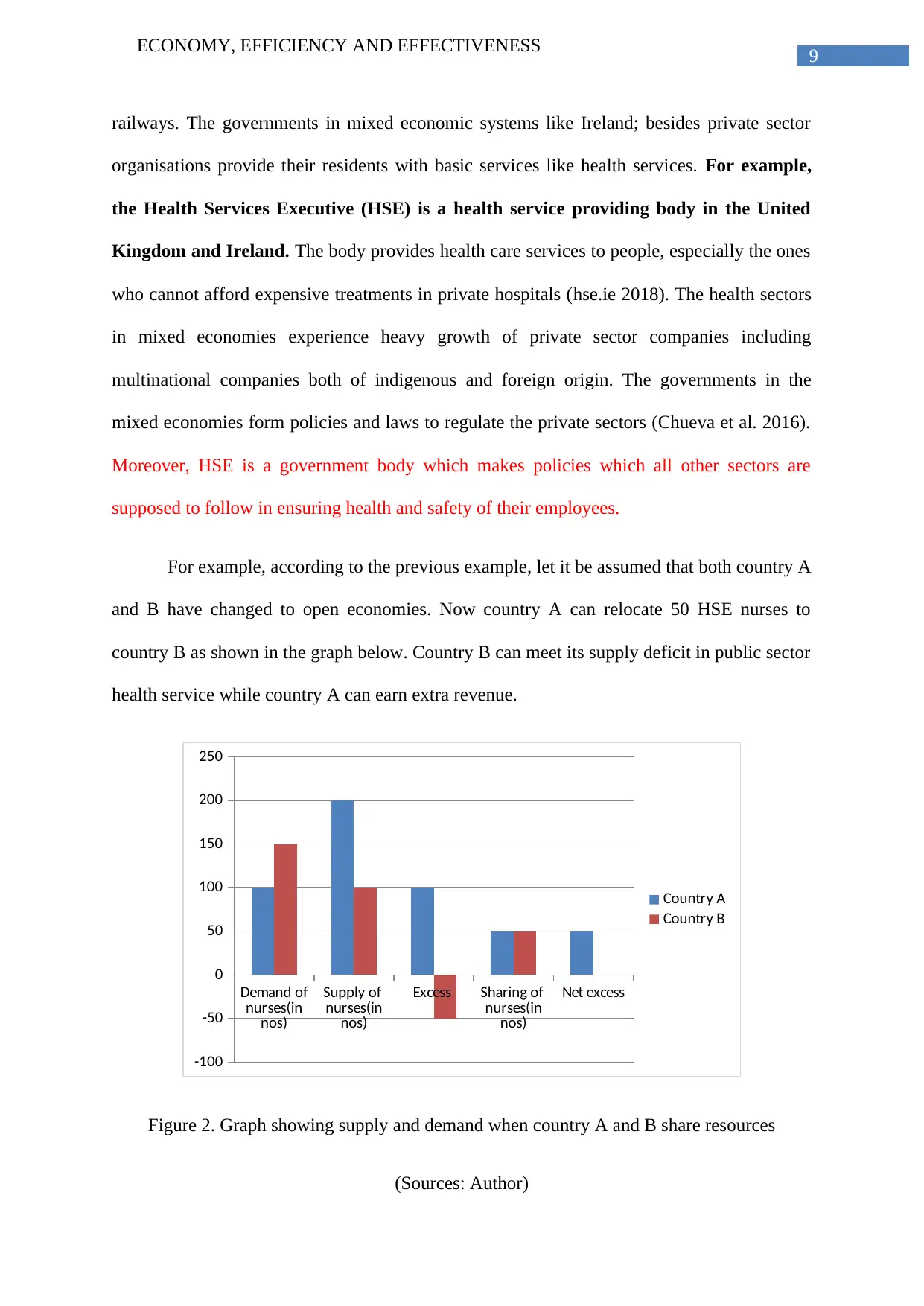
Figure 2. Graph showing supply and demand when country A and B share resources
(Sources: Author)
ECONOMY, EFFICIENCY AND EFFECTIVENESS
railways. The governments in mixed economic systems like Ireland; besides private sector
organisations provide their residents with basic services like health services. For example,
the Health Services Executive (HSE) is a health service providing body in the United
Kingdom and Ireland. The body provides health care services to people, especially the ones
who cannot afford expensive treatments in private hospitals (hse.ie 2018). The health sectors
in mixed economies experience heavy growth of private sector companies including
multinational companies both of indigenous and foreign origin. The governments in the
mixed economies form policies and laws to regulate the private sectors (Chueva et al. 2016).
Moreover, HSE is a government body which makes policies which all other sectors are
supposed to follow in ensuring health and safety of their employees.
For example, according to the previous example, let it be assumed that both country A
and B have changed to open economies. Now country A can relocate 50 HSE nurses to
country B as shown in the graph below. Country B can meet its supply deficit in public sector
health service while country A can earn extra revenue.
Demand of
nurses(in
nos)
Supply of
nurses(in
nos)
Excess Sharing of
nurses(in
nos)
Net excess
-100
-50
0
50
100
150
200
250
Country A
Country B
Figure 2. Graph showing supply and demand when country A and B share resources
(Sources: Author)
Paraphrase This Document
Need a fresh take? Get an instant paraphrase of this document with our AI Paraphraser
10
ECONOMY, EFFICIENCY AND EFFECTIVENESS
Thus, in mixed economic systems governments facilitate exports and imports of
goods between countries. These sharing of resources allow countries producing excess
commodities export to other countries which experience shortage of those commodities. The
governments and companies involved in exporting commodities are able to earn huge
revenues. This discussion proves clearly that term modern economy experiences flow of
products and money between countries or economies under strict control of
governments (Dudin et al. 2014).
Findings from the discussions:
The discussion above reveals several facts about the term economy and its usage in
the global context. The term economy refers to the system which facilitates flow of goods,
services and financial capital. The definition apparently points out that the term economy is
autonomous. However, in reality these flows of goods, services and money between countries
are not uncontrolled. The governments and international organisations manage the flow of
resources within their jurisdiction (Lei, Mol and Shuai 2017). For example, the health sector
cannot function efficiently in the Irish economy without the intervention of public sector
bodies like HSE. This role of governments in controlling the flow of resources within their
jurisdictions has resulted in diversity in the flow of resources and capital generated (Maclean,
Jagannathan and Panth 2018). Thus, prominent roles of governments of countries have led
to the use of terms economies and countries interchangeably.
The discussion points out that the term economy is actually vast and embraces factors
like extent of government interventions in the operations of different countries or economies.
The traditional economies were restricted within rural areas and were characterised by
exchange of goods of equal values. The modern economies are characterised by logistization,
use of IT to manage logistics and countries influencing each other’s markets. The discussion
ECONOMY, EFFICIENCY AND EFFECTIVENESS
Thus, in mixed economic systems governments facilitate exports and imports of
goods between countries. These sharing of resources allow countries producing excess
commodities export to other countries which experience shortage of those commodities. The
governments and companies involved in exporting commodities are able to earn huge
revenues. This discussion proves clearly that term modern economy experiences flow of
products and money between countries or economies under strict control of
governments (Dudin et al. 2014).
Findings from the discussions:
The discussion above reveals several facts about the term economy and its usage in
the global context. The term economy refers to the system which facilitates flow of goods,
services and financial capital. The definition apparently points out that the term economy is
autonomous. However, in reality these flows of goods, services and money between countries
are not uncontrolled. The governments and international organisations manage the flow of
resources within their jurisdiction (Lei, Mol and Shuai 2017). For example, the health sector
cannot function efficiently in the Irish economy without the intervention of public sector
bodies like HSE. This role of governments in controlling the flow of resources within their
jurisdictions has resulted in diversity in the flow of resources and capital generated (Maclean,
Jagannathan and Panth 2018). Thus, prominent roles of governments of countries have led
to the use of terms economies and countries interchangeably.
The discussion points out that the term economy is actually vast and embraces factors
like extent of government interventions in the operations of different countries or economies.
The traditional economies were restricted within rural areas and were characterised by
exchange of goods of equal values. The modern economies are characterised by logistization,
use of IT to manage logistics and countries influencing each other’s markets. The discussion
11
ECONOMY, EFFICIENCY AND EFFECTIVENESS
points out that modern economies are characterised by participation of public services
like government run public health services like HSE Ireland and their private
counterparts (hse.ie 2018). The modern economies are mostly mixed economies which
experience presence of private sector companies in manufacturing goods and services.
The main role of the governments today is to provide the economies with security from
external aggression and form laws to facilitate the functioning of the industrial sector.
The discussion stresses on the flow of goods and services and generation of revenue.
It must be pointed out that the aim of economic functions is to maximise the flow of products
in order to generate maximisation of revenue or gaining efficiency. Economic activities aim
to generate maximise output from minimum inputs. It can also be interpreted in monetary
terms that efficiency is the capability of earning the maximum possible financial returns from
investments in the markets (Serrador and Turner 2015). This aim of economic activities of
gaining efficiencies often leads to imprecise use of the two terms interchangeably.
Efficiency:
The term efficiency generally means the ability to produce target output by wasting
minimum amount of resources. The implications of the term ‘target output’ vary with
industry and contexts (Johnson, Leenders and McCue 2017). Efficiency in public sector
refers to providing important services to the people either at very low cost or almost free of
cost. For example, HSE Ireland is one such public sector health organisation which provides
services to people of Ireland on non-profit basis. Thus efficiency here means adding value to
money by channelizing it towards public welfare (hse.ie 2018).
ECONOMY, EFFICIENCY AND EFFECTIVENESS
points out that modern economies are characterised by participation of public services
like government run public health services like HSE Ireland and their private
counterparts (hse.ie 2018). The modern economies are mostly mixed economies which
experience presence of private sector companies in manufacturing goods and services.
The main role of the governments today is to provide the economies with security from
external aggression and form laws to facilitate the functioning of the industrial sector.
The discussion stresses on the flow of goods and services and generation of revenue.
It must be pointed out that the aim of economic functions is to maximise the flow of products
in order to generate maximisation of revenue or gaining efficiency. Economic activities aim
to generate maximise output from minimum inputs. It can also be interpreted in monetary
terms that efficiency is the capability of earning the maximum possible financial returns from
investments in the markets (Serrador and Turner 2015). This aim of economic activities of
gaining efficiencies often leads to imprecise use of the two terms interchangeably.
Efficiency:
The term efficiency generally means the ability to produce target output by wasting
minimum amount of resources. The implications of the term ‘target output’ vary with
industry and contexts (Johnson, Leenders and McCue 2017). Efficiency in public sector
refers to providing important services to the people either at very low cost or almost free of
cost. For example, HSE Ireland is one such public sector health organisation which provides
services to people of Ireland on non-profit basis. Thus efficiency here means adding value to
money by channelizing it towards public welfare (hse.ie 2018).
⊘ This is a preview!⊘
Do you want full access?
Subscribe today to unlock all pages.
Trusted by 1+ million students worldwide

1 out of 20


Related Documents


Your All-in-One AI-Powered Toolkit for Academic Success.
+13062052269
info@desklib.com
Available 24*7 on WhatsApp / Email
![[object Object]](/_next/static/media/star-bottom.7253800d.svg)
Unlock your academic potential
Copyright © 2020–2025 A2Z Services. All Rights Reserved. Developed and managed by ZUCOL.