Understanding Change AMUC504: Innovation in Organisations Assignment
VerifiedAdded on 2021/06/17
|20
|7459
|176
Homework Assignment
AI Summary
This assignment, completed for the "Understanding Change" module (AMUC504) at Ara Institute of Canterbury, focuses on the concepts of change and innovation within organizations, using the Wakatū Incorporation case study. The assignment requires students to demonstrate their understanding of how innovation and organizational change contribute to enhanced business performance. The assessment is divided into two parts, with the first part focusing on identifying ways to promote creativity and providing examples of their implementation within the case study company. The second part involves researching and answering questions related to change management in organizations, drawing on relevant theories and referencing sources using APA 6th edition. The assignment emphasizes the importance of innovation, creativity, and effective communication in driving organizational success and covers topics such as the use of smart technologies and the integration of different departments to bring about changes within the organization. The student has to answer the questions asked in the assignment brief and has to make sure that the answers are fully explained and the sources of facts and statements made are referenced.
Te Hoe Pakihi
Department of Business
Bachelor of Applied Management
New Zealand Diploma in Business
Assessment Two:
Assignment – Change/Innovation in organisations
Understanding Change
AMUC504
Semester One 2018
Due date: Wednesday 16 May 2018
Time: 1.00 pm
Instructions:
See page 2.
This is an Individual Assignment.
PART TOPIC MARKS
One Innovation and Creativity 25
Two Change in Organisations 45
Presentation and Referencing 5
TOTAL MARKS: 75
Student Name/ID ...................................................................................................
Ara Institute of Canterbury and its division members reserve the right to use electronic
means to detect and help prevent plagiarism. Students agree that when submitting this
assignment, it may be subject to submission for textual similarity review to Turnitin.com.
If an assessment is handed in late without an extension, a penalty of 10% per day will apply,
up to a maximum of 50%. If an assessment is received more than five days after the due
date, it will not be marked. If a student has a justifiable reason for non-submission of the
assessment, they have seven days following the due date to submit an aegrotat application.
Should a student wish to appeal any decisions they may do so in writing to the Head of
Department within ten days of receiving the decision.
This assessment is worth 30% of the total marks for this course.
This paper has 20 (20) pages including the cover sheet.
Department of Business
Bachelor of Applied Management
New Zealand Diploma in Business
Assessment Two:
Assignment – Change/Innovation in organisations
Understanding Change
AMUC504
Semester One 2018
Due date: Wednesday 16 May 2018
Time: 1.00 pm
Instructions:
See page 2.
This is an Individual Assignment.
PART TOPIC MARKS
One Innovation and Creativity 25
Two Change in Organisations 45
Presentation and Referencing 5
TOTAL MARKS: 75
Student Name/ID ...................................................................................................
Ara Institute of Canterbury and its division members reserve the right to use electronic
means to detect and help prevent plagiarism. Students agree that when submitting this
assignment, it may be subject to submission for textual similarity review to Turnitin.com.
If an assessment is handed in late without an extension, a penalty of 10% per day will apply,
up to a maximum of 50%. If an assessment is received more than five days after the due
date, it will not be marked. If a student has a justifiable reason for non-submission of the
assessment, they have seven days following the due date to submit an aegrotat application.
Should a student wish to appeal any decisions they may do so in writing to the Head of
Department within ten days of receiving the decision.
This assessment is worth 30% of the total marks for this course.
This paper has 20 (20) pages including the cover sheet.

Paraphrase This Document
Need a fresh take? Get an instant paraphrase of this document with our AI Paraphraser
Education and Applied Research Division Department of Business
INSTRUCTIONS:
Learning Outcome(s) Assessed
Learning Outcome One: Identify and demonstrate how innovation and organisation change
can contribute to enhanced business performance.
Instructions for assessment:
This is an individual assessment. For this assessment, first, you are required to work through
the case study in this assessment. Second, you have to conduct research about the
questions asked in this assessment and then answer these questions in relation to the case
study. The focus is on creativity, innovation, and change in organisations.
You will need to reference the theory that you base your answers on. This information may
be found in the textbooks, on the internet, and in the Library’s databases. In the Library,
there are numerous business magazines and articles that could help you. Databases can be
sourced online from the Library’s website, such as Australia/New Zealand Reference Centre.
Please note that sources such as Wikipedia and managementhelp.com, etc. are not reliable
academic references, so they should not be used.
Answer the questions asked but be careful to explain your answer fully and be sure to
reference the sources of facts and statements made so that you establish the validity of
what you say.
Correct use of APA 6th edition referencing style is expected.
If your answer is unclear or partially relevant you may be awarded a lower mark than that
shown in these instructions.
Submission instructions
This is an individual assignment.
The assignment should be written using Times New Roman 12-point font with 1.5-
line spacing.
The assignment must be referenced using the APA 6thstyle. You should reference
your work to indicate that you have properly researched the assignment and used
reliable and appropriate material drawn from knowledgeable sources. You should
provide at least two (2) appropriate references (other than the provided website or
sub components) throughout your work. The APA 6thstyle of referencing hand out is
available from Student Learning Services in the Library. There is also an online
access to resources on Ara Institute of Canterbury’s Library / Learning Services
website at: http://www.ara.ac.nz/services-and-support/libraryclick on “APA
Referencing” on the right hand side of the web page.
Submission is twofold. A paper copy of your assignment should be deposited in the
Department of Business drop box on the Ground floor of O Block and in the drop box
at Timaru campus or hand in to reception at the Ashburton campus by the deadline
with the official Ara assignment submission form signed and attached AND an
electronic copy must be deposited in the Turnitin drop box on Moodleby the same
time/day. Note: Turnitin will check the similarity of your assignment to other
assignments submitted there and to information available on the Internet. You
should not use material directly copied from another student’s assignment, or from
other sources without paraphrasing and acknowledging them through referencing.
16368535950246010569.docx 2/09/24 Page 2
© Ara Institute of Canterbury
INSTRUCTIONS:
Learning Outcome(s) Assessed
Learning Outcome One: Identify and demonstrate how innovation and organisation change
can contribute to enhanced business performance.
Instructions for assessment:
This is an individual assessment. For this assessment, first, you are required to work through
the case study in this assessment. Second, you have to conduct research about the
questions asked in this assessment and then answer these questions in relation to the case
study. The focus is on creativity, innovation, and change in organisations.
You will need to reference the theory that you base your answers on. This information may
be found in the textbooks, on the internet, and in the Library’s databases. In the Library,
there are numerous business magazines and articles that could help you. Databases can be
sourced online from the Library’s website, such as Australia/New Zealand Reference Centre.
Please note that sources such as Wikipedia and managementhelp.com, etc. are not reliable
academic references, so they should not be used.
Answer the questions asked but be careful to explain your answer fully and be sure to
reference the sources of facts and statements made so that you establish the validity of
what you say.
Correct use of APA 6th edition referencing style is expected.
If your answer is unclear or partially relevant you may be awarded a lower mark than that
shown in these instructions.
Submission instructions
This is an individual assignment.
The assignment should be written using Times New Roman 12-point font with 1.5-
line spacing.
The assignment must be referenced using the APA 6thstyle. You should reference
your work to indicate that you have properly researched the assignment and used
reliable and appropriate material drawn from knowledgeable sources. You should
provide at least two (2) appropriate references (other than the provided website or
sub components) throughout your work. The APA 6thstyle of referencing hand out is
available from Student Learning Services in the Library. There is also an online
access to resources on Ara Institute of Canterbury’s Library / Learning Services
website at: http://www.ara.ac.nz/services-and-support/libraryclick on “APA
Referencing” on the right hand side of the web page.
Submission is twofold. A paper copy of your assignment should be deposited in the
Department of Business drop box on the Ground floor of O Block and in the drop box
at Timaru campus or hand in to reception at the Ashburton campus by the deadline
with the official Ara assignment submission form signed and attached AND an
electronic copy must be deposited in the Turnitin drop box on Moodleby the same
time/day. Note: Turnitin will check the similarity of your assignment to other
assignments submitted there and to information available on the Internet. You
should not use material directly copied from another student’s assignment, or from
other sources without paraphrasing and acknowledging them through referencing.
16368535950246010569.docx 2/09/24 Page 2
© Ara Institute of Canterbury
Education and Applied Research Division Department of Business
If two assignments are submitted containing the same material then both students
will be asked to explain why it is so. If the copying is done knowingly by both
students then both students may not receive a mark.
The assignment should be around 2000 words excluding the reference page and the
cover page. A word count should be noted on the cover page. The word count listed
for each question is a guideline and does not need to be rigidly adhered to by
students as they formulate answers. However the student must NOT write beyond
2200 words.
The marking schedule is provided to guide you about what you have to do.
Late submissions will be subject to the late assignment procedures outlined on the
coversheet of this assignment.
Copying Another Person’s Work (Plagiarism)
This is an individual assignment and your answers will be checked to see that you have
not copied the final work of any other students, or from any other source. If you plagiarise by
using another person’s work the provisions of Ara Institute of Canterbury’s policy on
plagiarism will be invoked. This may lead to disciplinary action for one or more
participating students.
Cover Sheet
For the front cover of the document for your assignment, you must copy and paste the box
below, enlarged, with the correct information:
16368535950246010569.docx 2/09/24 Page 3
© Ara Institute of Canterbury
Innovation and Change in Organisations
By: [write your name and student number & delete this information and brackets]
Date: [write date you printed the assignment& delete this information and brackets]
Course name and number: [write “Understanding Change, AMUC504” and delete
brackets]
Assessment 2- Assignment
Course Lecturer: [write your Lecturer’s name & delete this informationand delete
brackets]
Word Count: [should be no more than 2000 words& delete this information and
brackets]
If two assignments are submitted containing the same material then both students
will be asked to explain why it is so. If the copying is done knowingly by both
students then both students may not receive a mark.
The assignment should be around 2000 words excluding the reference page and the
cover page. A word count should be noted on the cover page. The word count listed
for each question is a guideline and does not need to be rigidly adhered to by
students as they formulate answers. However the student must NOT write beyond
2200 words.
The marking schedule is provided to guide you about what you have to do.
Late submissions will be subject to the late assignment procedures outlined on the
coversheet of this assignment.
Copying Another Person’s Work (Plagiarism)
This is an individual assignment and your answers will be checked to see that you have
not copied the final work of any other students, or from any other source. If you plagiarise by
using another person’s work the provisions of Ara Institute of Canterbury’s policy on
plagiarism will be invoked. This may lead to disciplinary action for one or more
participating students.
Cover Sheet
For the front cover of the document for your assignment, you must copy and paste the box
below, enlarged, with the correct information:
16368535950246010569.docx 2/09/24 Page 3
© Ara Institute of Canterbury
Innovation and Change in Organisations
By: [write your name and student number & delete this information and brackets]
Date: [write date you printed the assignment& delete this information and brackets]
Course name and number: [write “Understanding Change, AMUC504” and delete
brackets]
Assessment 2- Assignment
Course Lecturer: [write your Lecturer’s name & delete this informationand delete
brackets]
Word Count: [should be no more than 2000 words& delete this information and
brackets]
⊘ This is a preview!⊘
Do you want full access?
Subscribe today to unlock all pages.

Trusted by 1+ million students worldwide
Education and Applied Research Division Department of Business
The Case Study
Sourced from:Callaghan Innovation, 2018
Wakatū Incorporation
Wakatū is a Māori family-owned business based in Te Tau Ihu (the top of the South Island).
A business of land and sea, Wakatū has three parts: Manaaki (people and culture), Whenua
(land and water space) and Kono (an award-winning food and drinks producer and exporter).
Introduction
Wakatū is a Māori family-owned business based in Te Tau Ihu (the top of the South Island).
A business of land and sea, Wakatū has three parts: Manaaki (people and culture), Whenua
(land and water space) and Kono (an award-winning food and drinks producer and
exporter).
Through the passage of time, the world has challenged them to innovate — to become
scientists, researchers, winemakers, branders, marketers, viticulturists and leaders.
Guided by TePaeTawhiti, the business’s long-term intergenerational vision, and deeply held
values of rangatiratanga, manaakitanga, whanaungatanga and kaitiakitanga, Wakatū
manages its assets in a way that will build on its legacy for the generations to come.
As one of the largest private land owners in Te Tau Ihu, the Whenua division of Wakatū
manages a diverse portfolio — from vineyards, orchards and grazing land to residential
properties, large retail developments and office buildings. With a strong heritage as
gardeners, fishers and providores, Wakatū, under its Kono brand, is an artisan producer and
exporter of award-winning wine, cider, seafood, pipfruit, hops and natural fruit bars.
What’s different about Wakatū?
What makes Wakatū different is its deep connection and commitment to whenua, moana
and tangata (land, sea and people), as well as its products. “Through the passage of time,
the world has challenged us to innovate — to become scientists, researchers, winemakers,
branders, marketers, viticulturists and leaders,” says Chief Executive Kerensa Johnston.
“We’ve taken up that challenge without hesitation.”
Wakatū has also made a concerted effort to focus on succession planning, with a robust
programme of scholarships, skills training, cultural inductions and governance experience.
These programmes are now paying dividends, with people who have been through them
working within the business at every level.
Its innovation strategy aims to commercialise high-value food and beverage applications to
address global nutrition, health and well-being challenges. Wakatūalso focuses on
leveraging science and technology applications in two programmes: high-value add, and
land and water wellness.
Miriana Stephens, a member of the board and Executive Director of Innovation, says
Wakatū’s land and water wellness programmes need to be leading edge. “This means not
only do we know the state of our lands, but that our business practices will contribute to land,
water and ecosystem well-being. This is all about being good kaitiaki (custodians).”
A new project involves collecting data from vineyards and orchards, and combining it with
smart technology to help operational teams make informed decisions, take care of the land,
and maximise potential and value. For example, a sensory network in the vineyards
captures real-time data, such as soil moisture levels, and combines it with other relevant
datasets, like climate information. This data is then centralised and analysed by an on-farm
platform, e-Whenua.
Miriana says this means specific areas of blocks can be targeted instead of, for example,
watering an entire block. “This is smart use of resources, and is good for both the
environment and our bottom line, and in line with our values.”
16368535950246010569.docx 2/09/24 Page 4
© Ara Institute of Canterbury
The Case Study
Sourced from:Callaghan Innovation, 2018
Wakatū Incorporation
Wakatū is a Māori family-owned business based in Te Tau Ihu (the top of the South Island).
A business of land and sea, Wakatū has three parts: Manaaki (people and culture), Whenua
(land and water space) and Kono (an award-winning food and drinks producer and exporter).
Introduction
Wakatū is a Māori family-owned business based in Te Tau Ihu (the top of the South Island).
A business of land and sea, Wakatū has three parts: Manaaki (people and culture), Whenua
(land and water space) and Kono (an award-winning food and drinks producer and
exporter).
Through the passage of time, the world has challenged them to innovate — to become
scientists, researchers, winemakers, branders, marketers, viticulturists and leaders.
Guided by TePaeTawhiti, the business’s long-term intergenerational vision, and deeply held
values of rangatiratanga, manaakitanga, whanaungatanga and kaitiakitanga, Wakatū
manages its assets in a way that will build on its legacy for the generations to come.
As one of the largest private land owners in Te Tau Ihu, the Whenua division of Wakatū
manages a diverse portfolio — from vineyards, orchards and grazing land to residential
properties, large retail developments and office buildings. With a strong heritage as
gardeners, fishers and providores, Wakatū, under its Kono brand, is an artisan producer and
exporter of award-winning wine, cider, seafood, pipfruit, hops and natural fruit bars.
What’s different about Wakatū?
What makes Wakatū different is its deep connection and commitment to whenua, moana
and tangata (land, sea and people), as well as its products. “Through the passage of time,
the world has challenged us to innovate — to become scientists, researchers, winemakers,
branders, marketers, viticulturists and leaders,” says Chief Executive Kerensa Johnston.
“We’ve taken up that challenge without hesitation.”
Wakatū has also made a concerted effort to focus on succession planning, with a robust
programme of scholarships, skills training, cultural inductions and governance experience.
These programmes are now paying dividends, with people who have been through them
working within the business at every level.
Its innovation strategy aims to commercialise high-value food and beverage applications to
address global nutrition, health and well-being challenges. Wakatūalso focuses on
leveraging science and technology applications in two programmes: high-value add, and
land and water wellness.
Miriana Stephens, a member of the board and Executive Director of Innovation, says
Wakatū’s land and water wellness programmes need to be leading edge. “This means not
only do we know the state of our lands, but that our business practices will contribute to land,
water and ecosystem well-being. This is all about being good kaitiaki (custodians).”
A new project involves collecting data from vineyards and orchards, and combining it with
smart technology to help operational teams make informed decisions, take care of the land,
and maximise potential and value. For example, a sensory network in the vineyards
captures real-time data, such as soil moisture levels, and combines it with other relevant
datasets, like climate information. This data is then centralised and analysed by an on-farm
platform, e-Whenua.
Miriana says this means specific areas of blocks can be targeted instead of, for example,
watering an entire block. “This is smart use of resources, and is good for both the
environment and our bottom line, and in line with our values.”
16368535950246010569.docx 2/09/24 Page 4
© Ara Institute of Canterbury
Paraphrase This Document
Need a fresh take? Get an instant paraphrase of this document with our AI Paraphraser
Education and Applied Research Division Department of Business
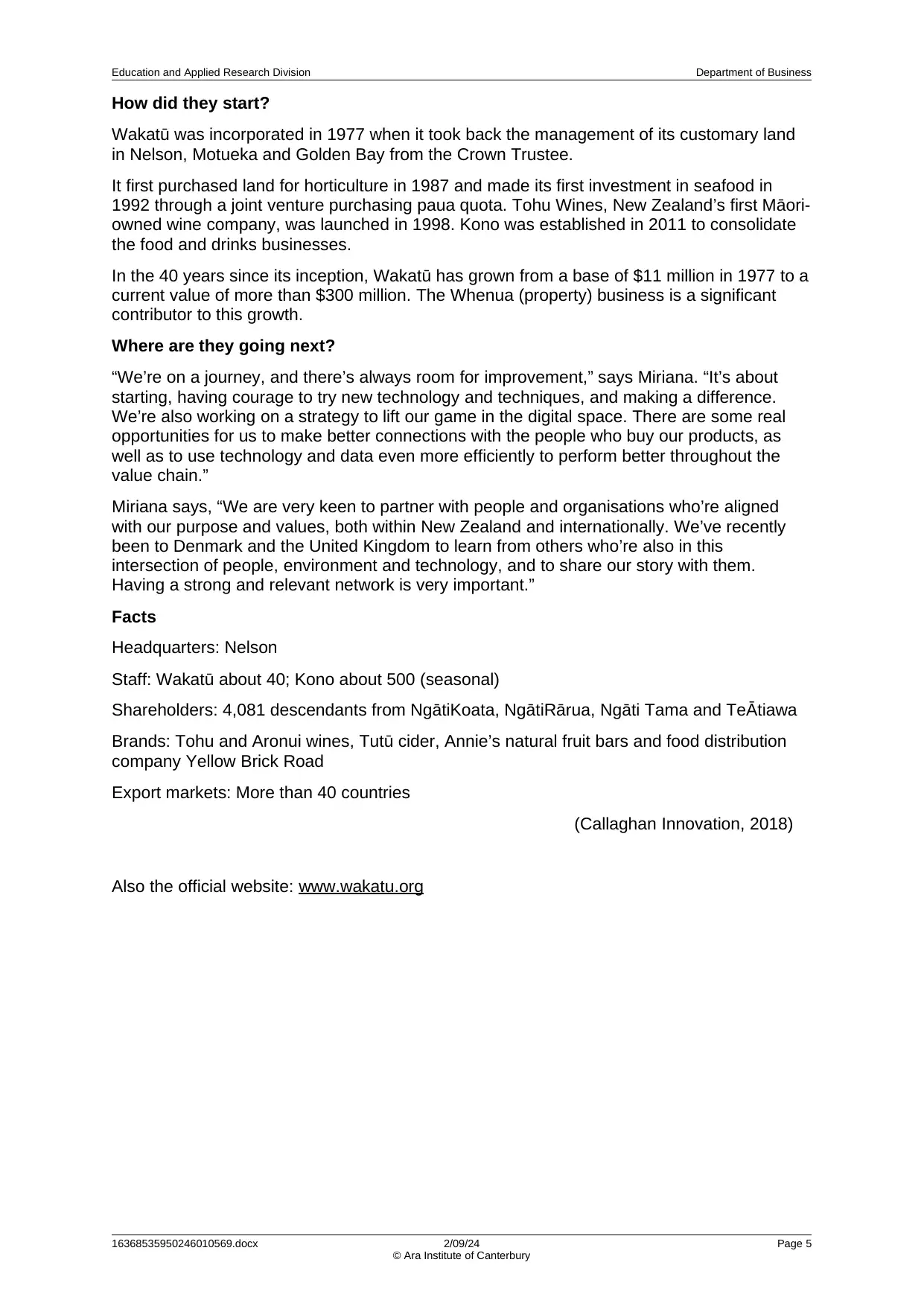
How did they start?
Wakatū was incorporated in 1977 when it took back the management of its customary land
in Nelson, Motueka and Golden Bay from the Crown Trustee.
It first purchased land for horticulture in 1987 and made its first investment in seafood in
1992 through a joint venture purchasing paua quota. Tohu Wines, New Zealand’s first Māori-
owned wine company, was launched in 1998. Kono was established in 2011 to consolidate
the food and drinks businesses.
In the 40 years since its inception, Wakatū has grown from a base of $11 million in 1977 to a
current value of more than $300 million. The Whenua (property) business is a significant
contributor to this growth.
Where are they going next?
“We’re on a journey, and there’s always room for improvement,” says Miriana. “It’s about
starting, having courage to try new technology and techniques, and making a difference.
We’re also working on a strategy to lift our game in the digital space. There are some real
opportunities for us to make better connections with the people who buy our products, as
well as to use technology and data even more efficiently to perform better throughout the
value chain.”
Miriana says, “We are very keen to partner with people and organisations who’re aligned
with our purpose and values, both within New Zealand and internationally. We’ve recently
been to Denmark and the United Kingdom to learn from others who’re also in this
intersection of people, environment and technology, and to share our story with them.
Having a strong and relevant network is very important.”
Facts
Headquarters: Nelson
Staff: Wakatū about 40; Kono about 500 (seasonal)
Shareholders: 4,081 descendants from NgātiKoata, NgātiRārua, Ngāti Tama and TeĀtiawa
Brands: Tohu and Aronui wines, Tutū cider, Annie’s natural fruit bars and food distribution
company Yellow Brick Road
Export markets: More than 40 countries
(Callaghan Innovation, 2018)
Also the official website: www.wakatu.org
16368535950246010569.docx 2/09/24 Page 5
© Ara Institute of Canterbury
How did they start?
Wakatū was incorporated in 1977 when it took back the management of its customary land
in Nelson, Motueka and Golden Bay from the Crown Trustee.
It first purchased land for horticulture in 1987 and made its first investment in seafood in
1992 through a joint venture purchasing paua quota. Tohu Wines, New Zealand’s first Māori-
owned wine company, was launched in 1998. Kono was established in 2011 to consolidate
the food and drinks businesses.
In the 40 years since its inception, Wakatū has grown from a base of $11 million in 1977 to a
current value of more than $300 million. The Whenua (property) business is a significant
contributor to this growth.
Where are they going next?
“We’re on a journey, and there’s always room for improvement,” says Miriana. “It’s about
starting, having courage to try new technology and techniques, and making a difference.
We’re also working on a strategy to lift our game in the digital space. There are some real
opportunities for us to make better connections with the people who buy our products, as
well as to use technology and data even more efficiently to perform better throughout the
value chain.”
Miriana says, “We are very keen to partner with people and organisations who’re aligned
with our purpose and values, both within New Zealand and internationally. We’ve recently
been to Denmark and the United Kingdom to learn from others who’re also in this
intersection of people, environment and technology, and to share our story with them.
Having a strong and relevant network is very important.”
Facts
Headquarters: Nelson
Staff: Wakatū about 40; Kono about 500 (seasonal)
Shareholders: 4,081 descendants from NgātiKoata, NgātiRārua, Ngāti Tama and TeĀtiawa
Brands: Tohu and Aronui wines, Tutū cider, Annie’s natural fruit bars and food distribution
company Yellow Brick Road
Export markets: More than 40 countries
(Callaghan Innovation, 2018)
Also the official website: www.wakatu.org
16368535950246010569.docx 2/09/24 Page 5
© Ara Institute of Canterbury
Education and Applied Research Division Department of Business
PART ONE TOTAL: 25 MARKS
Innovation and creativity
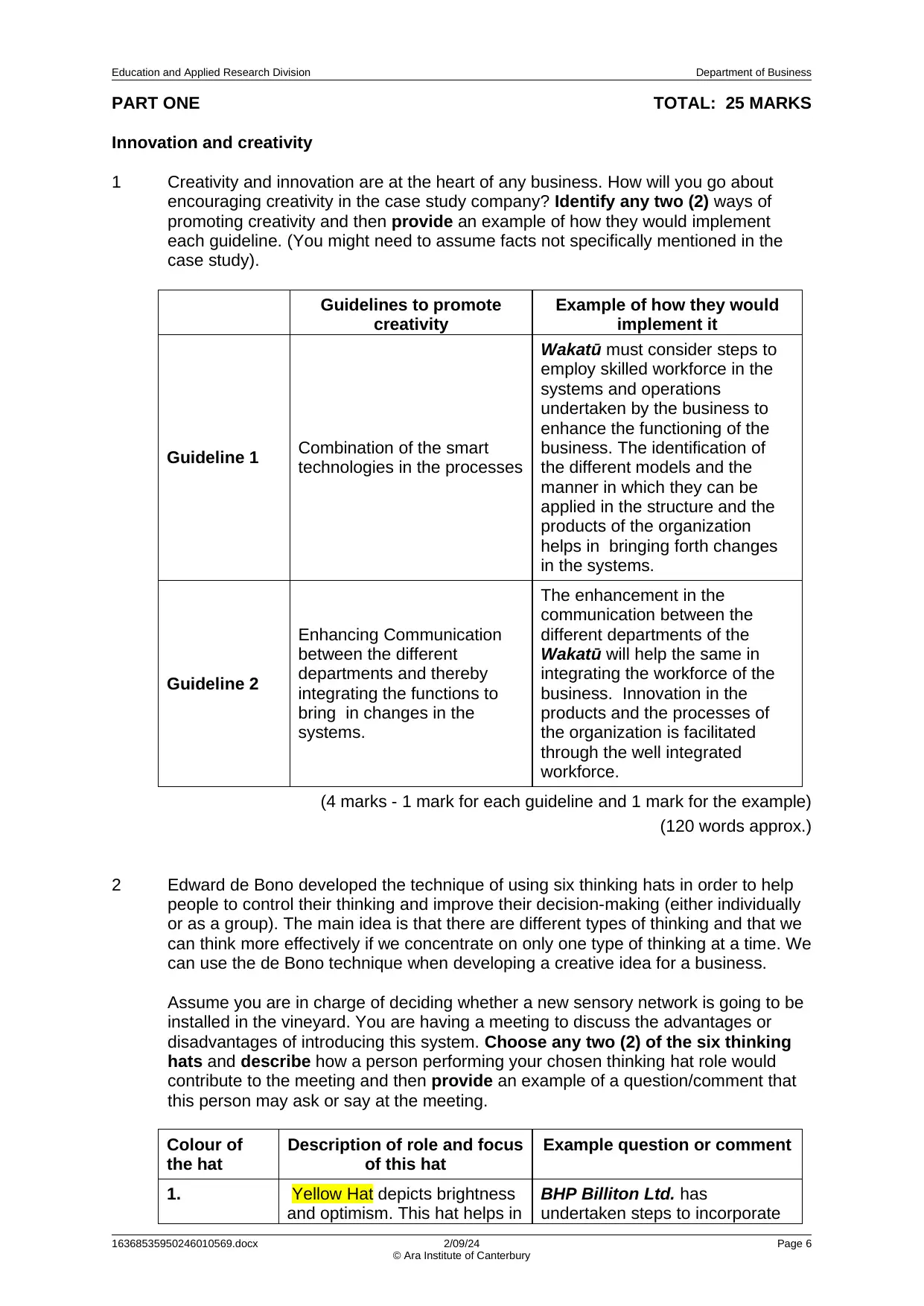
1 Creativity and innovation are at the heart of any business. How will you go about
encouraging creativity in the case study company? Identify any two (2) ways of
promoting creativity and then provide an example of how they would implement
each guideline. (You might need to assume facts not specifically mentioned in the
case study).
Guidelines to promote
creativity
Example of how they would
implement it
Guideline 1 Combination of the smart
technologies in the processes
Wakatū must consider steps to
employ skilled workforce in the
systems and operations
undertaken by the business to
enhance the functioning of the
business. The identification of
the different models and the
manner in which they can be
applied in the structure and the
products of the organization
helps in bringing forth changes
in the systems.
Guideline 2
Enhancing Communication
between the different
departments and thereby
integrating the functions to
bring in changes in the
systems.
The enhancement in the
communication between the
different departments of the
Wakatū will help the same in
integrating the workforce of the
business. Innovation in the
products and the processes of
the organization is facilitated
through the well integrated
workforce.
(4 marks - 1 mark for each guideline and 1 mark for the example)
(120 words approx.)
2 Edward de Bono developed the technique of using six thinking hats in order to help
people to control their thinking and improve their decision-making (either individually
or as a group). The main idea is that there are different types of thinking and that we
can think more effectively if we concentrate on only one type of thinking at a time. We
can use the de Bono technique when developing a creative idea for a business.
Assume you are in charge of deciding whether a new sensory network is going to be
installed in the vineyard. You are having a meeting to discuss the advantages or
disadvantages of introducing this system. Choose any two (2) of the six thinking
hats and describe how a person performing your chosen thinking hat role would
contribute to the meeting and then provide an example of a question/comment that
this person may ask or say at the meeting.
Colour of
the hat
Description of role and focus
of this hat
Example question or comment
1. Yellow Hat depicts brightness
and optimism. This hat helps in
BHP Billiton Ltd. has
undertaken steps to incorporate
16368535950246010569.docx 2/09/24 Page 6
© Ara Institute of Canterbury
PART ONE TOTAL: 25 MARKS
Innovation and creativity
1 Creativity and innovation are at the heart of any business. How will you go about
encouraging creativity in the case study company? Identify any two (2) ways of
promoting creativity and then provide an example of how they would implement
each guideline. (You might need to assume facts not specifically mentioned in the
case study).
Guidelines to promote
creativity
Example of how they would
implement it
Guideline 1 Combination of the smart
technologies in the processes
Wakatū must consider steps to
employ skilled workforce in the
systems and operations
undertaken by the business to
enhance the functioning of the
business. The identification of
the different models and the
manner in which they can be
applied in the structure and the
products of the organization
helps in bringing forth changes
in the systems.
Guideline 2
Enhancing Communication
between the different
departments and thereby
integrating the functions to
bring in changes in the
systems.
The enhancement in the
communication between the
different departments of the
Wakatū will help the same in
integrating the workforce of the
business. Innovation in the
products and the processes of
the organization is facilitated
through the well integrated
workforce.
(4 marks - 1 mark for each guideline and 1 mark for the example)
(120 words approx.)
2 Edward de Bono developed the technique of using six thinking hats in order to help
people to control their thinking and improve their decision-making (either individually
or as a group). The main idea is that there are different types of thinking and that we
can think more effectively if we concentrate on only one type of thinking at a time. We
can use the de Bono technique when developing a creative idea for a business.
Assume you are in charge of deciding whether a new sensory network is going to be
installed in the vineyard. You are having a meeting to discuss the advantages or
disadvantages of introducing this system. Choose any two (2) of the six thinking
hats and describe how a person performing your chosen thinking hat role would
contribute to the meeting and then provide an example of a question/comment that
this person may ask or say at the meeting.
Colour of
the hat
Description of role and focus
of this hat
Example question or comment
1. Yellow Hat depicts brightness
and optimism. This hat helps in
BHP Billiton Ltd. has
undertaken steps to incorporate
16368535950246010569.docx 2/09/24 Page 6
© Ara Institute of Canterbury
⊘ This is a preview!⊘
Do you want full access?
Subscribe today to unlock all pages.
Trusted by 1+ million students worldwide
Education and Applied Research Division Department of Business
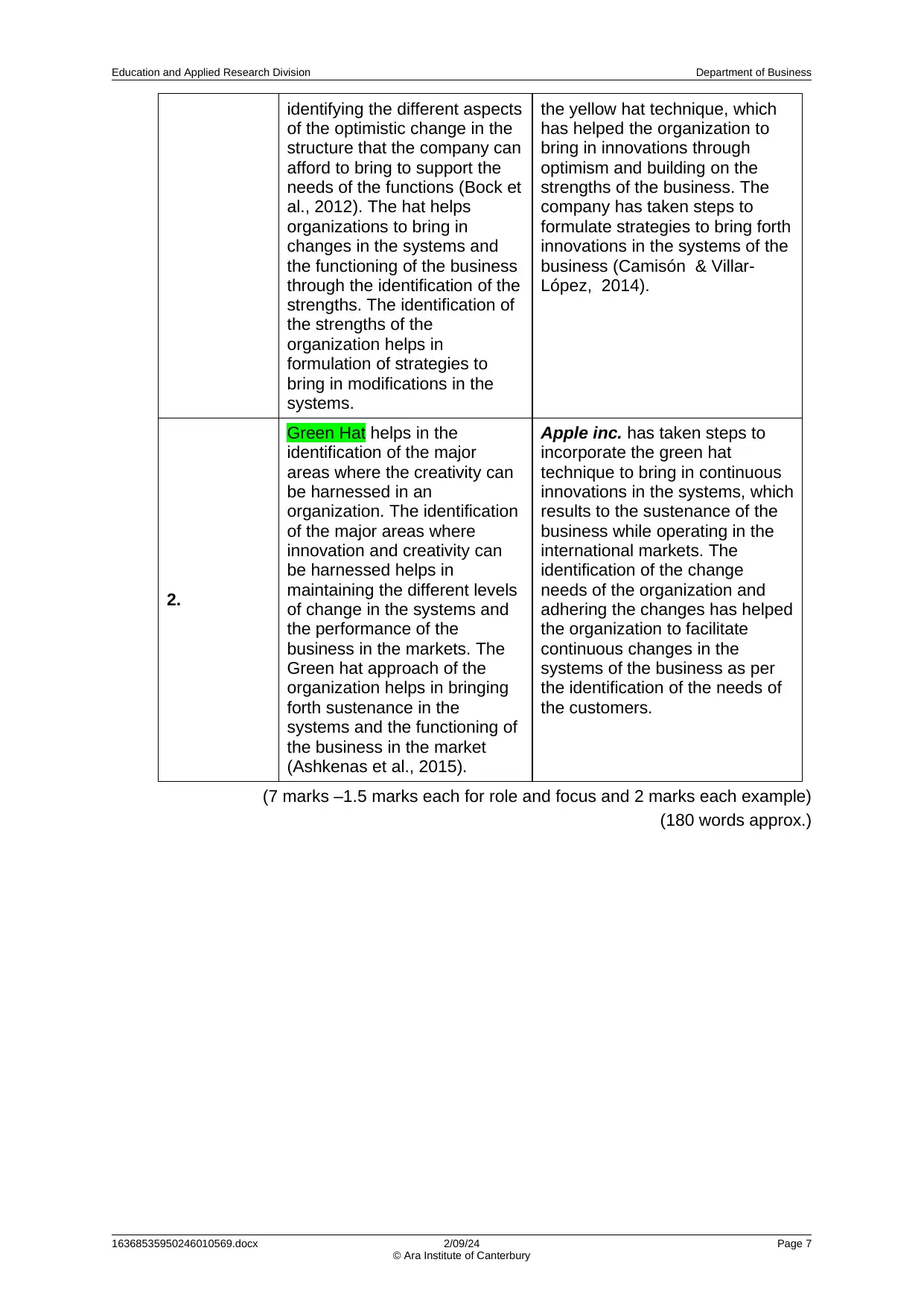
identifying the different aspects
of the optimistic change in the
structure that the company can
afford to bring to support the
needs of the functions (Bock et
al., 2012). The hat helps
organizations to bring in
changes in the systems and
the functioning of the business
through the identification of the
strengths. The identification of
the strengths of the
organization helps in
formulation of strategies to
bring in modifications in the
systems.
the yellow hat technique, which
has helped the organization to
bring in innovations through
optimism and building on the
strengths of the business. The
company has taken steps to
formulate strategies to bring forth
innovations in the systems of the
business (Camisón & Villar-
López, 2014).
2.
Green Hat helps in the
identification of the major
areas where the creativity can
be harnessed in an
organization. The identification
of the major areas where
innovation and creativity can
be harnessed helps in
maintaining the different levels
of change in the systems and
the performance of the
business in the markets. The
Green hat approach of the
organization helps in bringing
forth sustenance in the
systems and the functioning of
the business in the market
(Ashkenas et al., 2015).
Apple inc. has taken steps to
incorporate the green hat
technique to bring in continuous
innovations in the systems, which
results to the sustenance of the
business while operating in the
international markets. The
identification of the change
needs of the organization and
adhering the changes has helped
the organization to facilitate
continuous changes in the
systems of the business as per
the identification of the needs of
the customers.
(7 marks –1.5 marks each for role and focus and 2 marks each example)
(180 words approx.)
16368535950246010569.docx 2/09/24 Page 7
© Ara Institute of Canterbury
identifying the different aspects
of the optimistic change in the
structure that the company can
afford to bring to support the
needs of the functions (Bock et
al., 2012). The hat helps
organizations to bring in
changes in the systems and
the functioning of the business
through the identification of the
strengths. The identification of
the strengths of the
organization helps in
formulation of strategies to
bring in modifications in the
systems.
the yellow hat technique, which
has helped the organization to
bring in innovations through
optimism and building on the
strengths of the business. The
company has taken steps to
formulate strategies to bring forth
innovations in the systems of the
business (Camisón & Villar-
López, 2014).
2.
Green Hat helps in the
identification of the major
areas where the creativity can
be harnessed in an
organization. The identification
of the major areas where
innovation and creativity can
be harnessed helps in
maintaining the different levels
of change in the systems and
the performance of the
business in the markets. The
Green hat approach of the
organization helps in bringing
forth sustenance in the
systems and the functioning of
the business in the market
(Ashkenas et al., 2015).
Apple inc. has taken steps to
incorporate the green hat
technique to bring in continuous
innovations in the systems, which
results to the sustenance of the
business while operating in the
international markets. The
identification of the change
needs of the organization and
adhering the changes has helped
the organization to facilitate
continuous changes in the
systems of the business as per
the identification of the needs of
the customers.
(7 marks –1.5 marks each for role and focus and 2 marks each example)
(180 words approx.)
16368535950246010569.docx 2/09/24 Page 7
© Ara Institute of Canterbury
Paraphrase This Document
Need a fresh take? Get an instant paraphrase of this document with our AI Paraphraser
Education and Applied Research Division Department of Business
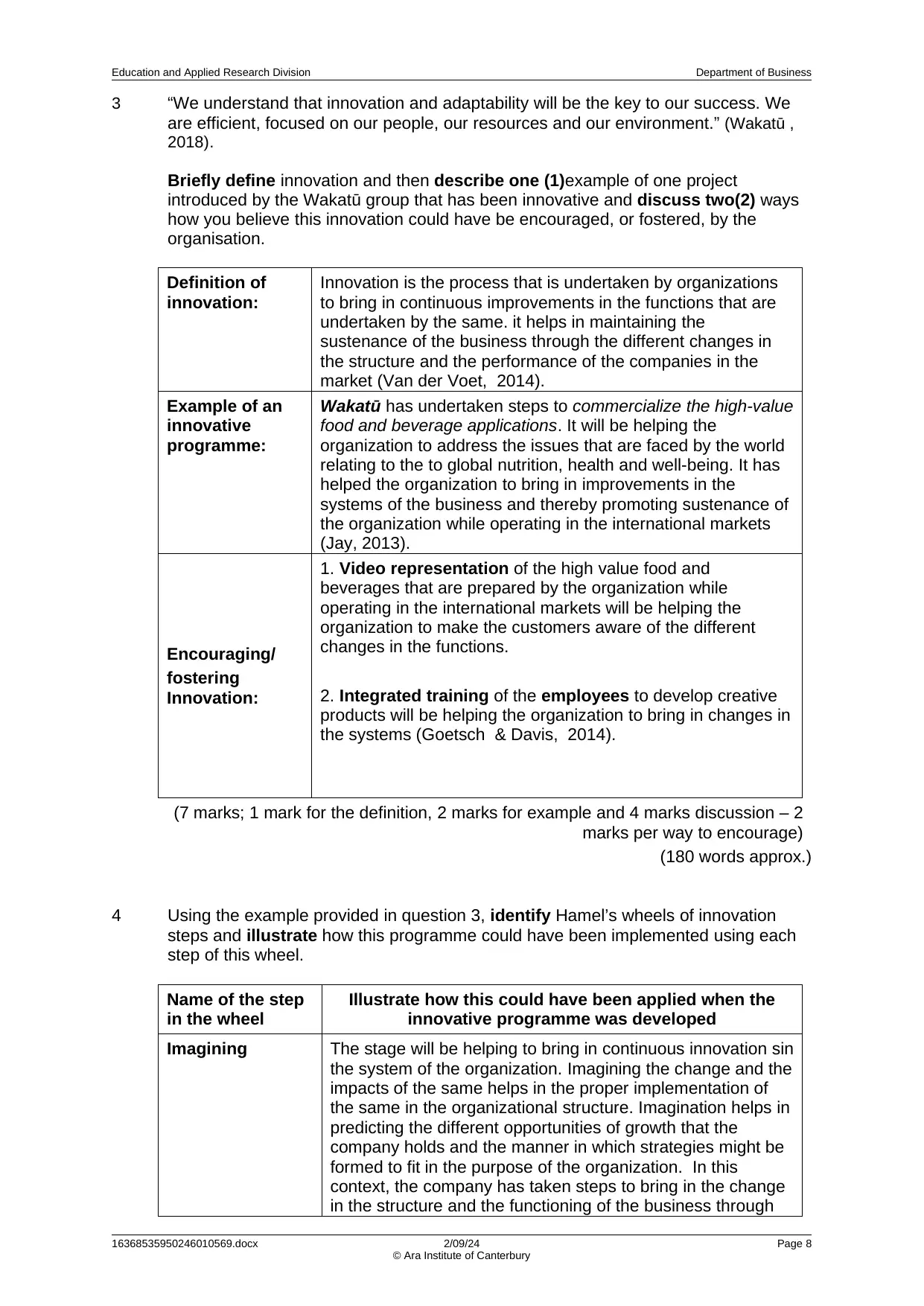
3 “We understand that innovation and adaptability will be the key to our success. We
are efficient, focused on our people, our resources and our environment.” (Wakatū ,
2018).
Briefly define innovation and then describe one (1)example of one project
introduced by the Wakatū group that has been innovative and discuss two(2) ways
how you believe this innovation could have be encouraged, or fostered, by the
organisation.
Definition of
innovation:
Innovation is the process that is undertaken by organizations
to bring in continuous improvements in the functions that are
undertaken by the same. it helps in maintaining the
sustenance of the business through the different changes in
the structure and the performance of the companies in the
market (Van der Voet, 2014).
Example of an
innovative
programme:
Wakatū has undertaken steps to commercialize the high-value
food and beverage applications. It will be helping the
organization to address the issues that are faced by the world
relating to the to global nutrition, health and well-being. It has
helped the organization to bring in improvements in the
systems of the business and thereby promoting sustenance of
the organization while operating in the international markets
(Jay, 2013).
Encouraging/
fostering
Innovation:
1. Video representation of the high value food and
beverages that are prepared by the organization while
operating in the international markets will be helping the
organization to make the customers aware of the different
changes in the functions.
2. Integrated training of the employees to develop creative
products will be helping the organization to bring in changes in
the systems (Goetsch & Davis, 2014).
(7 marks; 1 mark for the definition, 2 marks for example and 4 marks discussion – 2
marks per way to encourage)
(180 words approx.)
4 Using the example provided in question 3, identify Hamel’s wheels of innovation
steps and illustrate how this programme could have been implemented using each
step of this wheel.
Name of the step
in the wheel
Illustrate how this could have been applied when the
innovative programme was developed
Imagining The stage will be helping to bring in continuous innovation sin
the system of the organization. Imagining the change and the
impacts of the same helps in the proper implementation of
the same in the organizational structure. Imagination helps in
predicting the different opportunities of growth that the
company holds and the manner in which strategies might be
formed to fit in the purpose of the organization. In this
context, the company has taken steps to bring in the change
in the structure and the functioning of the business through
16368535950246010569.docx 2/09/24 Page 8
© Ara Institute of Canterbury
3 “We understand that innovation and adaptability will be the key to our success. We
are efficient, focused on our people, our resources and our environment.” (Wakatū ,
2018).
Briefly define innovation and then describe one (1)example of one project
introduced by the Wakatū group that has been innovative and discuss two(2) ways
how you believe this innovation could have be encouraged, or fostered, by the
organisation.
Definition of
innovation:
Innovation is the process that is undertaken by organizations
to bring in continuous improvements in the functions that are
undertaken by the same. it helps in maintaining the
sustenance of the business through the different changes in
the structure and the performance of the companies in the
market (Van der Voet, 2014).
Example of an
innovative
programme:
Wakatū has undertaken steps to commercialize the high-value
food and beverage applications. It will be helping the
organization to address the issues that are faced by the world
relating to the to global nutrition, health and well-being. It has
helped the organization to bring in improvements in the
systems of the business and thereby promoting sustenance of
the organization while operating in the international markets
(Jay, 2013).
Encouraging/
fostering
Innovation:
1. Video representation of the high value food and
beverages that are prepared by the organization while
operating in the international markets will be helping the
organization to make the customers aware of the different
changes in the functions.
2. Integrated training of the employees to develop creative
products will be helping the organization to bring in changes in
the systems (Goetsch & Davis, 2014).
(7 marks; 1 mark for the definition, 2 marks for example and 4 marks discussion – 2
marks per way to encourage)
(180 words approx.)
4 Using the example provided in question 3, identify Hamel’s wheels of innovation
steps and illustrate how this programme could have been implemented using each
step of this wheel.
Name of the step
in the wheel
Illustrate how this could have been applied when the
innovative programme was developed
Imagining The stage will be helping to bring in continuous innovation sin
the system of the organization. Imagining the change and the
impacts of the same helps in the proper implementation of
the same in the organizational structure. Imagination helps in
predicting the different opportunities of growth that the
company holds and the manner in which strategies might be
formed to fit in the purpose of the organization. In this
context, the company has taken steps to bring in the change
in the structure and the functioning of the business through
16368535950246010569.docx 2/09/24 Page 8
© Ara Institute of Canterbury
Education and Applied Research Division Department of Business
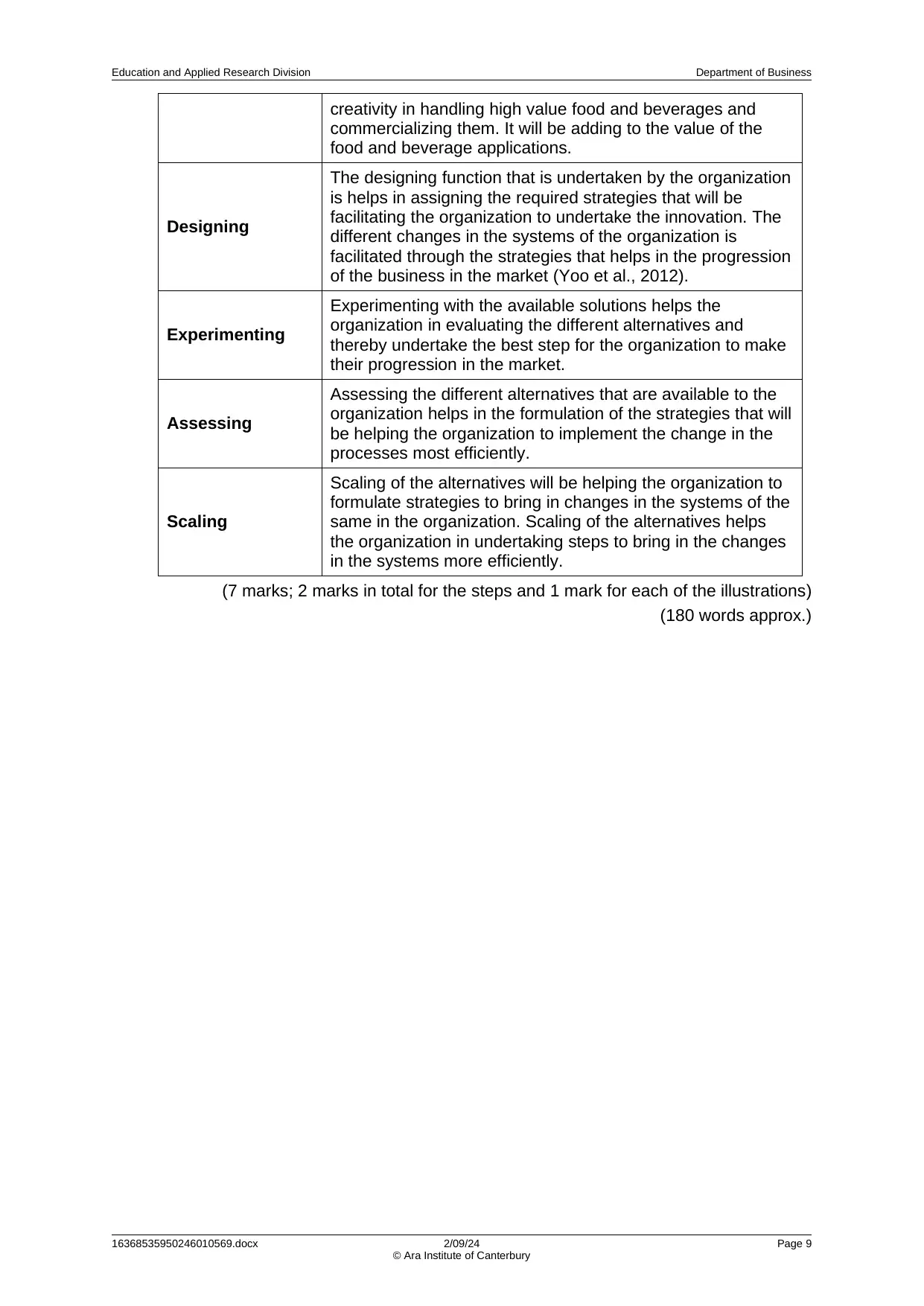
creativity in handling high value food and beverages and
commercializing them. It will be adding to the value of the
food and beverage applications.
Designing
The designing function that is undertaken by the organization
is helps in assigning the required strategies that will be
facilitating the organization to undertake the innovation. The
different changes in the systems of the organization is
facilitated through the strategies that helps in the progression
of the business in the market (Yoo et al., 2012).
Experimenting
Experimenting with the available solutions helps the
organization in evaluating the different alternatives and
thereby undertake the best step for the organization to make
their progression in the market.
Assessing
Assessing the different alternatives that are available to the
organization helps in the formulation of the strategies that will
be helping the organization to implement the change in the
processes most efficiently.
Scaling
Scaling of the alternatives will be helping the organization to
formulate strategies to bring in changes in the systems of the
same in the organization. Scaling of the alternatives helps
the organization in undertaking steps to bring in the changes
in the systems more efficiently.
(7 marks; 2 marks in total for the steps and 1 mark for each of the illustrations)
(180 words approx.)
16368535950246010569.docx 2/09/24 Page 9
© Ara Institute of Canterbury
creativity in handling high value food and beverages and
commercializing them. It will be adding to the value of the
food and beverage applications.
Designing
The designing function that is undertaken by the organization
is helps in assigning the required strategies that will be
facilitating the organization to undertake the innovation. The
different changes in the systems of the organization is
facilitated through the strategies that helps in the progression
of the business in the market (Yoo et al., 2012).
Experimenting
Experimenting with the available solutions helps the
organization in evaluating the different alternatives and
thereby undertake the best step for the organization to make
their progression in the market.
Assessing
Assessing the different alternatives that are available to the
organization helps in the formulation of the strategies that will
be helping the organization to implement the change in the
processes most efficiently.
Scaling
Scaling of the alternatives will be helping the organization to
formulate strategies to bring in changes in the systems of the
same in the organization. Scaling of the alternatives helps
the organization in undertaking steps to bring in the changes
in the systems more efficiently.
(7 marks; 2 marks in total for the steps and 1 mark for each of the illustrations)
(180 words approx.)
16368535950246010569.docx 2/09/24 Page 9
© Ara Institute of Canterbury
⊘ This is a preview!⊘
Do you want full access?
Subscribe today to unlock all pages.
Trusted by 1+ million students worldwide
Education and Applied Research Division Department of Business
PART TWO TOTAL: 45 MARKS
Change in Organisations
5 Describe three (3) examples of change that can occur in this company – either from
the case study or from the website- and explain how each can impact on the
organisation. Include, in your discussion of the impact on the organisation, what
target (task; people; culture; technology, etc.) has to be changed and then which
function/s (marketing, sales, production etc.) would be involved. (You might need to
assume information not directly listed in the above case study).
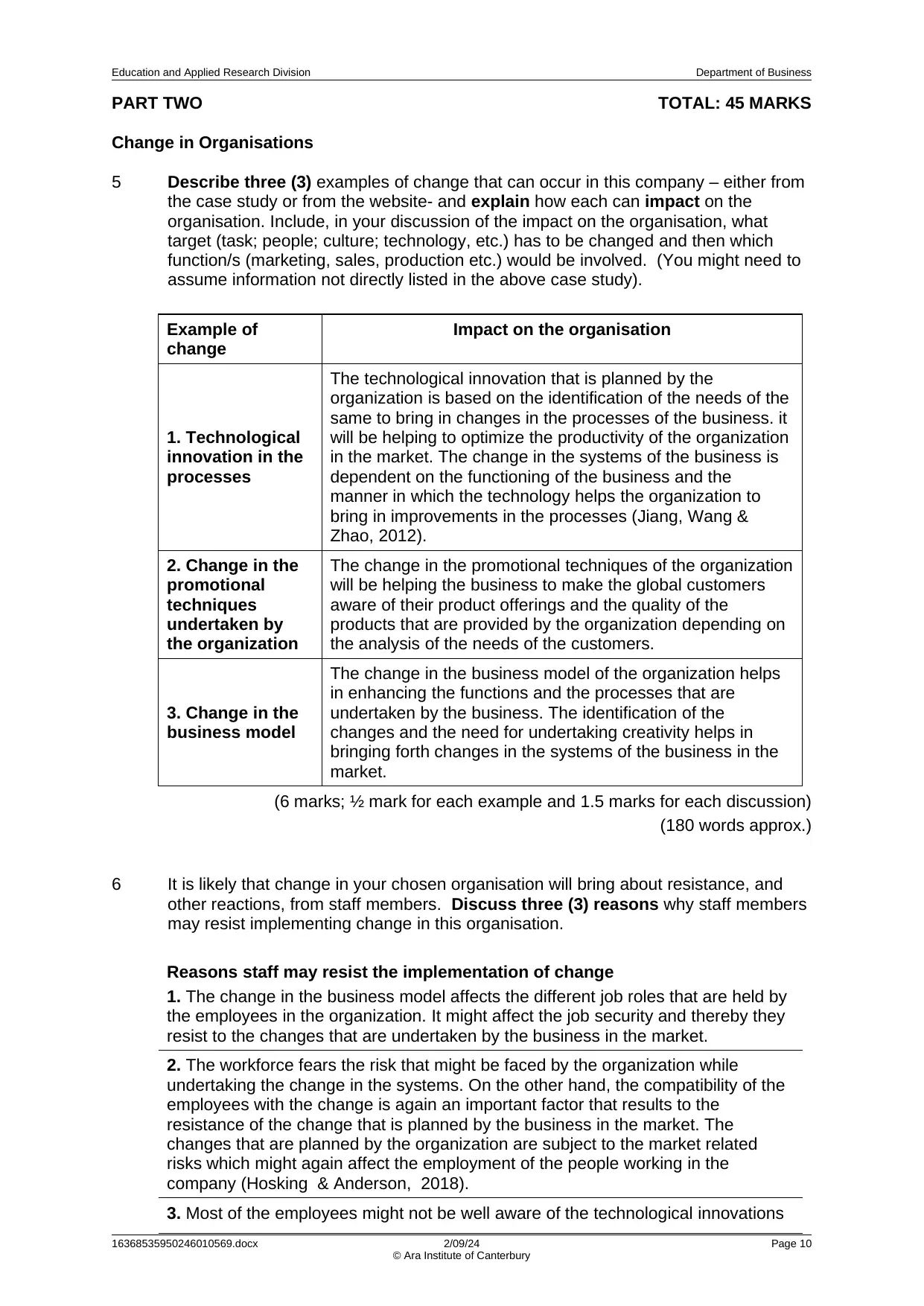
Example of
change
Impact on the organisation
1. Technological
innovation in the
processes
The technological innovation that is planned by the
organization is based on the identification of the needs of the
same to bring in changes in the processes of the business. it
will be helping to optimize the productivity of the organization
in the market. The change in the systems of the business is
dependent on the functioning of the business and the
manner in which the technology helps the organization to
bring in improvements in the processes (Jiang, Wang &
Zhao, 2012).
2. Change in the
promotional
techniques
undertaken by
the organization
The change in the promotional techniques of the organization
will be helping the business to make the global customers
aware of their product offerings and the quality of the
products that are provided by the organization depending on
the analysis of the needs of the customers.
3. Change in the
business model
The change in the business model of the organization helps
in enhancing the functions and the processes that are
undertaken by the business. The identification of the
changes and the need for undertaking creativity helps in
bringing forth changes in the systems of the business in the
market.
(6 marks; ½ mark for each example and 1.5 marks for each discussion)
(180 words approx.)
6 It is likely that change in your chosen organisation will bring about resistance, and
other reactions, from staff members. Discuss three (3) reasons why staff members
may resist implementing change in this organisation.
Reasons staff may resist the implementation of change
1. The change in the business model affects the different job roles that are held by
the employees in the organization. It might affect the job security and thereby they
resist to the changes that are undertaken by the business in the market.
2. The workforce fears the risk that might be faced by the organization while
undertaking the change in the systems. On the other hand, the compatibility of the
employees with the change is again an important factor that results to the
resistance of the change that is planned by the business in the market. The
changes that are planned by the organization are subject to the market related
risks which might again affect the employment of the people working in the
company (Hosking & Anderson, 2018).
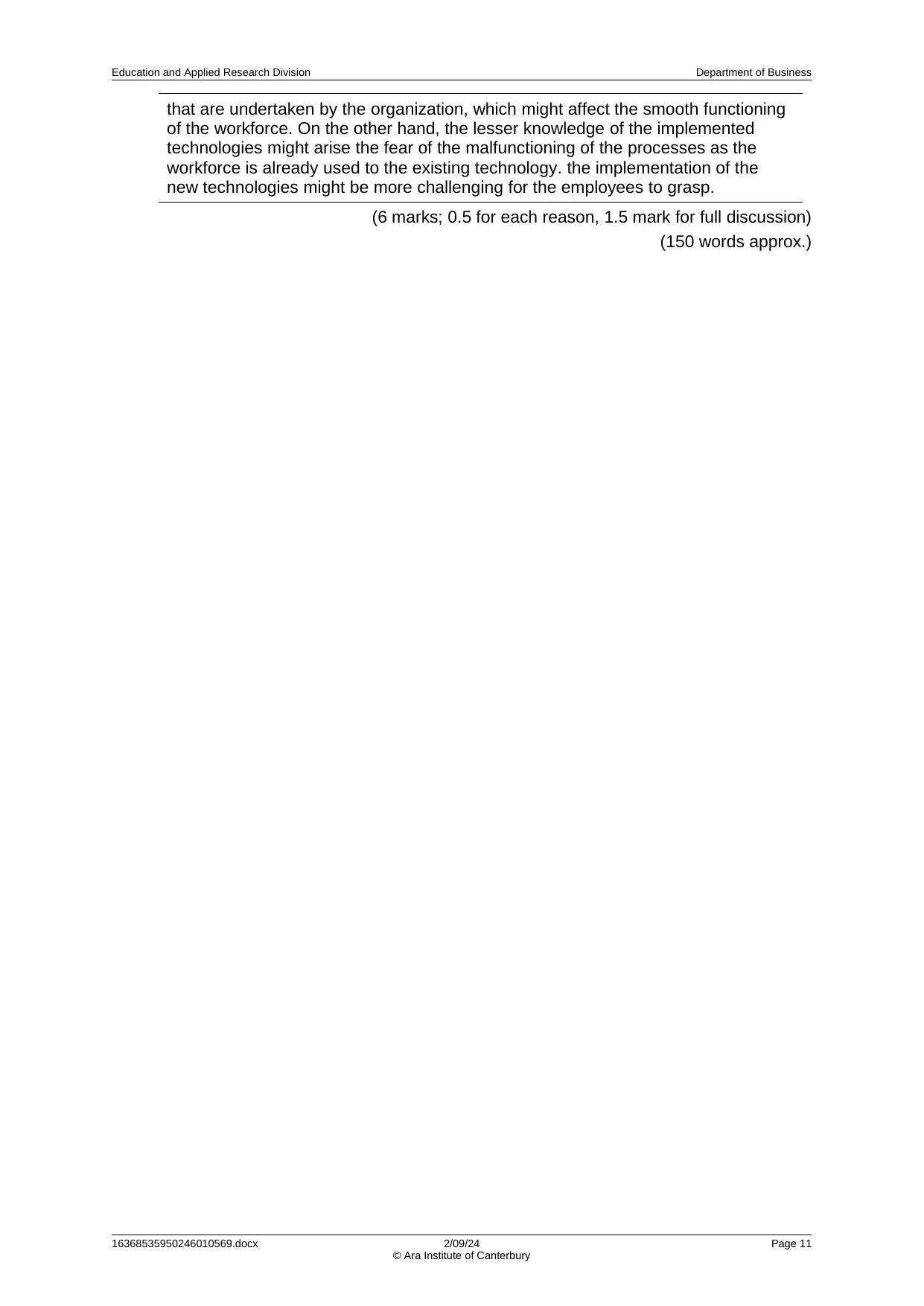
3. Most of the employees might not be well aware of the technological innovations
16368535950246010569.docx 2/09/24 Page 10
© Ara Institute of Canterbury
PART TWO TOTAL: 45 MARKS
Change in Organisations
5 Describe three (3) examples of change that can occur in this company – either from
the case study or from the website- and explain how each can impact on the
organisation. Include, in your discussion of the impact on the organisation, what
target (task; people; culture; technology, etc.) has to be changed and then which
function/s (marketing, sales, production etc.) would be involved. (You might need to
assume information not directly listed in the above case study).
Example of
change
Impact on the organisation
1. Technological
innovation in the
processes
The technological innovation that is planned by the
organization is based on the identification of the needs of the
same to bring in changes in the processes of the business. it
will be helping to optimize the productivity of the organization
in the market. The change in the systems of the business is
dependent on the functioning of the business and the
manner in which the technology helps the organization to
bring in improvements in the processes (Jiang, Wang &
Zhao, 2012).
2. Change in the
promotional
techniques
undertaken by
the organization
The change in the promotional techniques of the organization
will be helping the business to make the global customers
aware of their product offerings and the quality of the
products that are provided by the organization depending on
the analysis of the needs of the customers.
3. Change in the
business model
The change in the business model of the organization helps
in enhancing the functions and the processes that are
undertaken by the business. The identification of the
changes and the need for undertaking creativity helps in
bringing forth changes in the systems of the business in the
market.
(6 marks; ½ mark for each example and 1.5 marks for each discussion)
(180 words approx.)
6 It is likely that change in your chosen organisation will bring about resistance, and
other reactions, from staff members. Discuss three (3) reasons why staff members
may resist implementing change in this organisation.
Reasons staff may resist the implementation of change
1. The change in the business model affects the different job roles that are held by
the employees in the organization. It might affect the job security and thereby they
resist to the changes that are undertaken by the business in the market.
2. The workforce fears the risk that might be faced by the organization while
undertaking the change in the systems. On the other hand, the compatibility of the
employees with the change is again an important factor that results to the
resistance of the change that is planned by the business in the market. The
changes that are planned by the organization are subject to the market related
risks which might again affect the employment of the people working in the
company (Hosking & Anderson, 2018).
3. Most of the employees might not be well aware of the technological innovations
16368535950246010569.docx 2/09/24 Page 10
© Ara Institute of Canterbury
Paraphrase This Document
Need a fresh take? Get an instant paraphrase of this document with our AI Paraphraser
Education and Applied Research Division Department of Business
that are undertaken by the organization, which might affect the smooth functioning
of the workforce. On the other hand, the lesser knowledge of the implemented
technologies might arise the fear of the malfunctioning of the processes as the
workforce is already used to the existing technology. the implementation of the
new technologies might be more challenging for the employees to grasp.
(6 marks; 0.5 for each reason, 1.5 mark for full discussion)
(150 words approx.)
16368535950246010569.docx 2/09/24 Page 11
© Ara Institute of Canterbury
that are undertaken by the organization, which might affect the smooth functioning
of the workforce. On the other hand, the lesser knowledge of the implemented
technologies might arise the fear of the malfunctioning of the processes as the
workforce is already used to the existing technology. the implementation of the
new technologies might be more challenging for the employees to grasp.
(6 marks; 0.5 for each reason, 1.5 mark for full discussion)
(150 words approx.)
16368535950246010569.docx 2/09/24 Page 11
© Ara Institute of Canterbury
Education and Applied Research Division Department of Business
7 Changes in the external environment may have such a great impact on the
organisation that it may have to undergo change. Selectone (1) of the examples of
change you describe in question 5, which may require the organisation to undergo
change.
(a) UsingKurt Lewin’s planned change model,discuss what you would do to
implement this model/approach with all of its respective phases/steps in your
chosen organisation so that it adapts to your chosenexample of change in
environment.
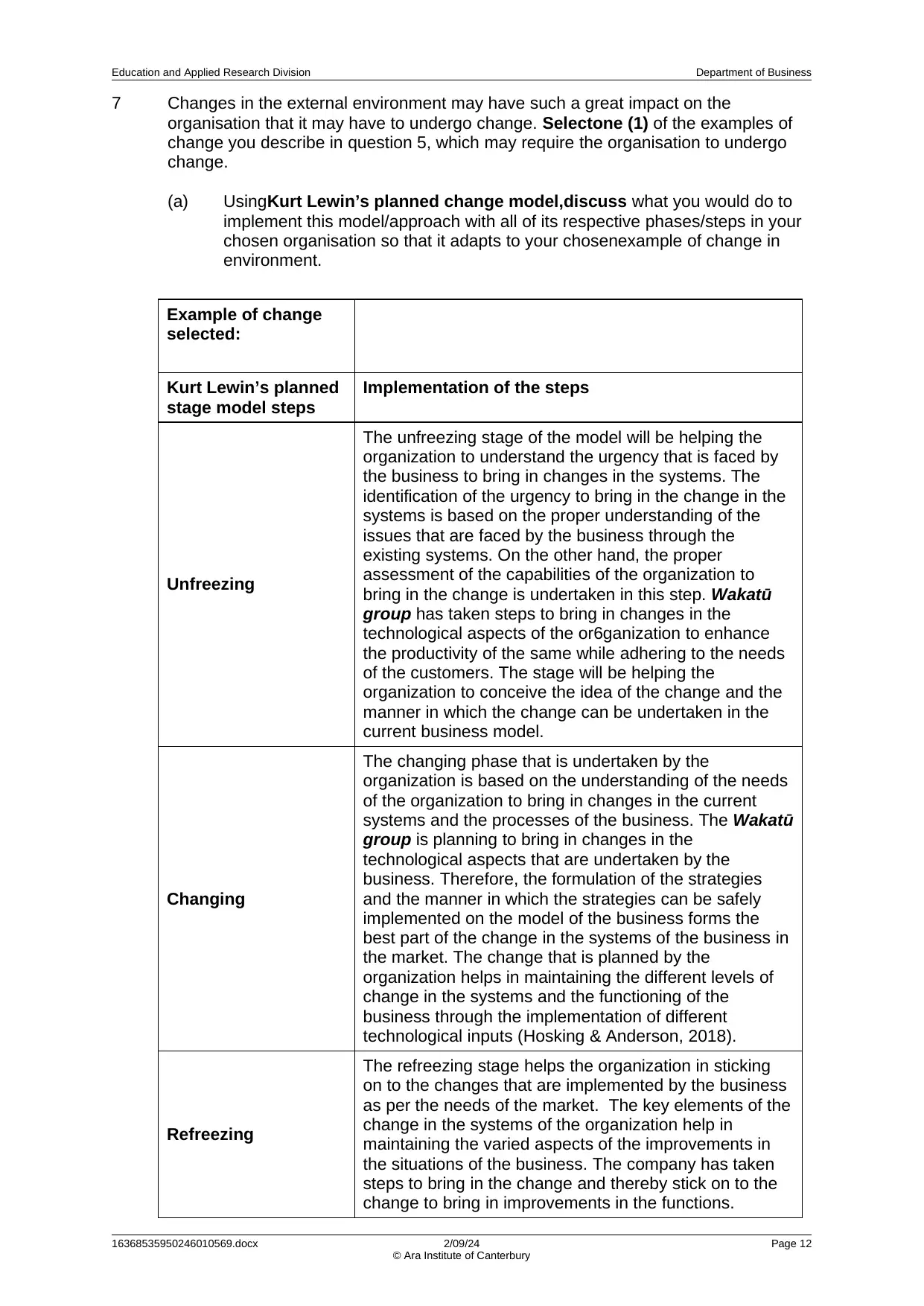
Example of change
selected:
Kurt Lewin’s planned
stage model steps
Implementation of the steps
Unfreezing
The unfreezing stage of the model will be helping the
organization to understand the urgency that is faced by
the business to bring in changes in the systems. The
identification of the urgency to bring in the change in the
systems is based on the proper understanding of the
issues that are faced by the business through the
existing systems. On the other hand, the proper
assessment of the capabilities of the organization to
bring in the change is undertaken in this step. Wakatū
group has taken steps to bring in changes in the
technological aspects of the or6ganization to enhance
the productivity of the same while adhering to the needs
of the customers. The stage will be helping the
organization to conceive the idea of the change and the
manner in which the change can be undertaken in the
current business model.
Changing
The changing phase that is undertaken by the
organization is based on the understanding of the needs
of the organization to bring in changes in the current
systems and the processes of the business. The Wakatū
group is planning to bring in changes in the
technological aspects that are undertaken by the
business. Therefore, the formulation of the strategies
and the manner in which the strategies can be safely
implemented on the model of the business forms the
best part of the change in the systems of the business in
the market. The change that is planned by the
organization helps in maintaining the different levels of
change in the systems and the functioning of the
business through the implementation of different
technological inputs (Hosking & Anderson, 2018).
Refreezing
The refreezing stage helps the organization in sticking
on to the changes that are implemented by the business
as per the needs of the market. The key elements of the
change in the systems of the organization help in
maintaining the varied aspects of the improvements in
the situations of the business. The company has taken
steps to bring in the change and thereby stick on to the
change to bring in improvements in the functions.
16368535950246010569.docx 2/09/24 Page 12
© Ara Institute of Canterbury
7 Changes in the external environment may have such a great impact on the
organisation that it may have to undergo change. Selectone (1) of the examples of
change you describe in question 5, which may require the organisation to undergo
change.
(a) UsingKurt Lewin’s planned change model,discuss what you would do to
implement this model/approach with all of its respective phases/steps in your
chosen organisation so that it adapts to your chosenexample of change in
environment.
Example of change
selected:
Kurt Lewin’s planned
stage model steps
Implementation of the steps
Unfreezing
The unfreezing stage of the model will be helping the
organization to understand the urgency that is faced by
the business to bring in changes in the systems. The
identification of the urgency to bring in the change in the
systems is based on the proper understanding of the
issues that are faced by the business through the
existing systems. On the other hand, the proper
assessment of the capabilities of the organization to
bring in the change is undertaken in this step. Wakatū
group has taken steps to bring in changes in the
technological aspects of the or6ganization to enhance
the productivity of the same while adhering to the needs
of the customers. The stage will be helping the
organization to conceive the idea of the change and the
manner in which the change can be undertaken in the
current business model.
Changing
The changing phase that is undertaken by the
organization is based on the understanding of the needs
of the organization to bring in changes in the current
systems and the processes of the business. The Wakatū
group is planning to bring in changes in the
technological aspects that are undertaken by the
business. Therefore, the formulation of the strategies
and the manner in which the strategies can be safely
implemented on the model of the business forms the
best part of the change in the systems of the business in
the market. The change that is planned by the
organization helps in maintaining the different levels of
change in the systems and the functioning of the
business through the implementation of different
technological inputs (Hosking & Anderson, 2018).
Refreezing
The refreezing stage helps the organization in sticking
on to the changes that are implemented by the business
as per the needs of the market. The key elements of the
change in the systems of the organization help in
maintaining the varied aspects of the improvements in
the situations of the business. The company has taken
steps to bring in the change and thereby stick on to the
change to bring in improvements in the functions.
16368535950246010569.docx 2/09/24 Page 12
© Ara Institute of Canterbury
⊘ This is a preview!⊘
Do you want full access?
Subscribe today to unlock all pages.
Trusted by 1+ million students worldwide

1 out of 20


Related Documents


Your All-in-One AI-Powered Toolkit for Academic Success.
+13062052269
info@desklib.com
Available 24*7 on WhatsApp / Email
![[object Object]](/_next/static/media/star-bottom.7253800d.svg)
Unlock your academic potential
Copyright © 2020–2026 A2Z Services. All Rights Reserved. Developed and managed by ZUCOL.