Education as a Tool of Colonization in New Zealand: A Study

Verified

Added on  2022/08/14

|4
|495
|46
Essay
AI Summary
This essay examines the role of education as a tool of colonization in New Zealand, focusing on its impact on the Maori population. The essay highlights how educational policies, particularly during the 1800s, aimed to assimilate the Maori people by suppressing their language and cultural practices. It discusses the implementation of English as the primary language in schools and the subsequent loss of Maori language proficiency among the younger generation. The essay references academic sources to support the argument that education played a crucial role in the colonization process, impacting the Maori's cultural identity and way of life. It concludes that the education system in New Zealand was a significant instrument of colonization, contributing to the marginalization of the Maori language and culture through systemic policies and practices. The essay draws upon the works of Lee-Morgan, Courtney, Muller, Lourie, and Ruckstuhl to support its claims.
Document Page
Running head: COLONIZATION
COLONIZATION
Name of the student:
Name of the university:
Author note:
tabler-icon-diamond-filled.svg

Paraphrase This Document

Need a fresh take? Get an instant paraphrase of this document with our AI Paraphraser
Document Page
1COLONIZATION
Introduction:
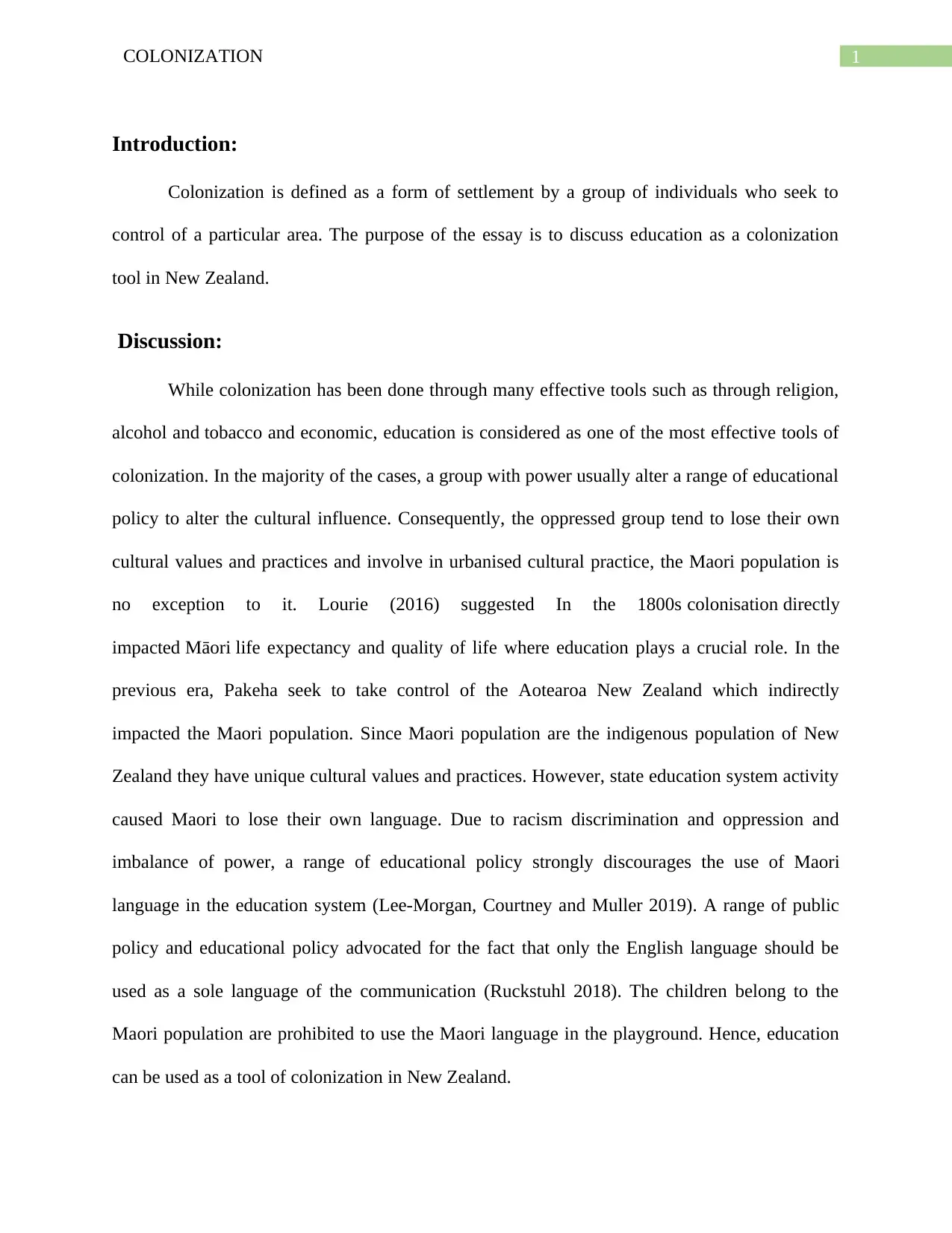
Colonization is defined as a form of settlement by a group of individuals who seek to
control of a particular area. The purpose of the essay is to discuss education as a colonization
tool in New Zealand.
Discussion:
While colonization has been done through many effective tools such as through religion,
alcohol and tobacco and economic, education is considered as one of the most effective tools of
colonization. In the majority of the cases, a group with power usually alter a range of educational
policy to alter the cultural influence. Consequently, the oppressed group tend to lose their own
cultural values and practices and involve in urbanised cultural practice, the Maori population is
no exception to it. Lourie (2016) suggested In the 1800s colonisation directly
impacted Māori life expectancy and quality of life where education plays a crucial role. In the
previous era, Pakeha seek to take control of the Aotearoa New Zealand which indirectly
impacted the Maori population. Since Maori population are the indigenous population of New
Zealand they have unique cultural values and practices. However, state education system activity
caused Maori to lose their own language. Due to racism discrimination and oppression and
imbalance of power, a range of educational policy strongly discourages the use of Maori
language in the education system (Lee-Morgan, Courtney and Muller 2019). A range of public
policy and educational policy advocated for the fact that only the English language should be
used as a sole language of the communication (Ruckstuhl 2018). The children belong to the
Maori population are prohibited to use the Maori language in the playground. Hence, education
can be used as a tool of colonization in New Zealand.
Document Page
2COLONIZATION
Conclusion:
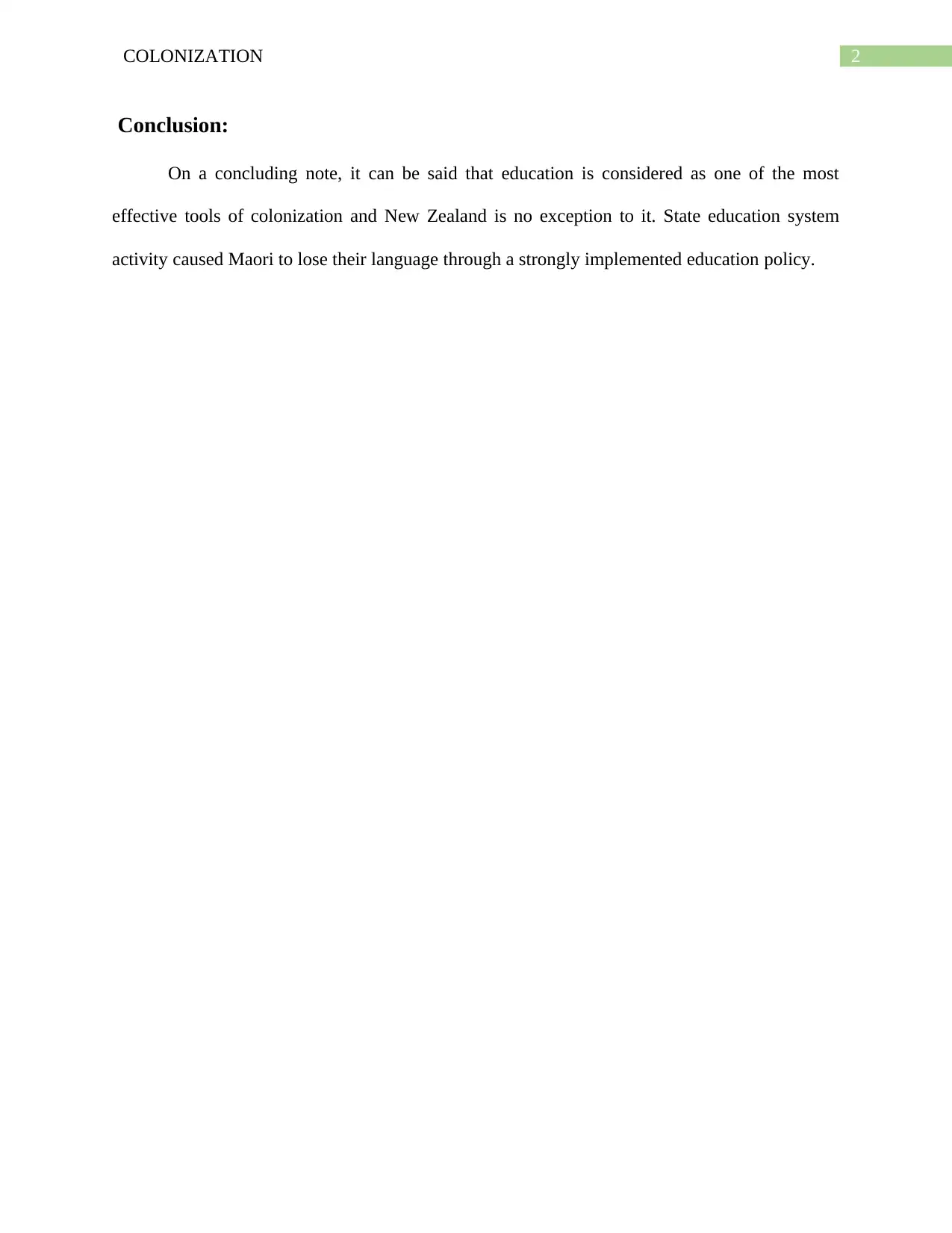
On a concluding note, it can be said that education is considered as one of the most
effective tools of colonization and New Zealand is no exception to it. State education system
activity caused Maori to lose their language through a strongly implemented education policy.
Document Page
3COLONIZATION
Reference:
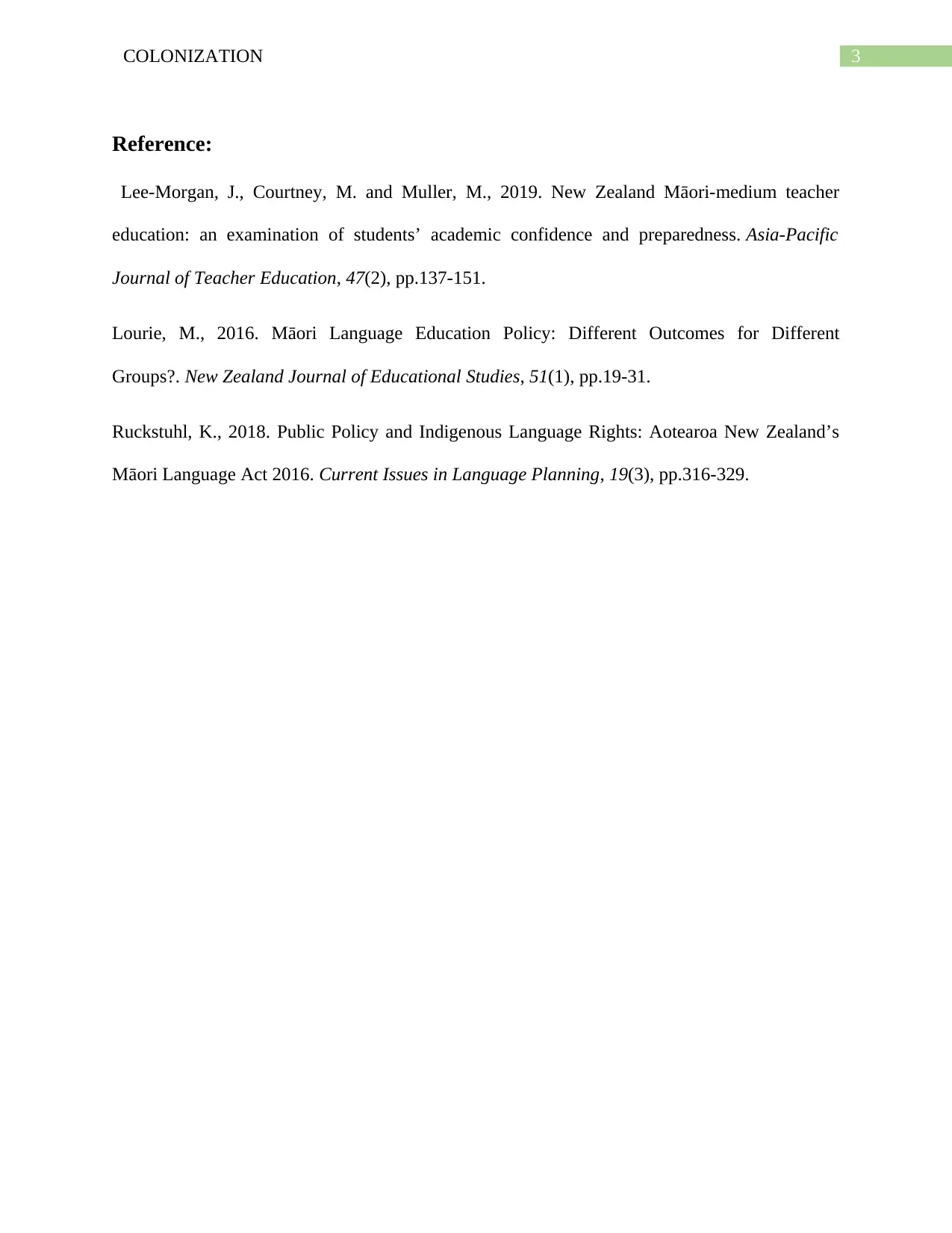
Lee-Morgan, J., Courtney, M. and Muller, M., 2019. New Zealand Māori-medium teacher
education: an examination of students’ academic confidence and preparedness. Asia-Pacific
Journal of Teacher Education, 47(2), pp.137-151.
Lourie, M., 2016. Māori Language Education Policy: Different Outcomes for Different
Groups?. New Zealand Journal of Educational Studies, 51(1), pp.19-31.
Ruckstuhl, K., 2018. Public Policy and Indigenous Language Rights: Aotearoa New Zealand’s
Māori Language Act 2016. Current Issues in Language Planning, 19(3), pp.316-329.
chevron_up_icon
1 out of 4
circle_padding
hide_on_mobile
zoom_out_icon
[object Object]