Designing Education and Care Programs in Childhood Settings

Verified

Added on  2023/01/19

|15
|2337
|95
Report
AI Summary
This report presents a comprehensive design for an education and care program tailored for children in early childhood settings, specifically focusing on the 0-3 age group. The report begins by outlining the Early Years Learning Framework (EYLF), detailing its planning cycle and the theoretical underpinnings that guide childhood learning, emphasizing the importance of creating environments where children can express themselves. It then develops a daily routine, complete with indoor and outdoor learning environment plans, showcasing how to structure a child's day from 7:00 am to 6:00 pm. The document progresses to outline the EYLF planning cycle, including stages of observation, analysis, planning, action, and reflection, providing a clear format for educators. Finally, the report includes a completed program plan, incorporating both implementation and reflection stages, demonstrating how to effectively apply learning environments and routines for children's development. The report references key literature to support the program's design and approach.

Document Page
Education and Care Program
Design in Childhood Setting
tabler-icon-diamond-filled.svg

Paraphrase This Document

Need a fresh take? Get an instant paraphrase of this document with our AI Paraphraser
Document Page
Table of Contents
SECTION 1......................................................................................................................................1
EYLF planning cycle and description about theoretical underpinnings and curriculum
approach......................................................................................................................................1
SECTION 2......................................................................................................................................2
Development of routine of the day for 0- 3 years children with drawing indoor and outdoor
learning environment..................................................................................................................2
Development of routine of the day (0- 3 years for 7:00 am to 6:00 pm)....................................3
SECTION 3......................................................................................................................................6
Plan about format of EYLF planning cycle stages and elements which is documented under
planning process..........................................................................................................................6
SECTION 4......................................................................................................................................7
Completed version of program plan with implementing and reflection stage on learning
environment and routine for children..........................................................................................7
REFERENCES................................................................................................................................8
Document Page
Document Page
SECTION 1
EYLF planning cycle and description about theoretical underpinnings and curriculum approach
EYLF is the abbreviation of Early Years Learning Framework which provides official
way to conduct and plan ways through which childhood learning of children can be improved.
For children, there is requirement of proper planning with the help of which child are able to
understand about ways to express their feelings and experience in front of others (Connors and
Morris, 2015). For children having age between 0- 3 years does not know how to
communication, hence with the help of this study, it is easy provide them and appropriate
manner of learning. When there is proper way to learning, then only, it is easy for children to get
to know about different factors which have to be followed and used while communicating with
others.
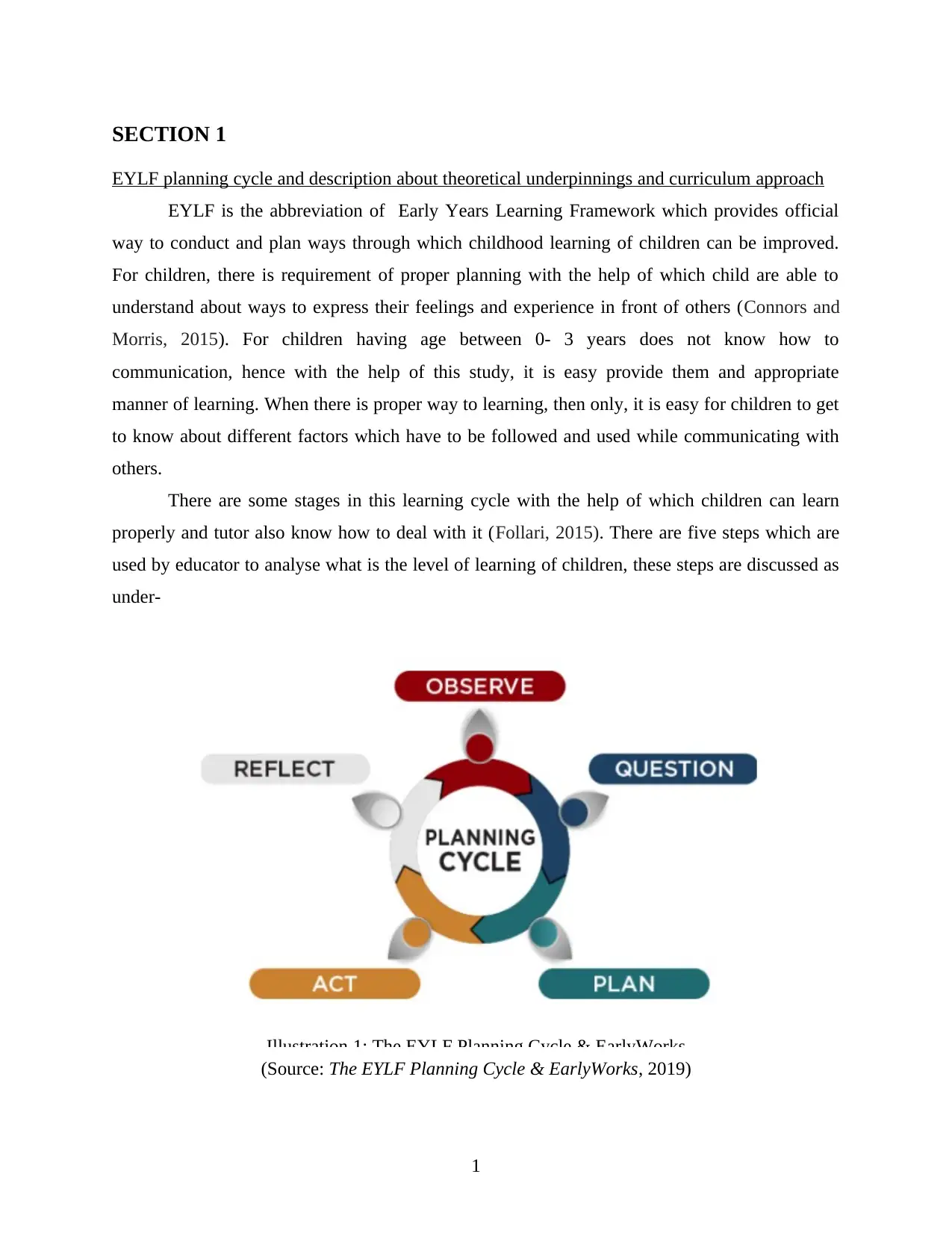
There are some stages in this learning cycle with the help of which children can learn
properly and tutor also know how to deal with it (Follari, 2015). There are five steps which are
used by educator to analyse what is the level of learning of children, these steps are discussed as
under-
(Source: The EYLF Planning Cycle & EarlyWorks, 2019)
1
Illustration 1: The EYLF Planning Cycle & EarlyWorks
tabler-icon-diamond-filled.svg

Paraphrase This Document

Need a fresh take? Get an instant paraphrase of this document with our AI Paraphraser
Document Page
Observe- This is the stage in which educator collects information about children through
which best way and effective manner can be used to learn it.
Analyse- After observation, here is requirement of analysis which of the following is best
option through which children learn about market trends.
Plan- After selecting one option, there is requirement of planning with the help of which
proper learning program can be planned. When program is planned properly, then it is easy for
enhancing knowledge (Garg and et. al., 2015).
Act- This is the stage in which planned operations are put in action. This is the way
through which best approach can be used and it is easy for tutor to improve their knowledge.
Reflect- In this tutor analyse that applied format is appropriate or not because this is the
way with the help of which positive and negative outcome can be known.
Theoretical and Curriculum Approaches
With the help of above mentioned steps, it is easy for tutor to educate and enhance
knowledge of child. When there is complete and specific information about ways through which
individuals can deal with it. Then it is easy for educator to acknowledge children. But there are
some theoretical and curriculum approaches with the help of which learning program for
children can be framed. There is requirement of proper planning with the help of which educator
have specified way to conduct operations. When there will requirement of planning and
understanding strategies with the help of which learning can be improved. There are some
positive as well as negative points of children due to which their working style can be improved
(Hestenes and et. al., 2015). With using proper approach, there will practical and appropriate
ways to implementing learning ways. While planning training and learning program for children,
then their skills of understanding have to be developed,. It is important that voice, expression,
etc. have to be considered. Educator must understand that there is important role of family
surroundings and environment, surroundings, etc. through which mental growth of children is
possible.
2
Document Page
SECTION 2
Development of routine of the day for 0- 3 years children with drawing indoor and outdoor
learning environment
Development of routine of the day (0- 3 years for 7:00 am to 6:00 pm)
07:00:00 This is the time when children start coming to centre and there is rush at
the place. If some children are new, then they might be crying for not
leaving their parents.
7:15am – 8:30 am At this time, there are some refreshments and breakfast through which
children become aware with each other. This is the way through which
they started interacting with educators.
8:30am -9:00am There are some activities with the help of which children started
interacting and make proper response over it. As per change in operations
which makes proper understanding about it.
9:00 am- 10:00 am This is the time of some indoor activities and makes with the help of which
children came to know about basic aspects such as animals, fruits, etc. It is
important for children because they started interacting with their peer
children and making friends.
10:00am -11:00am Educator plan some group activities for children with the help of which
they came to know about coo- operating with others and getting positive
outcome. It makes them able to understand others feeling as well.
11:00am -12:00 pm This is the time of some computerised activities through which children
came to know about technology which is in trend. There are some small
children too who slept at this time, so educator have to take care of them as
well.
12:00 pm – 1:30pm This is the time of lunch where children are served with some healthy
diet. For infants and other small children, there is proper facility of their
feeding.
3
Document Page
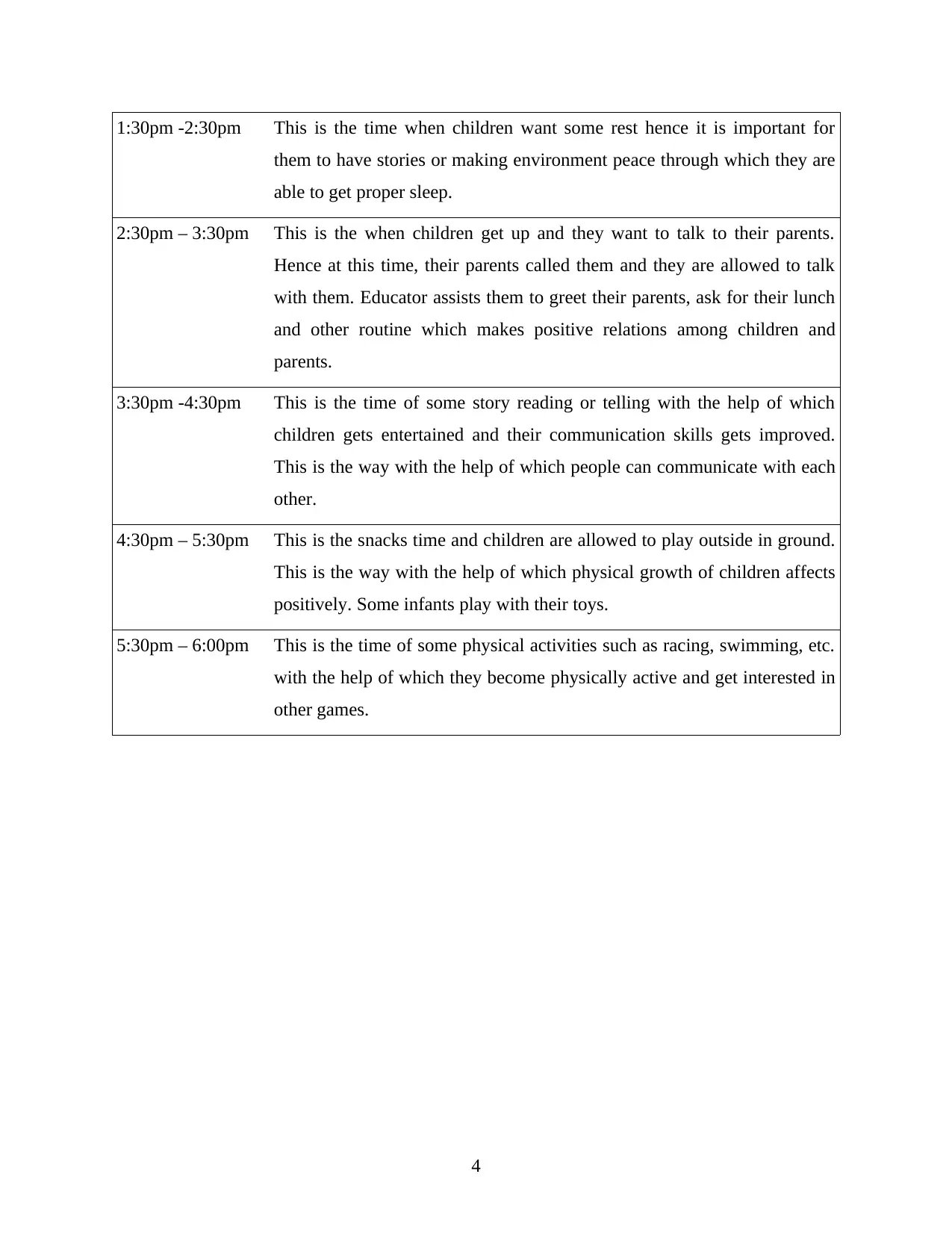
1:30pm -2:30pm This is the time when children want some rest hence it is important for
them to have stories or making environment peace through which they are
able to get proper sleep.
2:30pm – 3:30pm This is the when children get up and they want to talk to their parents.
Hence at this time, their parents called them and they are allowed to talk
with them. Educator assists them to greet their parents, ask for their lunch
and other routine which makes positive relations among children and
parents.
3:30pm -4:30pm This is the time of some story reading or telling with the help of which
children gets entertained and their communication skills gets improved.
This is the way with the help of which people can communicate with each
other.
4:30pm – 5:30pm This is the snacks time and children are allowed to play outside in ground.
This is the way with the help of which physical growth of children affects
positively. Some infants play with their toys.
5:30pm – 6:00pm This is the time of some physical activities such as racing, swimming, etc.
with the help of which they become physically active and get interested in
other games.
4
tabler-icon-diamond-filled.svg

Paraphrase This Document

Need a fresh take? Get an instant paraphrase of this document with our AI Paraphraser
Document Page
5
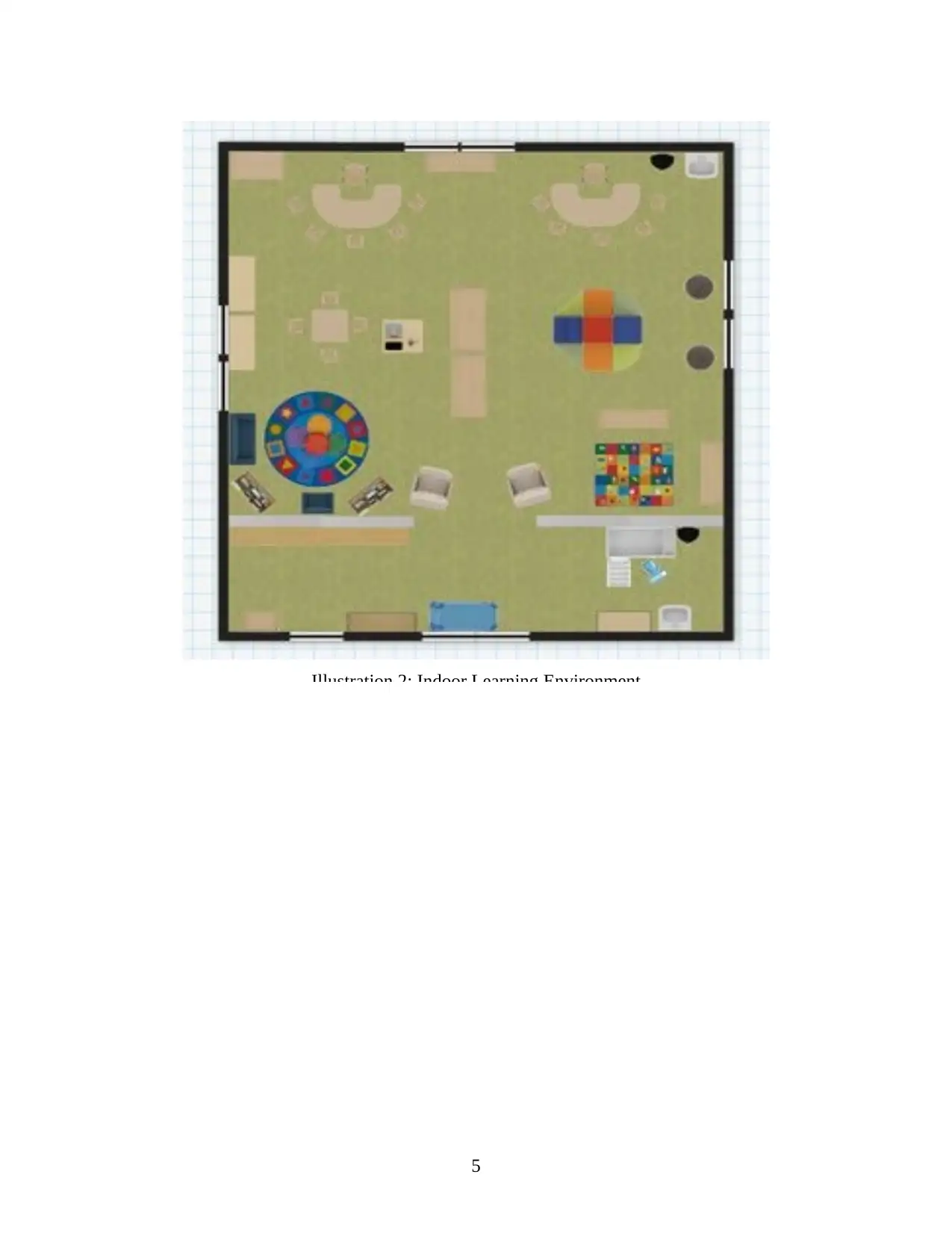
Illustration 2: Indoor Learning Environment
Document Page
6
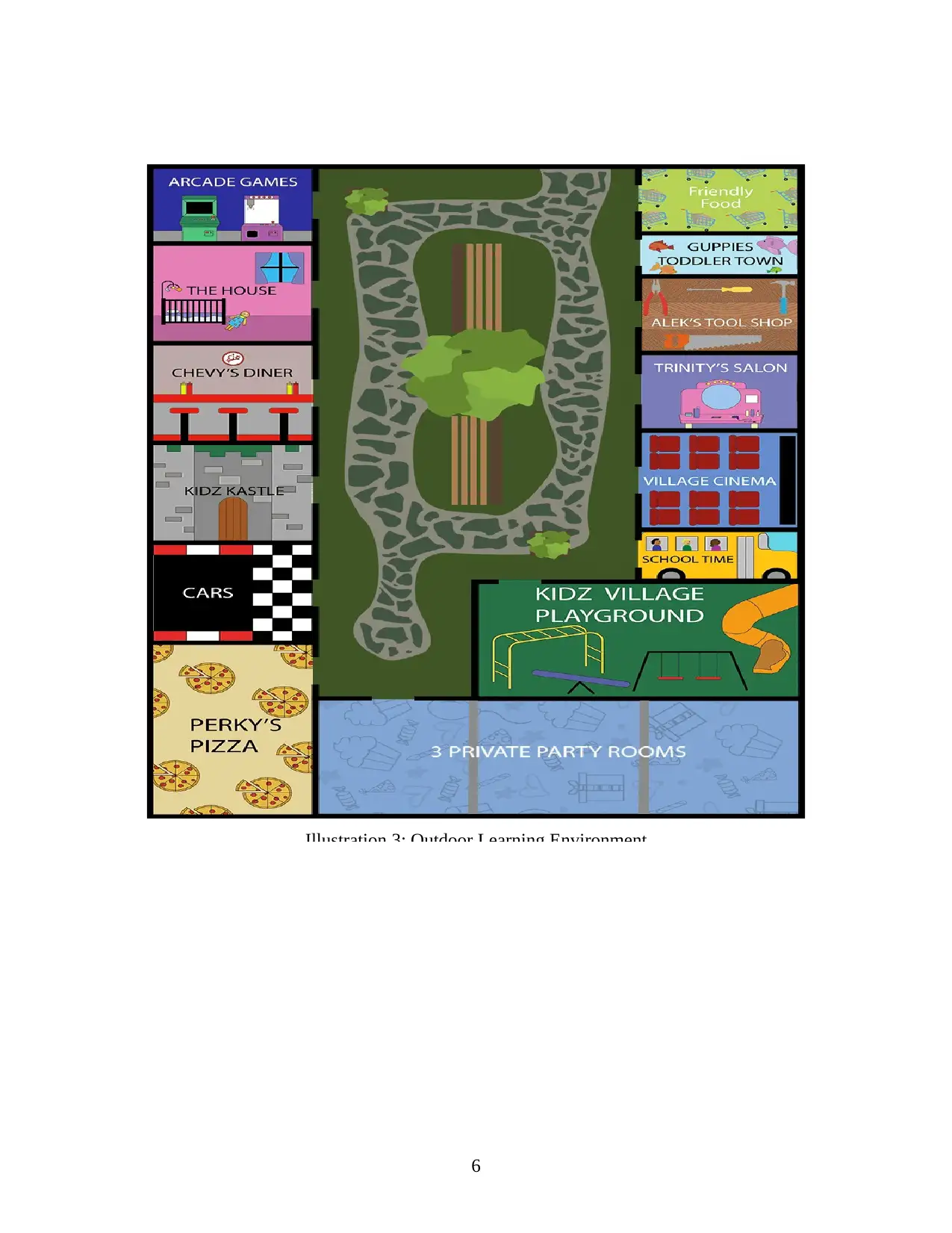
Illustration 3: Outdoor Learning Environment
Document Page
SECTION 3
Plan about format of EYLF planning cycle stages and elements which is documented under
planning process
There are three main components with the help of which early years learning in their
early stage is studying with the use of proper understanding them. When children get
understanding they are in safe environment, then there will sense of becoming, belongingness
and being.
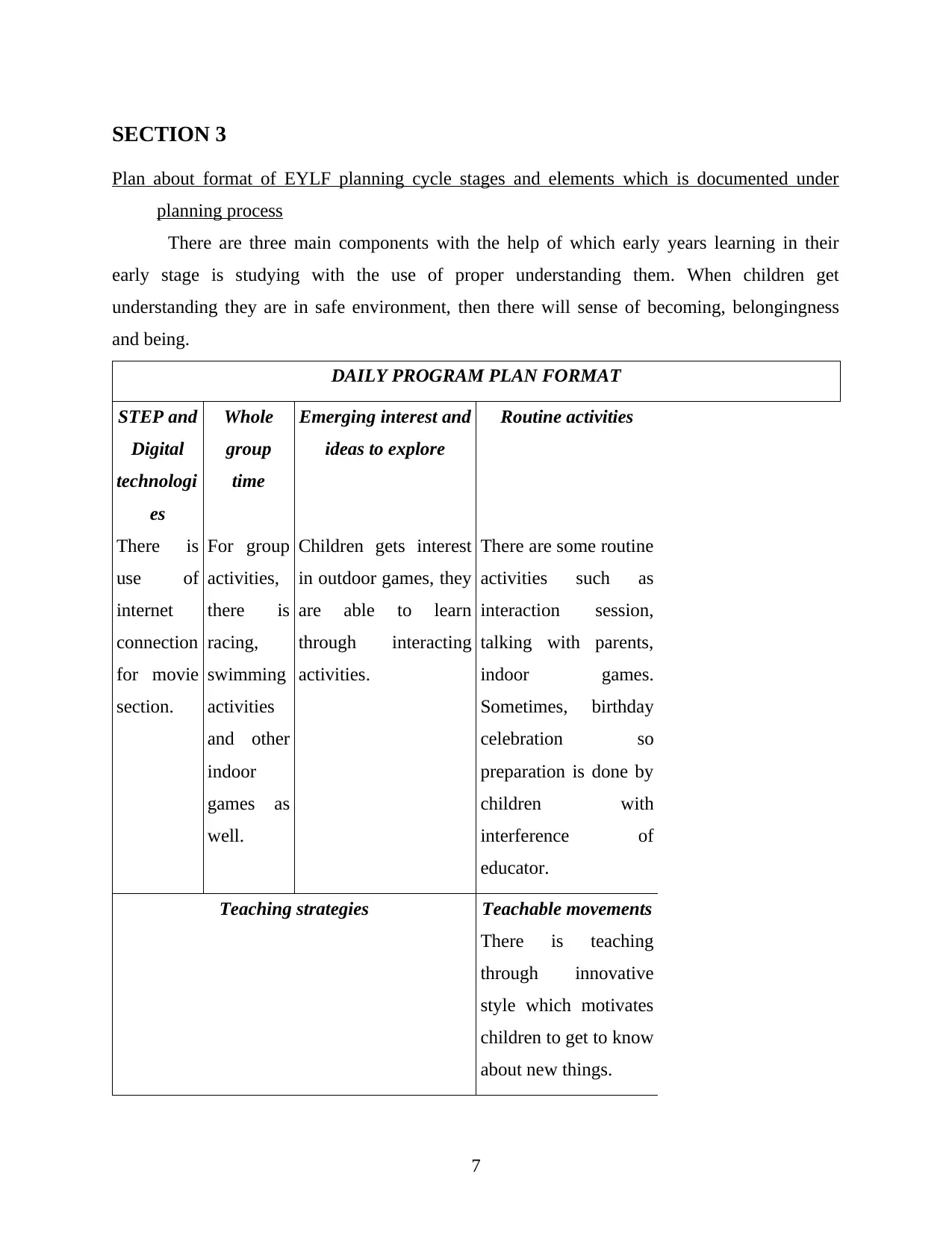
DAILY PROGRAM PLAN FORMAT
STEP and
Digital
technologi
es
There is
use of
internet
connection
for movie
section.
Whole
group
time
For group
activities,
there is
racing,
swimming
activities
and other
indoor
games as
well.
Emerging interest and
ideas to explore
Children gets interest
in outdoor games, they
are able to learn
through interacting
activities.
Routine activities
There are some routine
activities such as
interaction session,
talking with parents,
indoor games.
Sometimes, birthday
celebration so
preparation is done by
children with
interference of
educator.
Teaching strategies Teachable movements
There is teaching
through innovative
style which motivates
children to get to know
about new things.
7
tabler-icon-diamond-filled.svg

Paraphrase This Document

Need a fresh take? Get an instant paraphrase of this document with our AI Paraphraser
Document Page
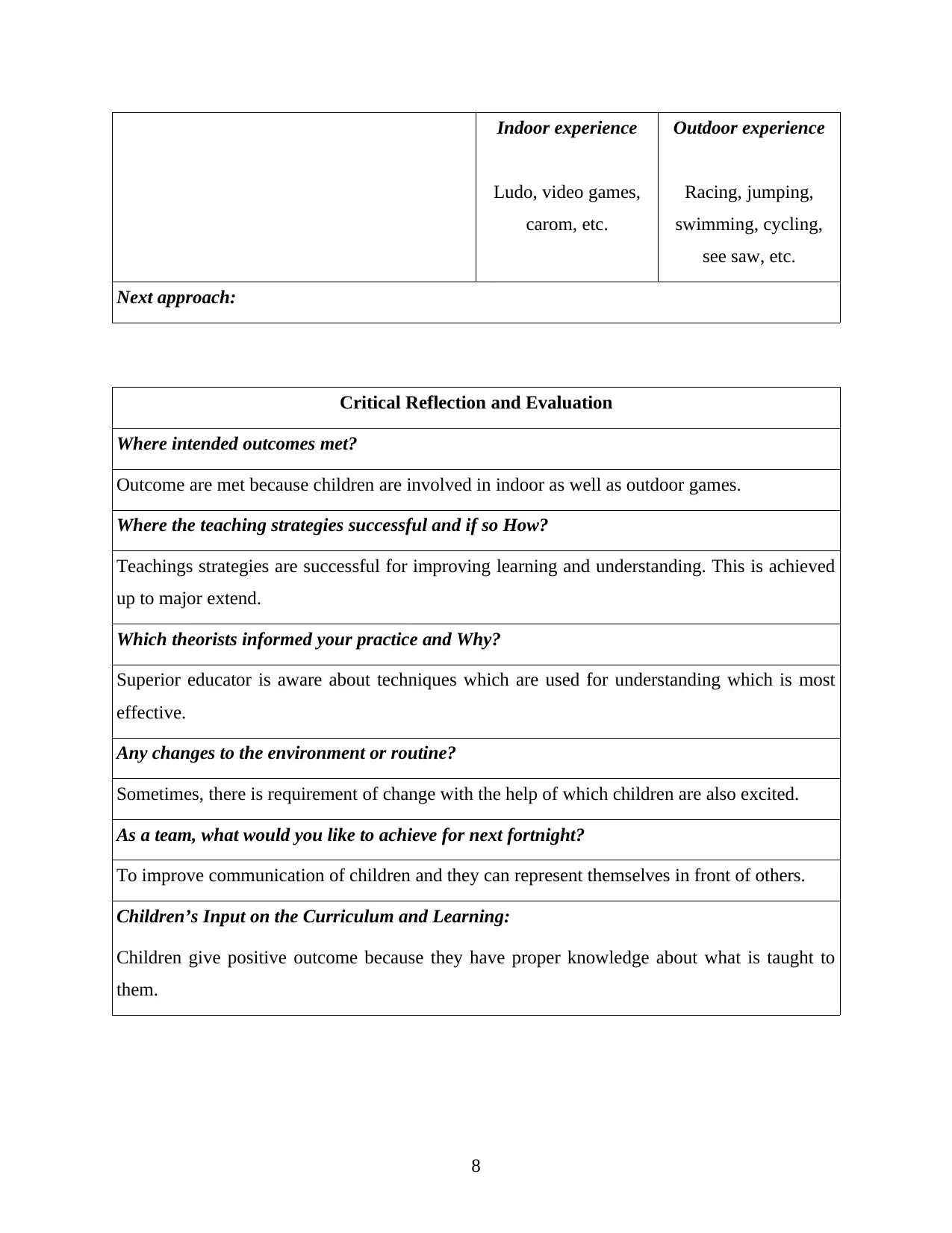
Indoor experience
Ludo, video games,
carom, etc.
Outdoor experience
Racing, jumping,
swimming, cycling,
see saw, etc.
Next approach:
Critical Reflection and Evaluation
Where intended outcomes met?
Outcome are met because children are involved in indoor as well as outdoor games.
Where the teaching strategies successful and if so How?
Teachings strategies are successful for improving learning and understanding. This is achieved
up to major extend.
Which theorists informed your practice and Why?
Superior educator is aware about techniques which are used for understanding which is most
effective.
Any changes to the environment or routine?
Sometimes, there is requirement of change with the help of which children are also excited.
As a team, what would you like to achieve for next fortnight?
To improve communication of children and they can represent themselves in front of others.
Children’s Input on the Curriculum and Learning:
Children give positive outcome because they have proper knowledge about what is taught to
them.
8
Document Page
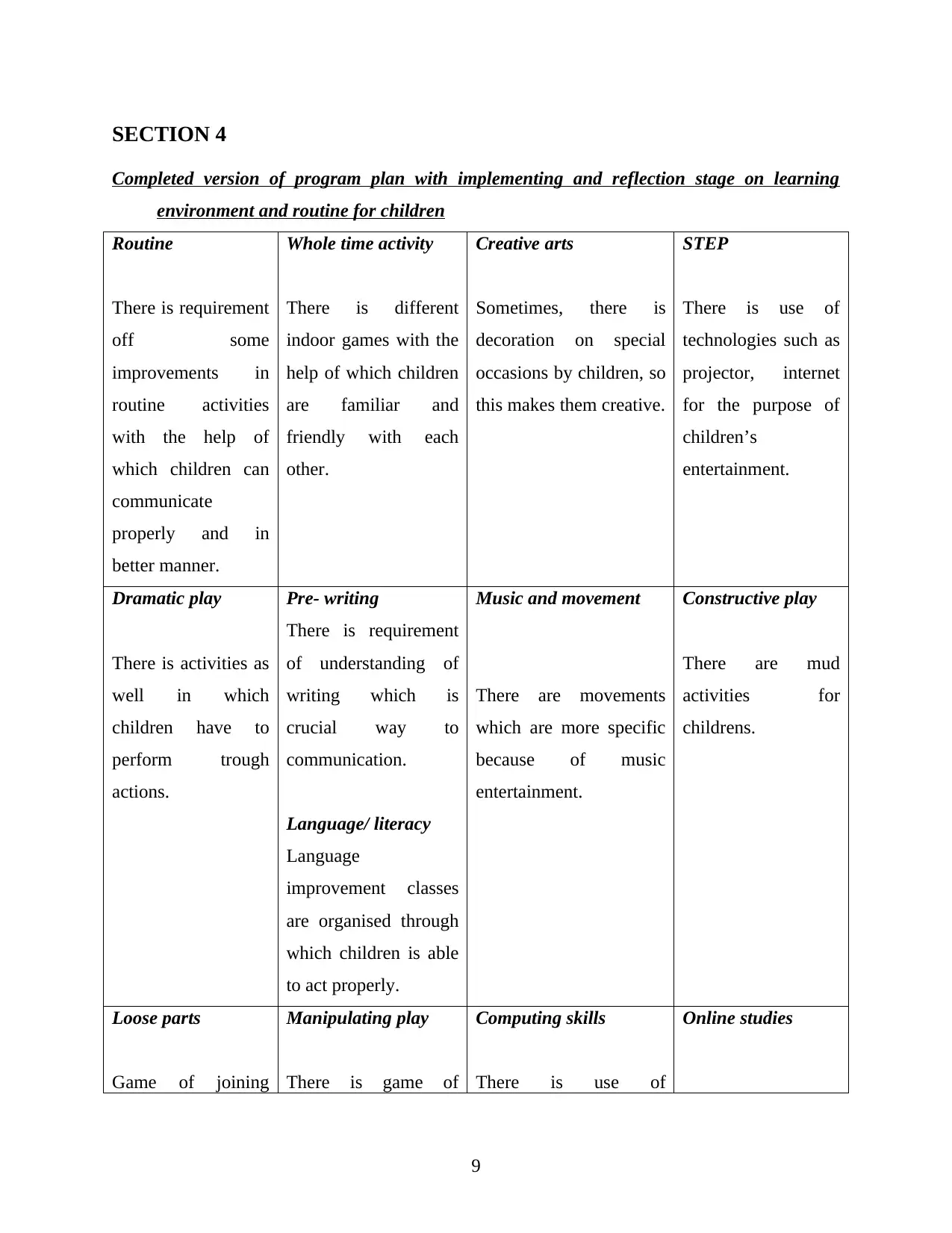
SECTION 4
Completed version of program plan with implementing and reflection stage on learning
environment and routine for children
Routine
There is requirement
off some
improvements in
routine activities
with the help of
which children can
communicate
properly and in
better manner.
Whole time activity
There is different
indoor games with the
help of which children
are familiar and
friendly with each
other.
Creative arts
Sometimes, there is
decoration on special
occasions by children, so
this makes them creative.
STEP
There is use of
technologies such as
projector, internet
for the purpose of
children’s
entertainment.
Dramatic play
There is activities as
well in which
children have to
perform trough
actions.
Pre- writing
There is requirement
of understanding of
writing which is
crucial way to
communication.
Language/ literacy
Language
improvement classes
are organised through
which children is able
to act properly.
Music and movement
There are movements
which are more specific
because of music
entertainment.
Constructive play
There are mud
activities for
childrens.
Loose parts
Game of joining
Manipulating play
There is game of
Computing skills
There is use of
Online studies
9
chevron_up_icon
1 out of 15
circle_padding
hide_on_mobile
zoom_out_icon
[object Object]