University Report: Effects of Caffeine on the Central Nervous System

Verified

Added on  2023/04/24

|8
|760
|389
Report
AI Summary
This report delves into the effects of caffeine on the central nervous system (CNS). It begins with an introduction to caffeine, highlighting its presence in various plants and its impact on the human body, including increased metabolism, heart rate, and blood pressure. The report then explores the mechanism of action, explaining how caffeine acts as a stimulant by inhibiting adenosine receptors, reducing fatigue, and influencing memory, learning, wakefulness, and motor coordination. It further discusses caffeine-containing drugs like Ergotamine and Fiorinal, and concludes by summarizing caffeine's effects on energy metabolism, the activation of noradrenaline neurons, and its impact on sleep and anxiety. The report references several studies to support its findings.
Document Page
Effects of caffeine on
CNS
Name of the student
Name of the university
tabler-icon-diamond-filled.svg

Paraphrase This Document

Need a fresh take? Get an instant paraphrase of this document with our AI Paraphraser
Document Page
Introduction
Caffeine is a chemical/drug obtained in plants
It is harmful for animals and humans when
consumed in large amounts
The drug increases body actions such as,
metabolism, heart rate, and blood pressure
It is the active ingredient present in coffee and is
also obtained from guarana, yerba maté, and
cacao
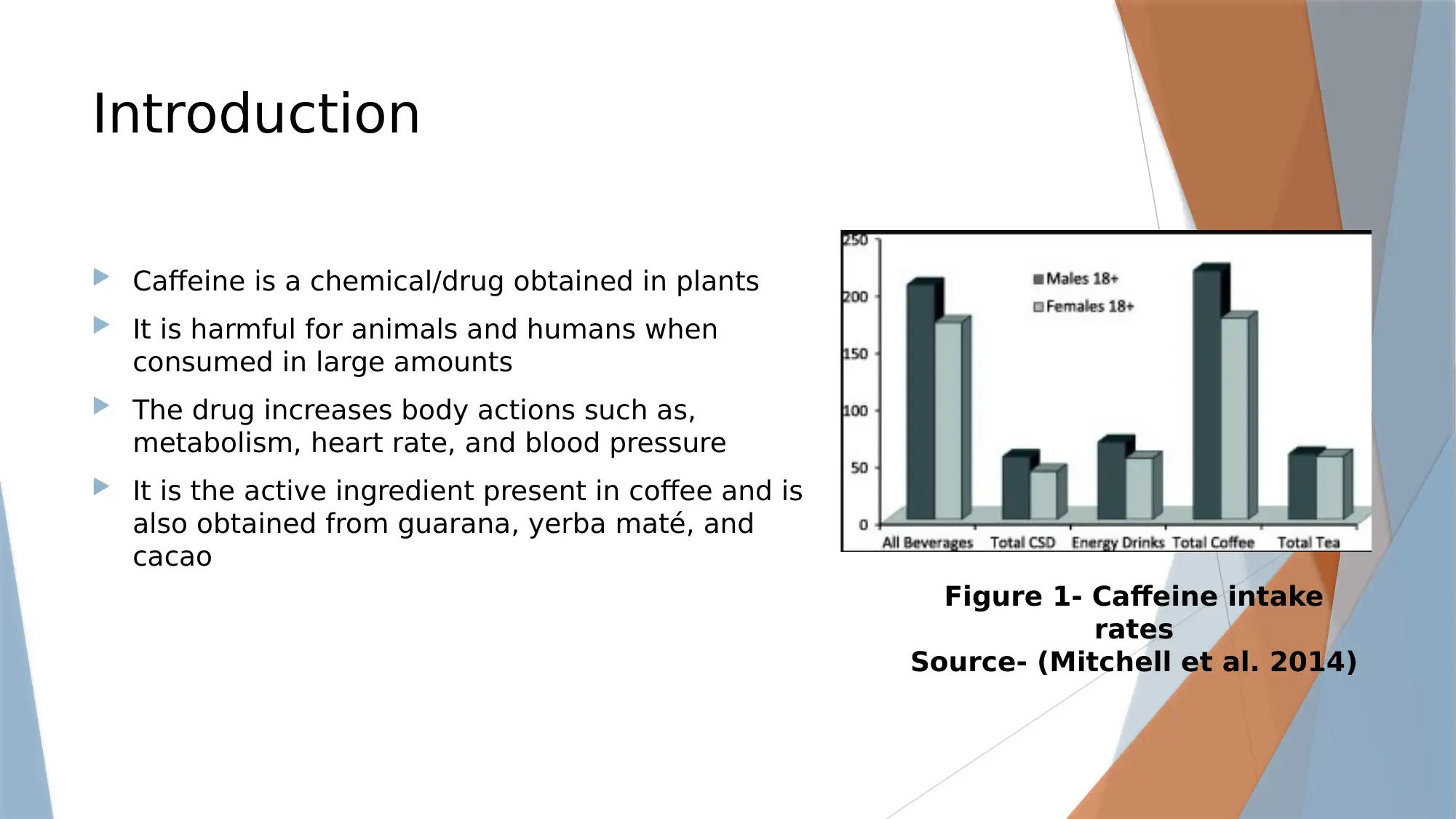
Figure 1- Caffeine intake
rates
Source- (Mitchell et al. 2014)
Document Page
Mechanism of action (1)
It acts as a stimulant of the central nervous
system
It belongs to the class of methylxanthine and is
one of the most widely consumed psychoactive
drug (Haller et al. 2014)
It reversibly inhibits the action and functioning
of adenosine on specific receptors
It also prevents drowsiness that is commonly
induced by adenosine
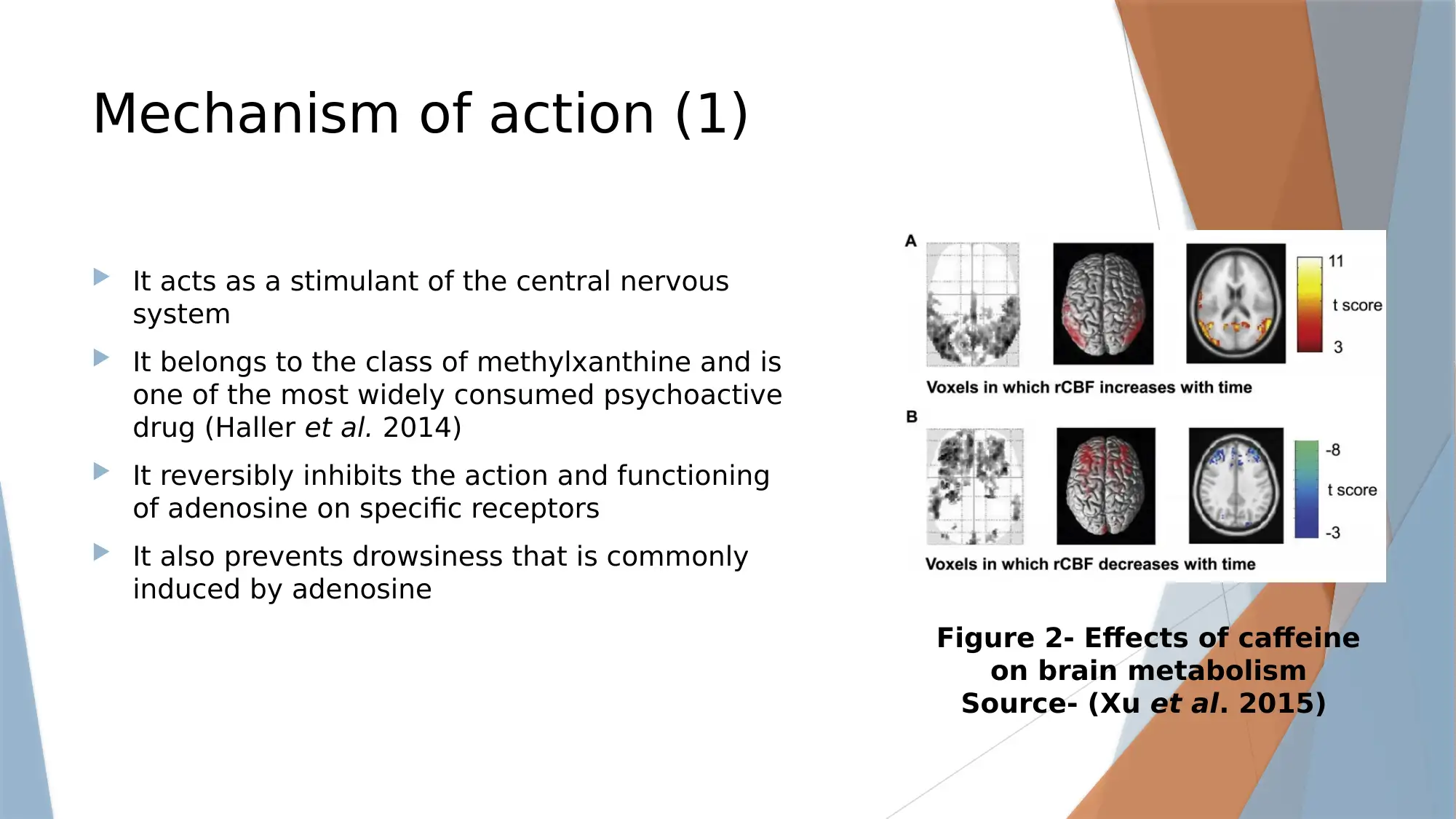
Figure 2- Effects of caffeine
on brain metabolism
Source- (Xu et al. 2015)
Document Page
Mechanism of action (2)
By acting on the central nervous system it substantially reduces
fatigue
It creates variable impact on memory and learning
Wakefulness, reaction time, motor coordination, and concentration
increases over time
Desired impacts are felt after an hour of consumption
The effects typically subsidise after an estimated 3-4 hours (Zhang et
al. 2016)
It also promotes task switching, alertness and attention
tabler-icon-diamond-filled.svg

Paraphrase This Document

Need a fresh take? Get an instant paraphrase of this document with our AI Paraphraser
Document Page
Caffeine containing drugs
Two drugs that contain caffeine are Ergotamine
and Fiorinal
Ergotamine belong to the class of drugs
commonly referred to as ergot alkaloids.
It narrows the blood vessels that surround the
brain and also treats migraine associated
headaches
Fiorinal comprises of a combination of
butalbital, aspirin, and caffeine and is typically
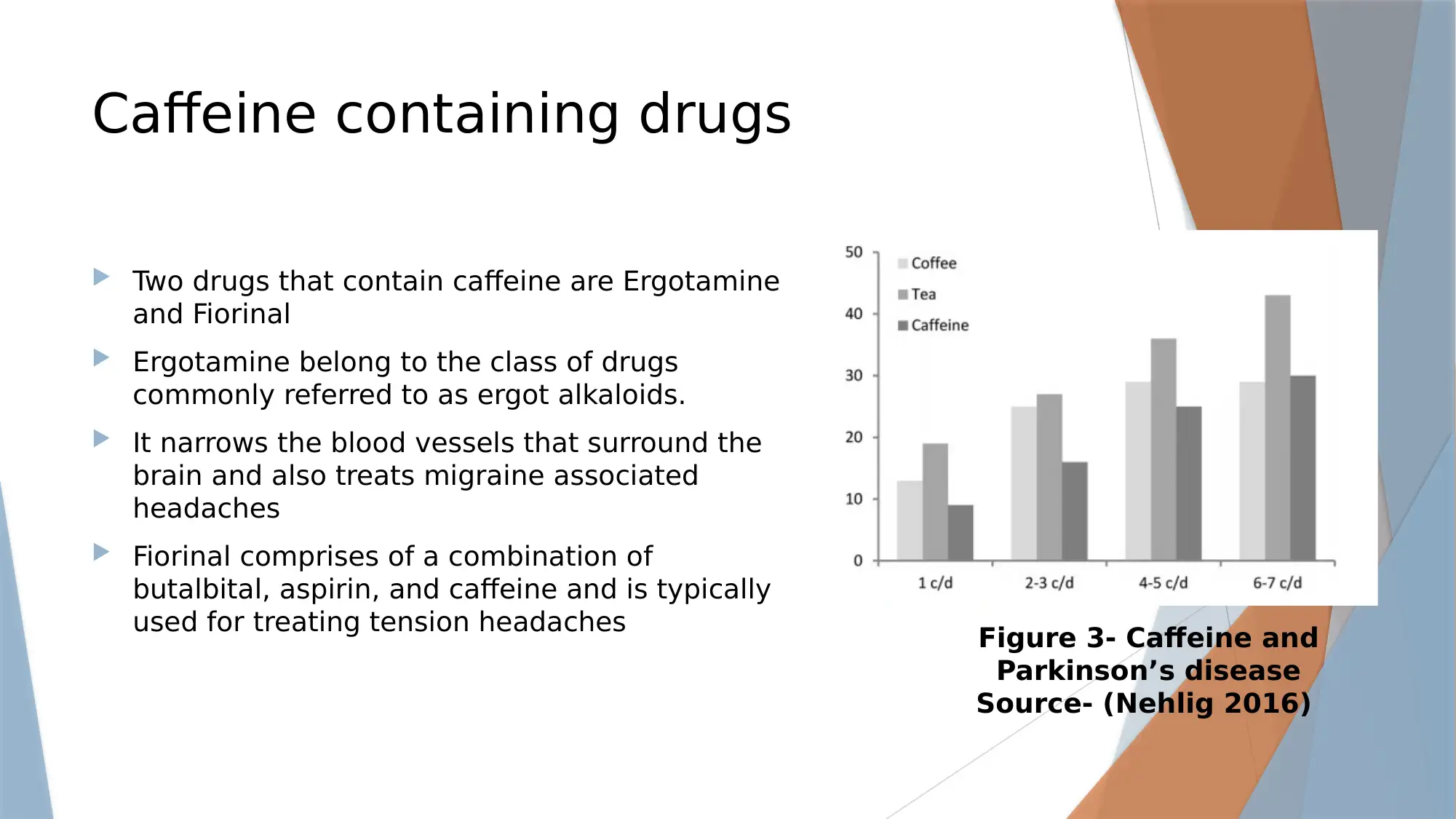
used for treating tension headaches Figure 3- Caffeine and
Parkinson’s disease
Source- (Nehlig 2016)
Document Page
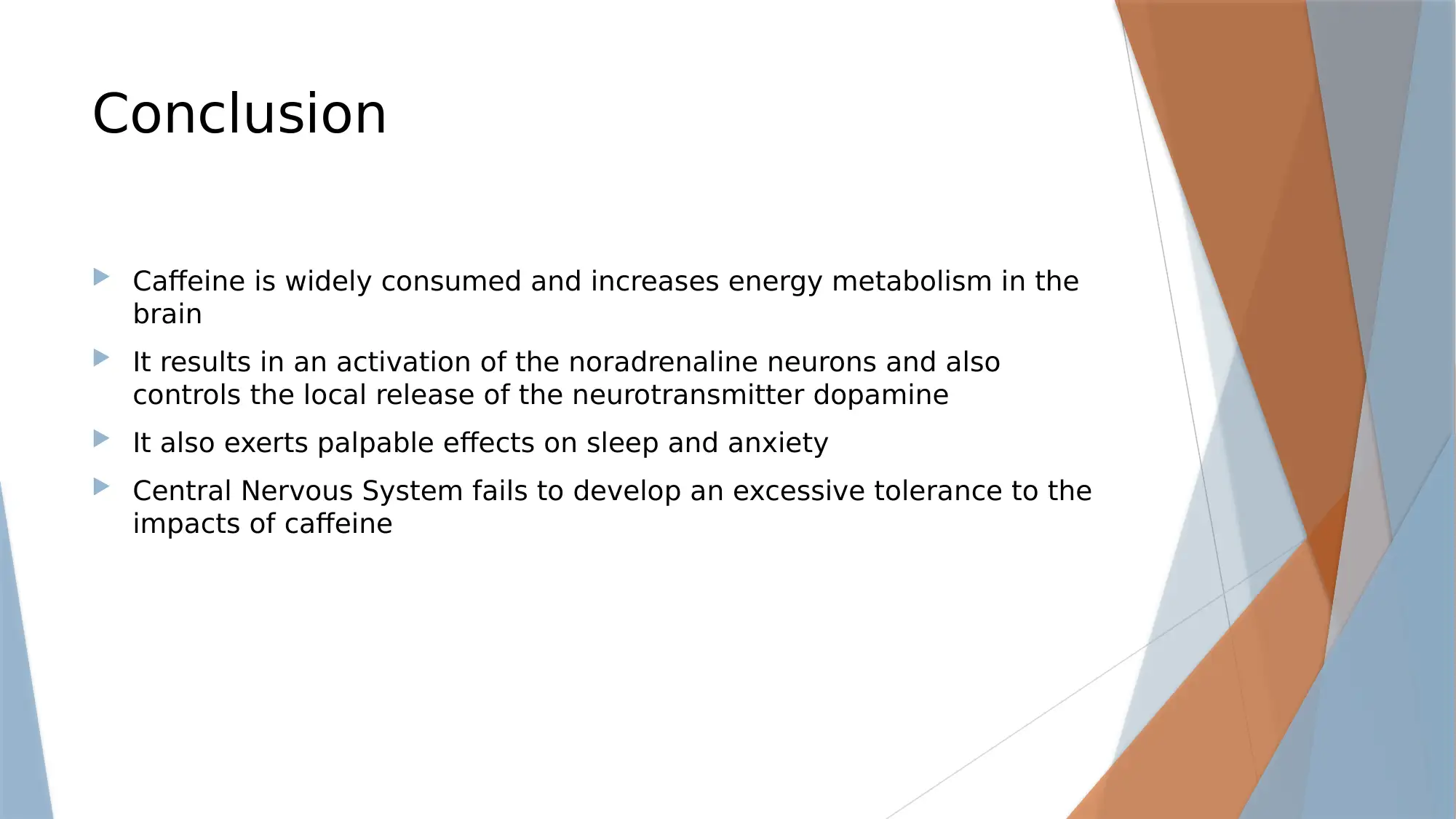
Conclusion
Caffeine is widely consumed and increases energy metabolism in the
brain
It results in an activation of the noradrenaline neurons and also
controls the local release of the neurotransmitter dopamine
It also exerts palpable effects on sleep and anxiety
Central Nervous System fails to develop an excessive tolerance to the
impacts of caffeine
Document Page
References
Haller, S., Montandon, M.L., Rodriguez, C., Moser, D., Toma, S., Hofmeister, J., Sinanaj, I., Lovblad, K.O.
and Giannakopoulos, P., 2014. Acute caffeine administration effect on brain activation patterns in mild
cognitive impairment. Journal of Alzheimer's Disease, 41(1), pp.101-112.
Kaster, M.P., Machado, N.J., Silva, H.B., Nunes, A., Ardais, A.P., Santana, M., Baqi, Y., Müller, C.E.,
Rodrigues, A.L.S., Porciúncula, L.O. and Chen, J.F., 2015. Caffeine acts through neuronal adenosine
A2A receptors to prevent mood and memory dysfunction triggered by chronic stress. Proceedings of
the National Academy of Sciences, 112(25), pp.7833-7838.
Mitchell, D.C., Knight, C.A., Hockenberry, J., Teplansky, R. and Hartman, T.J., 2014. Beverage caffeine
intakes in the US. Food and Chemical Toxicology, 63, pp.136-142.
Nehlig, A., 2016. Effects of coffee/caffeine on brain health and disease: What should I tell my
patients?. Practical neurology, 16(2), pp.89-95.
Rivera-Oliver, M. and Díaz-Ríos, M., 2014. Using caffeine and other adenosine receptor antagonists
and agonists as therapeutic tools against neurodegenerative diseases: a review. Life sciences, 101(1-
2), pp.1-9.
Robbins, L., 2015. Cluster Headache. In Advanced Headache Therapy (pp. 129-139). Springer, Cham.
Xu, F., Liu, P., Pekar, J.J. and Lu, H., 2015. Does acute caffeine ingestion alter brain metabolism in
young adults?. Neuroimage, 110, pp.39-47.
Zhang, J.J., Muenzner, J.K., el Maaty, M.A.A., Karge, B., Schobert, R., Wölfl, S. and Ott, I., 2016. A multi-
target caffeine derived rhodium (I) N-heterocyclic carbene complex: evaluation of the mechanism of
action. Dalton Transactions, 45(33), pp.13161-13168.
tabler-icon-diamond-filled.svg

Paraphrase This Document

Need a fresh take? Get an instant paraphrase of this document with our AI Paraphraser
Document Page
Thank you!
chevron_up_icon
1 out of 8
circle_padding
hide_on_mobile
zoom_out_icon
[object Object]