Strategies for Promoting Ego Integrity in Assisted Living Residents

Verified

Added on  2022/12/26

|18
|1308
|59
Presentation
AI Summary
This presentation examines the concept of ego integrity within the context of assisted living facilities, focusing on residents with varying needs for physical assistance and activities of daily living (ADLs). It explores the objectives of such facilities, emphasizing the promotion of ego integrity, as defined by Erikson's psychosocial theory, which is crucial for older adults. The presentation delves into ADLs, the importance of resolving regrets, and the variables that influence ego integrity, such as age, health, and marital status. It also covers measurement scales, psychosocial needs, and strategies for enhancing the well-being of older adults, including individual and group activities like walking clubs and reminiscence. The presentation highlights the significance of staff attitudes and the role of activities in ensuring the older adults' satisfaction and overall quality of life. It concludes by reinforcing the relevance of Erikson's stage eight in the context of assisted living, with references to supporting research.
Document Page
Ego Integrity Presentation
Name of the Student
tabler-icon-diamond-filled.svg

Paraphrase This Document

Need a fresh take? Get an instant paraphrase of this document with our AI Paraphraser
Document Page
Introduction
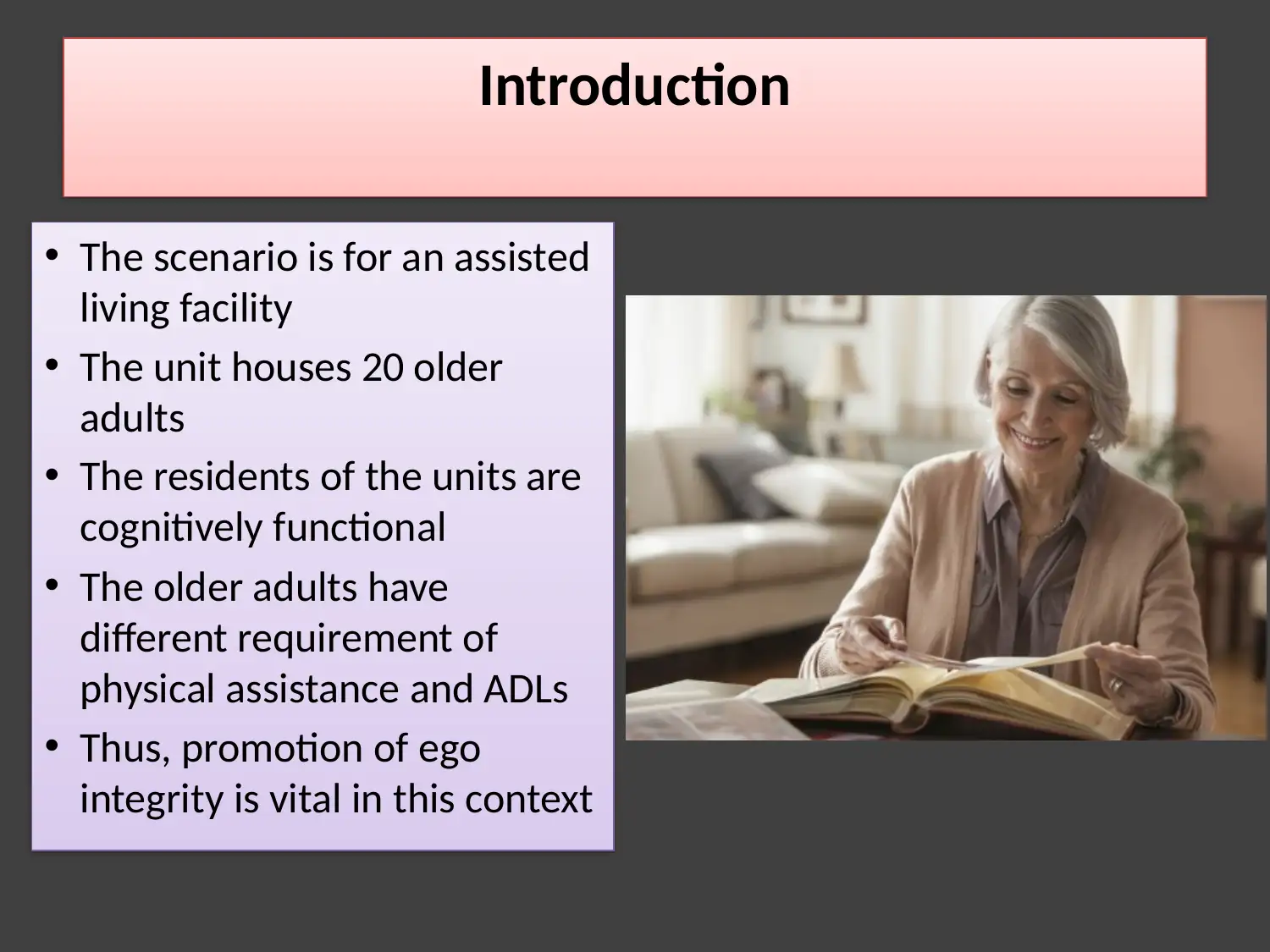
The scenario is for an assisted
living facility
The unit houses 20 older
adults
The residents of the units are
cognitively functional
The older adults have
different requirement of
physical assistance and ADLs
Thus, promotion of ego
integrity is vital in this context
Document Page
Objectives of the assisted living facility
The major objectives are-
To understand the varying degrees of physical
assistance with ADLs
To promote the ego integrity (Westerhof,
Bohlmeijer, & McAdams, 2017)
To facilitate the individual and group activities
Document Page
Determination of ADLs and support for Ego
Integrity
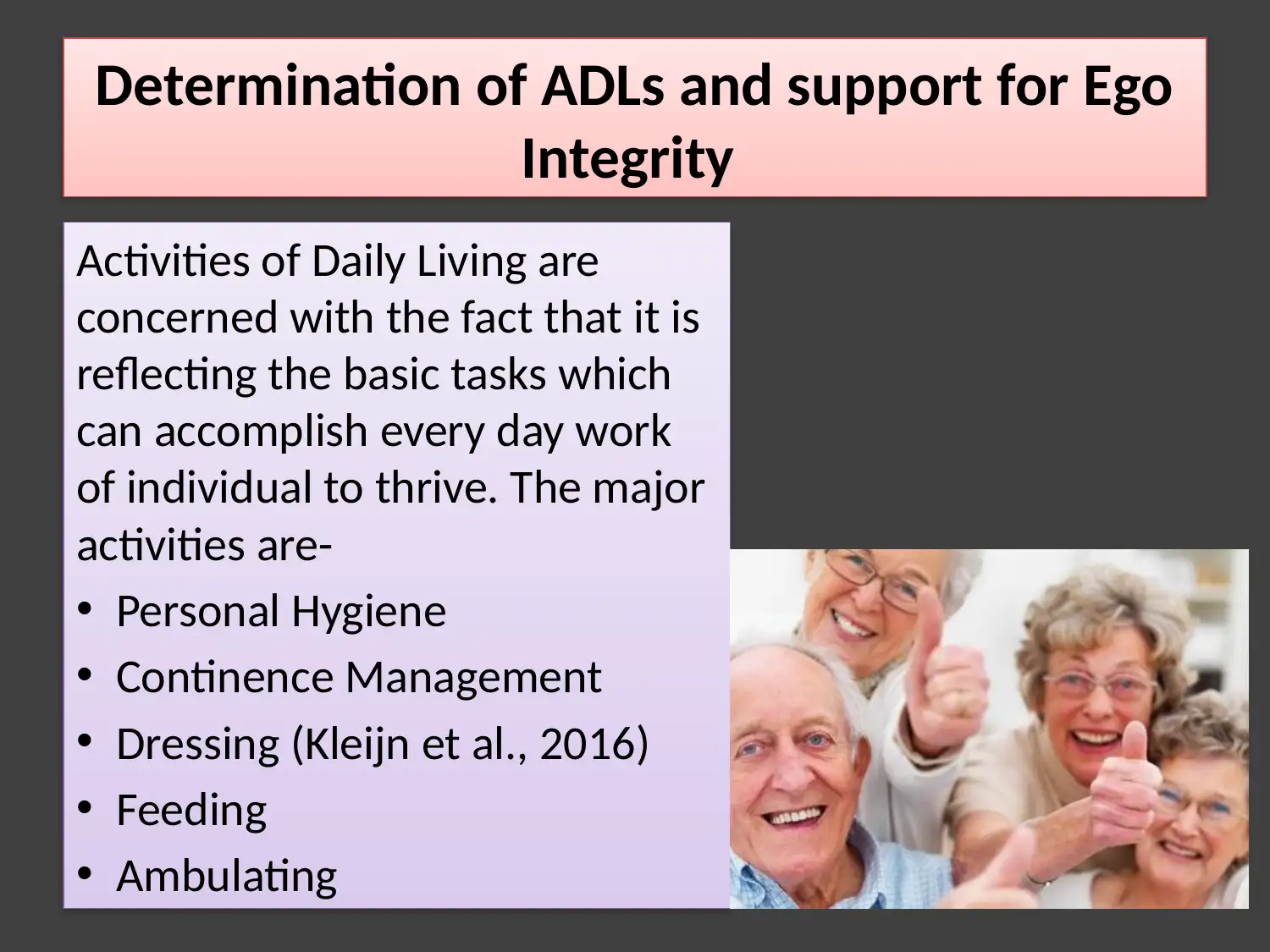
Activities of Daily Living are
concerned with the fact that it is
reflecting the basic tasks which
can accomplish every day work
of individual to thrive. The major
activities are-
Personal Hygiene
Continence Management
Dressing (Kleijn et al., 2016)
Feeding
Ambulating
tabler-icon-diamond-filled.svg

Paraphrase This Document

Need a fresh take? Get an instant paraphrase of this document with our AI Paraphraser
Document Page
Ego Integrity development and associated
theory
It is mainly concerned as coming to
terms with one’s life (Chan &
Nakamura, 2015)
It is prevalent among the older
adults of assisted living facility
A preoccupation with the past
experience have been observed in
this context
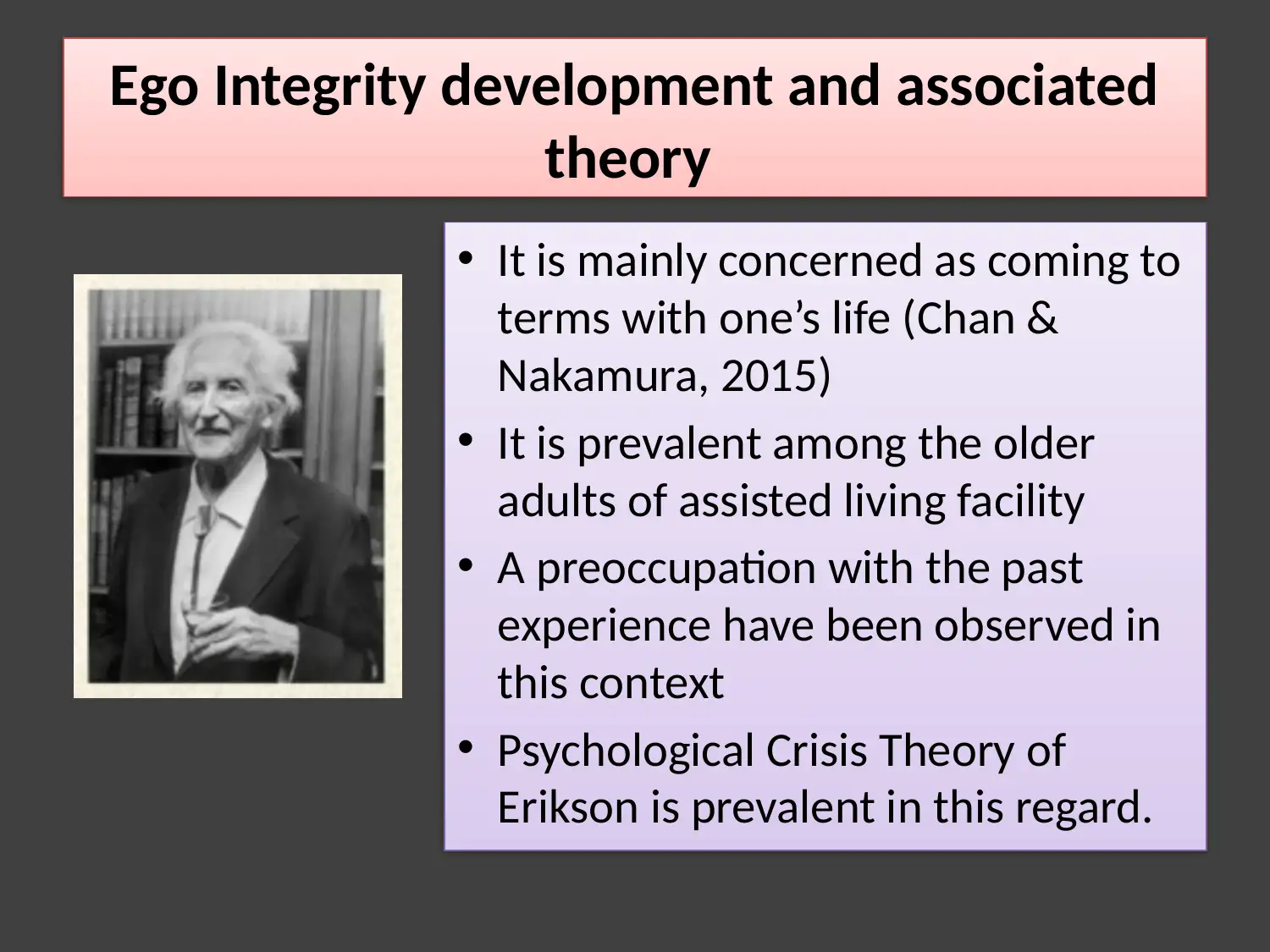
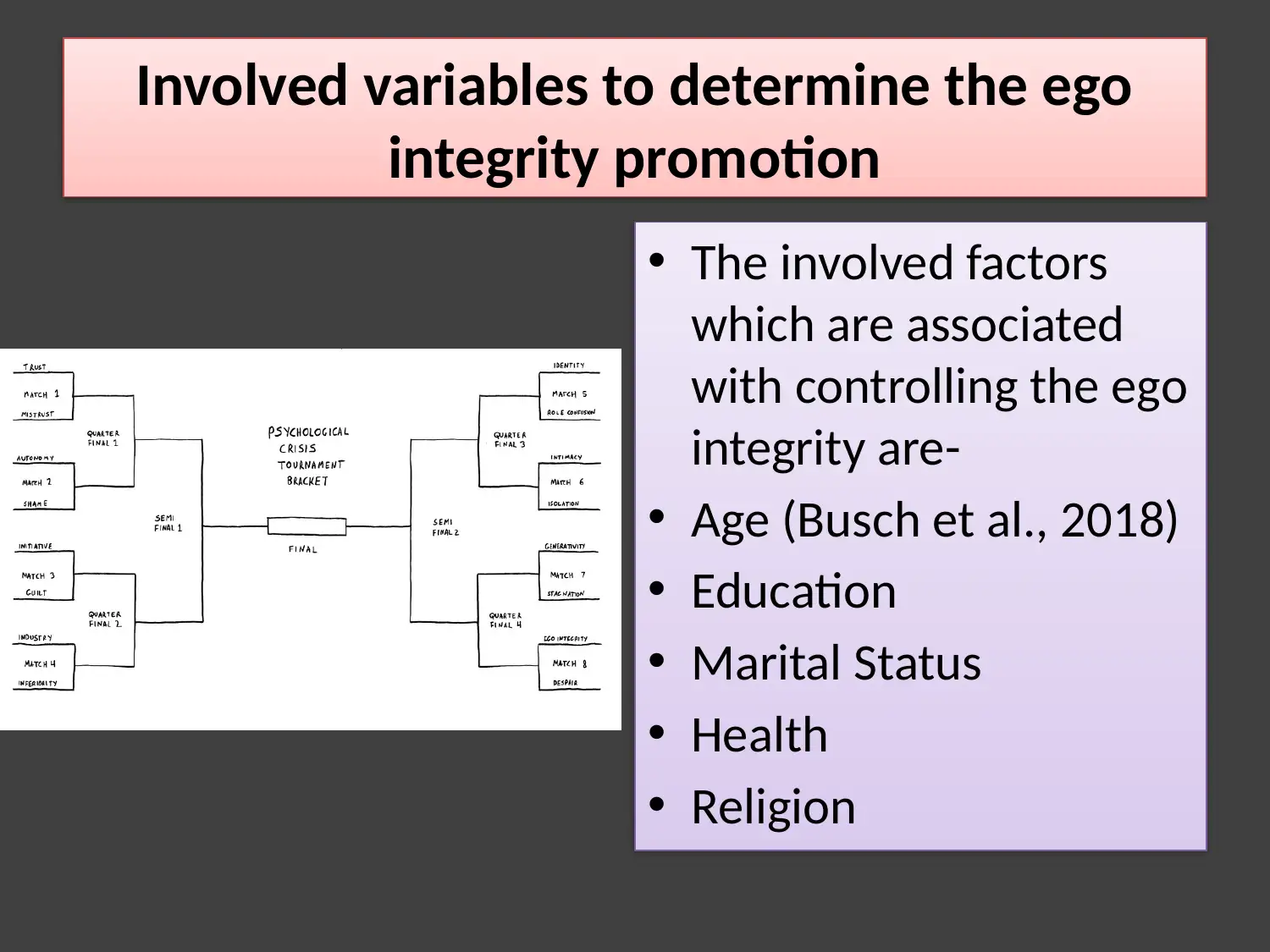
Psychological Crisis Theory of
Erikson is prevalent in this regard.
Document Page
Achieving Ego Integrity through personality
development
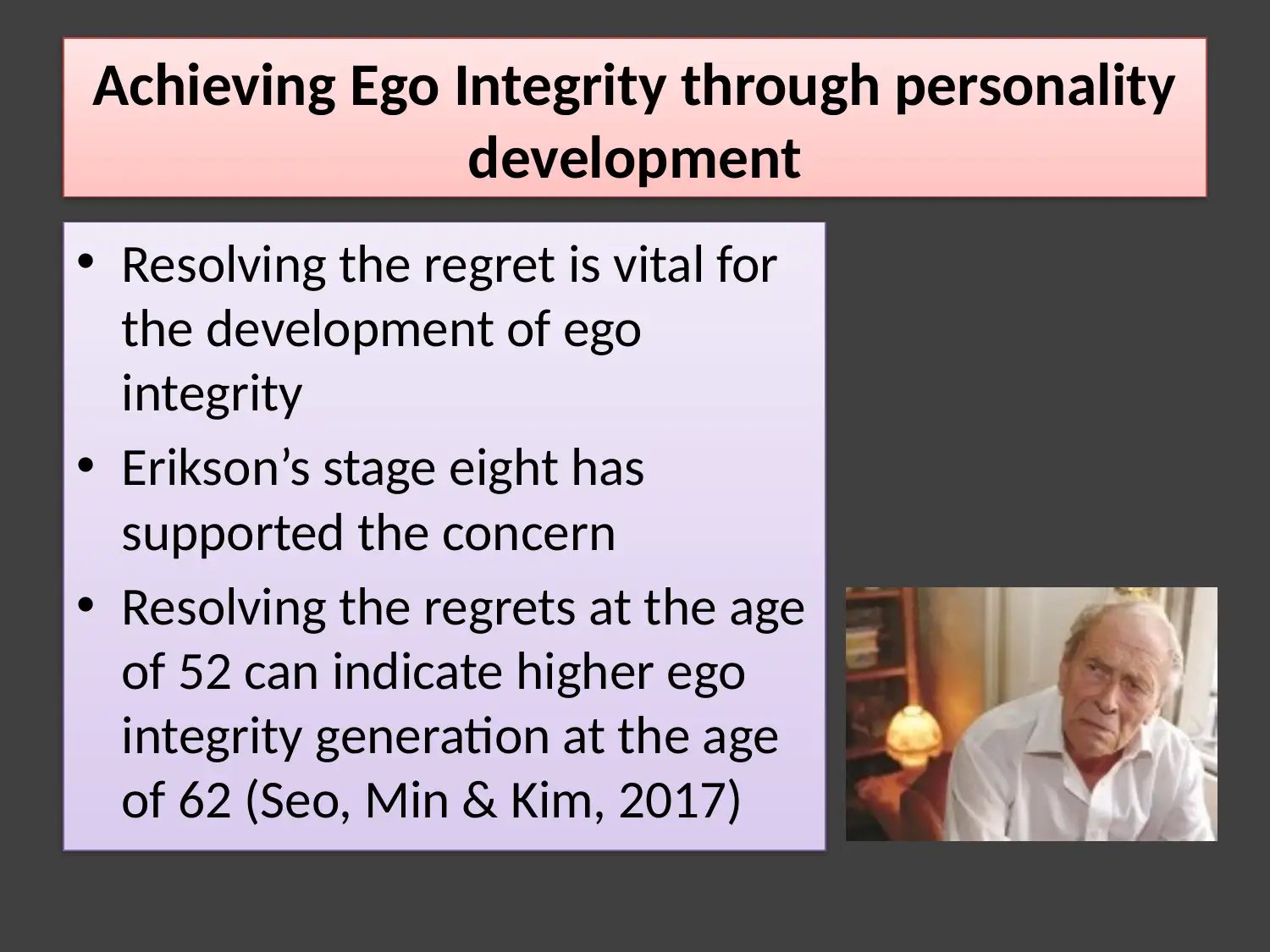
Resolving the regret is vital for
the development of ego
integrity
Erikson’s stage eight has
supported the concern
Resolving the regrets at the age
of 52 can indicate higher ego
integrity generation at the age
of 62 (Seo, Min & Kim, 2017)
Document Page
Involved variables to determine the ego
integrity promotion
The involved factors
which are associated
with controlling the ego
integrity are-
Age (Busch et al., 2018)
Education
Marital Status
Health
Religion
tabler-icon-diamond-filled.svg

Paraphrase This Document

Need a fresh take? Get an instant paraphrase of this document with our AI Paraphraser
Document Page
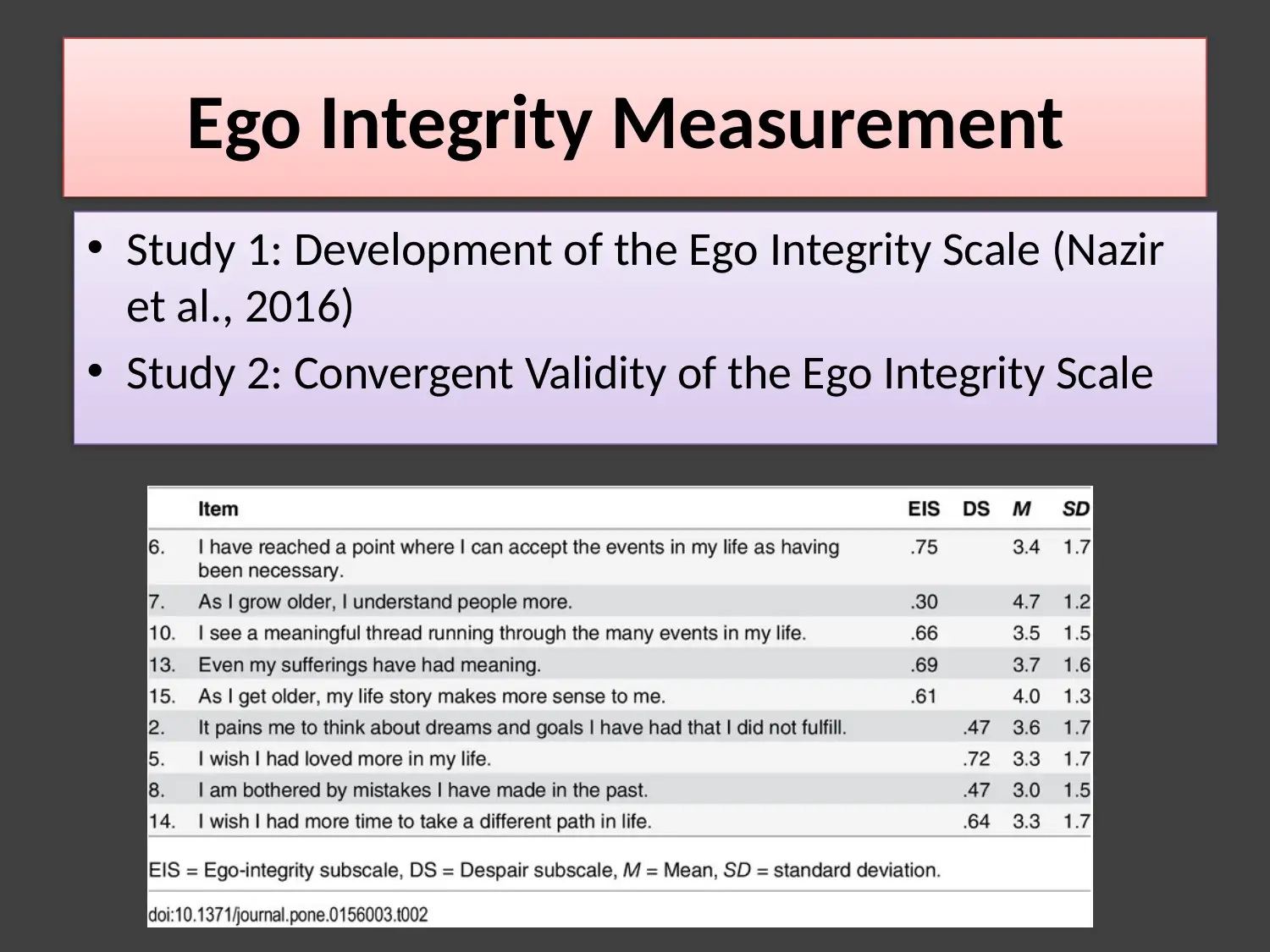
Ego Integrity Measurement
Study 1: Development of the Ego Integrity Scale (Nazir
et al., 2016)
Study 2: Convergent Validity of the Ego Integrity Scale
Document Page
Development of the Ego Integrity Scale
Mainly two steps are involved
Step one is associated with the generation of
the items to develop the Ego Integrity Scale
(Nazir et al., 2016)
Step two is linked with Reliability, Factor
Structure and Convergent Validity
Document Page
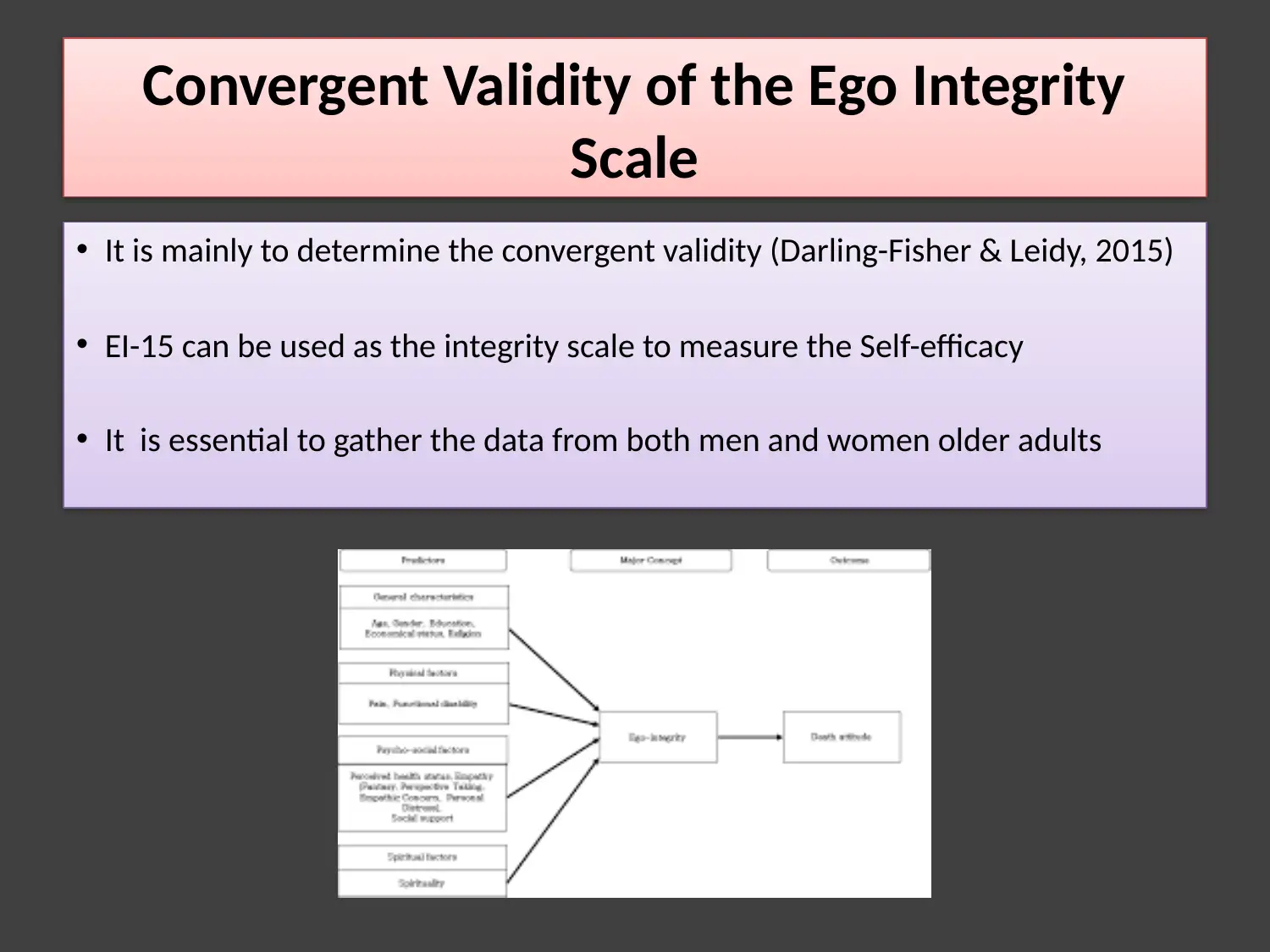
Convergent Validity of the Ego Integrity
Scale
It is mainly to determine the convergent validity (Darling-Fisher & Leidy, 2015)
EI-15 can be used as the integrity scale to measure the Self-efficacy
It is essential to gather the data from both men and women older adults
tabler-icon-diamond-filled.svg

Paraphrase This Document

Need a fresh take? Get an instant paraphrase of this document with our AI Paraphraser
Document Page
Psychosocial needs for the older Adults
Based on the scale the ego integrity can be
determined
It is helpful to live healthier (Vuksanovic, Dyck
M., & Green, 2015)
Strategies development for the Ego Integrity
generation is possible through this
Document Page
Developmental task of the older adults
It is necessary for the staff members to concentrate
towards the own attitude determination (Andrew &
Meeks, 2018)
It so vital for long-term care community support
Sense of satisfaction from regular life and occupational
practices are essential
Restriction towards the physical declination through
aging must be developed
Satisfaction generation during the past life
accomplishment is vital
chevron_up_icon
1 out of 18
circle_padding
hide_on_mobile
zoom_out_icon
[object Object]