Elements of Thoughts: Application in Military Decision Making Report

Verified

Added on  2020/02/19

|4
|543
|208
Report
AI Summary
This report delves into the elements of thoughts as defined by Paul and Elder, examining their application, particularly within the context of military decision-making. The analysis explores the challenges in applying these elements, such as reasoning, evidence, and critical thinking, in real-world scenarios where decisions may be influenced by factors beyond pure logic. The report highlights the limitations of the elements of thoughts in critical army decisions, emphasizing that while they provide a foundational guideline, other factors like strategy and diplomacy play significant roles. It concludes that army officials are not actively influenced by the 8 elements of thoughts, however passively they follow the guidelines provided by Paul and Elder. The report also references key sources like Bertoch et al. (2014) and Vego (2013) to support its arguments.

Document Page
Running head: ELEMENTS OF THOUGHTS
Elements of Thoughts
Name of the student:
Name of the University:
Author Note:
tabler-icon-diamond-filled.svg

Paraphrase This Document

Need a fresh take? Get an instant paraphrase of this document with our AI Paraphraser
Document Page
1ELEMENTS OF THOUGHTS
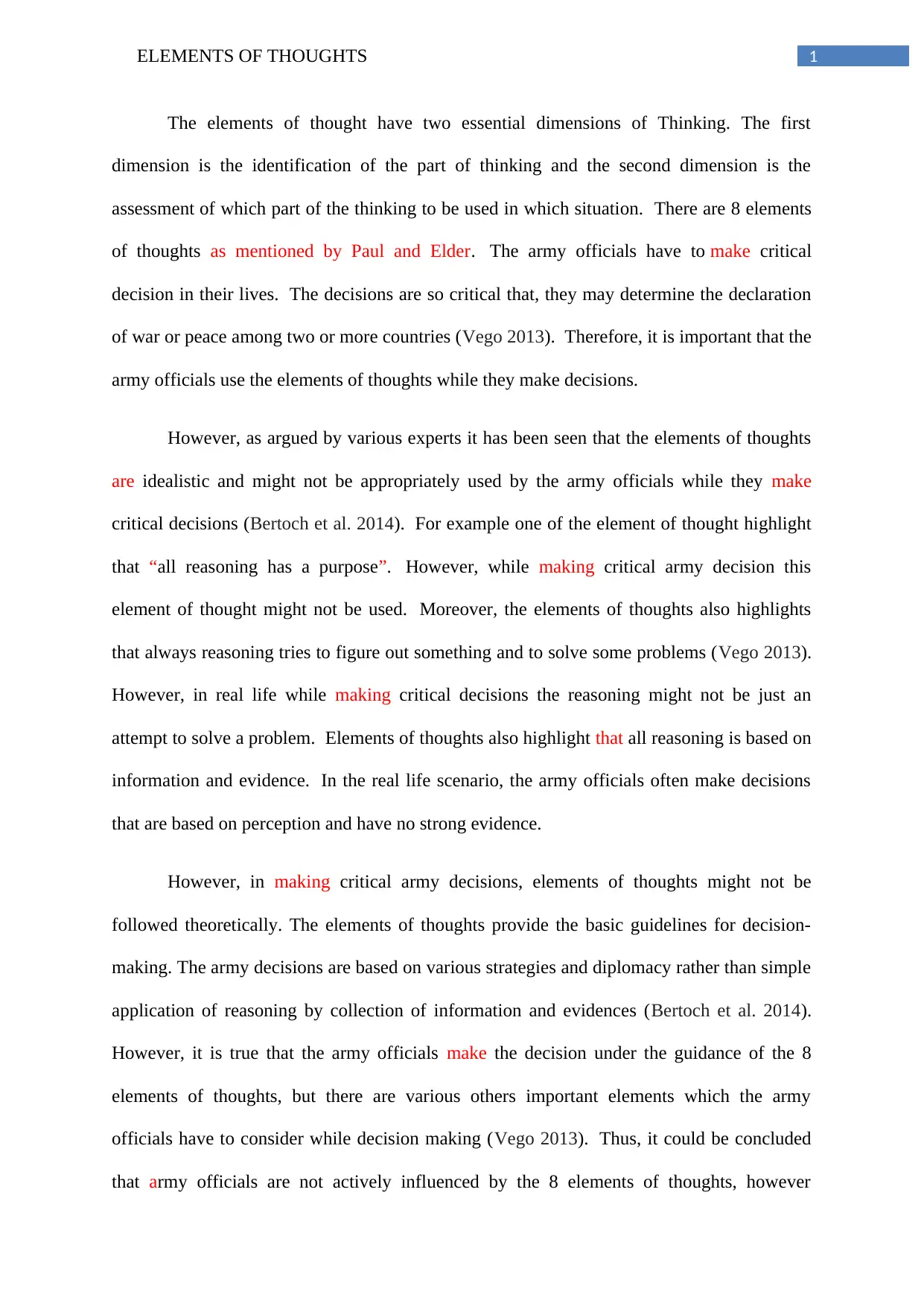
The elements of thought have two essential dimensions of Thinking. The first
dimension is the identification of the part of thinking and the second dimension is the
assessment of which part of the thinking to be used in which situation. There are 8 elements
of thoughts as mentioned by Paul and Elder. The army officials have to make critical
decision in their lives. The decisions are so critical that, they may determine the declaration
of war or peace among two or more countries (Vego 2013). Therefore, it is important that the
army officials use the elements of thoughts while they make decisions.
However, as argued by various experts it has been seen that the elements of thoughts
are idealistic and might not be appropriately used by the army officials while they make
critical decisions (Bertoch et al. 2014). For example one of the element of thought highlight
that all reasoning has a purpose. However, while making critical army decision this
element of thought might not be used. Moreover, the elements of thoughts also highlights
that always reasoning tries to figure out something and to solve some problems (Vego 2013).
However, in real life while making critical decisions the reasoning might not be just an
attempt to solve a problem. Elements of thoughts also highlight that all reasoning is based on
information and evidence. In the real life scenario, the army officials often make decisions
that are based on perception and have no strong evidence.
However, in making critical army decisions, elements of thoughts might not be
followed theoretically. The elements of thoughts provide the basic guidelines for decision-
making. The army decisions are based on various strategies and diplomacy rather than simple
application of reasoning by collection of information and evidences (Bertoch et al. 2014).
However, it is true that the army officials make the decision under the guidance of the 8
elements of thoughts, but there are various others important elements which the army
officials have to consider while decision making (Vego 2013). Thus, it could be concluded
that army officials are not actively influenced by the 8 elements of thoughts, however
Document Page
2ELEMENTS OF THOUGHTS
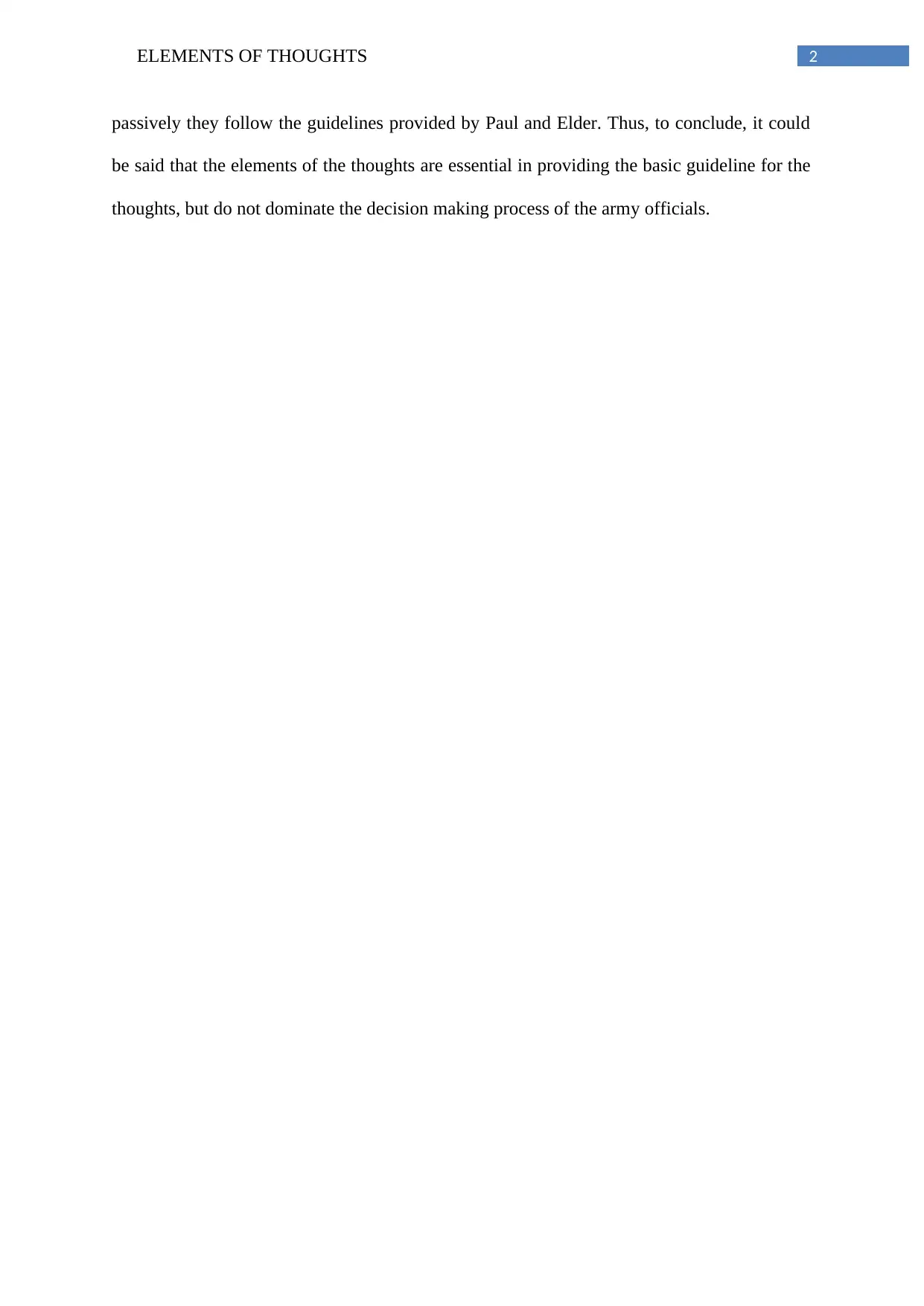
passively they follow the guidelines provided by Paul and Elder. Thus, to conclude, it could
be said that the elements of the thoughts are essential in providing the basic guideline for the
thoughts, but do not dominate the decision making process of the army officials.
Document Page
3ELEMENTS OF THOUGHTS
References
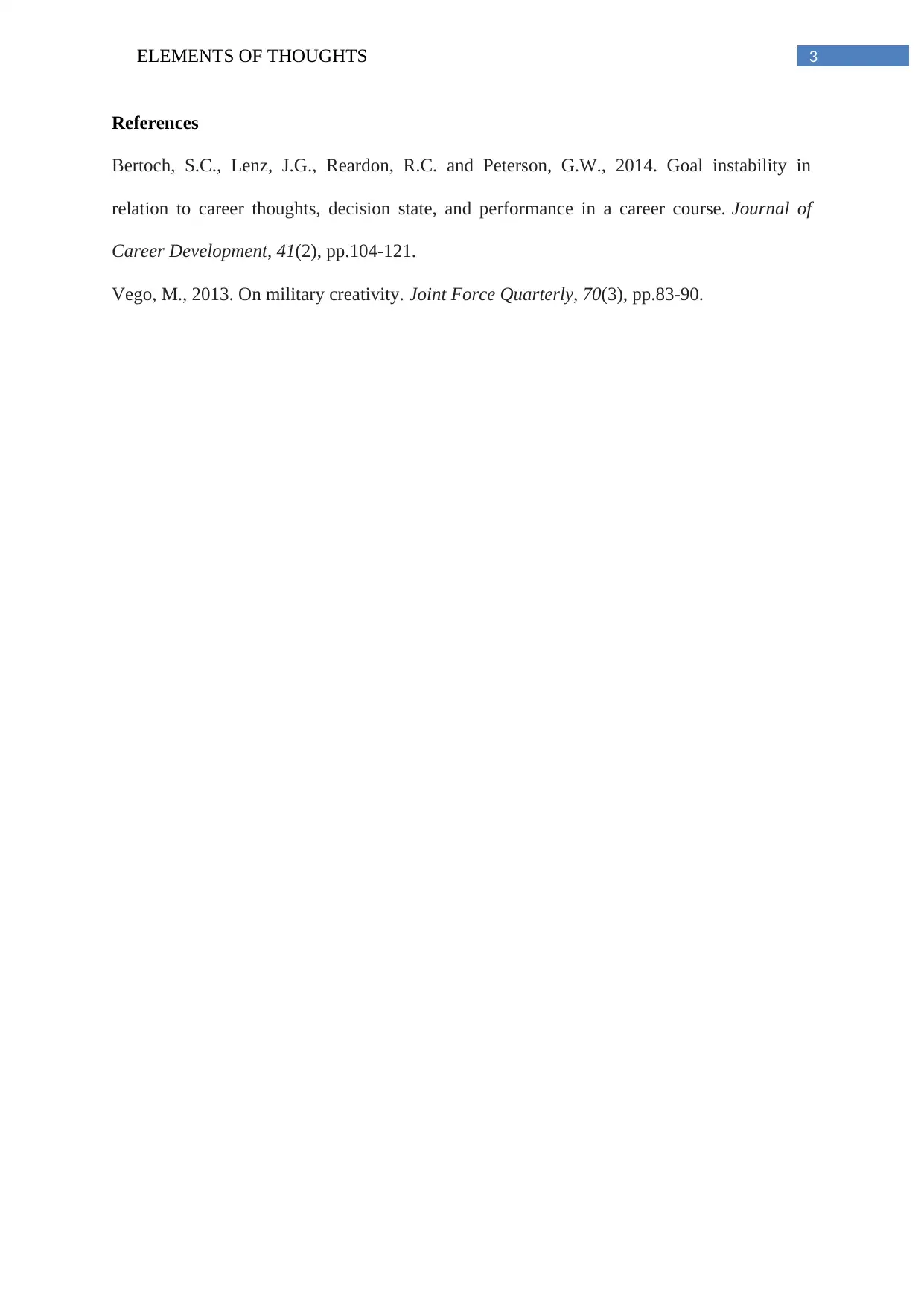
Bertoch, S.C., Lenz, J.G., Reardon, R.C. and Peterson, G.W., 2014. Goal instability in
relation to career thoughts, decision state, and performance in a career course. Journal of
Career Development, 41(2), pp.104-121.
Vego, M., 2013. On military creativity. Joint Force Quarterly, 70(3), pp.83-90.
chevron_up_icon
1 out of 4
circle_padding
hide_on_mobile
zoom_out_icon
[object Object]