Contemporary Culture's Embodiment of Disability: An Analytical Essay
VerifiedAdded on  2021/06/14
|6
|1259
|82
Essay
AI Summary
This essay delves into the concept of embodiment of disability, drawing upon the work of Jasbir Puar to analyze its impact on contemporary culture. It explores how disability is experienced and understood within social contexts, emphasizing the role of sign language, cultural constructions, and the influence of neoliberalism. The essay examines concepts such as transformation, extension, and reconstruction in relation to disabled bodies, addressing issues of discrimination, education, and ethical considerations. It highlights the importance of inclusion, social justice, and the development of inclusive environments, while also considering the impact of public culture and education programs on shaping perceptions and responses to disability. The analysis incorporates various perspectives including biopolitics, challenging environments, and the application of minority models to foster a comprehensive understanding of the embodiment of disability and its implications for individuals and society.
Running Head: EMBODIMENT DISABILITY 1
EMBODIMENT DISABILITY
NAME
INSTITUTION AFFILIATION
COURSE
DATE
EMBODIMENT DISABILITY
NAME
INSTITUTION AFFILIATION
COURSE
DATE
Paraphrase This Document
Need a fresh take? Get an instant paraphrase of this document with our AI Paraphraser

EMBODIMENT DISABILITY 2
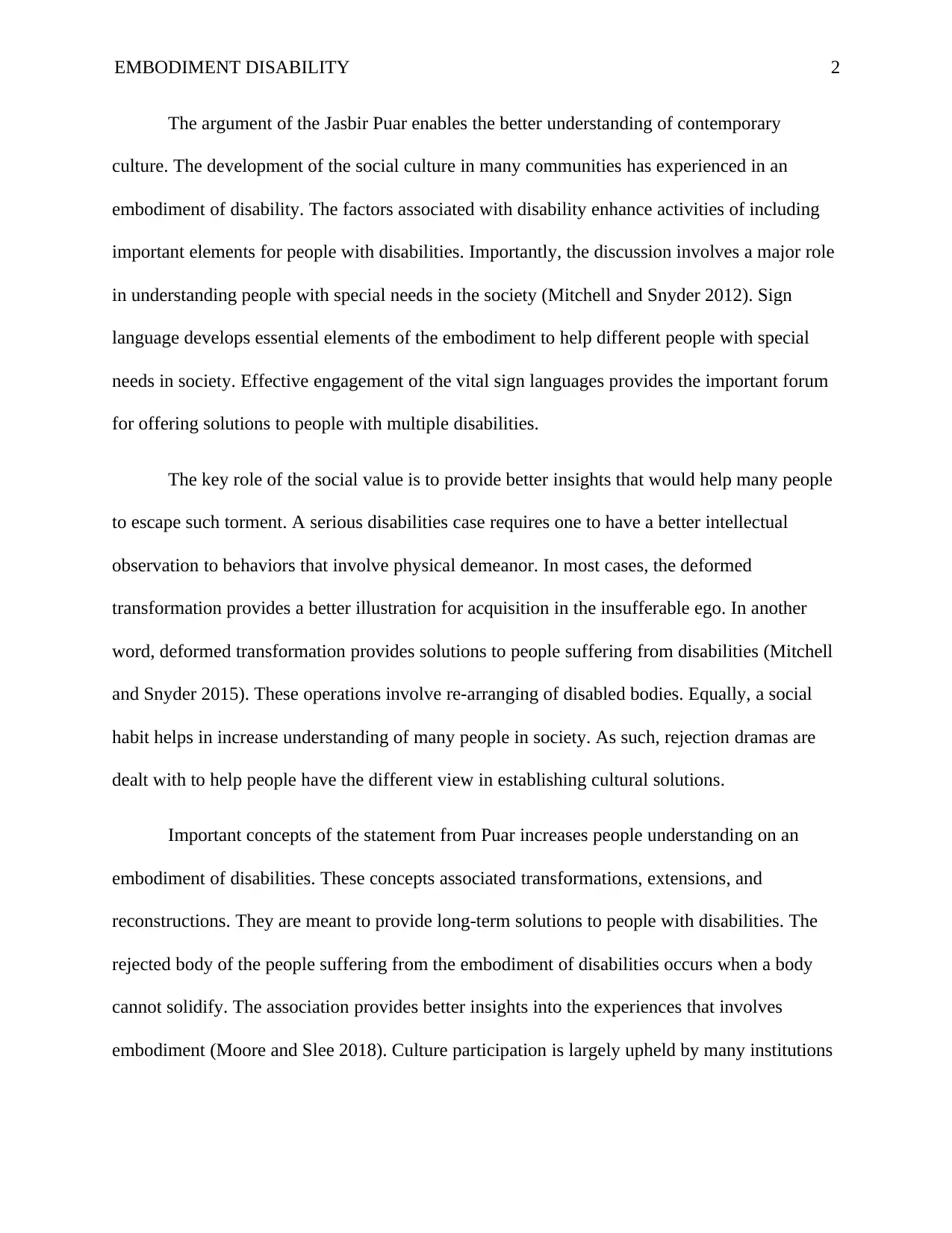
The argument of the Jasbir Puar enables the better understanding of contemporary
culture. The development of the social culture in many communities has experienced in an
embodiment of disability. The factors associated with disability enhance activities of including
important elements for people with disabilities. Importantly, the discussion involves a major role
in understanding people with special needs in the society (Mitchell and Snyder 2012). Sign
language develops essential elements of the embodiment to help different people with special
needs in society. Effective engagement of the vital sign languages provides the important forum
for offering solutions to people with multiple disabilities.
The key role of the social value is to provide better insights that would help many people
to escape such torment. A serious disabilities case requires one to have a better intellectual
observation to behaviors that involve physical demeanor. In most cases, the deformed
transformation provides a better illustration for acquisition in the insufferable ego. In another
word, deformed transformation provides solutions to people suffering from disabilities (Mitchell
and Snyder 2015). These operations involve re-arranging of disabled bodies. Equally, a social
habit helps in increase understanding of many people in society. As such, rejection dramas are
dealt with to help people have the different view in establishing cultural solutions.
Important concepts of the statement from Puar increases people understanding on an
embodiment of disabilities. These concepts associated transformations, extensions, and
reconstructions. They are meant to provide long-term solutions to people with disabilities. The
rejected body of the people suffering from the embodiment of disabilities occurs when a body
cannot solidify. The association provides better insights into the experiences that involves
embodiment (Moore and Slee 2018). Culture participation is largely upheld by many institutions
The argument of the Jasbir Puar enables the better understanding of contemporary
culture. The development of the social culture in many communities has experienced in an
embodiment of disability. The factors associated with disability enhance activities of including
important elements for people with disabilities. Importantly, the discussion involves a major role
in understanding people with special needs in the society (Mitchell and Snyder 2012). Sign
language develops essential elements of the embodiment to help different people with special
needs in society. Effective engagement of the vital sign languages provides the important forum
for offering solutions to people with multiple disabilities.
The key role of the social value is to provide better insights that would help many people
to escape such torment. A serious disabilities case requires one to have a better intellectual
observation to behaviors that involve physical demeanor. In most cases, the deformed
transformation provides a better illustration for acquisition in the insufferable ego. In another
word, deformed transformation provides solutions to people suffering from disabilities (Mitchell
and Snyder 2015). These operations involve re-arranging of disabled bodies. Equally, a social
habit helps in increase understanding of many people in society. As such, rejection dramas are
dealt with to help people have the different view in establishing cultural solutions.
Important concepts of the statement from Puar increases people understanding on an
embodiment of disabilities. These concepts associated transformations, extensions, and
reconstructions. They are meant to provide long-term solutions to people with disabilities. The
rejected body of the people suffering from the embodiment of disabilities occurs when a body
cannot solidify. The association provides better insights into the experiences that involves
embodiment (Moore and Slee 2018). Culture participation is largely upheld by many institutions

EMBODIMENT DISABILITY 3
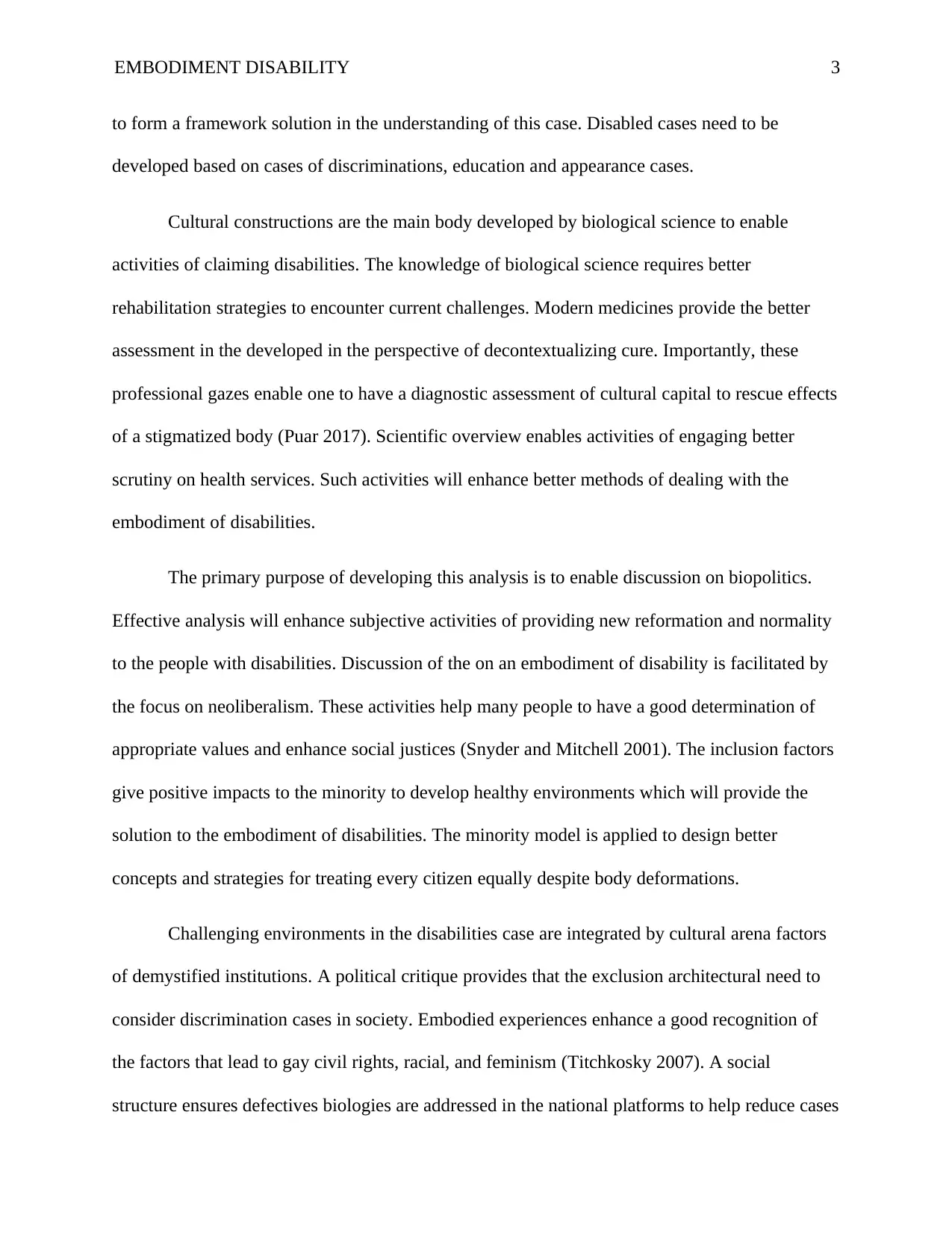
to form a framework solution in the understanding of this case. Disabled cases need to be
developed based on cases of discriminations, education and appearance cases.
Cultural constructions are the main body developed by biological science to enable
activities of claiming disabilities. The knowledge of biological science requires better
rehabilitation strategies to encounter current challenges. Modern medicines provide the better
assessment in the developed in the perspective of decontextualizing cure. Importantly, these
professional gazes enable one to have a diagnostic assessment of cultural capital to rescue effects
of a stigmatized body (Puar 2017). Scientific overview enables activities of engaging better
scrutiny on health services. Such activities will enhance better methods of dealing with the
embodiment of disabilities.
The primary purpose of developing this analysis is to enable discussion on biopolitics.
Effective analysis will enhance subjective activities of providing new reformation and normality
to the people with disabilities. Discussion of the on an embodiment of disability is facilitated by
the focus on neoliberalism. These activities help many people to have a good determination of
appropriate values and enhance social justices (Snyder and Mitchell 2001). The inclusion factors
give positive impacts to the minority to develop healthy environments which will provide the
solution to the embodiment of disabilities. The minority model is applied to design better
concepts and strategies for treating every citizen equally despite body deformations.
Challenging environments in the disabilities case are integrated by cultural arena factors
of demystified institutions. A political critique provides that the exclusion architectural need to
consider discrimination cases in society. Embodied experiences enhance a good recognition of
the factors that lead to gay civil rights, racial, and feminism (Titchkosky 2007). A social
structure ensures defectives biologies are addressed in the national platforms to help reduce cases
to form a framework solution in the understanding of this case. Disabled cases need to be
developed based on cases of discriminations, education and appearance cases.
Cultural constructions are the main body developed by biological science to enable
activities of claiming disabilities. The knowledge of biological science requires better
rehabilitation strategies to encounter current challenges. Modern medicines provide the better
assessment in the developed in the perspective of decontextualizing cure. Importantly, these
professional gazes enable one to have a diagnostic assessment of cultural capital to rescue effects
of a stigmatized body (Puar 2017). Scientific overview enables activities of engaging better
scrutiny on health services. Such activities will enhance better methods of dealing with the
embodiment of disabilities.
The primary purpose of developing this analysis is to enable discussion on biopolitics.
Effective analysis will enhance subjective activities of providing new reformation and normality
to the people with disabilities. Discussion of the on an embodiment of disability is facilitated by
the focus on neoliberalism. These activities help many people to have a good determination of
appropriate values and enhance social justices (Snyder and Mitchell 2001). The inclusion factors
give positive impacts to the minority to develop healthy environments which will provide the
solution to the embodiment of disabilities. The minority model is applied to design better
concepts and strategies for treating every citizen equally despite body deformations.
Challenging environments in the disabilities case are integrated by cultural arena factors
of demystified institutions. A political critique provides that the exclusion architectural need to
consider discrimination cases in society. Embodied experiences enhance a good recognition of
the factors that lead to gay civil rights, racial, and feminism (Titchkosky 2007). A social
structure ensures defectives biologies are addressed in the national platforms to help reduce cases
⊘ This is a preview!⊘
Do you want full access?
Subscribe today to unlock all pages.

Trusted by 1+ million students worldwide

EMBODIMENT DISABILITY 4
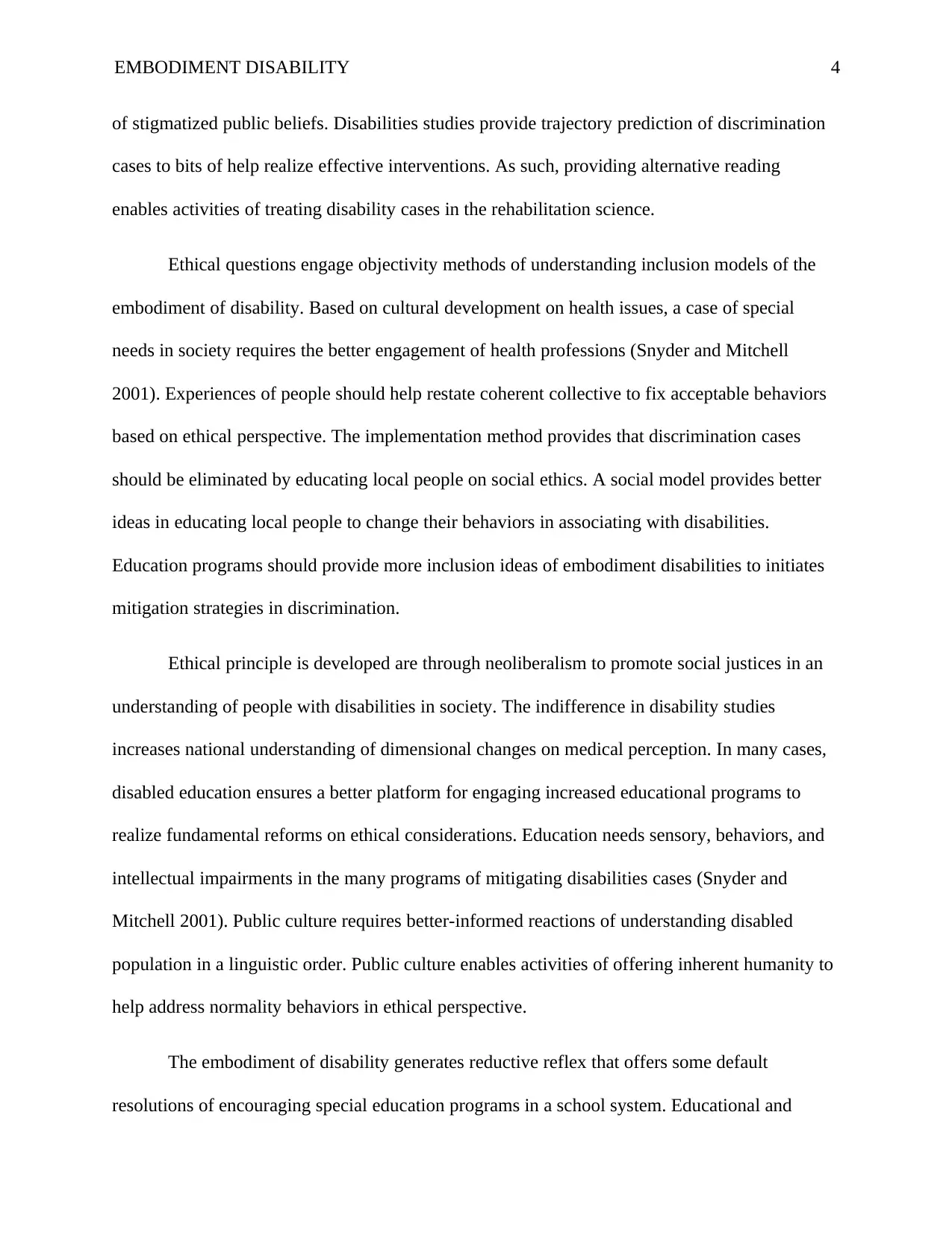
of stigmatized public beliefs. Disabilities studies provide trajectory prediction of discrimination
cases to bits of help realize effective interventions. As such, providing alternative reading
enables activities of treating disability cases in the rehabilitation science.
Ethical questions engage objectivity methods of understanding inclusion models of the
embodiment of disability. Based on cultural development on health issues, a case of special
needs in society requires the better engagement of health professions (Snyder and Mitchell
2001). Experiences of people should help restate coherent collective to fix acceptable behaviors
based on ethical perspective. The implementation method provides that discrimination cases
should be eliminated by educating local people on social ethics. A social model provides better
ideas in educating local people to change their behaviors in associating with disabilities.
Education programs should provide more inclusion ideas of embodiment disabilities to initiates
mitigation strategies in discrimination.
Ethical principle is developed are through neoliberalism to promote social justices in an
understanding of people with disabilities in society. The indifference in disability studies
increases national understanding of dimensional changes on medical perception. In many cases,
disabled education ensures a better platform for engaging increased educational programs to
realize fundamental reforms on ethical considerations. Education needs sensory, behaviors, and
intellectual impairments in the many programs of mitigating disabilities cases (Snyder and
Mitchell 2001). Public culture requires better-informed reactions of understanding disabled
population in a linguistic order. Public culture enables activities of offering inherent humanity to
help address normality behaviors in ethical perspective.
The embodiment of disability generates reductive reflex that offers some default
resolutions of encouraging special education programs in a school system. Educational and
of stigmatized public beliefs. Disabilities studies provide trajectory prediction of discrimination
cases to bits of help realize effective interventions. As such, providing alternative reading
enables activities of treating disability cases in the rehabilitation science.
Ethical questions engage objectivity methods of understanding inclusion models of the
embodiment of disability. Based on cultural development on health issues, a case of special
needs in society requires the better engagement of health professions (Snyder and Mitchell
2001). Experiences of people should help restate coherent collective to fix acceptable behaviors
based on ethical perspective. The implementation method provides that discrimination cases
should be eliminated by educating local people on social ethics. A social model provides better
ideas in educating local people to change their behaviors in associating with disabilities.
Education programs should provide more inclusion ideas of embodiment disabilities to initiates
mitigation strategies in discrimination.
Ethical principle is developed are through neoliberalism to promote social justices in an
understanding of people with disabilities in society. The indifference in disability studies
increases national understanding of dimensional changes on medical perception. In many cases,
disabled education ensures a better platform for engaging increased educational programs to
realize fundamental reforms on ethical considerations. Education needs sensory, behaviors, and
intellectual impairments in the many programs of mitigating disabilities cases (Snyder and
Mitchell 2001). Public culture requires better-informed reactions of understanding disabled
population in a linguistic order. Public culture enables activities of offering inherent humanity to
help address normality behaviors in ethical perspective.
The embodiment of disability generates reductive reflex that offers some default
resolutions of encouraging special education programs in a school system. Educational and
Paraphrase This Document
Need a fresh take? Get an instant paraphrase of this document with our AI Paraphraser

EMBODIMENT DISABILITY 5
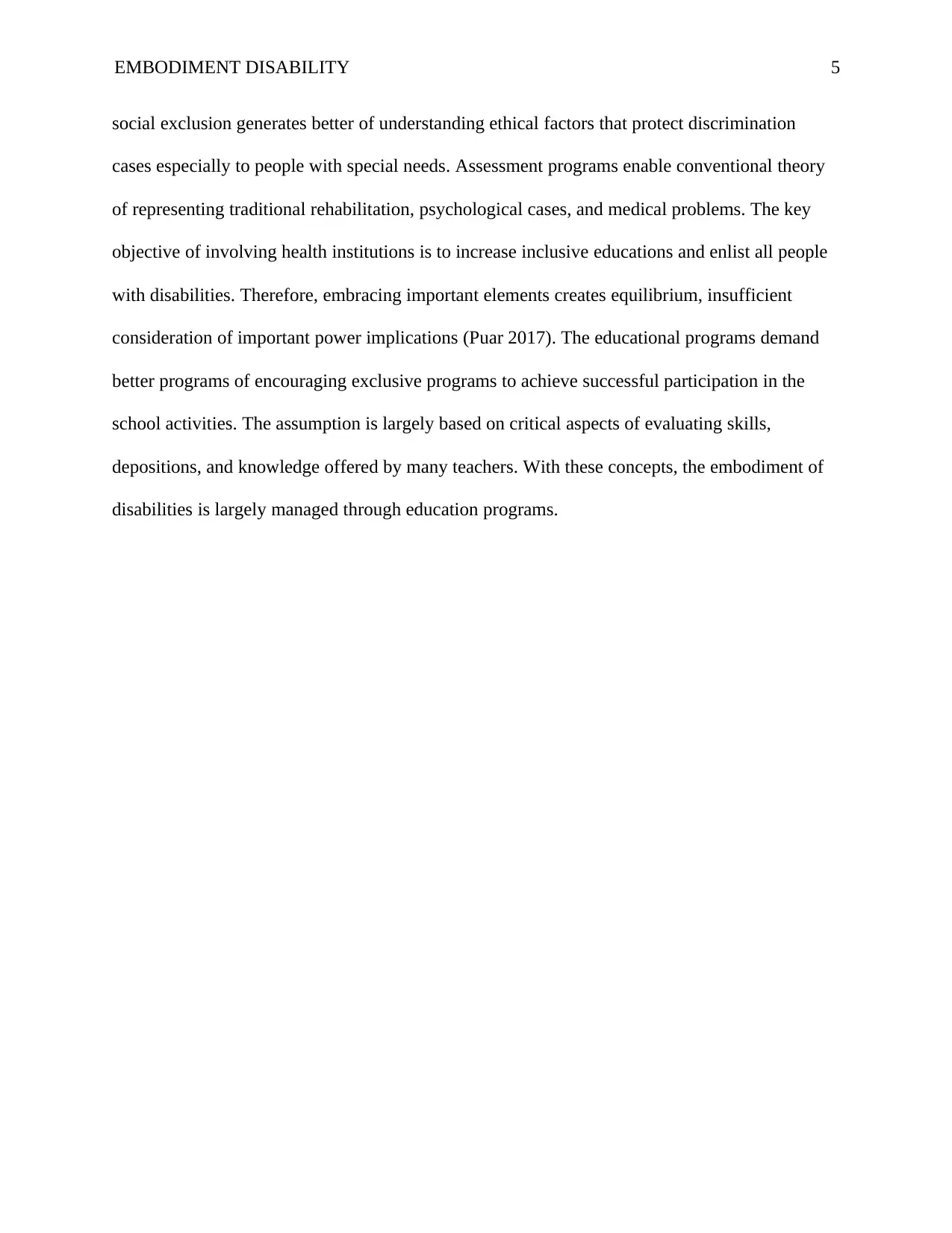
social exclusion generates better of understanding ethical factors that protect discrimination
cases especially to people with special needs. Assessment programs enable conventional theory
of representing traditional rehabilitation, psychological cases, and medical problems. The key
objective of involving health institutions is to increase inclusive educations and enlist all people
with disabilities. Therefore, embracing important elements creates equilibrium, insufficient
consideration of important power implications (Puar 2017). The educational programs demand
better programs of encouraging exclusive programs to achieve successful participation in the
school activities. The assumption is largely based on critical aspects of evaluating skills,
depositions, and knowledge offered by many teachers. With these concepts, the embodiment of
disabilities is largely managed through education programs.
social exclusion generates better of understanding ethical factors that protect discrimination
cases especially to people with special needs. Assessment programs enable conventional theory
of representing traditional rehabilitation, psychological cases, and medical problems. The key
objective of involving health institutions is to increase inclusive educations and enlist all people
with disabilities. Therefore, embracing important elements creates equilibrium, insufficient
consideration of important power implications (Puar 2017). The educational programs demand
better programs of encouraging exclusive programs to achieve successful participation in the
school activities. The assumption is largely based on critical aspects of evaluating skills,
depositions, and knowledge offered by many teachers. With these concepts, the embodiment of
disabilities is largely managed through education programs.

EMBODIMENT DISABILITY 6
References
Mitchell, D. and Snyder, S. (2012). Chapter 4: Minority Model. In: N. Watson, A. Roulstone and
C. Thomas, ed., The Handbook of Disability Studies. pp.42-45.
Mitchell, D. and Snyder, S. (2015). The biopolitics of disability. Neoliberalism, ablenationalism,
and peripheral embodiment. Ann Arbor.: The University of Michigan Press.
Moore, M. and Slee, R. (2018). Chapter 17: Disability Studies, Inclusive Education and
Exclusion. In: N. Watson, A. Roulstone and C. Thomas, ed., The Handbook of Disability
Studies. pp.225-237.
Puar, J. (2017). The right to maim. pp.ix-xxiv, 1-24.
Snyder, S. and Mitchell, D. (2001). Re-engaging the Body: Disability Studies and the Resistance
to Embodiment. Public Culture, 13(3), pp.367-390.
Titchkosky, T. (2007). Reading and writing disability differently: The textured life of
embodiment. University of Toronto Press.
References
Mitchell, D. and Snyder, S. (2012). Chapter 4: Minority Model. In: N. Watson, A. Roulstone and
C. Thomas, ed., The Handbook of Disability Studies. pp.42-45.
Mitchell, D. and Snyder, S. (2015). The biopolitics of disability. Neoliberalism, ablenationalism,
and peripheral embodiment. Ann Arbor.: The University of Michigan Press.
Moore, M. and Slee, R. (2018). Chapter 17: Disability Studies, Inclusive Education and
Exclusion. In: N. Watson, A. Roulstone and C. Thomas, ed., The Handbook of Disability
Studies. pp.225-237.
Puar, J. (2017). The right to maim. pp.ix-xxiv, 1-24.
Snyder, S. and Mitchell, D. (2001). Re-engaging the Body: Disability Studies and the Resistance
to Embodiment. Public Culture, 13(3), pp.367-390.
Titchkosky, T. (2007). Reading and writing disability differently: The textured life of
embodiment. University of Toronto Press.
⊘ This is a preview!⊘
Do you want full access?
Subscribe today to unlock all pages.

Trusted by 1+ million students worldwide
1 out of 6
Related Documents
Your All-in-One AI-Powered Toolkit for Academic Success.
 +13062052269
info@desklib.com
Available 24*7 on WhatsApp / Email
Unlock your academic potential
Copyright © 2020–2026 A2Z Services. All Rights Reserved. Developed and managed by ZUCOL.