Emergency Response Plan: Risk Assessment and Mitigation Strategies

Verified

Added on  2022/08/12

|4
|658
|14
Report
AI Summary
This report examines the critical components of an effective emergency response plan, highlighting the significance of preparedness in mitigating risks. It explores the potential consequences of lacking an emergency plan, including financial losses and safety hazards. The report emphasizes the role of risk assessment in identifying potential threats and designing effective response strategies. It discusses various steps involved in the risk assessment process, such as risk identification, analysis, and evaluation. The report concludes by underscoring the positive impact of an emergency response plan on an organization, including enhanced employee confidence, reduced injuries, and environmental protection. The report references several scholarly articles to support its claims and provide a comprehensive overview of the subject.
Document Page
Running head: EMERGENCY PLAN 1
EMERGENCY PLAN
Institution
Date
tabler-icon-diamond-filled.svg

Paraphrase This Document

Need a fresh take? Get an instant paraphrase of this document with our AI Paraphraser
Document Page
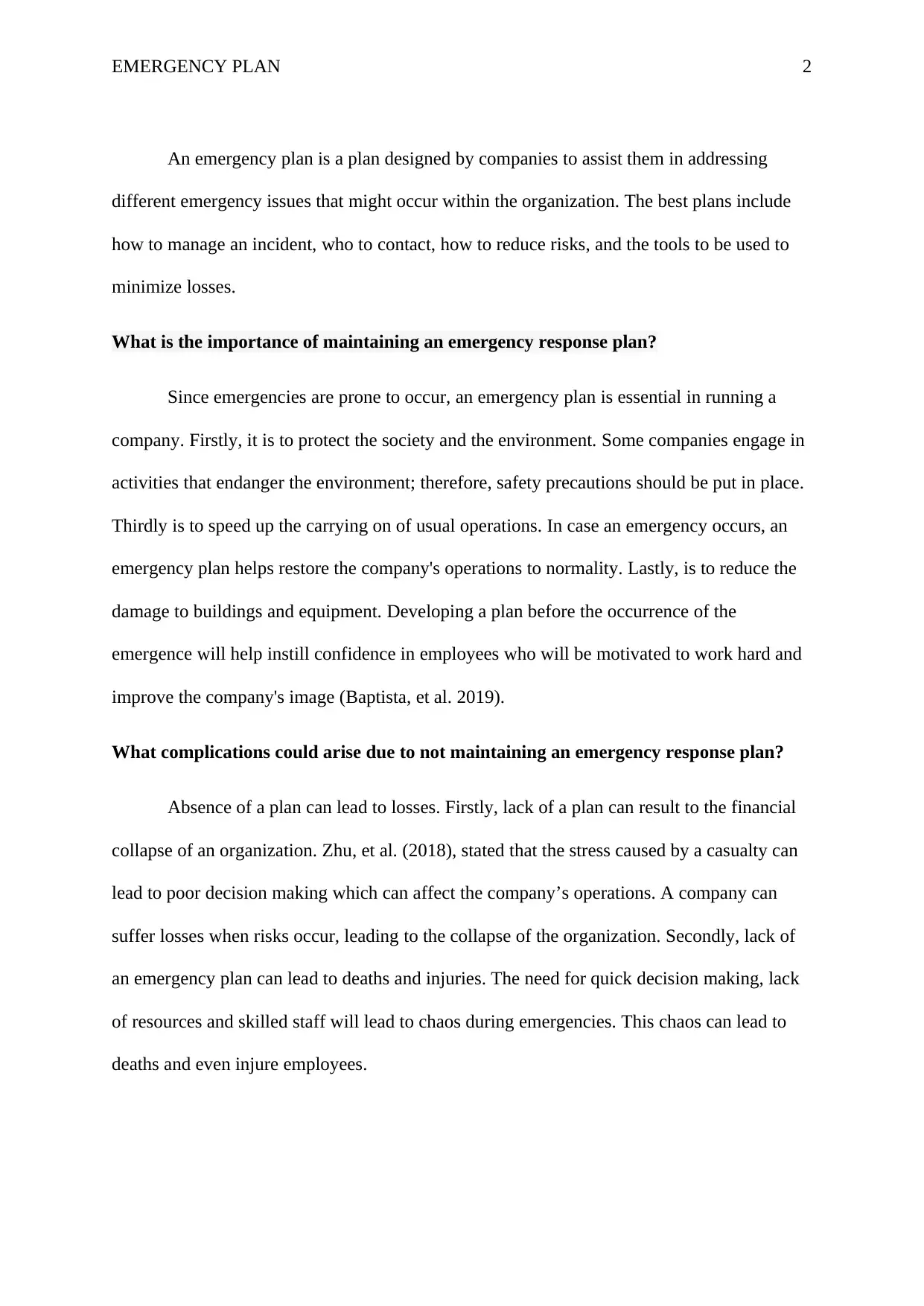
EMERGENCY PLAN 2
An emergency plan is a plan designed by companies to assist them in addressing
different emergency issues that might occur within the organization. The best plans include
how to manage an incident, who to contact, how to reduce risks, and the tools to be used to
minimize losses.
What is the importance of maintaining an emergency response plan?
Since emergencies are prone to occur, an emergency plan is essential in running a
company. Firstly, it is to protect the society and the environment. Some companies engage in
activities that endanger the environment; therefore, safety precautions should be put in place.
Thirdly is to speed up the carrying on of usual operations. In case an emergency occurs, an
emergency plan helps restore the company's operations to normality. Lastly, is to reduce the
damage to buildings and equipment. Developing a plan before the occurrence of the
emergence will help instill confidence in employees who will be motivated to work hard and
improve the company's image (Baptista, et al. 2019).
What complications could arise due to not maintaining an emergency response plan?
Absence of a plan can lead to losses. Firstly, lack of a plan can result to the financial
collapse of an organization. Zhu, et al. (2018), stated that the stress caused by a casualty can
lead to poor decision making which can affect the company’s operations. A company can
suffer losses when risks occur, leading to the collapse of the organization. Secondly, lack of
an emergency plan can lead to deaths and injuries. The need for quick decision making, lack
of resources and skilled staff will lead to chaos during emergencies. This chaos can lead to
deaths and even injure employees.
Document Page
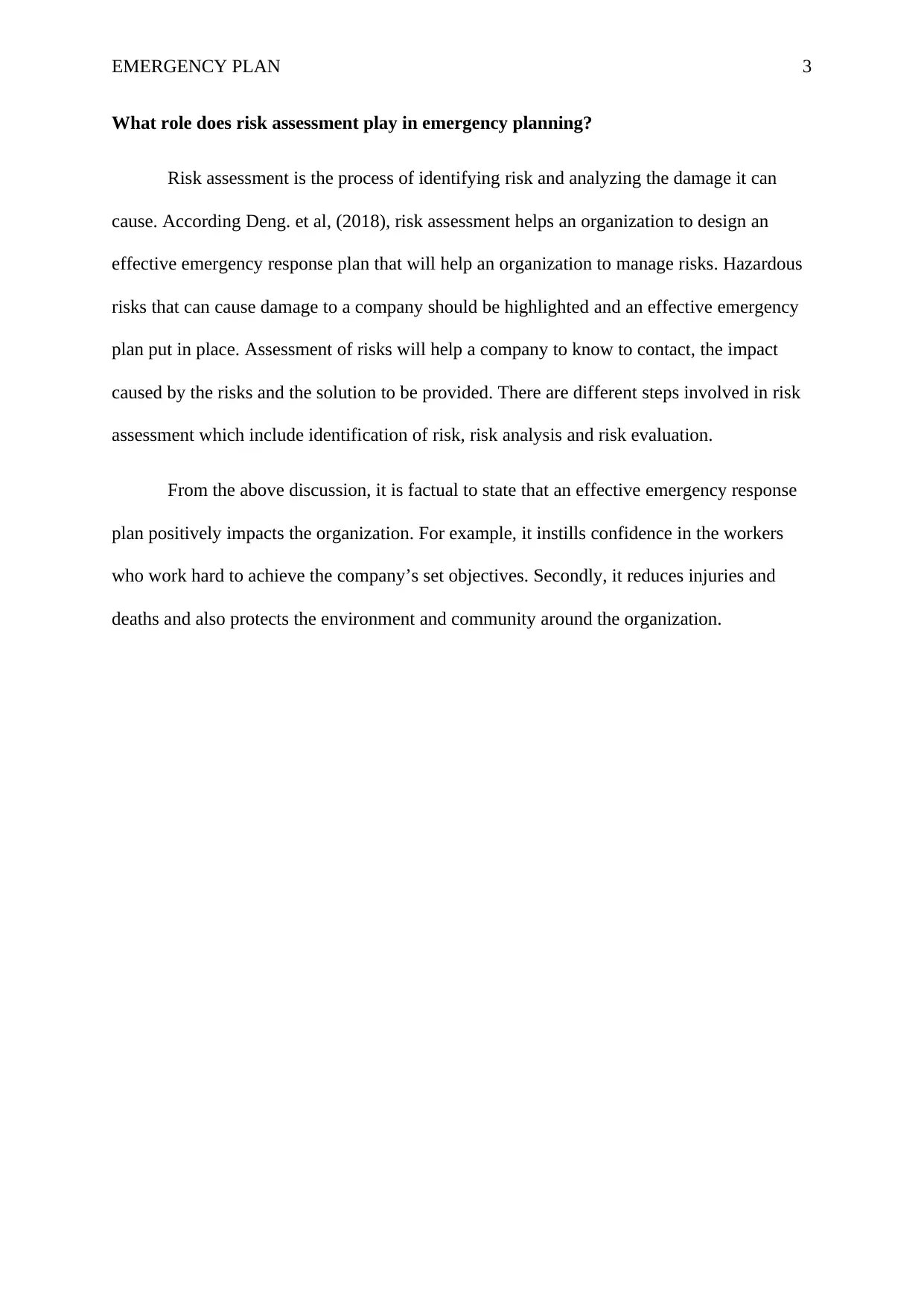
EMERGENCY PLAN 3
What role does risk assessment play in emergency planning?
Risk assessment is the process of identifying risk and analyzing the damage it can
cause. According Deng. et al, (2018), risk assessment helps an organization to design an
effective emergency response plan that will help an organization to manage risks. Hazardous
risks that can cause damage to a company should be highlighted and an effective emergency
plan put in place. Assessment of risks will help a company to know to contact, the impact
caused by the risks and the solution to be provided. There are different steps involved in risk
assessment which include identification of risk, risk analysis and risk evaluation.
From the above discussion, it is factual to state that an effective emergency response
plan positively impacts the organization. For example, it instills confidence in the workers
who work hard to achieve the company’s set objectives. Secondly, it reduces injuries and
deaths and also protects the environment and community around the organization.
Document Page
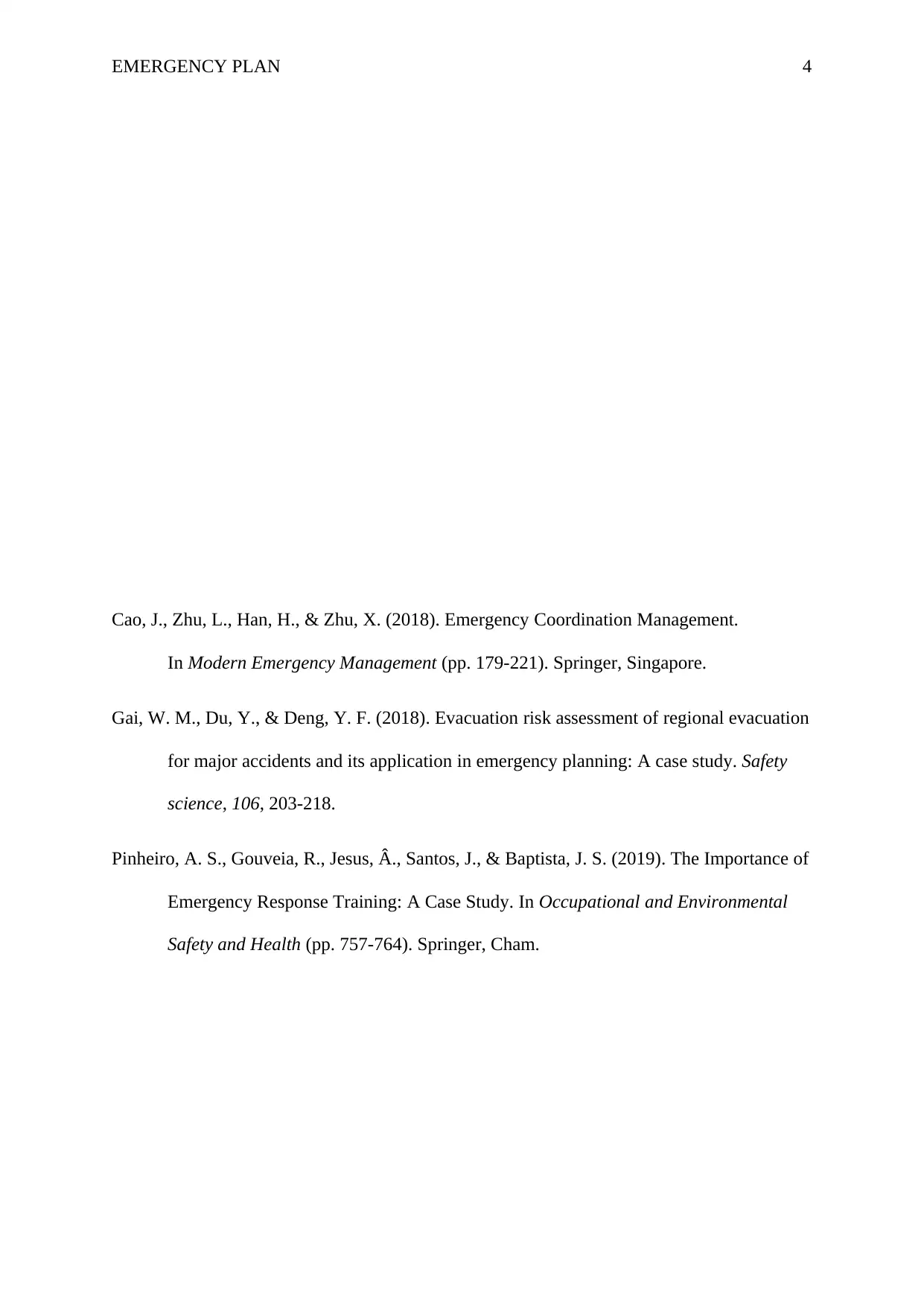
EMERGENCY PLAN 4
Cao, J., Zhu, L., Han, H., & Zhu, X. (2018). Emergency Coordination Management.
In Modern Emergency Management (pp. 179-221). Springer, Singapore.
Gai, W. M., Du, Y., & Deng, Y. F. (2018). Evacuation risk assessment of regional evacuation
for major accidents and its application in emergency planning: A case study. Safety
science, 106, 203-218.
Pinheiro, A. S., Gouveia, R., Jesus, Â., Santos, J., & Baptista, J. S. (2019). The Importance of
Emergency Response Training: A Case Study. In Occupational and Environmental
Safety and Health (pp. 757-764). Springer, Cham.
chevron_up_icon
1 out of 4
circle_padding
hide_on_mobile
zoom_out_icon
[object Object]