Management Analysis of Mushroom Records and Michael Solomon Gudinski

Verified

Added on  2022/10/06

|6
|1246
|20
Report
AI Summary
This report provides a detailed analysis of Michael Solomon Gudinski, the founder of Mushroom Records, a prominent figure in the Australian music industry. The analysis covers Gudinski's personal attributes, including his transformational leadership style and risk-taking abilities, which were crucial to Mushroom's success. It examines his strategies for managing creativity, innovation, and new product development, emphasizing the importance of recruiting skilled employees and fostering a diverse workforce. The report also assesses the environmental and contextual factors influencing Mushroom's success, such as the timing of key decisions like signing Skyhooks. Furthermore, it addresses the challenges faced by Mushroom, including industry competition, and highlights Gudinski's ability to adapt and make strategic decisions. The conclusion underscores Gudinski's unique decision-making skills and emphasizes the importance of risk-taking, combined with thorough environmental analysis, for achieving success in the music industry.

Document Page
Running head: MANAGEMENT
Management
Name of the Student
Name of the University
Author Note
tabler-icon-diamond-filled.svg

Paraphrase This Document

Need a fresh take? Get an instant paraphrase of this document with our AI Paraphraser
Document Page
1MANAGEMENT
Personal analysis
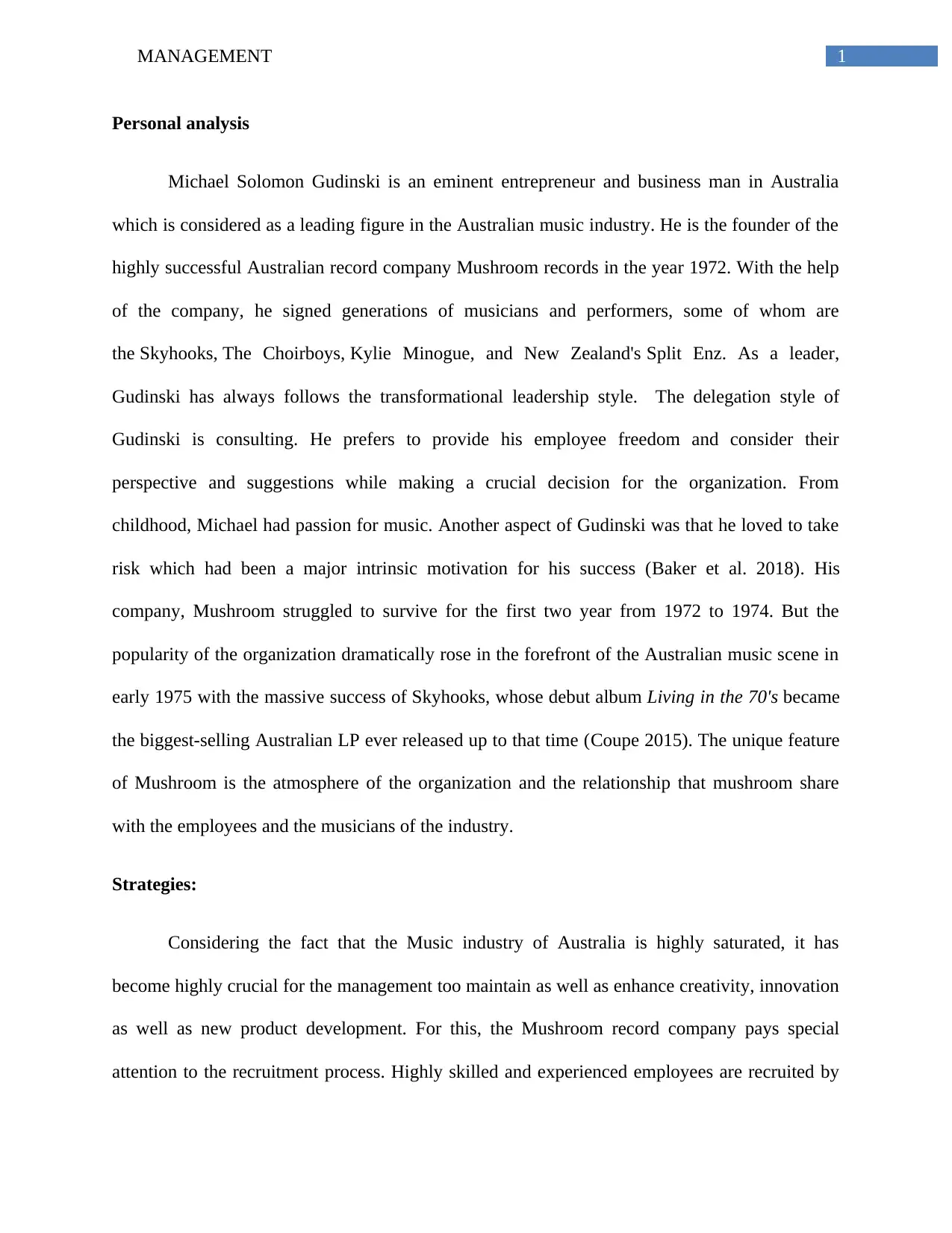
Michael Solomon Gudinski is an eminent entrepreneur and business man in Australia
which is considered as a leading figure in the Australian music industry. He is the founder of the
highly successful Australian record company Mushroom records in the year 1972. With the help
of the company, he signed generations of musicians and performers, some of whom are
the Skyhooks, The Choirboys, Kylie Minogue, and New Zealand's Split Enz. As a leader,
Gudinski has always follows the transformational leadership style. The delegation style of
Gudinski is consulting. He prefers to provide his employee freedom and consider their
perspective and suggestions while making a crucial decision for the organization. From
childhood, Michael had passion for music. Another aspect of Gudinski was that he loved to take
risk which had been a major intrinsic motivation for his success (Baker et al. 2018). His
company, Mushroom struggled to survive for the first two year from 1972 to 1974. But the
popularity of the organization dramatically rose in the forefront of the Australian music scene in
early 1975 with the massive success of Skyhooks, whose debut album Living in the 70's became
the biggest-selling Australian LP ever released up to that time (Coupe 2015). The unique feature
of Mushroom is the atmosphere of the organization and the relationship that mushroom share
with the employees and the musicians of the industry.
Strategies:
Considering the fact that the Music industry of Australia is highly saturated, it has
become highly crucial for the management too maintain as well as enhance creativity, innovation
as well as new product development. For this, the Mushroom record company pays special
attention to the recruitment process. Highly skilled and experienced employees are recruited by
Document Page
2MANAGEMENT
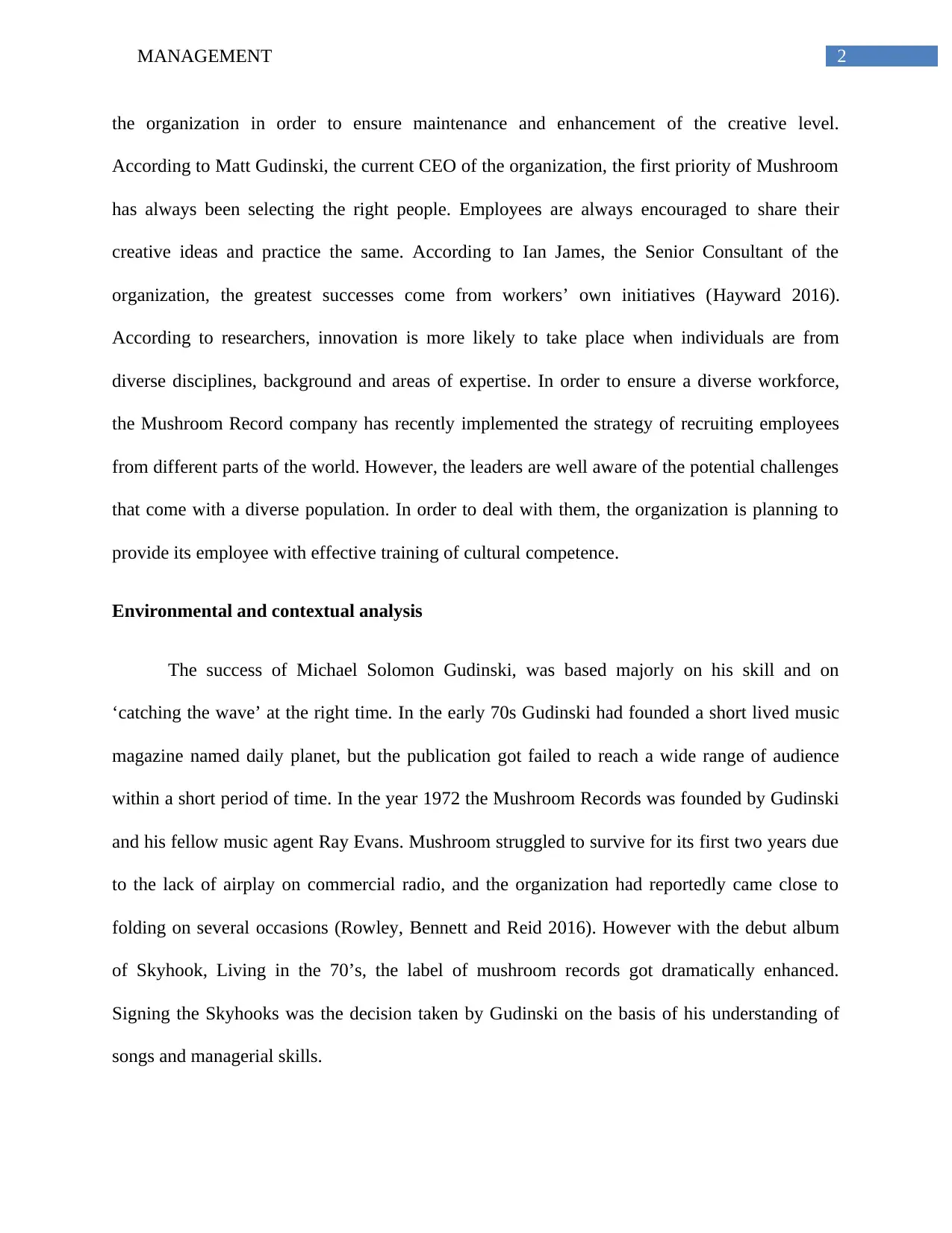
the organization in order to ensure maintenance and enhancement of the creative level.
According to Matt Gudinski, the current CEO of the organization, the first priority of Mushroom
has always been selecting the right people. Employees are always encouraged to share their
creative ideas and practice the same. According to Ian James, the Senior Consultant of the
organization, the greatest successes come from workers’ own initiatives (Hayward 2016).
According to researchers, innovation is more likely to take place when individuals are from
diverse disciplines, background and areas of expertise. In order to ensure a diverse workforce,
the Mushroom Record company has recently implemented the strategy of recruiting employees
from different parts of the world. However, the leaders are well aware of the potential challenges
that come with a diverse population. In order to deal with them, the organization is planning to
provide its employee with effective training of cultural competence.
Environmental and contextual analysis
The success of Michael Solomon Gudinski, was based majorly on his skill and on
‘catching the wave’ at the right time. In the early 70s Gudinski had founded a short lived music
magazine named daily planet, but the publication got failed to reach a wide range of audience
within a short period of time. In the year 1972 the Mushroom Records was founded by Gudinski
and his fellow music agent Ray Evans. Mushroom struggled to survive for its first two years due
to the lack of airplay on commercial radio, and the organization had reportedly came close to
folding on several occasions (Rowley, Bennett and Reid 2016). However with the debut album
of Skyhook, Living in the 70’s, the label of mushroom records got dramatically enhanced.
Signing the Skyhooks was the decision taken by Gudinski on the basis of his understanding of
songs and managerial skills.
Document Page
3MANAGEMENT
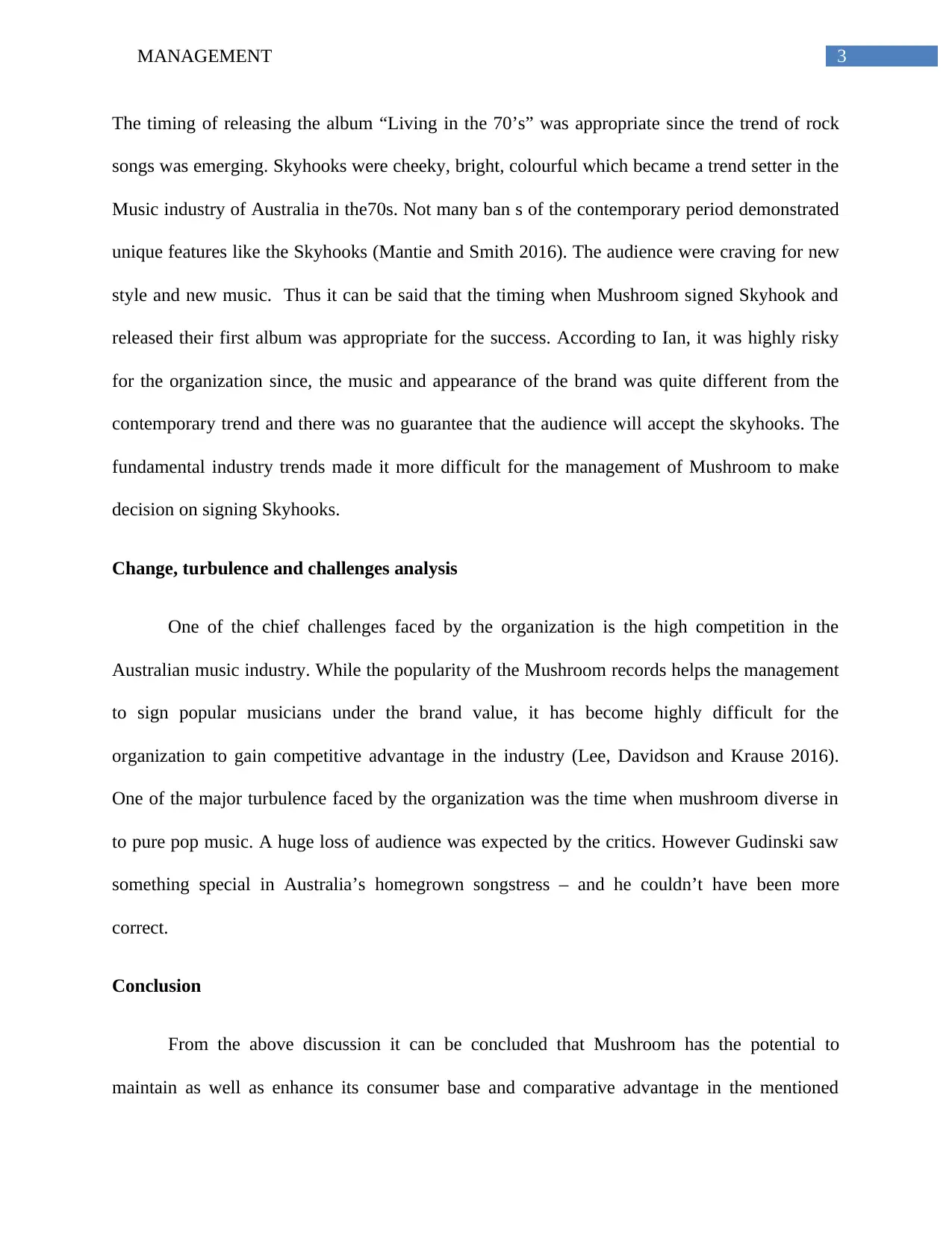
The timing of releasing the album “Living in the 70’s” was appropriate since the trend of rock
songs was emerging. Skyhooks were cheeky, bright, colourful which became a trend setter in the
Music industry of Australia in the70s. Not many ban s of the contemporary period demonstrated
unique features like the Skyhooks (Mantie and Smith 2016). The audience were craving for new
style and new music. Thus it can be said that the timing when Mushroom signed Skyhook and
released their first album was appropriate for the success. According to Ian, it was highly risky
for the organization since, the music and appearance of the brand was quite different from the
contemporary trend and there was no guarantee that the audience will accept the skyhooks. The
fundamental industry trends made it more difficult for the management of Mushroom to make
decision on signing Skyhooks.
Change, turbulence and challenges analysis
One of the chief challenges faced by the organization is the high competition in the
Australian music industry. While the popularity of the Mushroom records helps the management
to sign popular musicians under the brand value, it has become highly difficult for the
organization to gain competitive advantage in the industry (Lee, Davidson and Krause 2016).
One of the major turbulence faced by the organization was the time when mushroom diverse in
to pure pop music. A huge loss of audience was expected by the critics. However Gudinski saw
something special in Australia’s homegrown songstress – and he couldn’t have been more
correct.
Conclusion
From the above discussion it can be concluded that Mushroom has the potential to
maintain as well as enhance its consumer base and comparative advantage in the mentioned
tabler-icon-diamond-filled.svg

Paraphrase This Document

Need a fresh take? Get an instant paraphrase of this document with our AI Paraphraser
Document Page
4MANAGEMENT
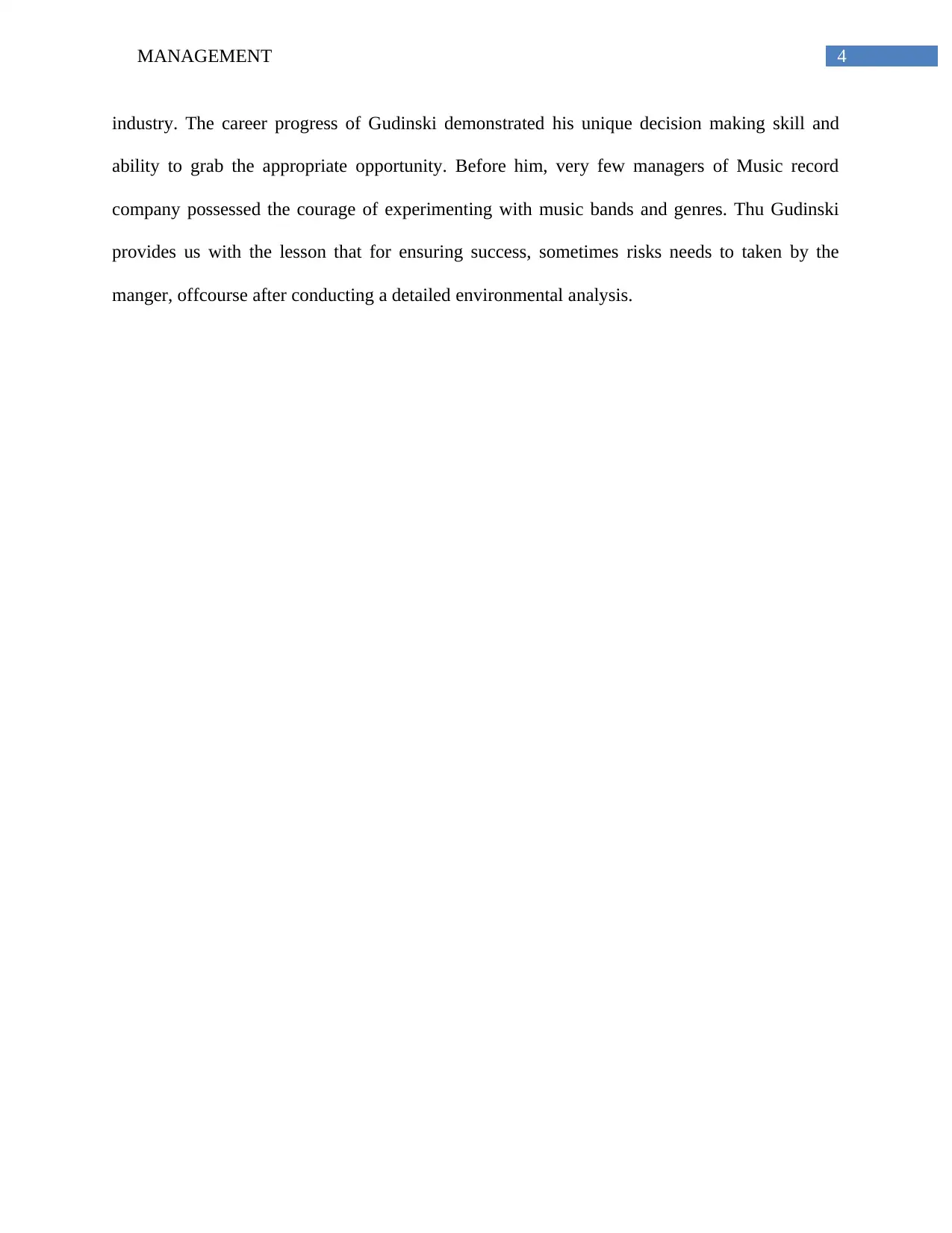
industry. The career progress of Gudinski demonstrated his unique decision making skill and
ability to grab the appropriate opportunity. Before him, very few managers of Music record
company possessed the courage of experimenting with music bands and genres. Thu Gudinski
provides us with the lesson that for ensuring success, sometimes risks needs to taken by the
manger, offcourse after conducting a detailed environmental analysis.
Document Page
5MANAGEMENT
Reference List
Baker, S., Strong, C., Istvandity, L. and Cantillon, Z. eds., 2018. The Routledge Companion to
Popular Music History and Heritage. Routledge.
Coupe, S., 2015. Gudinski: The Godfather of Australian Rock. Hachette Australia.
Hayward, P. ed., 2016. Sound alliances: Indigenous peoples, cultural politics, and popular music
in the Pacific. Bloomsbury Publishing.
Lee, J., Davidson, J.W. and Krause, A.E., 2016. Older people’s motivations for participating in
community singing in Australia. International Journal of Community Music, 9(2), pp.191-206.
Mantie, R. and Smith, G.D. eds., 2016. The Oxford handbook of music making and leisure.
Oxford University Press.
Rowley, J., Bennett, D. and Reid, A., 2016, July. Leadership as a core creativity for musician
identity. In Proceedings of the 21st international seminar of the ISME Commission for the
Education of the Professional Musician (pp. 43-51).
chevron_up_icon
1 out of 6
circle_padding
hide_on_mobile
zoom_out_icon
[object Object]