Employee Engagement and Leadership: A Report for Office Principles
VerifiedAdded on 2023/06/05
|21
|4790
|88
Report
AI Summary
This report investigates the correlation between strong leadership and employee engagement within Office Principles, prompted by increasing staff turnover and high recruitment costs. It defines employee engagement by examining various organizational perspectives and highlights its importance for productivity, retention, and profitability. The report emphasizes that strong leadership, company culture, and values are key factors in fostering an engaged workforce. It recommends implementing employee engagement surveys and leadership training programs to improve employee performance and overall organizational success. The research includes analysis of exit interviews and recruitment costs, revealing the impact of poor leadership on employee morale and financial performance. The report concludes with actionable recommendations to enhance employee engagement within Office Principles, aiming to attract talent, reduce turnover, and improve the work environment.
The Importance of Employee Engagement
Discovering the link between strong leadership
and employee engagement
Author: Gemma Zommerfield, CIPD Associate
01st June 2018
Discovering the link between strong leadership
and employee engagement
Author: Gemma Zommerfield, CIPD Associate
01st June 2018

Paraphrase This Document
Need a fresh take? Get an instant paraphrase of this document with our AI Paraphraser
Executive Summary
The aim of the report is to establish, of there is a direct correlation
between strong leadership and employee engagement. It provides the
recommendations that can improve employee engagement, attract talent,
decrease staff turnover and improve morale. The report highlights on the
fact that employee engagement today has become synonymous with
terms like 'employee experience' and 'employee satisfaction' however, my
research established that there no one way of defining what employee
engagement – the definition dependant on what engagement means to
the business. The report has discussed about the fact that an
organisations success can very much depend on how engaged a
workforce is. The report states that a happier, engaged employee can be
more productive for a company and it can help in increasing profitability
of a company. The report has brought out that strong, leadership, culture
and values have been repeatedly proven to be the main factors in
organisations having an engaged workforce. The report suggests that the
benefits of having good leaders for team. The report discusses that great
team leaders create great teams and great teams can be the difference
between and organisation success or not. The report elaborates on the co-
relation of strong leadership and that of employee engagement in an
organisation. The report recommends that employee engagement survey
along with training programme can be helpful in the aspect of employee
engagement that can improve performance of employees in an
organization.
The aim of the report is to establish, of there is a direct correlation
between strong leadership and employee engagement. It provides the
recommendations that can improve employee engagement, attract talent,
decrease staff turnover and improve morale. The report highlights on the
fact that employee engagement today has become synonymous with
terms like 'employee experience' and 'employee satisfaction' however, my
research established that there no one way of defining what employee
engagement – the definition dependant on what engagement means to
the business. The report has discussed about the fact that an
organisations success can very much depend on how engaged a
workforce is. The report states that a happier, engaged employee can be
more productive for a company and it can help in increasing profitability
of a company. The report has brought out that strong, leadership, culture
and values have been repeatedly proven to be the main factors in
organisations having an engaged workforce. The report suggests that the
benefits of having good leaders for team. The report discusses that great
team leaders create great teams and great teams can be the difference
between and organisation success or not. The report elaborates on the co-
relation of strong leadership and that of employee engagement in an
organisation. The report recommends that employee engagement survey
along with training programme can be helpful in the aspect of employee
engagement that can improve performance of employees in an
organization.
Table of Contents
1. Introduction
2. What is employee engagement
3. Why is employee engagement important?
4. What engages employees
5. The correlation between strong leadership and employee
engagement
6. The Impact of a dis-engaged workforce
7. Recommendation
8. References and Bibliography
Introduction
1. Introduction
2. What is employee engagement
3. Why is employee engagement important?
4. What engages employees
5. The correlation between strong leadership and employee
engagement
6. The Impact of a dis-engaged workforce
7. Recommendation
8. References and Bibliography
Introduction
⊘ This is a preview!⊘
Do you want full access?
Subscribe today to unlock all pages.

Trusted by 1+ million students worldwide
Office Principles have accumulated over 25 years’ experience working in
workplace interior design, office fit out and space planning. They have
sought out the very best expertise across many different fields to form a
team of experts that include architects, quantity surveyors and interior
designers, amongst others. Their objective is to rethink, redesign and
restructure office workplace environments, they pride themselves on
getting things right first time, on time and within budget.
Employee engagement has never been identified within the business
however with turnover of staff increasing, the need to attract and retain
talent within this fiercely competitive industry is increasing. In addition, a
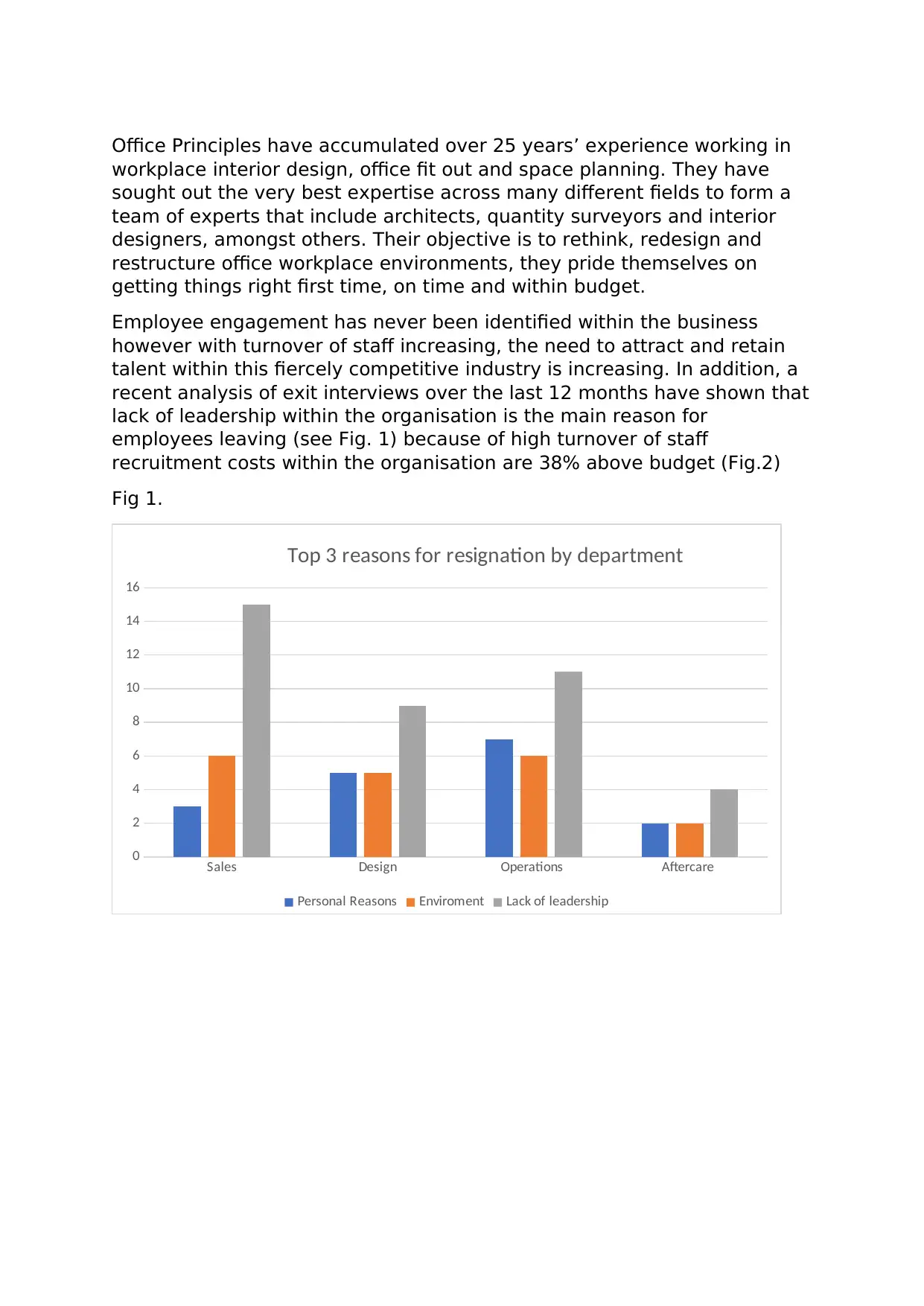
recent analysis of exit interviews over the last 12 months have shown that
lack of leadership within the organisation is the main reason for
employees leaving (see Fig. 1) because of high turnover of staff
recruitment costs within the organisation are 38% above budget (Fig.2)
Fig 1.
Sales Design Operations Aftercare
0
2
4
6
8
10
12
14
16
Top 3 reasons for resignation by department
Personal Reasons Enviroment Lack of leadership
workplace interior design, office fit out and space planning. They have
sought out the very best expertise across many different fields to form a
team of experts that include architects, quantity surveyors and interior
designers, amongst others. Their objective is to rethink, redesign and
restructure office workplace environments, they pride themselves on
getting things right first time, on time and within budget.
Employee engagement has never been identified within the business
however with turnover of staff increasing, the need to attract and retain
talent within this fiercely competitive industry is increasing. In addition, a
recent analysis of exit interviews over the last 12 months have shown that
lack of leadership within the organisation is the main reason for
employees leaving (see Fig. 1) because of high turnover of staff
recruitment costs within the organisation are 38% above budget (Fig.2)
Fig 1.
Sales Design Operations Aftercare
0
2
4
6
8
10
12
14
16
Top 3 reasons for resignation by department
Personal Reasons Enviroment Lack of leadership
Paraphrase This Document
Need a fresh take? Get an instant paraphrase of this document with our AI Paraphraser
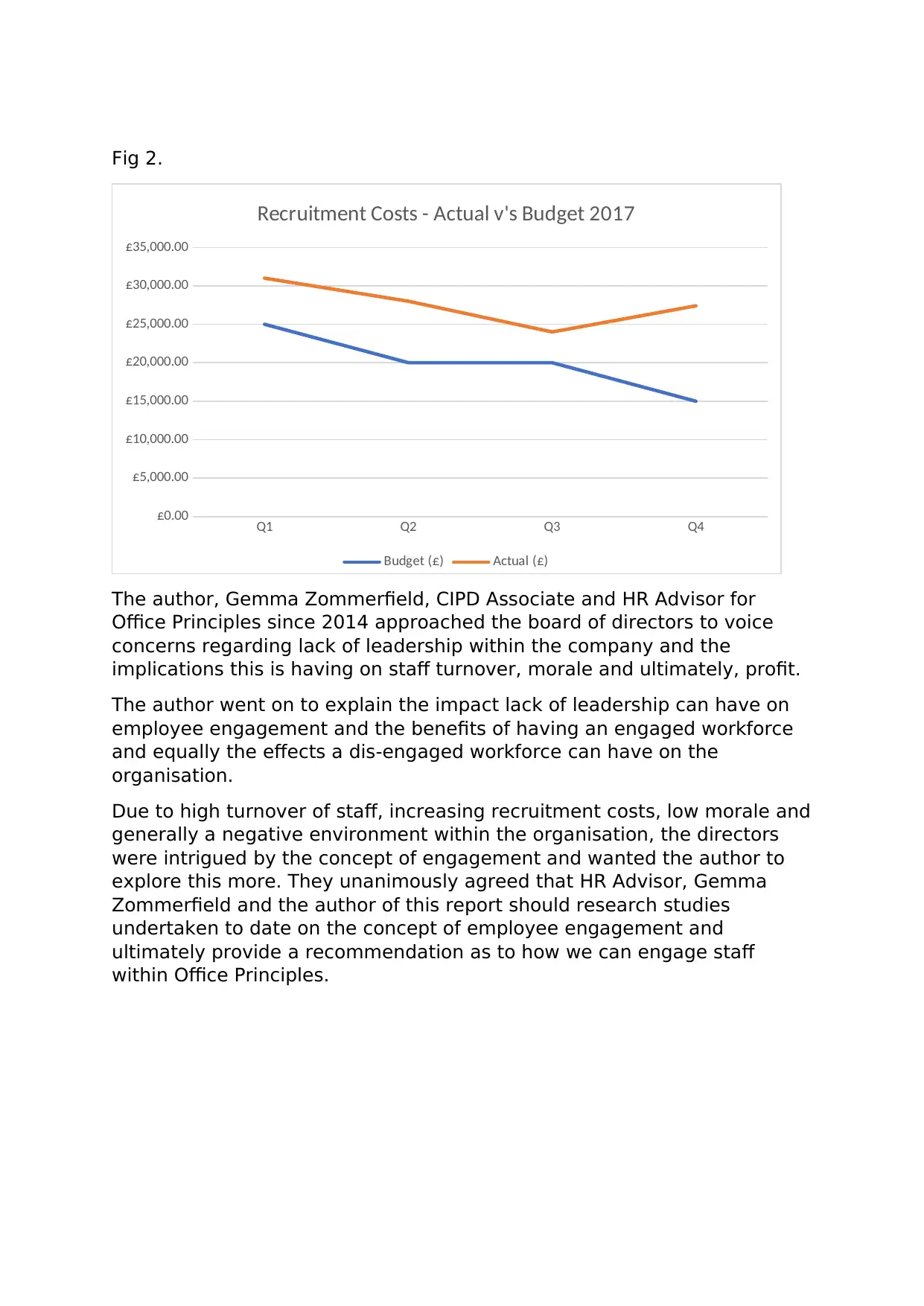
Fig 2.
Q1 Q2 Q3 Q4
£0.00
£5,000.00
£10,000.00
£15,000.00
£20,000.00
£25,000.00
£30,000.00
£35,000.00
Recruitment Costs - Actual v's Budget 2017
Budget (£) Actual (£)
The author, Gemma Zommerfield, CIPD Associate and HR Advisor for
Office Principles since 2014 approached the board of directors to voice
concerns regarding lack of leadership within the company and the
implications this is having on staff turnover, morale and ultimately, profit.
The author went on to explain the impact lack of leadership can have on
employee engagement and the benefits of having an engaged workforce
and equally the effects a dis-engaged workforce can have on the
organisation.
Due to high turnover of staff, increasing recruitment costs, low morale and
generally a negative environment within the organisation, the directors
were intrigued by the concept of engagement and wanted the author to
explore this more. They unanimously agreed that HR Advisor, Gemma
Zommerfield and the author of this report should research studies
undertaken to date on the concept of employee engagement and
ultimately provide a recommendation as to how we can engage staff
within Office Principles.
Q1 Q2 Q3 Q4
£0.00
£5,000.00
£10,000.00
£15,000.00
£20,000.00
£25,000.00
£30,000.00
£35,000.00
Recruitment Costs - Actual v's Budget 2017
Budget (£) Actual (£)
The author, Gemma Zommerfield, CIPD Associate and HR Advisor for
Office Principles since 2014 approached the board of directors to voice
concerns regarding lack of leadership within the company and the
implications this is having on staff turnover, morale and ultimately, profit.
The author went on to explain the impact lack of leadership can have on
employee engagement and the benefits of having an engaged workforce
and equally the effects a dis-engaged workforce can have on the
organisation.
Due to high turnover of staff, increasing recruitment costs, low morale and
generally a negative environment within the organisation, the directors
were intrigued by the concept of engagement and wanted the author to
explore this more. They unanimously agreed that HR Advisor, Gemma
Zommerfield and the author of this report should research studies
undertaken to date on the concept of employee engagement and
ultimately provide a recommendation as to how we can engage staff
within Office Principles.
What is engagement
Employee engagement first appeared as a concept in management theory
in the 1990s and became widespread in management practice in the
2000s, with almost 30 years of research on employee engagement
The online research revealed that different organisations have different
definitions for what employee engagement means to them - it is rare to
find two organisations defining employee engagement the same for
example
Dell refers to being engaged as given time and talents to the two
teambuilding activities
Barclays define employee engagement as the extent to which an
employee feels a sense of attachment to the organisation he or she works
for believes in its goals and supports is values
The NHS sees engagement as ‘a measure of how people connect in their
work
andfeel committed to their organisation and its goals. People who are high
ly engaged in
an activity feel excited and enthusiastic about their role, say time passes
quickly at
work, devote extra effort to the activity, identify with the task and describ
e
themselves to others in the context of their task (doctor, nurse, NHS mana
ger),
think about the questions or challenges posed by the activity during their
spare
moments (for example when travelling to and from work), resist distractio
ns, find it
easy to stay focused and invite others into the activity or organisation (the
ir enthusiasm is contagious)’
The Civil Service sees being engaged as more than being satisfied or
motivated engaged employees have a sense of personal attachment to
their work and organisation that that means they want to give their best
to help it succeed engaged employees tend to speak positively about their
organisation and have an active desire to stay.
The University of York suggest that employing employee engagement
is a combination of commitment to the organisation and its values plus a
Employee engagement first appeared as a concept in management theory
in the 1990s and became widespread in management practice in the
2000s, with almost 30 years of research on employee engagement
The online research revealed that different organisations have different
definitions for what employee engagement means to them - it is rare to
find two organisations defining employee engagement the same for
example
Dell refers to being engaged as given time and talents to the two
teambuilding activities
Barclays define employee engagement as the extent to which an
employee feels a sense of attachment to the organisation he or she works
for believes in its goals and supports is values
The NHS sees engagement as ‘a measure of how people connect in their
work
andfeel committed to their organisation and its goals. People who are high
ly engaged in
an activity feel excited and enthusiastic about their role, say time passes
quickly at
work, devote extra effort to the activity, identify with the task and describ
e
themselves to others in the context of their task (doctor, nurse, NHS mana
ger),
think about the questions or challenges posed by the activity during their
spare
moments (for example when travelling to and from work), resist distractio
ns, find it
easy to stay focused and invite others into the activity or organisation (the
ir enthusiasm is contagious)’
The Civil Service sees being engaged as more than being satisfied or
motivated engaged employees have a sense of personal attachment to
their work and organisation that that means they want to give their best
to help it succeed engaged employees tend to speak positively about their
organisation and have an active desire to stay.
The University of York suggest that employing employee engagement
is a combination of commitment to the organisation and its values plus a
⊘ This is a preview!⊘
Do you want full access?
Subscribe today to unlock all pages.
Trusted by 1+ million students worldwide
willingness to help our colleagues employee engagement skills beyond job
satisfaction and is not simply motivation.
Wikipedia define Employee Engagement as a fundamental concept in
the effort to understand and describe, both qualitatively and
quantitatively, the nature of the relationship between an organization and
its employees. An "engaged employee" is defined as one who is fully
absorbed by and enthusiastic about their work and so takes positive
action to further the organization's reputation and interests. An engaged
employee has a positive attitude towards the organization and its values.
An organization with "high" employee engagement might therefore be
expected to outperform those with "low" employee engagement
Source: From Wikipedia June 2018
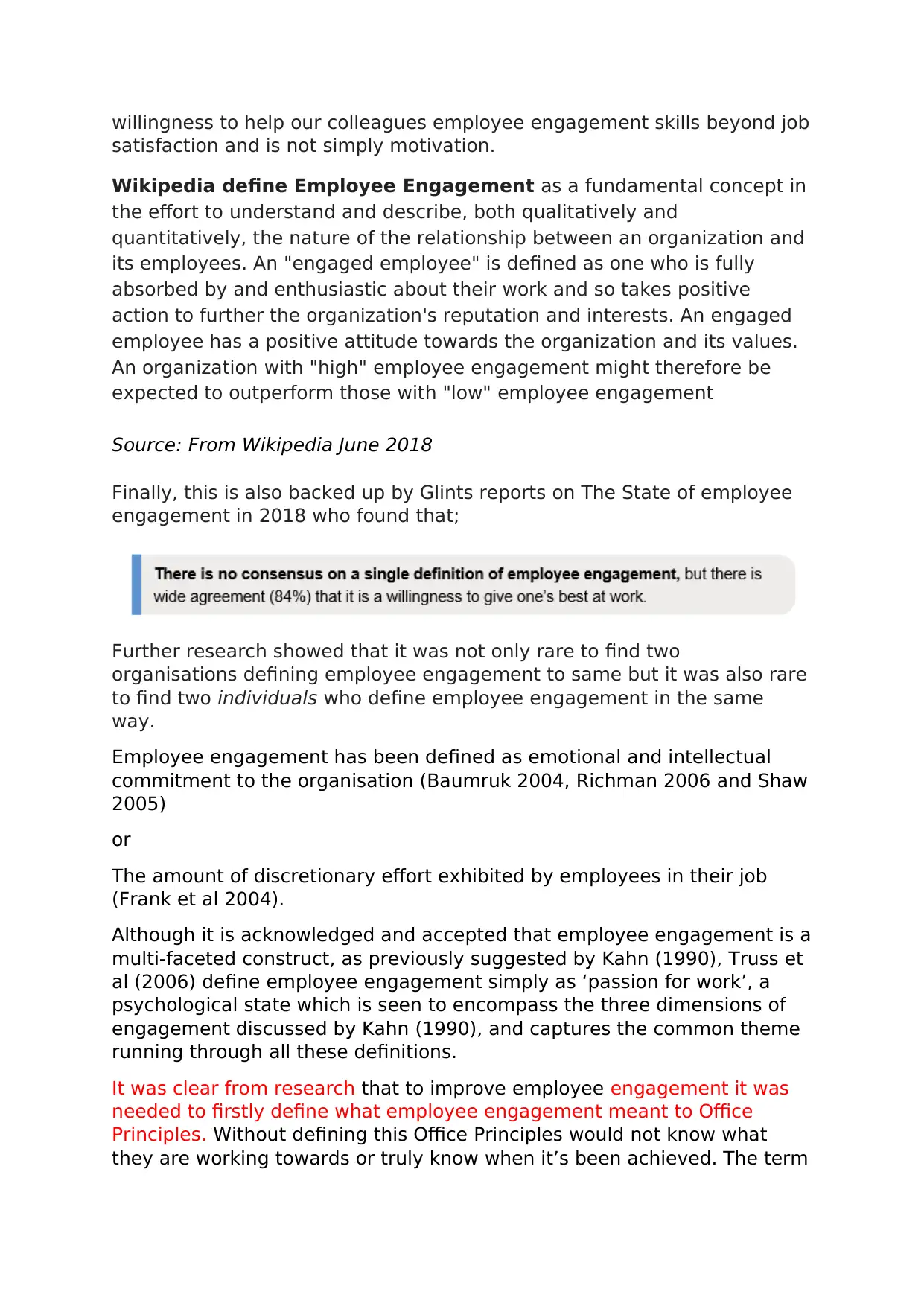
Finally, this is also backed up by Glints reports on The State of employee
engagement in 2018 who found that;
Further research showed that it was not only rare to find two
organisations defining employee engagement to same but it was also rare
to find two individuals who define employee engagement in the same
way.
Employee engagement has been defined as emotional and intellectual
commitment to the organisation (Baumruk 2004, Richman 2006 and Shaw
2005)
or
The amount of discretionary effort exhibited by employees in their job
(Frank et al 2004).
Although it is acknowledged and accepted that employee engagement is a
multi-faceted construct, as previously suggested by Kahn (1990), Truss et
al (2006) define employee engagement simply as ‘passion for work’, a
psychological state which is seen to encompass the three dimensions of
engagement discussed by Kahn (1990), and captures the common theme
running through all these definitions.
It was clear from research that to improve employee engagement it was
needed to firstly define what employee engagement meant to Office
Principles. Without defining this Office Principles would not know what
they are working towards or truly know when it’s been achieved. The term
satisfaction and is not simply motivation.
Wikipedia define Employee Engagement as a fundamental concept in
the effort to understand and describe, both qualitatively and
quantitatively, the nature of the relationship between an organization and
its employees. An "engaged employee" is defined as one who is fully
absorbed by and enthusiastic about their work and so takes positive
action to further the organization's reputation and interests. An engaged
employee has a positive attitude towards the organization and its values.
An organization with "high" employee engagement might therefore be
expected to outperform those with "low" employee engagement
Source: From Wikipedia June 2018
Finally, this is also backed up by Glints reports on The State of employee
engagement in 2018 who found that;
Further research showed that it was not only rare to find two
organisations defining employee engagement to same but it was also rare
to find two individuals who define employee engagement in the same
way.
Employee engagement has been defined as emotional and intellectual
commitment to the organisation (Baumruk 2004, Richman 2006 and Shaw
2005)
or
The amount of discretionary effort exhibited by employees in their job
(Frank et al 2004).
Although it is acknowledged and accepted that employee engagement is a
multi-faceted construct, as previously suggested by Kahn (1990), Truss et
al (2006) define employee engagement simply as ‘passion for work’, a
psychological state which is seen to encompass the three dimensions of
engagement discussed by Kahn (1990), and captures the common theme
running through all these definitions.
It was clear from research that to improve employee engagement it was
needed to firstly define what employee engagement meant to Office
Principles. Without defining this Office Principles would not know what
they are working towards or truly know when it’s been achieved. The term
Paraphrase This Document
Need a fresh take? Get an instant paraphrase of this document with our AI Paraphraser
‘employee engagement’ is so broad and vague but so much appears to
hang on this been achieved.
Why is employee engagement important?
The author believes when employees are engaged with their organisation
they feel a connection with the company, they believe the work they are
doing is important. As a result of this the performance and productivity is
increased, employee retention is increased along with morale and
reduced recruitment fee’s. Therefore, the overall success of a company
hang on this been achieved.
Why is employee engagement important?
The author believes when employees are engaged with their organisation
they feel a connection with the company, they believe the work they are
doing is important. As a result of this the performance and productivity is
increased, employee retention is increased along with morale and
reduced recruitment fee’s. Therefore, the overall success of a company
can depend on how engaged the workforce is and this has a direct impact
on the profitability organisations.
The Author’s theory is backed up by a report by Gemma Robertson Smith
and Carl Markwick, Employee Engagement, A Review of Current Thinking
Report 469, one of the key outcomes on their report was that
engagement can have a significant impact on the performance of
the organisation driving bottom-line profit and enabling organisation
agility and improved efficiency in driving change initiatives, they also
found that employed, engaged employees are more likely to stay with the
organisation and performed 20% better than their colleagues and
act as advocates for the organisation.
Personal Group commissioned a major investigation into the whole issue
of engagement. The result of the study is ‘The Business of Engagement’
Prefaced by Alex Edmans, professor of finance at the London Business
School, the report carried out a series of in-depth interviews with 10
leading CEOs and business leaders across the UK over a 12-month period
to test the hypothesis that happy employees are more engaged, and
therefore more productive.
The detailed study which includes a close examination of all the major
research in this area over the last few decades – is that there is a tangible
link between successful engagement and productivity. According to
Edmans once one take into account of other possible influences such as
company size, recent performance, and growth opportunities.
Organisations with high levels of employee satisfaction deliver returns on
stock that are 2.3% to 3.8% higher than their peers – which over a 28-year
period would mean investors gain a compound return of between 89%
and 184%.
During an interview Matthew Dearden the President of Europe at Clear
Channel was quoted saying “The magic bullet that makes the
difference is the quality and engagement of the people who are
driving the business” and Jonathan Cowan Vice President of Sage
Europe was quoted saying “An engage employee will go an extra
mile they will do the thing that they otherwise wouldn’t have they
will make the difference”
In the same study Edmans found that employees are more productive
and contribute more financially to the organisation if they feel
involved in and are committed to the organisation. Edmans also identified
a relationship between engagement and profitability to higher
productivity sales, customer satisfaction and increased employee
retention.
on the profitability organisations.
The Author’s theory is backed up by a report by Gemma Robertson Smith
and Carl Markwick, Employee Engagement, A Review of Current Thinking
Report 469, one of the key outcomes on their report was that
engagement can have a significant impact on the performance of
the organisation driving bottom-line profit and enabling organisation
agility and improved efficiency in driving change initiatives, they also
found that employed, engaged employees are more likely to stay with the
organisation and performed 20% better than their colleagues and
act as advocates for the organisation.
Personal Group commissioned a major investigation into the whole issue
of engagement. The result of the study is ‘The Business of Engagement’
Prefaced by Alex Edmans, professor of finance at the London Business
School, the report carried out a series of in-depth interviews with 10
leading CEOs and business leaders across the UK over a 12-month period
to test the hypothesis that happy employees are more engaged, and
therefore more productive.
The detailed study which includes a close examination of all the major
research in this area over the last few decades – is that there is a tangible
link between successful engagement and productivity. According to
Edmans once one take into account of other possible influences such as
company size, recent performance, and growth opportunities.
Organisations with high levels of employee satisfaction deliver returns on
stock that are 2.3% to 3.8% higher than their peers – which over a 28-year
period would mean investors gain a compound return of between 89%
and 184%.
During an interview Matthew Dearden the President of Europe at Clear
Channel was quoted saying “The magic bullet that makes the
difference is the quality and engagement of the people who are
driving the business” and Jonathan Cowan Vice President of Sage
Europe was quoted saying “An engage employee will go an extra
mile they will do the thing that they otherwise wouldn’t have they
will make the difference”
In the same study Edmans found that employees are more productive
and contribute more financially to the organisation if they feel
involved in and are committed to the organisation. Edmans also identified
a relationship between engagement and profitability to higher
productivity sales, customer satisfaction and increased employee
retention.
⊘ This is a preview!⊘
Do you want full access?
Subscribe today to unlock all pages.
Trusted by 1+ million students worldwide
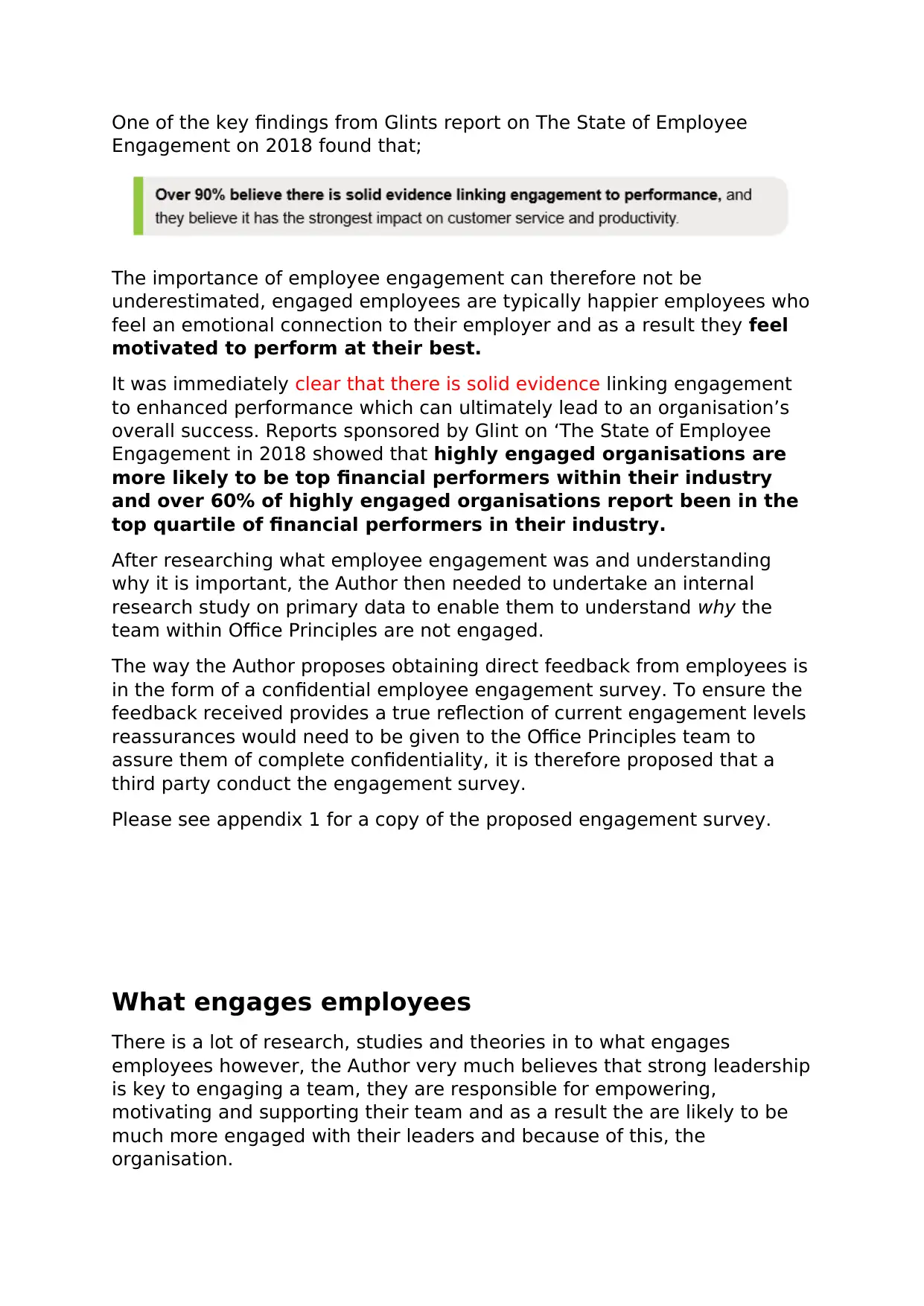
One of the key findings from Glints report on The State of Employee
Engagement on 2018 found that;
The importance of employee engagement can therefore not be
underestimated, engaged employees are typically happier employees who
feel an emotional connection to their employer and as a result they feel
motivated to perform at their best.
It was immediately clear that there is solid evidence linking engagement
to enhanced performance which can ultimately lead to an organisation’s
overall success. Reports sponsored by Glint on ‘The State of Employee
Engagement in 2018 showed that highly engaged organisations are
more likely to be top financial performers within their industry
and over 60% of highly engaged organisations report been in the
top quartile of financial performers in their industry.
After researching what employee engagement was and understanding
why it is important, the Author then needed to undertake an internal
research study on primary data to enable them to understand why the
team within Office Principles are not engaged.
The way the Author proposes obtaining direct feedback from employees is
in the form of a confidential employee engagement survey. To ensure the
feedback received provides a true reflection of current engagement levels
reassurances would need to be given to the Office Principles team to
assure them of complete confidentiality, it is therefore proposed that a
third party conduct the engagement survey.
Please see appendix 1 for a copy of the proposed engagement survey.
What engages employees
There is a lot of research, studies and theories in to what engages
employees however, the Author very much believes that strong leadership
is key to engaging a team, they are responsible for empowering,
motivating and supporting their team and as a result the are likely to be
much more engaged with their leaders and because of this, the
organisation.
Engagement on 2018 found that;
The importance of employee engagement can therefore not be
underestimated, engaged employees are typically happier employees who
feel an emotional connection to their employer and as a result they feel
motivated to perform at their best.
It was immediately clear that there is solid evidence linking engagement
to enhanced performance which can ultimately lead to an organisation’s
overall success. Reports sponsored by Glint on ‘The State of Employee
Engagement in 2018 showed that highly engaged organisations are
more likely to be top financial performers within their industry
and over 60% of highly engaged organisations report been in the
top quartile of financial performers in their industry.
After researching what employee engagement was and understanding
why it is important, the Author then needed to undertake an internal
research study on primary data to enable them to understand why the
team within Office Principles are not engaged.
The way the Author proposes obtaining direct feedback from employees is
in the form of a confidential employee engagement survey. To ensure the
feedback received provides a true reflection of current engagement levels
reassurances would need to be given to the Office Principles team to
assure them of complete confidentiality, it is therefore proposed that a
third party conduct the engagement survey.
Please see appendix 1 for a copy of the proposed engagement survey.
What engages employees
There is a lot of research, studies and theories in to what engages
employees however, the Author very much believes that strong leadership
is key to engaging a team, they are responsible for empowering,
motivating and supporting their team and as a result the are likely to be
much more engaged with their leaders and because of this, the
organisation.
Paraphrase This Document
Need a fresh take? Get an instant paraphrase of this document with our AI Paraphraser
The Authors theory is back up by the MacLeod Review who summarised
four ‘enablers’ that should be fundamentals of any employee engagement
strategy and those are;
1. Leadership that gives a ‘strong strategic narrative about the
organisation, where it’s come from and where it’s going’.
2. Line managers who motivate, empower and support their
employees.
3. Employee voice throughout the organisation, to challenge or
reinforce the status quo and involve employees in decision making
4. Organisational integrity stated values are embedded into
organisational culture; what we say is what we do. This closely
relates to the sense of fairness and trust in the organisation and the
psychological contract, which depend on employers delivering on
their commitments and fulfilling employees’ expectations.
The Advisory, Conciliation and Arbitration Service (ACAS) is a Crown non-
departmental public body of the Government in the United Kingdom. Its
purpose is to improve organisations and working life through the
promotion and facilitation in strong industrial relations practice.
ACAS has been specialising in the people sector of workplace life for the
past 35 years. They state there are four basic ingredients of employee
engagement that produce a more productive, motivated, happy business.
The Four ingredients are;
Leaders with a vision who value how individuals contribute
Line Managers who empower rather than control their staff
Values that are lived and not just spoken, leading to a sense of
trust and integrity
Employees who have the chance to voice their views and concerns.
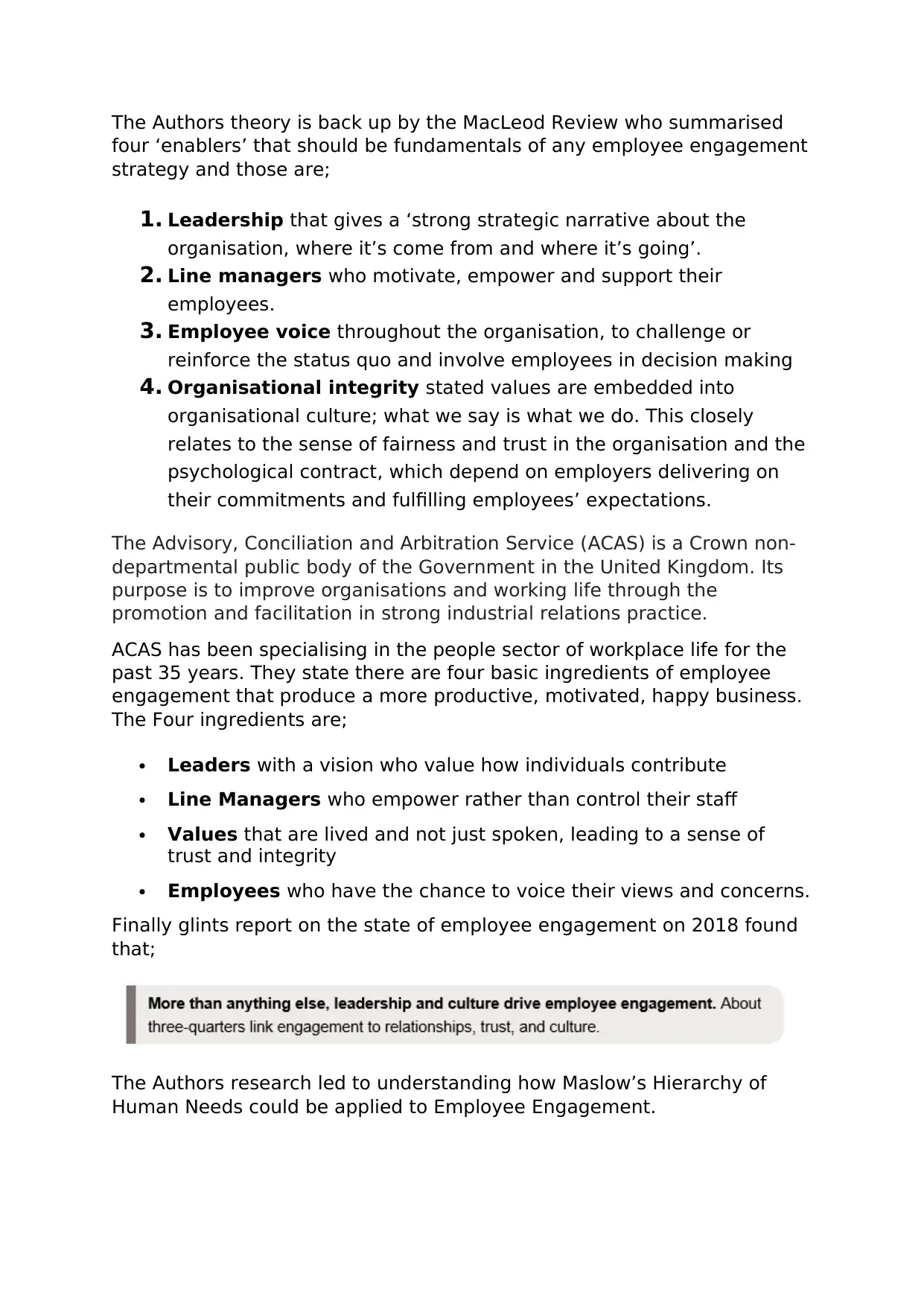
Finally glints report on the state of employee engagement on 2018 found
that;
The Authors research led to understanding how Maslow’s Hierarchy of
Human Needs could be applied to Employee Engagement.
four ‘enablers’ that should be fundamentals of any employee engagement
strategy and those are;
1. Leadership that gives a ‘strong strategic narrative about the
organisation, where it’s come from and where it’s going’.
2. Line managers who motivate, empower and support their
employees.
3. Employee voice throughout the organisation, to challenge or
reinforce the status quo and involve employees in decision making
4. Organisational integrity stated values are embedded into
organisational culture; what we say is what we do. This closely
relates to the sense of fairness and trust in the organisation and the
psychological contract, which depend on employers delivering on
their commitments and fulfilling employees’ expectations.
The Advisory, Conciliation and Arbitration Service (ACAS) is a Crown non-
departmental public body of the Government in the United Kingdom. Its
purpose is to improve organisations and working life through the
promotion and facilitation in strong industrial relations practice.
ACAS has been specialising in the people sector of workplace life for the
past 35 years. They state there are four basic ingredients of employee
engagement that produce a more productive, motivated, happy business.
The Four ingredients are;
Leaders with a vision who value how individuals contribute
Line Managers who empower rather than control their staff
Values that are lived and not just spoken, leading to a sense of
trust and integrity
Employees who have the chance to voice their views and concerns.
Finally glints report on the state of employee engagement on 2018 found
that;
The Authors research led to understanding how Maslow’s Hierarchy of
Human Needs could be applied to Employee Engagement.
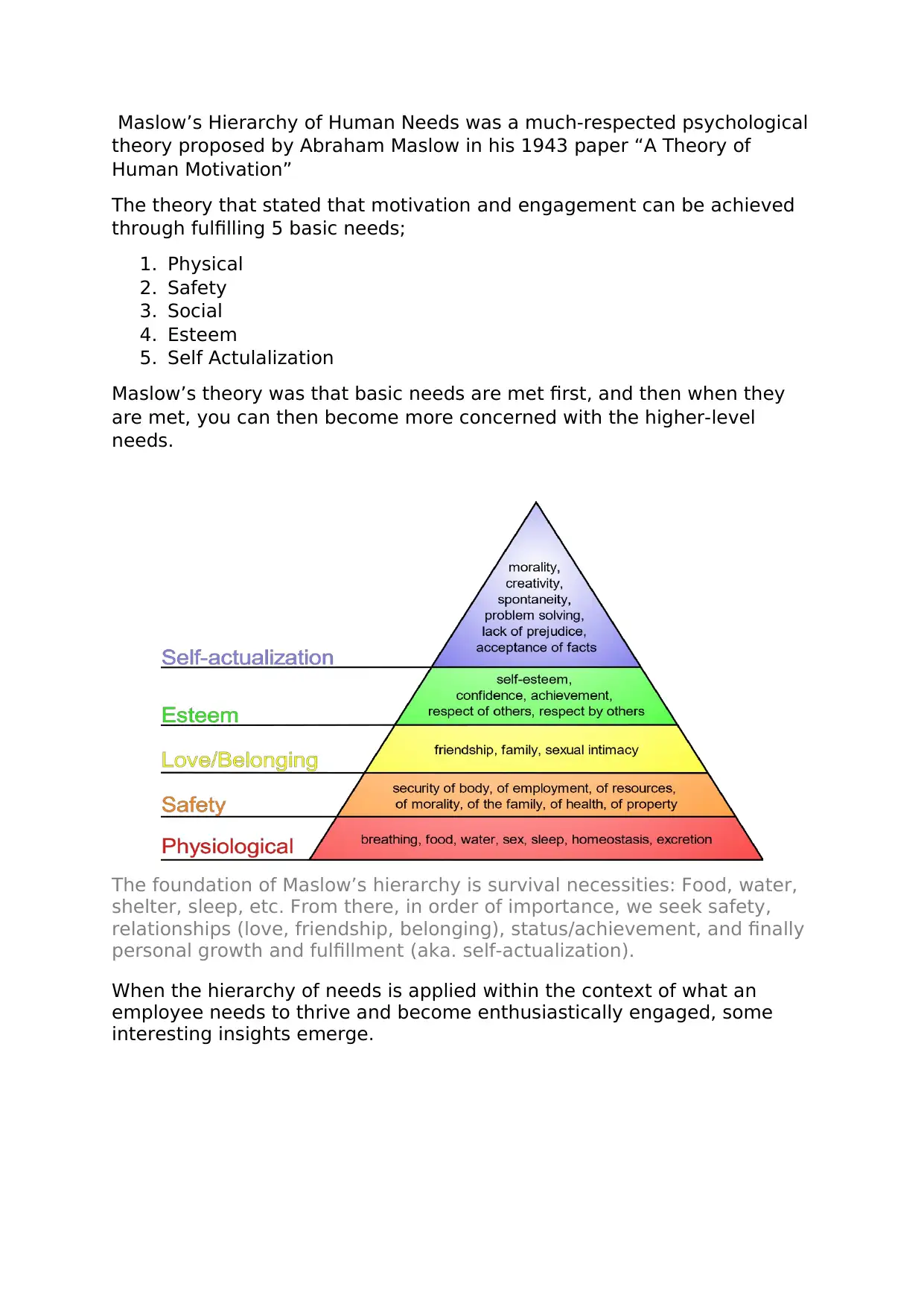
Maslow’s Hierarchy of Human Needs was a much-respected psychological
theory proposed by Abraham Maslow in his 1943 paper “A Theory of
Human Motivation”
The theory that stated that motivation and engagement can be achieved
through fulfilling 5 basic needs;
1. Physical
2. Safety
3. Social
4. Esteem
5. Self Actulalization
Maslow’s theory was that basic needs are met first, and then when they
are met, you can then become more concerned with the higher-level
needs.
The foundation of Maslow’s hierarchy is survival necessities: Food, water,
shelter, sleep, etc. From there, in order of importance, we seek safety,
relationships (love, friendship, belonging), status/achievement, and finally
personal growth and fulfillment (aka. self-actualization).
When the hierarchy of needs is applied within the context of what an
employee needs to thrive and become enthusiastically engaged, some
interesting insights emerge.
theory proposed by Abraham Maslow in his 1943 paper “A Theory of
Human Motivation”
The theory that stated that motivation and engagement can be achieved
through fulfilling 5 basic needs;
1. Physical
2. Safety
3. Social
4. Esteem
5. Self Actulalization
Maslow’s theory was that basic needs are met first, and then when they
are met, you can then become more concerned with the higher-level
needs.
The foundation of Maslow’s hierarchy is survival necessities: Food, water,
shelter, sleep, etc. From there, in order of importance, we seek safety,
relationships (love, friendship, belonging), status/achievement, and finally
personal growth and fulfillment (aka. self-actualization).
When the hierarchy of needs is applied within the context of what an
employee needs to thrive and become enthusiastically engaged, some
interesting insights emerge.
⊘ This is a preview!⊘
Do you want full access?
Subscribe today to unlock all pages.
Trusted by 1+ million students worldwide

1 out of 21


Related Documents


Your All-in-One AI-Powered Toolkit for Academic Success.
+13062052269
info@desklib.com
Available 24*7 on WhatsApp / Email
![[object Object]](/_next/static/media/star-bottom.7253800d.svg)
Unlock your academic potential
Copyright © 2020–2026 A2Z Services. All Rights Reserved. Developed and managed by ZUCOL.