BUS703 Managing Research: Employee Motivation & Performance Project

Verified

Added on  2023/06/13

|5
|1055
|90
Project
AI Summary
This project outlines the problem definition stage of a research proposal focused on employee motivation and performance within an organization. It identifies a decline in employee interest and productivity, leading to execution conflicts and hindered leadership. The project explores the impact of management decisions on employee psychology and organizational culture, emphasizing the need to understand employee needs and foster a cooperative environment. Key research questions address employee satisfaction, de-motivational factors, leadership styles, internal recruitment policies, and sustaining a healthy work culture. The objectives include analyzing current satisfaction levels, identifying causes of de-motivation, evaluating leadership effectiveness, and developing sustainable strategies for improved employee engagement and organizational performance. This project is intended to identify the key issues, and provide a foundation for further research into effective strategies for improving employee motivation and performance.
Document Page
Running head: EMPLOYEE MOTIVATION AND PERFORMANCE
Employee Motivation and Performance
Name of the Student:
Name of the University:
Author Note:
tabler-icon-diamond-filled.svg

Paraphrase This Document

Need a fresh take? Get an instant paraphrase of this document with our AI Paraphraser
Document Page
1EMPLOYEE MOTIVATION AND PERFORMANCE
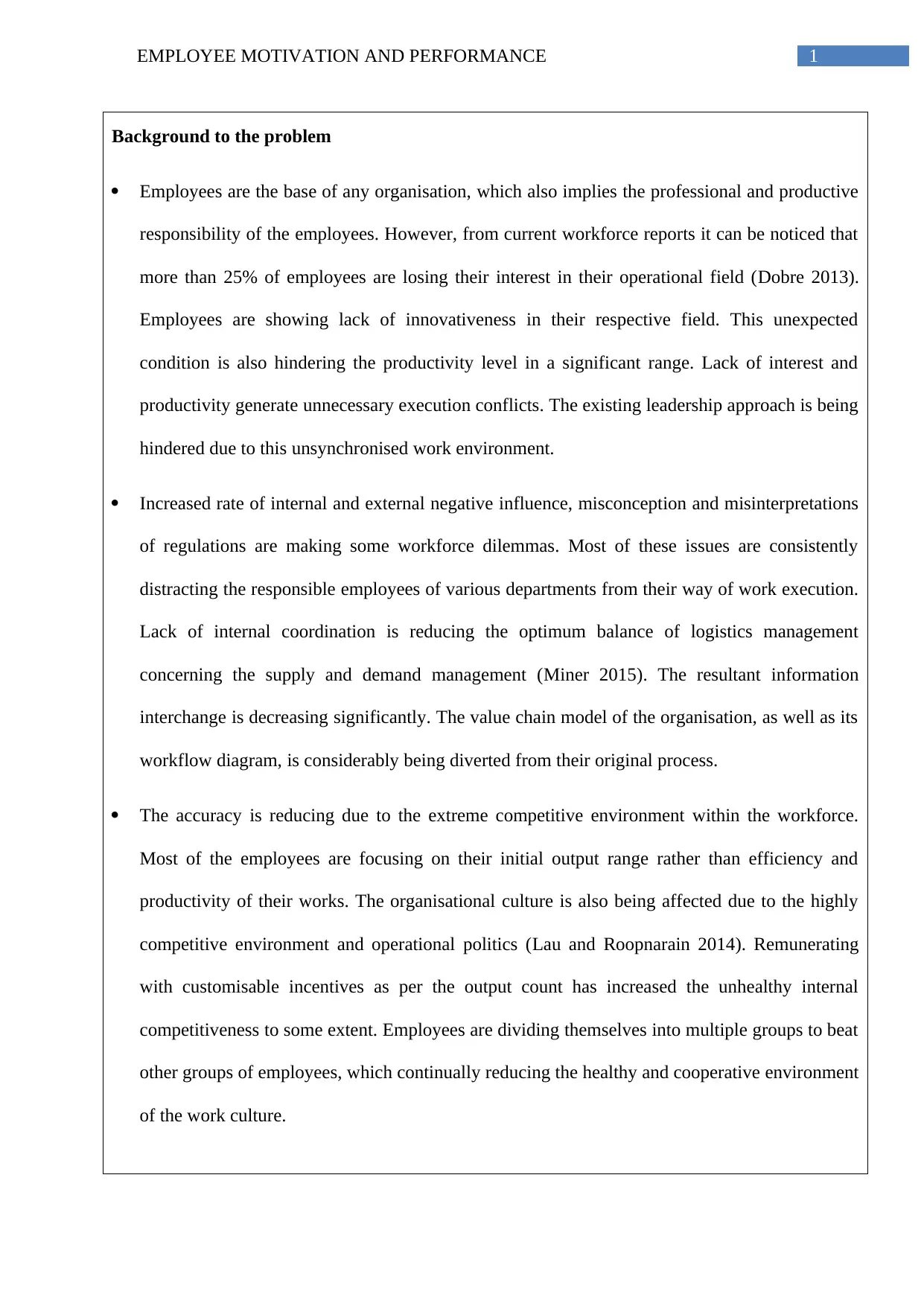
Background to the problem
Employees are the base of any organisation, which also implies the professional and productive
responsibility of the employees. However, from current workforce reports it can be noticed that
more than 25% of employees are losing their interest in their operational field (Dobre 2013).
Employees are showing lack of innovativeness in their respective field. This unexpected
condition is also hindering the productivity level in a significant range. Lack of interest and
productivity generate unnecessary execution conflicts. The existing leadership approach is being
hindered due to this unsynchronised work environment.
Increased rate of internal and external negative influence, misconception and misinterpretations
of regulations are making some workforce dilemmas. Most of these issues are consistently
distracting the responsible employees of various departments from their way of work execution.
Lack of internal coordination is reducing the optimum balance of logistics management
concerning the supply and demand management (Miner 2015). The resultant information
interchange is decreasing significantly. The value chain model of the organisation, as well as its
workflow diagram, is considerably being diverted from their original process.
The accuracy is reducing due to the extreme competitive environment within the workforce.
Most of the employees are focusing on their initial output range rather than efficiency and
productivity of their works. The organisational culture is also being affected due to the highly
competitive environment and operational politics (Lau and Roopnarain 2014). Remunerating
with customisable incentives as per the output count has increased the unhealthy internal
competitiveness to some extent. Employees are dividing themselves into multiple groups to beat
other groups of employees, which continually reducing the healthy and cooperative environment
of the work culture.
Document Page
2EMPLOYEE MOTIVATION AND PERFORMANCE
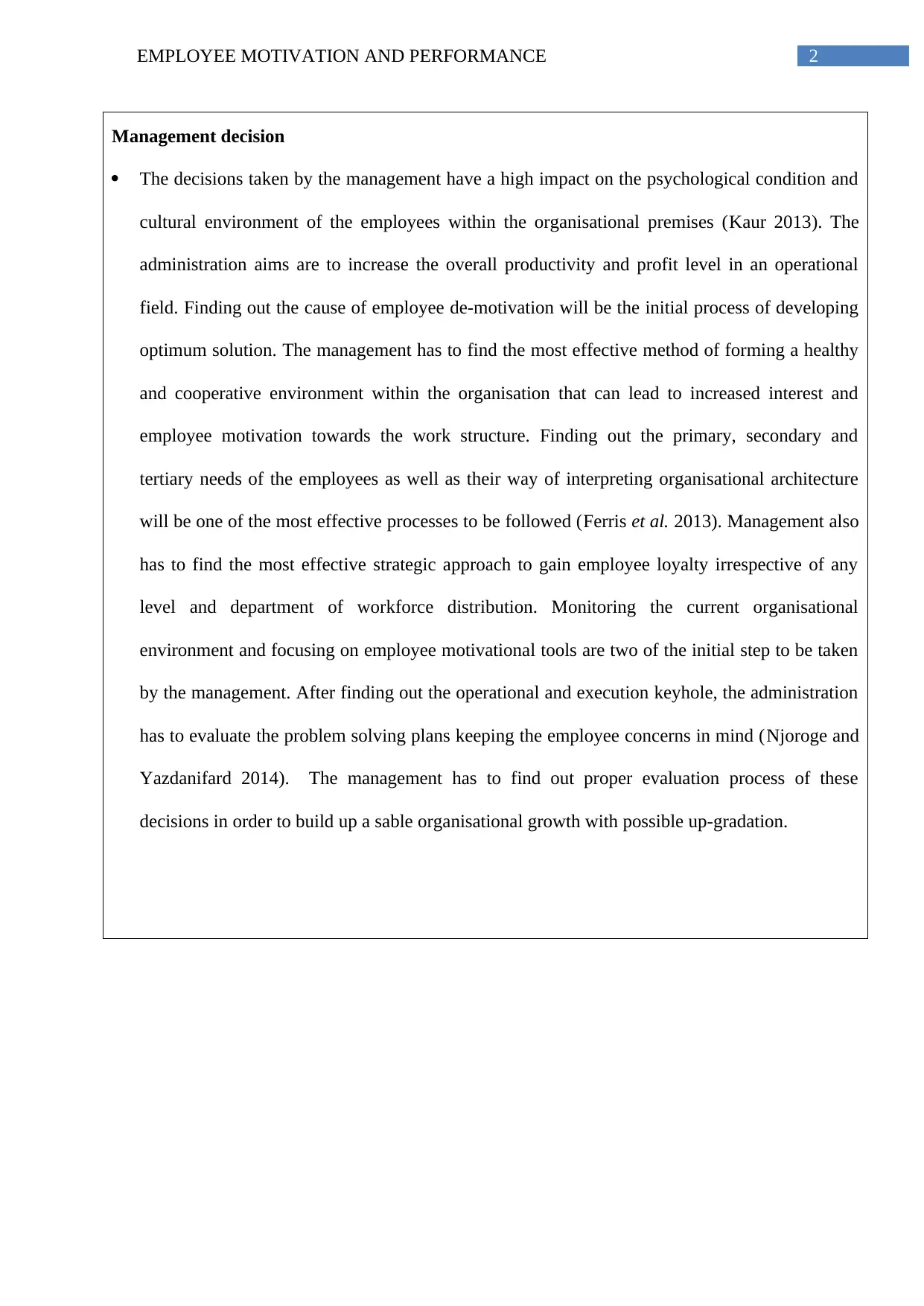
Management decision
The decisions taken by the management have a high impact on the psychological condition and
cultural environment of the employees within the organisational premises (Kaur 2013). The
administration aims are to increase the overall productivity and profit level in an operational
field. Finding out the cause of employee de-motivation will be the initial process of developing
optimum solution. The management has to find the most effective method of forming a healthy
and cooperative environment within the organisation that can lead to increased interest and
employee motivation towards the work structure. Finding out the primary, secondary and
tertiary needs of the employees as well as their way of interpreting organisational architecture
will be one of the most effective processes to be followed (Ferris et al. 2013). Management also
has to find the most effective strategic approach to gain employee loyalty irrespective of any
level and department of workforce distribution. Monitoring the current organisational
environment and focusing on employee motivational tools are two of the initial step to be taken
by the management. After finding out the operational and execution keyhole, the administration
has to evaluate the problem solving plans keeping the employee concerns in mind (Njoroge and
Yazdanifard 2014). The management has to find out proper evaluation process of these
decisions in order to build up a sable organisational growth with possible up-gradation.
Document Page
3EMPLOYEE MOTIVATION AND PERFORMANCE
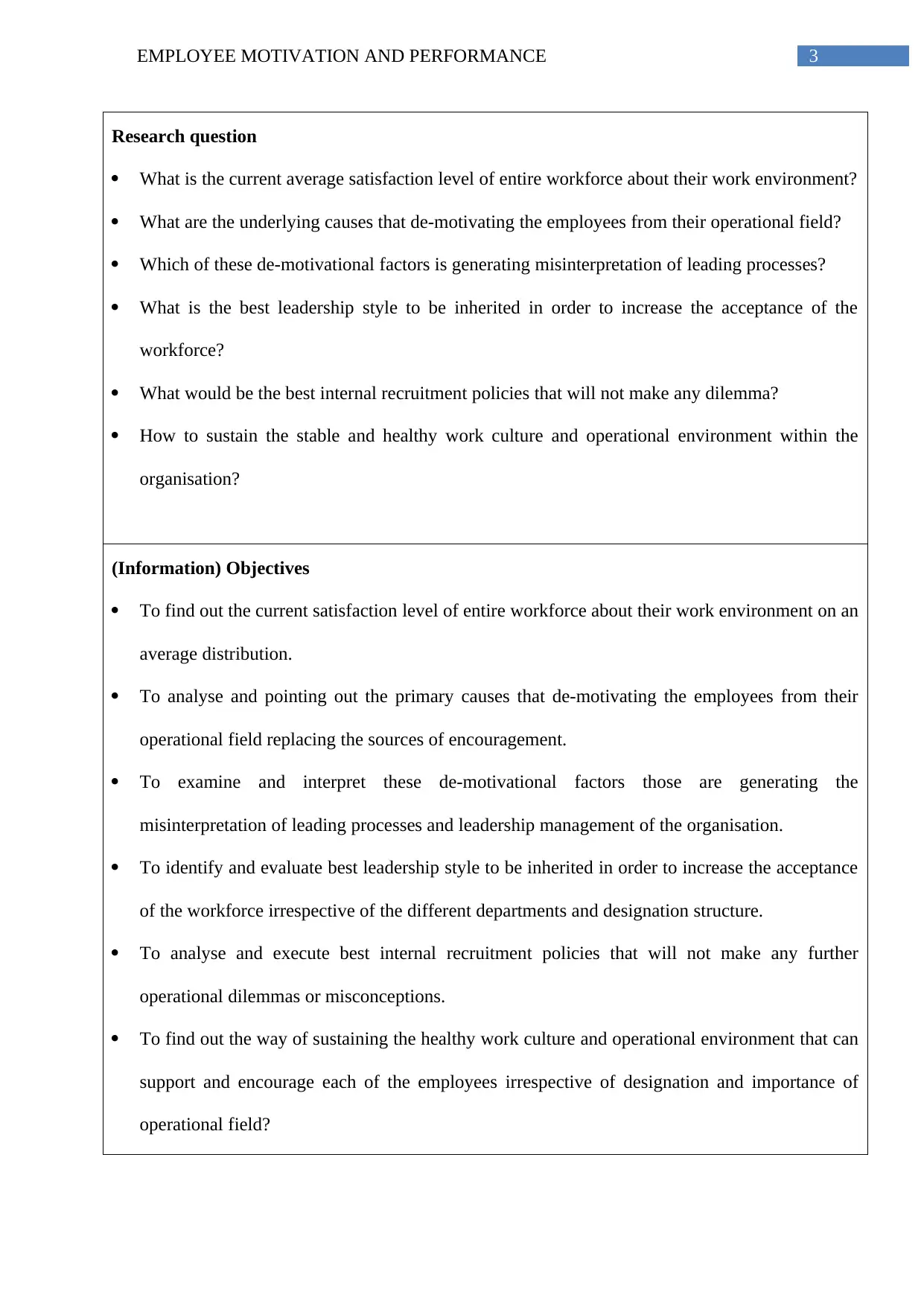
Research question
What is the current average satisfaction level of entire workforce about their work environment?
What are the underlying causes that de-motivating the employees from their operational field?
Which of these de-motivational factors is generating misinterpretation of leading processes?
What is the best leadership style to be inherited in order to increase the acceptance of the
workforce?
What would be the best internal recruitment policies that will not make any dilemma?
How to sustain the stable and healthy work culture and operational environment within the
organisation?
(Information) Objectives
To find out the current satisfaction level of entire workforce about their work environment on an
average distribution.
To analyse and pointing out the primary causes that de-motivating the employees from their
operational field replacing the sources of encouragement.
To examine and interpret these de-motivational factors those are generating the
misinterpretation of leading processes and leadership management of the organisation.
To identify and evaluate best leadership style to be inherited in order to increase the acceptance
of the workforce irrespective of the different departments and designation structure.
To analyse and execute best internal recruitment policies that will not make any further
operational dilemmas or misconceptions.
To find out the way of sustaining the healthy work culture and operational environment that can
support and encourage each of the employees irrespective of designation and importance of
operational field?
tabler-icon-diamond-filled.svg

Paraphrase This Document

Need a fresh take? Get an instant paraphrase of this document with our AI Paraphraser
Document Page
4EMPLOYEE MOTIVATION AND PERFORMANCE
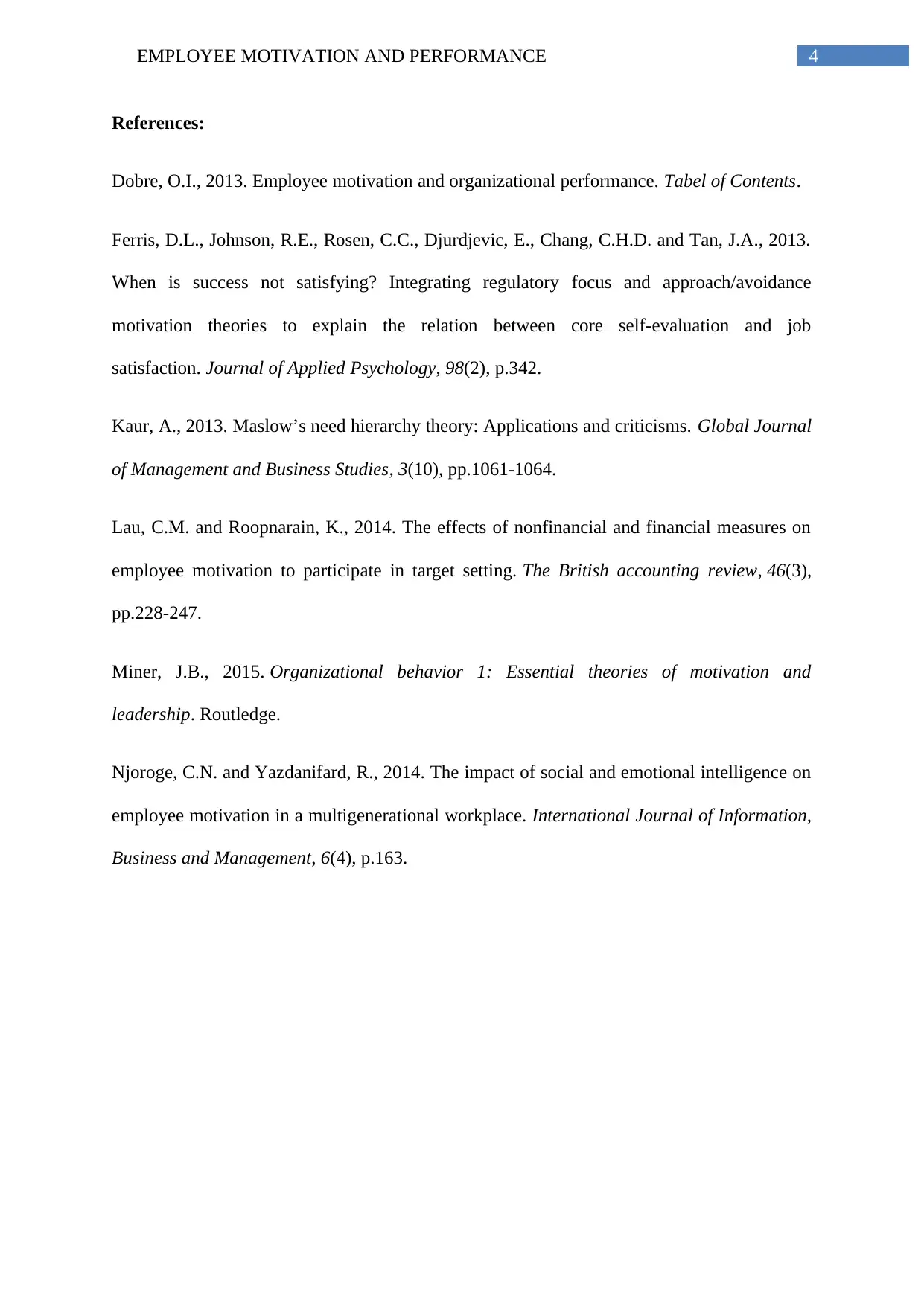
References:
Dobre, O.I., 2013. Employee motivation and organizational performance. Tabel of Contents.
Ferris, D.L., Johnson, R.E., Rosen, C.C., Djurdjevic, E., Chang, C.H.D. and Tan, J.A., 2013.
When is success not satisfying? Integrating regulatory focus and approach/avoidance
motivation theories to explain the relation between core self-evaluation and job
satisfaction. Journal of Applied Psychology, 98(2), p.342.
Kaur, A., 2013. Maslow’s need hierarchy theory: Applications and criticisms. Global Journal
of Management and Business Studies, 3(10), pp.1061-1064.
Lau, C.M. and Roopnarain, K., 2014. The effects of nonfinancial and financial measures on
employee motivation to participate in target setting. The British accounting review, 46(3),
pp.228-247.
Miner, J.B., 2015. Organizational behavior 1: Essential theories of motivation and
leadership. Routledge.
Njoroge, C.N. and Yazdanifard, R., 2014. The impact of social and emotional intelligence on
employee motivation in a multigenerational workplace. International Journal of Information,
Business and Management, 6(4), p.163.
chevron_up_icon
1 out of 5
circle_padding
hide_on_mobile
zoom_out_icon
[object Object]