MNG10720: Factors Affecting Employee Performance Research

Verified

Added on  2023/06/12

|9
|2136
|114
Report
AI Summary
This research report proposal aims to examine the factors influencing employee performance within Sydney's hotel and hospitality industry. The proposal outlines research objectives, including the impact of job training, organizational leadership, management, reward, and remuneration. A qualitative research design is proposed, utilizing in-depth interviews, focus groups, and questionnaires for data collection. The study intends to employ purposeful sampling to gather detailed insights from the Sydney hotel and hospitality sector. Data analysis techniques involve recording results in tables and presenting them as bar charts, with age brackets and chosen factors as study variables. Ethical considerations, such as confidentiality and individual consent, are addressed to ensure responsible research practices. The proposal also includes a Qualtrics survey with both open-ended and closed-ended questions to gather comprehensive data. The research intends to provide valuable insights into enhancing employee performance in the hospitality sector. Desklib provides a platform to access this and similar solved assignments.

Document Page
Research Report Proposal 1
RESEARCH REPORT PROPOSAL
(Student’s Name)
(Course Name)
(Instructor’s Name)
(Institution)
(Date)
tabler-icon-diamond-filled.svg

Paraphrase This Document

Need a fresh take? Get an instant paraphrase of this document with our AI Paraphraser
Document Page
Research Report Proposal 2
FACTORS INFLUENCING EMPLOYEE PERFORMANCE IN SYDNEY’S HOTEL AND
HOSPITALITY INDUSTRY
Problem Statement and Research Objectives
Problem Statement
The research seeks to examine the factors that influence performance of hotel and
hospitality employees within Sydney. In order to answer the research question fully, a number of
objectives will be developed and used. The paper proposes the following objectives for the
purpose of answering the research question.
Research Objectives
The research objectives can take the form of research questions which the researcher
wishes to answer. The research proposes two set of research objectives, the general and specific
objectives.
General Objectives
i. To examine the factors that influence performance of hotel and hospitality employees
within Australia.
Specific Objectives
i. To examine how job training influences the performance of employees in hotel and
hospitality industry in Sydney.
ii. To explore the contribution of organization leadership and management towards
employee performance in hotel and hospitality industry in Sydney.
Document Page
Research Report Proposal 3
iii. To determine how reward and remuneration influences employee performance in hotel
and hospitality industry in Sydney.
Research Design
The research hypothesis or questions determine the research design to be adopted, the
kind of data to be collected and their analysis. According to (Brotherton, 2015) while developing
a research design, it is important to determine whether the chosen design would enable one to
collect data to answer the research questions. A number of research designs have been
developed, which can be chose by a researcher. Some of the research designs are ideal for
deductive research process, while others are ideal for explorative research. The proposed
research study will seek to explore the factors that influence hotel and hospitality employee
performance in Sydney. The data to be collected will relate to employee training, management
leadership and compensation and how they influence the performance of employee within the
hotel and hospitality sector. As a result, the paper seeks to use qualitative research methodology
in the collection of the research data.
Many research designs can be used to study hospitality problems. According to (Hair,
2015) research designs can be grouped as descriptive, exploratory or causal. The descriptive
research design, which has been chosen for this study, it is used to develop a better
understanding of a phenomena (Reid & Bojanic, 2010). In the proposed research study, the paper
seeks to better understand the influence of training, management leadership and remuneration on
employee performance in the Sydney hotel and hospitality industry. However, this can only be
achieved with an appropriate research methodology, which is qualitative research method.
Document Page
Research Report Proposal 4
Qualitative research design will be used in the study. According to (Hudson, 2008)
qualitative research involve technique or methods that seek for subjective or qualitative data. It
includes the use of techniques such as interviews, questionnaires and non-participative
observations. The methodology is appropriate for this research since it offers the tools which will
allow for a better understanding how employee performance in hotel and hospitality in Sidney is
influenced by training, remuneration and management leadership. Secondly, the factors that
influence employee performance in hotel and hospitality sector can be best understood through
qualitative techniques.
Data Collection Methods
The data collection methods that will be adopted for this research study are in-depth
interviews and focus groups and questionnaires. According to (Bowie & Buttle, 2007) the use of
in-depth interviews allows the researcher to ask the respondent structured open-ended questions
in a face-to-face manner. Focus groups involve use of group dynamics in exploring the study
issue. On the other hand, questionnaires involve the use of open-ended questions given to
respondents where they outline their own opinions.
The use of in-depth interviews and focus groups allows the researcher to seek
clarification on information which is not clear. The researcher is able to eliminate bias that is
associated with questionnaires (Bowie and Buttle, 2007). However, they are time consuming,
expensive and may not be ideal where it is hard to reach respondents owing to their daily
commitments. The use of questionnaire is cheap and allows the collection of information from
respondents who do not wish to disclose their identity. They are not without limitations either,
which include potential misrepresentation of information.
tabler-icon-diamond-filled.svg

Paraphrase This Document

Need a fresh take? Get an instant paraphrase of this document with our AI Paraphraser
Document Page
Research Report Proposal 5
The use of qualitative methods of data collection is appropriate for the chosen research
design. Besides, these methods are relatively cheap and allows for an understanding of a
complex nature of phenomena unlike the use of quantitative research methods (Radzi et al.,
2014). Quantitative research methods are objective and may not allow the collection of other
information that could be relevant to phenomena under study.
Qualtrics Survey
The study will employ both open-ended and closed questions. According to (Jugenheimer
et al., 2014) there are two types of questions that researchers construct. One type is the open-
ended while the other type is closed ended questions. The open ended questions do not restrict
the response from the respondent when answering questions. However, closed questions provide
choices to which the respondent must choose from while answering the questions. Both of these
types of question have advantages as well as limitations.
The proposed research study will adopt both closed and open-ended questions in the
survey questions. The use of closed questions will allow the researcher to obtain specific answers
that will be critical in analysis of data (Jugenheimer et al., 2014). However, in the adoption of the
closed questions, the researcher will make the responses options as inclusive as much as
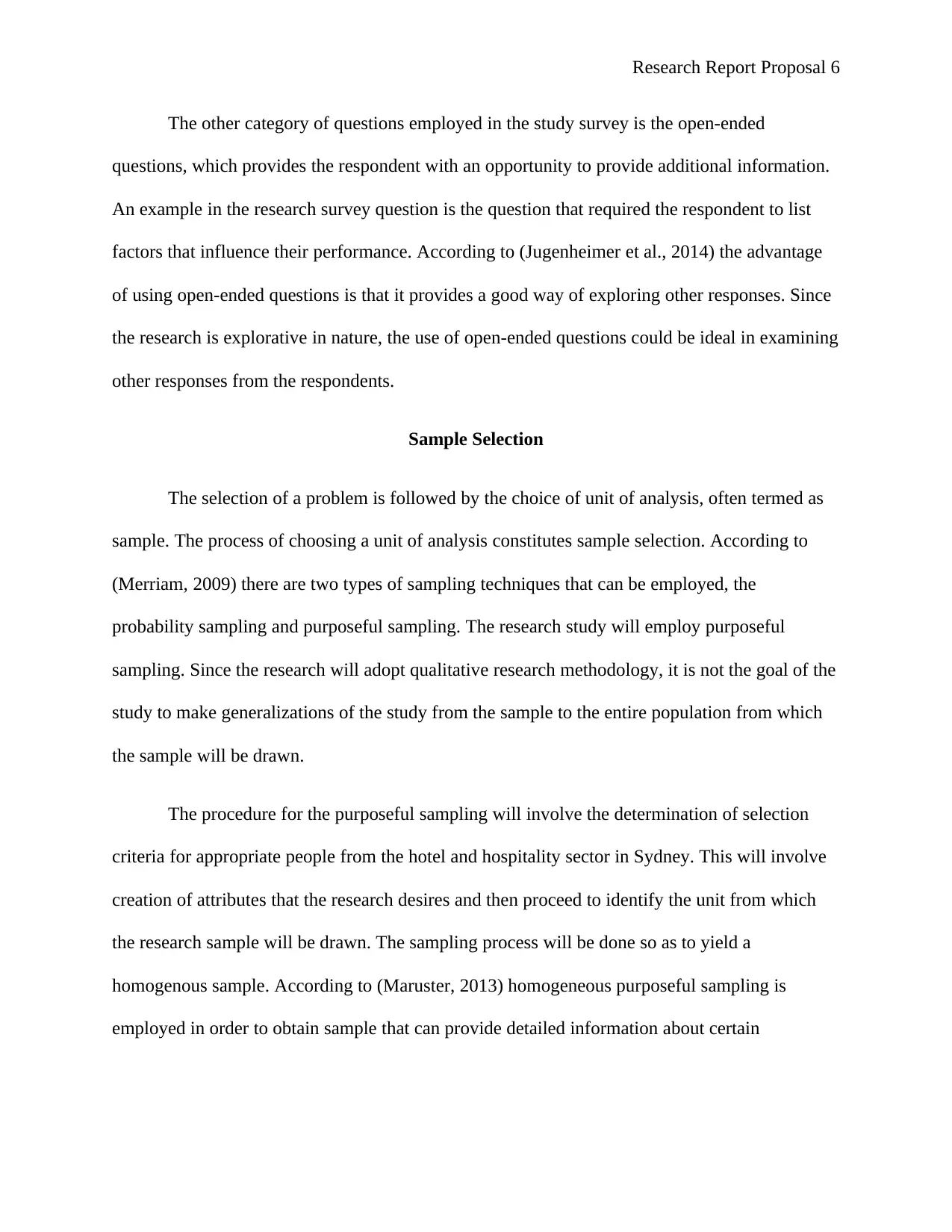
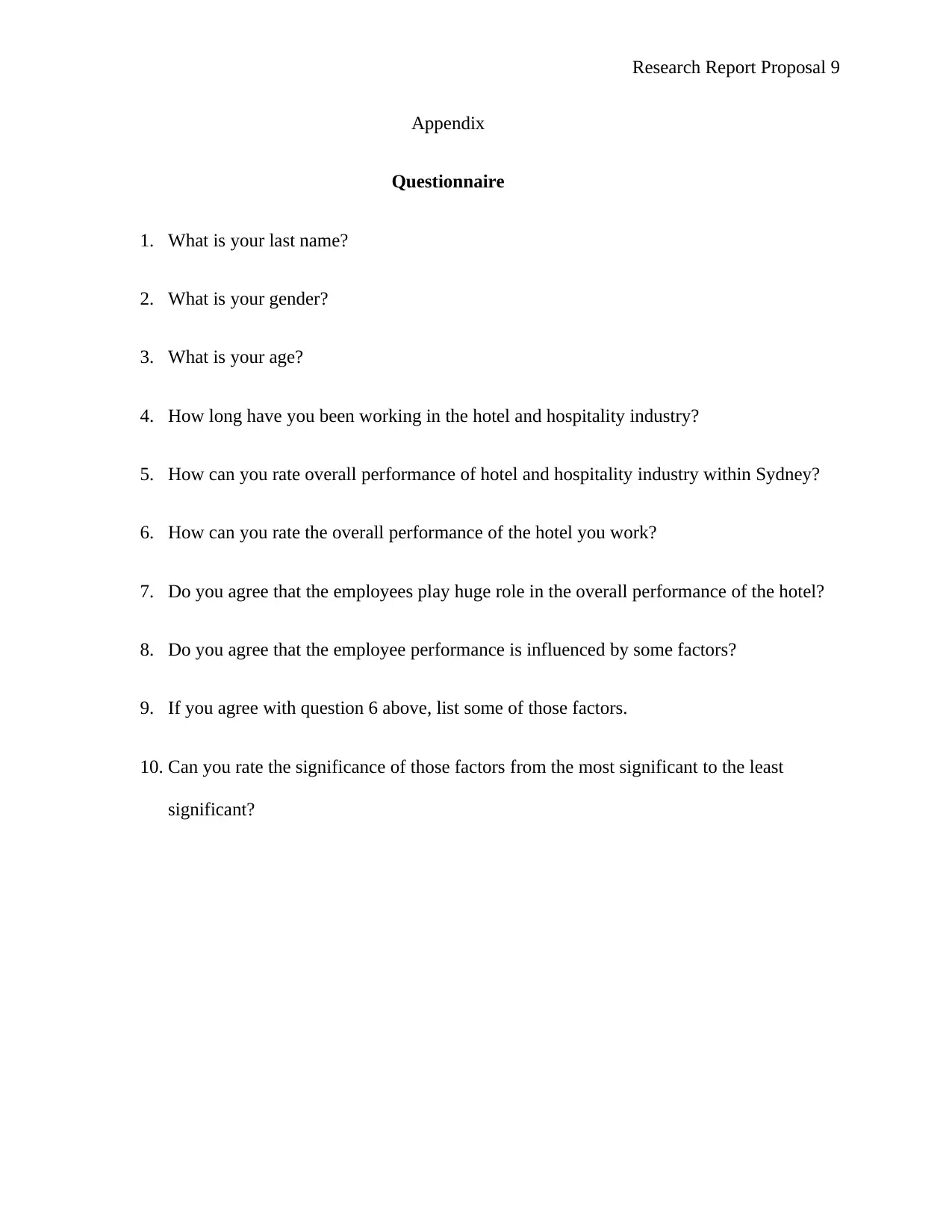
possible. An example of a closed question employed regards the question about age. In the
survey, it can be seen that the responses asks the respondent about their age and responses are
“under 18”, “18-30”, “31-50” and “above 50”. The question responses are inclusive since it
covers all the possible age brackets of the employees. The rationale behind the use of closed-
ended questions is the ease with which they can be managed and provides data that is easy to
analyse.
Document Page
Research Report Proposal 6
The other category of questions employed in the study survey is the open-ended
questions, which provides the respondent with an opportunity to provide additional information.
An example in the research survey question is the question that required the respondent to list
factors that influence their performance. According to (Jugenheimer et al., 2014) the advantage
of using open-ended questions is that it provides a good way of exploring other responses. Since
the research is explorative in nature, the use of open-ended questions could be ideal in examining
other responses from the respondents.
Sample Selection
The selection of a problem is followed by the choice of unit of analysis, often termed as
sample. The process of choosing a unit of analysis constitutes sample selection. According to
(Merriam, 2009) there are two types of sampling techniques that can be employed, the
probability sampling and purposeful sampling. The research study will employ purposeful
sampling. Since the research will adopt qualitative research methodology, it is not the goal of the
study to make generalizations of the study from the sample to the entire population from which
the sample will be drawn.
The procedure for the purposeful sampling will involve the determination of selection
criteria for appropriate people from the hotel and hospitality sector in Sydney. This will involve
creation of attributes that the research desires and then proceed to identify the unit from which
the research sample will be drawn. The sampling process will be done so as to yield a
homogenous sample. According to (Maruster, 2013) homogeneous purposeful sampling is
employed in order to obtain sample that can provide detailed information about certain
Document Page
Research Report Proposal 7
phenomena. This is appropriate for the research since the study aims to find detailed information
on the factors that influence employee performance in Sydney hotel and hospitality industry.
Data Analysis Techniques
Data analysis allows the researcher to provide an interpretation of research data in a way
that conclusions can be drawn easily (Crowther & Lancaster, 2012). According to the author,
there are many ways in which data analysis can be achieved. The proposed research will collect
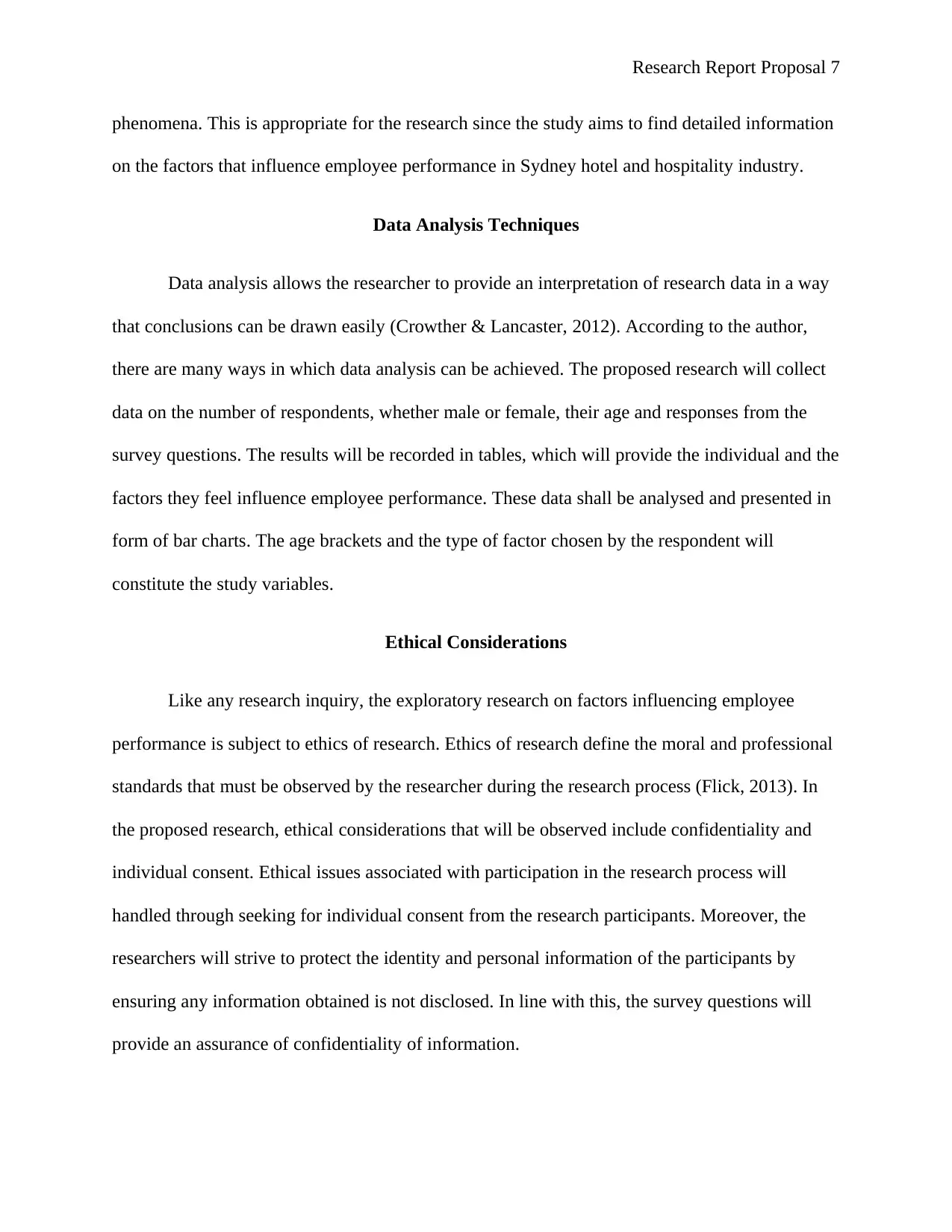
data on the number of respondents, whether male or female, their age and responses from the
survey questions. The results will be recorded in tables, which will provide the individual and the
factors they feel influence employee performance. These data shall be analysed and presented in
form of bar charts. The age brackets and the type of factor chosen by the respondent will
constitute the study variables.
Ethical Considerations
Like any research inquiry, the exploratory research on factors influencing employee
performance is subject to ethics of research. Ethics of research define the moral and professional
standards that must be observed by the researcher during the research process (Flick, 2013). In
the proposed research, ethical considerations that will be observed include confidentiality and
individual consent. Ethical issues associated with participation in the research process will
handled through seeking for individual consent from the research participants. Moreover, the
researchers will strive to protect the identity and personal information of the participants by
ensuring any information obtained is not disclosed. In line with this, the survey questions will
provide an assurance of confidentiality of information.
tabler-icon-diamond-filled.svg

Paraphrase This Document

Need a fresh take? Get an instant paraphrase of this document with our AI Paraphraser
Document Page
Research Report Proposal 8
References
Bowie, D. and Buttle, F. (2007). Hospitality Marketing. Burlington, MA: Routledge.
Brotherton, B. (2015). Researching Hospitality and Tourism. 2nd ed. Thousand Oaks, CA:
SAGE.
Crowther, D. and Lancaster, G. (2012). Research Methods. 2nd ed. Routledge.
Flick, U. ed., 2013. The SAGE handbook of qualitative data analysis. Sage.
Hair, J. (2015). Essentials of Business Research Methods. New York: M.E. Sharpe.
Hudson, S. (2008). Tourism and Hospitality Marketing: A Global Perspective. Los Angeles:
SAGE.
Jugenheimer, D., Kelley, L., Hudson, J. and Bradley, S. (2014). Advertising and Public Relations
Research. 2nd ed. New York: M.E. Sharpe.
Maruster, L. ed., 2013. Qualitative Research Methods. Sage.
Merriam, S. (2009). Qualitative Research. 3rd ed. San Francisco: John Wiley & Sons.
Radzi, S.M., Bakhtiar, M.F.S., Mohi, Z., Zahari, M.S.M., Sumarjan, N., Chik, C.T. and Anuar,
F.I. eds., 2014. Theory and Practice in Hospitality and Tourism Research. CRC Press.
Reid, R. and Bojanic, D. (2010). Hospitality Marketing Management. 5th ed. New Jersey: John
Wiley & Sons.
Document Page
Research Report Proposal 9
Appendix
Questionnaire
1. What is your last name?
2. What is your gender?
3. What is your age?
4. How long have you been working in the hotel and hospitality industry?
5. How can you rate overall performance of hotel and hospitality industry within Sydney?
6. How can you rate the overall performance of the hotel you work?
7. Do you agree that the employees play huge role in the overall performance of the hotel?
8. Do you agree that the employee performance is influenced by some factors?
9. If you agree with question 6 above, list some of those factors.
10. Can you rate the significance of those factors from the most significant to the least
significant?
chevron_up_icon
1 out of 9
circle_padding
hide_on_mobile
zoom_out_icon
[object Object]