ERCP Diagnostic Test: Procedure, Hospital Clerk's Tasks and Overview

Verified

Added on  2023/06/03

|4
|800
|427
Report
AI Summary
This report provides a comprehensive overview of the Endoscopic Retrograde Cholangiopancreatography (ERCP) diagnostic test. It explains the purpose of the test, which is to detect abnormalities in the bile and pancreatic ducts, and details the procedure, including patient preparation, the use of an endoscope and fluoroscopy, and the injection of a contrast medium. The report also outlines the role of the Hospital Unit Clerk in booking the test, contacting the General Medical Imaging Unit, documenting patient history, obtaining consent, coordinating with physicians and nurses, and managing inventory. References to relevant research papers are also included, providing a complete picture of the ERCP procedure and the associated responsibilities of the Hospital Unit Clerk.
Document Page
Running head: MEDICAL ASSIGNMENT
MEDICAL ASSIGNMENT
Name of the Student:
Name of the University:
Author Note:
tabler-icon-diamond-filled.svg

Paraphrase This Document

Need a fresh take? Get an instant paraphrase of this document with our AI Paraphraser
Document Page
1MEDICAL ASSIGNMENT
Purpose of the test:
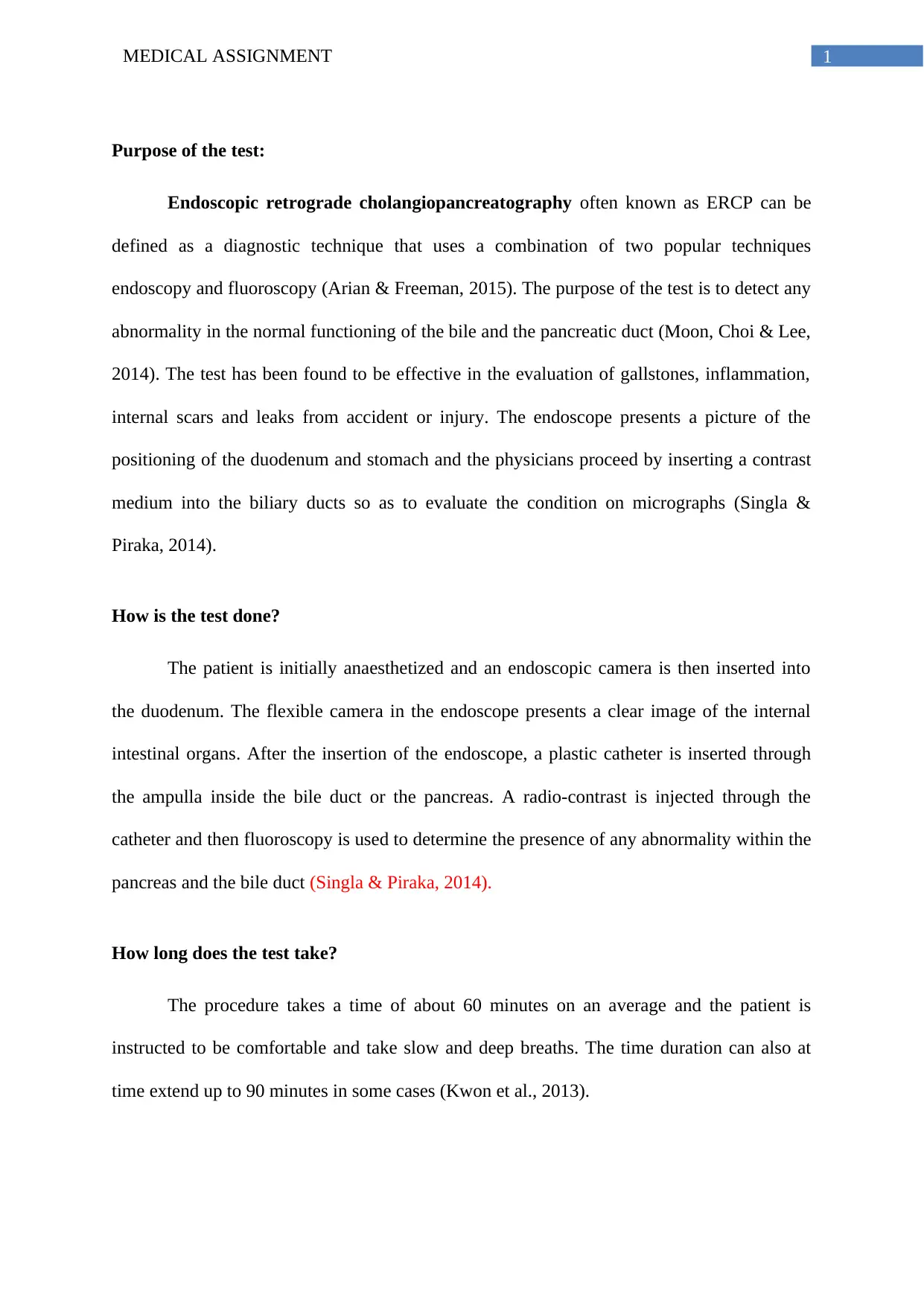
Endoscopic retrograde cholangiopancreatography often known as ERCP can be
defined as a diagnostic technique that uses a combination of two popular techniques
endoscopy and fluoroscopy (Arian & Freeman, 2015). The purpose of the test is to detect any
abnormality in the normal functioning of the bile and the pancreatic duct (Moon, Choi & Lee,
2014). The test has been found to be effective in the evaluation of gallstones, inflammation,
internal scars and leaks from accident or injury. The endoscope presents a picture of the
positioning of the duodenum and stomach and the physicians proceed by inserting a contrast
medium into the biliary ducts so as to evaluate the condition on micrographs (Singla &
Piraka, 2014).
How is the test done?
The patient is initially anaesthetized and an endoscopic camera is then inserted into
the duodenum. The flexible camera in the endoscope presents a clear image of the internal
intestinal organs. After the insertion of the endoscope, a plastic catheter is inserted through
the ampulla inside the bile duct or the pancreas. A radio-contrast is injected through the
catheter and then fluoroscopy is used to determine the presence of any abnormality within the
pancreas and the bile duct (Singla & Piraka, 2014).
How long does the test take?
The procedure takes a time of about 60 minutes on an average and the patient is
instructed to be comfortable and take slow and deep breaths. The time duration can also at
time extend up to 90 minutes in some cases (Kwon et al., 2013).
Document Page
2MEDICAL ASSIGNMENT
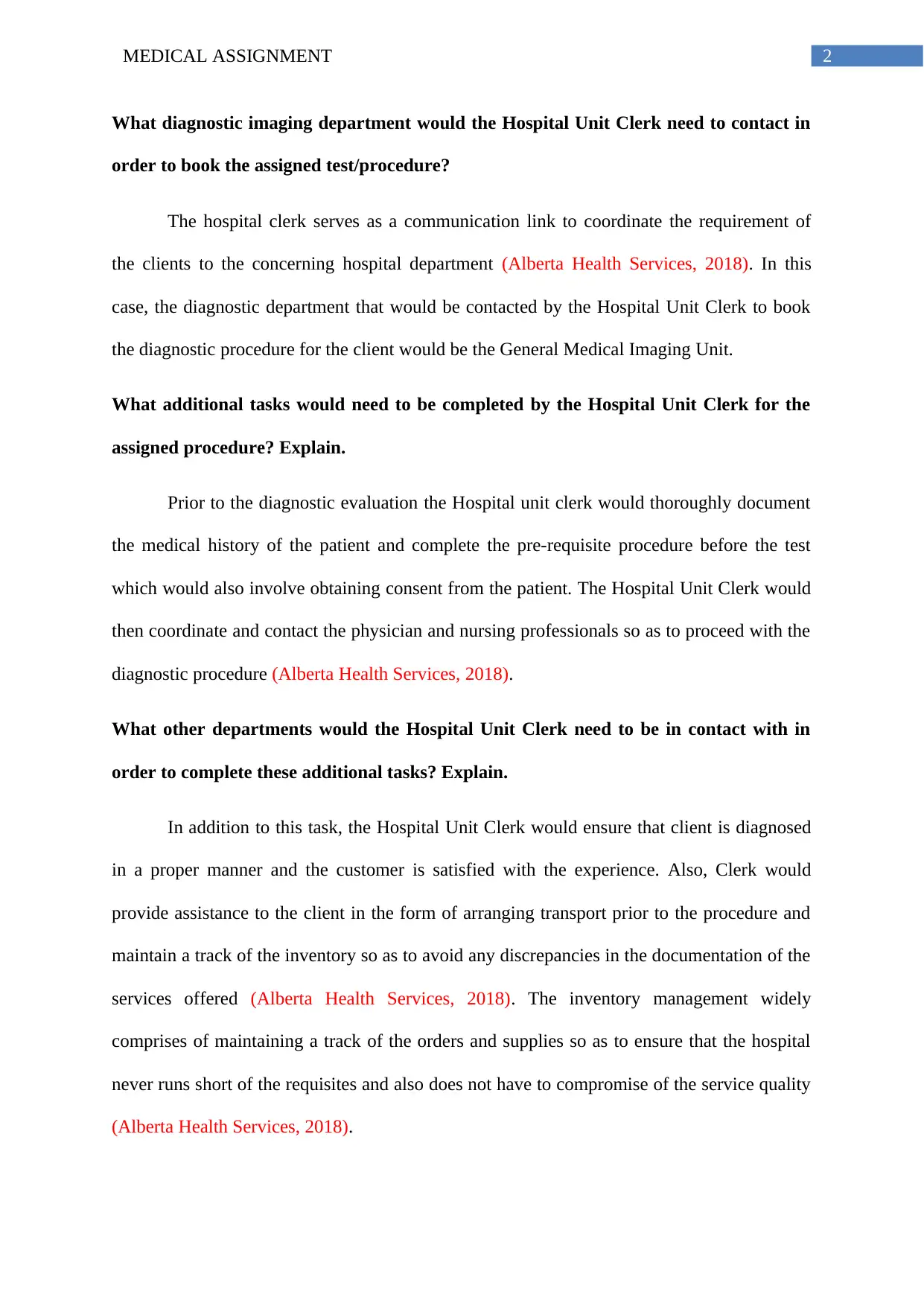
What diagnostic imaging department would the Hospital Unit Clerk need to contact in
order to book the assigned test/procedure?
The hospital clerk serves as a communication link to coordinate the requirement of
the clients to the concerning hospital department (Alberta Health Services, 2018). In this
case, the diagnostic department that would be contacted by the Hospital Unit Clerk to book
the diagnostic procedure for the client would be the General Medical Imaging Unit.
What additional tasks would need to be completed by the Hospital Unit Clerk for the
assigned procedure? Explain.
Prior to the diagnostic evaluation the Hospital unit clerk would thoroughly document
the medical history of the patient and complete the pre-requisite procedure before the test
which would also involve obtaining consent from the patient. The Hospital Unit Clerk would
then coordinate and contact the physician and nursing professionals so as to proceed with the
diagnostic procedure (Alberta Health Services, 2018).
What other departments would the Hospital Unit Clerk need to be in contact with in
order to complete these additional tasks? Explain.
In addition to this task, the Hospital Unit Clerk would ensure that client is diagnosed
in a proper manner and the customer is satisfied with the experience. Also, Clerk would
provide assistance to the client in the form of arranging transport prior to the procedure and
maintain a track of the inventory so as to avoid any discrepancies in the documentation of the
services offered (Alberta Health Services, 2018). The inventory management widely
comprises of maintaining a track of the orders and supplies so as to ensure that the hospital
never runs short of the requisites and also does not have to compromise of the service quality
(Alberta Health Services, 2018).
Document Page
3MEDICAL ASSIGNMENT
References:
Arain, M. A., & Freeman, M. L. (2015). Endoscopic Retrograde
Cholangiopancreatography. Yamada's Textbook of Gastroenterology, 2582-2611.
Kwon, C. I., Song, S. H., Hahm, K. B., & Ko, K. H. (2013). Unusual complications related to
endoscopic retrograde cholangiopancreatography and its endoscopic
treatment. Clinical endoscopy, 46(3), 251.
Moon, J. H., Choi, H. J., & Lee, Y. N. (2014). Endoscopic retrograde
cholangiopancreatography. Gastrointestinal endoscopy, 80(3), 388-391.
Alberta Health Services, A. (2018). Unit Clerk | Alberta Health Services. [online]
Alberta Health Services. Available at:
https://www.albertahealthservices.ca/careers/Page12295.aspx [Accessed 4 Nov.
2018].
Singla, S., & Piraka, C. (2014). Endoscopic retrograde cholangiopancreatography. Clinical
Liver Disease, 4(6), 133-137.
chevron_up_icon
1 out of 4
circle_padding
hide_on_mobile
zoom_out_icon
[object Object]