Project: Reducing Energy Consumption & Enhancing Efficiency at UNI
VerifiedAdded on 2023/06/11
|14
|3276
|338
Project
AI Summary
This project identifies the causes of high energy consumption at the University of Northern Iowa, highlighting lab instruments, computing devices, and other facilities as major contributors. It recommends technical, environmental, and social strategies to mitigate energy consumption and enhance efficiency. Technical solutions include adopting low-power lab equipment and implementing a cloud-based IoT monitoring system. Environmental strategies focus on passive cooling and green building design. Social strategies emphasize raising awareness among university associates about their responsibility to save energy. The project concludes with recommendations for future studies and emphasizes the importance of sustainable energy practices within the university campus. Desklib provides access to a wealth of solved assignments and study materials for students.
Running head: REDUCTION IN ENERGY CONSUMPTION & ENHANCE EFFICIENCY
REDUCTION IN ENERGY CONSUMPTION & ENHANCE EFFICIENCY
Name of the Student
Name of the University
Author Note
REDUCTION IN ENERGY CONSUMPTION & ENHANCE EFFICIENCY
Name of the Student
Name of the University
Author Note

Paraphrase This Document
Need a fresh take? Get an instant paraphrase of this document with our AI Paraphraser
1REDUCTION IN ENERGY CONSUMPTION & ENHANCE EFFICIENCY
Abstract
The paper in discussion has focused on evaluating the causes that are responsible for the high
consumption of energy in the University of Northern Iowa and the results reveals that the lab
instruments are the highest energy consuming devices while the computing systems &
devices along with laundry gyms and other instruments are responsible for most of the power
consumption. Post the identification, tools and techniques has been recommended as the
remedial means to mitigate the energy consumption and in the process enhance the energy
efficiency. The remedial means consists of disruptive technologies along with environmental
approaches that are capable of saving energy. Additionally, making the University associates
aware towards their social responsibility to save energy has also been recommended as part
of the solution. Finally, the paper has been summarised and has also offered potential future
studies paths to conclude the paper.
Abstract
The paper in discussion has focused on evaluating the causes that are responsible for the high
consumption of energy in the University of Northern Iowa and the results reveals that the lab
instruments are the highest energy consuming devices while the computing systems &
devices along with laundry gyms and other instruments are responsible for most of the power
consumption. Post the identification, tools and techniques has been recommended as the
remedial means to mitigate the energy consumption and in the process enhance the energy
efficiency. The remedial means consists of disruptive technologies along with environmental
approaches that are capable of saving energy. Additionally, making the University associates
aware towards their social responsibility to save energy has also been recommended as part
of the solution. Finally, the paper has been summarised and has also offered potential future
studies paths to conclude the paper.
2REDUCTION IN ENERGY CONSUMPTION & ENHANCE EFFICIENCY
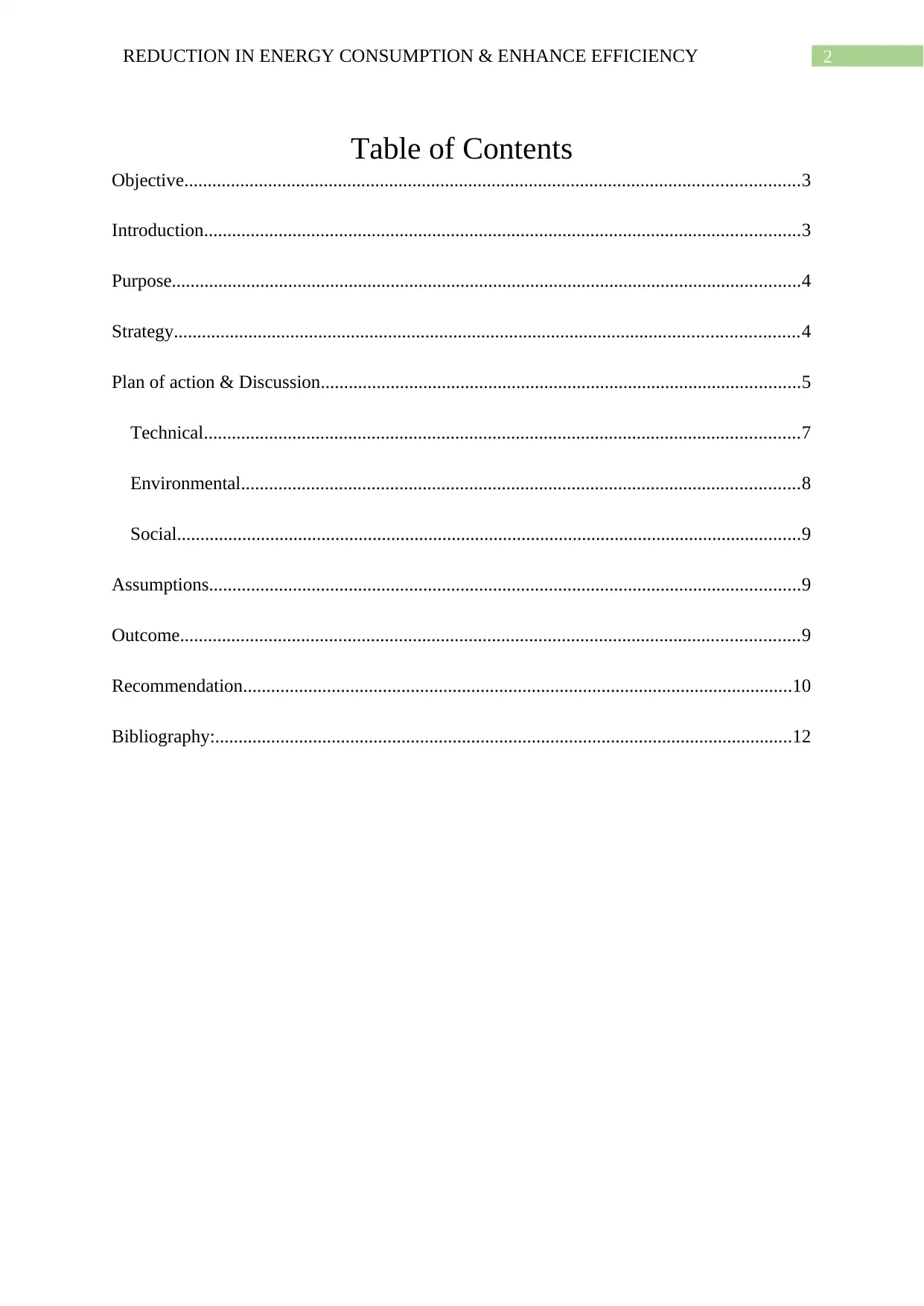
Table of Contents
Objective....................................................................................................................................3
Introduction................................................................................................................................3
Purpose.......................................................................................................................................4
Strategy......................................................................................................................................4
Plan of action & Discussion.......................................................................................................5
Technical................................................................................................................................7
Environmental........................................................................................................................8
Social......................................................................................................................................9
Assumptions...............................................................................................................................9
Outcome.....................................................................................................................................9
Recommendation......................................................................................................................10
Bibliography:............................................................................................................................12
Table of Contents
Objective....................................................................................................................................3
Introduction................................................................................................................................3
Purpose.......................................................................................................................................4
Strategy......................................................................................................................................4
Plan of action & Discussion.......................................................................................................5
Technical................................................................................................................................7
Environmental........................................................................................................................8
Social......................................................................................................................................9
Assumptions...............................................................................................................................9
Outcome.....................................................................................................................................9
Recommendation......................................................................................................................10
Bibliography:............................................................................................................................12
⊘ This is a preview!⊘
Do you want full access?
Subscribe today to unlock all pages.

Trusted by 1+ million students worldwide
3REDUCTION IN ENERGY CONSUMPTION & ENHANCE EFFICIENCY
Objective
The objective of the proposed paper is to identify tools or techniques that can be
introduced within the campus that would assist in reduction of the energy and enhance the
energy efficiency. The deemed objective is followed by sub-objectives such as the
identification of the sources that are responsible for most of the energy consumption in the
organisation and how can its capacity be reduced. Additionally, the focus has also been
driven towards the potential disruptive solutions that can be introduced within the institution
that would assist in reduction of the energy consumption.
The vitality of the objectives could be understood by the fact that the campus in
consideration “University of Northern Iowa” has adopted renewal energy sources to assist in
developing a sustainable environment within the campus. Additionally, the motive of the
university is very clear and it states that their goal “decrease energy consumption in all
buildings on campus. Each individual plays a part in this by reducing their energy use and
every little bit helps”. In the process they want to inspire the whole Iowa region and others
also to develop a greener environment within the campuses of organisations, institutions and
others. Hence, depending upon the goal of the organisation in consideration it becomes of
great necessity that the campus in using the energy in efficient, effective and sustainably
which justifies the vitality of the proposed objectives.
Introduction
Energy consumption and reduction in its consumption is one of the most prominent
concerns that has been surfacing at a global level. Most of the organisations, institutions,
homes and others are attempting to identify and adopt the tools and technologies that are
capable of developing the discussed scenario. The reason behind such high level of desirable
lays base on the fact that the discussed measure is not just favourable from financial
Objective
The objective of the proposed paper is to identify tools or techniques that can be
introduced within the campus that would assist in reduction of the energy and enhance the
energy efficiency. The deemed objective is followed by sub-objectives such as the
identification of the sources that are responsible for most of the energy consumption in the
organisation and how can its capacity be reduced. Additionally, the focus has also been
driven towards the potential disruptive solutions that can be introduced within the institution
that would assist in reduction of the energy consumption.
The vitality of the objectives could be understood by the fact that the campus in
consideration “University of Northern Iowa” has adopted renewal energy sources to assist in
developing a sustainable environment within the campus. Additionally, the motive of the
university is very clear and it states that their goal “decrease energy consumption in all
buildings on campus. Each individual plays a part in this by reducing their energy use and
every little bit helps”. In the process they want to inspire the whole Iowa region and others
also to develop a greener environment within the campuses of organisations, institutions and
others. Hence, depending upon the goal of the organisation in consideration it becomes of
great necessity that the campus in using the energy in efficient, effective and sustainably
which justifies the vitality of the proposed objectives.
Introduction
Energy consumption and reduction in its consumption is one of the most prominent
concerns that has been surfacing at a global level. Most of the organisations, institutions,
homes and others are attempting to identify and adopt the tools and technologies that are
capable of developing the discussed scenario. The reason behind such high level of desirable
lays base on the fact that the discussed measure is not just favourable from financial
Paraphrase This Document
Need a fresh take? Get an instant paraphrase of this document with our AI Paraphraser
4REDUCTION IN ENERGY CONSUMPTION & ENHANCE EFFICIENCY
perspective but is also capable of developing a sustainable future. Hence, the discussed paper
has attempted to support the discussed global cause by offering recommendations for the
tools and techniques that are capable of offering reduced energy consumption and enhanced
energy efficiency in the campus of University of Northern Iowa (UNI).
The objectives of the paper have been achieved by discussing the key factors that
needs to be taken in consideration while discussion a plan of action that has assist in fulfilling
the objective. The assumptions made to recommend solutions for enhanced energy efficiency
and other crucial details has been discussed before concluding the paper and offer potential
recommendations to mitigate energy consumption and enhance energy efficiency.
Purpose
The purpose of the paper is to develop a strategy consisting of tools and techniques
that are capable of mitigating energy consumption and in the process enhancing the energy
efficiency of the campus. The following sections has offered strategy, plan of actions and
other crucial factors that has assist in achieving the purpose of the paper.
Strategy
The strategy to attain the discussed goals has been achieved by adopting the primary
data collection method. The primary data has been collected from the students, the professors
and other stakeholders of the organisation. Additionally, secondary data has been requested
from the energy department of the institution. The secondary data has assist in understanding
the sources that are responsible for the energy consumption while the primary data has offer
assistance with the development of the strategy to mitigate the energy consuming sources and
in the process enhance the efficiency. The strategy for reducing energy consumption has been
deduced on the data collected from the above discussed means and the knowledge acquired
by the author while pursuing the ETS (Environment, Technology and Society) course. The
perspective but is also capable of developing a sustainable future. Hence, the discussed paper
has attempted to support the discussed global cause by offering recommendations for the
tools and techniques that are capable of offering reduced energy consumption and enhanced
energy efficiency in the campus of University of Northern Iowa (UNI).
The objectives of the paper have been achieved by discussing the key factors that
needs to be taken in consideration while discussion a plan of action that has assist in fulfilling
the objective. The assumptions made to recommend solutions for enhanced energy efficiency
and other crucial details has been discussed before concluding the paper and offer potential
recommendations to mitigate energy consumption and enhance energy efficiency.
Purpose
The purpose of the paper is to develop a strategy consisting of tools and techniques
that are capable of mitigating energy consumption and in the process enhancing the energy
efficiency of the campus. The following sections has offered strategy, plan of actions and
other crucial factors that has assist in achieving the purpose of the paper.
Strategy
The strategy to attain the discussed goals has been achieved by adopting the primary
data collection method. The primary data has been collected from the students, the professors
and other stakeholders of the organisation. Additionally, secondary data has been requested
from the energy department of the institution. The secondary data has assist in understanding
the sources that are responsible for the energy consumption while the primary data has offer
assistance with the development of the strategy to mitigate the energy consuming sources and
in the process enhance the efficiency. The strategy for reducing energy consumption has been
deduced on the data collected from the above discussed means and the knowledge acquired
by the author while pursuing the ETS (Environment, Technology and Society) course. The
5REDUCTION IN ENERGY CONSUMPTION & ENHANCE EFFICIENCY
consideration of the disruptive tools and techniques available in the energy preservation
literary works has also been taken in consideration to present the strategy for fulfilling the
objective.
Plan of action & Discussion
The plan of action for the discussed scenario was step based and the steps that were assessed
has been discussed as follows
Step 1: Identification- The first step was to analyse the sources that were responsible for the
energy consumption and the identification revealed that the following items were responsible
for most of the power consumption
Lab instruments:
Lab instruments are the sources that are responsible for most of the energy
consumption. The lab instruments in discussion extend from hydrology to chemistry, applied
physics and all other departmental instruments that are used for the research, operations and
training purposes. The operation of the instruments in consideration consumes power
however, it also consumes huge power if the equipment is suffering from any fault or is left
plugged in the power source.
Computing devices:
Computer has become an integral part of day to day life and are responsible for huge
power inside of a campus and in the discussed scenario is also one of the most prominent
source of power consumption. From Labs to offices and residents all of the places computer
and other computing devices are established themselves and hence consumes a lot of energy.
The computing devices includes the printers, fax machines and other devices which are also
visible in almost every section of the campus and consumes a lot of energy.
consideration of the disruptive tools and techniques available in the energy preservation
literary works has also been taken in consideration to present the strategy for fulfilling the
objective.
Plan of action & Discussion
The plan of action for the discussed scenario was step based and the steps that were assessed
has been discussed as follows
Step 1: Identification- The first step was to analyse the sources that were responsible for the
energy consumption and the identification revealed that the following items were responsible
for most of the power consumption
Lab instruments:
Lab instruments are the sources that are responsible for most of the energy
consumption. The lab instruments in discussion extend from hydrology to chemistry, applied
physics and all other departmental instruments that are used for the research, operations and
training purposes. The operation of the instruments in consideration consumes power
however, it also consumes huge power if the equipment is suffering from any fault or is left
plugged in the power source.
Computing devices:
Computer has become an integral part of day to day life and are responsible for huge
power inside of a campus and in the discussed scenario is also one of the most prominent
source of power consumption. From Labs to offices and residents all of the places computer
and other computing devices are established themselves and hence consumes a lot of energy.
The computing devices includes the printers, fax machines and other devices which are also
visible in almost every section of the campus and consumes a lot of energy.
⊘ This is a preview!⊘
Do you want full access?
Subscribe today to unlock all pages.
Trusted by 1+ million students worldwide
6REDUCTION IN ENERGY CONSUMPTION & ENHANCE EFFICIENCY
Kitchen & breakdown:
Kitchen and its equipment’s are also one of the primary source of energy consumption
and needs to be assessed to mitigate the power consumption within the campus and hence are
a subject of discussion in the paper. The freezes, exhausts, microwave ovens and other
primary cooking & kitchen instruments are high power consuming and are in dire need of
technology to reduce their energy consumption.
Occupant Comfort:
The occupant comfort are the instruments that are used for the comfort purposes and
the most core components of the discussed category are the fans, air conditioners, desk
lamps, space heaters and other devices. The energy use of the devices in consideration is very
high and should be made more energy efficient.
Gym & Training instruments:
The gym and the training instruments that are part of the gyms and other training
zones of a campus are also high energy consuming and needs strategy that can assist in
mitigating the energy consumption while, in the process making the section in context more
energy efficient.
Laundry instruments:
The laundry tools installed within a campus are also energy consuming and hence, are
in need of tools and techniques that can offer their assistance in mitigating the amount of
energy consumed by the discussed instrument types.
Miscellaneous:
The miscellaneous category consists of all the tools apart from the above mentioned
tools that are responsible for consuming electricity within a campus. It may include the
Kitchen & breakdown:
Kitchen and its equipment’s are also one of the primary source of energy consumption
and needs to be assessed to mitigate the power consumption within the campus and hence are
a subject of discussion in the paper. The freezes, exhausts, microwave ovens and other
primary cooking & kitchen instruments are high power consuming and are in dire need of
technology to reduce their energy consumption.
Occupant Comfort:
The occupant comfort are the instruments that are used for the comfort purposes and
the most core components of the discussed category are the fans, air conditioners, desk
lamps, space heaters and other devices. The energy use of the devices in consideration is very
high and should be made more energy efficient.
Gym & Training instruments:
The gym and the training instruments that are part of the gyms and other training
zones of a campus are also high energy consuming and needs strategy that can assist in
mitigating the energy consumption while, in the process making the section in context more
energy efficient.
Laundry instruments:
The laundry tools installed within a campus are also energy consuming and hence, are
in need of tools and techniques that can offer their assistance in mitigating the amount of
energy consumed by the discussed instrument types.
Miscellaneous:
The miscellaneous category consists of all the tools apart from the above mentioned
tools that are responsible for consuming electricity within a campus. It may include the
Paraphrase This Document
Need a fresh take? Get an instant paraphrase of this document with our AI Paraphraser
7REDUCTION IN ENERGY CONSUMPTION & ENHANCE EFFICIENCY
mobile, laptop and other gadgets charging tools, hair straightener and all the other
instruments that are used by the associates who are associated with the campus and the
energy consumption.
Step 2: Strategy in discussion:
The second step as part of plan of action to decrease the energy consumption and in
the process enhance the energy efficiency is the strategies (tools & techniques) that can assist
in attaining the discussed measure has been categorised in three categories and discussed as
follows:
Technical
The technical aspect is one of the prominent discussion and has been considered in the
discussed section. The technical strategies that are in existence which are capable of reducing
the energy consumption within a campus has been discussed.
The energy consuming sources can be manipulated to reduce the consumption in the
energy by adopting lab equipment that are low power consuming and are does not emit
carbon expellant. However, only adoption of energy friendly equipment cannot mitigate the
energy consumption, their adequate use is also the factor that needs to be taken in
consideration. Hence. The rated energy efficient equipment should be purchased for the
institutional use which will enable the university to increase the energy efficiency.
Additionally, to attain the discussed objective a monitoring system should be attached with
the lab instruments that will measure and notify the system if any instrument is consuming
excessive power. It will be effective for all the devices that consumes energy. The discussed
monitoring system can be placed by use of the smart technology. The technology in
discussion is the IoT (Internet of Things) or it would be more adequate to state CoT (Cloud of
Things). The systems of the university should be attached to the cloud based IoT networks
mobile, laptop and other gadgets charging tools, hair straightener and all the other
instruments that are used by the associates who are associated with the campus and the
energy consumption.
Step 2: Strategy in discussion:
The second step as part of plan of action to decrease the energy consumption and in
the process enhance the energy efficiency is the strategies (tools & techniques) that can assist
in attaining the discussed measure has been categorised in three categories and discussed as
follows:
Technical
The technical aspect is one of the prominent discussion and has been considered in the
discussed section. The technical strategies that are in existence which are capable of reducing
the energy consumption within a campus has been discussed.
The energy consuming sources can be manipulated to reduce the consumption in the
energy by adopting lab equipment that are low power consuming and are does not emit
carbon expellant. However, only adoption of energy friendly equipment cannot mitigate the
energy consumption, their adequate use is also the factor that needs to be taken in
consideration. Hence. The rated energy efficient equipment should be purchased for the
institutional use which will enable the university to increase the energy efficiency.
Additionally, to attain the discussed objective a monitoring system should be attached with
the lab instruments that will measure and notify the system if any instrument is consuming
excessive power. It will be effective for all the devices that consumes energy. The discussed
monitoring system can be placed by use of the smart technology. The technology in
discussion is the IoT (Internet of Things) or it would be more adequate to state CoT (Cloud of
Things). The systems of the university should be attached to the cloud based IoT networks
8REDUCTION IN ENERGY CONSUMPTION & ENHANCE EFFICIENCY
that will enable the monitoring of the system and even cut the power if programmed to cut
the power in case of energy waste. The IoT has proved its prominence in monitoring,
notifying and control the systems that are associated with it and hence will be capable of
controlling the lab, kitchen, computers and all the other network. The reason for
recommending cloud based IoT lays basis on the fact that cloud will extend the network to
the whole campus and in dire situations can be accessed by the higher management of the
university from remote location and if need they can also control the instruments part of the
university. However, IoT will itself consume energy and hence the power consumption must
be reduced to make the implementation feasible. The energy consumption in the IoT can be
mitigated by using “hybrid topology” and “ultra-low powered Bluetooth low energy wireless
device”. Additionally, other techniques can also be approached to mitigate the energy
consumption by th IoT.
Environmental
The environment is capable of assisting the humanity in unimaginable & different
pattern. The scenario in energy reduction can also be considered the same as the environment
is capable of mitigating the energy consumption with the campus and is the topic of
discussion in the discussed section.
As stated above environment is capable of assisting in offering reduction in energy
consumption through the means such as the passive cooling also known as the natural cooling
which can reduce the power consumption of air conditioning and other cooling means that are
required for other instruments such as instruments and plants. Green buildings can also assist
in reducing the energy consumption of the lights, fans and other necessary electrical
requirements of a room or building. Adequate windows and ventilation along other necessary
lighting and cooling means are also capable of reducing energy consumption. Other means
that will enable the monitoring of the system and even cut the power if programmed to cut
the power in case of energy waste. The IoT has proved its prominence in monitoring,
notifying and control the systems that are associated with it and hence will be capable of
controlling the lab, kitchen, computers and all the other network. The reason for
recommending cloud based IoT lays basis on the fact that cloud will extend the network to
the whole campus and in dire situations can be accessed by the higher management of the
university from remote location and if need they can also control the instruments part of the
university. However, IoT will itself consume energy and hence the power consumption must
be reduced to make the implementation feasible. The energy consumption in the IoT can be
mitigated by using “hybrid topology” and “ultra-low powered Bluetooth low energy wireless
device”. Additionally, other techniques can also be approached to mitigate the energy
consumption by th IoT.
Environmental
The environment is capable of assisting the humanity in unimaginable & different
pattern. The scenario in energy reduction can also be considered the same as the environment
is capable of mitigating the energy consumption with the campus and is the topic of
discussion in the discussed section.
As stated above environment is capable of assisting in offering reduction in energy
consumption through the means such as the passive cooling also known as the natural cooling
which can reduce the power consumption of air conditioning and other cooling means that are
required for other instruments such as instruments and plants. Green buildings can also assist
in reducing the energy consumption of the lights, fans and other necessary electrical
requirements of a room or building. Adequate windows and ventilation along other necessary
lighting and cooling means are also capable of reducing energy consumption. Other means
⊘ This is a preview!⊘
Do you want full access?
Subscribe today to unlock all pages.
Trusted by 1+ million students worldwide
9REDUCTION IN ENERGY CONSUMPTION & ENHANCE EFFICIENCY
which includes environmental involvement can be adopted to enhance the energy efficiency
of the campus.
Social
Like the technical and environmental aspects, social aspects are also capable of
mitigating the energy consumption and in the process enhance energy efficiency and has been
discussed in the following section.
Just like the social responsibility of the institution, the individuals associated with the
institution also holds social responsibility. They can fulfil their social responsibility in energy
consumption by unplugging the devices when not in use. Adequate attention should be cited
to the most commonly used instruments such as the computing devices, occupant comfort,
gym instruments and others because it will save a great amount of energy. The social
responsibility of the individuals is not limited to only their actions but it extends to awaking
their friends and other associates about the benefits of energy saving.
The above discussed strategies and tools can be adopted to mitigate the energy
consumption of the University of Northern Iowa and in the process increase the energy
efficiency of the campus.
Step 3: Implementation:
The final step is to implement the proposed strategies within the campus either
virtually to simulate the results or in real-life scenario to evaluate the validity of the results.
Assumptions
The strategies offered above are generalised in nature and have taken very less
assumptions. The only assumption made in the report is that the buildings in the campus are
not based on the eco-friendly techniques.
which includes environmental involvement can be adopted to enhance the energy efficiency
of the campus.
Social
Like the technical and environmental aspects, social aspects are also capable of
mitigating the energy consumption and in the process enhance energy efficiency and has been
discussed in the following section.
Just like the social responsibility of the institution, the individuals associated with the
institution also holds social responsibility. They can fulfil their social responsibility in energy
consumption by unplugging the devices when not in use. Adequate attention should be cited
to the most commonly used instruments such as the computing devices, occupant comfort,
gym instruments and others because it will save a great amount of energy. The social
responsibility of the individuals is not limited to only their actions but it extends to awaking
their friends and other associates about the benefits of energy saving.
The above discussed strategies and tools can be adopted to mitigate the energy
consumption of the University of Northern Iowa and in the process increase the energy
efficiency of the campus.
Step 3: Implementation:
The final step is to implement the proposed strategies within the campus either
virtually to simulate the results or in real-life scenario to evaluate the validity of the results.
Assumptions
The strategies offered above are generalised in nature and have taken very less
assumptions. The only assumption made in the report is that the buildings in the campus are
not based on the eco-friendly techniques.
Paraphrase This Document
Need a fresh take? Get an instant paraphrase of this document with our AI Paraphraser
10REDUCTION IN ENERGY CONSUMPTION & ENHANCE EFFICIENCY
Outcome
The outcome of the proposed work is identification or development of the technique
or tool that has ensure that the objective and sub-objectives of the proposed work is achieved.
Additionally, it has also been expected that the proposed tool and techniques is reliable &
feasible so that it can be implemented in the real-life scenario and is suitable for
implementation within the organisation. The solutions proposed in the discussed report has
been categories in three categories and are categorised in environmental, technical and social
sections. The report has offered the most basic ideas about the tools and techniques so that
the institution can manipulate its implementation strategy to make it more suitable for the
organisation in consideration. Finally, in conclusion, the report will be emphasised to state
that high energy consumption is not just responsible for the financial loss that a body suffers
but also is a major threat for the environment and hence needs to be mitigated. Additionally,
adopting the most basic ideas to mitigate the challenges in discussion can prove to be most
prominent approach to attain an energy efficient environment within the organisation,
institution or other similar entity.
Recommendation
The discussed research work has offered an insight into the problems and instruments
that are the core reason for power consumption in the institution in consideration which can
be further justified by statistical method to cite in figures the amount of energy consumed by
each discussed category. Additionally, the fractional stats collected about the instruments and
their energy consumption can be used to develop a plan that is capable of guiding the use and
controlling of the instruments so that the energy consumption is limited. The paper will also
assist the users who are willing to propose a framework capable of reducing the total energy
consumption within the campus by a large margin. One of the most prominent research work
that the readers of the discussed article can pursue is the “Use of environment in mitigating
Outcome
The outcome of the proposed work is identification or development of the technique
or tool that has ensure that the objective and sub-objectives of the proposed work is achieved.
Additionally, it has also been expected that the proposed tool and techniques is reliable &
feasible so that it can be implemented in the real-life scenario and is suitable for
implementation within the organisation. The solutions proposed in the discussed report has
been categories in three categories and are categorised in environmental, technical and social
sections. The report has offered the most basic ideas about the tools and techniques so that
the institution can manipulate its implementation strategy to make it more suitable for the
organisation in consideration. Finally, in conclusion, the report will be emphasised to state
that high energy consumption is not just responsible for the financial loss that a body suffers
but also is a major threat for the environment and hence needs to be mitigated. Additionally,
adopting the most basic ideas to mitigate the challenges in discussion can prove to be most
prominent approach to attain an energy efficient environment within the organisation,
institution or other similar entity.
Recommendation
The discussed research work has offered an insight into the problems and instruments
that are the core reason for power consumption in the institution in consideration which can
be further justified by statistical method to cite in figures the amount of energy consumed by
each discussed category. Additionally, the fractional stats collected about the instruments and
their energy consumption can be used to develop a plan that is capable of guiding the use and
controlling of the instruments so that the energy consumption is limited. The paper will also
assist the users who are willing to propose a framework capable of reducing the total energy
consumption within the campus by a large margin. One of the most prominent research work
that the readers of the discussed article can pursue is the “Use of environment in mitigating
11REDUCTION IN ENERGY CONSUMPTION & ENHANCE EFFICIENCY
the energy consumption and in the process enhance the energy efficiency in a campus or
organisation.”. The above stated topic for further work will be of great vitality as the
outcome from the work over the discussed topic will be sustainable in nature and will also
develop a sense of responsibility towards the environment. The topic “social responsibility
of students, professors and other institutional associates towards saving energy” is also a
vital topic that can be pursued with assistance of the discussed paper. Finally, it would be
stated that the paper can be reviewed by the readers to determine more opportunities for
further work.
the energy consumption and in the process enhance the energy efficiency in a campus or
organisation.”. The above stated topic for further work will be of great vitality as the
outcome from the work over the discussed topic will be sustainable in nature and will also
develop a sense of responsibility towards the environment. The topic “social responsibility
of students, professors and other institutional associates towards saving energy” is also a
vital topic that can be pursued with assistance of the discussed paper. Finally, it would be
stated that the paper can be reviewed by the readers to determine more opportunities for
further work.
⊘ This is a preview!⊘
Do you want full access?
Subscribe today to unlock all pages.
Trusted by 1+ million students worldwide

1 out of 14


Related Documents


Your All-in-One AI-Powered Toolkit for Academic Success.
+13062052269
info@desklib.com
Available 24*7 on WhatsApp / Email
![[object Object]](/_next/static/media/star-bottom.7253800d.svg)
Unlock your academic potential
Copyright © 2020–2026 A2Z Services. All Rights Reserved. Developed and managed by ZUCOL.