Analysis of ICT Energy Usage & CO2 Emission for Global Marketplace
VerifiedAdded on 2023/06/10
|10
|2871
|89
Report
AI Summary
This report provides a comprehensive analysis of energy usage and carbon dioxide (CO2) emissions associated with Information and Communication Technology (ICT) within the context of the Global Personal Marketplace (GPMC) project. It begins by introducing the significance of energy efficiency and sustainability in ICT, emphasizing user engagement and the rising energy consumption of computing. The report categorizes energy usage, including memory-based computation, communication technology, and network protection. It then details the GPMC system, its objectives, functional and data requirements, and billing cycles. Furthermore, the report explores green computing techniques and payback periods for recommended actions to reduce energy consumption. Finally, it evaluates CO2 emissions for the GPMC project, providing estimates and recommendations for integrating sustainability into ICT projects, while acknowledging that, although the specific amount of CO2 released may not be noticeable, its impacts on the other hand are eminent in the global warming perspective. Desklib offers this report and other study resources for students.

INSTITUTION:
FACULTY:
DEPARTMENT:
COURSE TITLE:
COURSE CODE:
NAME:
REGISTRATION NUMBER:
TUTOR:
FACULTY:
DEPARTMENT:
COURSE TITLE:
COURSE CODE:
NAME:
REGISTRATION NUMBER:
TUTOR:

Paraphrase This Document
Need a fresh take? Get an instant paraphrase of this document with our AI Paraphraser
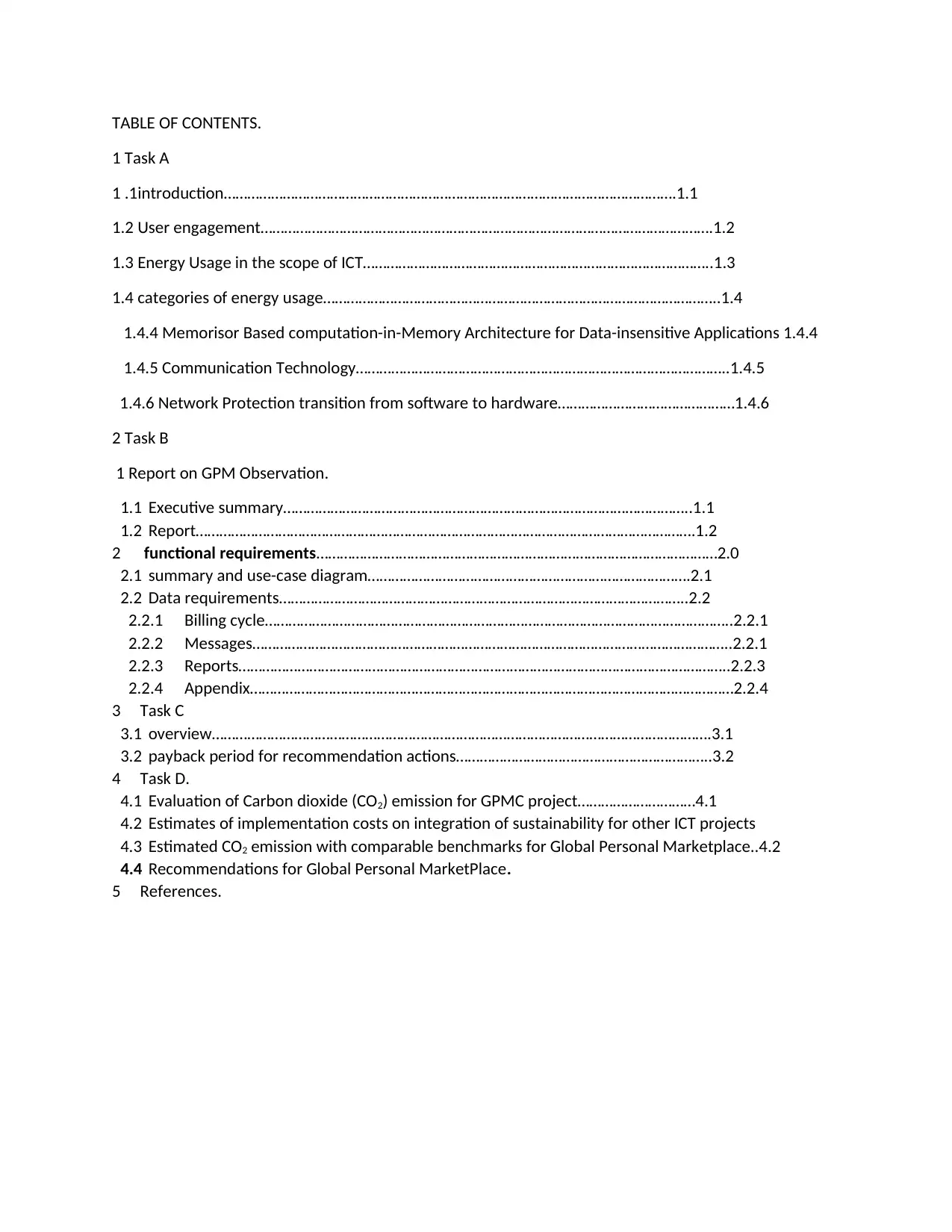
TABLE OF CONTENTS.
1 Task A
1 .1introduction…………………………………………………………………………………………………….1.1
1.2 User engagement…………………………………………………………………………………………………….1.2
1.3 Energy Usage in the scope of ICT……………………………………………………………………………..1.3
1.4 categories of energy usage………………………………………………………………………………………..1.4
1.4.4 Memorisor Based computation-in-Memory Architecture for Data-insensitive Applications 1.4.4
1.4.5 Communication Technology…………………………………………………………………………………..1.4.5
1.4.6 Network Protection transition from software to hardware………………………………………1.4.6
2 Task B
1 Report on GPM Observation.
1.1 Executive summary…………………………………………………………………………………………..1.1
1.2 Report……………………………………………………………………………………………………………….1.2
2 functional requirements…………………………………………………………………………………………2.0
2.1 summary and use-case diagram……………………………………………………………………….2.1
2.2 Data requirements…………………………………………………………………………………………..2.2
2.2.1 Billing cycle………………………………………………………………………………………………………..2.2.1
2.2.2 Messages…………………………………………………………………………………………………………..2.2.1
2.2.3 Reports……………………………………………………………………………………………………………..2.2.3
2.2.4 Appendix……………………………………………………………………………………………………………2.2.4
3 Task C
3.1 overview……………………………………………………………………………………………………………….3.1
3.2 payback period for recommendation actions………………………………………………………..3.2
4 Task D.
4.1 Evaluation of Carbon dioxide (CO2) emission for GPMC project…………………………4.1
4.2 Estimates of implementation costs on integration of sustainability for other ICT projects
4.3 Estimated CO2 emission with comparable benchmarks for Global Personal Marketplace..4.2
4.4 Recommendations for Global Personal MarketPlace.
5 References.
1 Task A
1 .1introduction…………………………………………………………………………………………………….1.1
1.2 User engagement…………………………………………………………………………………………………….1.2
1.3 Energy Usage in the scope of ICT……………………………………………………………………………..1.3
1.4 categories of energy usage………………………………………………………………………………………..1.4
1.4.4 Memorisor Based computation-in-Memory Architecture for Data-insensitive Applications 1.4.4
1.4.5 Communication Technology…………………………………………………………………………………..1.4.5
1.4.6 Network Protection transition from software to hardware………………………………………1.4.6
2 Task B
1 Report on GPM Observation.
1.1 Executive summary…………………………………………………………………………………………..1.1
1.2 Report……………………………………………………………………………………………………………….1.2
2 functional requirements…………………………………………………………………………………………2.0
2.1 summary and use-case diagram……………………………………………………………………….2.1
2.2 Data requirements…………………………………………………………………………………………..2.2
2.2.1 Billing cycle………………………………………………………………………………………………………..2.2.1
2.2.2 Messages…………………………………………………………………………………………………………..2.2.1
2.2.3 Reports……………………………………………………………………………………………………………..2.2.3
2.2.4 Appendix……………………………………………………………………………………………………………2.2.4
3 Task C
3.1 overview……………………………………………………………………………………………………………….3.1
3.2 payback period for recommendation actions………………………………………………………..3.2
4 Task D.
4.1 Evaluation of Carbon dioxide (CO2) emission for GPMC project…………………………4.1
4.2 Estimates of implementation costs on integration of sustainability for other ICT projects
4.3 Estimated CO2 emission with comparable benchmarks for Global Personal Marketplace..4.2
4.4 Recommendations for Global Personal MarketPlace.
5 References.
Energy Usage in the scope of ICT.
1 Task A.
1.1 Introduction
Drawing from Van Heddeghem, Lambert, Lannoo, Colle, Pickavet & Demeester. 2014,Energy efficiency
and sustainability inventiveness have a huge range of possible results in energy, cost and other
parameters. The bearing of ICT and its related substructure, a synchronized tactic to this growth of
energy metrics for ICT paraphernalia is encouraged for a great deal by various multinationals.
1.2 User engagement.
Local user commitment and well-organized partnership with project cohorts all over the whole life cycle
of energy efficacy measures are very essential to realizing energy efficiency results.
1.3 Energy Usage in the Scope of ICT.
Kramers, Höjer, Lövehagen & Wangel. 2014 writes that In this times, computing has turned out to be a
very influential reserve in almost every sector for diverse reasons that includes processing and
automation and repossession of informationIt is projected that computing munches not less than 3% of
global electricity and the rate is rising progressively. These are well elaborated by Vereecken, Van
Heddeghem, Colle, Pickavet & Demeester, 2010, March.
1.4 These categories of energy usage include;
1.4.4 Memorisor Based computation-in-Memory Architecture for Data-insensitive Applications.
This is an energy consumption category that is on the rise trajectory significantly and it involves
computer applications and memory usage. Covering programming and application use by the computer
users themselves.
1.4.5 Communication Technology.
This is one that would take the largest share of the 3% of the energy consumption, it ranges from mobile
computing to the actual computing through laptops, pc, desktops and tablets and I-pads due to the fact
every person in the world is at least connected to two social networking platforms for communication
either for official use or social use.
1.4.6 Network Protection transition from software to hardware.
It is also contributing to the global statistics in the energy consumption significantly as security is always
a challenge regardless of the tremendous innovative measures for cyber security, this has seen the
coming up hardware security gadgets say things like biometrics, the face recognition that is really
integration of the hardware and software though more of hardware for security reasons.
Task B
1 Task A.
1.1 Introduction
Drawing from Van Heddeghem, Lambert, Lannoo, Colle, Pickavet & Demeester. 2014,Energy efficiency
and sustainability inventiveness have a huge range of possible results in energy, cost and other
parameters. The bearing of ICT and its related substructure, a synchronized tactic to this growth of
energy metrics for ICT paraphernalia is encouraged for a great deal by various multinationals.
1.2 User engagement.
Local user commitment and well-organized partnership with project cohorts all over the whole life cycle
of energy efficacy measures are very essential to realizing energy efficiency results.
1.3 Energy Usage in the Scope of ICT.
Kramers, Höjer, Lövehagen & Wangel. 2014 writes that In this times, computing has turned out to be a
very influential reserve in almost every sector for diverse reasons that includes processing and
automation and repossession of informationIt is projected that computing munches not less than 3% of
global electricity and the rate is rising progressively. These are well elaborated by Vereecken, Van
Heddeghem, Colle, Pickavet & Demeester, 2010, March.
1.4 These categories of energy usage include;
1.4.4 Memorisor Based computation-in-Memory Architecture for Data-insensitive Applications.
This is an energy consumption category that is on the rise trajectory significantly and it involves
computer applications and memory usage. Covering programming and application use by the computer
users themselves.
1.4.5 Communication Technology.
This is one that would take the largest share of the 3% of the energy consumption, it ranges from mobile
computing to the actual computing through laptops, pc, desktops and tablets and I-pads due to the fact
every person in the world is at least connected to two social networking platforms for communication
either for official use or social use.
1.4.6 Network Protection transition from software to hardware.
It is also contributing to the global statistics in the energy consumption significantly as security is always
a challenge regardless of the tremendous innovative measures for cyber security, this has seen the
coming up hardware security gadgets say things like biometrics, the face recognition that is really
integration of the hardware and software though more of hardware for security reasons.
Task B
⊘ This is a preview!⊘
Do you want full access?
Subscribe today to unlock all pages.

Trusted by 1+ million students worldwide
REPORT ON GPM OBSERVATION
1.1 Executive summary
Global Personal Marketplace system could also be termed as Web-based marketplace interchangeably
integrating personal and small firms to purchase an auction all sorts of commodities. It makes ample use
of the internet and the world wide web to radically build on the manner in which they purchase and sell
things.
GPM objectives.
choice of commodities
easier search
easier buying.
Reduced e-commerce risks.
Objectives of the seller
large of customer base.
Enabling them to easily target and personalize the marketing process to prospective buyers.
Enable easier determination of market prices.
Minimize the risk issues associated to online selling of items.
1.2 Report.
Table of contents.
1 Introduction.
1.1 Specification Definition.
1.2 Specification of objectives.
1.3 Intended Audiences.
2 GPMC Overview
2.1 Definition
2.2 Business Goal.
2.3 Business Objectives.
2.4 Context of the marketplace.
3 Functional Requirements.
1.1 Executive summary
Global Personal Marketplace system could also be termed as Web-based marketplace interchangeably
integrating personal and small firms to purchase an auction all sorts of commodities. It makes ample use
of the internet and the world wide web to radically build on the manner in which they purchase and sell
things.
GPM objectives.
choice of commodities
easier search
easier buying.
Reduced e-commerce risks.
Objectives of the seller
large of customer base.
Enabling them to easily target and personalize the marketing process to prospective buyers.
Enable easier determination of market prices.
Minimize the risk issues associated to online selling of items.
1.2 Report.
Table of contents.
1 Introduction.
1.1 Specification Definition.
1.2 Specification of objectives.
1.3 Intended Audiences.
2 GPMC Overview
2.1 Definition
2.2 Business Goal.
2.3 Business Objectives.
2.4 Context of the marketplace.
3 Functional Requirements.
Paraphrase This Document
Need a fresh take? Get an instant paraphrase of this document with our AI Paraphraser
3.1 Summary use case diagrams.
4 Data Requirements.
4.1 Billing cycle.
4.2 Messages.
4.3 Reports.
1.Introduction
1.1 Specification Definition.
Global Personal Market place basically is wide market actually world market at a personalized level say
from one’s comfort of home or office or just any other place but the logic here is that one accesses a
world-wide market without the need to necessarily move up and forth.
1.2 Specification of objectives.
GPMC is an ICT-business integration of ideas and functionality as way of innovation in the business
world and a huge milestone in the field of ICT, this is an enhancement of the global village aspect of the
current technology buy making communication very easy and convenient not necessarily requiring one
to physically travel.
1.3 Audience.
There is no really specific intended audience, this is due to the fact we all rely on business almost
entirely and since business organizations and transactions are going digital in terms of operations and
even services we therefore need to follow the suit.
2 GPMC Overview.
2.1 Definition.
As elaborated in the introduction part of this report, this is generally a system an e-bay to say which
brings together buyers and sellers from wherever the place in the world as long as they are aware of the
GPMC and have access to the internet Creque & Gooden. 2011Puts it.
2.2 Business Goal.
Everything made has a purpose regardless of the fact that some inventions are discovered accidentally
but eventually serves a role though, GPMC is a well thought idea of how to bring close the buyers and
the seller.
2.3 Business Objectives.
Goals hand in hand with the goals but rather this are long term visions to be achieved after a certain
period of time. Every business organization must have some visions which it wants to achieve after a
certain period of time the GPMC should help the firm realize this.
4 Data Requirements.
4.1 Billing cycle.
4.2 Messages.
4.3 Reports.
1.Introduction
1.1 Specification Definition.
Global Personal Market place basically is wide market actually world market at a personalized level say
from one’s comfort of home or office or just any other place but the logic here is that one accesses a
world-wide market without the need to necessarily move up and forth.
1.2 Specification of objectives.
GPMC is an ICT-business integration of ideas and functionality as way of innovation in the business
world and a huge milestone in the field of ICT, this is an enhancement of the global village aspect of the
current technology buy making communication very easy and convenient not necessarily requiring one
to physically travel.
1.3 Audience.
There is no really specific intended audience, this is due to the fact we all rely on business almost
entirely and since business organizations and transactions are going digital in terms of operations and
even services we therefore need to follow the suit.
2 GPMC Overview.
2.1 Definition.
As elaborated in the introduction part of this report, this is generally a system an e-bay to say which
brings together buyers and sellers from wherever the place in the world as long as they are aware of the
GPMC and have access to the internet Creque & Gooden. 2011Puts it.
2.2 Business Goal.
Everything made has a purpose regardless of the fact that some inventions are discovered accidentally
but eventually serves a role though, GPMC is a well thought idea of how to bring close the buyers and
the seller.
2.3 Business Objectives.
Goals hand in hand with the goals but rather this are long term visions to be achieved after a certain
period of time. Every business organization must have some visions which it wants to achieve after a
certain period of time the GPMC should help the firm realize this.
2.4 Context of the marketplace.
Gopalakrishnan. 2012 states that whereas the operator oriented design stresses on user essentials, and
information architecture stresses on content. Effective GPMC from the very basic website to the fully
fledged one requires an involvement of well-know how of the context. Information architecture stresses
on the two aspects but is not exhaustive and the environmental context is not provided. Market is made
of both buyers and the sellers and the commodities themselves, it is to an agreement that there is a lot
of completion in the marketplace hence calls for an exhaustive analysis of the market and be able to
come up with strategies that will help curb the ever increasing competition which also has to be fair thus
calls for total compliance with the market regulator terms and conditions as provided by the laws
concerning the field.
Conclusion.
The GPMC in enhancement of the global village aspect in the marketing and business field at large is the
a good strategy of securing the future of business in technological perspective.
2 Functional Requirements.
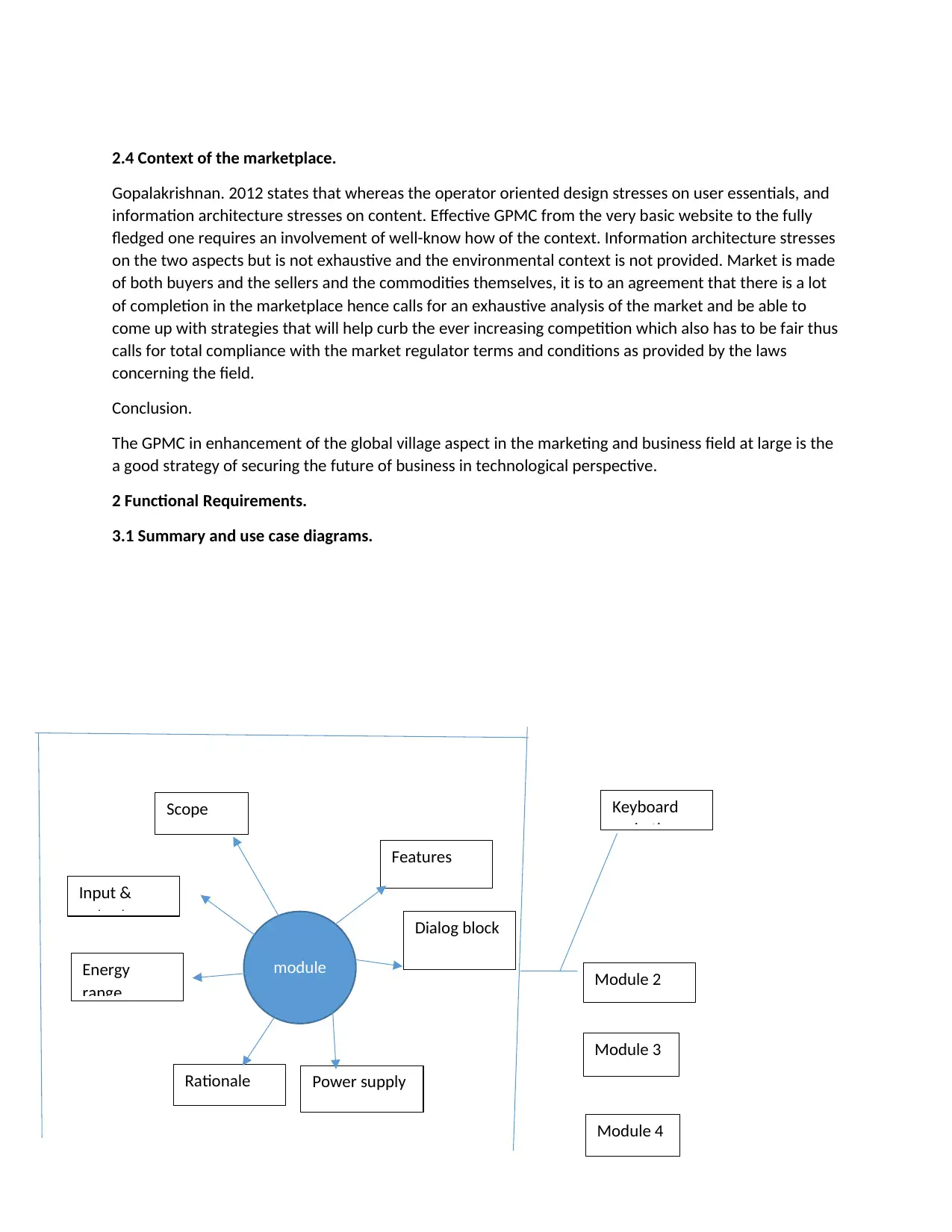
3.1 Summary and use case diagrams.
Input &
output
Energy
range
Rationale Power supply
Scope
Features
Dialog block
module Module 2
Module 3
Module 4
Keyboard
and other
Gopalakrishnan. 2012 states that whereas the operator oriented design stresses on user essentials, and
information architecture stresses on content. Effective GPMC from the very basic website to the fully
fledged one requires an involvement of well-know how of the context. Information architecture stresses
on the two aspects but is not exhaustive and the environmental context is not provided. Market is made
of both buyers and the sellers and the commodities themselves, it is to an agreement that there is a lot
of completion in the marketplace hence calls for an exhaustive analysis of the market and be able to
come up with strategies that will help curb the ever increasing competition which also has to be fair thus
calls for total compliance with the market regulator terms and conditions as provided by the laws
concerning the field.
Conclusion.
The GPMC in enhancement of the global village aspect in the marketing and business field at large is the
a good strategy of securing the future of business in technological perspective.
2 Functional Requirements.
3.1 Summary and use case diagrams.
Input &
output
Energy
range
Rationale Power supply
Scope
Features
Dialog block
module Module 2
Module 3
Module 4
Keyboard
and other
⊘ This is a preview!⊘
Do you want full access?
Subscribe today to unlock all pages.
Trusted by 1+ million students worldwide
2.2 Data Requirements.
2.2.1 Billing cycle.
The GPM is an all-sufficient system to say supporting various forms of transactions even up to digital
currency, the bitcoin. The billing cycle is as to the provider some preferring pay after delivery or pay on
delivery plans, whichever the case it is very formal and very secure to cater for the issues of fraudsters.
This could be internet-mobile banking or entirely internet banking such as the famous pay-pal services.
2.2.1 Messages.
This goes systematically from the billing services such that there is communication between the buyers
and the sellers, the information flow should be provided explicitly and in a secure way since it might
involve the use of personal account numbers. This therefore hints about the presence of secure
database server to facilitate the communication.
4.3 Reports.
The system should be able to keep a good record of all the transactions done over a certain period of
time and the records retrieved anytime they are required for use. Word-press website serves the best in
report generation even though we can be able to generate these I-Reports from web applications aided
by Java, C# or ajax programming languages. The code can be customized to generate the very specific
report the user might want.
Appendix.
Current issues, the period that a user should have an account with the system.
Should user credentials be updated often?
How should the item be searched for with the sort algorithms.
3 Task C.
3.1 Overview.
Having in mind the great impact of computing in the consumption of energy in the world-wide energy
grid, it is very important to use the available energy conservatively for obvious reasons one is because it
2.2.1 Billing cycle.
The GPM is an all-sufficient system to say supporting various forms of transactions even up to digital
currency, the bitcoin. The billing cycle is as to the provider some preferring pay after delivery or pay on
delivery plans, whichever the case it is very formal and very secure to cater for the issues of fraudsters.
This could be internet-mobile banking or entirely internet banking such as the famous pay-pal services.
2.2.1 Messages.
This goes systematically from the billing services such that there is communication between the buyers
and the sellers, the information flow should be provided explicitly and in a secure way since it might
involve the use of personal account numbers. This therefore hints about the presence of secure
database server to facilitate the communication.
4.3 Reports.
The system should be able to keep a good record of all the transactions done over a certain period of
time and the records retrieved anytime they are required for use. Word-press website serves the best in
report generation even though we can be able to generate these I-Reports from web applications aided
by Java, C# or ajax programming languages. The code can be customized to generate the very specific
report the user might want.
Appendix.
Current issues, the period that a user should have an account with the system.
Should user credentials be updated often?
How should the item be searched for with the sort algorithms.
3 Task C.
3.1 Overview.
Having in mind the great impact of computing in the consumption of energy in the world-wide energy
grid, it is very important to use the available energy conservatively for obvious reasons one is because it
Paraphrase This Document
Need a fresh take? Get an instant paraphrase of this document with our AI Paraphraser
would be very economical for the firms involved and to try to evade the global warming and climate
change issues.
This can be achieved by various means one of them being the green computing technique, this is the
ecologically responsible and eco-friendly use of computing gadgets, according to the International
Federation of Global & Green ICT, Gai, Qiu, Zhao, Tao & Zong. 2016 found out that it is the learning and
practice of environmentally maintainable IT.
Green computing is very possible if every stakeholder plays an active role in the realization of it, both
the users and the enforcement teams are involved not leaving out the policy makers, this could be
realized through software and disposition optimization, the efficiency of algorithms significantly affects
the quantity of computer assets needed for a given computing role, algorithms could be switched from
slow to much quicker algorithms thus calls for design of very efficient algorithms in terms of speed and
even size such as the hash algorithms. Virtualization also plays an important role, it refers to the notion
of resources in the computer, this may be processes of execution or even rational computer systems on
a hardware. Terminal servers have also been employed in this field largely, the operator at a terminal
joins to a chief server, every computing activity is done on the server but the operator has a taste of the
OS on the terminal and cuts down 1/8 of the energy consumption that is involved if otherwise.
3.2 Pay back periods for recommendation actions.
This has not yet been achieved greatly. The involved agencies have to partner with the local users to see
this becoming a success, It can be recommended that the stakeholders make this a legal procedure in
every way from the manufacturing point to the using part of it in all fields.
4 Task D.
4.1 Evaluation of Carbon dioxide (CO2) emission for GPMC project.
Research by Ecofys in partnership with WWF, focusing on the openings presented by the ICT to minimize
GHG discharges by examining and likening the present literature on the Carbon dioxide discharge
lessening hypothetically by the ICT and suggesting a procedural tactic to clout the current literature gain
intuition on the ICT bearing on CO2 secretion. Sample studies on ICT and GHG emissions, EPA?LBNL
2000-John retrieved from http://enduse.lbl.gov/info/46418-abstract.html. Classified under Commerce
and services such as E-commerce done on the GPM platform do have a significant role in the secretion
of CO2, described by Uziel, Elste, Kattanek, Hollosi, Gerlach & Goetze. 2013, October.
4.2 Estimated CO2 emission with comparable benchmarks for Global Personal Marketplace.
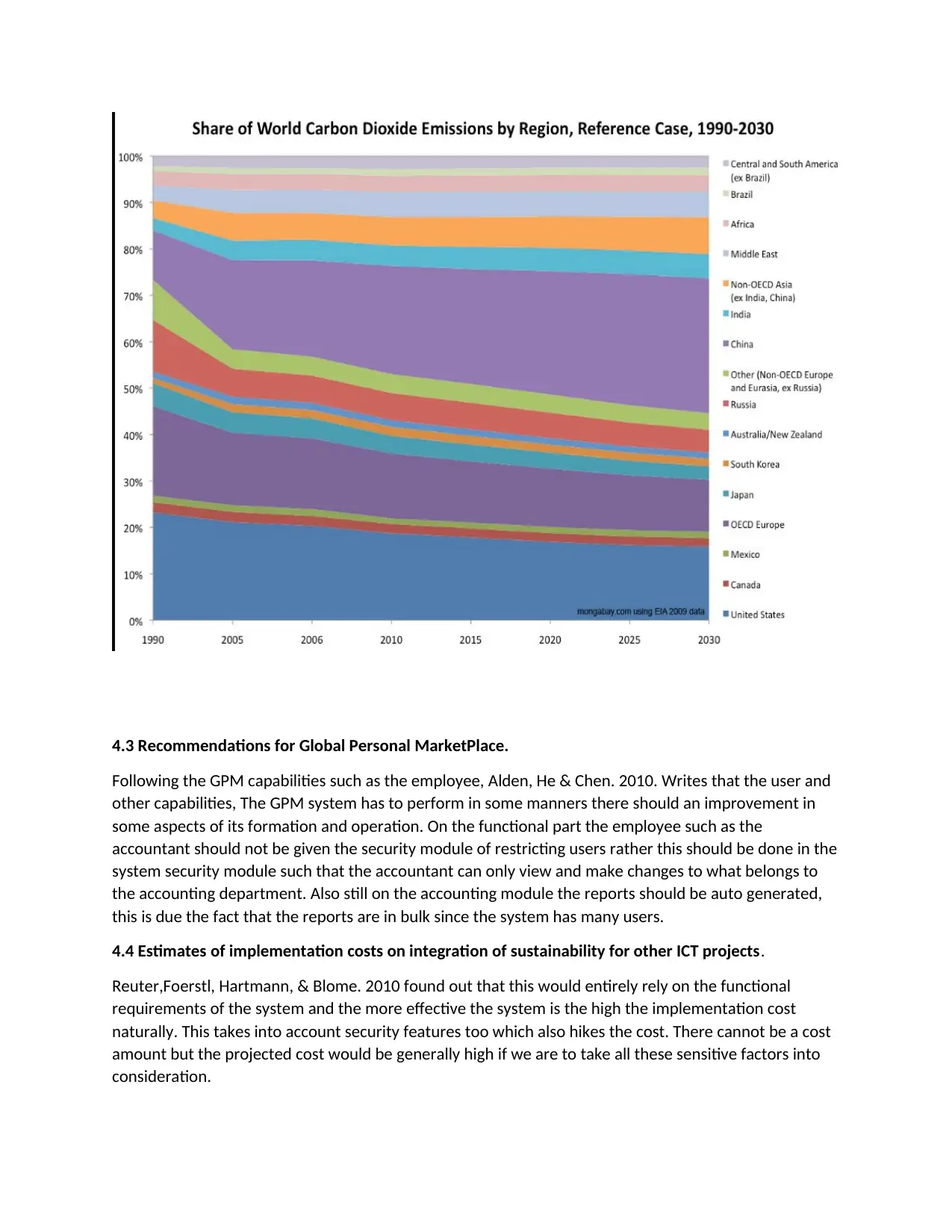
Whereas the emitted content of CO2 may not be noticeable, Banzhaf, & Kasim. 2016 writes that its
impacts on the other hand are eminent in the global warming perspective, There is no specific amount
of CO2 released but the fact is that the amount is on the rise trajectory due to ever growing computing
world. According to the Department of Energy and Energy Information Administration in the United
States of America and China this are the statistics from years back to the vision 2030 as far as carbon
dioxide emission is concerned. Retrieved from http://www/rainforests.mongobay.com.
change issues.
This can be achieved by various means one of them being the green computing technique, this is the
ecologically responsible and eco-friendly use of computing gadgets, according to the International
Federation of Global & Green ICT, Gai, Qiu, Zhao, Tao & Zong. 2016 found out that it is the learning and
practice of environmentally maintainable IT.
Green computing is very possible if every stakeholder plays an active role in the realization of it, both
the users and the enforcement teams are involved not leaving out the policy makers, this could be
realized through software and disposition optimization, the efficiency of algorithms significantly affects
the quantity of computer assets needed for a given computing role, algorithms could be switched from
slow to much quicker algorithms thus calls for design of very efficient algorithms in terms of speed and
even size such as the hash algorithms. Virtualization also plays an important role, it refers to the notion
of resources in the computer, this may be processes of execution or even rational computer systems on
a hardware. Terminal servers have also been employed in this field largely, the operator at a terminal
joins to a chief server, every computing activity is done on the server but the operator has a taste of the
OS on the terminal and cuts down 1/8 of the energy consumption that is involved if otherwise.
3.2 Pay back periods for recommendation actions.
This has not yet been achieved greatly. The involved agencies have to partner with the local users to see
this becoming a success, It can be recommended that the stakeholders make this a legal procedure in
every way from the manufacturing point to the using part of it in all fields.
4 Task D.
4.1 Evaluation of Carbon dioxide (CO2) emission for GPMC project.
Research by Ecofys in partnership with WWF, focusing on the openings presented by the ICT to minimize
GHG discharges by examining and likening the present literature on the Carbon dioxide discharge
lessening hypothetically by the ICT and suggesting a procedural tactic to clout the current literature gain
intuition on the ICT bearing on CO2 secretion. Sample studies on ICT and GHG emissions, EPA?LBNL
2000-John retrieved from http://enduse.lbl.gov/info/46418-abstract.html. Classified under Commerce
and services such as E-commerce done on the GPM platform do have a significant role in the secretion
of CO2, described by Uziel, Elste, Kattanek, Hollosi, Gerlach & Goetze. 2013, October.
4.2 Estimated CO2 emission with comparable benchmarks for Global Personal Marketplace.
Whereas the emitted content of CO2 may not be noticeable, Banzhaf, & Kasim. 2016 writes that its
impacts on the other hand are eminent in the global warming perspective, There is no specific amount
of CO2 released but the fact is that the amount is on the rise trajectory due to ever growing computing
world. According to the Department of Energy and Energy Information Administration in the United
States of America and China this are the statistics from years back to the vision 2030 as far as carbon
dioxide emission is concerned. Retrieved from http://www/rainforests.mongobay.com.
4.3 Recommendations for Global Personal MarketPlace.
Following the GPM capabilities such as the employee, Alden, He & Chen. 2010. Writes that the user and
other capabilities, The GPM system has to perform in some manners there should an improvement in
some aspects of its formation and operation. On the functional part the employee such as the
accountant should not be given the security module of restricting users rather this should be done in the
system security module such that the accountant can only view and make changes to what belongs to
the accounting department. Also still on the accounting module the reports should be auto generated,
this is due the fact that the reports are in bulk since the system has many users.
4.4 Estimates of implementation costs on integration of sustainability for other ICT projects.
Reuter,Foerstl, Hartmann, & Blome. 2010 found out that this would entirely rely on the functional
requirements of the system and the more effective the system is the high the implementation cost
naturally. This takes into account security features too which also hikes the cost. There cannot be a cost
amount but the projected cost would be generally high if we are to take all these sensitive factors into
consideration.
Following the GPM capabilities such as the employee, Alden, He & Chen. 2010. Writes that the user and
other capabilities, The GPM system has to perform in some manners there should an improvement in
some aspects of its formation and operation. On the functional part the employee such as the
accountant should not be given the security module of restricting users rather this should be done in the
system security module such that the accountant can only view and make changes to what belongs to
the accounting department. Also still on the accounting module the reports should be auto generated,
this is due the fact that the reports are in bulk since the system has many users.
4.4 Estimates of implementation costs on integration of sustainability for other ICT projects.
Reuter,Foerstl, Hartmann, & Blome. 2010 found out that this would entirely rely on the functional
requirements of the system and the more effective the system is the high the implementation cost
naturally. This takes into account security features too which also hikes the cost. There cannot be a cost
amount but the projected cost would be generally high if we are to take all these sensitive factors into
consideration.
⊘ This is a preview!⊘
Do you want full access?
Subscribe today to unlock all pages.
Trusted by 1+ million students worldwide
Refferences.
Alden, D. L., He, Y., & Chen, Q. (2010). Service recommendations and customer evaluations in the
international marketplace: Cultural and situational contingencies. Journal of Business Research, 63(1),
38-44.
Banzhaf, H. S., & Kasim, T. (2016). Fuel Consumption and Gasoline Prices: The Role of Assortative
Matching between Households and Automobiles (No. w22983). National Bureau of Economic Research
Creque, C. A., & Gooden, D. J. (2011). Cultural intelligence and global business competencies: A
framework for organizational effectiveness in the global marketplace. International Journal of
Management and Information Systems, 15(4), 141-146.
Gai, K., Qiu, M., Zhao, H., Tao, L., & Zong, Z. (2016). Dynamic energy-aware cloudlet-based mobile cloud
computing model for green computing. Journal of Network and Computer Applications, 59, 46-54
Gopalakrishnan, K. C. (2012). U.S. Patent No. 8,156,010. Washington, DC: U.S. Patent and Trademark
Office.
Kramers, A., Höjer, M., Lövehagen, N., & Wangel, J. (2014). Smart sustainable cities–Exploring ICT
solutions for reduced energy use in cities. Environmental modelling & software, 56, 52-62.
Reuter, C., Foerstl, K. A. I., Hartmann, E. V. I., & Blome, C. (2010). Sustainable global supplier
management: the role of dynamic capabilities in achieving competitive advantage. Journal of Supply
Chain Management, 46(2), 45-63.
Uziel, S., Elste, T., Kattanek, W., Hollosi, D., Gerlach, S., & Goetze, S. (2013, October). Networked
embedded acoustic processing system for smart building applications. In Design and Architectures for
Signal and Image Processing (DASIP), 2013 Conference on (pp. 349-350). IEEE.
Van Heddeghem, W., Lambert, S., Lannoo, B., Colle, D., Pickavet, M., & Demeester, P. (2014). Trends in
worldwide ICT electricity consumption from 2007 to 2012. Computer Communications, 50, 64-76.
Vereecken, W., Van Heddeghem, W., Colle, D., Pickavet, M., & Demeester, P. (2010, March). Overall ICT
footprint and green communication technologies. In Communications, Control and Signal Processing
(ISCCSP), 2010 4th International Symposium on (pp. 1-6). IEEE.
Alden, D. L., He, Y., & Chen, Q. (2010). Service recommendations and customer evaluations in the
international marketplace: Cultural and situational contingencies. Journal of Business Research, 63(1),
38-44.
Banzhaf, H. S., & Kasim, T. (2016). Fuel Consumption and Gasoline Prices: The Role of Assortative
Matching between Households and Automobiles (No. w22983). National Bureau of Economic Research
Creque, C. A., & Gooden, D. J. (2011). Cultural intelligence and global business competencies: A
framework for organizational effectiveness in the global marketplace. International Journal of
Management and Information Systems, 15(4), 141-146.
Gai, K., Qiu, M., Zhao, H., Tao, L., & Zong, Z. (2016). Dynamic energy-aware cloudlet-based mobile cloud
computing model for green computing. Journal of Network and Computer Applications, 59, 46-54
Gopalakrishnan, K. C. (2012). U.S. Patent No. 8,156,010. Washington, DC: U.S. Patent and Trademark
Office.
Kramers, A., Höjer, M., Lövehagen, N., & Wangel, J. (2014). Smart sustainable cities–Exploring ICT
solutions for reduced energy use in cities. Environmental modelling & software, 56, 52-62.
Reuter, C., Foerstl, K. A. I., Hartmann, E. V. I., & Blome, C. (2010). Sustainable global supplier
management: the role of dynamic capabilities in achieving competitive advantage. Journal of Supply
Chain Management, 46(2), 45-63.
Uziel, S., Elste, T., Kattanek, W., Hollosi, D., Gerlach, S., & Goetze, S. (2013, October). Networked
embedded acoustic processing system for smart building applications. In Design and Architectures for
Signal and Image Processing (DASIP), 2013 Conference on (pp. 349-350). IEEE.
Van Heddeghem, W., Lambert, S., Lannoo, B., Colle, D., Pickavet, M., & Demeester, P. (2014). Trends in
worldwide ICT electricity consumption from 2007 to 2012. Computer Communications, 50, 64-76.
Vereecken, W., Van Heddeghem, W., Colle, D., Pickavet, M., & Demeester, P. (2010, March). Overall ICT
footprint and green communication technologies. In Communications, Control and Signal Processing
(ISCCSP), 2010 4th International Symposium on (pp. 1-6). IEEE.

1 out of 10


Your All-in-One AI-Powered Toolkit for Academic Success.
+13062052269
info@desklib.com
Available 24*7 on WhatsApp / Email
![[object Object]](/_next/static/media/star-bottom.7253800d.svg)
Unlock your academic potential
Copyright © 2020–2026 A2Z Services. All Rights Reserved. Developed and managed by ZUCOL.