Materials Engineering Lab Report: ENG-364, Semester 1, CDU
VerifiedAdded on 2022/09/06
|6
|1353
|18
Report
AI Summary
This materials engineering lab report, submitted for ENG-364, investigates the properties of mild steel and high tensile (HT) steel through Vickers hardness and tensile testing. The report details the experimental procedures, including the use of Vickers hardness testers and tensile testing machines, to analyze the relationship between material hardness, strength, and failure modes. Results show that HT steel exhibits higher hardness and tensile strength compared to mild steel, but is more brittle. The report also includes calculations of stress and strain, analysis of failure modes, and a discussion of the challenges encountered during testing, such as vibrations and surface conditions. The conclusion summarizes the findings and suggests improvements for future experiments, such as direct measurement of indentation diagonals and the use of more sensitive tests like the Knoop test. The report references several sources and includes a stress-strain curve for both steel types.
ENG-364 MATERIALS ENGINEERING LAB REPOT
SUBMITTED: 05/04/2020
AIM
The purpose of this laboratory is to introduce students to the materials lab, some of the testing
methods that will be used during the semester and to some fundamental material properties.
We will use this equipment to investigate the relationships between
Material hardness and strength
Material hardness and failure mode in a tensile test
Material structure and failure mode in a tensile test
APPARATUS
Vickers hardness tester
Tensile testing machine
SUMMARY
Mild steel is a soft steel or low carbon steel containing about 0.145-0.250 % carbon while high
tensile (HT) steel is a high carbon steel with 0.58-0.81% carbon. Greater penetration is realized
in mild steel whose Vicker’s hardness, HV=230) than in HT steel which has a HV of 430
(Www.ChineseStandard.net, 2018, p. 18) ). On the contrary, overcoming the tensile strength in
HT steel demands a greater load (24.5 kN than in mild steel (kN). Hence, HT steel is stronger
than mild steel. Also, the ultimate tensile strength is lower in mild steel i.e. 600-800) N/mm2 than
in HT steel i.e. 2100N/mm2 (Davis, 2004, p. 99). In addition, HT steel is harder than mild steel.
However, HT steel is more brittle than mild steel due to higher carbon content in mild steel
(SAWHNEY, 2015, p. xx). In addition, mild steel tougher than HT steel. Both malleability and
ductility are higher in mild steel than in HT steel. The difficulties involved in these tests include
the scratched blocks become difficult to read creating a need to engage multiple blocks. In
addition, vibrations in the environment are a major challenge as they affect loading accuracy.
The indenter oscillation alone can cause it to get deeper into the test metal. To deal with the
vibrations, the indenter is placed on free level environments to ensure proper translation of the
vibrations.
SUBMITTED: 05/04/2020
AIM
The purpose of this laboratory is to introduce students to the materials lab, some of the testing
methods that will be used during the semester and to some fundamental material properties.
We will use this equipment to investigate the relationships between
Material hardness and strength
Material hardness and failure mode in a tensile test
Material structure and failure mode in a tensile test
APPARATUS
Vickers hardness tester
Tensile testing machine
SUMMARY
Mild steel is a soft steel or low carbon steel containing about 0.145-0.250 % carbon while high
tensile (HT) steel is a high carbon steel with 0.58-0.81% carbon. Greater penetration is realized
in mild steel whose Vicker’s hardness, HV=230) than in HT steel which has a HV of 430
(Www.ChineseStandard.net, 2018, p. 18) ). On the contrary, overcoming the tensile strength in
HT steel demands a greater load (24.5 kN than in mild steel (kN). Hence, HT steel is stronger
than mild steel. Also, the ultimate tensile strength is lower in mild steel i.e. 600-800) N/mm2 than
in HT steel i.e. 2100N/mm2 (Davis, 2004, p. 99). In addition, HT steel is harder than mild steel.
However, HT steel is more brittle than mild steel due to higher carbon content in mild steel
(SAWHNEY, 2015, p. xx). In addition, mild steel tougher than HT steel. Both malleability and
ductility are higher in mild steel than in HT steel. The difficulties involved in these tests include
the scratched blocks become difficult to read creating a need to engage multiple blocks. In
addition, vibrations in the environment are a major challenge as they affect loading accuracy.
The indenter oscillation alone can cause it to get deeper into the test metal. To deal with the
vibrations, the indenter is placed on free level environments to ensure proper translation of the
vibrations.
Paraphrase This Document
Need a fresh take? Get an instant paraphrase of this document with our AI Paraphraser

RESULTS
The test results are as shown in the tables 1nand 2 below
Table 1: data measurement for bolts tested in tensile tester
TENSILE TEST Force (kN) Failure Mode & Comments
Mild steel bolt 12.2
The bolt required less load to bend. This is due t
is high malleability and ductility as a result of
lower carbon content
‘High tensile’ bolt 24.5
The bolt required more load to snap at the thread.
This is due to its low malleability and ductility
because of high carbon content.
Table 2: data measurement for bolts tested in Vickers’s hardness tester
HARDNESS TEST Test 1 Test 2 Test 3
Mild steel bolt 230
‘High tensile’ bolt 430
The Vicker’s hardness test method involves causing an indent on the steel under test by use of a
diamond indenter. The diamond indenter is a square-based right pyramid. The load is subjected
to 136° angle between the opposite faces as in figure 1 below (Warlimont & Martienssen, 2018,
p. 241). The load, applied for 10-15 seconds, can then could then have the two diagonals (d1, d2)
of the indentation remaining on its surface after removing it measured using a microscope, and
their average (d) determined. The sloping surface area is determined.
Figure1: orientation of load to indenter in Vicker’s test
The test results are as shown in the tables 1nand 2 below
Table 1: data measurement for bolts tested in tensile tester
TENSILE TEST Force (kN) Failure Mode & Comments
Mild steel bolt 12.2
The bolt required less load to bend. This is due t
is high malleability and ductility as a result of
lower carbon content
‘High tensile’ bolt 24.5
The bolt required more load to snap at the thread.
This is due to its low malleability and ductility
because of high carbon content.
Table 2: data measurement for bolts tested in Vickers’s hardness tester
HARDNESS TEST Test 1 Test 2 Test 3
Mild steel bolt 230
‘High tensile’ bolt 430
The Vicker’s hardness test method involves causing an indent on the steel under test by use of a
diamond indenter. The diamond indenter is a square-based right pyramid. The load is subjected
to 136° angle between the opposite faces as in figure 1 below (Warlimont & Martienssen, 2018,
p. 241). The load, applied for 10-15 seconds, can then could then have the two diagonals (d1, d2)
of the indentation remaining on its surface after removing it measured using a microscope, and
their average (d) determined. The sloping surface area is determined.
Figure1: orientation of load to indenter in Vicker’s test

Then the Vicker’s hardness, HV, is determined as HV=1.854 P
d 2 , with P in kilogram and d2 in
square milimetres (Tiryakioğlu et al., 2019, p. 105 Tiryakioğlu et al., 2019, p. xx)). The sloping
surface area is as follow:
a) HT steel
HV=1.854 P
d 2 : d2= 1.854 P
HV = 1.854× 24.5 ×103
9.81 × 4302 = 0.025mm2; d= 0.158mm
b) Mild steel
,d2=1.854× 12.2 ×103
9.81 ×2302 = 0.04359; d= 0.209 mm
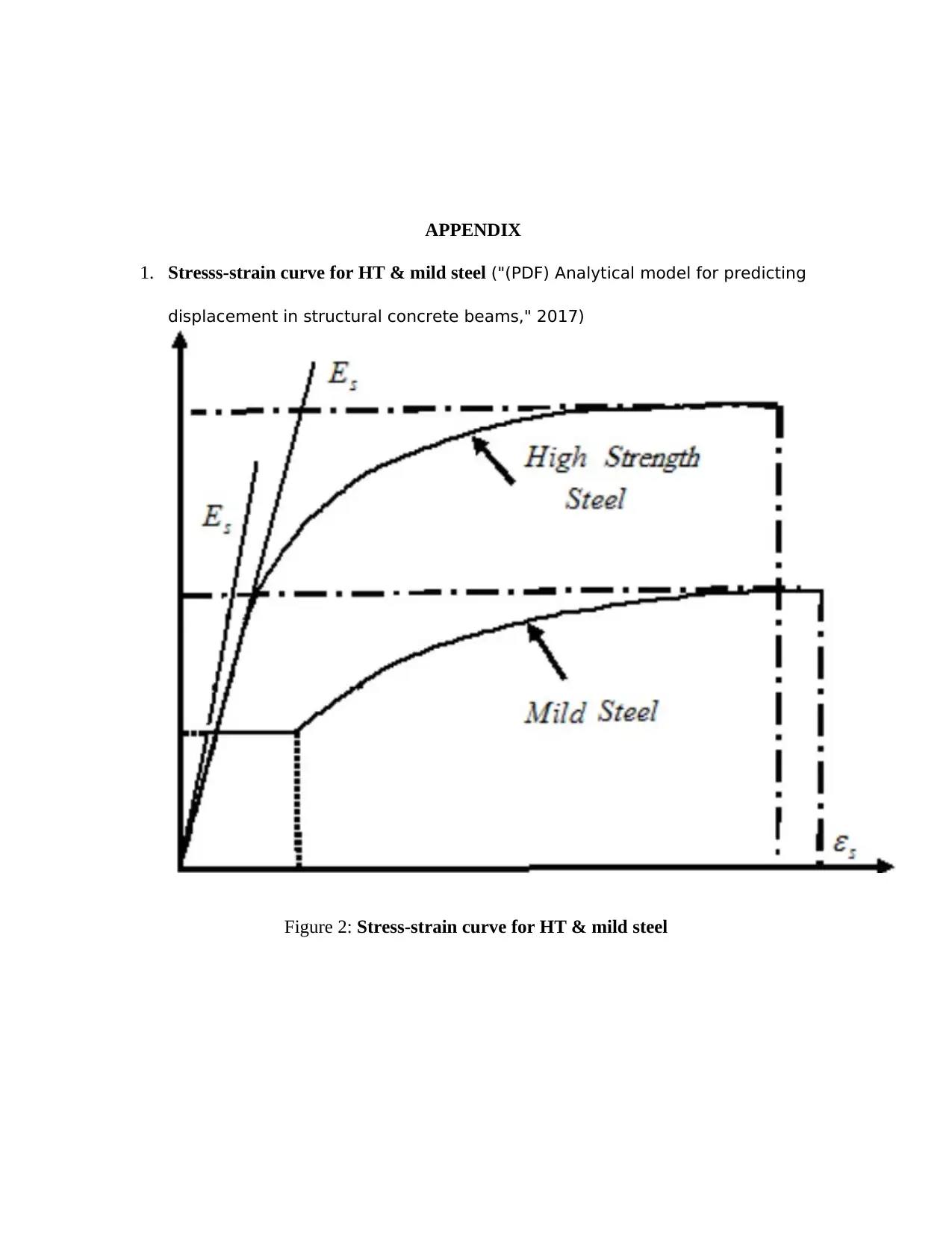
From the foregoing, the stress strain plot would display that the yield strength for HT steel is
higher than that of mild steel. The diagonal of the indentation on the steel materials also differ
from each other as evident in the calculations.
Stress, σ = load
area ; a) for HT steel, σ =¿ 24500
0.025 × 106 = 980, 000,000,000Pa = 980 GPa
For mild stee,σ =¿ 12200
0.04359 × 106 = 279880706584 ≈ 279.9 GPa
CONCLUSION
The tensile test undertaken using the universal test machine; it is possible to obtain the
mechanical properties of the materials. A stretch in the material exerts it to both plastic and
elastic deformation ("Specification for through-thickness tension testing of steel plates for
special applications," n.d., p. 31). Strain hardening happens during material strengthening until
the material fractures. Both HT and mild steel have different material hardness and tensile
properties. The calculated value of d may not be accurate. This report suggests next experiments
should come up with a way of measuring d directly instead of determining it by calculation.
The sensitivity of Vickers test to surface conditions is very low. The report further suggests that
subsequent activities tests should consider more sensitive tests like Knoop test to factor in
surface conditions.
SOLUTION TO QUESTIONS
1) Tensile test
a. Mild steel failure is ductile in nature with elaborate elastic, plastic and strain hardening
stages. HT steel has a heightened yield point with a low plastic ductility and high brittle
fracture.
b. Difference in load= (24500-12200)N = 12300 N.
d 2 , with P in kilogram and d2 in
square milimetres (Tiryakioğlu et al., 2019, p. 105 Tiryakioğlu et al., 2019, p. xx)). The sloping
surface area is as follow:
a) HT steel
HV=1.854 P
d 2 : d2= 1.854 P
HV = 1.854× 24.5 ×103
9.81 × 4302 = 0.025mm2; d= 0.158mm
b) Mild steel
,d2=1.854× 12.2 ×103
9.81 ×2302 = 0.04359; d= 0.209 mm
From the foregoing, the stress strain plot would display that the yield strength for HT steel is
higher than that of mild steel. The diagonal of the indentation on the steel materials also differ
from each other as evident in the calculations.
Stress, σ = load
area ; a) for HT steel, σ =¿ 24500
0.025 × 106 = 980, 000,000,000Pa = 980 GPa
For mild stee,σ =¿ 12200
0.04359 × 106 = 279880706584 ≈ 279.9 GPa
CONCLUSION
The tensile test undertaken using the universal test machine; it is possible to obtain the
mechanical properties of the materials. A stretch in the material exerts it to both plastic and
elastic deformation ("Specification for through-thickness tension testing of steel plates for
special applications," n.d., p. 31). Strain hardening happens during material strengthening until
the material fractures. Both HT and mild steel have different material hardness and tensile
properties. The calculated value of d may not be accurate. This report suggests next experiments
should come up with a way of measuring d directly instead of determining it by calculation.
The sensitivity of Vickers test to surface conditions is very low. The report further suggests that
subsequent activities tests should consider more sensitive tests like Knoop test to factor in
surface conditions.
SOLUTION TO QUESTIONS
1) Tensile test
a. Mild steel failure is ductile in nature with elaborate elastic, plastic and strain hardening
stages. HT steel has a heightened yield point with a low plastic ductility and high brittle
fracture.
b. Difference in load= (24500-12200)N = 12300 N.
⊘ This is a preview!⊘
Do you want full access?
Subscribe today to unlock all pages.

Trusted by 1+ million students worldwide

c. The materials fail at the point where the tensile testing machine grips them. The thread
experiences plastic deformation and the shaft elastic stretching.
d. This is due to a decrease in the stiffness of the threads next to the head.
2) Hardness test
a. The Vicker’s number for mild steel is 230 while that for HT steel is 430
b. At the time of breaking of the mild steel, the load sustained is smaller while for HT
steel the load sustained is larger. However, for both steels, there are more likely to
experience chopping off its particles due to load penetration onto it.
3) The increase in load sustained before breaking usually accompanies increase in material
hardness. Material failure mode however depends majorly on its ductility and
malleability levels. Materials that are least malleable e.g. glass will most probably snap
without warning, a property called brittleness. They form fractures and can easily creep.
Malleable materials would bend long before breaking apart. Here, mild steel as more
ductile and malleable hence it snaps more rapidly than high tensile steel.
experiences plastic deformation and the shaft elastic stretching.
d. This is due to a decrease in the stiffness of the threads next to the head.
2) Hardness test
a. The Vicker’s number for mild steel is 230 while that for HT steel is 430
b. At the time of breaking of the mild steel, the load sustained is smaller while for HT
steel the load sustained is larger. However, for both steels, there are more likely to
experience chopping off its particles due to load penetration onto it.
3) The increase in load sustained before breaking usually accompanies increase in material
hardness. Material failure mode however depends majorly on its ductility and
malleability levels. Materials that are least malleable e.g. glass will most probably snap
without warning, a property called brittleness. They form fractures and can easily creep.
Malleable materials would bend long before breaking apart. Here, mild steel as more
ductile and malleable hence it snaps more rapidly than high tensile steel.
Paraphrase This Document
Need a fresh take? Get an instant paraphrase of this document with our AI Paraphraser

REFERENCES
Bendikienė, R., & Juzėnas, K. (2017). Materials engineering 2017. Trans Tech Publications.
(PDF) Analytical model for predicting displacement in structural concrete beams. (2017, April 1).
ResearchGate. https://www.researchgate.net/publication/314371777_Analytical_
Model_for_Predicting_Displacement_in_Structural_Concrete_Beams
SAWHNEY, G. (2015). Fundamentals of mechanical engineering: Thermodynamics,
mechanics, theory of machines, strength of materials and fluid dynamics (3rd ed.). PHI
Learning Pvt.
Specification for through-thickness tension testing of steel plates for special applications.
(n.d.). https://doi.org/10.1520/a0770_a0770m
Tiryakioğlu, M., Griffiths, W., & Jolly, M. (2019). Shape casting: 7th international symposium
celebrating prof. John Campbell's 80th birthday. Springer.
Warlimont, H., & Martienssen, W. (2018). Springer handbook of materials data. Springer.
Www.ChineseStandard.net. (2018). GB 9948-2013: Translated English of Chinese standard.
(GB9948-2013): Seamless steel tubes for petroleum cracking.
//www.chinesestandard.net.
Bendikienė, R., & Juzėnas, K. (2017). Materials engineering 2017. Trans Tech Publications.
(PDF) Analytical model for predicting displacement in structural concrete beams. (2017, April 1).
ResearchGate. https://www.researchgate.net/publication/314371777_Analytical_
Model_for_Predicting_Displacement_in_Structural_Concrete_Beams
SAWHNEY, G. (2015). Fundamentals of mechanical engineering: Thermodynamics,
mechanics, theory of machines, strength of materials and fluid dynamics (3rd ed.). PHI
Learning Pvt.
Specification for through-thickness tension testing of steel plates for special applications.
(n.d.). https://doi.org/10.1520/a0770_a0770m
Tiryakioğlu, M., Griffiths, W., & Jolly, M. (2019). Shape casting: 7th international symposium
celebrating prof. John Campbell's 80th birthday. Springer.
Warlimont, H., & Martienssen, W. (2018). Springer handbook of materials data. Springer.
Www.ChineseStandard.net. (2018). GB 9948-2013: Translated English of Chinese standard.
(GB9948-2013): Seamless steel tubes for petroleum cracking.
//www.chinesestandard.net.

APPENDIX
1. Stresss-strain curve for HT & mild steel ("(PDF) Analytical model for predicting
displacement in structural concrete beams," 2017)
Figure 2: Stress-strain curve for HT & mild steel
1. Stresss-strain curve for HT & mild steel ("(PDF) Analytical model for predicting
displacement in structural concrete beams," 2017)
Figure 2: Stress-strain curve for HT & mild steel
⊘ This is a preview!⊘
Do you want full access?
Subscribe today to unlock all pages.

Trusted by 1+ million students worldwide
1 out of 6
Your All-in-One AI-Powered Toolkit for Academic Success.
+13062052269
info@desklib.com
Available 24*7 on WhatsApp / Email
Unlock your academic potential
Copyright © 2020–2025 A2Z Services. All Rights Reserved. Developed and managed by ZUCOL.