Water Sources: Alternative Solutions for Water Scarcity in Urban Areas

Verified

Added on  2020/02/24

|3
|399
|81
Report
AI Summary
This report examines the issue of water scarcity and proposes alternative solutions for cities facing water shortages. The primary solution discussed is sourcing water from nearby regions with abundant water resources, utilizing a pipeline system to transport water and implementing a large-scale water transfer system. The report also addresses the potential environmental concerns associated with excessive water importation, emphasizing the importance of water conservation policies, efficient water usage, and public awareness campaigns. The report references relevant sources to support the proposed solutions, highlighting the need for sustainable water management practices to address the challenges of water scarcity in urban areas. The report also emphasizes the importance of implementing water conservation measures and educating the public about water-saving practices to reduce water wastage and ensure the responsible use of the available water resources.
Document Page
Water Sources 1
ALTERNATIVE WATER SOURCES
Students Name
Course
Professor’s name
University
(City)State
Date
tabler-icon-diamond-filled.svg

Paraphrase This Document

Need a fresh take? Get an instant paraphrase of this document with our AI Paraphraser
Document Page
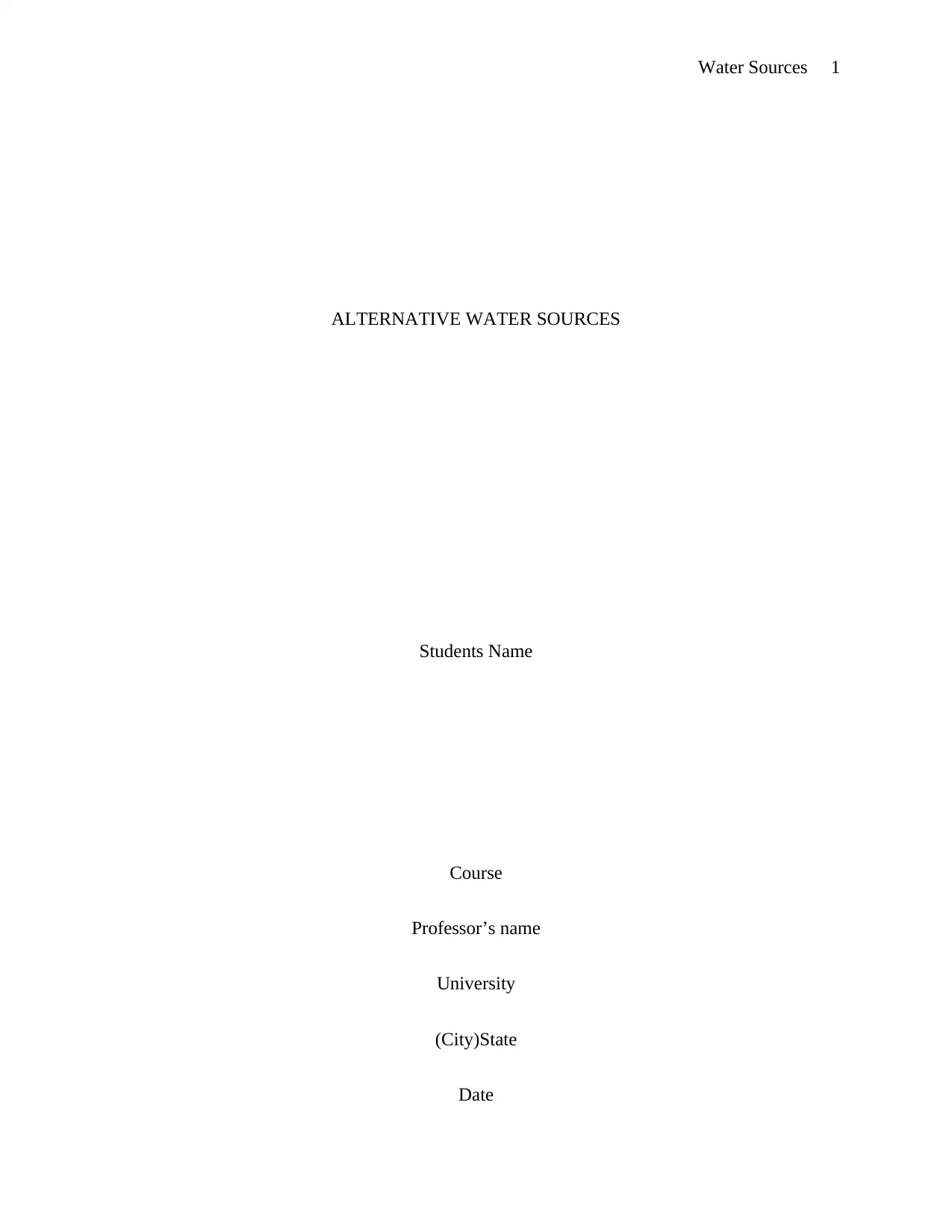
Water Sources 2
Alternative Water Sources
Water is an essential commodity and a vital need in households, firms and industries. For
this reason, water scarcity is a chronic crisis for the city. Therefore, the city has to find
alternative sources of water supply for use in households and industries. Given that the city is
inland, the best alternative source of water supply for it will be sourcing the water from nearby
cities that are not affected by the water scarcity problem (Bardford and Everitt, 2012). Primarily,
this can be achieved by building a cross-city/country pipeline to help channel water from regions
that have plenty of water to the water scarce city.
Mainly, this alternative source of water will utilize the principle of gravity to channel
surplus water from regions that receive high rainfall. In turn, it will help solve the water shortage
problem in the city. However, it is worth noting that this measure will require a large scale water
transfer system and the water received may be stored in a reservoir (Bardford and Everitt, 2012).
From there, it can be channeled to households and firms.
By and large, this method may spur the interest of environmentalists and green activists
in the city where the water is sourced. Excessive importation of water may lead to depletion of
its water resources. Therefore, the water must be used sparingly. The city must also ensure that it
puts in place water conservation policies and measures in the region to ensure that the water
received is used guardedly (Wikstrom, 2012). Thus the city government must sensitize its
residents to use less water and even recycle to reduce wastage.
Document Page
Water Sources 3
References
Bardford,V. and Everitt, L. (2012). Eight radical solutions for the water shortage. [Online] BBC
News. Available at: http://www.bbc.com/news/magazine-17600062.[Accessed 4 Sept 2017]
Wikstrom, J. (2012). 6 Solutions to the Water Shortage Crisis. [Online] Triple Pundit. Available
at: http://www.triplepundit.com/2015/06/innovative-solutions-water-shortage-crisis/.[Accessed
4 Sept 2017]
chevron_up_icon
1 out of 3
circle_padding
hide_on_mobile
zoom_out_icon
[object Object]