Application of Integral Calculus in Information Technology Report
VerifiedAdded on 2023/01/10
|10
|2351
|24
Report
AI Summary
This report delves into the significant role of integral calculus within the realm of information technology. It begins by introducing the fundamental concepts of calculus, distinguishing between differential and integral calculus, and highlighting the integral calculus's focus on areas, volumes, and lengths. The report then explores the application of integral calculus in several key areas of IT. These include scientific computing, where integral calculus provides essential tools and techniques for solving mathematical models; the design and analysis of algorithms, where calculus helps analyze computational complexity and design algorithms; asymptomatic enumeration, which involves using integral calculus to estimate the behavior of generating functions; graphical and visual design, where calculus is crucial for creating three-dimensional graphics; and information processing, where calculus is used in creating statistics solvers, simulators, and probabilities. The report concludes by emphasizing the critical importance of integral calculus for success in the IT field.
Engineering Mathematics 1
Application of Integral Calculus in Information Technology
Student
Course
Tutor
Institutional Affiliations
State
Date
Application of Integral Calculus in Information Technology
Student
Course
Tutor
Institutional Affiliations
State
Date

Paraphrase This Document
Need a fresh take? Get an instant paraphrase of this document with our AI Paraphraser
Engineering Mathematics 2
Application of integral calculus in information technology
Introduction
Invention of calculus was one of the greatest contribution to the modern science. A lot of
technological accomplishment including information science, landing on the mood among other
technological accomplishment would not be accomplished without the invention of calculus. The
term “calculus” has its origin from a Latin word meaning small stone (Yao, 2012, pp.285-297).
This is due to the reason that many years ago, people used the small stones to do calculations and
solve many arithmetic problems. The theorem of calculus was discovered by two people namely
Isaac Newton and Baron Gottfried. The two gentlemen discovered the theorem in the 17th
century. It was invented in order to help in solving problems while dealing with the changing
quantities (Machado, Galhano, and Trujillo, 2014, pp.577-582). It is therefore christened
mathematics of change. Calculus is divided into two main sub topics including differential
calculus and integral calculus. This essay focuses on the integral calculus.
The Integral calculus is a branch of calculus which deals with the applications and theory
of integration. As differential calculus focus on rates of change including velocities, slopes of
tangent lines among other areas, the integral calculus focuses on the total size of a given value
for example volumes, areas, and lengths. The better part of integral calculus is based on
derivation of formulas which are afterwards used in finding anti-derivatives (Azodolmolky,
Nejabati, Pazouki, Wieder, Yahyapour, and Simeonidou, 2013, pp. 1397-1402). In that sense, the
integral calculus has been a gate way to many courses in information technology which are
devoted to the studies involving graphics and programming among others. As such, the integral
calculus has been a critical aspect in information technology. In that rationale, I sought to do a
research on the application of the integral calculus in the following areas of information
Application of integral calculus in information technology
Introduction
Invention of calculus was one of the greatest contribution to the modern science. A lot of
technological accomplishment including information science, landing on the mood among other
technological accomplishment would not be accomplished without the invention of calculus. The
term “calculus” has its origin from a Latin word meaning small stone (Yao, 2012, pp.285-297).
This is due to the reason that many years ago, people used the small stones to do calculations and
solve many arithmetic problems. The theorem of calculus was discovered by two people namely
Isaac Newton and Baron Gottfried. The two gentlemen discovered the theorem in the 17th
century. It was invented in order to help in solving problems while dealing with the changing
quantities (Machado, Galhano, and Trujillo, 2014, pp.577-582). It is therefore christened
mathematics of change. Calculus is divided into two main sub topics including differential
calculus and integral calculus. This essay focuses on the integral calculus.
The Integral calculus is a branch of calculus which deals with the applications and theory
of integration. As differential calculus focus on rates of change including velocities, slopes of
tangent lines among other areas, the integral calculus focuses on the total size of a given value
for example volumes, areas, and lengths. The better part of integral calculus is based on
derivation of formulas which are afterwards used in finding anti-derivatives (Azodolmolky,
Nejabati, Pazouki, Wieder, Yahyapour, and Simeonidou, 2013, pp. 1397-1402). In that sense, the
integral calculus has been a gate way to many courses in information technology which are
devoted to the studies involving graphics and programming among others. As such, the integral
calculus has been a critical aspect in information technology. In that rationale, I sought to do a
research on the application of the integral calculus in the following areas of information
Engineering Mathematics 3
technology: scientific computing, designing and analysis of algorithms, asymptomatic
enumeration, graphical and visual design as well as information processing.
Scientific computing
Scientific computing involves a collection of tools, theories and techniques which are
essential in solving computer mathematical models of problems in engineering and science at
large. A good number of tools and techniques which are applied here are originally integral
calculus based most of which got originated way back before computers came to be. The integral
calculus constitute a better part of computer science. The advent of electronic computers have
signaled a new era which involves solving many scientific problems (Almeida, and Torres, 2009,
pp.1816-1820). As such, the numerical approaches that were developed for manual calculation
by hand are getting abandoned and some have been revised. Some of the considerations which
seemed irrelevant for manual calculations have now become efficient and effective approaches
for use in a large information system.
Some of the considerations including computer operating systems, programming
languages, the correctness of programs and management of voluminous data got subsumed under
the domain of information technology where scientific computing has become import. Be that as
it may, mathematics, calculus in particular, continues to play a significant role in information
technology. The integral calculus offers the mathematical model language that is to be solved as
well as the information concerning the importance of a model, it also facilitates scientific
computing with the theoretical origin of the numerical methods thus increasing the tools for use
in information technology.
technology: scientific computing, designing and analysis of algorithms, asymptomatic
enumeration, graphical and visual design as well as information processing.
Scientific computing
Scientific computing involves a collection of tools, theories and techniques which are
essential in solving computer mathematical models of problems in engineering and science at
large. A good number of tools and techniques which are applied here are originally integral
calculus based most of which got originated way back before computers came to be. The integral
calculus constitute a better part of computer science. The advent of electronic computers have
signaled a new era which involves solving many scientific problems (Almeida, and Torres, 2009,
pp.1816-1820). As such, the numerical approaches that were developed for manual calculation
by hand are getting abandoned and some have been revised. Some of the considerations which
seemed irrelevant for manual calculations have now become efficient and effective approaches
for use in a large information system.
Some of the considerations including computer operating systems, programming
languages, the correctness of programs and management of voluminous data got subsumed under
the domain of information technology where scientific computing has become import. Be that as
it may, mathematics, calculus in particular, continues to play a significant role in information
technology. The integral calculus offers the mathematical model language that is to be solved as
well as the information concerning the importance of a model, it also facilitates scientific
computing with the theoretical origin of the numerical methods thus increasing the tools for use
in information technology.
⊘ This is a preview!⊘
Do you want full access?
Subscribe today to unlock all pages.

Trusted by 1+ million students worldwide
Engineering Mathematics 4
The computer algebra system for direct computation of derivatives and integrals either
numerically or symbolically are the most flagrant here (Du, Gunzburger, Lehoucq, and Zhou,
2013, pp.493-540). Moreover, any application simulating a continuous differential equation
based physical system for instance computational fluid dynamics always involve computing
integrals and derivatives. Additionally, computer simulation may get embedded in optimizing
algorithms for optimal designs for example optimal design of something using a computer rather
than the use of trial and error technique which would be costly. Needless to say, integral calculus
is of great importance in scientific computing; it has made scientific computing to be a critical
aspect in experiments and analysis of scientific innovation.
Design and analysis of algorithms
The analysis of algorithms refers to examination of the computational complexity of the
algorithm. This may include the space, time among other resources that may be necessary for
executing a given algorithm (Ueberhuber, 2012, pp.23-45). It normally involve finding functions
that compares the length of the algorithm to the number of the storage it may use. This is
normally done by applying the integral calculus.
In a very large instances, the behavior of a combinatorial algorithms can easily get
analyzed through calculus. In most cases, it is used for a randomized algorithms; the probability
in the modern era heavily relies on analytics. From another perspective, one can sometimes
design algorithms for solving a discrete a problem through consideration of a continuous
analogue, apply calculus in solving the problem and then discrete in order to find the algorithm
for the original problem (Ramírez, Mondié, Garrido, and Sipahi, 2016, pp.1688-169). This may
be done by for example finding an appropriate root of a polynomial equation. A Newton’s
method can be found using calculus and then discrete it.
The computer algebra system for direct computation of derivatives and integrals either
numerically or symbolically are the most flagrant here (Du, Gunzburger, Lehoucq, and Zhou,
2013, pp.493-540). Moreover, any application simulating a continuous differential equation
based physical system for instance computational fluid dynamics always involve computing
integrals and derivatives. Additionally, computer simulation may get embedded in optimizing
algorithms for optimal designs for example optimal design of something using a computer rather
than the use of trial and error technique which would be costly. Needless to say, integral calculus
is of great importance in scientific computing; it has made scientific computing to be a critical
aspect in experiments and analysis of scientific innovation.
Design and analysis of algorithms
The analysis of algorithms refers to examination of the computational complexity of the
algorithm. This may include the space, time among other resources that may be necessary for
executing a given algorithm (Ueberhuber, 2012, pp.23-45). It normally involve finding functions
that compares the length of the algorithm to the number of the storage it may use. This is
normally done by applying the integral calculus.
In a very large instances, the behavior of a combinatorial algorithms can easily get
analyzed through calculus. In most cases, it is used for a randomized algorithms; the probability
in the modern era heavily relies on analytics. From another perspective, one can sometimes
design algorithms for solving a discrete a problem through consideration of a continuous
analogue, apply calculus in solving the problem and then discrete in order to find the algorithm
for the original problem (Ramírez, Mondié, Garrido, and Sipahi, 2016, pp.1688-169). This may
be done by for example finding an appropriate root of a polynomial equation. A Newton’s
method can be found using calculus and then discrete it.
Paraphrase This Document
Need a fresh take? Get an instant paraphrase of this document with our AI Paraphraser
Engineering Mathematics 5
Various information technology experts have examined several uses of integral calculus
in algorithm generation. Li and Zeng (2015, pp74), explore Risch algorithm for indefinite
integration. According to the authors, integral calculus is applied in generating computer
algorithms which are intern used in finding anti-derivatives.
Asymptomatic enumeration
In some occasions, the only way to work out enumeration problems is by making
generating functions and estimate its asymptomatic behavior by use of analytic method. This is
where the importance integral calculus is seen (Sinoquet, 2010, pp.56-71). Considering
asymptomatic enumeration of compacted binary trees (a compacted binary tree refers to graphic
which is developed in a way that recurring sub trees in the main tree are represented by pointers
thus making unique sub trees). In such representation, a special class of directed acyclic graph is
formed. Given that we are only concerned with the given size of compacted trees and their
asymptomatic number, where the number of the internal nodes gives the compacted trees. This
problem, however, poses many difficulties due to its super exponential growth. As a result,
investigation will be restricted to trees of bounded right height then the asymptomatic counting
problem for this class and another class which further simplified and closely related to it will be
worked out.
This will require application of integral calculus for exponential generating function to be
used for the both the compacted trees for relaxed trees as well as the compacted trees for
bounded right height whose difference is seen by dropping the condition for uniqueness
(Neufeld, 2015, p.341). By this, we can be able to derive an integral equation for and work out
the problem.
Various information technology experts have examined several uses of integral calculus
in algorithm generation. Li and Zeng (2015, pp74), explore Risch algorithm for indefinite
integration. According to the authors, integral calculus is applied in generating computer
algorithms which are intern used in finding anti-derivatives.
Asymptomatic enumeration
In some occasions, the only way to work out enumeration problems is by making
generating functions and estimate its asymptomatic behavior by use of analytic method. This is
where the importance integral calculus is seen (Sinoquet, 2010, pp.56-71). Considering
asymptomatic enumeration of compacted binary trees (a compacted binary tree refers to graphic
which is developed in a way that recurring sub trees in the main tree are represented by pointers
thus making unique sub trees). In such representation, a special class of directed acyclic graph is
formed. Given that we are only concerned with the given size of compacted trees and their
asymptomatic number, where the number of the internal nodes gives the compacted trees. This
problem, however, poses many difficulties due to its super exponential growth. As a result,
investigation will be restricted to trees of bounded right height then the asymptomatic counting
problem for this class and another class which further simplified and closely related to it will be
worked out.
This will require application of integral calculus for exponential generating function to be
used for the both the compacted trees for relaxed trees as well as the compacted trees for
bounded right height whose difference is seen by dropping the condition for uniqueness
(Neufeld, 2015, p.341). By this, we can be able to derive an integral equation for and work out
the problem.
Engineering Mathematics 6
Graphical and visual design
Mathematics is very important in designing computer graphics. Various areas is
mathematical techniques are applied in computer graphics with an important area including
calculus. This section presents the application of calculus for computer graphical and visual
design.
Generally, calculus is applied in making visuals and graphics. The graphics and visuals
are always three dimensional. They are mainly used for video games. These visuals are also used
by militaries for simulation, in satellite images, maps among other areas in the military
(Smirnov, and Bogun, 2011, pp, 78-91). They are also used by architectures to in making graphic
buildings and outlines.
Notably, the knowledge of calculus is essential in advanced computer graphic and visual
design. It offers a basic background in computer graphics. This is due to the reason that graphic
designers describe their problems and solutions in graphic. Moreover, calculus is one of the areas
in mathematics, alongside algebra that has open most doors for many computer graphic and
visual designers.
Information processing
The integral calculus can also be used for information processing in information
technology. It is used by computer programmers to create statistics solvers, simulators as well as
probabilities. An example is computation using computer algebra. It is also used in signal
processing and machine learning. A basic calculus is applied in signal processing and machine
learning. Computer programmers use physic problems to write simulations. This involves
application of a lot of mathematics, however, performing that effectively normally require a
Graphical and visual design
Mathematics is very important in designing computer graphics. Various areas is
mathematical techniques are applied in computer graphics with an important area including
calculus. This section presents the application of calculus for computer graphical and visual
design.
Generally, calculus is applied in making visuals and graphics. The graphics and visuals
are always three dimensional. They are mainly used for video games. These visuals are also used
by militaries for simulation, in satellite images, maps among other areas in the military
(Smirnov, and Bogun, 2011, pp, 78-91). They are also used by architectures to in making graphic
buildings and outlines.
Notably, the knowledge of calculus is essential in advanced computer graphic and visual
design. It offers a basic background in computer graphics. This is due to the reason that graphic
designers describe their problems and solutions in graphic. Moreover, calculus is one of the areas
in mathematics, alongside algebra that has open most doors for many computer graphic and
visual designers.
Information processing
The integral calculus can also be used for information processing in information
technology. It is used by computer programmers to create statistics solvers, simulators as well as
probabilities. An example is computation using computer algebra. It is also used in signal
processing and machine learning. A basic calculus is applied in signal processing and machine
learning. Computer programmers use physic problems to write simulations. This involves
application of a lot of mathematics, however, performing that effectively normally require a
⊘ This is a preview!⊘
Do you want full access?
Subscribe today to unlock all pages.
Trusted by 1+ million students worldwide
Engineering Mathematics 7
knowledge in calculus. Games programmers on the other hand must also be very comfortable
with calculus, this is due to the reason that games involves graphics and visuals that require the
knowledge on calculus to program (Lawler, and Molluzzo, 2015, p.45). Most importantly,
calculus has many applications in this domain but it is more useful in computer programming.
Integral calculus is used in three dimensional programming. This involves computing the normal
to a given surface by working out a tangent then you take the orthogonal unit vector.
The following programs shows the application of calculus in programming:
Class integral () {
ImportJava.scanner;
Main () {
scannerReader = new scanner (system.in)
stringEquestion = retrieveInfo (): // this will retarieve the equation and save it in string
form.
System.out.printLn (“Please key in the value of Y”);
Double valueOfX = reader.int ();
Double Answer = solve (equation.valueOfY);
system.out.ptrintLn (“The value of the definite integral is equal to: “+ answer) ;} }
Conclusion
As a conclusion, this essay has presented the use of calculus in information technology.
This involved doing research on the applications of integral calculus in the technology domain.
knowledge in calculus. Games programmers on the other hand must also be very comfortable
with calculus, this is due to the reason that games involves graphics and visuals that require the
knowledge on calculus to program (Lawler, and Molluzzo, 2015, p.45). Most importantly,
calculus has many applications in this domain but it is more useful in computer programming.
Integral calculus is used in three dimensional programming. This involves computing the normal
to a given surface by working out a tangent then you take the orthogonal unit vector.
The following programs shows the application of calculus in programming:
Class integral () {
ImportJava.scanner;
Main () {
scannerReader = new scanner (system.in)
stringEquestion = retrieveInfo (): // this will retarieve the equation and save it in string
form.
System.out.printLn (“Please key in the value of Y”);
Double valueOfX = reader.int ();
Double Answer = solve (equation.valueOfY);
system.out.ptrintLn (“The value of the definite integral is equal to: “+ answer) ;} }
Conclusion
As a conclusion, this essay has presented the use of calculus in information technology.
This involved doing research on the applications of integral calculus in the technology domain.
Paraphrase This Document
Need a fresh take? Get an instant paraphrase of this document with our AI Paraphraser
Engineering Mathematics 8
In doing so, the document examined the meaning and the origin of calculus in the introductory
part as well as various sub topics in calculus including integral and differential calculus. We have
explored the integral calculus in details and examine its application in information technology. It
has been found that the integral calculus is widely applied in information technology with the
areas of application ranging from the design and analysis of algorithms, scientific computation,
asymptomatic enumeration, graphical and visual design and information processing among
others. As it can be seen, the integral calculus has a very critical role in the information
technology. It can therefore be concluded that learning integral calculus is the key to success for
most information technology professionals.
In doing so, the document examined the meaning and the origin of calculus in the introductory
part as well as various sub topics in calculus including integral and differential calculus. We have
explored the integral calculus in details and examine its application in information technology. It
has been found that the integral calculus is widely applied in information technology with the
areas of application ranging from the design and analysis of algorithms, scientific computation,
asymptomatic enumeration, graphical and visual design and information processing among
others. As it can be seen, the integral calculus has a very critical role in the information
technology. It can therefore be concluded that learning integral calculus is the key to success for
most information technology professionals.
Engineering Mathematics 9
References
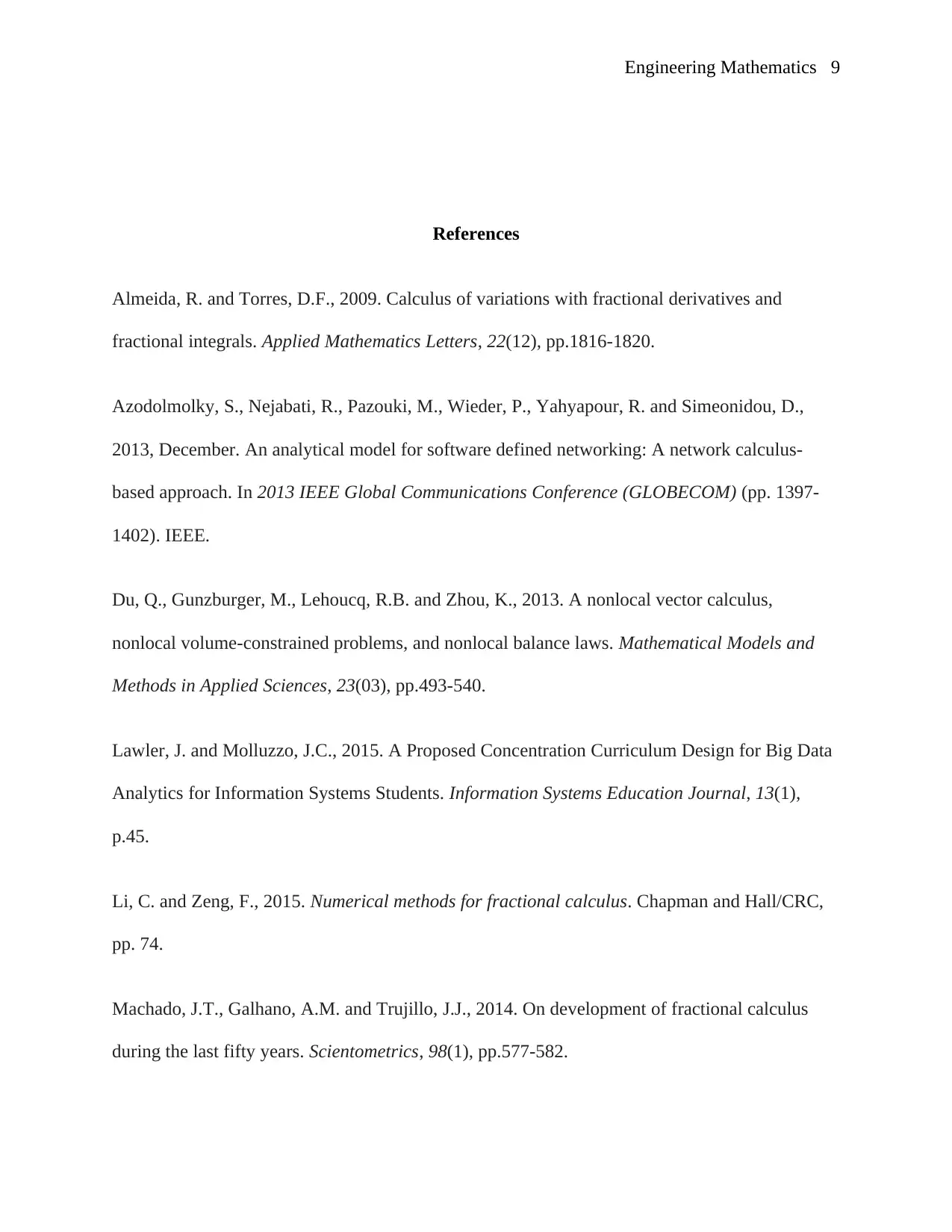
Almeida, R. and Torres, D.F., 2009. Calculus of variations with fractional derivatives and
fractional integrals. Applied Mathematics Letters, 22(12), pp.1816-1820.
Azodolmolky, S., Nejabati, R., Pazouki, M., Wieder, P., Yahyapour, R. and Simeonidou, D.,
2013, December. An analytical model for software defined networking: A network calculus-
based approach. In 2013 IEEE Global Communications Conference (GLOBECOM) (pp. 1397-
1402). IEEE.
Du, Q., Gunzburger, M., Lehoucq, R.B. and Zhou, K., 2013. A nonlocal vector calculus,
nonlocal volume-constrained problems, and nonlocal balance laws. Mathematical Models and
Methods in Applied Sciences, 23(03), pp.493-540.
Lawler, J. and Molluzzo, J.C., 2015. A Proposed Concentration Curriculum Design for Big Data
Analytics for Information Systems Students. Information Systems Education Journal, 13(1),
p.45.
Li, C. and Zeng, F., 2015. Numerical methods for fractional calculus. Chapman and Hall/CRC,
pp. 74.
Machado, J.T., Galhano, A.M. and Trujillo, J.J., 2014. On development of fractional calculus
during the last fifty years. Scientometrics, 98(1), pp.577-582.
References
Almeida, R. and Torres, D.F., 2009. Calculus of variations with fractional derivatives and
fractional integrals. Applied Mathematics Letters, 22(12), pp.1816-1820.
Azodolmolky, S., Nejabati, R., Pazouki, M., Wieder, P., Yahyapour, R. and Simeonidou, D.,
2013, December. An analytical model for software defined networking: A network calculus-
based approach. In 2013 IEEE Global Communications Conference (GLOBECOM) (pp. 1397-
1402). IEEE.
Du, Q., Gunzburger, M., Lehoucq, R.B. and Zhou, K., 2013. A nonlocal vector calculus,
nonlocal volume-constrained problems, and nonlocal balance laws. Mathematical Models and
Methods in Applied Sciences, 23(03), pp.493-540.
Lawler, J. and Molluzzo, J.C., 2015. A Proposed Concentration Curriculum Design for Big Data
Analytics for Information Systems Students. Information Systems Education Journal, 13(1),
p.45.
Li, C. and Zeng, F., 2015. Numerical methods for fractional calculus. Chapman and Hall/CRC,
pp. 74.
Machado, J.T., Galhano, A.M. and Trujillo, J.J., 2014. On development of fractional calculus
during the last fifty years. Scientometrics, 98(1), pp.577-582.
⊘ This is a preview!⊘
Do you want full access?
Subscribe today to unlock all pages.
Trusted by 1+ million students worldwide
Engineering Mathematics 10
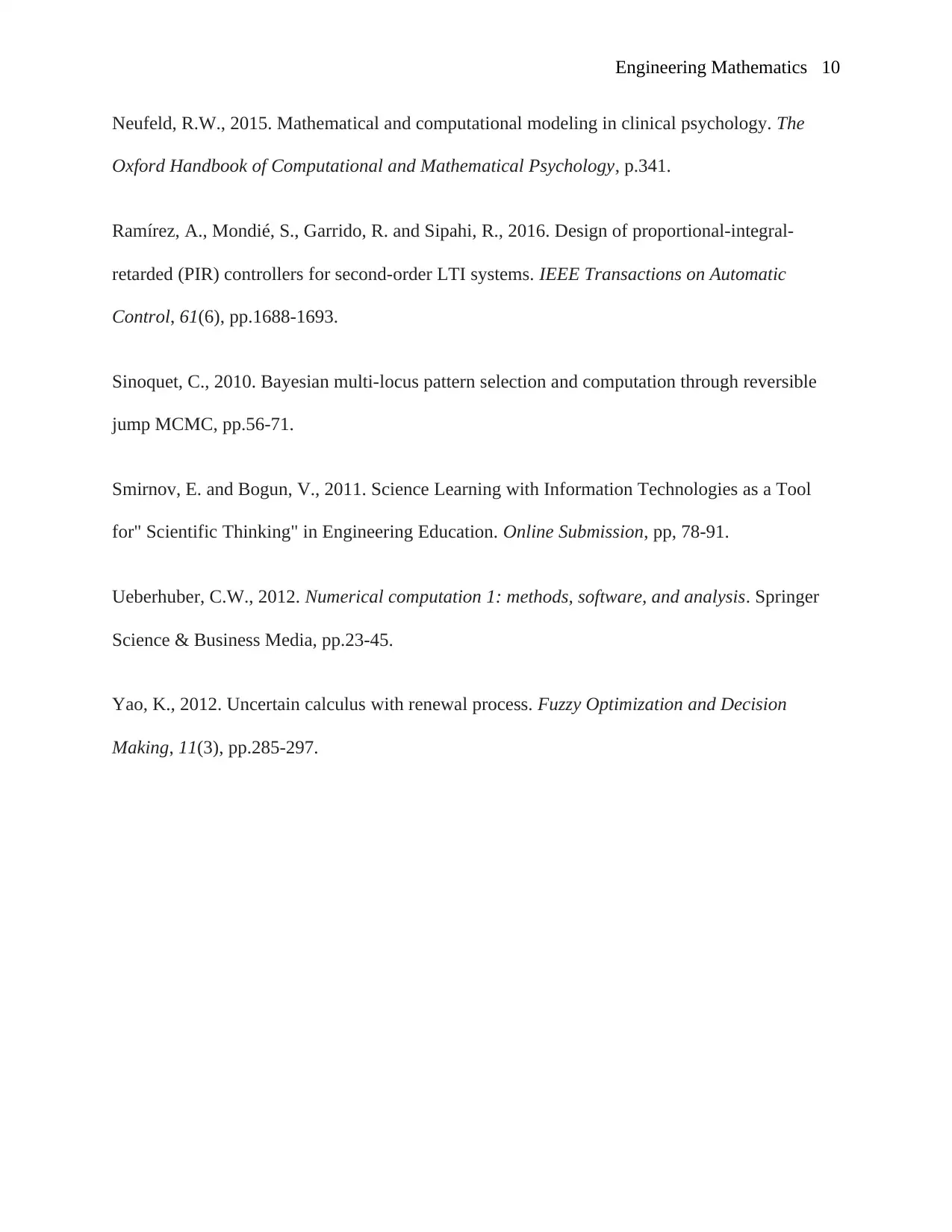
Neufeld, R.W., 2015. Mathematical and computational modeling in clinical psychology. The
Oxford Handbook of Computational and Mathematical Psychology, p.341.
Ramírez, A., Mondié, S., Garrido, R. and Sipahi, R., 2016. Design of proportional-integral-
retarded (PIR) controllers for second-order LTI systems. IEEE Transactions on Automatic
Control, 61(6), pp.1688-1693.
Sinoquet, C., 2010. Bayesian multi-locus pattern selection and computation through reversible
jump MCMC, pp.56-71.
Smirnov, E. and Bogun, V., 2011. Science Learning with Information Technologies as a Tool
for" Scientific Thinking" in Engineering Education. Online Submission, pp, 78-91.
Ueberhuber, C.W., 2012. Numerical computation 1: methods, software, and analysis. Springer
Science & Business Media, pp.23-45.
Yao, K., 2012. Uncertain calculus with renewal process. Fuzzy Optimization and Decision
Making, 11(3), pp.285-297.
Neufeld, R.W., 2015. Mathematical and computational modeling in clinical psychology. The
Oxford Handbook of Computational and Mathematical Psychology, p.341.
Ramírez, A., Mondié, S., Garrido, R. and Sipahi, R., 2016. Design of proportional-integral-
retarded (PIR) controllers for second-order LTI systems. IEEE Transactions on Automatic
Control, 61(6), pp.1688-1693.
Sinoquet, C., 2010. Bayesian multi-locus pattern selection and computation through reversible
jump MCMC, pp.56-71.
Smirnov, E. and Bogun, V., 2011. Science Learning with Information Technologies as a Tool
for" Scientific Thinking" in Engineering Education. Online Submission, pp, 78-91.
Ueberhuber, C.W., 2012. Numerical computation 1: methods, software, and analysis. Springer
Science & Business Media, pp.23-45.
Yao, K., 2012. Uncertain calculus with renewal process. Fuzzy Optimization and Decision
Making, 11(3), pp.285-297.

1 out of 10


Related Documents


Your All-in-One AI-Powered Toolkit for Academic Success.
+13062052269
info@desklib.com
Available 24*7 on WhatsApp / Email
![[object Object]](/_next/static/media/star-bottom.7253800d.svg)
Unlock your academic potential
Copyright © 2020–2026 A2Z Services. All Rights Reserved. Developed and managed by ZUCOL.