Critical Analysis: Children's Participation in Child Protection System
VerifiedAdded on 2023/01/17
|16
|4157
|33
Homework Assignment
AI Summary
This assignment critically analyzes a research article exploring children's participation in the child protection system in England. The study, based on qualitative methods, involved 26 children aged 6-17 years. It examines factors promoting children's involvement, the role of family members, and ethical considerations. The assignment reviews the research paradigm, methodology, and construction of children, including ethical considerations, children's voices, positioning of children, power relationships, and structural influences. The findings highlight children's understanding of the child protection process, the importance of trusting relationships with social workers, and the impact of structural influences on children's participation. The analysis also identifies strengths and limitations of the research, offering a comprehensive overview of the challenges and opportunities within the child protection system. The study found that while most children had some awareness of the process, there were varying levels of understanding and the importance of clear communication between social workers and the children involved. This analysis also highlights the importance of enhancing children's agency and power within the system, advocating for improved access to complaint mechanisms and independent advocacy services.
Running Head: ENGLISH
0
Children literature for literacy
6/6/2019
0
Children literature for literacy
6/6/2019

Paraphrase This Document
Need a fresh take? Get an instant paraphrase of this document with our AI Paraphraser
ENGLISH
1
Contents
Research paradigm................................................................................................................................2
Project Aim / Purpose............................................................................................................................2
Key research question............................................................................................................................2
Methodology & Methods in Research...................................................................................................3
Participants............................................................................................................................................3
Construction of children (including ethical considerations, children’s voice, positioning of children
and power relationships, and structural influences)...............................................................................3
Results / Outcomes................................................................................................................................5
Strengths & Limitations of research......................................................................................................6
References.............................................................................................................................................7
Appendix...............................................................................................................................................9
ASSESSMENT 3: CRITICAL ANALYSIS TEMPLATE................................................................................9
1
Contents
Research paradigm................................................................................................................................2
Project Aim / Purpose............................................................................................................................2
Key research question............................................................................................................................2
Methodology & Methods in Research...................................................................................................3
Participants............................................................................................................................................3
Construction of children (including ethical considerations, children’s voice, positioning of children
and power relationships, and structural influences)...............................................................................3
Results / Outcomes................................................................................................................................5
Strengths & Limitations of research......................................................................................................6
References.............................................................................................................................................7
Appendix...............................................................................................................................................9
ASSESSMENT 3: CRITICAL ANALYSIS TEMPLATE................................................................................9
ENGLISH
2
Research paradigm
A Research paradigm determines the research model or approach used to conduct the
research on a particular topic or issue, and which has been used over a period of time. The
research on the selected topic ‘Children rights’ will define fundamental rights available to
children in the community. Children rights refer to the human rights of the children, inclusive
of the rights in context to special protection, and care to the minors. There are twelve rights
to the children, which play an essential role contributing to their care in the society
(Whittaker, 2017).
The research paper presents a qualitative study of the article reviewed about the
children rights. The paper included information about 26 participants (children) regarding
human rights in context to the country England. Moreover, the research will also analyse the
issues that affect children rights, i.e. agency, positioning of children, relationships, and the
impact of structural influences. The role of the children is considered important in this
research, as their awareness in the child protection process, and their relationship with the
social workers will determine effectiveness of the social policies. Thus, the research paper
will show and explore the aspects of children rights and their participation in the children
protection system (Whittaker, 2017).
Project Aim / Purpose
The aim or purpose of the research paper, includes the assessment of the rights to the
children, aged between 6-17 years, and their role or participation in the children protection
system.
Key research question
1. What are the factors promoting the Children participation in the child protection system?
2. What is the essential role of the family members or parents supporting the children
rights?
2
Research paradigm
A Research paradigm determines the research model or approach used to conduct the
research on a particular topic or issue, and which has been used over a period of time. The
research on the selected topic ‘Children rights’ will define fundamental rights available to
children in the community. Children rights refer to the human rights of the children, inclusive
of the rights in context to special protection, and care to the minors. There are twelve rights
to the children, which play an essential role contributing to their care in the society
(Whittaker, 2017).
The research paper presents a qualitative study of the article reviewed about the
children rights. The paper included information about 26 participants (children) regarding
human rights in context to the country England. Moreover, the research will also analyse the
issues that affect children rights, i.e. agency, positioning of children, relationships, and the
impact of structural influences. The role of the children is considered important in this
research, as their awareness in the child protection process, and their relationship with the
social workers will determine effectiveness of the social policies. Thus, the research paper
will show and explore the aspects of children rights and their participation in the children
protection system (Whittaker, 2017).
Project Aim / Purpose
The aim or purpose of the research paper, includes the assessment of the rights to the
children, aged between 6-17 years, and their role or participation in the children protection
system.
Key research question
1. What are the factors promoting the Children participation in the child protection system?
2. What is the essential role of the family members or parents supporting the children
rights?
⊘ This is a preview!⊘
Do you want full access?
Subscribe today to unlock all pages.

Trusted by 1+ million students worldwide
ENGLISH
3
Methodology & Methods in Research
A qualitative study or method has been used in this research paper to analyse the
experiences of the children through their involvement in the child protection system. In this
study, young people were also involved, i.e. in the research commissioning process, as they
form a major part of the group. Qualitative research is a scientific method of observation to
collect the non-numerical data, and it includes the definitions, meanings, and the concepts of
the topic, ‘Children rights’. The study through the qualitative method has resulted
determining the extent to which, children participated in the process of participation system.
A plan was included as a part of the study in this research on the children rights (Berrick et
al., 2015).
Participants
The study included the participants or children between the age-group of 6-17 years
in context to the given country.
Construction of children (including ethical considerations, children’s voice,
positioning of children and power relationships, and structural influences)
The research paper on the topic, ‘children rights’ describes the views and
perspectives of the children and their participation in their protection. the concept of
protecting the human rights of the children includes several aspects or themes, such as ethics,
children’s voice, the positioning of children, and the power relationships. One of the main
ethical consideration in this study included the children’s tie or relationship with their
parents. It acts as major ethical concern for the professionals to achieve the right balance of
involving them in the social relationships with the people in community. Here, the ethical
consideration also included the participants from two different regions and it was ethically
approved by the committees and the agencies involved in the conduct of research. the
authors also stated that the method of ‘interview’ represented the base of analysis. As the
majority of the discussions and interviews took place at the children homes, and they were
given the right to speak about the things they do not want to discuss. it means the author
3
Methodology & Methods in Research
A qualitative study or method has been used in this research paper to analyse the
experiences of the children through their involvement in the child protection system. In this
study, young people were also involved, i.e. in the research commissioning process, as they
form a major part of the group. Qualitative research is a scientific method of observation to
collect the non-numerical data, and it includes the definitions, meanings, and the concepts of
the topic, ‘Children rights’. The study through the qualitative method has resulted
determining the extent to which, children participated in the process of participation system.
A plan was included as a part of the study in this research on the children rights (Berrick et
al., 2015).
Participants
The study included the participants or children between the age-group of 6-17 years
in context to the given country.
Construction of children (including ethical considerations, children’s voice,
positioning of children and power relationships, and structural influences)
The research paper on the topic, ‘children rights’ describes the views and
perspectives of the children and their participation in their protection. the concept of
protecting the human rights of the children includes several aspects or themes, such as ethics,
children’s voice, the positioning of children, and the power relationships. One of the main
ethical consideration in this study included the children’s tie or relationship with their
parents. It acts as major ethical concern for the professionals to achieve the right balance of
involving them in the social relationships with the people in community. Here, the ethical
consideration also included the participants from two different regions and it was ethically
approved by the committees and the agencies involved in the conduct of research. the
authors also stated that the method of ‘interview’ represented the base of analysis. As the
majority of the discussions and interviews took place at the children homes, and they were
given the right to speak about the things they do not want to discuss. it means the author
Paraphrase This Document
Need a fresh take? Get an instant paraphrase of this document with our AI Paraphraser
ENGLISH
4
stated that ‘children voice’ is considered important in the study or protection of human rights
(Harriss, MacSween & Atkinson, 2017).
However, through this article the authors and several other researchers stated that the
aspect of children positioning. It has been found that amongst the role of social workers,
parents and child, the child does not hold maximum power or position in the society. The
adult professional judgement is one major criterion that analyses the extent of the child
participating in the protection. Therefore, one major issue has been highlighted by the
people conducting research on the study, i.e. positioning of the children within society
(Keddell, 2015).
To enhance their position or power in the society and at their homes, some major
improvements can be done. These include enhancing the access to the children for lodging or
placing the complaints and problems faced by them in the procedures of the system. Heimer,
Näsman & Palme (2018), mentioned that, the advisory committee in the region also state the
major change in terms of increasing the independent advocacy services. From the study
conducted on the essence of the children contribution in their own protection, the quality of
‘relationship’ acts as the vital factor. Children who are able to communicate with the social
workers or other community members, they as they should first identify and take into
account the age of the child and understanding level of the child while making judgements
about them for their participation (Bartlett et al., 2016).
The authors, in the study also described the aspect of the trusting relationships or
power relationships with the social workers. This stated that the social workers and the
people in the community has the right or power to undertake the decisions for these children.
the role of power relationship is important to these children, as it raises their confidence, and
boost their self-efficacy to participate in the process.
Caputo (2017), stated that, a less trusting relationship of these children with the social
workers or community members will take away the opportunity to express the feelings or
issues related to them. One major factor that undermines the quality of the relationship of the
children with the social worker is the awareness in the child in context to any information or
data obtained from other resources. Therefore, it is an important responsibility of the social
worker to provide them information related to the process of children protection. Besides,
this the researchers identified many structural influences related to the children participation
4
stated that ‘children voice’ is considered important in the study or protection of human rights
(Harriss, MacSween & Atkinson, 2017).
However, through this article the authors and several other researchers stated that the
aspect of children positioning. It has been found that amongst the role of social workers,
parents and child, the child does not hold maximum power or position in the society. The
adult professional judgement is one major criterion that analyses the extent of the child
participating in the protection. Therefore, one major issue has been highlighted by the
people conducting research on the study, i.e. positioning of the children within society
(Keddell, 2015).
To enhance their position or power in the society and at their homes, some major
improvements can be done. These include enhancing the access to the children for lodging or
placing the complaints and problems faced by them in the procedures of the system. Heimer,
Näsman & Palme (2018), mentioned that, the advisory committee in the region also state the
major change in terms of increasing the independent advocacy services. From the study
conducted on the essence of the children contribution in their own protection, the quality of
‘relationship’ acts as the vital factor. Children who are able to communicate with the social
workers or other community members, they as they should first identify and take into
account the age of the child and understanding level of the child while making judgements
about them for their participation (Bartlett et al., 2016).
The authors, in the study also described the aspect of the trusting relationships or
power relationships with the social workers. This stated that the social workers and the
people in the community has the right or power to undertake the decisions for these children.
the role of power relationship is important to these children, as it raises their confidence, and
boost their self-efficacy to participate in the process.
Caputo (2017), stated that, a less trusting relationship of these children with the social
workers or community members will take away the opportunity to express the feelings or
issues related to them. One major factor that undermines the quality of the relationship of the
children with the social worker is the awareness in the child in context to any information or
data obtained from other resources. Therefore, it is an important responsibility of the social
worker to provide them information related to the process of children protection. Besides,
this the researchers identified many structural influences related to the children participation
ENGLISH
5
in the process. The aspect of structural influences consist of the perception of the
community participations, important role of the support systems, agencies, and the
government bodies. The structural influence has been identified as major issue, as the agency
identified in the study six families, which were not a part of the process of participation due
to the issues related to social workers. As further, the researchers also argued that the
children must be allowed for participating, in the process before acquiring the parental
consent. This will further improve the study, and lead to betterment of the process of the
child protection in context to the human rights across different regions (Livingstone & Third,
2017).
Results / Outcomes
The study conducted by the researchers or authors in the analysis of the children
rights, led to the results stating the understanding level with respect to the children
participation. Less understanding was observed in the children aged less than 10, they had
partial understanding or awareness about the result of participation. Moreover, from the
study conducted on making the children aware about 12 rights, available to them, only six
were fully aware, or concerned about preserving their rights (Phillips, 2016).
The outcome or result of the study conducted on several groups of children,
determined that least of the children were aware of the process of child protection. In
addition, they were analyzing the aspect of the intervention of their parents, to support their
protection. The research findings also mentioned that, thirteen of these children represented
sound relationship with the social workers, and six did not, leading to emergence of issues.
Remaining five children gave mixed response regarding the effectiveness of their relation
with the social workers. Some of the children in the process of interview, felt annoyed or
irritated because of the same old questions asked multiple times. The research findings also
explained the aspect, that older people or children in the later years were ,more capable of
understanding and involving in the child protection process. Hence, it has been found that
the social workers or community members across the country must assure and enhance the
participation of the children in the protection process (Austin, 2016).
5
in the process. The aspect of structural influences consist of the perception of the
community participations, important role of the support systems, agencies, and the
government bodies. The structural influence has been identified as major issue, as the agency
identified in the study six families, which were not a part of the process of participation due
to the issues related to social workers. As further, the researchers also argued that the
children must be allowed for participating, in the process before acquiring the parental
consent. This will further improve the study, and lead to betterment of the process of the
child protection in context to the human rights across different regions (Livingstone & Third,
2017).
Results / Outcomes
The study conducted by the researchers or authors in the analysis of the children
rights, led to the results stating the understanding level with respect to the children
participation. Less understanding was observed in the children aged less than 10, they had
partial understanding or awareness about the result of participation. Moreover, from the
study conducted on making the children aware about 12 rights, available to them, only six
were fully aware, or concerned about preserving their rights (Phillips, 2016).
The outcome or result of the study conducted on several groups of children,
determined that least of the children were aware of the process of child protection. In
addition, they were analyzing the aspect of the intervention of their parents, to support their
protection. The research findings also mentioned that, thirteen of these children represented
sound relationship with the social workers, and six did not, leading to emergence of issues.
Remaining five children gave mixed response regarding the effectiveness of their relation
with the social workers. Some of the children in the process of interview, felt annoyed or
irritated because of the same old questions asked multiple times. The research findings also
explained the aspect, that older people or children in the later years were ,more capable of
understanding and involving in the child protection process. Hence, it has been found that
the social workers or community members across the country must assure and enhance the
participation of the children in the protection process (Austin, 2016).
⊘ This is a preview!⊘
Do you want full access?
Subscribe today to unlock all pages.
Trusted by 1+ million students worldwide
ENGLISH
6
Strengths & Limitations of research
One of the major limitation of the study conducted exploring the children rights, lacks
an in-depth analysis, and it does not cover all the factors affecting their participation in the
system.
Second limitation of the study on the children rights, does not include the analysis of
the children rights in every part or region of the country. It studies the aspect of children
rights in the overall country, that it conducts a study on a wider level. This often lacks the
determination of the children rights in other parts, and only on few, i.e. 26 children.
Moreover, the study lacks in defining the role and relationships of the children with the social
workers in the system. The perspective of the research paper does not provided proper
information on the two groups of children in the study, and their participation in protection of
the rights. The children aged less than 6 years, were provided a little information to them
related to their rights and their protection in the system. Thus, these acts as major
disadvantages or limitations of the study, which should be undertaken and resolved to lead
betterment in the growth and development of children within society.
6
Strengths & Limitations of research
One of the major limitation of the study conducted exploring the children rights, lacks
an in-depth analysis, and it does not cover all the factors affecting their participation in the
system.
Second limitation of the study on the children rights, does not include the analysis of
the children rights in every part or region of the country. It studies the aspect of children
rights in the overall country, that it conducts a study on a wider level. This often lacks the
determination of the children rights in other parts, and only on few, i.e. 26 children.
Moreover, the study lacks in defining the role and relationships of the children with the social
workers in the system. The perspective of the research paper does not provided proper
information on the two groups of children in the study, and their participation in protection of
the rights. The children aged less than 6 years, were provided a little information to them
related to their rights and their protection in the system. Thus, these acts as major
disadvantages or limitations of the study, which should be undertaken and resolved to lead
betterment in the growth and development of children within society.
Paraphrase This Document
Need a fresh take? Get an instant paraphrase of this document with our AI Paraphraser
ENGLISH
7
References
Austin, M. W. (2016). Conceptions of parenthood: ethics and the family. United Kingdom:
Routledge.
Bartlett, S., Hart, R., Satterthwaite, D., de la Barra, X. & Missair, A. (2016). Cities for
children: children's rights, poverty and urban management. United Kingdom:
Routledge.
Berrick, J. D., Dickens, J., Pösö, T. & Skivenes, M. (2015). Children's involvement in care
order decision-making: A cross-country analysis. Child abuse & neglect, 49, 128-
141.
Caputo, V. (2017). Children’s participation and protection in a globalised world: reimagining
‘too young to wed’ through a cultural politics of childhood. The International Journal
of Human Rights, 21(1), 76-88.
Cossar, J., Brandon, M. & Jordan, P. (2016). ‘You've got to trust her and she's got to trust
you’: children's views on participation in the child protection system. Child & Family
Social Work, 21(1), 103-112.
Freeman, M. (2017). The value and values of children’s rights. In Children's Rights (pp. 91-
106). United Kingdom: Routledge.
Harriss, D. J., MacSween, A. & Atkinson, G. (2017). Standards for ethics in sport and
exercise science research: 2018 update. International journal of sports medicine,
38(14), 1126-1131.
Heimer, M., Näsman, E. & Palme, J. (2018). Vulnerable children's rights to participation,
protection, and provision: The process of defining the problem in Swedish child and
family welfare. Child & Family Social Work, 23(2), 316-323.
Keddell, E. (2015). The ethics of predictive risk modelling in the Aotearoa/New Zealand
child welfare context: Child abuse prevention or neo-liberal tool?. Critical Social
Policy, 35(1), 69-88.
Livingstone, S. & Third, A. (2017). Children and young people’s rights in the digital age: An
emerging agenda.
7
References
Austin, M. W. (2016). Conceptions of parenthood: ethics and the family. United Kingdom:
Routledge.
Bartlett, S., Hart, R., Satterthwaite, D., de la Barra, X. & Missair, A. (2016). Cities for
children: children's rights, poverty and urban management. United Kingdom:
Routledge.
Berrick, J. D., Dickens, J., Pösö, T. & Skivenes, M. (2015). Children's involvement in care
order decision-making: A cross-country analysis. Child abuse & neglect, 49, 128-
141.
Caputo, V. (2017). Children’s participation and protection in a globalised world: reimagining
‘too young to wed’ through a cultural politics of childhood. The International Journal
of Human Rights, 21(1), 76-88.
Cossar, J., Brandon, M. & Jordan, P. (2016). ‘You've got to trust her and she's got to trust
you’: children's views on participation in the child protection system. Child & Family
Social Work, 21(1), 103-112.
Freeman, M. (2017). The value and values of children’s rights. In Children's Rights (pp. 91-
106). United Kingdom: Routledge.
Harriss, D. J., MacSween, A. & Atkinson, G. (2017). Standards for ethics in sport and
exercise science research: 2018 update. International journal of sports medicine,
38(14), 1126-1131.
Heimer, M., Näsman, E. & Palme, J. (2018). Vulnerable children's rights to participation,
protection, and provision: The process of defining the problem in Swedish child and
family welfare. Child & Family Social Work, 23(2), 316-323.
Keddell, E. (2015). The ethics of predictive risk modelling in the Aotearoa/New Zealand
child welfare context: Child abuse prevention or neo-liberal tool?. Critical Social
Policy, 35(1), 69-88.
Livingstone, S. & Third, A. (2017). Children and young people’s rights in the digital age: An
emerging agenda.
ENGLISH
8
Phillips, L. G. (2016). Educating children and young people on the UNCRC: Actions,
avoidance and awakenings. Children’s Rights, Educational Research and the
UNCRC, 39-59.
Whittaker, J. K. (2017). The child welfare challenge: Policy, practice, and research. United
Kingdom: Routledge.
8
Phillips, L. G. (2016). Educating children and young people on the UNCRC: Actions,
avoidance and awakenings. Children’s Rights, Educational Research and the
UNCRC, 39-59.
Whittaker, J. K. (2017). The child welfare challenge: Policy, practice, and research. United
Kingdom: Routledge.
⊘ This is a preview!⊘
Do you want full access?
Subscribe today to unlock all pages.
Trusted by 1+ million students worldwide
ENGLISH
9
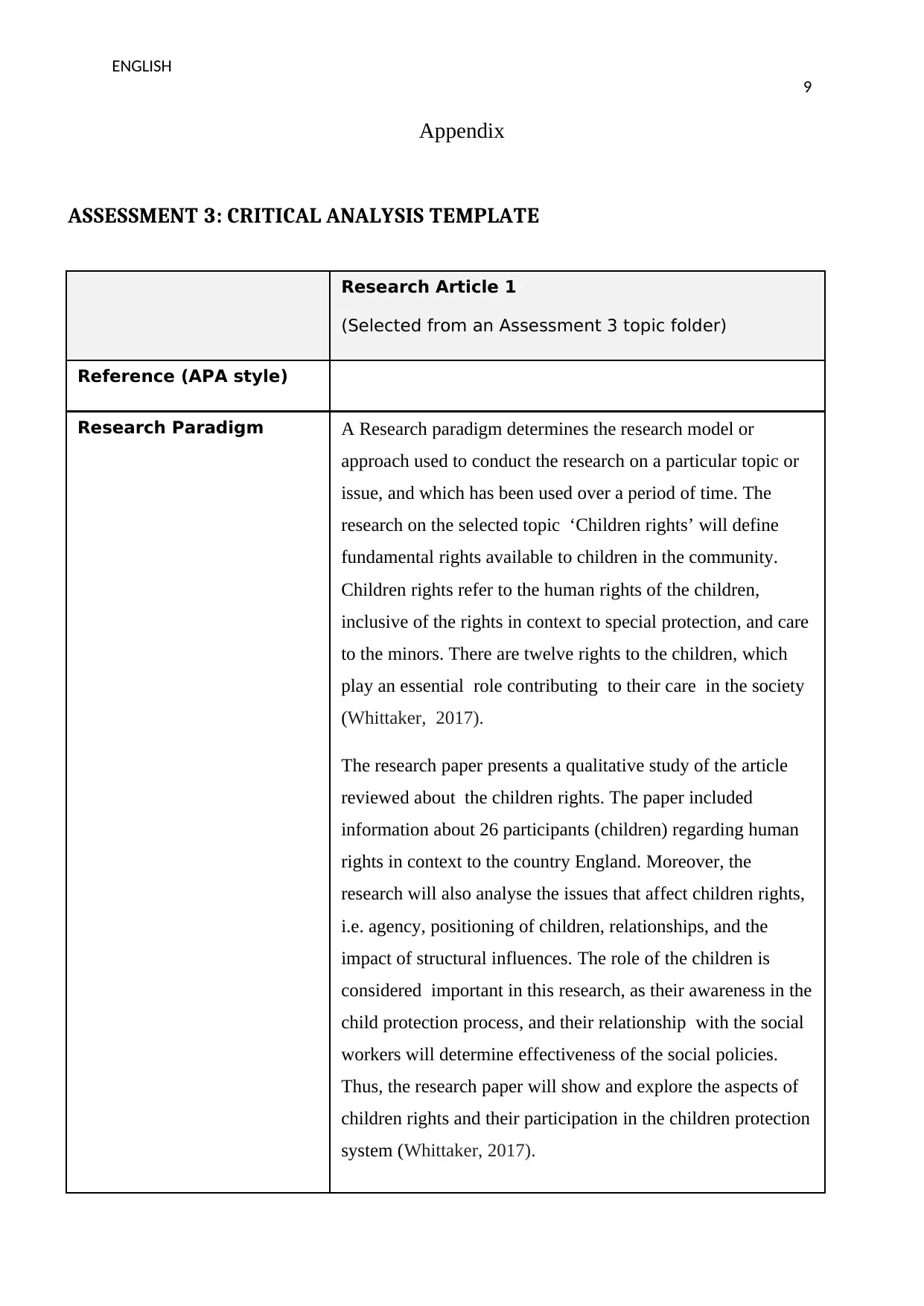
Appendix
ASSESSMENT 3: CRITICAL ANALYSIS TEMPLATE
Research Article 1
(Selected from an Assessment 3 topic folder)
Reference (APA style)
Research Paradigm A Research paradigm determines the research model or
approach used to conduct the research on a particular topic or
issue, and which has been used over a period of time. The
research on the selected topic ‘Children rights’ will define
fundamental rights available to children in the community.
Children rights refer to the human rights of the children,
inclusive of the rights in context to special protection, and care
to the minors. There are twelve rights to the children, which
play an essential role contributing to their care in the society
(Whittaker, 2017).
The research paper presents a qualitative study of the article
reviewed about the children rights. The paper included
information about 26 participants (children) regarding human
rights in context to the country England. Moreover, the
research will also analyse the issues that affect children rights,
i.e. agency, positioning of children, relationships, and the
impact of structural influences. The role of the children is
considered important in this research, as their awareness in the
child protection process, and their relationship with the social
workers will determine effectiveness of the social policies.
Thus, the research paper will show and explore the aspects of
children rights and their participation in the children protection
system (Whittaker, 2017).
9
Appendix
ASSESSMENT 3: CRITICAL ANALYSIS TEMPLATE
Research Article 1
(Selected from an Assessment 3 topic folder)
Reference (APA style)
Research Paradigm A Research paradigm determines the research model or
approach used to conduct the research on a particular topic or
issue, and which has been used over a period of time. The
research on the selected topic ‘Children rights’ will define
fundamental rights available to children in the community.
Children rights refer to the human rights of the children,
inclusive of the rights in context to special protection, and care
to the minors. There are twelve rights to the children, which
play an essential role contributing to their care in the society
(Whittaker, 2017).
The research paper presents a qualitative study of the article
reviewed about the children rights. The paper included
information about 26 participants (children) regarding human
rights in context to the country England. Moreover, the
research will also analyse the issues that affect children rights,
i.e. agency, positioning of children, relationships, and the
impact of structural influences. The role of the children is
considered important in this research, as their awareness in the
child protection process, and their relationship with the social
workers will determine effectiveness of the social policies.
Thus, the research paper will show and explore the aspects of
children rights and their participation in the children protection
system (Whittaker, 2017).
Paraphrase This Document
Need a fresh take? Get an instant paraphrase of this document with our AI Paraphraser
ENGLISH
10
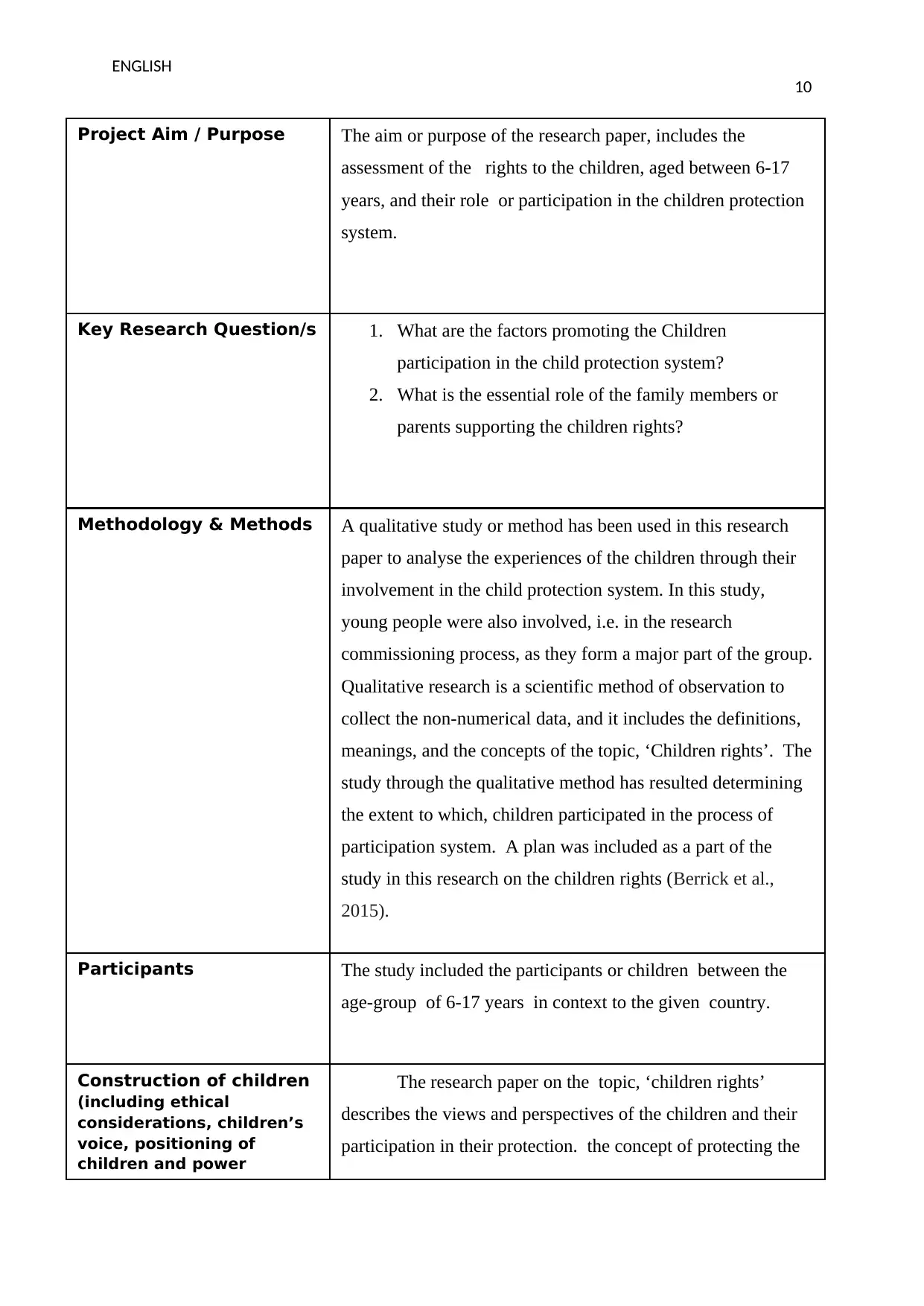
Project Aim / Purpose The aim or purpose of the research paper, includes the
assessment of the rights to the children, aged between 6-17
years, and their role or participation in the children protection
system.
Key Research Question/s 1. What are the factors promoting the Children
participation in the child protection system?
2. What is the essential role of the family members or
parents supporting the children rights?
Methodology & Methods A qualitative study or method has been used in this research
paper to analyse the experiences of the children through their
involvement in the child protection system. In this study,
young people were also involved, i.e. in the research
commissioning process, as they form a major part of the group.
Qualitative research is a scientific method of observation to
collect the non-numerical data, and it includes the definitions,
meanings, and the concepts of the topic, ‘Children rights’. The
study through the qualitative method has resulted determining
the extent to which, children participated in the process of
participation system. A plan was included as a part of the
study in this research on the children rights (Berrick et al.,
2015).
Participants The study included the participants or children between the
age-group of 6-17 years in context to the given country.
Construction of children
(including ethical
considerations, children’s
voice, positioning of
children and power
The research paper on the topic, ‘children rights’
describes the views and perspectives of the children and their
participation in their protection. the concept of protecting the
10
Project Aim / Purpose The aim or purpose of the research paper, includes the
assessment of the rights to the children, aged between 6-17
years, and their role or participation in the children protection
system.
Key Research Question/s 1. What are the factors promoting the Children
participation in the child protection system?
2. What is the essential role of the family members or
parents supporting the children rights?
Methodology & Methods A qualitative study or method has been used in this research
paper to analyse the experiences of the children through their
involvement in the child protection system. In this study,
young people were also involved, i.e. in the research
commissioning process, as they form a major part of the group.
Qualitative research is a scientific method of observation to
collect the non-numerical data, and it includes the definitions,
meanings, and the concepts of the topic, ‘Children rights’. The
study through the qualitative method has resulted determining
the extent to which, children participated in the process of
participation system. A plan was included as a part of the
study in this research on the children rights (Berrick et al.,
2015).
Participants The study included the participants or children between the
age-group of 6-17 years in context to the given country.
Construction of children
(including ethical
considerations, children’s
voice, positioning of
children and power
The research paper on the topic, ‘children rights’
describes the views and perspectives of the children and their
participation in their protection. the concept of protecting the
ENGLISH
11
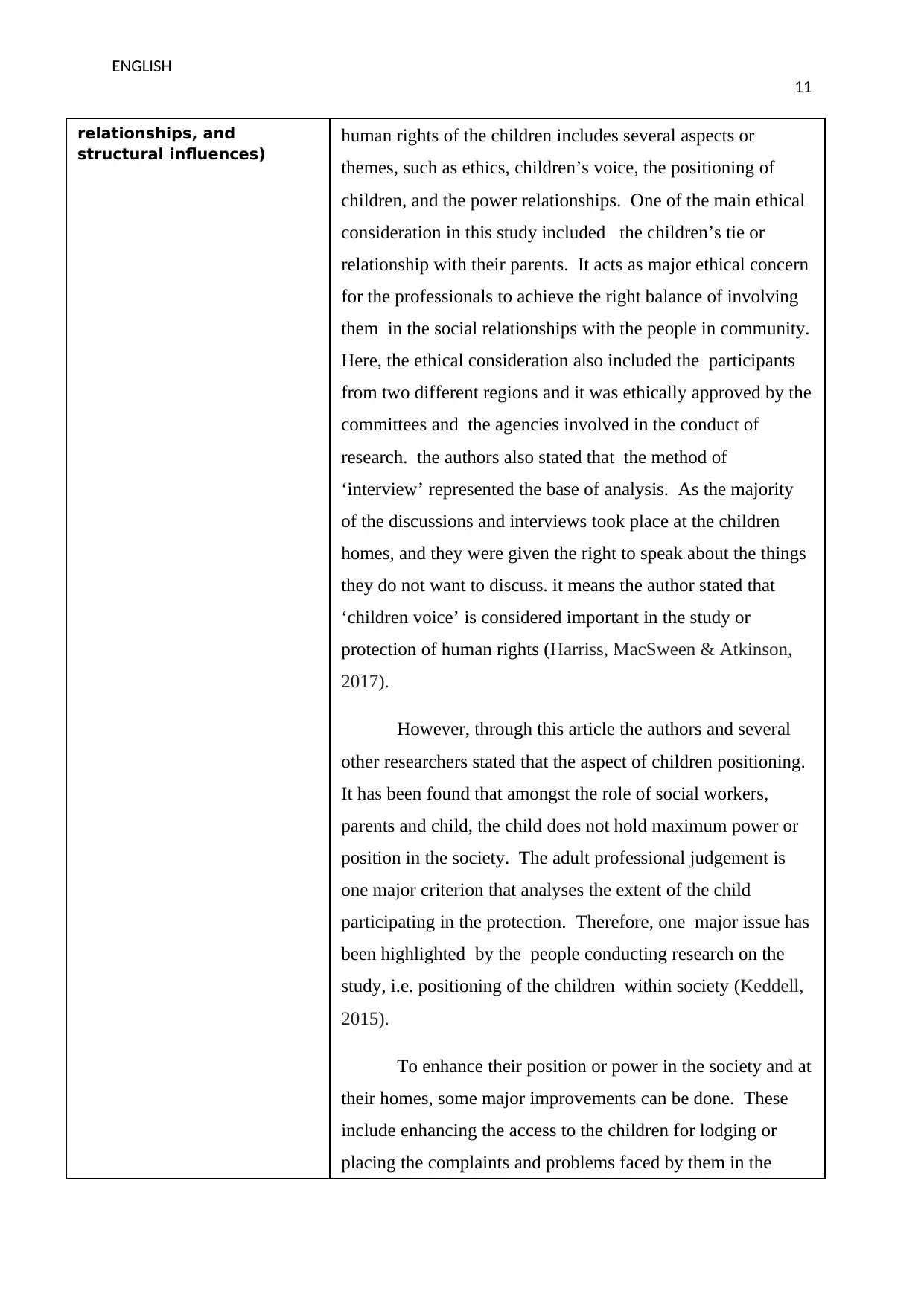
relationships, and
structural influences)
human rights of the children includes several aspects or
themes, such as ethics, children’s voice, the positioning of
children, and the power relationships. One of the main ethical
consideration in this study included the children’s tie or
relationship with their parents. It acts as major ethical concern
for the professionals to achieve the right balance of involving
them in the social relationships with the people in community.
Here, the ethical consideration also included the participants
from two different regions and it was ethically approved by the
committees and the agencies involved in the conduct of
research. the authors also stated that the method of
‘interview’ represented the base of analysis. As the majority
of the discussions and interviews took place at the children
homes, and they were given the right to speak about the things
they do not want to discuss. it means the author stated that
‘children voice’ is considered important in the study or
protection of human rights (Harriss, MacSween & Atkinson,
2017).
However, through this article the authors and several
other researchers stated that the aspect of children positioning.
It has been found that amongst the role of social workers,
parents and child, the child does not hold maximum power or
position in the society. The adult professional judgement is
one major criterion that analyses the extent of the child
participating in the protection. Therefore, one major issue has
been highlighted by the people conducting research on the
study, i.e. positioning of the children within society (Keddell,
2015).
To enhance their position or power in the society and at
their homes, some major improvements can be done. These
include enhancing the access to the children for lodging or
placing the complaints and problems faced by them in the
11
relationships, and
structural influences)
human rights of the children includes several aspects or
themes, such as ethics, children’s voice, the positioning of
children, and the power relationships. One of the main ethical
consideration in this study included the children’s tie or
relationship with their parents. It acts as major ethical concern
for the professionals to achieve the right balance of involving
them in the social relationships with the people in community.
Here, the ethical consideration also included the participants
from two different regions and it was ethically approved by the
committees and the agencies involved in the conduct of
research. the authors also stated that the method of
‘interview’ represented the base of analysis. As the majority
of the discussions and interviews took place at the children
homes, and they were given the right to speak about the things
they do not want to discuss. it means the author stated that
‘children voice’ is considered important in the study or
protection of human rights (Harriss, MacSween & Atkinson,
2017).
However, through this article the authors and several
other researchers stated that the aspect of children positioning.
It has been found that amongst the role of social workers,
parents and child, the child does not hold maximum power or
position in the society. The adult professional judgement is
one major criterion that analyses the extent of the child
participating in the protection. Therefore, one major issue has
been highlighted by the people conducting research on the
study, i.e. positioning of the children within society (Keddell,
2015).
To enhance their position or power in the society and at
their homes, some major improvements can be done. These
include enhancing the access to the children for lodging or
placing the complaints and problems faced by them in the
⊘ This is a preview!⊘
Do you want full access?
Subscribe today to unlock all pages.
Trusted by 1+ million students worldwide

1 out of 16


Related Documents


Your All-in-One AI-Powered Toolkit for Academic Success.
+13062052269
info@desklib.com
Available 24*7 on WhatsApp / Email
![[object Object]](/_next/static/media/star-bottom.7253800d.svg)
Unlock your academic potential
Copyright © 2020–2026 A2Z Services. All Rights Reserved. Developed and managed by ZUCOL.