The Poem 'Elder': Analysis of Indigenous Voices in Saskatchewan

Verified

Added on  2022/08/10

|4
|601
|439
Essay
AI Summary
This essay provides an in-depth analysis of the poem 'Elder,' focusing on the experiences and voices of the indigenous people in Saskatchewan, Canada. The poem, part of the collection 'Kisiskaciwan,' highlights the struggles of the Cree people and their resistance to oppression. The essay examines the themes of unity, peace, and the importance of preserving cultural identity. It explores the historical context of the First Nations and the impact of social segregation. The poem emphasizes the importance of the Cree people's connection to their elders, who serve as knowledge keepers. The analysis considers the poem's message of defiance against oppression and the quest for love, peace, and wellness within the indigenous community. The essay emphasizes the significance of the poem in reflecting the voices of the indigenous people and their pursuit of equality and freedom.
Document Page
Running head: ENGLISH
English
Name of the Student
Name of the University
Author Note
tabler-icon-diamond-filled.svg

Paraphrase This Document

Need a fresh take? Get an instant paraphrase of this document with our AI Paraphraser
Document Page
1ENGLISH
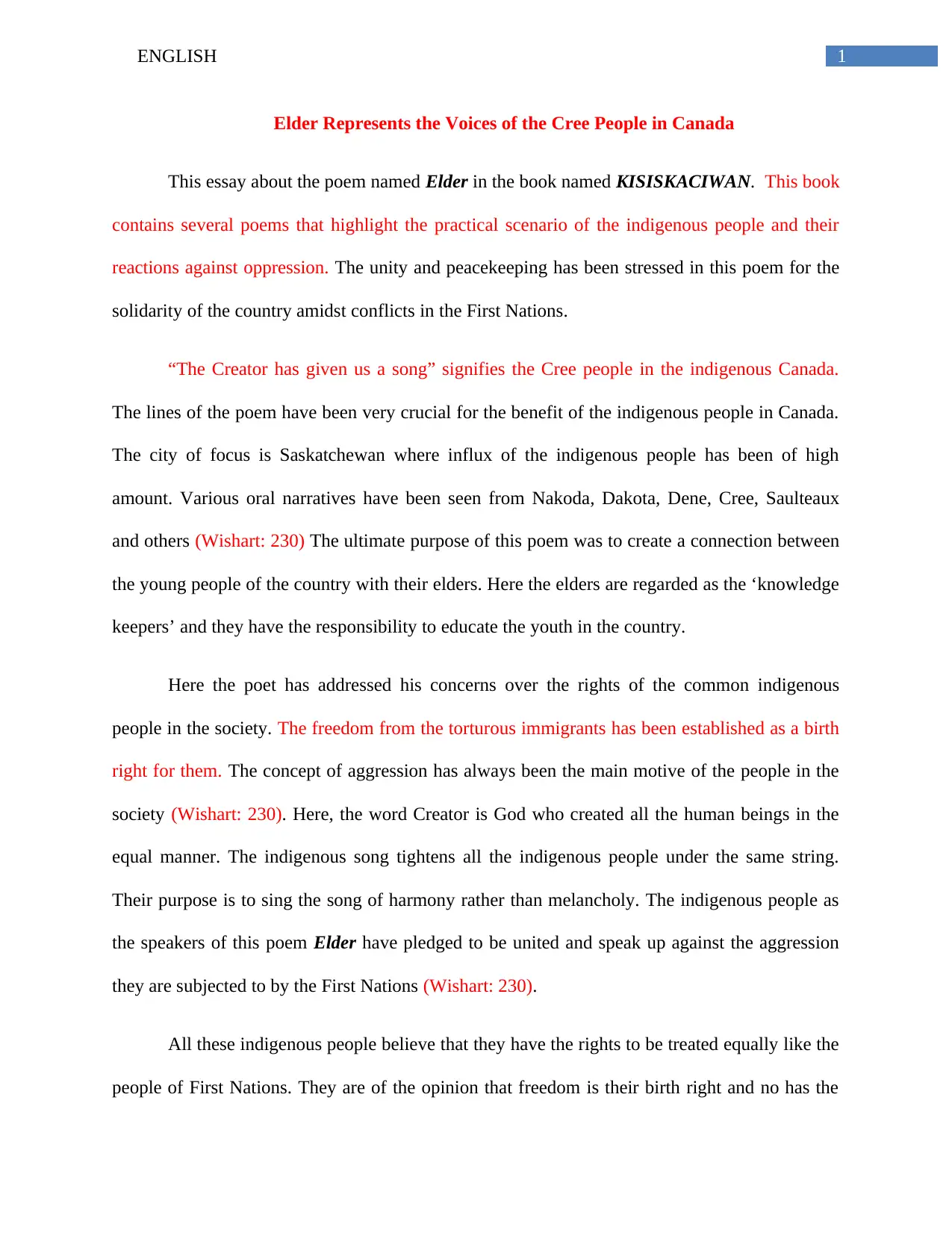
Elder Represents the Voices of the Cree People in Canada
This essay about the poem named Elder in the book named KISISKACIWAN. This book
contains several poems that highlight the practical scenario of the indigenous people and their
reactions against oppression. The unity and peacekeeping has been stressed in this poem for the
solidarity of the country amidst conflicts in the First Nations.
“The Creator has given us a song” signifies the Cree people in the indigenous Canada.
The lines of the poem have been very crucial for the benefit of the indigenous people in Canada.
The city of focus is Saskatchewan where influx of the indigenous people has been of high
amount. Various oral narratives have been seen from Nakoda, Dakota, Dene, Cree, Saulteaux
and others (Wishart: 230) The ultimate purpose of this poem was to create a connection between
the young people of the country with their elders. Here the elders are regarded as the ‘knowledge
keepers’ and they have the responsibility to educate the youth in the country.
Here the poet has addressed his concerns over the rights of the common indigenous
people in the society. The freedom from the torturous immigrants has been established as a birth
right for them. The concept of aggression has always been the main motive of the people in the
society (Wishart: 230). Here, the word Creator is God who created all the human beings in the
equal manner. The indigenous song tightens all the indigenous people under the same string.
Their purpose is to sing the song of harmony rather than melancholy. The indigenous people as
the speakers of this poem Elder have pledged to be united and speak up against the aggression
they are subjected to by the First Nations (Wishart: 230).
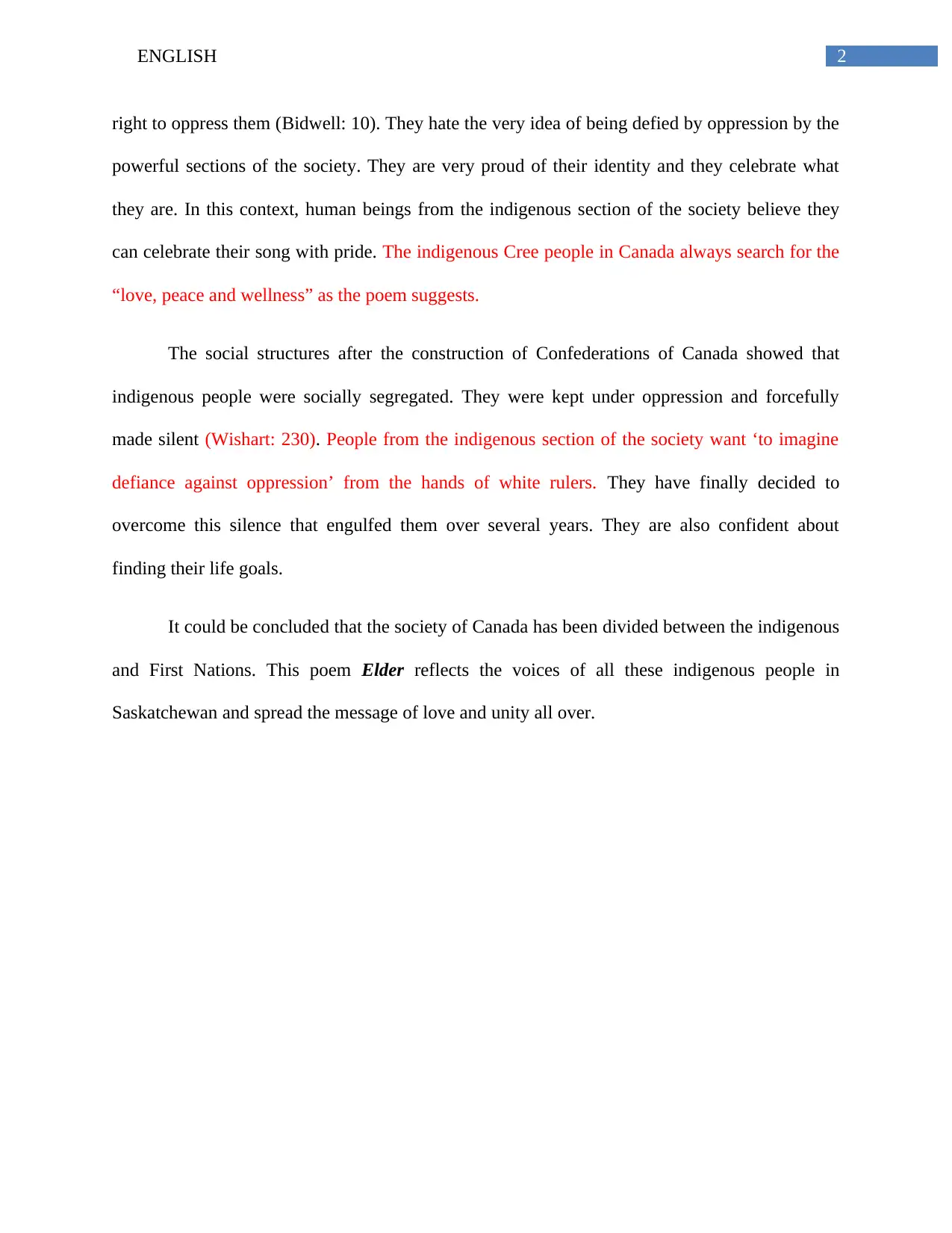
All these indigenous people believe that they have the rights to be treated equally like the
people of First Nations. They are of the opinion that freedom is their birth right and no has the
Document Page
2ENGLISH
right to oppress them (Bidwell: 10). They hate the very idea of being defied by oppression by the
powerful sections of the society. They are very proud of their identity and they celebrate what
they are. In this context, human beings from the indigenous section of the society believe they
can celebrate their song with pride. The indigenous Cree people in Canada always search for the
“love, peace and wellness” as the poem suggests.
The social structures after the construction of Confederations of Canada showed that
indigenous people were socially segregated. They were kept under oppression and forcefully
made silent (Wishart: 230). People from the indigenous section of the society want ‘to imagine
defiance against oppression’ from the hands of white rulers. They have finally decided to
overcome this silence that engulfed them over several years. They are also confident about
finding their life goals.
It could be concluded that the society of Canada has been divided between the indigenous
and First Nations. This poem Elder reflects the voices of all these indigenous people in
Saskatchewan and spread the message of love and unity all over.
Document Page
3ENGLISH
References
Wishart, Vern. Kisiskaciwan (Saskatchewan). 2012.
chevron_up_icon
1 out of 4
circle_padding
hide_on_mobile
zoom_out_icon
[object Object]