Evaluating Historical Naming Conventions and Modern Calls for Renaming
VerifiedAdded on 2020/05/16
|8
|1753
|350
AI Summary
The assignment focuses on examining the ethical considerations involved in renaming public institutions named after controversial historical figures. By analyzing Regina Rini's arguments and perspectives, students will explore how historical context, societal values, and cultural heritage intersect with contemporary demands for social justice and accountability. The analysis will involve evaluating both sides of the debate: the need to address past injustices and the implications of erasing or altering historical memory. Students are encouraged to consider specific case studies mentioned in the article, such as institutions named after figures like Ben Tillman and Robert E. Lee, and discuss broader societal impacts. Ultimately, this assignment aims to foster critical thinking about how societies should navigate their complex histories while striving for a more equitable future.
Running head: ENGLISH LITERATURE
ENGLISH LITERATURE
Name of Student
Name of University
Author note:
ENGLISH LITERATURE
Name of Student
Name of University
Author note:

Paraphrase This Document
Need a fresh take? Get an instant paraphrase of this document with our AI Paraphraser
1ENGLISH LITERATURE
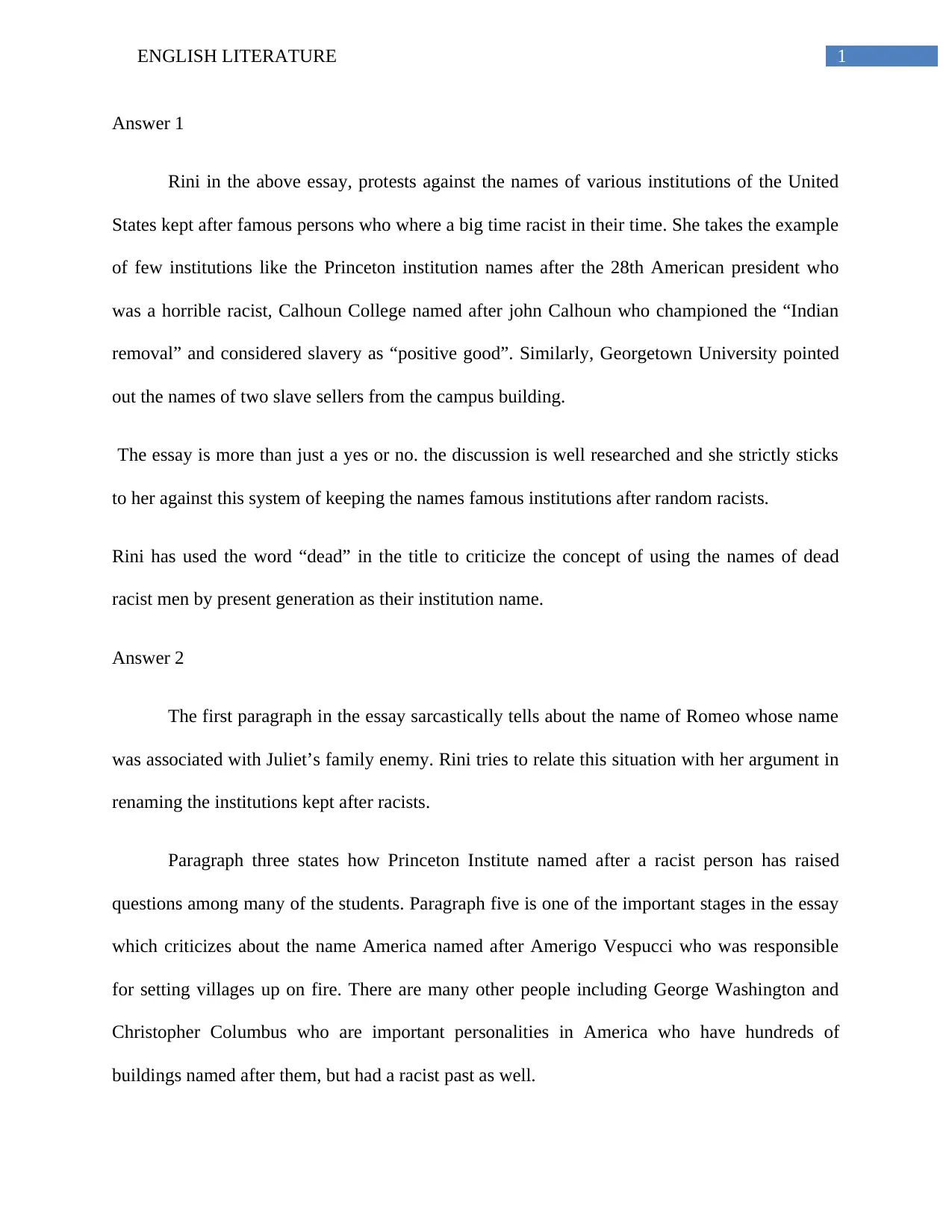
Answer 1
Rini in the above essay, protests against the names of various institutions of the United
States kept after famous persons who where a big time racist in their time. She takes the example
of few institutions like the Princeton institution names after the 28th American president who
was a horrible racist, Calhoun College named after john Calhoun who championed the “Indian
removal” and considered slavery as “positive good”. Similarly, Georgetown University pointed
out the names of two slave sellers from the campus building.
The essay is more than just a yes or no. the discussion is well researched and she strictly sticks
to her against this system of keeping the names famous institutions after random racists.
Rini has used the word “dead” in the title to criticize the concept of using the names of dead
racist men by present generation as their institution name.
Answer 2
The first paragraph in the essay sarcastically tells about the name of Romeo whose name
was associated with Juliet’s family enemy. Rini tries to relate this situation with her argument in
renaming the institutions kept after racists.
Paragraph three states how Princeton Institute named after a racist person has raised
questions among many of the students. Paragraph five is one of the important stages in the essay
which criticizes about the name America named after Amerigo Vespucci who was responsible
for setting villages up on fire. There are many other people including George Washington and
Christopher Columbus who are important personalities in America who have hundreds of
buildings named after them, but had a racist past as well.
Answer 1
Rini in the above essay, protests against the names of various institutions of the United
States kept after famous persons who where a big time racist in their time. She takes the example
of few institutions like the Princeton institution names after the 28th American president who
was a horrible racist, Calhoun College named after john Calhoun who championed the “Indian
removal” and considered slavery as “positive good”. Similarly, Georgetown University pointed
out the names of two slave sellers from the campus building.
The essay is more than just a yes or no. the discussion is well researched and she strictly sticks
to her against this system of keeping the names famous institutions after random racists.
Rini has used the word “dead” in the title to criticize the concept of using the names of dead
racist men by present generation as their institution name.
Answer 2
The first paragraph in the essay sarcastically tells about the name of Romeo whose name
was associated with Juliet’s family enemy. Rini tries to relate this situation with her argument in
renaming the institutions kept after racists.
Paragraph three states how Princeton Institute named after a racist person has raised
questions among many of the students. Paragraph five is one of the important stages in the essay
which criticizes about the name America named after Amerigo Vespucci who was responsible
for setting villages up on fire. There are many other people including George Washington and
Christopher Columbus who are important personalities in America who have hundreds of
buildings named after them, but had a racist past as well.
2ENGLISH LITERATURE
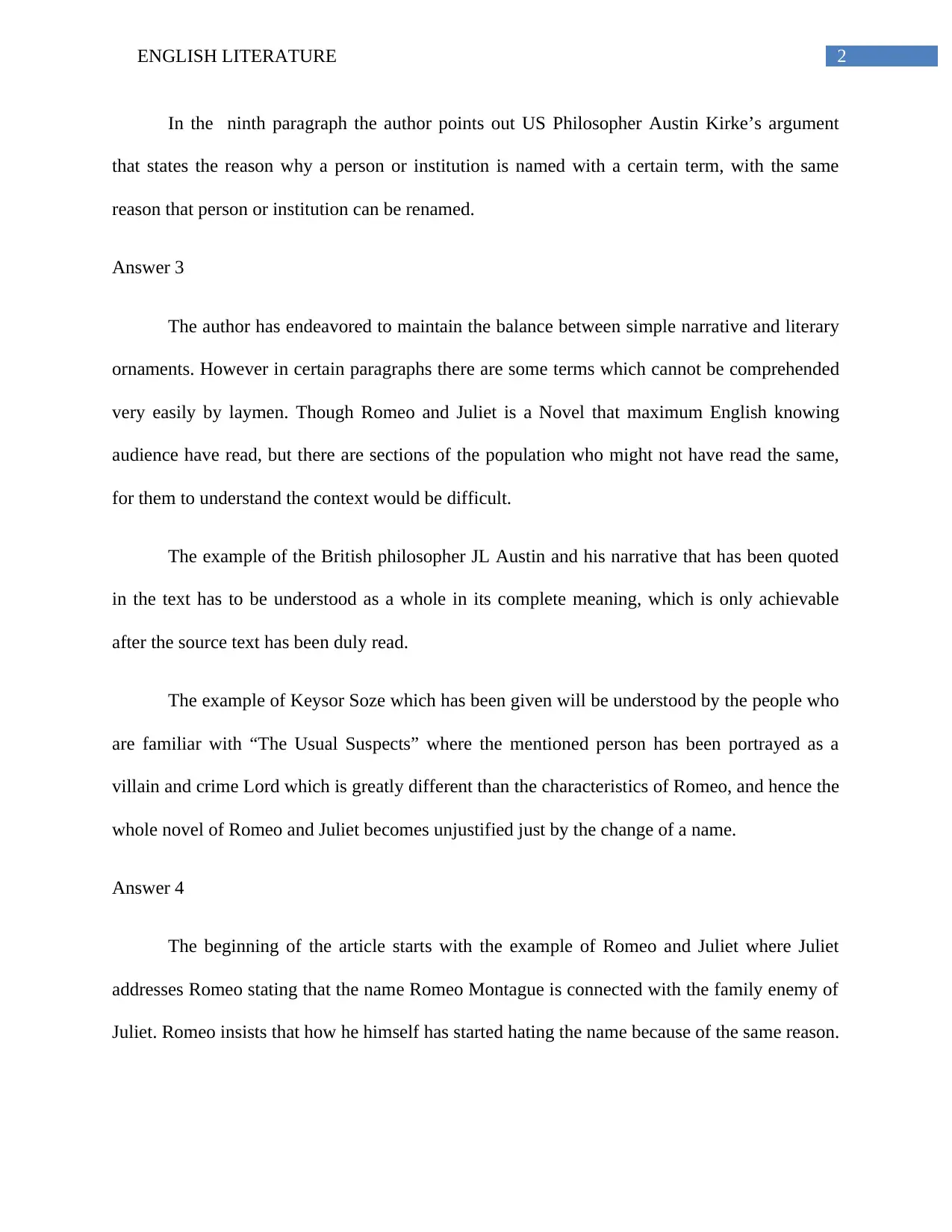
In the ninth paragraph the author points out US Philosopher Austin Kirke’s argument
that states the reason why a person or institution is named with a certain term, with the same
reason that person or institution can be renamed.
Answer 3
The author has endeavored to maintain the balance between simple narrative and literary
ornaments. However in certain paragraphs there are some terms which cannot be comprehended
very easily by laymen. Though Romeo and Juliet is a Novel that maximum English knowing
audience have read, but there are sections of the population who might not have read the same,
for them to understand the context would be difficult.
The example of the British philosopher JL Austin and his narrative that has been quoted
in the text has to be understood as a whole in its complete meaning, which is only achievable
after the source text has been duly read.
The example of Keysor Soze which has been given will be understood by the people who
are familiar with “The Usual Suspects” where the mentioned person has been portrayed as a
villain and crime Lord which is greatly different than the characteristics of Romeo, and hence the
whole novel of Romeo and Juliet becomes unjustified just by the change of a name.
Answer 4
The beginning of the article starts with the example of Romeo and Juliet where Juliet
addresses Romeo stating that the name Romeo Montague is connected with the family enemy of
Juliet. Romeo insists that how he himself has started hating the name because of the same reason.
In the ninth paragraph the author points out US Philosopher Austin Kirke’s argument
that states the reason why a person or institution is named with a certain term, with the same
reason that person or institution can be renamed.
Answer 3
The author has endeavored to maintain the balance between simple narrative and literary
ornaments. However in certain paragraphs there are some terms which cannot be comprehended
very easily by laymen. Though Romeo and Juliet is a Novel that maximum English knowing
audience have read, but there are sections of the population who might not have read the same,
for them to understand the context would be difficult.
The example of the British philosopher JL Austin and his narrative that has been quoted
in the text has to be understood as a whole in its complete meaning, which is only achievable
after the source text has been duly read.
The example of Keysor Soze which has been given will be understood by the people who
are familiar with “The Usual Suspects” where the mentioned person has been portrayed as a
villain and crime Lord which is greatly different than the characteristics of Romeo, and hence the
whole novel of Romeo and Juliet becomes unjustified just by the change of a name.
Answer 4
The beginning of the article starts with the example of Romeo and Juliet where Juliet
addresses Romeo stating that the name Romeo Montague is connected with the family enemy of
Juliet. Romeo insists that how he himself has started hating the name because of the same reason.
⊘ This is a preview!⊘
Do you want full access?
Subscribe today to unlock all pages.

Trusted by 1+ million students worldwide
3ENGLISH LITERATURE
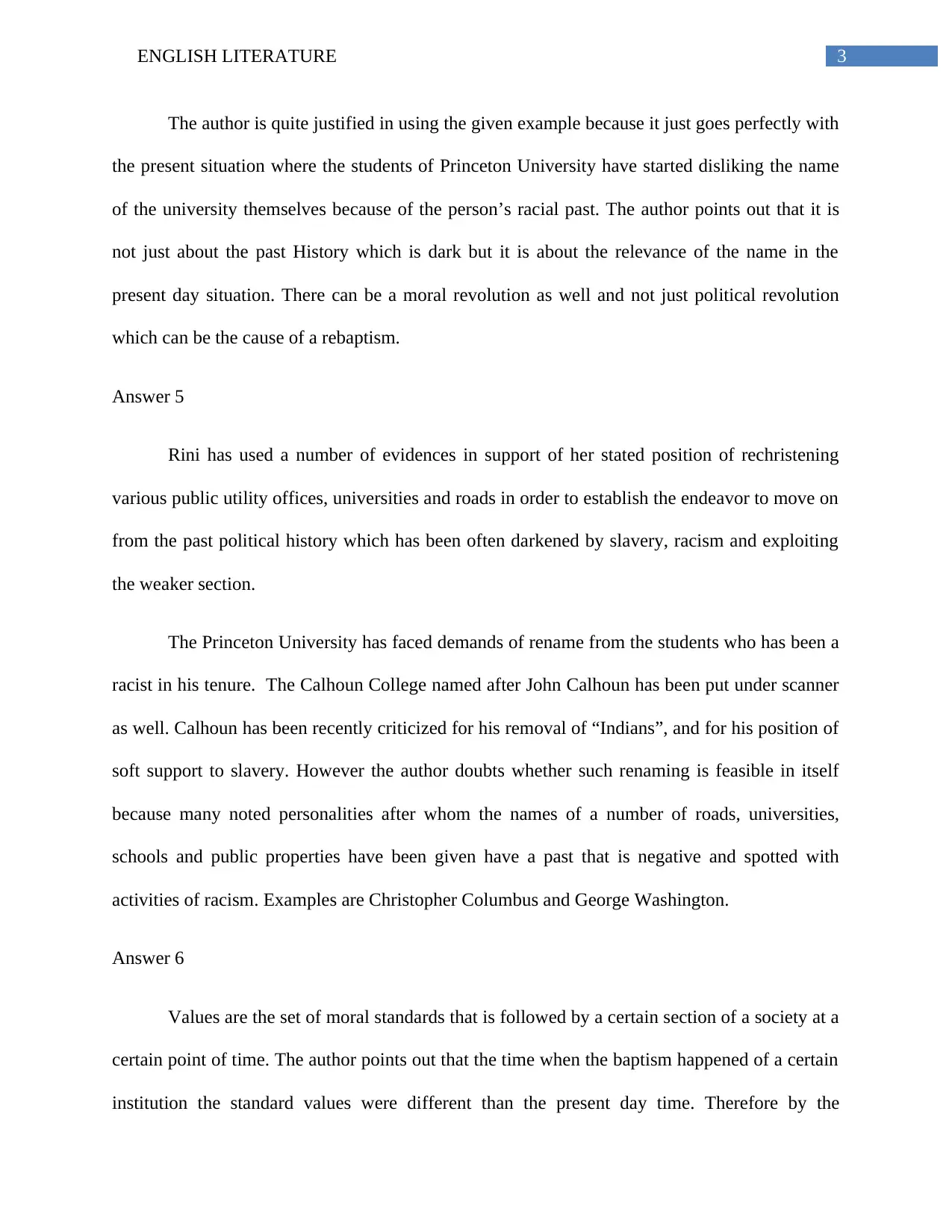
The author is quite justified in using the given example because it just goes perfectly with
the present situation where the students of Princeton University have started disliking the name
of the university themselves because of the person’s racial past. The author points out that it is
not just about the past History which is dark but it is about the relevance of the name in the
present day situation. There can be a moral revolution as well and not just political revolution
which can be the cause of a rebaptism.
Answer 5
Rini has used a number of evidences in support of her stated position of rechristening
various public utility offices, universities and roads in order to establish the endeavor to move on
from the past political history which has been often darkened by slavery, racism and exploiting
the weaker section.
The Princeton University has faced demands of rename from the students who has been a
racist in his tenure. The Calhoun College named after John Calhoun has been put under scanner
as well. Calhoun has been recently criticized for his removal of “Indians”, and for his position of
soft support to slavery. However the author doubts whether such renaming is feasible in itself
because many noted personalities after whom the names of a number of roads, universities,
schools and public properties have been given have a past that is negative and spotted with
activities of racism. Examples are Christopher Columbus and George Washington.
Answer 6
Values are the set of moral standards that is followed by a certain section of a society at a
certain point of time. The author points out that the time when the baptism happened of a certain
institution the standard values were different than the present day time. Therefore by the
The author is quite justified in using the given example because it just goes perfectly with
the present situation where the students of Princeton University have started disliking the name
of the university themselves because of the person’s racial past. The author points out that it is
not just about the past History which is dark but it is about the relevance of the name in the
present day situation. There can be a moral revolution as well and not just political revolution
which can be the cause of a rebaptism.
Answer 5
Rini has used a number of evidences in support of her stated position of rechristening
various public utility offices, universities and roads in order to establish the endeavor to move on
from the past political history which has been often darkened by slavery, racism and exploiting
the weaker section.
The Princeton University has faced demands of rename from the students who has been a
racist in his tenure. The Calhoun College named after John Calhoun has been put under scanner
as well. Calhoun has been recently criticized for his removal of “Indians”, and for his position of
soft support to slavery. However the author doubts whether such renaming is feasible in itself
because many noted personalities after whom the names of a number of roads, universities,
schools and public properties have been given have a past that is negative and spotted with
activities of racism. Examples are Christopher Columbus and George Washington.
Answer 6
Values are the set of moral standards that is followed by a certain section of a society at a
certain point of time. The author points out that the time when the baptism happened of a certain
institution the standard values were different than the present day time. Therefore by the
Paraphrase This Document
Need a fresh take? Get an instant paraphrase of this document with our AI Paraphraser
4ENGLISH LITERATURE
rebaptism the people are not denying the past but are endeavoring in establishing the values of
the present in a better way. As was pointed out by John Calhoun, slavery was a positive good
(Grove). Even George Washington had several numbers of slaves at his disposal. Therefore that
might be the practice at that point of time which is at present day not really considered as
morally “good”. The author by value only tries to establish that over the time the belief and
thought process of the people change. That can be justifiably reflected by rechristening the
names of premiere institutions of a country.
ANSWER 7
Authority signifies the power or supremacy to do something at will. The naming of
different institutions and public properties have historically happened by the authority of certain
sections of political class. The author points out the unchallenged power of the political class in
the past and the present that can christen or rechristen at will and wish.
However situation seems to change lately. There are people who have started to question
this unlimited and unethical power, “authority” as the author calls it. Rini points out that because
Romeo’s parents had the ultimate authority over their child they could name him as they wished,
but there is nothing that can stop the process from repeating, may be by someone else this time,
Romeo himself rather.
Answer 8
“We” is a collective term that the speaker uses to denote himself or herself along with
other people who match the given criterion. The author has chosen to use “we” in the places
where she either proposes to challenge status-quo, or she points out the absurdity in such action.
She herself has justified how renaming of the public institutions is necessary when the name is
rebaptism the people are not denying the past but are endeavoring in establishing the values of
the present in a better way. As was pointed out by John Calhoun, slavery was a positive good
(Grove). Even George Washington had several numbers of slaves at his disposal. Therefore that
might be the practice at that point of time which is at present day not really considered as
morally “good”. The author by value only tries to establish that over the time the belief and
thought process of the people change. That can be justifiably reflected by rechristening the
names of premiere institutions of a country.
ANSWER 7
Authority signifies the power or supremacy to do something at will. The naming of
different institutions and public properties have historically happened by the authority of certain
sections of political class. The author points out the unchallenged power of the political class in
the past and the present that can christen or rechristen at will and wish.
However situation seems to change lately. There are people who have started to question
this unlimited and unethical power, “authority” as the author calls it. Rini points out that because
Romeo’s parents had the ultimate authority over their child they could name him as they wished,
but there is nothing that can stop the process from repeating, may be by someone else this time,
Romeo himself rather.
Answer 8
“We” is a collective term that the speaker uses to denote himself or herself along with
other people who match the given criterion. The author has chosen to use “we” in the places
where she either proposes to challenge status-quo, or she points out the absurdity in such action.
She herself has justified how renaming of the public institutions is necessary when the name is
5ENGLISH LITERATURE
that of a personality who carries a bloody or dark past. Then again she referred how far they, the
people of America at the present time, termed as “we”, can go because the name of the nation
itself has to be changed in that case.
The author has cleverly used “you” to evoke the emotion required to understand the
context she wants to portray. Her statement “positive good great great grandparent’s forced
labour” makes the reader feel a certain amount of guilt because of the actions performed by the
predecessors who justified slavery as “positive good”.
Answer 9
The main two angles that have been raised by the author are contradictory in nature. In
the first part she states how there has been a clamor about renaming Princeton institution because
of the dark history associated with the name of the person after whom the institute is baptized.
She asks “why not”, and justifies that it is natural in today’s times to question the dark and racist
past and such people must be trimmed of the honorary positions.
Her second angle is how far the country can go in terms of such renaming. America itself
is named after Amerigo Vespucci who had the past of setting villages on fire, or George
Washington who owned several hundred of slaves himself after whom the capital of USA is
named, or Columbus who is behind killing of many Indians. “Where should we stop?” she asks.
Answer 10
There has been a number of cases recently where there was strong demand for name
changing of different public institutions, some of which really make sense after the study of the
article by Regina Rini. Ben Tillman has been criticized for several of his actions including some
that of a personality who carries a bloody or dark past. Then again she referred how far they, the
people of America at the present time, termed as “we”, can go because the name of the nation
itself has to be changed in that case.
The author has cleverly used “you” to evoke the emotion required to understand the
context she wants to portray. Her statement “positive good great great grandparent’s forced
labour” makes the reader feel a certain amount of guilt because of the actions performed by the
predecessors who justified slavery as “positive good”.
Answer 9
The main two angles that have been raised by the author are contradictory in nature. In
the first part she states how there has been a clamor about renaming Princeton institution because
of the dark history associated with the name of the person after whom the institute is baptized.
She asks “why not”, and justifies that it is natural in today’s times to question the dark and racist
past and such people must be trimmed of the honorary positions.
Her second angle is how far the country can go in terms of such renaming. America itself
is named after Amerigo Vespucci who had the past of setting villages on fire, or George
Washington who owned several hundred of slaves himself after whom the capital of USA is
named, or Columbus who is behind killing of many Indians. “Where should we stop?” she asks.
Answer 10
There has been a number of cases recently where there was strong demand for name
changing of different public institutions, some of which really make sense after the study of the
article by Regina Rini. Ben Tillman has been criticized for several of his actions including some
⊘ This is a preview!⊘
Do you want full access?
Subscribe today to unlock all pages.
Trusted by 1+ million students worldwide
6ENGLISH LITERATURE
relating him to the Hamburg Massacre. He has been related to various racist anti African
activities in America. The Tillman Hall in Clemson University is thus demanded to be
rechristened. Robert E Lee divides the public opinion, because he had been proactive in killing
many in a bloody civil war (Foner). The terms like red skin or black skin has been in question
and out of use for a long time now. Differentiation according to skin color is the basic form of
racism. Therefore the “Washington Redskins football team: has been pressurized by various
quarters to rename their team.
There are many examples, which seem to be quite justified after reading the article.
However the author herself again questions how far can we go in this game of naming and
renaming.
relating him to the Hamburg Massacre. He has been related to various racist anti African
activities in America. The Tillman Hall in Clemson University is thus demanded to be
rechristened. Robert E Lee divides the public opinion, because he had been proactive in killing
many in a bloody civil war (Foner). The terms like red skin or black skin has been in question
and out of use for a long time now. Differentiation according to skin color is the basic form of
racism. Therefore the “Washington Redskins football team: has been pressurized by various
quarters to rename their team.
There are many examples, which seem to be quite justified after reading the article.
However the author herself again questions how far can we go in this game of naming and
renaming.
Paraphrase This Document
Need a fresh take? Get an instant paraphrase of this document with our AI Paraphraser
7ENGLISH LITERATURE
REFERENCES:
Foner, Eric. "The Making And The Breaking Of The Legend Of Robert E. Lee." Nytimes.Com,
2018, https://www.nytimes.com/2017/08/28/books/review/eric-foner-robert-e-lee.html.
Grove, John G. John C. Calhoun's Theory of Republicanism. University Press of Kansas, 2016.
REFERENCES:
Foner, Eric. "The Making And The Breaking Of The Legend Of Robert E. Lee." Nytimes.Com,
2018, https://www.nytimes.com/2017/08/28/books/review/eric-foner-robert-e-lee.html.
Grove, John G. John C. Calhoun's Theory of Republicanism. University Press of Kansas, 2016.

1 out of 8


Your All-in-One AI-Powered Toolkit for Academic Success.
+13062052269
info@desklib.com
Available 24*7 on WhatsApp / Email
![[object Object]](/_next/static/media/star-bottom.7253800d.svg)
Unlock your academic potential
Copyright © 2020–2026 A2Z Services. All Rights Reserved. Developed and managed by ZUCOL.