University English Morphology Assignment: CTEL 501

Verified

Added on  2022/08/12

|12
|752
|28
Homework Assignment
AI Summary
This assignment delves into the core concepts of English morphology, commencing with a definition of morphology as the study of words, their structure, and relationships within a language. It explores key elements like stem, root words, and affixation, as well as the contextual impacts of parts of speech, intonation, and stress on word meaning. The document differentiates between content words and function words, and provides a detailed explanation of morphemes, distinguishing between free and bound morphemes with examples. Affixation, including prefixes, suffixes, infixes, and circumfixes, is thoroughly examined in terms of how it alters word meanings. Furthermore, the assignment covers various word formation processes like compounding, derivation, clipping, blending, and backformation. It also addresses the hindrances and needs of English learners in morphology, and suggests strategies for assessment and understanding. The importance of morphological skills for fluent reading and writing is emphasized, including an understanding of affixes, word formation, and morpheme types, as well as the role of Greek and Latin roots in English morphology. References from key linguistic texts are included to support the analysis.
Document Page
CTEL 501: ENGLISH MORPHOLOGY
Name of the Student
Name of the University
Author note
tabler-icon-diamond-filled.svg

Paraphrase This Document

Need a fresh take? Get an instant paraphrase of this document with our AI Paraphraser
Document Page
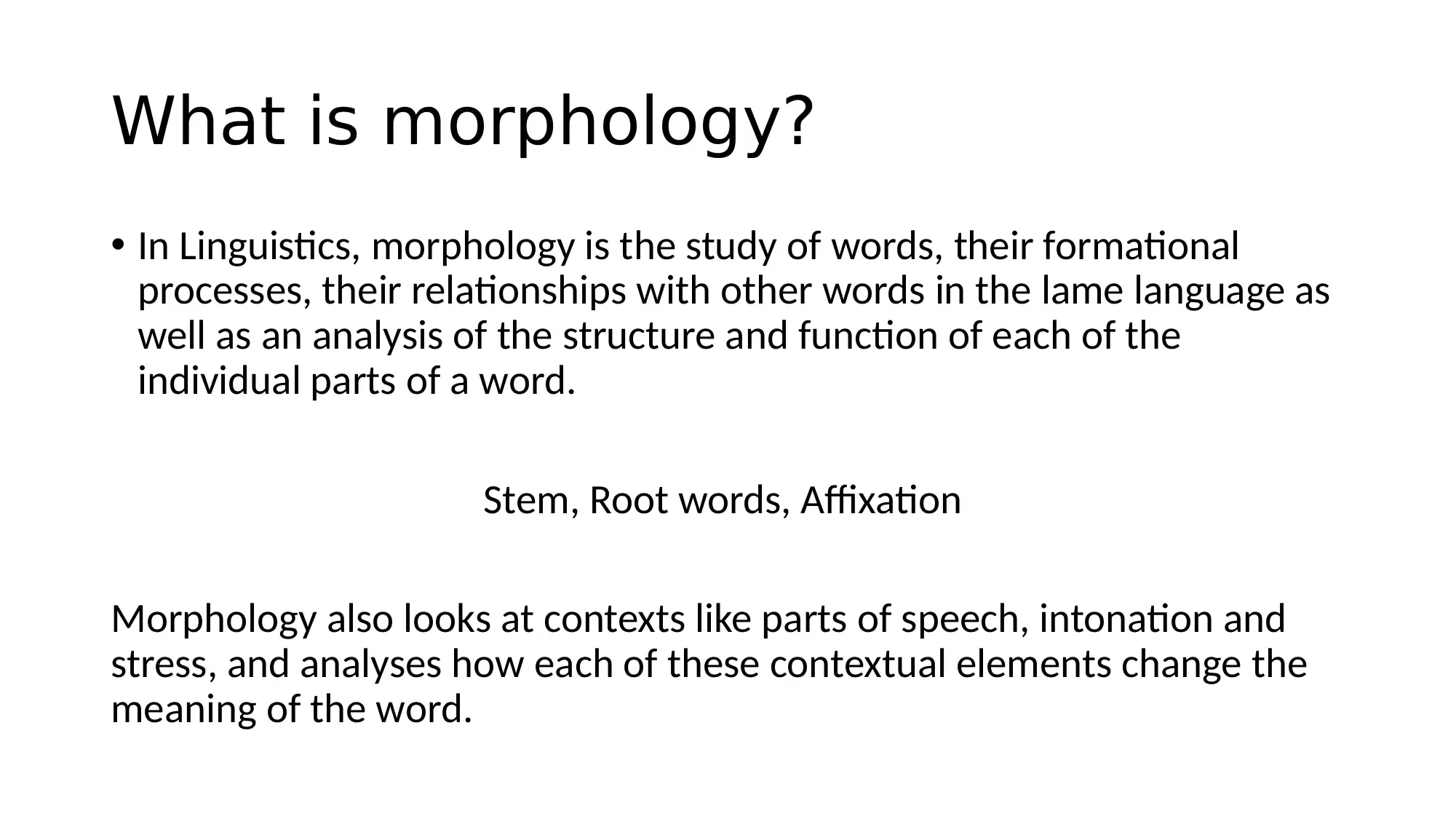
What is morphology?
In Linguistics, morphology is the study of words, their formational
processes, their relationships with other words in the lame language as
well as an analysis of the structure and function of each of the
individual parts of a word.
Stem, Root words, Affixation
Morphology also looks at contexts like parts of speech, intonation and
stress, and analyses how each of these contextual elements change the
meaning of the word.
Document Page
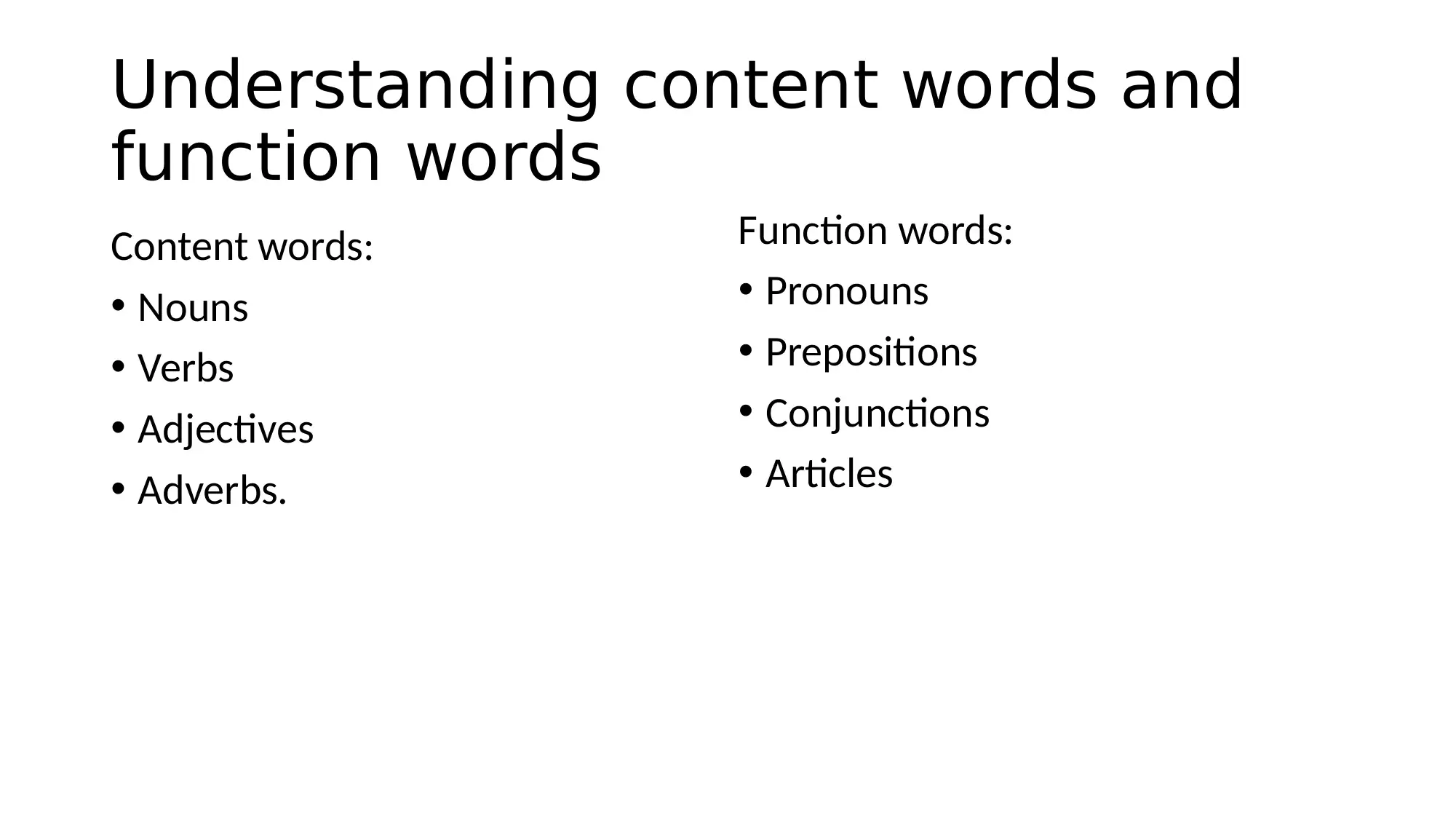
Understanding content words and
function words
Content words:
Nouns
Verbs
Adjectives
Adverbs.
Function words:
Pronouns
Prepositions
Conjunctions
Articles
Document Page
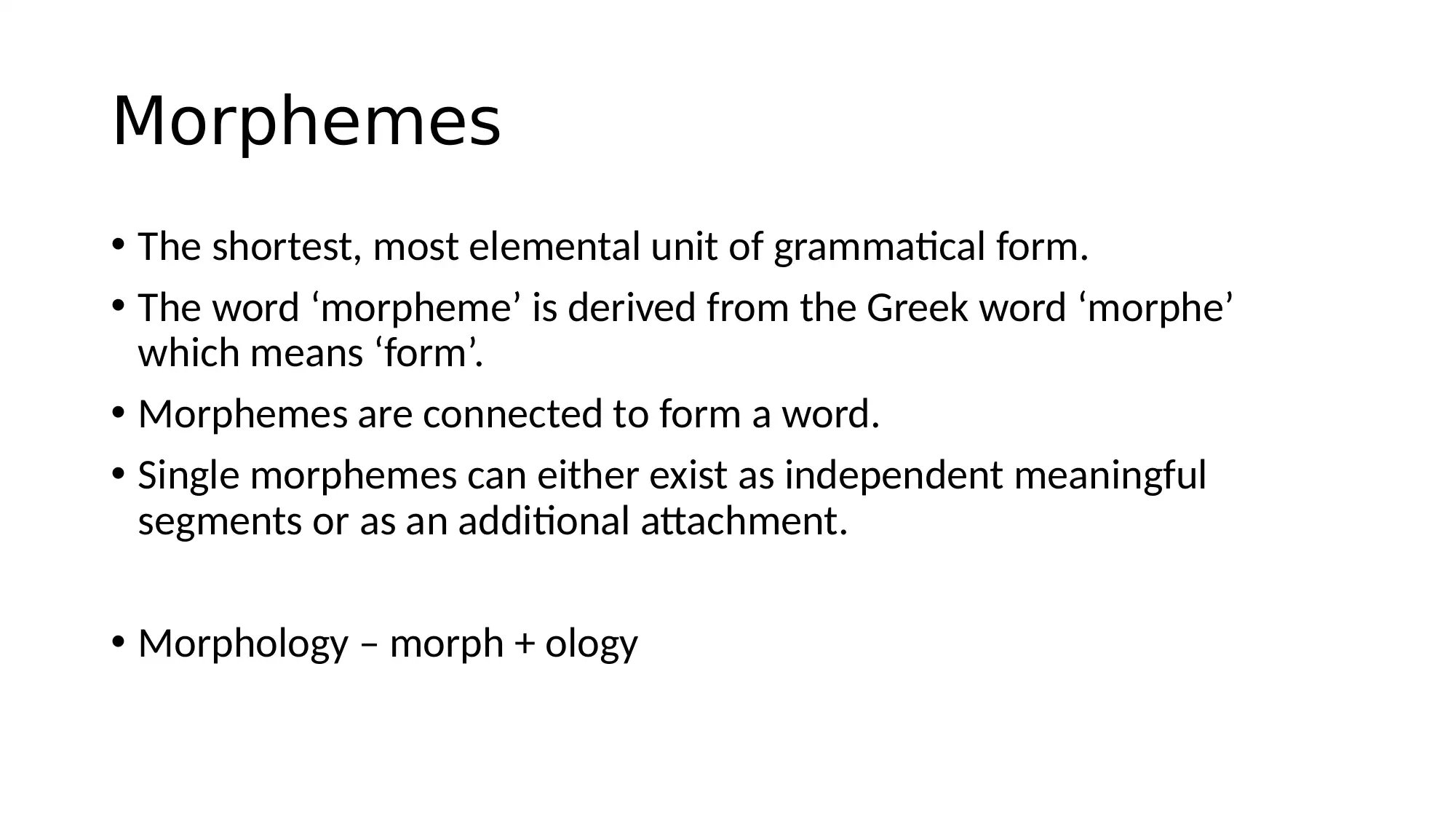
Morphemes
The shortest, most elemental unit of grammatical form.
The word ‘morpheme’ is derived from the Greek word ‘morphe’
which means ‘form’.
Morphemes are connected to form a word.
Single morphemes can either exist as independent meaningful
segments or as an additional attachment.
Morphology – morph + ology
tabler-icon-diamond-filled.svg

Paraphrase This Document

Need a fresh take? Get an instant paraphrase of this document with our AI Paraphraser
Document Page
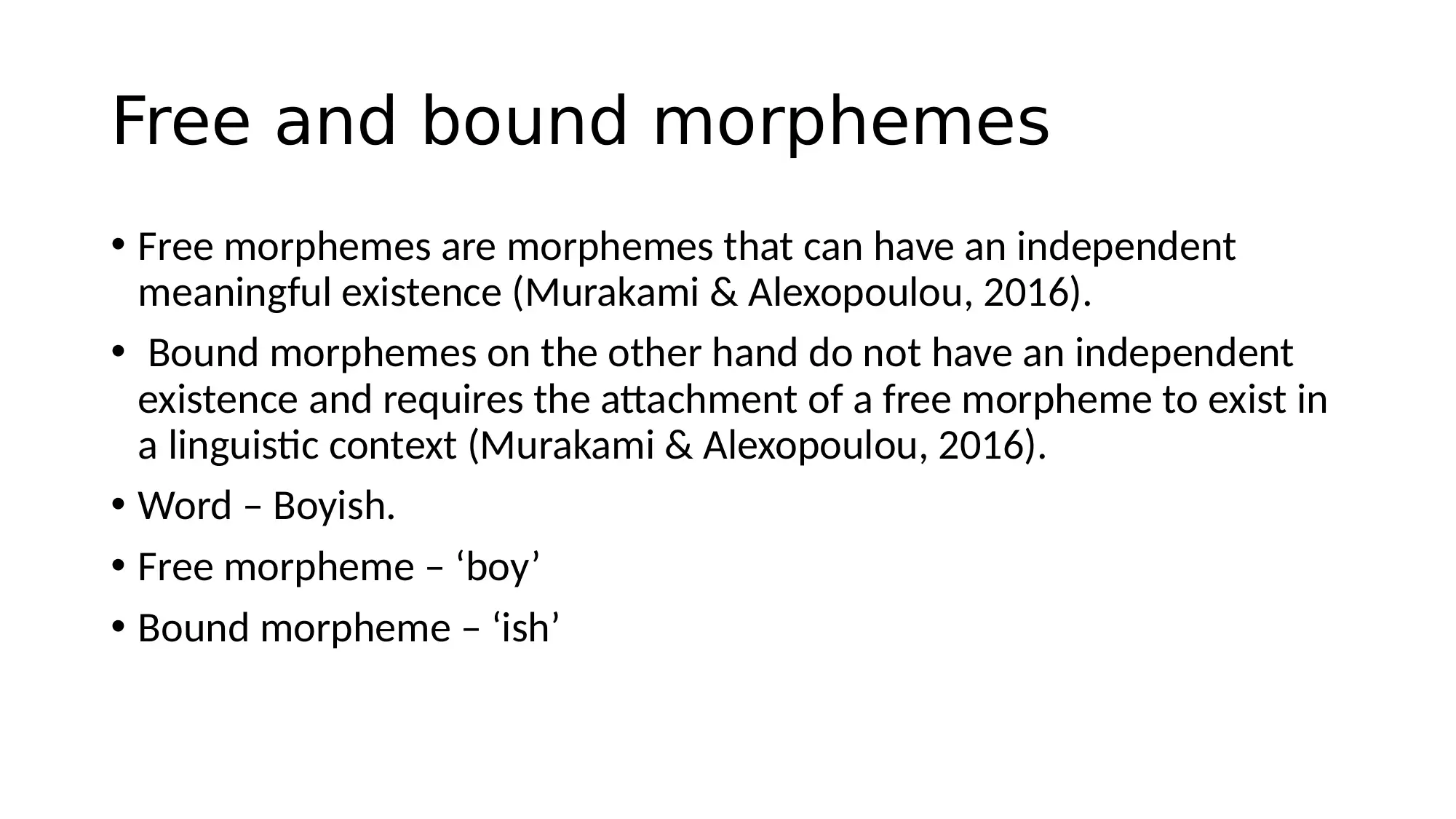
Free and bound morphemes
Free morphemes are morphemes that can have an independent
meaningful existence (Murakami & Alexopoulou, 2016).
Bound morphemes on the other hand do not have an independent
existence and requires the attachment of a free morpheme to exist in
a linguistic context (Murakami & Alexopoulou, 2016).
Word – Boyish.
Free morpheme – ‘boy’
Bound morpheme – ‘ish’
Document Page
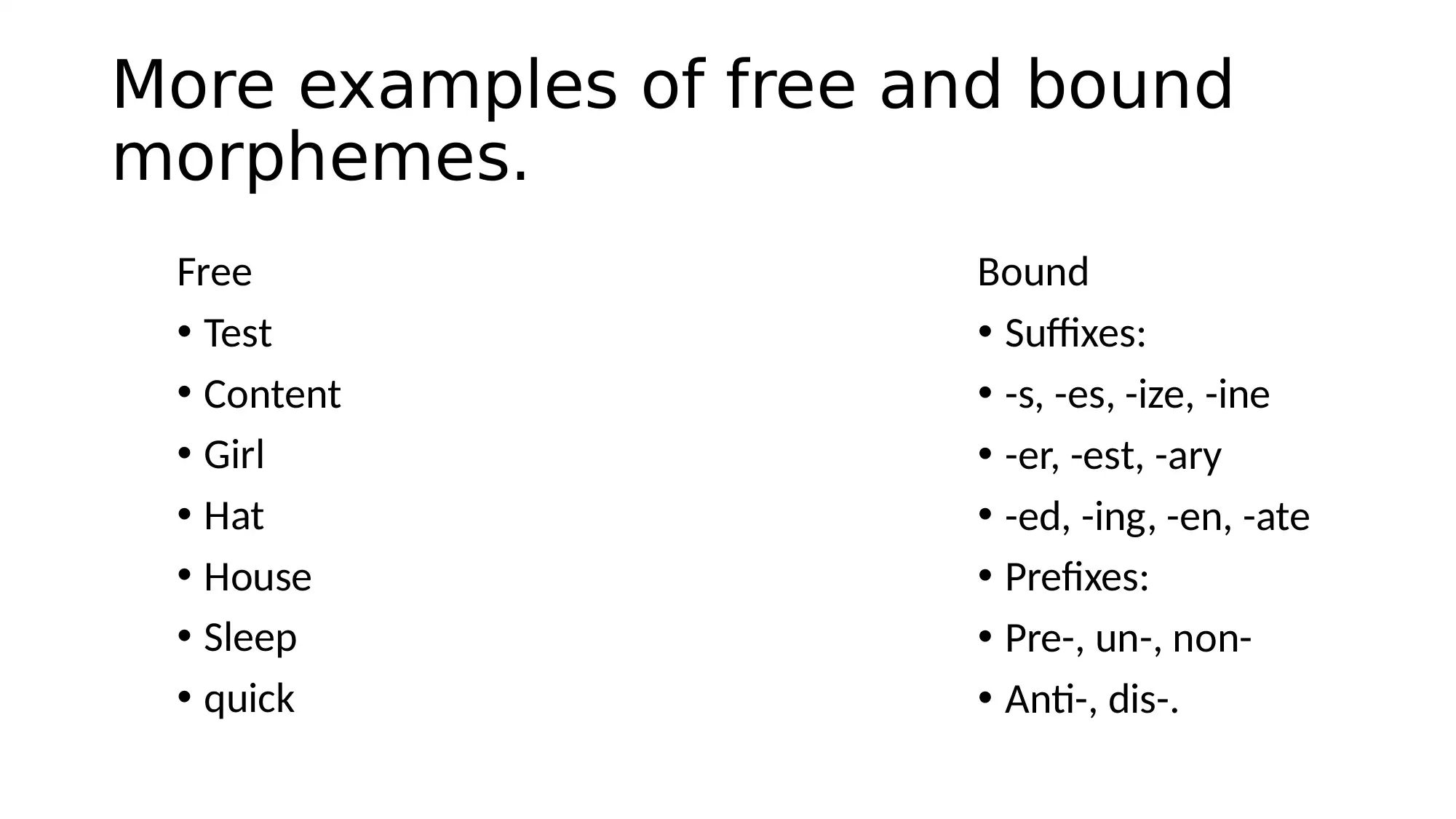
More examples of free and bound
morphemes.
Bound
Suffixes:
-s, -es, -ize, -ine
-er, -est, -ary
-ed, -ing, -en, -ate
Prefixes:
Pre-, un-, non-
Anti-, dis-.
Free
Test
Content
Girl
Hat
House
Sleep
quick
Document Page
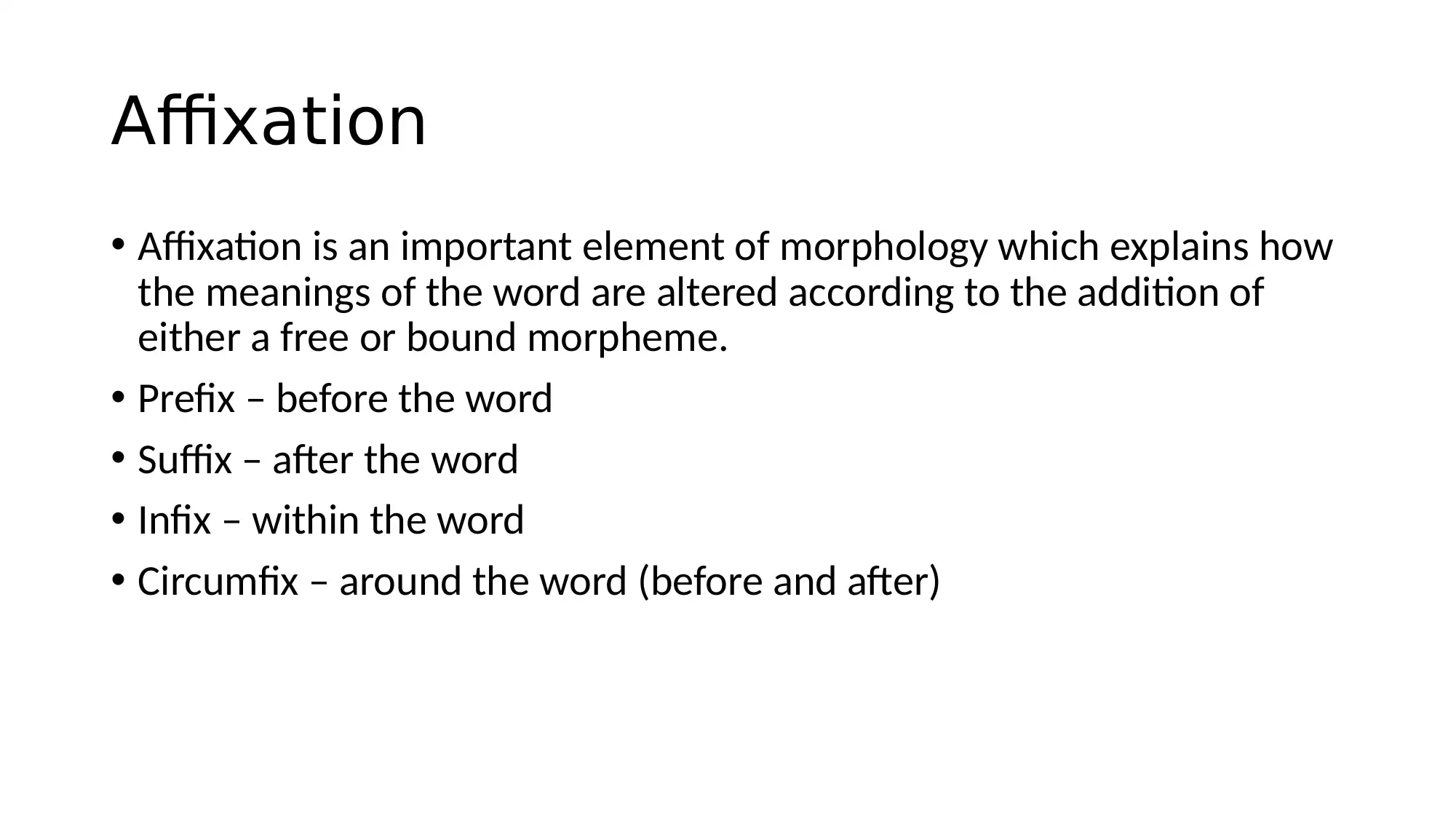
Affixation
Affixation is an important element of morphology which explains how
the meanings of the word are altered according to the addition of
either a free or bound morpheme.
Prefix – before the word
Suffix – after the word
Infix – within the word
Circumfix – around the word (before and after)
tabler-icon-diamond-filled.svg

Paraphrase This Document

Need a fresh take? Get an instant paraphrase of this document with our AI Paraphraser
Document Page
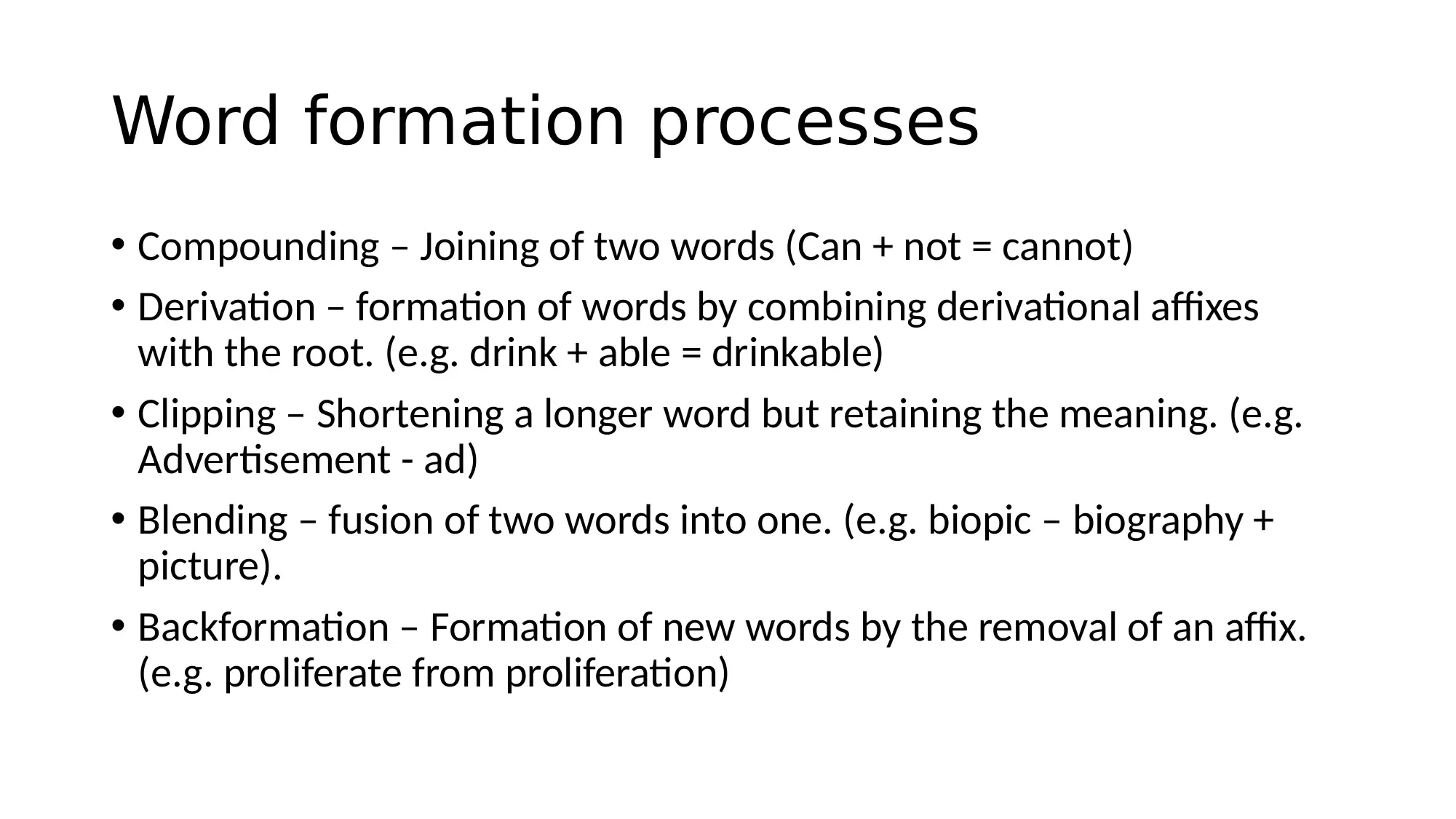
Word formation processes
Compounding – Joining of two words (Can + not = cannot)
Derivation – formation of words by combining derivational affixes
with the root. (e.g. drink + able = drinkable)
Clipping – Shortening a longer word but retaining the meaning. (e.g.
Advertisement - ad)
Blending – fusion of two words into one. (e.g. biopic – biography +
picture).
Backformation – Formation of new words by the removal of an affix.
(e.g. proliferate from proliferation)
Document Page
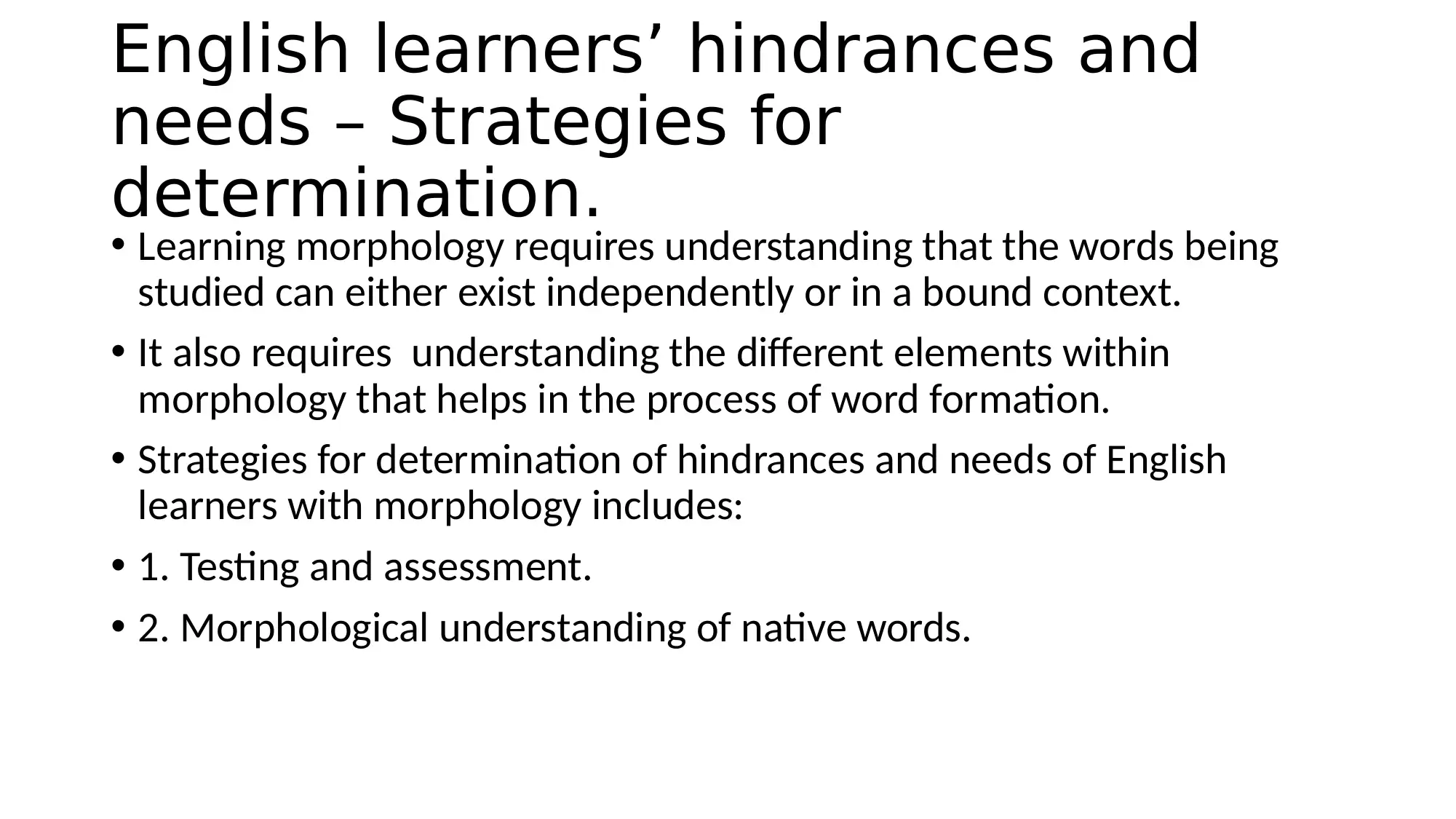
English learners’ hindrances and
needs – Strategies for
determination.
Learning morphology requires understanding that the words being
studied can either exist independently or in a bound context.
It also requires understanding the different elements within
morphology that helps in the process of word formation.
Strategies for determination of hindrances and needs of English
learners with morphology includes:
1. Testing and assessment.
2. Morphological understanding of native words.
Document Page
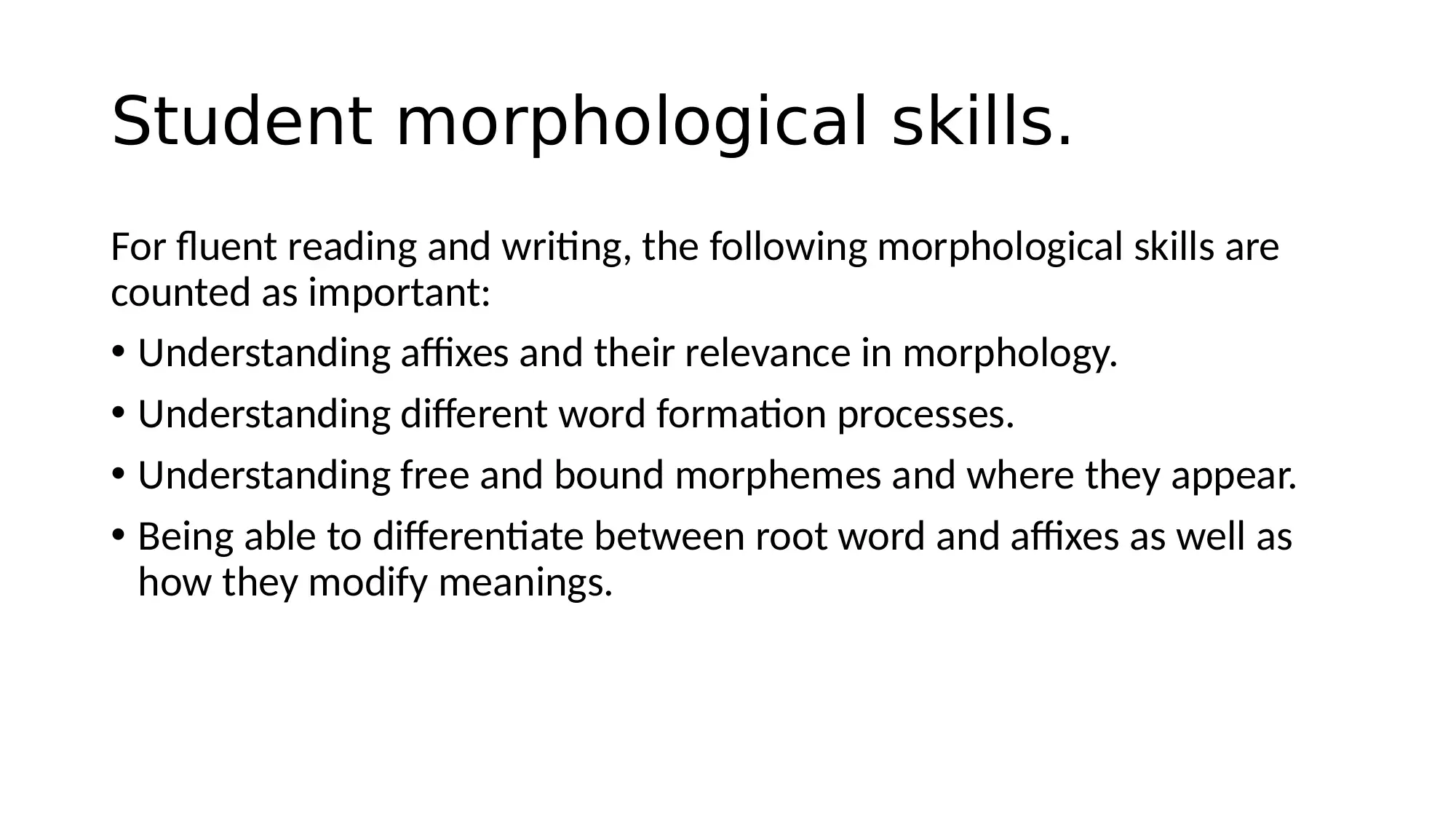
Student morphological skills.
For fluent reading and writing, the following morphological skills are
counted as important:
Understanding affixes and their relevance in morphology.
Understanding different word formation processes.
Understanding free and bound morphemes and where they appear.
Being able to differentiate between root word and affixes as well as
how they modify meanings.
tabler-icon-diamond-filled.svg

Paraphrase This Document

Need a fresh take? Get an instant paraphrase of this document with our AI Paraphraser
Document Page
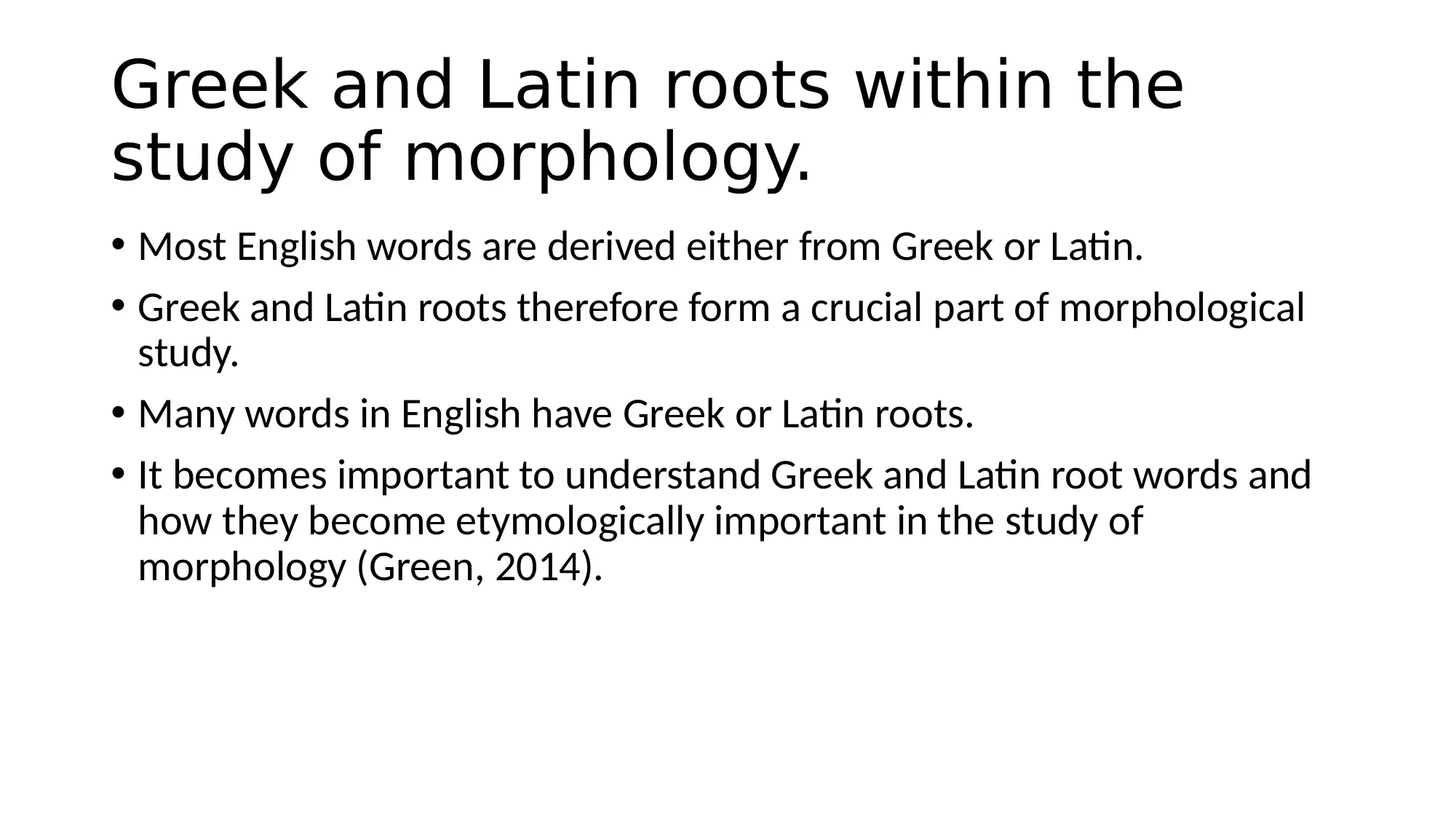
Greek and Latin roots within the
study of morphology.
Most English words are derived either from Greek or Latin.
Greek and Latin roots therefore form a crucial part of morphological
study.
Many words in English have Greek or Latin roots.
It becomes important to understand Greek and Latin root words and
how they become etymologically important in the study of
morphology (Green, 2014).
Document Page
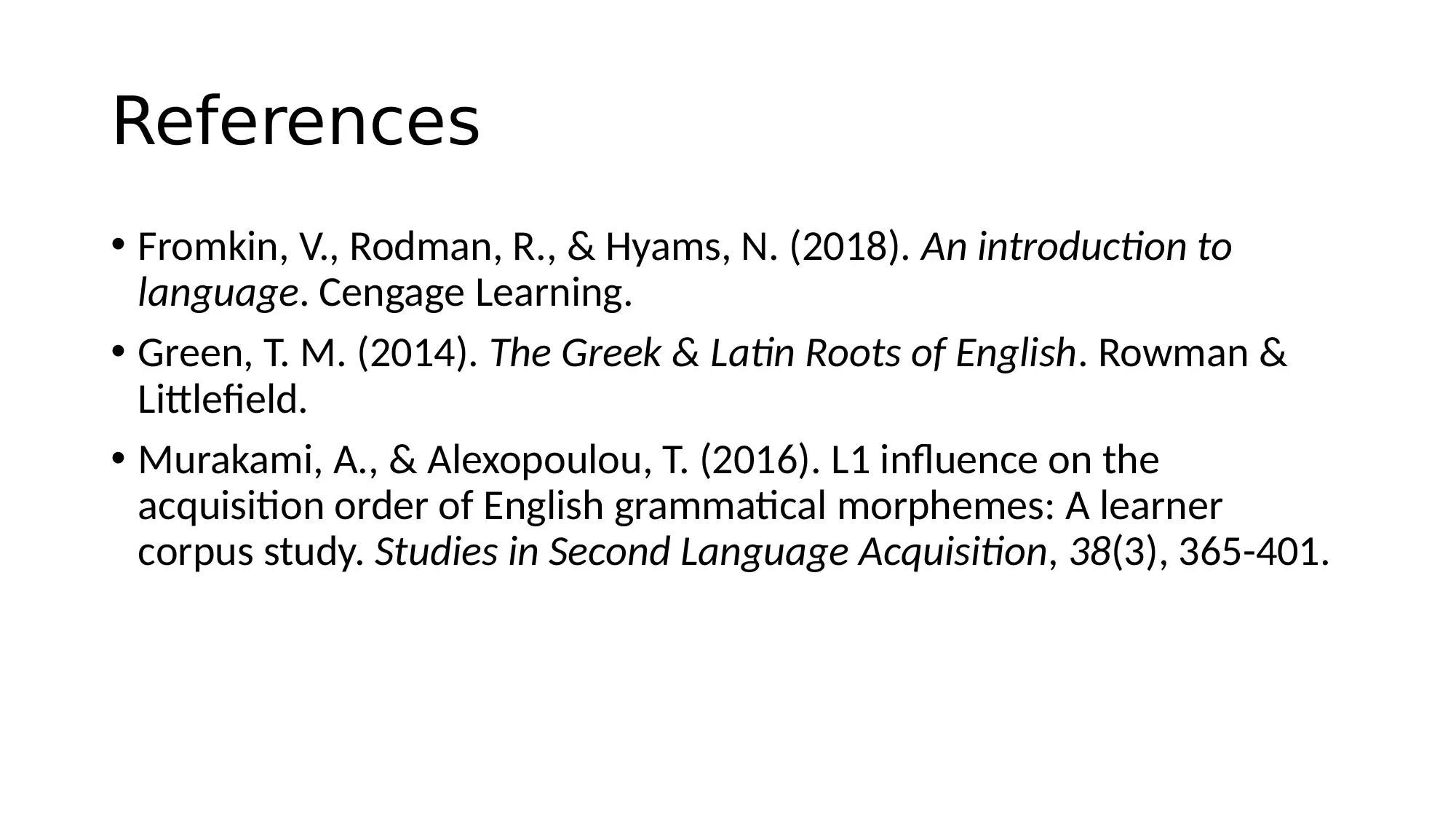
References
Fromkin, V., Rodman, R., & Hyams, N. (2018). An introduction to
language. Cengage Learning.
Green, T. M. (2014). The Greek & Latin Roots of English. Rowman &
Littlefield.
Murakami, A., & Alexopoulou, T. (2016). L1 influence on the
acquisition order of English grammatical morphemes: A learner
corpus study. Studies in Second Language Acquisition, 38(3), 365-401.
chevron_up_icon
1 out of 12
circle_padding
hide_on_mobile
zoom_out_icon
[object Object]