Healthcare Innovation Report: Sexual Health Workshop for Nurses
VerifiedAdded on 2022/09/07
|21
|4994
|20
Report
AI Summary
This report presents an evidence-based rationale for a patient service innovation (PSI) focused on sexual health workshops for healthcare workers, particularly within a care home setting in London. The aim is to enhance the knowledge and confidence of healthcare workers in supporting the sexual health of individuals with learning disabilities. The report outlines the objectives, which include identifying sexual health issues faced by this population and increasing awareness among healthcare workers. The PSI aligns with the NHS Outcomes Framework, emphasizing the reduction of premature deaths among individuals with learning disabilities. The report provides a background on the NHS, change management strategies (including Kotter's 8-stage model), leadership theories, and time management. It details the project's stakeholders, implementation timeline, and evaluation methods. The report emphasizes the importance of addressing sexual health needs, promoting positive sexuality, and preventing sexual exploitation and related health issues. The overall goal is to improve the quality of life and well-being of individuals with learning disabilities through improved healthcare worker training and support.

Running head: HEALTHCARE
Enhancing Innovation in Nursing
Name of the Student
Name of the University
Author Note
Enhancing Innovation in Nursing
Name of the Student
Name of the University
Author Note

Paraphrase This Document
Need a fresh take? Get an instant paraphrase of this document with our AI Paraphraser
1HEALTHCARE
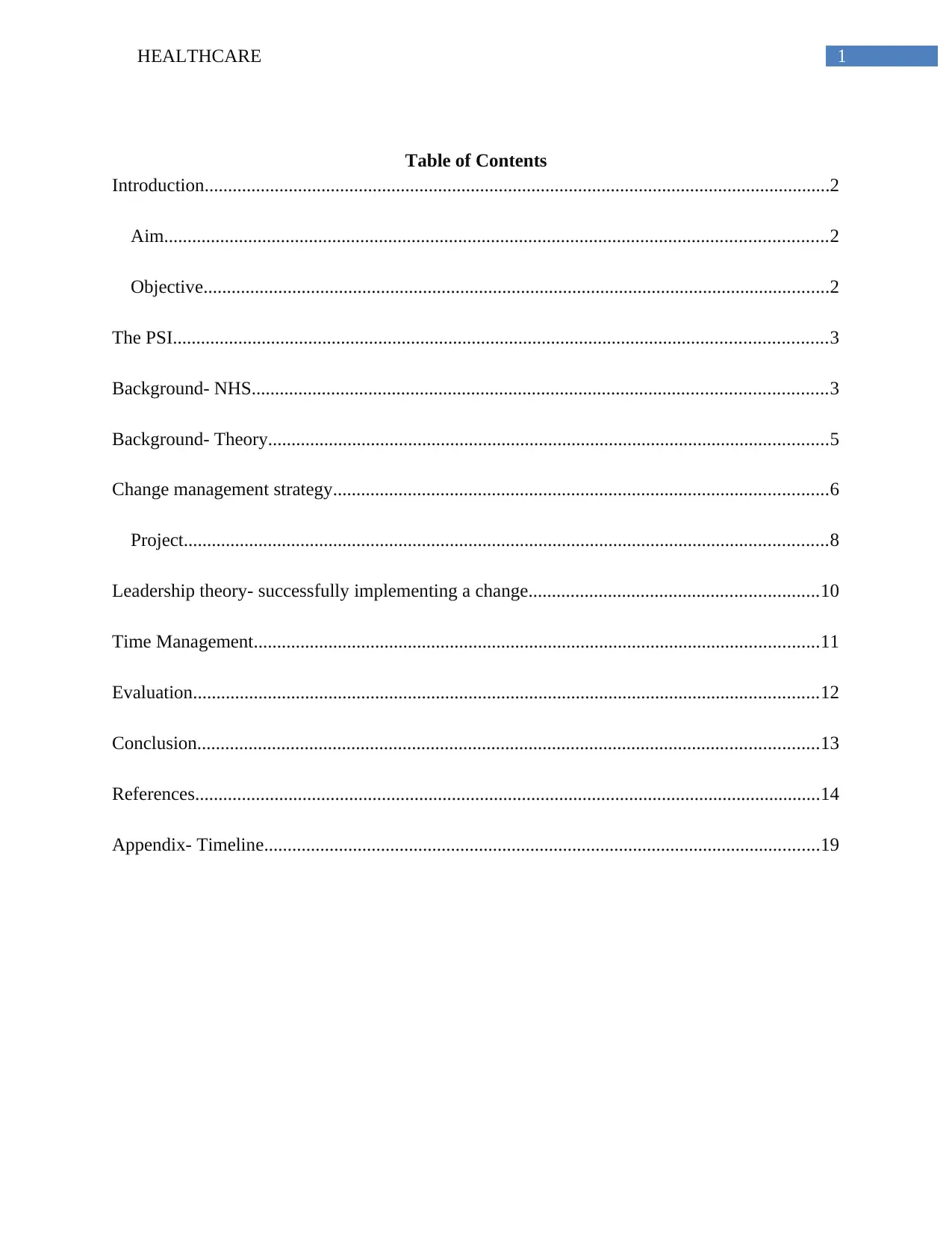
Table of Contents
Introduction......................................................................................................................................2
Aim..............................................................................................................................................2
Objective......................................................................................................................................2
The PSI............................................................................................................................................3
Background- NHS...........................................................................................................................3
Background- Theory........................................................................................................................5
Change management strategy..........................................................................................................6
Project..........................................................................................................................................8
Leadership theory- successfully implementing a change..............................................................10
Time Management.........................................................................................................................11
Evaluation......................................................................................................................................12
Conclusion.....................................................................................................................................13
References......................................................................................................................................14
Appendix- Timeline.......................................................................................................................19
Table of Contents
Introduction......................................................................................................................................2
Aim..............................................................................................................................................2
Objective......................................................................................................................................2
The PSI............................................................................................................................................3
Background- NHS...........................................................................................................................3
Background- Theory........................................................................................................................5
Change management strategy..........................................................................................................6
Project..........................................................................................................................................8
Leadership theory- successfully implementing a change..............................................................10
Time Management.........................................................................................................................11
Evaluation......................................................................................................................................12
Conclusion.....................................................................................................................................13
References......................................................................................................................................14
Appendix- Timeline.......................................................................................................................19
2HEALTHCARE
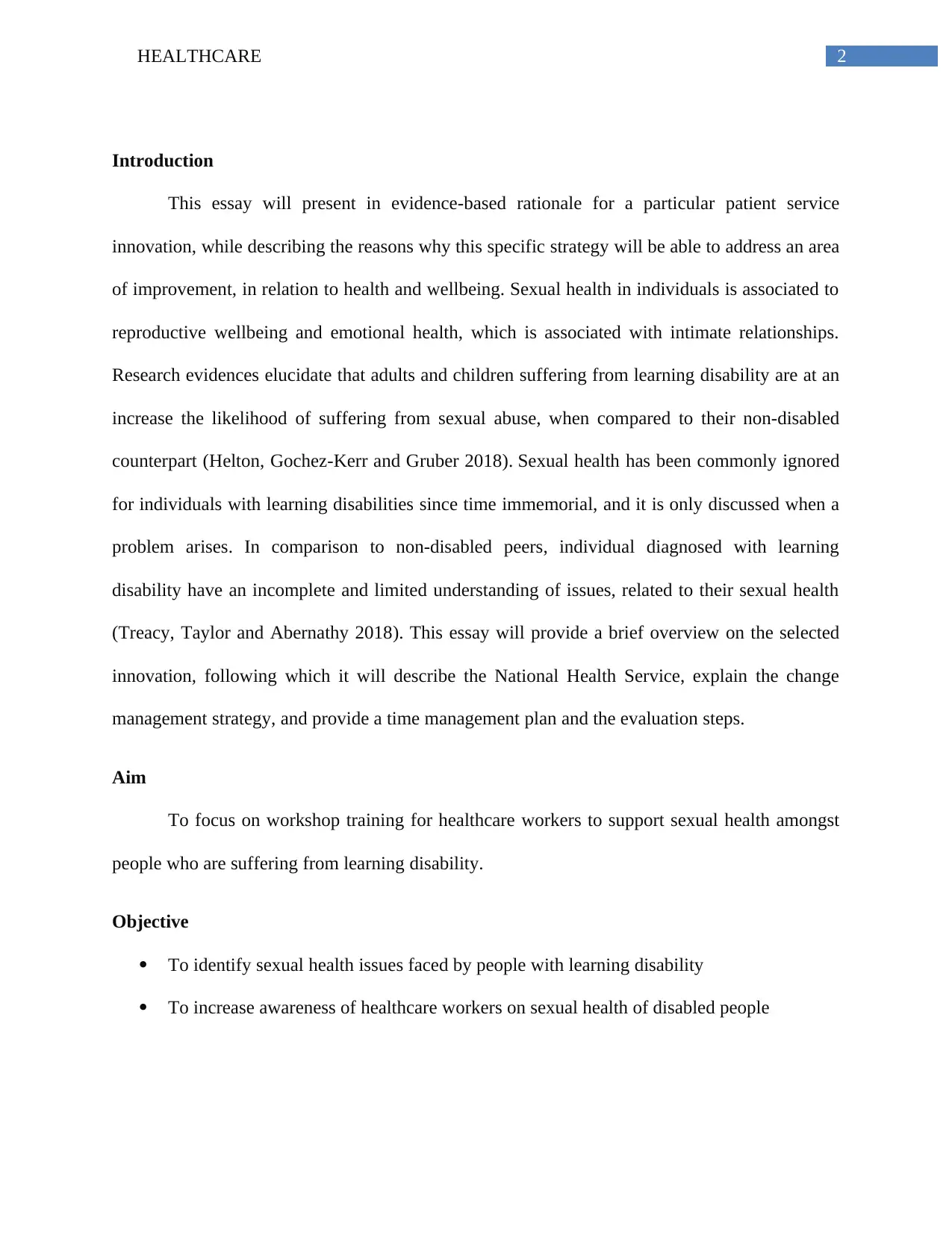
Introduction
This essay will present in evidence-based rationale for a particular patient service
innovation, while describing the reasons why this specific strategy will be able to address an area
of improvement, in relation to health and wellbeing. Sexual health in individuals is associated to
reproductive wellbeing and emotional health, which is associated with intimate relationships.
Research evidences elucidate that adults and children suffering from learning disability are at an
increase the likelihood of suffering from sexual abuse, when compared to their non-disabled
counterpart (Helton, Gochez-Kerr and Gruber 2018). Sexual health has been commonly ignored
for individuals with learning disabilities since time immemorial, and it is only discussed when a
problem arises. In comparison to non-disabled peers, individual diagnosed with learning
disability have an incomplete and limited understanding of issues, related to their sexual health
(Treacy, Taylor and Abernathy 2018). This essay will provide a brief overview on the selected
innovation, following which it will describe the National Health Service, explain the change
management strategy, and provide a time management plan and the evaluation steps.
Aim
To focus on workshop training for healthcare workers to support sexual health amongst
people who are suffering from learning disability.
Objective
To identify sexual health issues faced by people with learning disability
To increase awareness of healthcare workers on sexual health of disabled people
Introduction
This essay will present in evidence-based rationale for a particular patient service
innovation, while describing the reasons why this specific strategy will be able to address an area
of improvement, in relation to health and wellbeing. Sexual health in individuals is associated to
reproductive wellbeing and emotional health, which is associated with intimate relationships.
Research evidences elucidate that adults and children suffering from learning disability are at an
increase the likelihood of suffering from sexual abuse, when compared to their non-disabled
counterpart (Helton, Gochez-Kerr and Gruber 2018). Sexual health has been commonly ignored
for individuals with learning disabilities since time immemorial, and it is only discussed when a
problem arises. In comparison to non-disabled peers, individual diagnosed with learning
disability have an incomplete and limited understanding of issues, related to their sexual health
(Treacy, Taylor and Abernathy 2018). This essay will provide a brief overview on the selected
innovation, following which it will describe the National Health Service, explain the change
management strategy, and provide a time management plan and the evaluation steps.
Aim
To focus on workshop training for healthcare workers to support sexual health amongst
people who are suffering from learning disability.
Objective
To identify sexual health issues faced by people with learning disability
To increase awareness of healthcare workers on sexual health of disabled people
⊘ This is a preview!⊘
Do you want full access?
Subscribe today to unlock all pages.

Trusted by 1+ million students worldwide
3HEALTHCARE
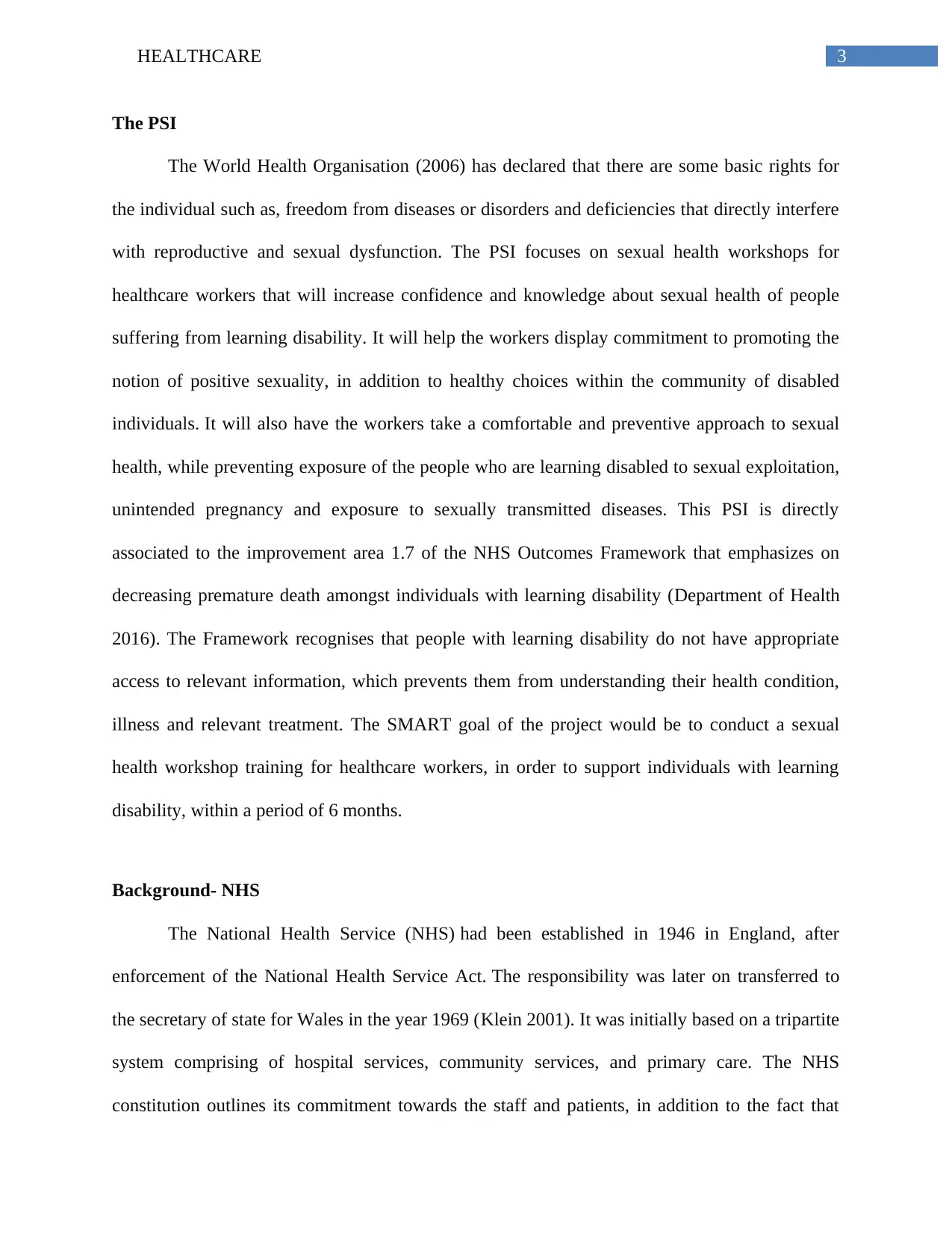
The PSI
The World Health Organisation (2006) has declared that there are some basic rights for
the individual such as, freedom from diseases or disorders and deficiencies that directly interfere
with reproductive and sexual dysfunction. The PSI focuses on sexual health workshops for
healthcare workers that will increase confidence and knowledge about sexual health of people
suffering from learning disability. It will help the workers display commitment to promoting the
notion of positive sexuality, in addition to healthy choices within the community of disabled
individuals. It will also have the workers take a comfortable and preventive approach to sexual
health, while preventing exposure of the people who are learning disabled to sexual exploitation,
unintended pregnancy and exposure to sexually transmitted diseases. This PSI is directly
associated to the improvement area 1.7 of the NHS Outcomes Framework that emphasizes on
decreasing premature death amongst individuals with learning disability (Department of Health
2016). The Framework recognises that people with learning disability do not have appropriate
access to relevant information, which prevents them from understanding their health condition,
illness and relevant treatment. The SMART goal of the project would be to conduct a sexual
health workshop training for healthcare workers, in order to support individuals with learning
disability, within a period of 6 months.
Background- NHS
The National Health Service (NHS) had been established in 1946 in England, after
enforcement of the National Health Service Act. The responsibility was later on transferred to
the secretary of state for Wales in the year 1969 (Klein 2001). It was initially based on a tripartite
system comprising of hospital services, community services, and primary care. The NHS
constitution outlines its commitment towards the staff and patients, in addition to the fact that
The PSI
The World Health Organisation (2006) has declared that there are some basic rights for
the individual such as, freedom from diseases or disorders and deficiencies that directly interfere
with reproductive and sexual dysfunction. The PSI focuses on sexual health workshops for
healthcare workers that will increase confidence and knowledge about sexual health of people
suffering from learning disability. It will help the workers display commitment to promoting the
notion of positive sexuality, in addition to healthy choices within the community of disabled
individuals. It will also have the workers take a comfortable and preventive approach to sexual
health, while preventing exposure of the people who are learning disabled to sexual exploitation,
unintended pregnancy and exposure to sexually transmitted diseases. This PSI is directly
associated to the improvement area 1.7 of the NHS Outcomes Framework that emphasizes on
decreasing premature death amongst individuals with learning disability (Department of Health
2016). The Framework recognises that people with learning disability do not have appropriate
access to relevant information, which prevents them from understanding their health condition,
illness and relevant treatment. The SMART goal of the project would be to conduct a sexual
health workshop training for healthcare workers, in order to support individuals with learning
disability, within a period of 6 months.
Background- NHS
The National Health Service (NHS) had been established in 1946 in England, after
enforcement of the National Health Service Act. The responsibility was later on transferred to
the secretary of state for Wales in the year 1969 (Klein 2001). It was initially based on a tripartite
system comprising of hospital services, community services, and primary care. The NHS
constitution outlines its commitment towards the staff and patients, in addition to the fact that
Paraphrase This Document
Need a fresh take? Get an instant paraphrase of this document with our AI Paraphraser
4HEALTHCARE
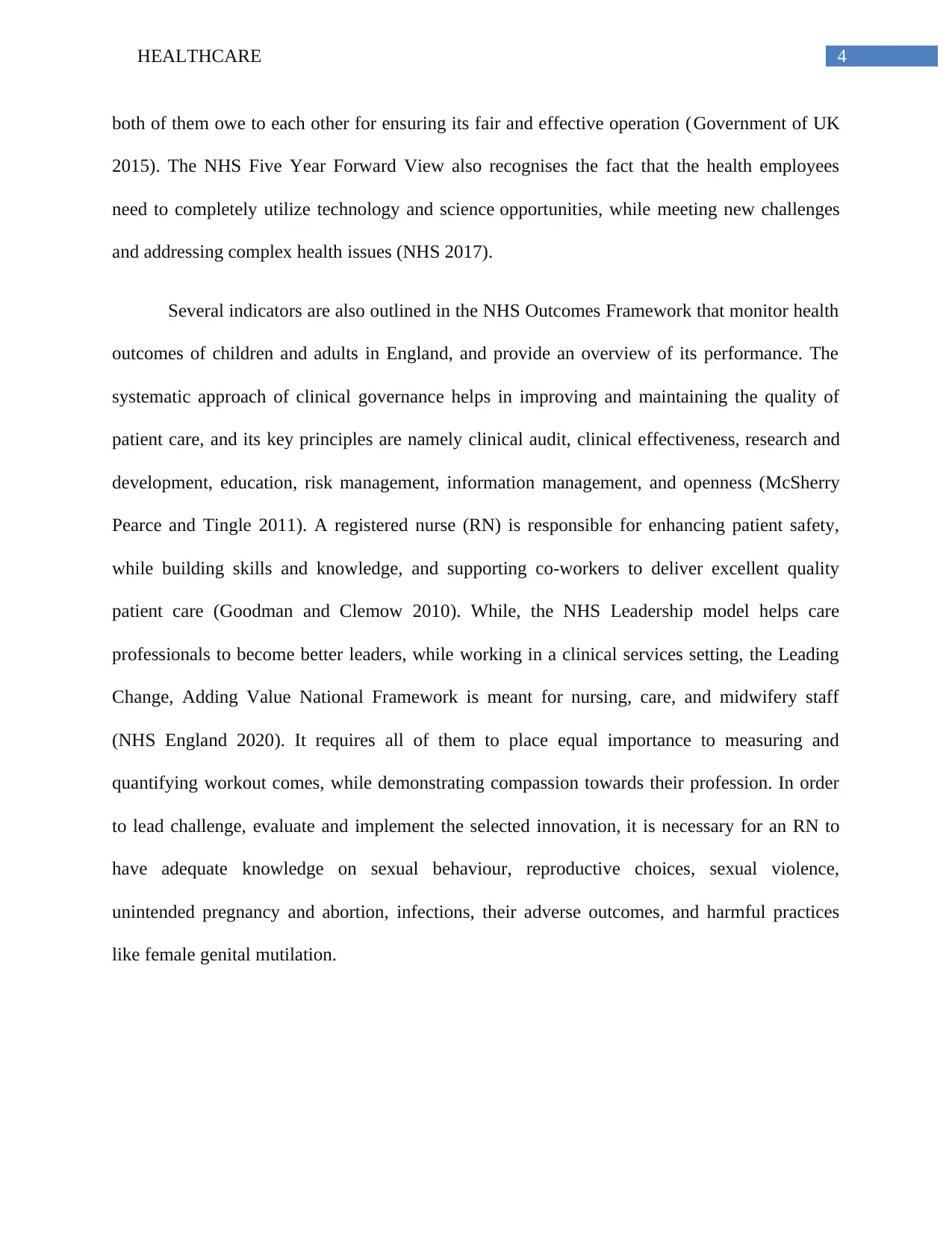
both of them owe to each other for ensuring its fair and effective operation (Government of UK
2015). The NHS Five Year Forward View also recognises the fact that the health employees
need to completely utilize technology and science opportunities, while meeting new challenges
and addressing complex health issues (NHS 2017).
Several indicators are also outlined in the NHS Outcomes Framework that monitor health
outcomes of children and adults in England, and provide an overview of its performance. The
systematic approach of clinical governance helps in improving and maintaining the quality of
patient care, and its key principles are namely clinical audit, clinical effectiveness, research and
development, education, risk management, information management, and openness (McSherry
Pearce and Tingle 2011). A registered nurse (RN) is responsible for enhancing patient safety,
while building skills and knowledge, and supporting co-workers to deliver excellent quality
patient care (Goodman and Clemow 2010). While, the NHS Leadership model helps care
professionals to become better leaders, while working in a clinical services setting, the Leading
Change, Adding Value National Framework is meant for nursing, care, and midwifery staff
(NHS England 2020). It requires all of them to place equal importance to measuring and
quantifying workout comes, while demonstrating compassion towards their profession. In order
to lead challenge, evaluate and implement the selected innovation, it is necessary for an RN to
have adequate knowledge on sexual behaviour, reproductive choices, sexual violence,
unintended pregnancy and abortion, infections, their adverse outcomes, and harmful practices
like female genital mutilation.
both of them owe to each other for ensuring its fair and effective operation (Government of UK
2015). The NHS Five Year Forward View also recognises the fact that the health employees
need to completely utilize technology and science opportunities, while meeting new challenges
and addressing complex health issues (NHS 2017).
Several indicators are also outlined in the NHS Outcomes Framework that monitor health
outcomes of children and adults in England, and provide an overview of its performance. The
systematic approach of clinical governance helps in improving and maintaining the quality of
patient care, and its key principles are namely clinical audit, clinical effectiveness, research and
development, education, risk management, information management, and openness (McSherry
Pearce and Tingle 2011). A registered nurse (RN) is responsible for enhancing patient safety,
while building skills and knowledge, and supporting co-workers to deliver excellent quality
patient care (Goodman and Clemow 2010). While, the NHS Leadership model helps care
professionals to become better leaders, while working in a clinical services setting, the Leading
Change, Adding Value National Framework is meant for nursing, care, and midwifery staff
(NHS England 2020). It requires all of them to place equal importance to measuring and
quantifying workout comes, while demonstrating compassion towards their profession. In order
to lead challenge, evaluate and implement the selected innovation, it is necessary for an RN to
have adequate knowledge on sexual behaviour, reproductive choices, sexual violence,
unintended pregnancy and abortion, infections, their adverse outcomes, and harmful practices
like female genital mutilation.
5HEALTHCARE
Background- Theory
The significance of delivering high quality healthcare services has been identified by
healthcare professionals since several decades. However, this has been governed by several
factors like improvement programme, quality assurance, and patient participation (Sherwood and
Barnsteiner 2012). Sexual relationships have been identified as a domain of disempowerment
and taboo for marginalised population such as, individuals affected with learning disabilities
(Bates, Terry and Popple 2017). Such persons are not only subjected to poor sexual associations
emotionally, but also physically and psychologically. Researchers mention that female victims
are most susceptible to make poor relationship choices, and become sexually passive, in
comparison to male victims who display likelihood of becoming perpetrators of behaviour that is
sexually harmful (Doughty et al 2017). There is a growing body of evidence that such persons
with learning disability have similar sexual rights and needs as those without any disability
(Brown and McCann 2018).
Findings from a literature review suggested that the affected population demonstrates
extreme variability, in terms of their sexual knowledge, however, on an average they also reports
deficits in knowledge, when compared to non-disabled persons. This calls for the need of tailored
education and increased support (Borawska-Charko, Rohleder and Finlay 2017). It is estimated
that 1 million individuals in the UK suffer from learning disability, and there were approximately
1,191,000 persons in England with the condition in the year 2011. This comprised of
905,000 adults consisting of 375,000 females and 530,000 males, respectively (Mental Health
Foundation 2020). As per government reports they are 286,000 children of the age group 0-17
years, with learning disability in the UK. In addition, roughly 200,000 children have been
identified to be at School Action Plus phase of assessment of SEN, besides having particular
Background- Theory
The significance of delivering high quality healthcare services has been identified by
healthcare professionals since several decades. However, this has been governed by several
factors like improvement programme, quality assurance, and patient participation (Sherwood and
Barnsteiner 2012). Sexual relationships have been identified as a domain of disempowerment
and taboo for marginalised population such as, individuals affected with learning disabilities
(Bates, Terry and Popple 2017). Such persons are not only subjected to poor sexual associations
emotionally, but also physically and psychologically. Researchers mention that female victims
are most susceptible to make poor relationship choices, and become sexually passive, in
comparison to male victims who display likelihood of becoming perpetrators of behaviour that is
sexually harmful (Doughty et al 2017). There is a growing body of evidence that such persons
with learning disability have similar sexual rights and needs as those without any disability
(Brown and McCann 2018).
Findings from a literature review suggested that the affected population demonstrates
extreme variability, in terms of their sexual knowledge, however, on an average they also reports
deficits in knowledge, when compared to non-disabled persons. This calls for the need of tailored
education and increased support (Borawska-Charko, Rohleder and Finlay 2017). It is estimated
that 1 million individuals in the UK suffer from learning disability, and there were approximately
1,191,000 persons in England with the condition in the year 2011. This comprised of
905,000 adults consisting of 375,000 females and 530,000 males, respectively (Mental Health
Foundation 2020). As per government reports they are 286,000 children of the age group 0-17
years, with learning disability in the UK. In addition, roughly 200,000 children have been
identified to be at School Action Plus phase of assessment of SEN, besides having particular
⊘ This is a preview!⊘
Do you want full access?
Subscribe today to unlock all pages.
Trusted by 1+ million students worldwide
6HEALTHCARE
educational needs correlated with learning disabilities (Mental Health Foundation 2020). The
National Institute for Health and Care Excellence emphasizes that all practitioners working with
young people, adults, and children with learning disability, in addition to their family members,
must provide person-centred care, by finding out the expectations that the customers have, not
only from their life but also from the care services (NICE 2018). It also focuses on active
involvement of the people in all decisions that create an impact on them, apart from respecting
their sexual identity, religious and cultural preferences, and promoting continuity of relationship.
Despite the lack of evidence on sexual wellbeing and health of young people affected with
learning disability, they are generally considered by their peers and parents as ‘sexual eternal
children’ who require protection from the world of sexuality. Not only are they found to be
confused about expectations and conventions about sex, but are not able to interpret media
representations related to sexuality, and face difficulty in finding trusting adults with whom they
can discuss issues of sexuality appropriately (NHS Health Scotland 2007). According to the Care
quality Commission (2019) for people with learning disability it is generally difficult to establish
whether they are capable to consent for sexual relationships. The aforementioned factors
combine together to impose restrictions on access of young individuals with learning disabilities
to necessary sexual information, advice, and assistance that they require from formal services, in
relation to sexuality and behaviour that are considered inappropriate or appropriate in public.
Change management strategy
Change management refers to the transitioning of companies, groups, individuals, or projects
from one condition to another, in such a way that it is able to address the altering objectives and
requirements (Hayes 2018). Below given are some of the change management models that are
available, along with their advantages and disadvantages:
educational needs correlated with learning disabilities (Mental Health Foundation 2020). The
National Institute for Health and Care Excellence emphasizes that all practitioners working with
young people, adults, and children with learning disability, in addition to their family members,
must provide person-centred care, by finding out the expectations that the customers have, not
only from their life but also from the care services (NICE 2018). It also focuses on active
involvement of the people in all decisions that create an impact on them, apart from respecting
their sexual identity, religious and cultural preferences, and promoting continuity of relationship.
Despite the lack of evidence on sexual wellbeing and health of young people affected with
learning disability, they are generally considered by their peers and parents as ‘sexual eternal
children’ who require protection from the world of sexuality. Not only are they found to be
confused about expectations and conventions about sex, but are not able to interpret media
representations related to sexuality, and face difficulty in finding trusting adults with whom they
can discuss issues of sexuality appropriately (NHS Health Scotland 2007). According to the Care
quality Commission (2019) for people with learning disability it is generally difficult to establish
whether they are capable to consent for sexual relationships. The aforementioned factors
combine together to impose restrictions on access of young individuals with learning disabilities
to necessary sexual information, advice, and assistance that they require from formal services, in
relation to sexuality and behaviour that are considered inappropriate or appropriate in public.
Change management strategy
Change management refers to the transitioning of companies, groups, individuals, or projects
from one condition to another, in such a way that it is able to address the altering objectives and
requirements (Hayes 2018). Below given are some of the change management models that are
available, along with their advantages and disadvantages:
Paraphrase This Document
Need a fresh take? Get an instant paraphrase of this document with our AI Paraphraser
7HEALTHCARE
Lewin’s change management model- One of the most effective and popular model, this
helps in understanding structured and organised change through three different stages of
unfreezing, change, and refreezing. This model is relatively easy to understand, and
offers visual language that is able to excellently display the action that should be adopted
by leaders. It also allows the leaders to take into consideration both qualitative and
quantitative analysis for working through change (Tang 2019). However, it fails to
discuss strategies by which people who demonstrate resistance to changes can be dealt
with.
McKinsey 7-S framework- Developed in the 1986, the model places an emphasis on the
significance of leaders, in relation to assessment of different components of their
business, prior to jumping into any conclusion. The seven factors that characterize the
model are strategy, structure, system, shared value, staff, style, and skills. This model is
holistic and necessitates that all leaders must have an in-depth observation of different
parts of a business, which might create a negative or positive impact on transition
(Paquibut 2017). However, these seven factors that govern this model are interrelated.
Therefore, if a part of the change management plan fails, in relation to one factor, the
other domains will also be affected, thereby adding complexity.
Kotter’s change management model- This is one of the most popular models that is
segregated into eight stages where each stage elaborates on a core principal, related with
response of individuals to change (Tang 2019). The model incorporates a series of steps
that should be followed by leaders during change management such as, developing a
sense of urgency, formulating core coalition, establishing strategic vision, incorporating
all individuals in plan, overcoming obstacles, emphasizing on short term goal, continuing
Lewin’s change management model- One of the most effective and popular model, this
helps in understanding structured and organised change through three different stages of
unfreezing, change, and refreezing. This model is relatively easy to understand, and
offers visual language that is able to excellently display the action that should be adopted
by leaders. It also allows the leaders to take into consideration both qualitative and
quantitative analysis for working through change (Tang 2019). However, it fails to
discuss strategies by which people who demonstrate resistance to changes can be dealt
with.
McKinsey 7-S framework- Developed in the 1986, the model places an emphasis on the
significance of leaders, in relation to assessment of different components of their
business, prior to jumping into any conclusion. The seven factors that characterize the
model are strategy, structure, system, shared value, staff, style, and skills. This model is
holistic and necessitates that all leaders must have an in-depth observation of different
parts of a business, which might create a negative or positive impact on transition
(Paquibut 2017). However, these seven factors that govern this model are interrelated.
Therefore, if a part of the change management plan fails, in relation to one factor, the
other domains will also be affected, thereby adding complexity.
Kotter’s change management model- This is one of the most popular models that is
segregated into eight stages where each stage elaborates on a core principal, related with
response of individuals to change (Tang 2019). The model incorporates a series of steps
that should be followed by leaders during change management such as, developing a
sense of urgency, formulating core coalition, establishing strategic vision, incorporating
all individuals in plan, overcoming obstacles, emphasizing on short term goal, continuing
8HEALTHCARE
the momentum, and adding stability. However, it is based on a top-down strategic
method, and requires all leaders to collect feedback.
Change management in this project will be based on Kotter’s 8 stage change management
model. The three major components of this project will be namely, (i) assessment of readiness,
(ii) clear communication, and (iii) resistance management. The workshop will not only focus on
enhancing understanding of the healthcare workers on different aspects of sexual health and
related issues of people suffering from learning disability, but will also focus on increasing their
awareness and discernment.
Project
This change management will take place at a care home in London. Taking into
consideration the fact that health workers employed in this care home are responsible for
supporting the affected population to live a rewarding and fulfilling life, and maintaining their
independence, it is necessary to conduct the workshop in the organisation itself that will ensure
maximum participation from the employees. The stakeholders of this change management
project will be general practitioners, nursing staff, consultant psychiatrists, social workers, and
effective counsellors. While the general practitioners and nurses will predominantly look after
the physical wellbeing of the patients suffering from learning disability, their emotional and
mental wellbeing will be assessed and maintained by the social workers, psychiatrists and
counsellors. Both of these are intricately associated to sexual health.
The project will be conducted over the time of six months during which the eight steps of
the change management model will be sequential implemented. During the first step awareness
will be created among the stakeholders regarding the existing problem, by generating
the momentum, and adding stability. However, it is based on a top-down strategic
method, and requires all leaders to collect feedback.
Change management in this project will be based on Kotter’s 8 stage change management
model. The three major components of this project will be namely, (i) assessment of readiness,
(ii) clear communication, and (iii) resistance management. The workshop will not only focus on
enhancing understanding of the healthcare workers on different aspects of sexual health and
related issues of people suffering from learning disability, but will also focus on increasing their
awareness and discernment.
Project
This change management will take place at a care home in London. Taking into
consideration the fact that health workers employed in this care home are responsible for
supporting the affected population to live a rewarding and fulfilling life, and maintaining their
independence, it is necessary to conduct the workshop in the organisation itself that will ensure
maximum participation from the employees. The stakeholders of this change management
project will be general practitioners, nursing staff, consultant psychiatrists, social workers, and
effective counsellors. While the general practitioners and nurses will predominantly look after
the physical wellbeing of the patients suffering from learning disability, their emotional and
mental wellbeing will be assessed and maintained by the social workers, psychiatrists and
counsellors. Both of these are intricately associated to sexual health.
The project will be conducted over the time of six months during which the eight steps of
the change management model will be sequential implemented. During the first step awareness
will be created among the stakeholders regarding the existing problem, by generating
⊘ This is a preview!⊘
Do you want full access?
Subscribe today to unlock all pages.
Trusted by 1+ million students worldwide
9HEALTHCARE
conversations with them about the sexual health of people with learning disability, and the
complications that they have to endure (Brock, Peak and Bunch 2019). A forum will be
established where the persistent issues and their probable solutions will be identified and
discussed. This step will develop the need for change. The coalition to be built must comprise of
a plethora of skills, individuals and experiences, belonging to different domains of the
organization, in order to maximize its efficacy (McSherry and Warr 2010). Evaluation will help
in spreading message throughout the care home, besides delegating task and ensuring support. A
vision for enhancing sexual health and wellness of the valuable population will be developed in
an understandable and simple manner that would generate support from the stakeholders.
This vision will be inspirational in order to obtain maximum effects, following which
communication will be initiated throughout the organization, in order to convey the meanings of
the intended message (Parkin 2009). In the following steps the obstacles will be removed and
provisions will be created where workshops will be held for the healthcare workers, one every
week, for a duration of 40 minutes. This workshop will not only elaborate on the sexual violence
that the target population is subjected to, but will also focus on strategies that the workers must
adopt in order to make the former aware of their sexual health. The workshops will offer an
increased confidence and knowledge related to sexual health of the target population, including
sexually transmitted diseases, sexual language, cervical screening, sexual values, unwanted
pregnancies, sexual prejudices, contraceptive use, gender and sexual stereotypes, and sexual
history.
The sixth step will focus on creation of an unambiguous and visible growth prospect as
soon as possible, by recognising the noteworthy improvements that might occur between 6-18
months, in relation to health of the target population (Brock, Peak and Bunch 2019). An
conversations with them about the sexual health of people with learning disability, and the
complications that they have to endure (Brock, Peak and Bunch 2019). A forum will be
established where the persistent issues and their probable solutions will be identified and
discussed. This step will develop the need for change. The coalition to be built must comprise of
a plethora of skills, individuals and experiences, belonging to different domains of the
organization, in order to maximize its efficacy (McSherry and Warr 2010). Evaluation will help
in spreading message throughout the care home, besides delegating task and ensuring support. A
vision for enhancing sexual health and wellness of the valuable population will be developed in
an understandable and simple manner that would generate support from the stakeholders.
This vision will be inspirational in order to obtain maximum effects, following which
communication will be initiated throughout the organization, in order to convey the meanings of
the intended message (Parkin 2009). In the following steps the obstacles will be removed and
provisions will be created where workshops will be held for the healthcare workers, one every
week, for a duration of 40 minutes. This workshop will not only elaborate on the sexual violence
that the target population is subjected to, but will also focus on strategies that the workers must
adopt in order to make the former aware of their sexual health. The workshops will offer an
increased confidence and knowledge related to sexual health of the target population, including
sexually transmitted diseases, sexual language, cervical screening, sexual values, unwanted
pregnancies, sexual prejudices, contraceptive use, gender and sexual stereotypes, and sexual
history.
The sixth step will focus on creation of an unambiguous and visible growth prospect as
soon as possible, by recognising the noteworthy improvements that might occur between 6-18
months, in relation to health of the target population (Brock, Peak and Bunch 2019). An
Paraphrase This Document
Need a fresh take? Get an instant paraphrase of this document with our AI Paraphraser
10HEALTHCARE
organisational culture will influence how the healthcare workers will understand and experience
the change. Understanding the organisational culture will facilitate determination of strategies for
leading change (Elsmore 2017). Reluctance of the experienced healthcare workers to participate
in the workshop, dislike towards the management, fear of unknown, and peer pressure might be
some barriers to the change management (Amarantou et al 2018). They will be address by the
last two steps of the model, which focus on sustaining and maintaining the change for prolonged
duration, even after it has been accomplished. Encouraging the aforementioned senior
stakeholders, as well as new employees for adopting the change, appreciating individuals who
participate in it, displaying leadership skills by adapting to the intended change by themselves,
will help to overcome the resistance to change management (Hickey and Kritek 2012).
Leadership theory- successfully implementing a change
This change management will be governed by the theory of transformational leadership,
where a leader will work with the healthcare employees in order to recognise the required
change, developing a vision for directing the change through motivation and inspiration,
following which the change will be executed in tandem with the stakeholders of the organization
(Bach and Ellis 2015). Transformational leadership will emphasize on team building by
motivating the employees, which in turn will enhance their job performance and morale. This
will comprise of inculcating a sense of identity amongst the healthcare workers to that of the
project and the care home. While adorning the role of a transformational leader, the workers will
be inspire that will increase their interest in the change project (Bishop 2009). Challenging them
to take responsibility for their work will also prove effective. Team building will also be fostered
by identifying the individual strengths and weaknesses of each employee that will help in
aligning them with the change management goals, thus improving their performance. Intellectual
organisational culture will influence how the healthcare workers will understand and experience
the change. Understanding the organisational culture will facilitate determination of strategies for
leading change (Elsmore 2017). Reluctance of the experienced healthcare workers to participate
in the workshop, dislike towards the management, fear of unknown, and peer pressure might be
some barriers to the change management (Amarantou et al 2018). They will be address by the
last two steps of the model, which focus on sustaining and maintaining the change for prolonged
duration, even after it has been accomplished. Encouraging the aforementioned senior
stakeholders, as well as new employees for adopting the change, appreciating individuals who
participate in it, displaying leadership skills by adapting to the intended change by themselves,
will help to overcome the resistance to change management (Hickey and Kritek 2012).
Leadership theory- successfully implementing a change
This change management will be governed by the theory of transformational leadership,
where a leader will work with the healthcare employees in order to recognise the required
change, developing a vision for directing the change through motivation and inspiration,
following which the change will be executed in tandem with the stakeholders of the organization
(Bach and Ellis 2015). Transformational leadership will emphasize on team building by
motivating the employees, which in turn will enhance their job performance and morale. This
will comprise of inculcating a sense of identity amongst the healthcare workers to that of the
project and the care home. While adorning the role of a transformational leader, the workers will
be inspire that will increase their interest in the change project (Bishop 2009). Challenging them
to take responsibility for their work will also prove effective. Team building will also be fostered
by identifying the individual strengths and weaknesses of each employee that will help in
aligning them with the change management goals, thus improving their performance. Intellectual
11HEALTHCARE
stimulation, individualized consideration and idealized influence will also give rise to a positive
work culture (Barr and Dowding 2015).
A transformational leader will change the work culture by understanding it first,
following which the culture will be realigned with the new mission and vision of the
organisation. Transformational leaders typically possess the classic ability of idealized influence
and charisma, which in turn help in motivating the employees (Adair 2007). Presence of a strong
direction sense and the capability to achieve productive work will also help the transformational
leaders to enthuse the healthcare workers for accepting the proposed change. The leader will not
only play an important role in challenging the status quo, but will also take efforts to inculcate
creativity among the subordinates by offering them support and encouragement (Gopee and
Galloway 2014). This in turn will foster supportive associations and help in open
communication, by this means providing the opportunity to all healthcare workers to share their
opinion and ideas, in relation to the change management.
Time Management
The entire change management project, beginning from planning, to implementation, and
finally evaluation of the outcomes will encompass an estimated 6 months time. The first two
months will be spent in planning of the project. Workshop training will be provided to the
healthcare workers over a period of three months. The remaining one month will be spent in
evaluating whether the training has brought about any significant change in the knowledge and
awareness of healthcare workers, and if it has helped in enhancing sexual health among
individuals suffering from learning disability. The outcomes of good time management in a
change management project are that it increases productivity and effectiveness, and most
stimulation, individualized consideration and idealized influence will also give rise to a positive
work culture (Barr and Dowding 2015).
A transformational leader will change the work culture by understanding it first,
following which the culture will be realigned with the new mission and vision of the
organisation. Transformational leaders typically possess the classic ability of idealized influence
and charisma, which in turn help in motivating the employees (Adair 2007). Presence of a strong
direction sense and the capability to achieve productive work will also help the transformational
leaders to enthuse the healthcare workers for accepting the proposed change. The leader will not
only play an important role in challenging the status quo, but will also take efforts to inculcate
creativity among the subordinates by offering them support and encouragement (Gopee and
Galloway 2014). This in turn will foster supportive associations and help in open
communication, by this means providing the opportunity to all healthcare workers to share their
opinion and ideas, in relation to the change management.
Time Management
The entire change management project, beginning from planning, to implementation, and
finally evaluation of the outcomes will encompass an estimated 6 months time. The first two
months will be spent in planning of the project. Workshop training will be provided to the
healthcare workers over a period of three months. The remaining one month will be spent in
evaluating whether the training has brought about any significant change in the knowledge and
awareness of healthcare workers, and if it has helped in enhancing sexual health among
individuals suffering from learning disability. The outcomes of good time management in a
change management project are that it increases productivity and effectiveness, and most
⊘ This is a preview!⊘
Do you want full access?
Subscribe today to unlock all pages.
Trusted by 1+ million students worldwide

1 out of 21


Related Documents


Your All-in-One AI-Powered Toolkit for Academic Success.
+13062052269
info@desklib.com
Available 24*7 on WhatsApp / Email
![[object Object]](/_next/static/media/star-bottom.7253800d.svg)
Unlock your academic potential
Copyright © 2020–2025 A2Z Services. All Rights Reserved. Developed and managed by ZUCOL.