INF2177 - Fall 2018: Current State Analysis Report, U of T

Verified

Added on  2023/05/31

|5
|744
|106
Report
AI Summary
This report presents an analysis of the current state of enterprise architecture, focusing on the challenges and opportunities associated with system integration within the context of the University of Toronto. It examines the transition from older, manual systems to newer, database-driven systems, highlighting the hardware and software compatibility issues that arise. The report also discusses the evolution of analysis methodologies, including the use of examination tools and various frameworks, as well as the impact of these changes on student performance. Furthermore, the report considers the importance of understanding student knowledge levels and developing effective assessment taxonomies. The analysis draws on various models, such as the Business Model Canvas and ArchiMate, and includes a bibliography of relevant sources to support the findings.
Document Page
Running head: ENTERPRISE ARCHITECTURE CURRENT STATE ANALYSIS
Enterprise architecture current state
analysis
Name of the Student:
Name of the University:
Author Note
tabler-icon-diamond-filled.svg

Paraphrase This Document

Need a fresh take? Get an instant paraphrase of this document with our AI Paraphraser
Document Page
1
ENTERPRISE ARCHITECTURE CURRENT STATE ANALYSIS
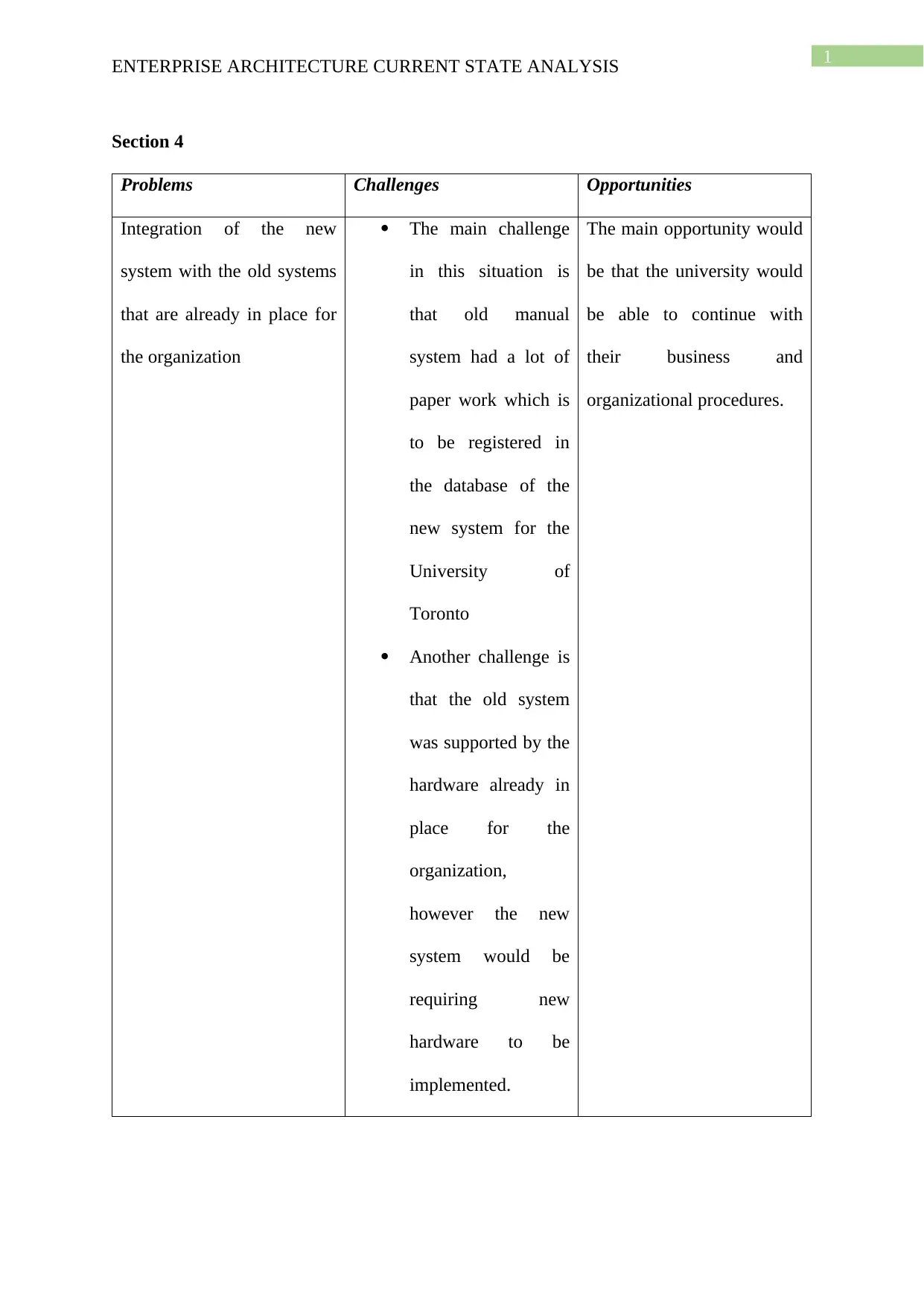
Section 4
Problems Challenges Opportunities
Integration of the new
system with the old systems
that are already in place for
the organization
The main challenge
in this situation is
that old manual
system had a lot of
paper work which is
to be registered in
the database of the
new system for the
University of
Toronto
Another challenge is
that the old system
was supported by the
hardware already in
place for the
organization,
however the new
system would be
requiring new
hardware to be
implemented.
The main opportunity would
be that the university would
be able to continue with
their business and
organizational procedures.
Document Page
2
ENTERPRISE ARCHITECTURE CURRENT STATE ANALYSIS
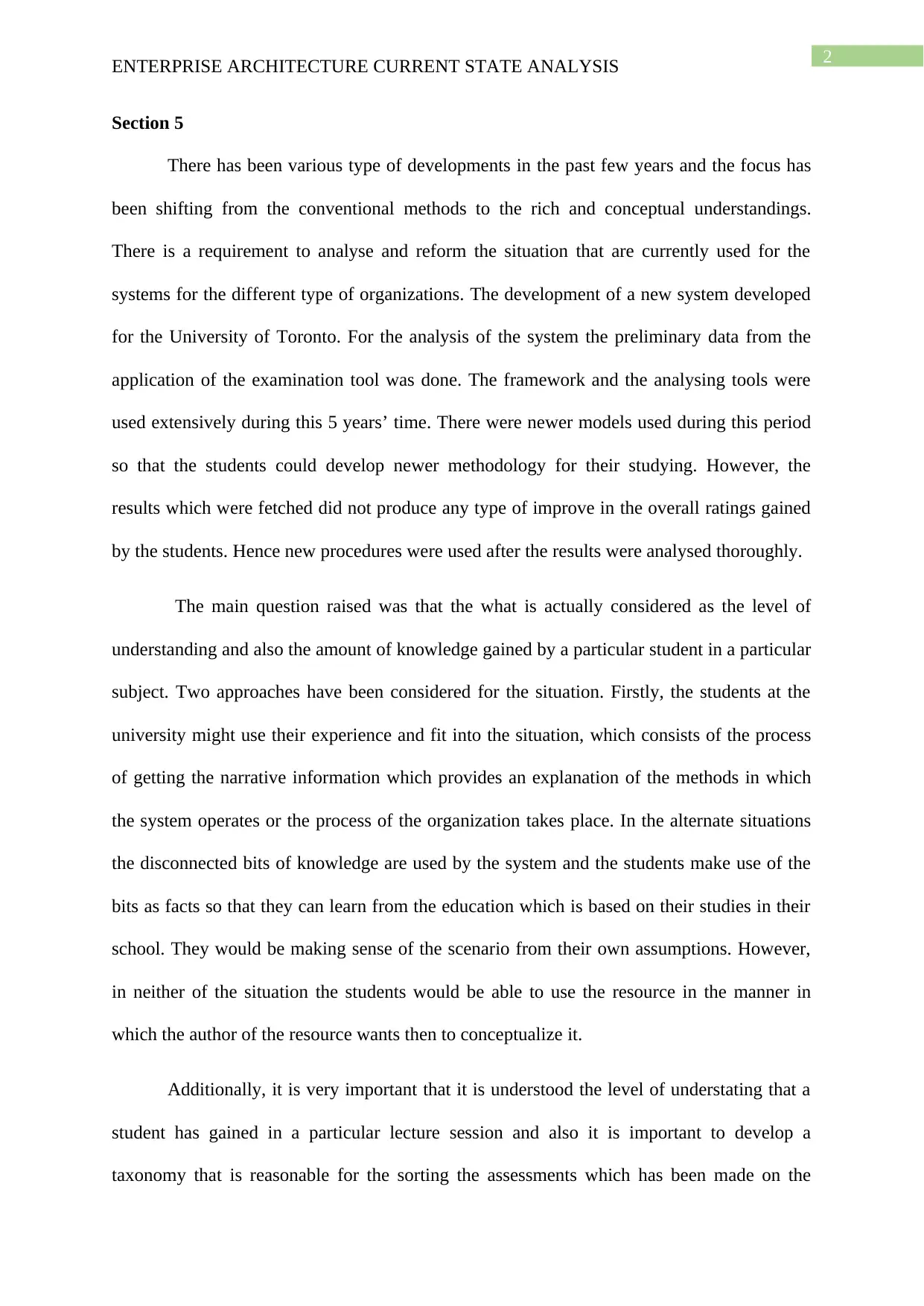
Section 5
There has been various type of developments in the past few years and the focus has
been shifting from the conventional methods to the rich and conceptual understandings.
There is a requirement to analyse and reform the situation that are currently used for the
systems for the different type of organizations. The development of a new system developed
for the University of Toronto. For the analysis of the system the preliminary data from the
application of the examination tool was done. The framework and the analysing tools were
used extensively during this 5 years’ time. There were newer models used during this period
so that the students could develop newer methodology for their studying. However, the
results which were fetched did not produce any type of improve in the overall ratings gained
by the students. Hence new procedures were used after the results were analysed thoroughly.
The main question raised was that the what is actually considered as the level of
understanding and also the amount of knowledge gained by a particular student in a particular
subject. Two approaches have been considered for the situation. Firstly, the students at the
university might use their experience and fit into the situation, which consists of the process
of getting the narrative information which provides an explanation of the methods in which
the system operates or the process of the organization takes place. In the alternate situations
the disconnected bits of knowledge are used by the system and the students make use of the
bits as facts so that they can learn from the education which is based on their studies in their
school. They would be making sense of the scenario from their own assumptions. However,
in neither of the situation the students would be able to use the resource in the manner in
which the author of the resource wants then to conceptualize it.
Additionally, it is very important that it is understood the level of understating that a
student has gained in a particular lecture session and also it is important to develop a
taxonomy that is reasonable for the sorting the assessments which has been made on the
Document Page
3
ENTERPRISE ARCHITECTURE CURRENT STATE ANALYSIS
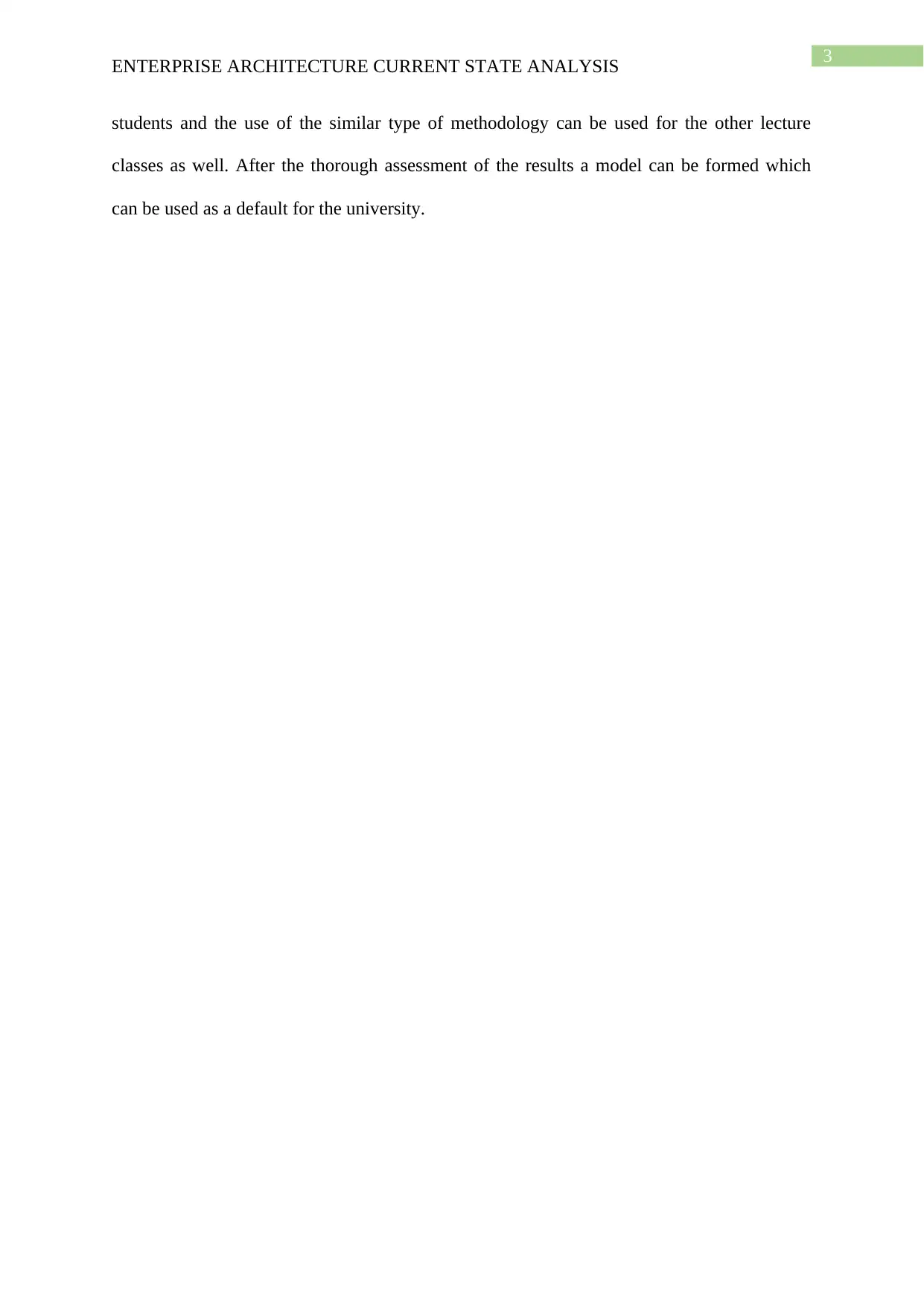
students and the use of the similar type of methodology can be used for the other lecture
classes as well. After the thorough assessment of the results a model can be formed which
can be used as a default for the university.
tabler-icon-diamond-filled.svg

Paraphrase This Document

Need a fresh take? Get an instant paraphrase of this document with our AI Paraphraser
Document Page
4
ENTERPRISE ARCHITECTURE CURRENT STATE ANALYSIS
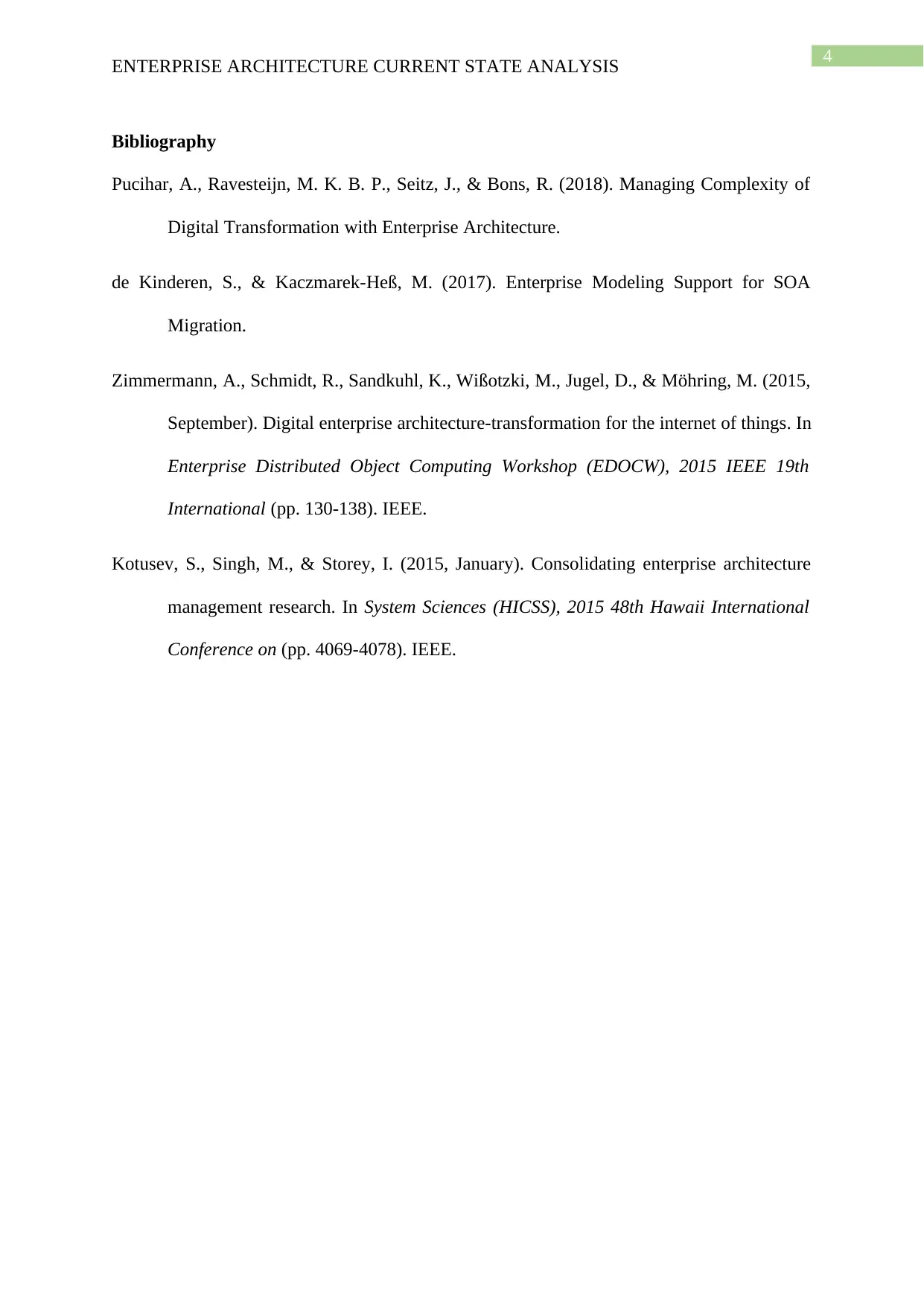
Bibliography
Pucihar, A., Ravesteijn, M. K. B. P., Seitz, J., & Bons, R. (2018). Managing Complexity of
Digital Transformation with Enterprise Architecture.
de Kinderen, S., & Kaczmarek-Heß, M. (2017). Enterprise Modeling Support for SOA
Migration.
Zimmermann, A., Schmidt, R., Sandkuhl, K., Wißotzki, M., Jugel, D., & Möhring, M. (2015,
September). Digital enterprise architecture-transformation for the internet of things. In
Enterprise Distributed Object Computing Workshop (EDOCW), 2015 IEEE 19th
International (pp. 130-138). IEEE.
Kotusev, S., Singh, M., & Storey, I. (2015, January). Consolidating enterprise architecture
management research. In System Sciences (HICSS), 2015 48th Hawaii International
Conference on (pp. 4069-4078). IEEE.
chevron_up_icon
1 out of 5
circle_padding
hide_on_mobile
zoom_out_icon
[object Object]