Report on Enterprise Architecture Concepts for Transport Industry
VerifiedAdded on 2022/08/24
|14
|4783
|22
Report
AI Summary
This report, prepared by a student for a university assignment, explores the application of Enterprise Architecture concepts to transform the transport industry in Australia. The core focus is on the implementation of feeder networks using technologies like driverless cars to improve public transport accessibility, particularly in less densely populated areas. The report identifies key stakeholders, outlines a business concept with a vision for the future, and details a strategy for implementation, including strategic goals and principles. It examines the value proposition for stakeholders, analyzes potential changes in stakeholder relationships and competitive positions, and addresses technological and financial viability. The report also includes a brief strategic analysis and considers a staged approach to the transformation, acknowledging the need to adapt to evolving technologies and market conditions. The study uses Infrastructure Australia's guidelines to provide recommendations for designing a solution that could be the basis of a transport industry transformation strategy.
Enterprise Architecture Concepts. Assignment 1. Semester 1 2019
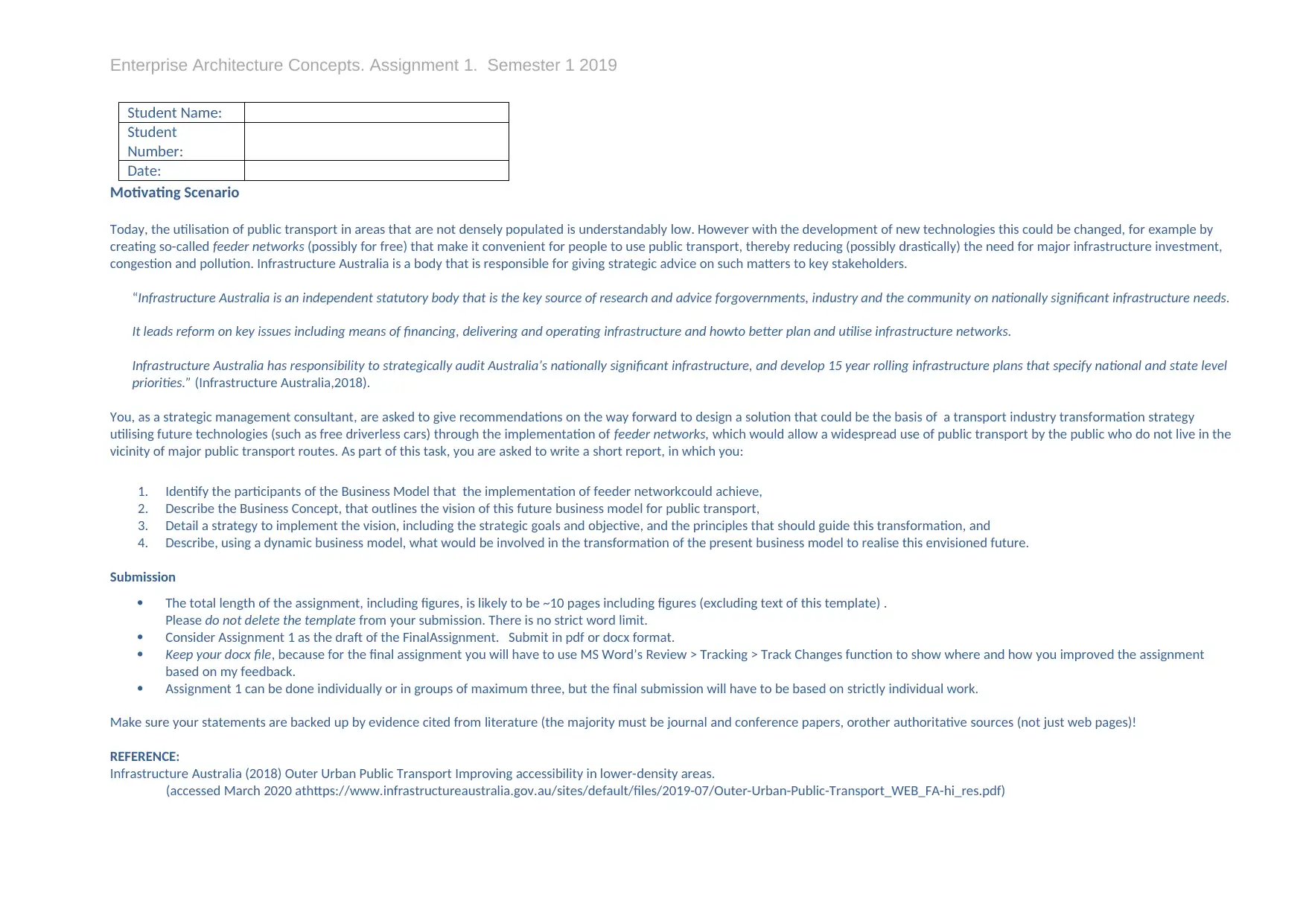
Motivating Scenario
Today, the utilisation of public transport in areas that are not densely populated is understandably low. However with the development of new technologies this could be changed, for example by
creating so-called feeder networks (possibly for free) that make it convenient for people to use public transport, thereby reducing (possibly drastically) the need for major infrastructure investment,
congestion and pollution. Infrastructure Australia is a body that is responsible for giving strategic advice on such matters to key stakeholders.
“Infrastructure Australia is an independent statutory body that is the key source of research and advice forgovernments, industry and the community on nationally significant infrastructure needs.
It leads reform on key issues including means of financing, delivering and operating infrastructure and howto better plan and utilise infrastructure networks.
Infrastructure Australia has responsibility to strategically audit Australia’s nationally significant infrastructure, and develop 15 year rolling infrastructure plans that specify national and state level
priorities.” (Infrastructure Australia,2018).
You, as a strategic management consultant, are asked to give recommendations on the way forward to design a solution that could be the basis of a transport industry transformation strategy
utilising future technologies (such as free driverless cars) through the implementation of feeder networks, which would allow a widespread use of public transport by the public who do not live in the
vicinity of major public transport routes. As part of this task, you are asked to write a short report, in which you:
1. Identify the participants of the Business Model that the implementation of feeder networkcould achieve,
2. Describe the Business Concept, that outlines the vision of this future business model for public transport,
3. Detail a strategy to implement the vision, including the strategic goals and objective, and the principles that should guide this transformation, and
4. Describe, using a dynamic business model, what would be involved in the transformation of the present business model to realise this envisioned future.
Submission
The total length of the assignment, including figures, is likely to be ~10 pages including figures (excluding text of this template) .
Please do not delete the template from your submission. There is no strict word limit.
Consider Assignment 1 as the draft of the FinalAssignment. Submit in pdf or docx format.
Keep your docx file, because for the final assignment you will have to use MS Word’s Review > Tracking > Track Changes function to show where and how you improved the assignment
based on my feedback.
Assignment 1 can be done individually or in groups of maximum three, but the final submission will have to be based on strictly individual work.
Make sure your statements are backed up by evidence cited from literature (the majority must be journal and conference papers, orother authoritative sources (not just web pages)!
REFERENCE:
Infrastructure Australia (2018) Outer Urban Public Transport Improving accessibility in lower-density areas.
(accessed March 2020 athttps://www.infrastructureaustralia.gov.au/sites/default/files/2019-07/Outer-Urban-Public-Transport_WEB_FA-hi_res.pdf)
Student Name:
Student
Number:
Date:
Motivating Scenario
Today, the utilisation of public transport in areas that are not densely populated is understandably low. However with the development of new technologies this could be changed, for example by
creating so-called feeder networks (possibly for free) that make it convenient for people to use public transport, thereby reducing (possibly drastically) the need for major infrastructure investment,
congestion and pollution. Infrastructure Australia is a body that is responsible for giving strategic advice on such matters to key stakeholders.
“Infrastructure Australia is an independent statutory body that is the key source of research and advice forgovernments, industry and the community on nationally significant infrastructure needs.
It leads reform on key issues including means of financing, delivering and operating infrastructure and howto better plan and utilise infrastructure networks.
Infrastructure Australia has responsibility to strategically audit Australia’s nationally significant infrastructure, and develop 15 year rolling infrastructure plans that specify national and state level
priorities.” (Infrastructure Australia,2018).
You, as a strategic management consultant, are asked to give recommendations on the way forward to design a solution that could be the basis of a transport industry transformation strategy
utilising future technologies (such as free driverless cars) through the implementation of feeder networks, which would allow a widespread use of public transport by the public who do not live in the
vicinity of major public transport routes. As part of this task, you are asked to write a short report, in which you:
1. Identify the participants of the Business Model that the implementation of feeder networkcould achieve,
2. Describe the Business Concept, that outlines the vision of this future business model for public transport,
3. Detail a strategy to implement the vision, including the strategic goals and objective, and the principles that should guide this transformation, and
4. Describe, using a dynamic business model, what would be involved in the transformation of the present business model to realise this envisioned future.
Submission
The total length of the assignment, including figures, is likely to be ~10 pages including figures (excluding text of this template) .
Please do not delete the template from your submission. There is no strict word limit.
Consider Assignment 1 as the draft of the FinalAssignment. Submit in pdf or docx format.
Keep your docx file, because for the final assignment you will have to use MS Word’s Review > Tracking > Track Changes function to show where and how you improved the assignment
based on my feedback.
Assignment 1 can be done individually or in groups of maximum three, but the final submission will have to be based on strictly individual work.
Make sure your statements are backed up by evidence cited from literature (the majority must be journal and conference papers, orother authoritative sources (not just web pages)!
REFERENCE:
Infrastructure Australia (2018) Outer Urban Public Transport Improving accessibility in lower-density areas.
(accessed March 2020 athttps://www.infrastructureaustralia.gov.au/sites/default/files/2019-07/Outer-Urban-Public-Transport_WEB_FA-hi_res.pdf)
Student Name:
Student
Number:
Date:

Paraphrase This Document
Need a fresh take? Get an instant paraphrase of this document with our AI Paraphraser
Enterprise Architecture Concepts. Assignment 1. Semester 1 2019
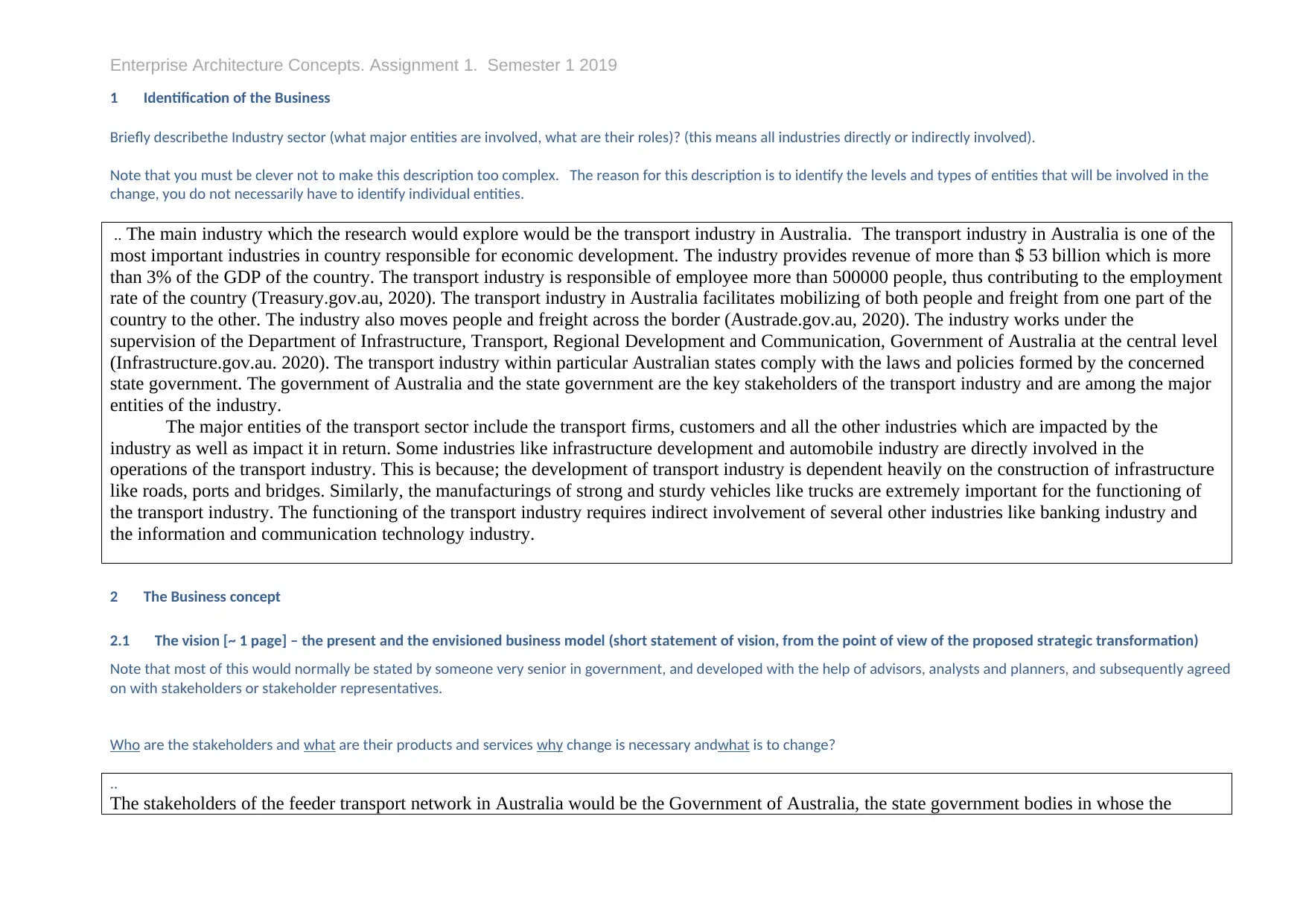
1 Identification of the Business
Briefly describethe Industry sector (what major entities are involved, what are their roles)? (this means all industries directly or indirectly involved).
Note that you must be clever not to make this description too complex. The reason for this description is to identify the levels and types of entities that will be involved in the
change, you do not necessarily have to identify individual entities.
.. The main industry which the research would explore would be the transport industry in Australia. The transport industry in Australia is one of the
most important industries in country responsible for economic development. The industry provides revenue of more than $ 53 billion which is more
than 3% of the GDP of the country. The transport industry is responsible of employee more than 500000 people, thus contributing to the employment
rate of the country (Treasury.gov.au, 2020). The transport industry in Australia facilitates mobilizing of both people and freight from one part of the
country to the other. The industry also moves people and freight across the border (Austrade.gov.au, 2020). The industry works under the
supervision of the Department of Infrastructure, Transport, Regional Development and Communication, Government of Australia at the central level
(Infrastructure.gov.au. 2020). The transport industry within particular Australian states comply with the laws and policies formed by the concerned
state government. The government of Australia and the state government are the key stakeholders of the transport industry and are among the major
entities of the industry.
The major entities of the transport sector include the transport firms, customers and all the other industries which are impacted by the
industry as well as impact it in return. Some industries like infrastructure development and automobile industry are directly involved in the
operations of the transport industry. This is because; the development of transport industry is dependent heavily on the construction of infrastructure
like roads, ports and bridges. Similarly, the manufacturings of strong and sturdy vehicles like trucks are extremely important for the functioning of
the transport industry. The functioning of the transport industry requires indirect involvement of several other industries like banking industry and
the information and communication technology industry.
2 The Business concept
2.1 The vision [~ 1 page] – the present and the envisioned business model (short statement of vision, from the point of view of the proposed strategic transformation)
Note that most of this would normally be stated by someone very senior in government, and developed with the help of advisors, analysts and planners, and subsequently agreed
on with stakeholders or stakeholder representatives.
Who are the stakeholders and what are their products and services why change is necessary andwhat is to change?
..
The stakeholders of the feeder transport network in Australia would be the Government of Australia, the state government bodies in whose the
1 Identification of the Business
Briefly describethe Industry sector (what major entities are involved, what are their roles)? (this means all industries directly or indirectly involved).
Note that you must be clever not to make this description too complex. The reason for this description is to identify the levels and types of entities that will be involved in the
change, you do not necessarily have to identify individual entities.
.. The main industry which the research would explore would be the transport industry in Australia. The transport industry in Australia is one of the
most important industries in country responsible for economic development. The industry provides revenue of more than $ 53 billion which is more
than 3% of the GDP of the country. The transport industry is responsible of employee more than 500000 people, thus contributing to the employment
rate of the country (Treasury.gov.au, 2020). The transport industry in Australia facilitates mobilizing of both people and freight from one part of the
country to the other. The industry also moves people and freight across the border (Austrade.gov.au, 2020). The industry works under the
supervision of the Department of Infrastructure, Transport, Regional Development and Communication, Government of Australia at the central level
(Infrastructure.gov.au. 2020). The transport industry within particular Australian states comply with the laws and policies formed by the concerned
state government. The government of Australia and the state government are the key stakeholders of the transport industry and are among the major
entities of the industry.
The major entities of the transport sector include the transport firms, customers and all the other industries which are impacted by the
industry as well as impact it in return. Some industries like infrastructure development and automobile industry are directly involved in the
operations of the transport industry. This is because; the development of transport industry is dependent heavily on the construction of infrastructure
like roads, ports and bridges. Similarly, the manufacturings of strong and sturdy vehicles like trucks are extremely important for the functioning of
the transport industry. The functioning of the transport industry requires indirect involvement of several other industries like banking industry and
the information and communication technology industry.
2 The Business concept
2.1 The vision [~ 1 page] – the present and the envisioned business model (short statement of vision, from the point of view of the proposed strategic transformation)
Note that most of this would normally be stated by someone very senior in government, and developed with the help of advisors, analysts and planners, and subsequently agreed
on with stakeholders or stakeholder representatives.
Who are the stakeholders and what are their products and services why change is necessary andwhat is to change?
..
The stakeholders of the feeder transport network in Australia would be the Government of Australia, the state government bodies in whose the
Enterprise Architecture Concepts. Assignment 1. Semester 1 2019
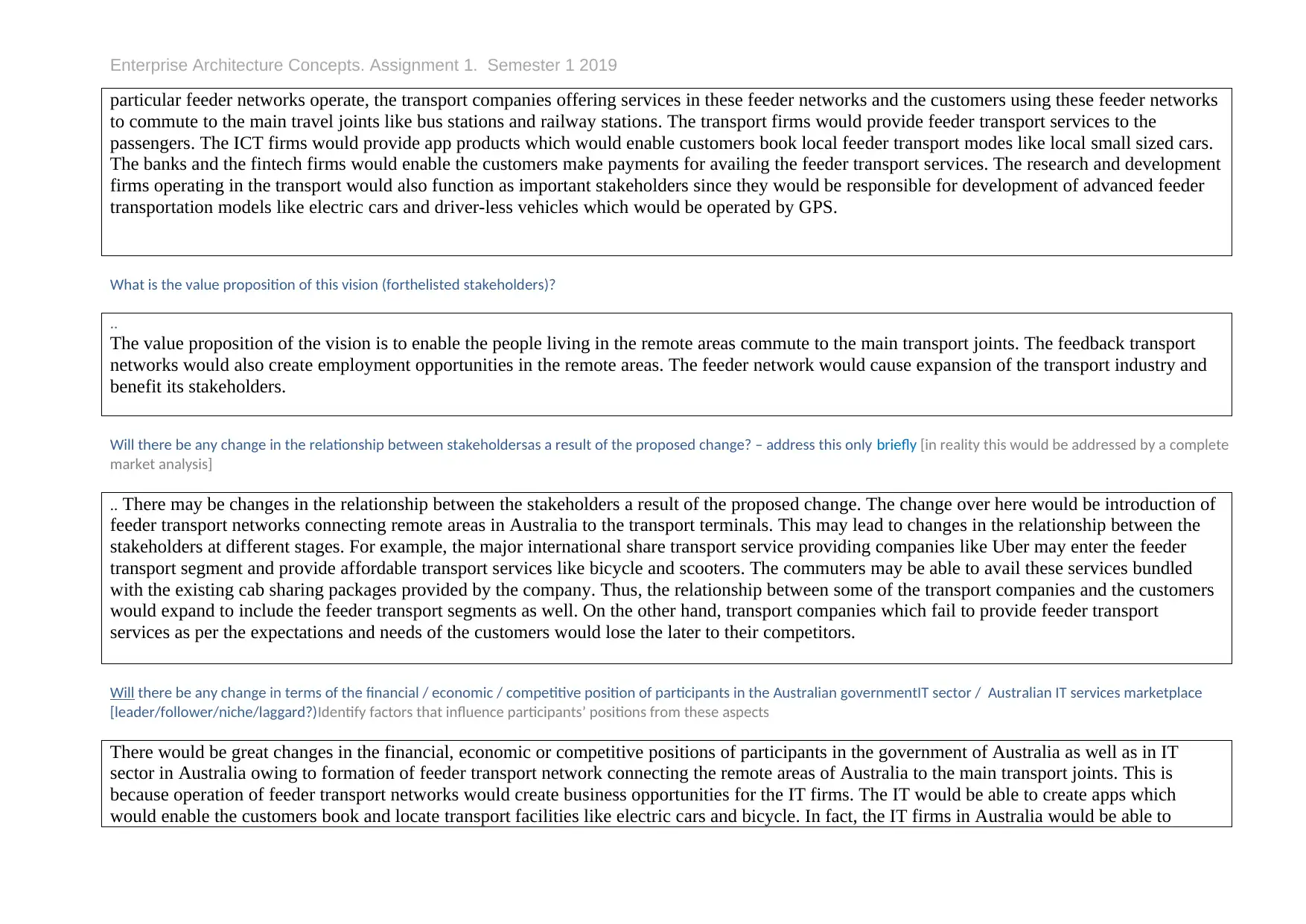
particular feeder networks operate, the transport companies offering services in these feeder networks and the customers using these feeder networks
to commute to the main travel joints like bus stations and railway stations. The transport firms would provide feeder transport services to the
passengers. The ICT firms would provide app products which would enable customers book local feeder transport modes like local small sized cars.
The banks and the fintech firms would enable the customers make payments for availing the feeder transport services. The research and development
firms operating in the transport would also function as important stakeholders since they would be responsible for development of advanced feeder
transportation models like electric cars and driver-less vehicles which would be operated by GPS.
What is the value proposition of this vision (forthelisted stakeholders)?
..
The value proposition of the vision is to enable the people living in the remote areas commute to the main transport joints. The feedback transport
networks would also create employment opportunities in the remote areas. The feeder network would cause expansion of the transport industry and
benefit its stakeholders.
Will there be any change in the relationship between stakeholdersas a result of the proposed change? – address this only briefly [in reality this would be addressed by a complete
market analysis]
.. There may be changes in the relationship between the stakeholders a result of the proposed change. The change over here would be introduction of
feeder transport networks connecting remote areas in Australia to the transport terminals. This may lead to changes in the relationship between the
stakeholders at different stages. For example, the major international share transport service providing companies like Uber may enter the feeder
transport segment and provide affordable transport services like bicycle and scooters. The commuters may be able to avail these services bundled
with the existing cab sharing packages provided by the company. Thus, the relationship between some of the transport companies and the customers
would expand to include the feeder transport segments as well. On the other hand, transport companies which fail to provide feeder transport
services as per the expectations and needs of the customers would lose the later to their competitors.
Will there be any change in terms of the financial / economic / competitive position of participants in the Australian governmentIT sector / Australian IT services marketplace
[leader/follower/niche/laggard?)Identify factors that influence participants’ positions from these aspects
There would be great changes in the financial, economic or competitive positions of participants in the government of Australia as well as in IT
sector in Australia owing to formation of feeder transport network connecting the remote areas of Australia to the main transport joints. This is
because operation of feeder transport networks would create business opportunities for the IT firms. The IT would be able to create apps which
would enable the customers book and locate transport facilities like electric cars and bicycle. In fact, the IT firms in Australia would be able to
particular feeder networks operate, the transport companies offering services in these feeder networks and the customers using these feeder networks
to commute to the main travel joints like bus stations and railway stations. The transport firms would provide feeder transport services to the
passengers. The ICT firms would provide app products which would enable customers book local feeder transport modes like local small sized cars.
The banks and the fintech firms would enable the customers make payments for availing the feeder transport services. The research and development
firms operating in the transport would also function as important stakeholders since they would be responsible for development of advanced feeder
transportation models like electric cars and driver-less vehicles which would be operated by GPS.
What is the value proposition of this vision (forthelisted stakeholders)?
..
The value proposition of the vision is to enable the people living in the remote areas commute to the main transport joints. The feedback transport
networks would also create employment opportunities in the remote areas. The feeder network would cause expansion of the transport industry and
benefit its stakeholders.
Will there be any change in the relationship between stakeholdersas a result of the proposed change? – address this only briefly [in reality this would be addressed by a complete
market analysis]
.. There may be changes in the relationship between the stakeholders a result of the proposed change. The change over here would be introduction of
feeder transport networks connecting remote areas in Australia to the transport terminals. This may lead to changes in the relationship between the
stakeholders at different stages. For example, the major international share transport service providing companies like Uber may enter the feeder
transport segment and provide affordable transport services like bicycle and scooters. The commuters may be able to avail these services bundled
with the existing cab sharing packages provided by the company. Thus, the relationship between some of the transport companies and the customers
would expand to include the feeder transport segments as well. On the other hand, transport companies which fail to provide feeder transport
services as per the expectations and needs of the customers would lose the later to their competitors.
Will there be any change in terms of the financial / economic / competitive position of participants in the Australian governmentIT sector / Australian IT services marketplace
[leader/follower/niche/laggard?)Identify factors that influence participants’ positions from these aspects
There would be great changes in the financial, economic or competitive positions of participants in the government of Australia as well as in IT
sector in Australia owing to formation of feeder transport network connecting the remote areas of Australia to the main transport joints. This is
because operation of feeder transport networks would create business opportunities for the IT firms. The IT would be able to create apps which
would enable the customers book and locate transport facilities like electric cars and bicycle. In fact, the IT firms in Australia would be able to
⊘ This is a preview!⊘
Do you want full access?
Subscribe today to unlock all pages.

Trusted by 1+ million students worldwide
Enterprise Architecture Concepts. Assignment 1. Semester 1 2019
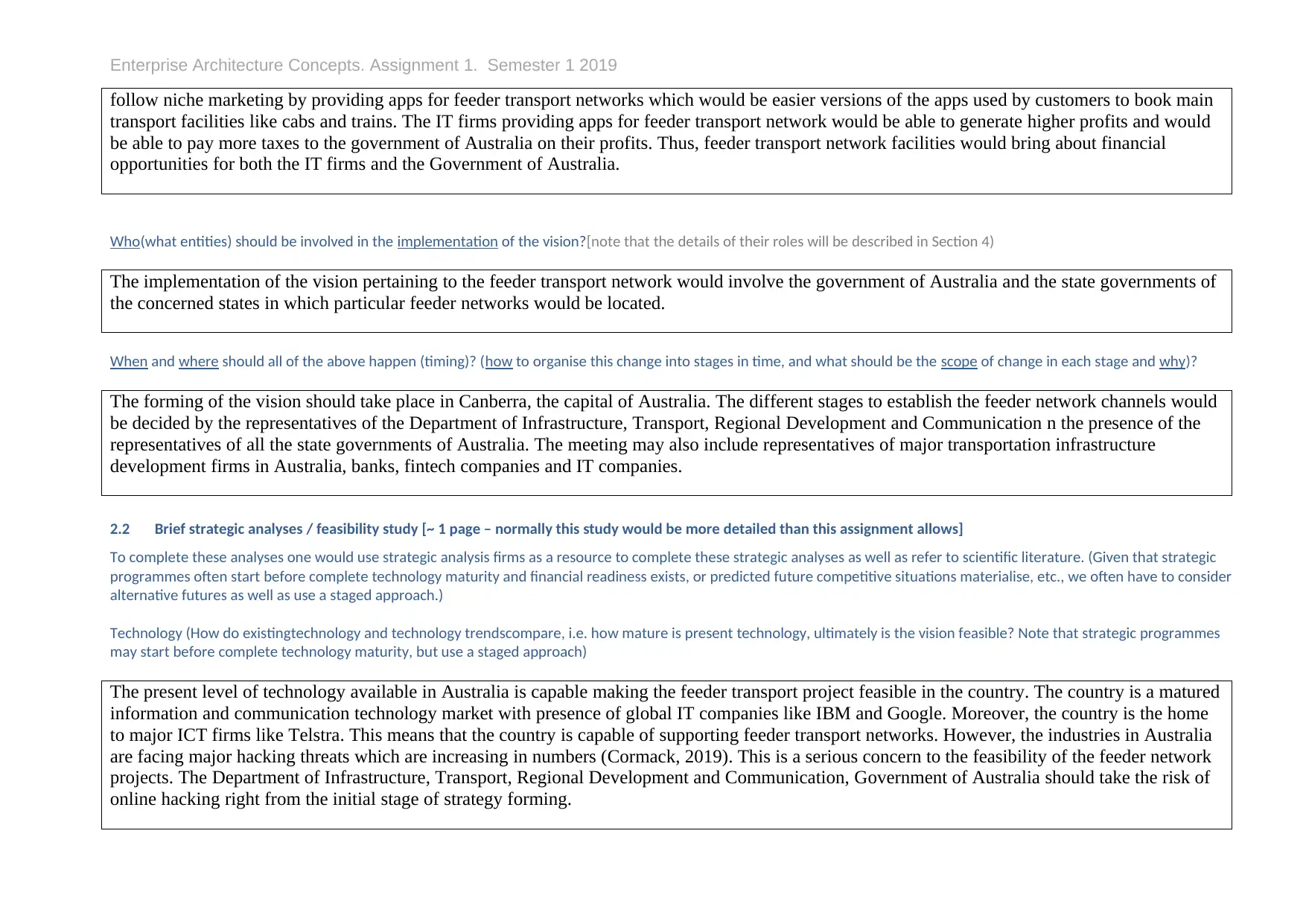
follow niche marketing by providing apps for feeder transport networks which would be easier versions of the apps used by customers to book main
transport facilities like cabs and trains. The IT firms providing apps for feeder transport network would be able to generate higher profits and would
be able to pay more taxes to the government of Australia on their profits. Thus, feeder transport network facilities would bring about financial
opportunities for both the IT firms and the Government of Australia.
Who(what entities) should be involved in the implementation of the vision?[note that the details of their roles will be described in Section 4)
The implementation of the vision pertaining to the feeder transport network would involve the government of Australia and the state governments of
the concerned states in which particular feeder networks would be located.
When and where should all of the above happen (timing)? (how to organise this change into stages in time, and what should be the scope of change in each stage and why)?
The forming of the vision should take place in Canberra, the capital of Australia. The different stages to establish the feeder network channels would
be decided by the representatives of the Department of Infrastructure, Transport, Regional Development and Communication n the presence of the
representatives of all the state governments of Australia. The meeting may also include representatives of major transportation infrastructure
development firms in Australia, banks, fintech companies and IT companies.
2.2 Brief strategic analyses / feasibility study [~ 1 page – normally this study would be more detailed than this assignment allows]
To complete these analyses one would use strategic analysis firms as a resource to complete these strategic analyses as well as refer to scientific literature. (Given that strategic
programmes often start before complete technology maturity and financial readiness exists, or predicted future competitive situations materialise, etc., we often have to consider
alternative futures as well as use a staged approach.)
Technology (How do existingtechnology and technology trendscompare, i.e. how mature is present technology, ultimately is the vision feasible? Note that strategic programmes
may start before complete technology maturity, but use a staged approach)
The present level of technology available in Australia is capable making the feeder transport project feasible in the country. The country is a matured
information and communication technology market with presence of global IT companies like IBM and Google. Moreover, the country is the home
to major ICT firms like Telstra. This means that the country is capable of supporting feeder transport networks. However, the industries in Australia
are facing major hacking threats which are increasing in numbers (Cormack, 2019). This is a serious concern to the feasibility of the feeder network
projects. The Department of Infrastructure, Transport, Regional Development and Communication, Government of Australia should take the risk of
online hacking right from the initial stage of strategy forming.
follow niche marketing by providing apps for feeder transport networks which would be easier versions of the apps used by customers to book main
transport facilities like cabs and trains. The IT firms providing apps for feeder transport network would be able to generate higher profits and would
be able to pay more taxes to the government of Australia on their profits. Thus, feeder transport network facilities would bring about financial
opportunities for both the IT firms and the Government of Australia.
Who(what entities) should be involved in the implementation of the vision?[note that the details of their roles will be described in Section 4)
The implementation of the vision pertaining to the feeder transport network would involve the government of Australia and the state governments of
the concerned states in which particular feeder networks would be located.
When and where should all of the above happen (timing)? (how to organise this change into stages in time, and what should be the scope of change in each stage and why)?
The forming of the vision should take place in Canberra, the capital of Australia. The different stages to establish the feeder network channels would
be decided by the representatives of the Department of Infrastructure, Transport, Regional Development and Communication n the presence of the
representatives of all the state governments of Australia. The meeting may also include representatives of major transportation infrastructure
development firms in Australia, banks, fintech companies and IT companies.
2.2 Brief strategic analyses / feasibility study [~ 1 page – normally this study would be more detailed than this assignment allows]
To complete these analyses one would use strategic analysis firms as a resource to complete these strategic analyses as well as refer to scientific literature. (Given that strategic
programmes often start before complete technology maturity and financial readiness exists, or predicted future competitive situations materialise, etc., we often have to consider
alternative futures as well as use a staged approach.)
Technology (How do existingtechnology and technology trendscompare, i.e. how mature is present technology, ultimately is the vision feasible? Note that strategic programmes
may start before complete technology maturity, but use a staged approach)
The present level of technology available in Australia is capable making the feeder transport project feasible in the country. The country is a matured
information and communication technology market with presence of global IT companies like IBM and Google. Moreover, the country is the home
to major ICT firms like Telstra. This means that the country is capable of supporting feeder transport networks. However, the industries in Australia
are facing major hacking threats which are increasing in numbers (Cormack, 2019). This is a serious concern to the feasibility of the feeder network
projects. The Department of Infrastructure, Transport, Regional Development and Communication, Government of Australia should take the risk of
online hacking right from the initial stage of strategy forming.
Paraphrase This Document
Need a fresh take? Get an instant paraphrase of this document with our AI Paraphraser
Enterprise Architecture Concepts. Assignment 1. Semester 1 2019
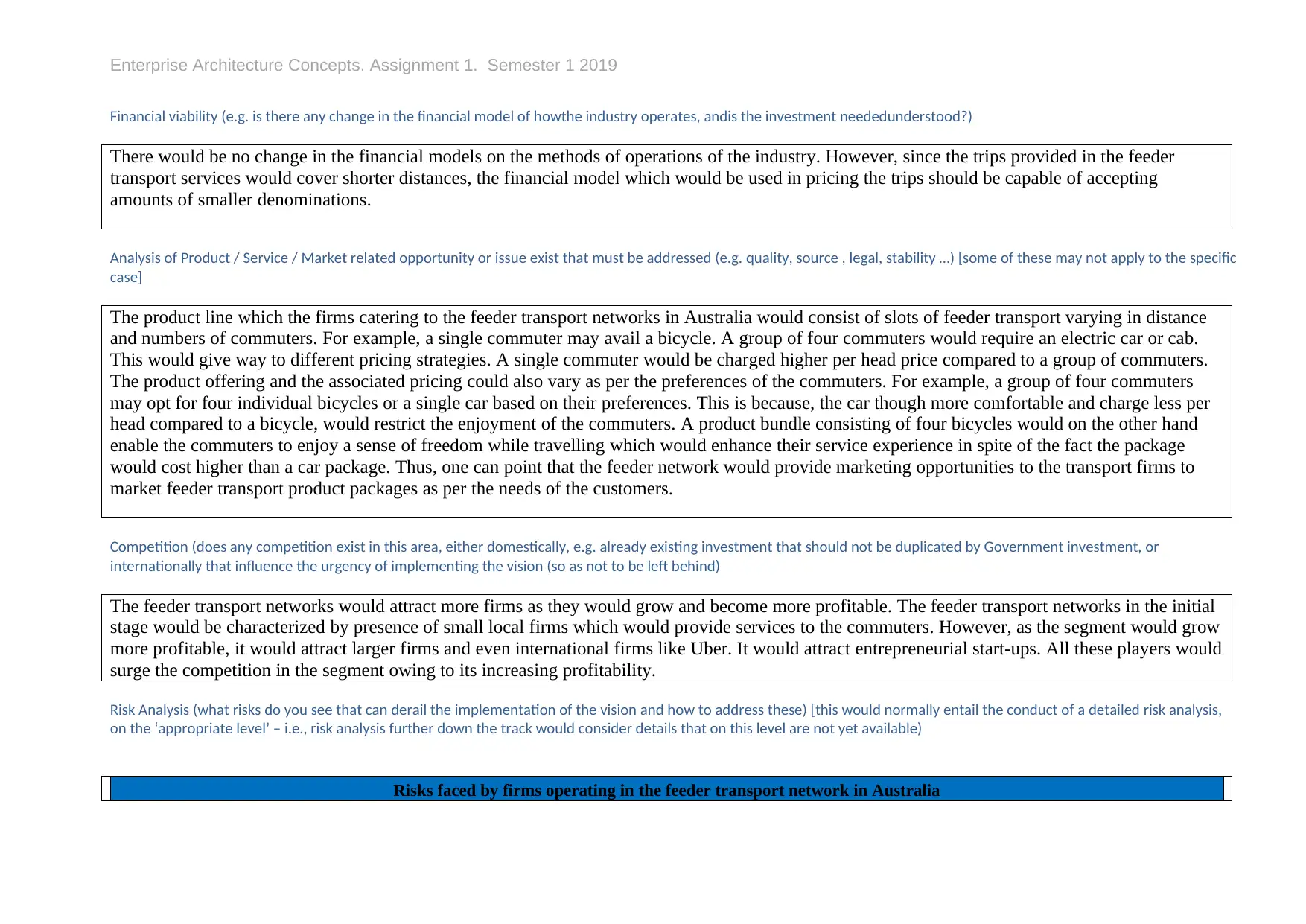
Financial viability (e.g. is there any change in the financial model of howthe industry operates, andis the investment neededunderstood?)
There would be no change in the financial models on the methods of operations of the industry. However, since the trips provided in the feeder
transport services would cover shorter distances, the financial model which would be used in pricing the trips should be capable of accepting
amounts of smaller denominations.
Analysis of Product / Service / Market related opportunity or issue exist that must be addressed (e.g. quality, source , legal, stability …) [some of these may not apply to the specific
case]
The product line which the firms catering to the feeder transport networks in Australia would consist of slots of feeder transport varying in distance
and numbers of commuters. For example, a single commuter may avail a bicycle. A group of four commuters would require an electric car or cab.
This would give way to different pricing strategies. A single commuter would be charged higher per head price compared to a group of commuters.
The product offering and the associated pricing could also vary as per the preferences of the commuters. For example, a group of four commuters
may opt for four individual bicycles or a single car based on their preferences. This is because, the car though more comfortable and charge less per
head compared to a bicycle, would restrict the enjoyment of the commuters. A product bundle consisting of four bicycles would on the other hand
enable the commuters to enjoy a sense of freedom while travelling which would enhance their service experience in spite of the fact the package
would cost higher than a car package. Thus, one can point that the feeder network would provide marketing opportunities to the transport firms to
market feeder transport product packages as per the needs of the customers.
Competition (does any competition exist in this area, either domestically, e.g. already existing investment that should not be duplicated by Government investment, or
internationally that influence the urgency of implementing the vision (so as not to be left behind)
The feeder transport networks would attract more firms as they would grow and become more profitable. The feeder transport networks in the initial
stage would be characterized by presence of small local firms which would provide services to the commuters. However, as the segment would grow
more profitable, it would attract larger firms and even international firms like Uber. It would attract entrepreneurial start-ups. All these players would
surge the competition in the segment owing to its increasing profitability.
Risk Analysis (what risks do you see that can derail the implementation of the vision and how to address these) [this would normally entail the conduct of a detailed risk analysis,
on the ‘appropriate level’ – i.e., risk analysis further down the track would consider details that on this level are not yet available)
Risks faced by firms operating in the feeder transport network in Australia
Financial viability (e.g. is there any change in the financial model of howthe industry operates, andis the investment neededunderstood?)
There would be no change in the financial models on the methods of operations of the industry. However, since the trips provided in the feeder
transport services would cover shorter distances, the financial model which would be used in pricing the trips should be capable of accepting
amounts of smaller denominations.
Analysis of Product / Service / Market related opportunity or issue exist that must be addressed (e.g. quality, source , legal, stability …) [some of these may not apply to the specific
case]
The product line which the firms catering to the feeder transport networks in Australia would consist of slots of feeder transport varying in distance
and numbers of commuters. For example, a single commuter may avail a bicycle. A group of four commuters would require an electric car or cab.
This would give way to different pricing strategies. A single commuter would be charged higher per head price compared to a group of commuters.
The product offering and the associated pricing could also vary as per the preferences of the commuters. For example, a group of four commuters
may opt for four individual bicycles or a single car based on their preferences. This is because, the car though more comfortable and charge less per
head compared to a bicycle, would restrict the enjoyment of the commuters. A product bundle consisting of four bicycles would on the other hand
enable the commuters to enjoy a sense of freedom while travelling which would enhance their service experience in spite of the fact the package
would cost higher than a car package. Thus, one can point that the feeder network would provide marketing opportunities to the transport firms to
market feeder transport product packages as per the needs of the customers.
Competition (does any competition exist in this area, either domestically, e.g. already existing investment that should not be duplicated by Government investment, or
internationally that influence the urgency of implementing the vision (so as not to be left behind)
The feeder transport networks would attract more firms as they would grow and become more profitable. The feeder transport networks in the initial
stage would be characterized by presence of small local firms which would provide services to the commuters. However, as the segment would grow
more profitable, it would attract larger firms and even international firms like Uber. It would attract entrepreneurial start-ups. All these players would
surge the competition in the segment owing to its increasing profitability.
Risk Analysis (what risks do you see that can derail the implementation of the vision and how to address these) [this would normally entail the conduct of a detailed risk analysis,
on the ‘appropriate level’ – i.e., risk analysis further down the track would consider details that on this level are not yet available)
Risks faced by firms operating in the feeder transport network in Australia
Enterprise Architecture Concepts. Assignment 1. Semester 1 2019
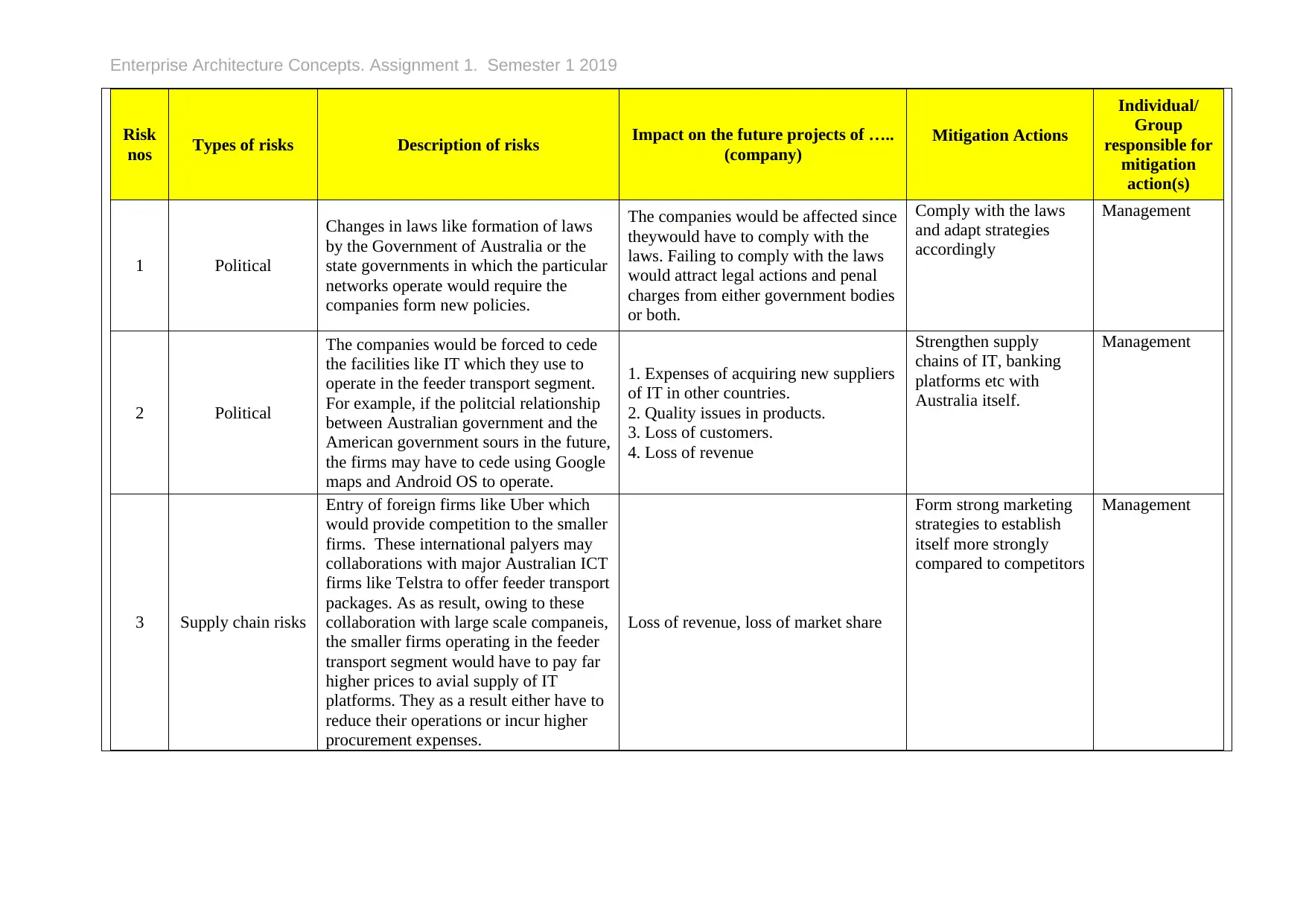
Risk
nos Types of risks Description of risks Impact on the future projects of …..
(company)
Mitigation Actions
Individual/
Group
responsible for
mitigation
action(s)
1 Political
Changes in laws like formation of laws
by the Government of Australia or the
state governments in which the particular
networks operate would require the
companies form new policies.
The companies would be affected since
theywould have to comply with the
laws. Failing to comply with the laws
would attract legal actions and penal
charges from either government bodies
or both.
Comply with the laws
and adapt strategies
accordingly
Management
2 Political
The companies would be forced to cede
the facilities like IT which they use to
operate in the feeder transport segment.
For example, if the politcial relationship
between Australian government and the
American government sours in the future,
the firms may have to cede using Google
maps and Android OS to operate.
1. Expenses of acquiring new suppliers
of IT in other countries.
2. Quality issues in products.
3. Loss of customers.
4. Loss of revenue
Strengthen supply
chains of IT, banking
platforms etc with
Australia itself.
Management
3 Supply chain risks
Entry of foreign firms like Uber which
would provide competition to the smaller
firms. These international palyers may
collaborations with major Australian ICT
firms like Telstra to offer feeder transport
packages. As as result, owing to these
collaboration with large scale companeis,
the smaller firms operating in the feeder
transport segment would have to pay far
higher prices to avial supply of IT
platforms. They as a result either have to
reduce their operations or incur higher
procurement expenses.
Loss of revenue, loss of market share
Form strong marketing
strategies to establish
itself more strongly
compared to competitors
Management
Risk
nos Types of risks Description of risks Impact on the future projects of …..
(company)
Mitigation Actions
Individual/
Group
responsible for
mitigation
action(s)
1 Political
Changes in laws like formation of laws
by the Government of Australia or the
state governments in which the particular
networks operate would require the
companies form new policies.
The companies would be affected since
theywould have to comply with the
laws. Failing to comply with the laws
would attract legal actions and penal
charges from either government bodies
or both.
Comply with the laws
and adapt strategies
accordingly
Management
2 Political
The companies would be forced to cede
the facilities like IT which they use to
operate in the feeder transport segment.
For example, if the politcial relationship
between Australian government and the
American government sours in the future,
the firms may have to cede using Google
maps and Android OS to operate.
1. Expenses of acquiring new suppliers
of IT in other countries.
2. Quality issues in products.
3. Loss of customers.
4. Loss of revenue
Strengthen supply
chains of IT, banking
platforms etc with
Australia itself.
Management
3 Supply chain risks
Entry of foreign firms like Uber which
would provide competition to the smaller
firms. These international palyers may
collaborations with major Australian ICT
firms like Telstra to offer feeder transport
packages. As as result, owing to these
collaboration with large scale companeis,
the smaller firms operating in the feeder
transport segment would have to pay far
higher prices to avial supply of IT
platforms. They as a result either have to
reduce their operations or incur higher
procurement expenses.
Loss of revenue, loss of market share
Form strong marketing
strategies to establish
itself more strongly
compared to competitors
Management
⊘ This is a preview!⊘
Do you want full access?
Subscribe today to unlock all pages.
Trusted by 1+ million students worldwide
Enterprise Architecture Concepts. Assignment 1. Semester 1 2019
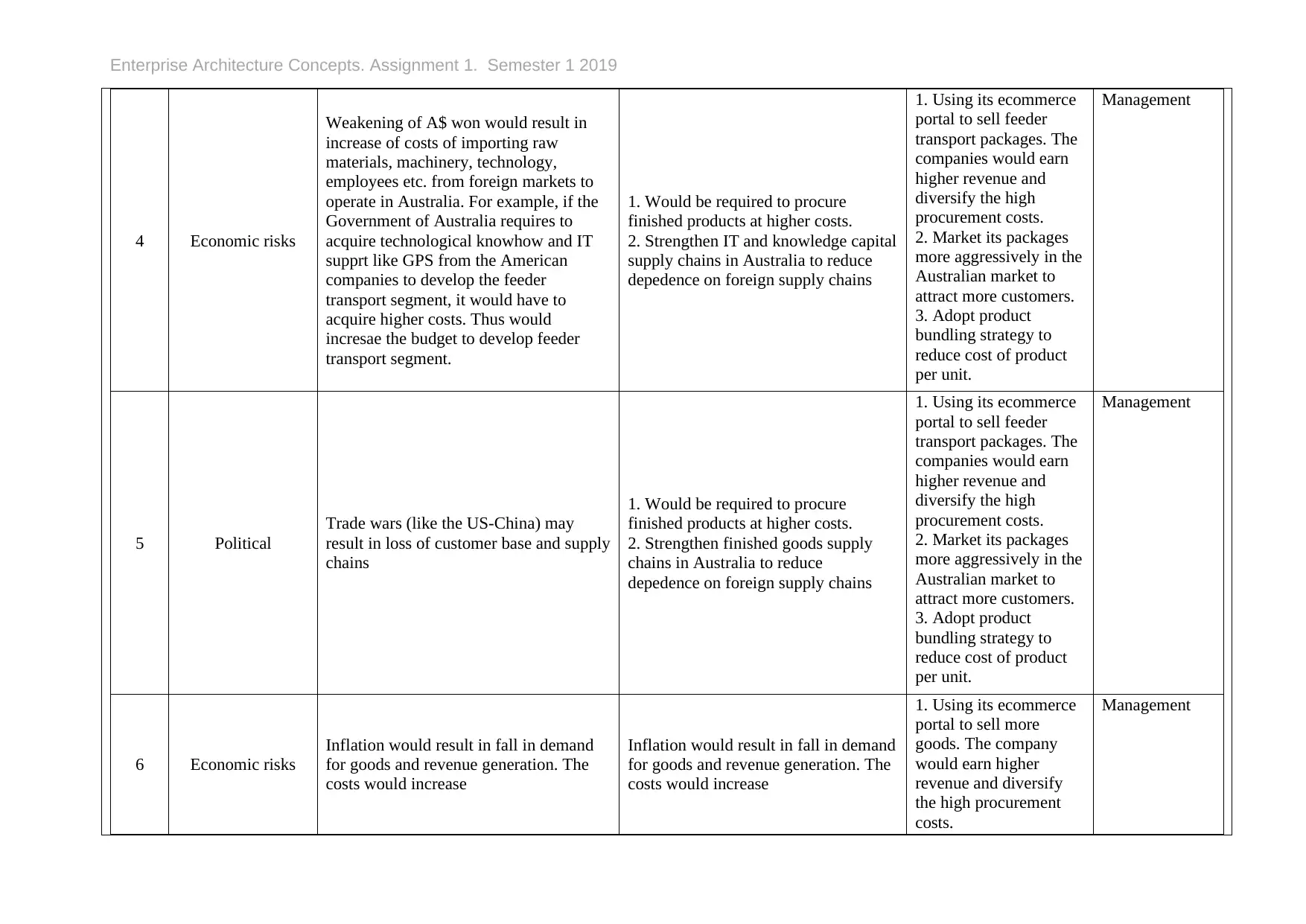
4 Economic risks
Weakening of A$ won would result in
increase of costs of importing raw
materials, machinery, technology,
employees etc. from foreign markets to
operate in Australia. For example, if the
Government of Australia requires to
acquire technological knowhow and IT
supprt like GPS from the American
companies to develop the feeder
transport segment, it would have to
acquire higher costs. Thus would
incresae the budget to develop feeder
transport segment.
1. Would be required to procure
finished products at higher costs.
2. Strengthen IT and knowledge capital
supply chains in Australia to reduce
depedence on foreign supply chains
1. Using its ecommerce
portal to sell feeder
transport packages. The
companies would earn
higher revenue and
diversify the high
procurement costs.
2. Market its packages
more aggressively in the
Australian market to
attract more customers.
3. Adopt product
bundling strategy to
reduce cost of product
per unit.
Management
5 Political
Trade wars (like the US-China) may
result in loss of customer base and supply
chains
1. Would be required to procure
finished products at higher costs.
2. Strengthen finished goods supply
chains in Australia to reduce
depedence on foreign supply chains
1. Using its ecommerce
portal to sell feeder
transport packages. The
companies would earn
higher revenue and
diversify the high
procurement costs.
2. Market its packages
more aggressively in the
Australian market to
attract more customers.
3. Adopt product
bundling strategy to
reduce cost of product
per unit.
Management
6 Economic risks
Inflation would result in fall in demand
for goods and revenue generation. The
costs would increase
Inflation would result in fall in demand
for goods and revenue generation. The
costs would increase
1. Using its ecommerce
portal to sell more
goods. The company
would earn higher
revenue and diversify
the high procurement
costs.
Management
4 Economic risks
Weakening of A$ won would result in
increase of costs of importing raw
materials, machinery, technology,
employees etc. from foreign markets to
operate in Australia. For example, if the
Government of Australia requires to
acquire technological knowhow and IT
supprt like GPS from the American
companies to develop the feeder
transport segment, it would have to
acquire higher costs. Thus would
incresae the budget to develop feeder
transport segment.
1. Would be required to procure
finished products at higher costs.
2. Strengthen IT and knowledge capital
supply chains in Australia to reduce
depedence on foreign supply chains
1. Using its ecommerce
portal to sell feeder
transport packages. The
companies would earn
higher revenue and
diversify the high
procurement costs.
2. Market its packages
more aggressively in the
Australian market to
attract more customers.
3. Adopt product
bundling strategy to
reduce cost of product
per unit.
Management
5 Political
Trade wars (like the US-China) may
result in loss of customer base and supply
chains
1. Would be required to procure
finished products at higher costs.
2. Strengthen finished goods supply
chains in Australia to reduce
depedence on foreign supply chains
1. Using its ecommerce
portal to sell feeder
transport packages. The
companies would earn
higher revenue and
diversify the high
procurement costs.
2. Market its packages
more aggressively in the
Australian market to
attract more customers.
3. Adopt product
bundling strategy to
reduce cost of product
per unit.
Management
6 Economic risks
Inflation would result in fall in demand
for goods and revenue generation. The
costs would increase
Inflation would result in fall in demand
for goods and revenue generation. The
costs would increase
1. Using its ecommerce
portal to sell more
goods. The company
would earn higher
revenue and diversify
the high procurement
costs.
Management
Paraphrase This Document
Need a fresh take? Get an instant paraphrase of this document with our AI Paraphraser
Enterprise Architecture Concepts. Assignment 1. Semester 1 2019
2. Market its goods
more aggressively in the
Australian market to
attract more customers.
3. Adopt product
bundling strategy to
reduce cost of product
per unit.
4. Recommend
Samsung to reduce its
product offering
available at competitor
retail outlets.
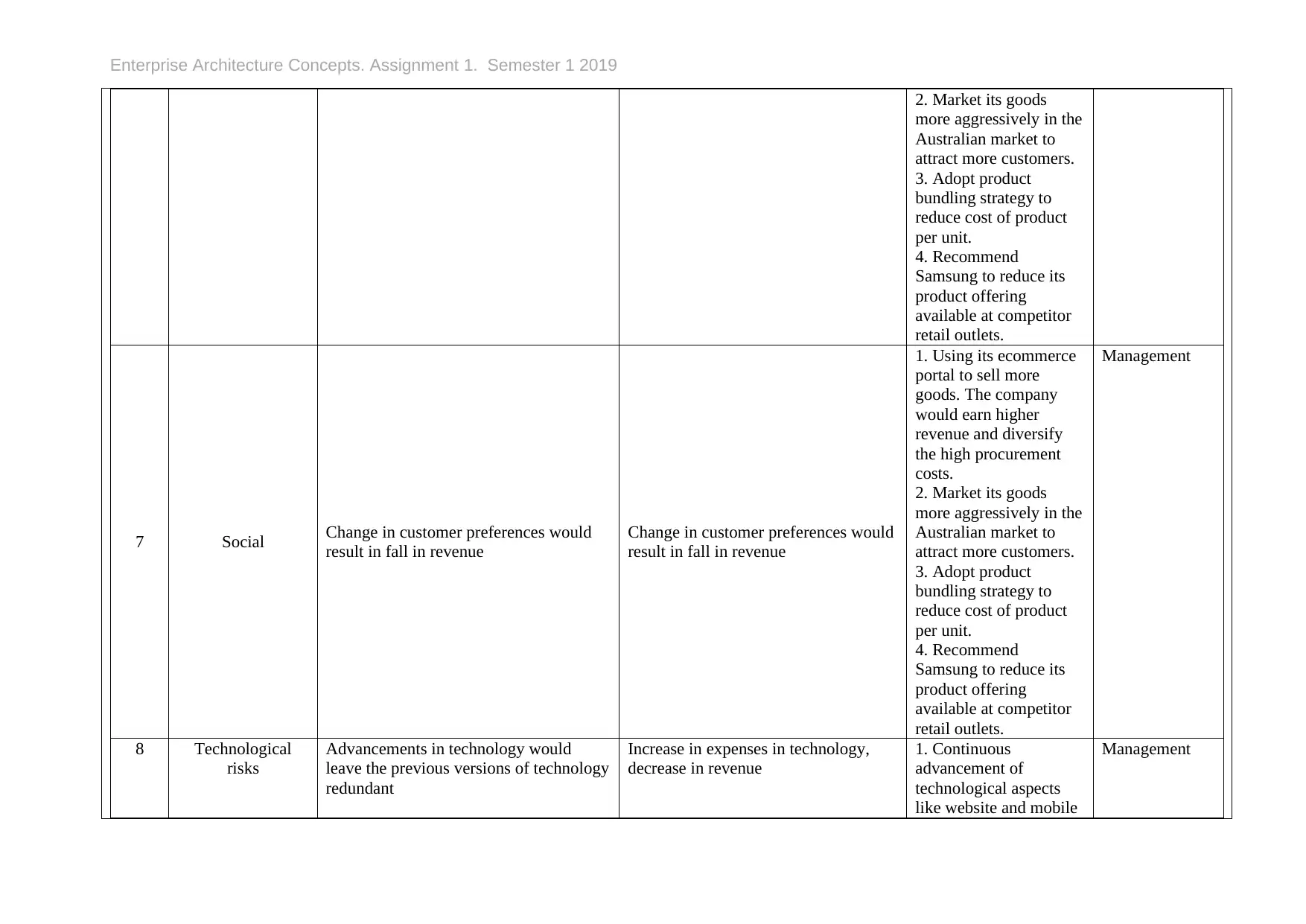
7 Social Change in customer preferences would
result in fall in revenue
Change in customer preferences would
result in fall in revenue
1. Using its ecommerce
portal to sell more
goods. The company
would earn higher
revenue and diversify
the high procurement
costs.
2. Market its goods
more aggressively in the
Australian market to
attract more customers.
3. Adopt product
bundling strategy to
reduce cost of product
per unit.
4. Recommend
Samsung to reduce its
product offering
available at competitor
retail outlets.
Management
8 Technological
risks
Advancements in technology would
leave the previous versions of technology
redundant
Increase in expenses in technology,
decrease in revenue
1. Continuous
advancement of
technological aspects
like website and mobile
Management
2. Market its goods
more aggressively in the
Australian market to
attract more customers.
3. Adopt product
bundling strategy to
reduce cost of product
per unit.
4. Recommend
Samsung to reduce its
product offering
available at competitor
retail outlets.
7 Social Change in customer preferences would
result in fall in revenue
Change in customer preferences would
result in fall in revenue
1. Using its ecommerce
portal to sell more
goods. The company
would earn higher
revenue and diversify
the high procurement
costs.
2. Market its goods
more aggressively in the
Australian market to
attract more customers.
3. Adopt product
bundling strategy to
reduce cost of product
per unit.
4. Recommend
Samsung to reduce its
product offering
available at competitor
retail outlets.
Management
8 Technological
risks
Advancements in technology would
leave the previous versions of technology
redundant
Increase in expenses in technology,
decrease in revenue
1. Continuous
advancement of
technological aspects
like website and mobile
Management
Enterprise Architecture Concepts. Assignment 1. Semester 1 2019
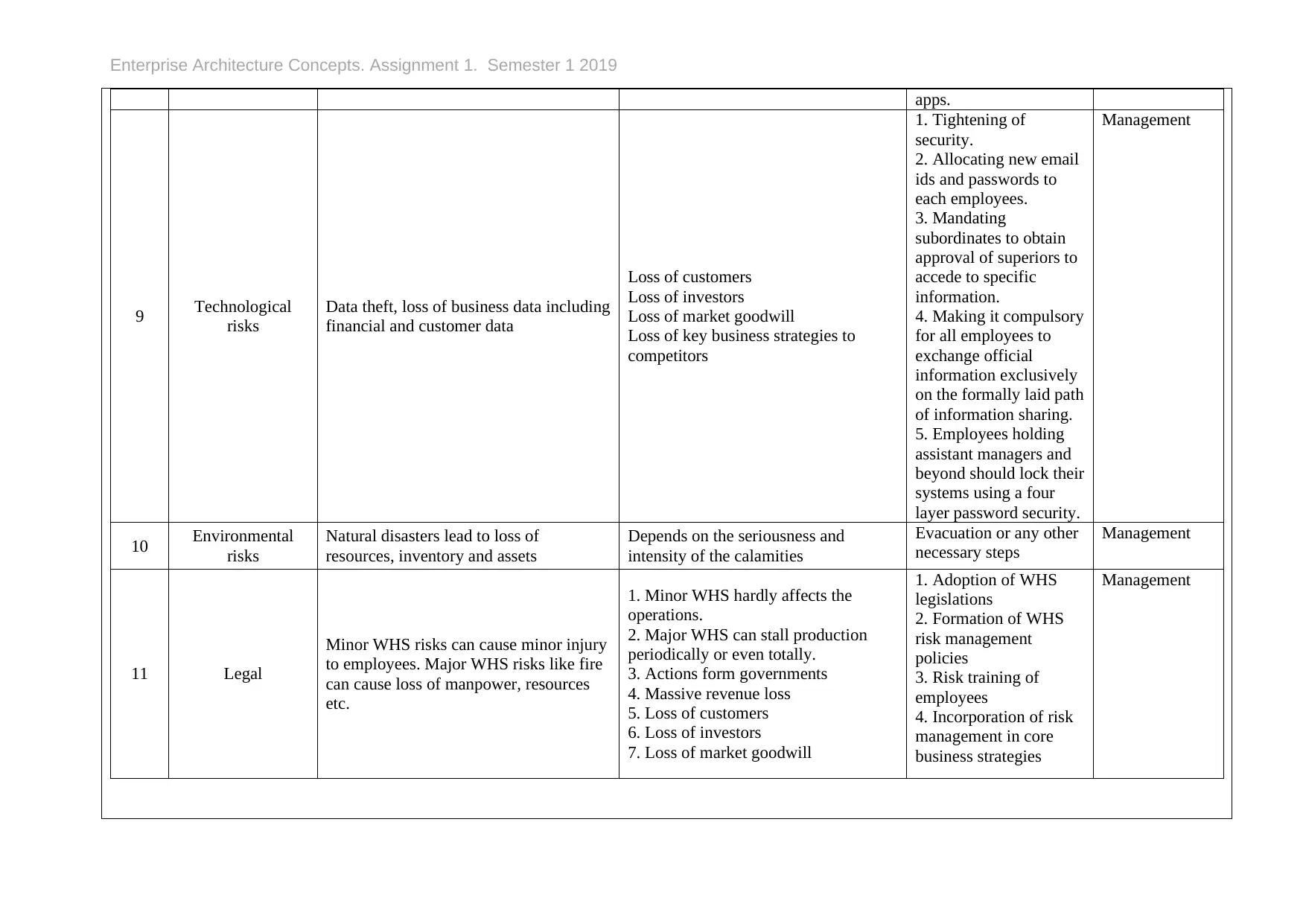
apps.
9 Technological
risks
Data theft, loss of business data including
financial and customer data
Loss of customers
Loss of investors
Loss of market goodwill
Loss of key business strategies to
competitors
1. Tightening of
security.
2. Allocating new email
ids and passwords to
each employees.
3. Mandating
subordinates to obtain
approval of superiors to
accede to specific
information.
4. Making it compulsory
for all employees to
exchange official
information exclusively
on the formally laid path
of information sharing.
5. Employees holding
assistant managers and
beyond should lock their
systems using a four
layer password security.
Management
10 Environmental
risks
Natural disasters lead to loss of
resources, inventory and assets
Depends on the seriousness and
intensity of the calamities
Evacuation or any other
necessary steps
Management
11 Legal
Minor WHS risks can cause minor injury
to employees. Major WHS risks like fire
can cause loss of manpower, resources
etc.
1. Minor WHS hardly affects the
operations.
2. Major WHS can stall production
periodically or even totally.
3. Actions form governments
4. Massive revenue loss
5. Loss of customers
6. Loss of investors
7. Loss of market goodwill
1. Adoption of WHS
legislations
2. Formation of WHS
risk management
policies
3. Risk training of
employees
4. Incorporation of risk
management in core
business strategies
Management
apps.
9 Technological
risks
Data theft, loss of business data including
financial and customer data
Loss of customers
Loss of investors
Loss of market goodwill
Loss of key business strategies to
competitors
1. Tightening of
security.
2. Allocating new email
ids and passwords to
each employees.
3. Mandating
subordinates to obtain
approval of superiors to
accede to specific
information.
4. Making it compulsory
for all employees to
exchange official
information exclusively
on the formally laid path
of information sharing.
5. Employees holding
assistant managers and
beyond should lock their
systems using a four
layer password security.
Management
10 Environmental
risks
Natural disasters lead to loss of
resources, inventory and assets
Depends on the seriousness and
intensity of the calamities
Evacuation or any other
necessary steps
Management
11 Legal
Minor WHS risks can cause minor injury
to employees. Major WHS risks like fire
can cause loss of manpower, resources
etc.
1. Minor WHS hardly affects the
operations.
2. Major WHS can stall production
periodically or even totally.
3. Actions form governments
4. Massive revenue loss
5. Loss of customers
6. Loss of investors
7. Loss of market goodwill
1. Adoption of WHS
legislations
2. Formation of WHS
risk management
policies
3. Risk training of
employees
4. Incorporation of risk
management in core
business strategies
Management
⊘ This is a preview!⊘
Do you want full access?
Subscribe today to unlock all pages.
Trusted by 1+ million students worldwide
Enterprise Architecture Concepts. Assignment 1. Semester 1 2019
Analysis of Resources and Capabilities that influences the feasibility of implementing the vision (existing / missing / envisioned human-, technical-, infrastructure-, logistics-, IT
resources and capabilities)
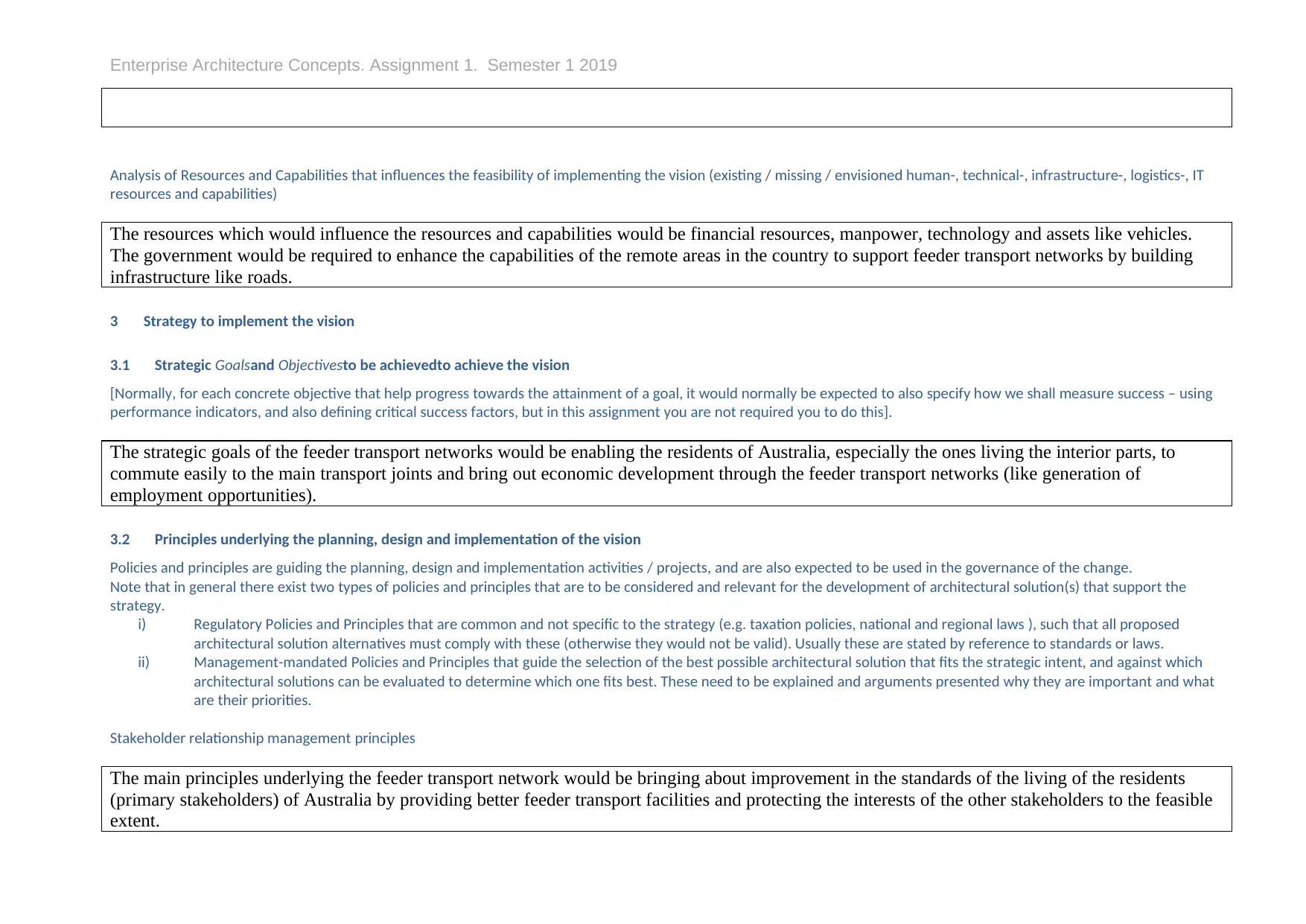
The resources which would influence the resources and capabilities would be financial resources, manpower, technology and assets like vehicles.
The government would be required to enhance the capabilities of the remote areas in the country to support feeder transport networks by building
infrastructure like roads.
3 Strategy to implement the vision
3.1 Strategic Goalsand Objectivesto be achievedto achieve the vision
[Normally, for each concrete objective that help progress towards the attainment of a goal, it would normally be expected to also specify how we shall measure success – using
performance indicators, and also defining critical success factors, but in this assignment you are not required you to do this].
The strategic goals of the feeder transport networks would be enabling the residents of Australia, especially the ones living the interior parts, to
commute easily to the main transport joints and bring out economic development through the feeder transport networks (like generation of
employment opportunities).
3.2 Principles underlying the planning, design and implementation of the vision
Policies and principles are guiding the planning, design and implementation activities / projects, and are also expected to be used in the governance of the change.
Note that in general there exist two types of policies and principles that are to be considered and relevant for the development of architectural solution(s) that support the
strategy.
i) Regulatory Policies and Principles that are common and not specific to the strategy (e.g. taxation policies, national and regional laws ), such that all proposed
architectural solution alternatives must comply with these (otherwise they would not be valid). Usually these are stated by reference to standards or laws.
ii) Management-mandated Policies and Principles that guide the selection of the best possible architectural solution that fits the strategic intent, and against which
architectural solutions can be evaluated to determine which one fits best. These need to be explained and arguments presented why they are important and what
are their priorities.
Stakeholder relationship management principles
The main principles underlying the feeder transport network would be bringing about improvement in the standards of the living of the residents
(primary stakeholders) of Australia by providing better feeder transport facilities and protecting the interests of the other stakeholders to the feasible
extent.
Analysis of Resources and Capabilities that influences the feasibility of implementing the vision (existing / missing / envisioned human-, technical-, infrastructure-, logistics-, IT
resources and capabilities)
The resources which would influence the resources and capabilities would be financial resources, manpower, technology and assets like vehicles.
The government would be required to enhance the capabilities of the remote areas in the country to support feeder transport networks by building
infrastructure like roads.
3 Strategy to implement the vision
3.1 Strategic Goalsand Objectivesto be achievedto achieve the vision
[Normally, for each concrete objective that help progress towards the attainment of a goal, it would normally be expected to also specify how we shall measure success – using
performance indicators, and also defining critical success factors, but in this assignment you are not required you to do this].
The strategic goals of the feeder transport networks would be enabling the residents of Australia, especially the ones living the interior parts, to
commute easily to the main transport joints and bring out economic development through the feeder transport networks (like generation of
employment opportunities).
3.2 Principles underlying the planning, design and implementation of the vision
Policies and principles are guiding the planning, design and implementation activities / projects, and are also expected to be used in the governance of the change.
Note that in general there exist two types of policies and principles that are to be considered and relevant for the development of architectural solution(s) that support the
strategy.
i) Regulatory Policies and Principles that are common and not specific to the strategy (e.g. taxation policies, national and regional laws ), such that all proposed
architectural solution alternatives must comply with these (otherwise they would not be valid). Usually these are stated by reference to standards or laws.
ii) Management-mandated Policies and Principles that guide the selection of the best possible architectural solution that fits the strategic intent, and against which
architectural solutions can be evaluated to determine which one fits best. These need to be explained and arguments presented why they are important and what
are their priorities.
Stakeholder relationship management principles
The main principles underlying the feeder transport network would be bringing about improvement in the standards of the living of the residents
(primary stakeholders) of Australia by providing better feeder transport facilities and protecting the interests of the other stakeholders to the feasible
extent.
Paraphrase This Document
Need a fresh take? Get an instant paraphrase of this document with our AI Paraphraser
Enterprise Architecture Concepts. Assignment 1. Semester 1 2019
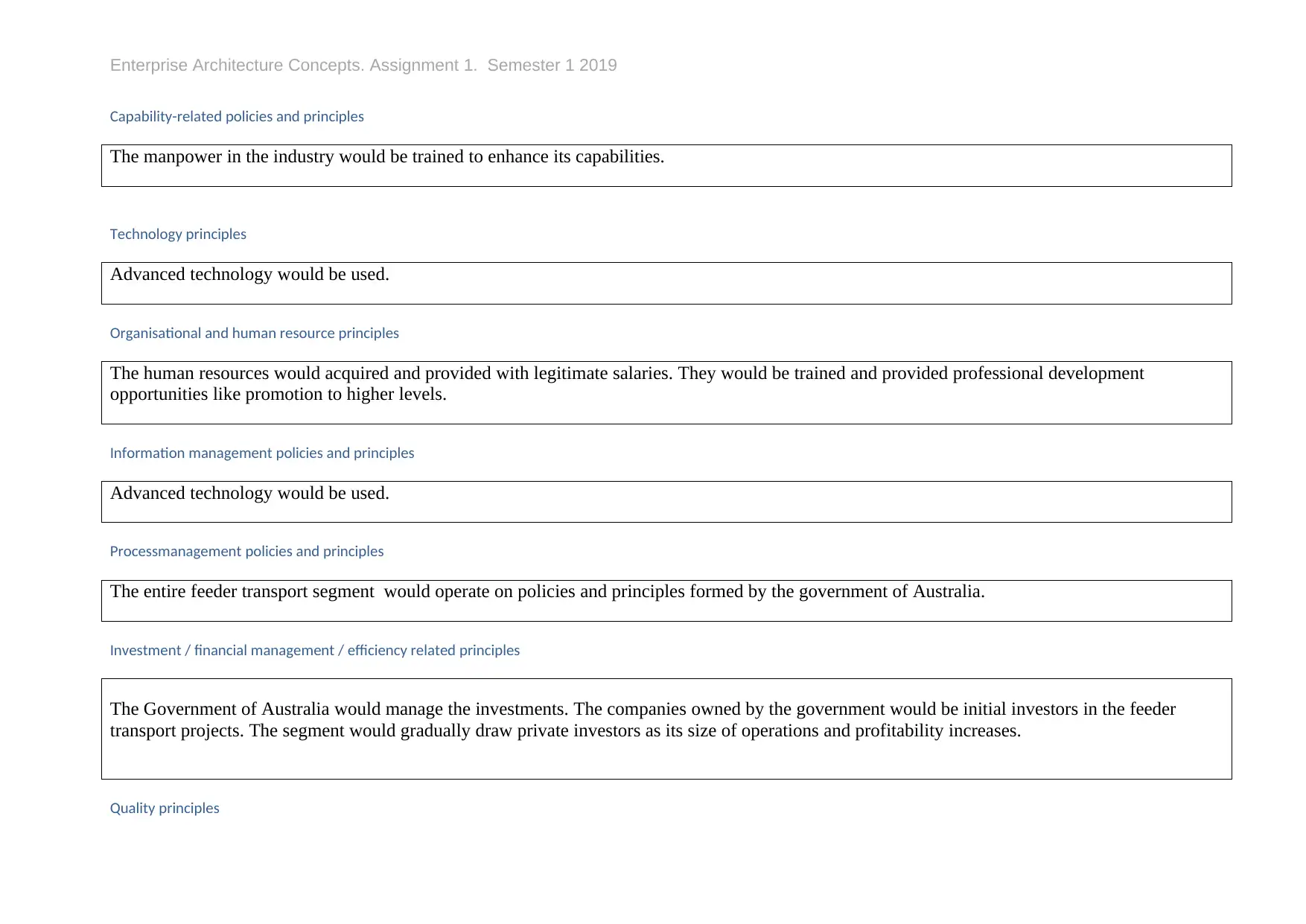
Capability-related policies and principles
The manpower in the industry would be trained to enhance its capabilities.
Technology principles
Advanced technology would be used.
Organisational and human resource principles
The human resources would acquired and provided with legitimate salaries. They would be trained and provided professional development
opportunities like promotion to higher levels.
Information management policies and principles
Advanced technology would be used.
Processmanagement policies and principles
The entire feeder transport segment would operate on policies and principles formed by the government of Australia.
Investment / financial management / efficiency related principles
The Government of Australia would manage the investments. The companies owned by the government would be initial investors in the feeder
transport projects. The segment would gradually draw private investors as its size of operations and profitability increases.
Quality principles
Capability-related policies and principles
The manpower in the industry would be trained to enhance its capabilities.
Technology principles
Advanced technology would be used.
Organisational and human resource principles
The human resources would acquired and provided with legitimate salaries. They would be trained and provided professional development
opportunities like promotion to higher levels.
Information management policies and principles
Advanced technology would be used.
Processmanagement policies and principles
The entire feeder transport segment would operate on policies and principles formed by the government of Australia.
Investment / financial management / efficiency related principles
The Government of Australia would manage the investments. The companies owned by the government would be initial investors in the feeder
transport projects. The segment would gradually draw private investors as its size of operations and profitability increases.
Quality principles
Enterprise Architecture Concepts. Assignment 1. Semester 1 2019
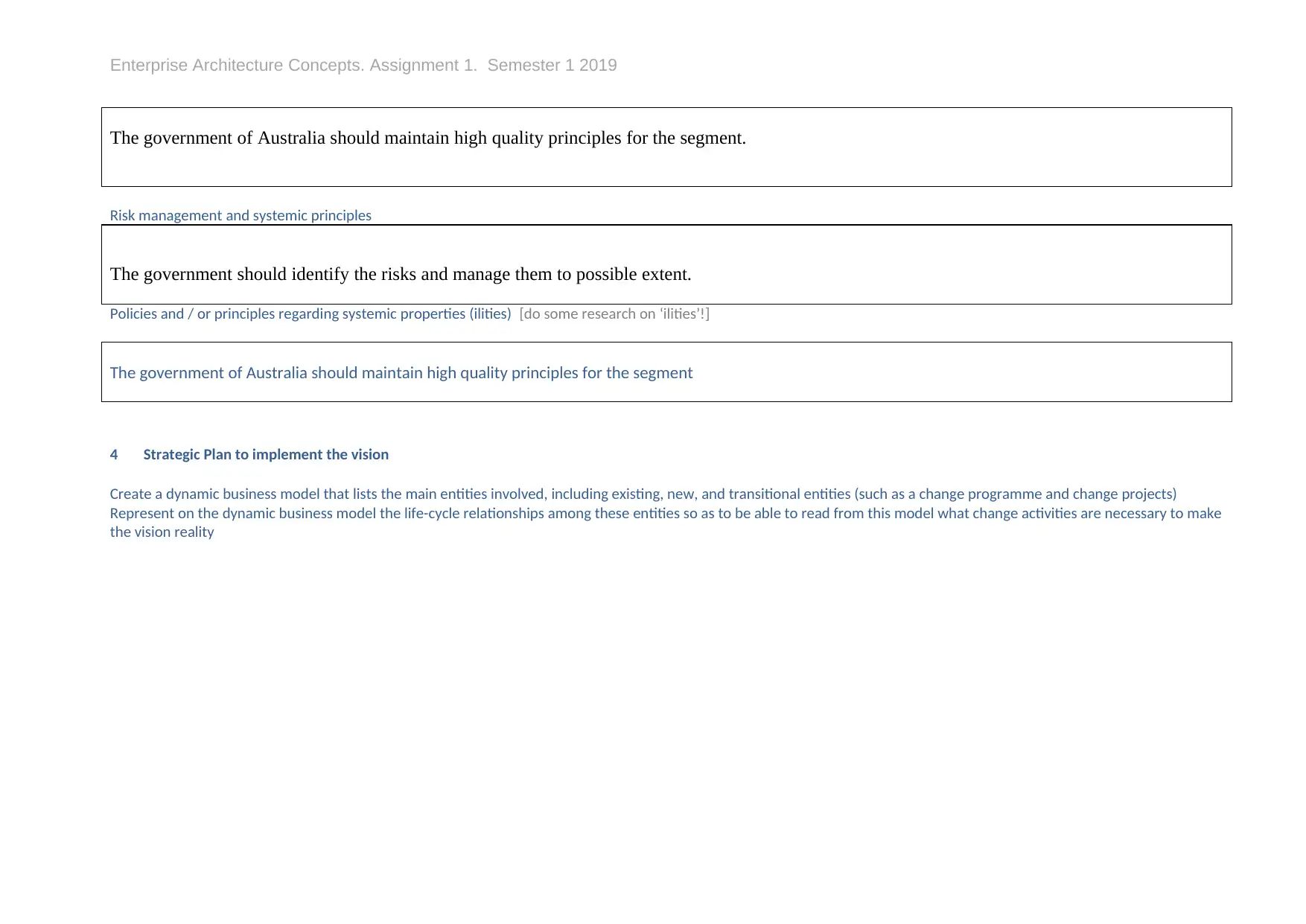
The government of Australia should maintain high quality principles for the segment.
Risk management and systemic principles
The government should identify the risks and manage them to possible extent.
Policies and / or principles regarding systemic properties (ilities) [do some research on ‘ilities’!]
The government of Australia should maintain high quality principles for the segment
4 Strategic Plan to implement the vision
Create a dynamic business model that lists the main entities involved, including existing, new, and transitional entities (such as a change programme and change projects)
Represent on the dynamic business model the life-cycle relationships among these entities so as to be able to read from this model what change activities are necessary to make
the vision reality
The government of Australia should maintain high quality principles for the segment.
Risk management and systemic principles
The government should identify the risks and manage them to possible extent.
Policies and / or principles regarding systemic properties (ilities) [do some research on ‘ilities’!]
The government of Australia should maintain high quality principles for the segment
4 Strategic Plan to implement the vision
Create a dynamic business model that lists the main entities involved, including existing, new, and transitional entities (such as a change programme and change projects)
Represent on the dynamic business model the life-cycle relationships among these entities so as to be able to read from this model what change activities are necessary to make
the vision reality
⊘ This is a preview!⊘
Do you want full access?
Subscribe today to unlock all pages.
Trusted by 1+ million students worldwide

1 out of 14


Related Documents


Your All-in-One AI-Powered Toolkit for Academic Success.
+13062052269
info@desklib.com
Available 24*7 on WhatsApp / Email
![[object Object]](/_next/static/media/star-bottom.7253800d.svg)
Unlock your academic potential
Copyright © 2020–2026 A2Z Services. All Rights Reserved. Developed and managed by ZUCOL.