Cisco's Enterprise Systems Implementation: A Comprehensive Report
VerifiedAdded on 2022/10/02
|17
|3339
|447
Report
AI Summary
This report delves into Cisco's Enterprise Systems, examining the nature of these systems and their implementation process. It outlines the opportunities and challenges Cisco faced, providing an overview of the company's background and market position. The report details the steps involved in the implementation process, from initial assessment to system configuration and data conversion. It also explores various difficulties encountered during the adoption of these systems, such as financial implications, managerial roles, and organizational change. Furthermore, the report assesses the success of the Enterprise Systems adoption, discussing the metrics used to measure its impact. The report provides a comprehensive analysis of the Cisco case study, supported by relevant references, and offers insights into the practical aspects of Enterprise Systems implementation.

Running head: ENTERPRISE SYSTEM
ENTERPRISE SYSTEM
Name of the Student:
Name of the University:
Author Note:
ENTERPRISE SYSTEM
Name of the Student:
Name of the University:
Author Note:

Paraphrase This Document
Need a fresh take? Get an instant paraphrase of this document with our AI Paraphraser
1ENTERPRISE SYSTEM
Executive Summary:
The aim of the study is to find out the nature of the Enterprise Systems and the implementation
process in the Cisco and also find out the difficulties after installing the enterprise systems. There
are some opportunities and problems with Cisco. Enterprise systems are the way to produce
goods and provide services in the organization. The enterprise systems had many benefits to the
company that integrate different branch and department of the company. Enterprise systems are
comprehensive and challenging and need proper planning and execute their implementation. It
affects the business. Finally it is essential part of the organization to train the staffs to use the
enterprise systems properly and to make sure the correct application of the enterprise systems.
Executive Summary:
The aim of the study is to find out the nature of the Enterprise Systems and the implementation
process in the Cisco and also find out the difficulties after installing the enterprise systems. There
are some opportunities and problems with Cisco. Enterprise systems are the way to produce
goods and provide services in the organization. The enterprise systems had many benefits to the
company that integrate different branch and department of the company. Enterprise systems are
comprehensive and challenging and need proper planning and execute their implementation. It
affects the business. Finally it is essential part of the organization to train the staffs to use the
enterprise systems properly and to make sure the correct application of the enterprise systems.
2ENTERPRISE SYSTEM
Table of Contents
Introduction:....................................................................................................................................3
Discussion:.......................................................................................................................................3
Opportunities of Cisco:................................................................................................................3
Problems of Cisco:.......................................................................................................................4
The nature of the Enterprise Systems and the implementation process:.....................................6
Difficulties:..................................................................................................................................9
Adoption of Enterprise Systems:...............................................................................................13
Conclusion:....................................................................................................................................13
References:....................................................................................................................................15
Table of Contents
Introduction:....................................................................................................................................3
Discussion:.......................................................................................................................................3
Opportunities of Cisco:................................................................................................................3
Problems of Cisco:.......................................................................................................................4
The nature of the Enterprise Systems and the implementation process:.....................................6
Difficulties:..................................................................................................................................9
Adoption of Enterprise Systems:...............................................................................................13
Conclusion:....................................................................................................................................13
References:....................................................................................................................................15
⊘ This is a preview!⊘
Do you want full access?
Subscribe today to unlock all pages.

Trusted by 1+ million students worldwide
3ENTERPRISE SYSTEM
Introduction:
Cisco Systems Inc. is an American multinational organization which head office in San
Jose, California. Cisco manufactures, develops and sell telecommunication instrument,
networking hardware products and many high-technology facilities. Cisco focuses on the tech
markets such as domain security, energy management internet of things. On June 8, 2009, Cisco
was included the Dow Jones Industrial Average and also launched S&P 500 Index, the Russell
1000 Index and the Russell 1000 Growth Stock Index. In 1984 Cisco Systems Inc. was
established by Sandy Lerner and Leonard Bosack. Both of them developed the overview of a
local area network being able to link geographically different computers over the multiprotocol
router system. In 2017, Cisco earnings US$0.1 billion and yearly revenue US$49.3 billion. In
2018 Cisco’s market capitalization was valued US$213.2 billion. Cisco developed many
companies to spin goods into the company. In 1995–1996 Cisco completed more than ten
acquisitions. In Stratacom, the most significant deals have occurred. Cisco also acquired Cerent
Corporation which is located in Petaluma, California.
Discussion:
Opportunities of Cisco:
Growth in the Software market: In between 2015-2020 the network function virtualization
(NFV) and software-defined networking (SDN) market are estimated to expand over 86% at a
CAGR to reach almost $45 billion value (Schoettle and Sivak 2014).
Growth in cloud computing: By 2019, the annual global cloud traffic of Cisco Global Cloud
Index is estimated to account from 2.1 to 8.6 zettabytes (ZB). Also Global data centre traffic is
Introduction:
Cisco Systems Inc. is an American multinational organization which head office in San
Jose, California. Cisco manufactures, develops and sell telecommunication instrument,
networking hardware products and many high-technology facilities. Cisco focuses on the tech
markets such as domain security, energy management internet of things. On June 8, 2009, Cisco
was included the Dow Jones Industrial Average and also launched S&P 500 Index, the Russell
1000 Index and the Russell 1000 Growth Stock Index. In 1984 Cisco Systems Inc. was
established by Sandy Lerner and Leonard Bosack. Both of them developed the overview of a
local area network being able to link geographically different computers over the multiprotocol
router system. In 2017, Cisco earnings US$0.1 billion and yearly revenue US$49.3 billion. In
2018 Cisco’s market capitalization was valued US$213.2 billion. Cisco developed many
companies to spin goods into the company. In 1995–1996 Cisco completed more than ten
acquisitions. In Stratacom, the most significant deals have occurred. Cisco also acquired Cerent
Corporation which is located in Petaluma, California.
Discussion:
Opportunities of Cisco:
Growth in the Software market: In between 2015-2020 the network function virtualization
(NFV) and software-defined networking (SDN) market are estimated to expand over 86% at a
CAGR to reach almost $45 billion value (Schoettle and Sivak 2014).
Growth in cloud computing: By 2019, the annual global cloud traffic of Cisco Global Cloud
Index is estimated to account from 2.1 to 8.6 zettabytes (ZB). Also Global data centre traffic is
Paraphrase This Document
Need a fresh take? Get an instant paraphrase of this document with our AI Paraphraser
4ENTERPRISE SYSTEM
expected to expand triple from 3.4 to 10.4 zettabytes (ZB), and Cloud is predicted to grow its
total data centre traffic for more than 82% by 2019. The Cisco company strongly exits in the
sector its profits and revenues (Hlyne, Zavarsky and Butakov 2015).
Lower inflation rate: For the consumer of Cisco, the low inflation rate is more stable in the
marketplace (Peterside, Zavarsky and Butakov 2015). The latest taxation rule can affect the
business techniques significantly and can exposed different opportunity for active players like
Cisco to raise its revenue and profit (Miraz et al, 2015).
Growth and development in Cloud Security: The growth and development in cloud computing is
the reason for cloud security’s growth. In between 2014-2022 Global cloud security solutions
marketplace is predicted to grow more than 13% and by 2022 it is predicted to reach around $12
billion.
New environmental policies: The different opportunities build a new level playing field for all
the players in the area. It is an excellent opportunity for Cisco, and it is an advantage for different
technology and also achieve market share in the latest product segments. They open a new
market so that government contract with the acceptance of new technology and also contract
with government free trade which has provided Cisco a chances to come into a new emerging
market (Schoettle and Sivak 2014).
Problems of Cisco:
Volatile Market: Volatile market such as the sales of data centre, router sales, service providers
and new products sales experience are the attributes of changing business conditions and
economic conditions of all the nations they do trade with (Peterside, Zavarsky and Butakov
2015).
expected to expand triple from 3.4 to 10.4 zettabytes (ZB), and Cloud is predicted to grow its
total data centre traffic for more than 82% by 2019. The Cisco company strongly exits in the
sector its profits and revenues (Hlyne, Zavarsky and Butakov 2015).
Lower inflation rate: For the consumer of Cisco, the low inflation rate is more stable in the
marketplace (Peterside, Zavarsky and Butakov 2015). The latest taxation rule can affect the
business techniques significantly and can exposed different opportunity for active players like
Cisco to raise its revenue and profit (Miraz et al, 2015).
Growth and development in Cloud Security: The growth and development in cloud computing is
the reason for cloud security’s growth. In between 2014-2022 Global cloud security solutions
marketplace is predicted to grow more than 13% and by 2022 it is predicted to reach around $12
billion.
New environmental policies: The different opportunities build a new level playing field for all
the players in the area. It is an excellent opportunity for Cisco, and it is an advantage for different
technology and also achieve market share in the latest product segments. They open a new
market so that government contract with the acceptance of new technology and also contract
with government free trade which has provided Cisco a chances to come into a new emerging
market (Schoettle and Sivak 2014).
Problems of Cisco:
Volatile Market: Volatile market such as the sales of data centre, router sales, service providers
and new products sales experience are the attributes of changing business conditions and
economic conditions of all the nations they do trade with (Peterside, Zavarsky and Butakov
2015).
5ENTERPRISE SYSTEM
Competition: The competitor of Cisco are Alcatel-Lucent, Arista Networks, Amazon Web
Services, Avaya, ARRIS Group, Brocade Communications, Check Point Software Technologies,
Citrix Systems, Blue Jeans Networks, Dell, Huawei Technologies Extreme Networks, LM
Ericsson, F5 Networks, Fortinet, Fire Eye, Palo Alto Networks, IBM, HP, Juniper Networks,
Microsoft, Motorola Solutions, Riverbed Technology, Polycom, Ruckus Wireless, Symantec,
VMware and Ubiquiti Networks (Schoettle and Sivak 2014).
Liability laws: Different countries have different liability laws, and Cisco exposed to various
liability claims which are changed the strategies in those markets. The other problem is turning
customers purchasing behaviour from online channel and also present physical frame of supply
chain model.
Litigations: The main problem of Cisco is the Brazilian federal tax authorities. The federal tax
authorities claimed approx. $1.1 billion, $262 million for interest and $1.2 billion for additional
penalties. Many illegal activities harm the organization’s brand image (Peterside, Zavarsky and
Butakov 2015).
No regular supply of innovative products: Throughout the years, the organization has improved
its many products, but sometimes those products are answerable by other players to the
development. Secondly throughout the year the demand and supply of latest products are not
regular, so the numbers of sales are leading to high and low swings (Daman, Tripathi and Mishra
2016).
Intense competition in the market: Stable profitability has grown the number of performers in the
sector over the last one or two years, which has put downward stress on not only cost-effective
but also on total sales (Daman, Tripathi and Mishra 2016).
Competition: The competitor of Cisco are Alcatel-Lucent, Arista Networks, Amazon Web
Services, Avaya, ARRIS Group, Brocade Communications, Check Point Software Technologies,
Citrix Systems, Blue Jeans Networks, Dell, Huawei Technologies Extreme Networks, LM
Ericsson, F5 Networks, Fortinet, Fire Eye, Palo Alto Networks, IBM, HP, Juniper Networks,
Microsoft, Motorola Solutions, Riverbed Technology, Polycom, Ruckus Wireless, Symantec,
VMware and Ubiquiti Networks (Schoettle and Sivak 2014).
Liability laws: Different countries have different liability laws, and Cisco exposed to various
liability claims which are changed the strategies in those markets. The other problem is turning
customers purchasing behaviour from online channel and also present physical frame of supply
chain model.
Litigations: The main problem of Cisco is the Brazilian federal tax authorities. The federal tax
authorities claimed approx. $1.1 billion, $262 million for interest and $1.2 billion for additional
penalties. Many illegal activities harm the organization’s brand image (Peterside, Zavarsky and
Butakov 2015).
No regular supply of innovative products: Throughout the years, the organization has improved
its many products, but sometimes those products are answerable by other players to the
development. Secondly throughout the year the demand and supply of latest products are not
regular, so the numbers of sales are leading to high and low swings (Daman, Tripathi and Mishra
2016).
Intense competition in the market: Stable profitability has grown the number of performers in the
sector over the last one or two years, which has put downward stress on not only cost-effective
but also on total sales (Daman, Tripathi and Mishra 2016).
⊘ This is a preview!⊘
Do you want full access?
Subscribe today to unlock all pages.
Trusted by 1+ million students worldwide
6ENTERPRISE SYSTEM
New technologies development: In the medium, to long term future new technologies are
developed by the market disruptor, and the other competitors create a significant problem to the
industry. The nature of the most valuable and extremely high profitable goods is seasonal, and
during the peak time any doubtful incident may affect the profitability of the organization in
short to medium period.
New environment regulations: In 2016 new environment regulations of Paris agreement might be
a problem to some of the present product categories and in international markets lack of
experienced workforce creates a challenge to steady growth of revenue for Cisco in those
marketplaces.
The nature of the Enterprise Systems and the implementation process:
Enterprise system is a software architecture that aids information sharing and the flow of
info among the several functions within the company and geographical locations. It helps to take
decisions in the company. An Enterprise system is the backbone of the enterprise-wide
information system. It is a central database which designs data and feeds those data into the latest
application which operate general computing, and for this reason standardizing business are
proceed and their data used in the unified environment. With enterprise systems, data are entered
only one time. In Cisco the enterprise systems help the market leader in international networking
industry.
The flow chart in the following figure evaluates the different activities of the
implementation process:
New technologies development: In the medium, to long term future new technologies are
developed by the market disruptor, and the other competitors create a significant problem to the
industry. The nature of the most valuable and extremely high profitable goods is seasonal, and
during the peak time any doubtful incident may affect the profitability of the organization in
short to medium period.
New environment regulations: In 2016 new environment regulations of Paris agreement might be
a problem to some of the present product categories and in international markets lack of
experienced workforce creates a challenge to steady growth of revenue for Cisco in those
marketplaces.
The nature of the Enterprise Systems and the implementation process:
Enterprise system is a software architecture that aids information sharing and the flow of
info among the several functions within the company and geographical locations. It helps to take
decisions in the company. An Enterprise system is the backbone of the enterprise-wide
information system. It is a central database which designs data and feeds those data into the latest
application which operate general computing, and for this reason standardizing business are
proceed and their data used in the unified environment. With enterprise systems, data are entered
only one time. In Cisco the enterprise systems help the market leader in international networking
industry.
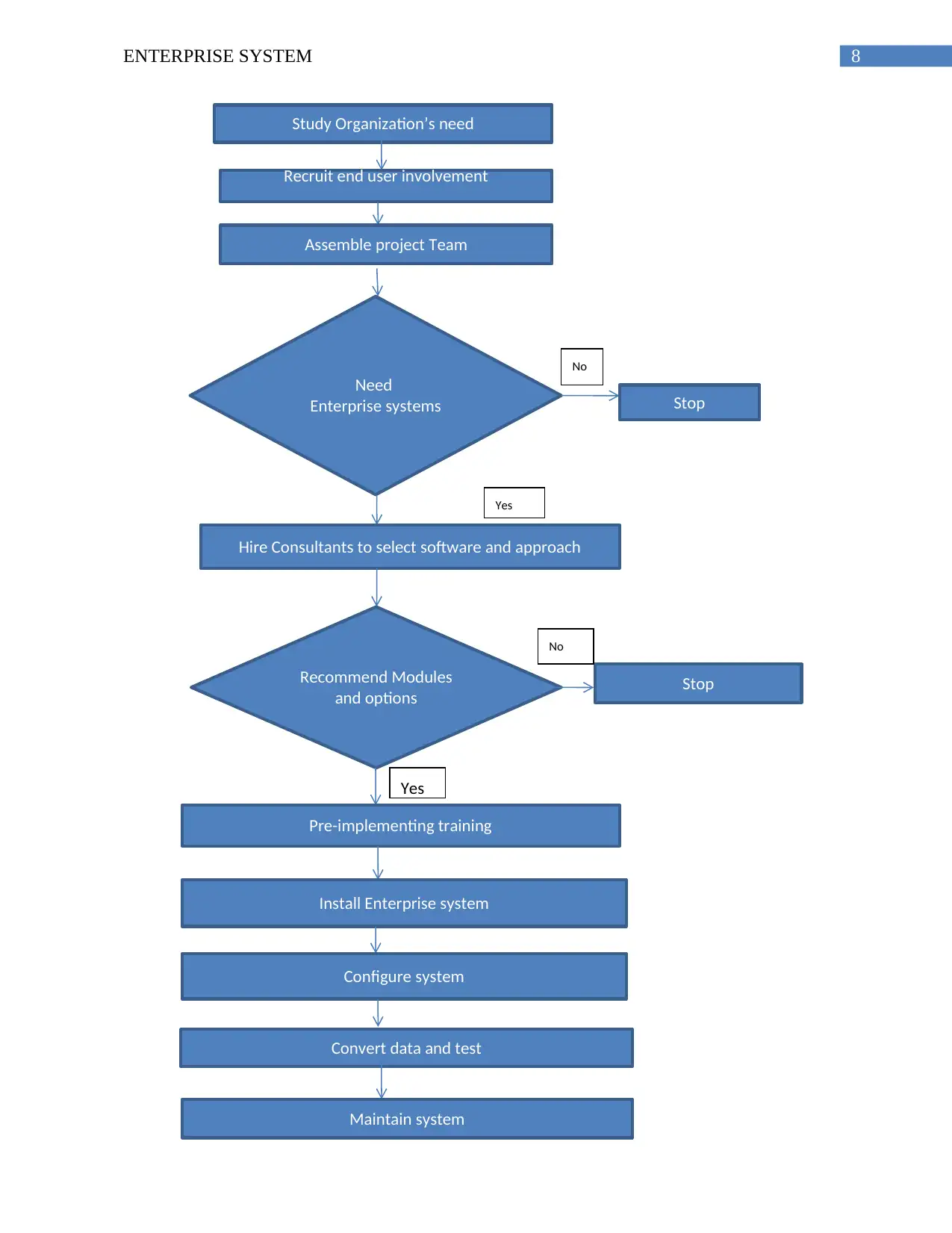
The flow chart in the following figure evaluates the different activities of the
implementation process:
Paraphrase This Document
Need a fresh take? Get an instant paraphrase of this document with our AI Paraphraser
7ENTERPRISE SYSTEM
Step 1: Managers of the company conduct a study of the present condition to measure the
organizational needs by examining the availability of database, hardware and software and make
the decision to implement the enterprise systems where the integration is crucial.
Step 2: The second step is to involve and recruited educated and professional end-users during
the implementation process.
Step 3: The third significant activity is manager arrange a project group or team or the directing
committee which consists of professionals from the entire functional portion to lead the
assignment or project.
Step 4: After deciding to implement Enterprise systems, system consultant team will recruit to
estimate the importance of implementing enterprise systems. Most of the situation, the consultant
team refers to the operational team such as finance, human resource, logistics, manufacturing and
forecasting etc. It helps the business to business applications like customer relationship
management, supply chain management, e-marketplace and e-procurement.
Step 5: Manager, employee, shareholders and also end-users, vendors, managers and customers,
all of them trained for the enterprise system before it implemented.
Step 6: The enterprise system installation process will define some issues like hardware
acquisition, software acquisition and software testing.
Step 7, 8 & 9: In the database, data and information converted to the format which is used in the
new enterprise system, servers and upgraded network.
Step 1: Managers of the company conduct a study of the present condition to measure the
organizational needs by examining the availability of database, hardware and software and make
the decision to implement the enterprise systems where the integration is crucial.
Step 2: The second step is to involve and recruited educated and professional end-users during
the implementation process.
Step 3: The third significant activity is manager arrange a project group or team or the directing
committee which consists of professionals from the entire functional portion to lead the
assignment or project.
Step 4: After deciding to implement Enterprise systems, system consultant team will recruit to
estimate the importance of implementing enterprise systems. Most of the situation, the consultant
team refers to the operational team such as finance, human resource, logistics, manufacturing and
forecasting etc. It helps the business to business applications like customer relationship
management, supply chain management, e-marketplace and e-procurement.
Step 5: Manager, employee, shareholders and also end-users, vendors, managers and customers,
all of them trained for the enterprise system before it implemented.
Step 6: The enterprise system installation process will define some issues like hardware
acquisition, software acquisition and software testing.
Step 7, 8 & 9: In the database, data and information converted to the format which is used in the
new enterprise system, servers and upgraded network.
8ENTERPRISE SYSTEM
Yes
Study Organization’s need
Recruit end user involvement
Assemble project Team
Need
Enterprise systems Stop
Hire Consultants to select software and approach
Recommend Modules
and options Stop
Pre-implementing training
Install Enterprise system
Configure system
Convert data and test
Maintain system
No
No
Yes
Yes
Study Organization’s need
Recruit end user involvement
Assemble project Team
Need
Enterprise systems Stop
Hire Consultants to select software and approach
Recommend Modules
and options Stop
Pre-implementing training
Install Enterprise system
Configure system
Convert data and test
Maintain system
No
No
Yes
⊘ This is a preview!⊘
Do you want full access?
Subscribe today to unlock all pages.
Trusted by 1+ million students worldwide
9ENTERPRISE SYSTEM
Difficulties:
1. Fundamental Issues:
Implementation of Enterprise systems might be costly, broad and labour-intensive which
impact on the company’s bottom line such as internal auditing, enterprise system consultant
and IT staff.
a) Role of Managers:
The manager should allow the fundamental difficulties of systems integration by
finding the company’s mission and vision.
o Does the management of the company clearly realize its present business
processes, and can it take implementation decision in perfect time?
o Is management decided to change the organizational structure, cultural
environment and operations to accommodate enterprise systems?
o Is the management prepared to include drastic business process and re-
engineering efforts to achieve dramatic results?
b) Top management commitment:
Senior management should allow the strategic implications of enterprise systems
implementation. Top management should be asked different questions before
embarking on assignment.
o How does enterprise systems on the organizational culture and structure?
What is the scope of enterprise systems implementation in an organization?
o Does the enterprise system make an organization’s competitive position
secure?
Difficulties:
1. Fundamental Issues:
Implementation of Enterprise systems might be costly, broad and labour-intensive which
impact on the company’s bottom line such as internal auditing, enterprise system consultant
and IT staff.
a) Role of Managers:
The manager should allow the fundamental difficulties of systems integration by
finding the company’s mission and vision.
o Does the management of the company clearly realize its present business
processes, and can it take implementation decision in perfect time?
o Is management decided to change the organizational structure, cultural
environment and operations to accommodate enterprise systems?
o Is the management prepared to include drastic business process and re-
engineering efforts to achieve dramatic results?
b) Top management commitment:
Senior management should allow the strategic implications of enterprise systems
implementation. Top management should be asked different questions before
embarking on assignment.
o How does enterprise systems on the organizational culture and structure?
What is the scope of enterprise systems implementation in an organization?
o Does the enterprise system make an organization’s competitive position
secure?
Paraphrase This Document
Need a fresh take? Get an instant paraphrase of this document with our AI Paraphraser
10ENTERPRISE SYSTEM
o If it is a multinational organization, the management may allow the system
globally or restrict the system to some of the regional units?
o Are there are any other options which meet the organizational needs better
than an enterprise system?
c) Role of an auditor:
Auditor plays a vital role in facilitating the company and laying the organization’s
success with their power, knowledge, business processes, internal controlling and
compliance requirements.
o Find out the documents which are used in the company’s regular operations.
o Document contractions and its roles.
o Shortlisted the company’s master database.
o Generate a list of presently used and currently generated management
information reports.
2. Implementation cost and time:
a) Implementation cost:
The cost of previous software is low-cost differentiate with in-house development,
and the entire budget of the implementation could be four or five times of the software’s
buying price. The implementation prices are raised like the customization growths. After
the training the particular staff's strategies like organization perks, bonus programs,
incentive, salary hiked, repeated training and appeals to organization loyalty effort to
retain them.
b) Implementation time:
o If it is a multinational organization, the management may allow the system
globally or restrict the system to some of the regional units?
o Are there are any other options which meet the organizational needs better
than an enterprise system?
c) Role of an auditor:
Auditor plays a vital role in facilitating the company and laying the organization’s
success with their power, knowledge, business processes, internal controlling and
compliance requirements.
o Find out the documents which are used in the company’s regular operations.
o Document contractions and its roles.
o Shortlisted the company’s master database.
o Generate a list of presently used and currently generated management
information reports.
2. Implementation cost and time:
a) Implementation cost:
The cost of previous software is low-cost differentiate with in-house development,
and the entire budget of the implementation could be four or five times of the software’s
buying price. The implementation prices are raised like the customization growths. After
the training the particular staff's strategies like organization perks, bonus programs,
incentive, salary hiked, repeated training and appeals to organization loyalty effort to
retain them.
b) Implementation time:
11ENTERPRISE SYSTEM
Enterprise systems packages are very common and must be organized to a particular
type of trade and also follow the implemented module at a time. Some of the popular set-
up elements are sales and distribution, production and planning, material management,
finance, and control modules (Ahmad, Zakaria, and Sedera 2013). The implementation
length impacts the total number of elements being implemented, the amount of
customization, the scope of the implementation, and the total number of applied
interfaces. The opportunity of implementation increased internationally from a particular
business to multiple units spread and increased the period of implementation.
3. Organizational change process:
Enterprise system implementation requires business processes re-engineering of the
present methods, chooses the experienced staffs on the new systems and incorporate with
the enterprise systems with other business information systems (Ahmad, Zakaria, and
Sedera 2013)
a) Reengineering of the existing process:
Implementing the enterprise systems includes the re-engineering of the present
business processes, which is under the popular enterprise systems models. Enterprise
systems are constructed on top practices which are followed in the sector. The enterprise
systems customizing are very high.
b) Selection of right employees:
To implement the enterprise systems organization should willing to offer their some
of best staffs to the assignment for a successful and affective implementation. Internal
resources on the assignment might be exhibited the capability to understand the needs of
Enterprise systems packages are very common and must be organized to a particular
type of trade and also follow the implemented module at a time. Some of the popular set-
up elements are sales and distribution, production and planning, material management,
finance, and control modules (Ahmad, Zakaria, and Sedera 2013). The implementation
length impacts the total number of elements being implemented, the amount of
customization, the scope of the implementation, and the total number of applied
interfaces. The opportunity of implementation increased internationally from a particular
business to multiple units spread and increased the period of implementation.
3. Organizational change process:
Enterprise system implementation requires business processes re-engineering of the
present methods, chooses the experienced staffs on the new systems and incorporate with
the enterprise systems with other business information systems (Ahmad, Zakaria, and
Sedera 2013)
a) Reengineering of the existing process:
Implementing the enterprise systems includes the re-engineering of the present
business processes, which is under the popular enterprise systems models. Enterprise
systems are constructed on top practices which are followed in the sector. The enterprise
systems customizing are very high.
b) Selection of right employees:
To implement the enterprise systems organization should willing to offer their some
of best staffs to the assignment for a successful and affective implementation. Internal
resources on the assignment might be exhibited the capability to understand the needs of
⊘ This is a preview!⊘
Do you want full access?
Subscribe today to unlock all pages.
Trusted by 1+ million students worldwide

1 out of 17


Your All-in-One AI-Powered Toolkit for Academic Success.
+13062052269
info@desklib.com
Available 24*7 on WhatsApp / Email
![[object Object]](/_next/static/media/star-bottom.7253800d.svg)
Unlock your academic potential
Copyright © 2020–2026 A2Z Services. All Rights Reserved. Developed and managed by ZUCOL.