Entrepreneurship and Small Business Management in the UK Report
VerifiedAdded on 2024/05/17
|21
|5009
|239
Report
AI Summary
This report provides a detailed examination of entrepreneurship and small business management in the United Kingdom, highlighting the different types of entrepreneurial ventures, including corporate, public, serial, lifestyle, and academic entrepreneurship, and their relation to the typology of entrepreneurship. It explores the similarities and differences between these ventures, with a particular focus on micro, small, and medium enterprises (SMEs). The report assesses the impact of small businesses on the UK economy using relevant data and statistics, illustrating their contribution to employment and turnover. It also explains the importance of small businesses and start-ups to the growth of the social economy, emphasizing their role in communal innovation and regional development. The analysis covers the challenges faced by SMEs and their potential for future growth, concluding that they are a vital component of the UK economy.
ENTREPRENEURSHIP AND SMALL BUSINESS
MANAGEMENT
1
MANAGEMENT
1

Paraphrase This Document
Need a fresh take? Get an instant paraphrase of this document with our AI Paraphraser

Table of Contents
Introduction................................................................................................................................3
Task 1.........................................................................................................................................4
Task 2.........................................................................................................................................7
Task 3.......................................................................................................................................11
Task 4.......................................................................................................................................15
Conclusion................................................................................................................................17
Reference List..........................................................................................................................18
2
Introduction................................................................................................................................3
Task 1.........................................................................................................................................4
Task 2.........................................................................................................................................7
Task 3.......................................................................................................................................11
Task 4.......................................................................................................................................15
Conclusion................................................................................................................................17
Reference List..........................................................................................................................18
2

Introduction
Entrepreneurship being the study of starting up of trade and flourishing its business has
gradually become a large sector of revenue collection in the United Kingdom. The popularity
of the subject has grown so much that is now being incorporated as a college major in UK.
The rapid growth has now ranked the country fourth in the field of entrepreneurship in the
world. This report covers the examination of entrepreneurial ventures and its typology. The
different scopes of entrepreneurships in UK have also been elaborately discussed hereunder.
3
Entrepreneurship being the study of starting up of trade and flourishing its business has
gradually become a large sector of revenue collection in the United Kingdom. The popularity
of the subject has grown so much that is now being incorporated as a college major in UK.
The rapid growth has now ranked the country fourth in the field of entrepreneurship in the
world. This report covers the examination of entrepreneurial ventures and its typology. The
different scopes of entrepreneurships in UK have also been elaborately discussed hereunder.
3
⊘ This is a preview!⊘
Do you want full access?
Subscribe today to unlock all pages.

Trusted by 1+ million students worldwide
Task 1
P1: Examine different types of entrepreneurial ventures and explain how they relate to
the typology of entrepreneurship.
The process of designing, launching and running of a business organization is known as
entrepreneurship (Kuratko et al., 2016). It is often started as a small scale business in its
initial stage. The person taking such initiative and running it is called entrepreneur. It can also
be describes as the capacity and willingness to develop and run the business, organize it and
manage the trade venture irrespective of the risk of loss, with the aim of making
profit. Entrepreneurship is a practice of trade, where either a team or an individual recognizes
business opportunities and deploys the essential resources needed for its exploitation. The
rise of entrepreneurial ventures in the United Kingdom has served potentially to the growth in
its economy (Guerrero et al., 2015). It is the rising industry that promises to build a healthy
economic environment in the country
Entrepreneurship is multifaceted in nature and has diverse ranges to it. The different kinds of
entrepreneurship are: corporate entrepreneurship, public entrepreneurship, serial
entrepreneurship, lifestyle entrepreneurship and academic entrepreneurship.
Corporate entrepreneurship is generally referred to the process of developing new ideas and
opportunities for the purpose of improving an established business venture by increasing its
profitability and enhancing its competitiveness in the market. The corporate enterprises in
the United Kingdom have seen a remarkable growth in the past decade, but somehow have
fallen stagnant in the recent days. There is a massive cloud of uncertainty over the large
corporate houses in UK.
Public sector entrepreneurship can be defined as the circulation of inventive public policies
initiated to generate larger economic growth and development and financial prosperity. The
change in the economic status quo of a public sector organization into a more productive unit
of trade that can engage in creating a unit where they can strongly tackle the uncertainty in
the market is the chief motive of public entrepreneurship.
4
P1: Examine different types of entrepreneurial ventures and explain how they relate to
the typology of entrepreneurship.
The process of designing, launching and running of a business organization is known as
entrepreneurship (Kuratko et al., 2016). It is often started as a small scale business in its
initial stage. The person taking such initiative and running it is called entrepreneur. It can also
be describes as the capacity and willingness to develop and run the business, organize it and
manage the trade venture irrespective of the risk of loss, with the aim of making
profit. Entrepreneurship is a practice of trade, where either a team or an individual recognizes
business opportunities and deploys the essential resources needed for its exploitation. The
rise of entrepreneurial ventures in the United Kingdom has served potentially to the growth in
its economy (Guerrero et al., 2015). It is the rising industry that promises to build a healthy
economic environment in the country
Entrepreneurship is multifaceted in nature and has diverse ranges to it. The different kinds of
entrepreneurship are: corporate entrepreneurship, public entrepreneurship, serial
entrepreneurship, lifestyle entrepreneurship and academic entrepreneurship.
Corporate entrepreneurship is generally referred to the process of developing new ideas and
opportunities for the purpose of improving an established business venture by increasing its
profitability and enhancing its competitiveness in the market. The corporate enterprises in
the United Kingdom have seen a remarkable growth in the past decade, but somehow have
fallen stagnant in the recent days. There is a massive cloud of uncertainty over the large
corporate houses in UK.
Public sector entrepreneurship can be defined as the circulation of inventive public policies
initiated to generate larger economic growth and development and financial prosperity. The
change in the economic status quo of a public sector organization into a more productive unit
of trade that can engage in creating a unit where they can strongly tackle the uncertainty in
the market is the chief motive of public entrepreneurship.
4
Paraphrase This Document
Need a fresh take? Get an instant paraphrase of this document with our AI Paraphraser
Private entrepreneurship refers to the establishment of a business organization and the
process of conducting trade and commerce in a capitalist open market operating for the
purpose of making profit without the interference of any government or public sector. Private
enterprise is an establishment where economic activities are undertaken by private
individuals under private ownerships.
An entrepreneur who runs multiple numbers of successive trade and commerce and shifts his
direction as soon as the thrill of making profit seems over form the former business is known
as serial entrepreneur. Such mode entrepreneurship looks for profitable business ideas that
are viable in nature.
Lifestyle entrepreneurship is a where an individual or a group of individuals engage in the
activity of creating a business for the purpose of altering their general mode of lifestyle than
merely making profits. A lifestyle entrepreneur sets focus on the life rewards that are
provided to the people who have an innate passion for what take up as professions in their life
and enjoys their task.
Academic entrepreneurship can be defined as the process of creating leadership in the course
of creating fiscal value by conducting innovative activities with the premises or at the outdoor
locations conducted by an academic institution. It transpires at the level of groups of
individuals or an individual who act independently or as a part of the faculty or university of
the academic institution that makes profit with the development of the educational society
and institutes multiple kinds of learning programs within it.
A manager of an institution who has the responsibility of promoting innovative product
development schemes of the company is known as an intrapreneur.
Entrepreneurship is also known as a human resource of fiscal administration. It is a source of
productive and innovative ideas of marketing products and services to make profit. Hence it
is clear that there is a wide scope in the arena of entrepreneurship. The better the organized
structure, innovative ideas, marketing schemes of a business, the better scope of development
and accumulation of wealth will be enjoyed by the entrepreneurship. The development and
growth of entrepreneurship ventures depends on factors such as the economic status quo of
the nation, demand of the product and services in the market and capacity to expand the
5
process of conducting trade and commerce in a capitalist open market operating for the
purpose of making profit without the interference of any government or public sector. Private
enterprise is an establishment where economic activities are undertaken by private
individuals under private ownerships.
An entrepreneur who runs multiple numbers of successive trade and commerce and shifts his
direction as soon as the thrill of making profit seems over form the former business is known
as serial entrepreneur. Such mode entrepreneurship looks for profitable business ideas that
are viable in nature.
Lifestyle entrepreneurship is a where an individual or a group of individuals engage in the
activity of creating a business for the purpose of altering their general mode of lifestyle than
merely making profits. A lifestyle entrepreneur sets focus on the life rewards that are
provided to the people who have an innate passion for what take up as professions in their life
and enjoys their task.
Academic entrepreneurship can be defined as the process of creating leadership in the course
of creating fiscal value by conducting innovative activities with the premises or at the outdoor
locations conducted by an academic institution. It transpires at the level of groups of
individuals or an individual who act independently or as a part of the faculty or university of
the academic institution that makes profit with the development of the educational society
and institutes multiple kinds of learning programs within it.
A manager of an institution who has the responsibility of promoting innovative product
development schemes of the company is known as an intrapreneur.
Entrepreneurship is also known as a human resource of fiscal administration. It is a source of
productive and innovative ideas of marketing products and services to make profit. Hence it
is clear that there is a wide scope in the arena of entrepreneurship. The better the organized
structure, innovative ideas, marketing schemes of a business, the better scope of development
and accumulation of wealth will be enjoyed by the entrepreneurship. The development and
growth of entrepreneurship ventures depends on factors such as the economic status quo of
the nation, demand of the product and services in the market and capacity to expand the
5
business. If the economic status is of deflation in a country there are very limited chances of
development of entrepreneurial ventures in the country. Market demand is the first policy all
ventures must comply by in order to make development as nobody will be willing to purchase
product or services from a company which does not have demand scale in the current market.
P2: Explore the similarities and differences between entrepreneurial ventures.
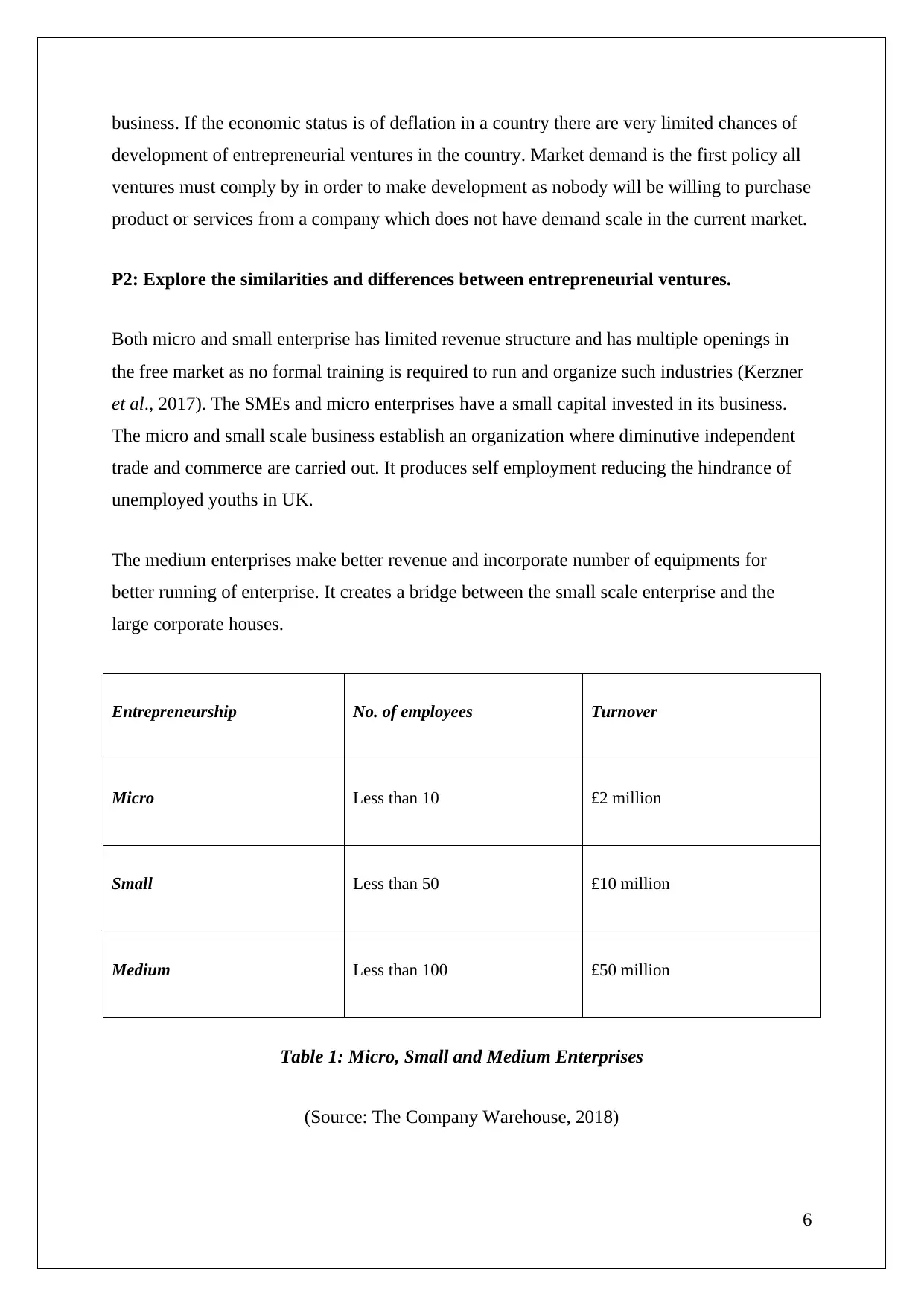
Both micro and small enterprise has limited revenue structure and has multiple openings in
the free market as no formal training is required to run and organize such industries (Kerzner
et al., 2017). The SMEs and micro enterprises have a small capital invested in its business.
The micro and small scale business establish an organization where diminutive independent
trade and commerce are carried out. It produces self employment reducing the hindrance of
unemployed youths in UK.
The medium enterprises make better revenue and incorporate number of equipments for
better running of enterprise. It creates a bridge between the small scale enterprise and the
large corporate houses.
Entrepreneurship No. of employees Turnover
Micro Less than 10 £2 million
Small Less than 50 £10 million
Medium Less than 100 £50 million
Table 1: Micro, Small and Medium Enterprises
(Source: The Company Warehouse, 2018)
6
development of entrepreneurial ventures in the country. Market demand is the first policy all
ventures must comply by in order to make development as nobody will be willing to purchase
product or services from a company which does not have demand scale in the current market.
P2: Explore the similarities and differences between entrepreneurial ventures.
Both micro and small enterprise has limited revenue structure and has multiple openings in
the free market as no formal training is required to run and organize such industries (Kerzner
et al., 2017). The SMEs and micro enterprises have a small capital invested in its business.
The micro and small scale business establish an organization where diminutive independent
trade and commerce are carried out. It produces self employment reducing the hindrance of
unemployed youths in UK.
The medium enterprises make better revenue and incorporate number of equipments for
better running of enterprise. It creates a bridge between the small scale enterprise and the
large corporate houses.
Entrepreneurship No. of employees Turnover
Micro Less than 10 £2 million
Small Less than 50 £10 million
Medium Less than 100 £50 million
Table 1: Micro, Small and Medium Enterprises
(Source: The Company Warehouse, 2018)
6
⊘ This is a preview!⊘
Do you want full access?
Subscribe today to unlock all pages.
Trusted by 1+ million students worldwide
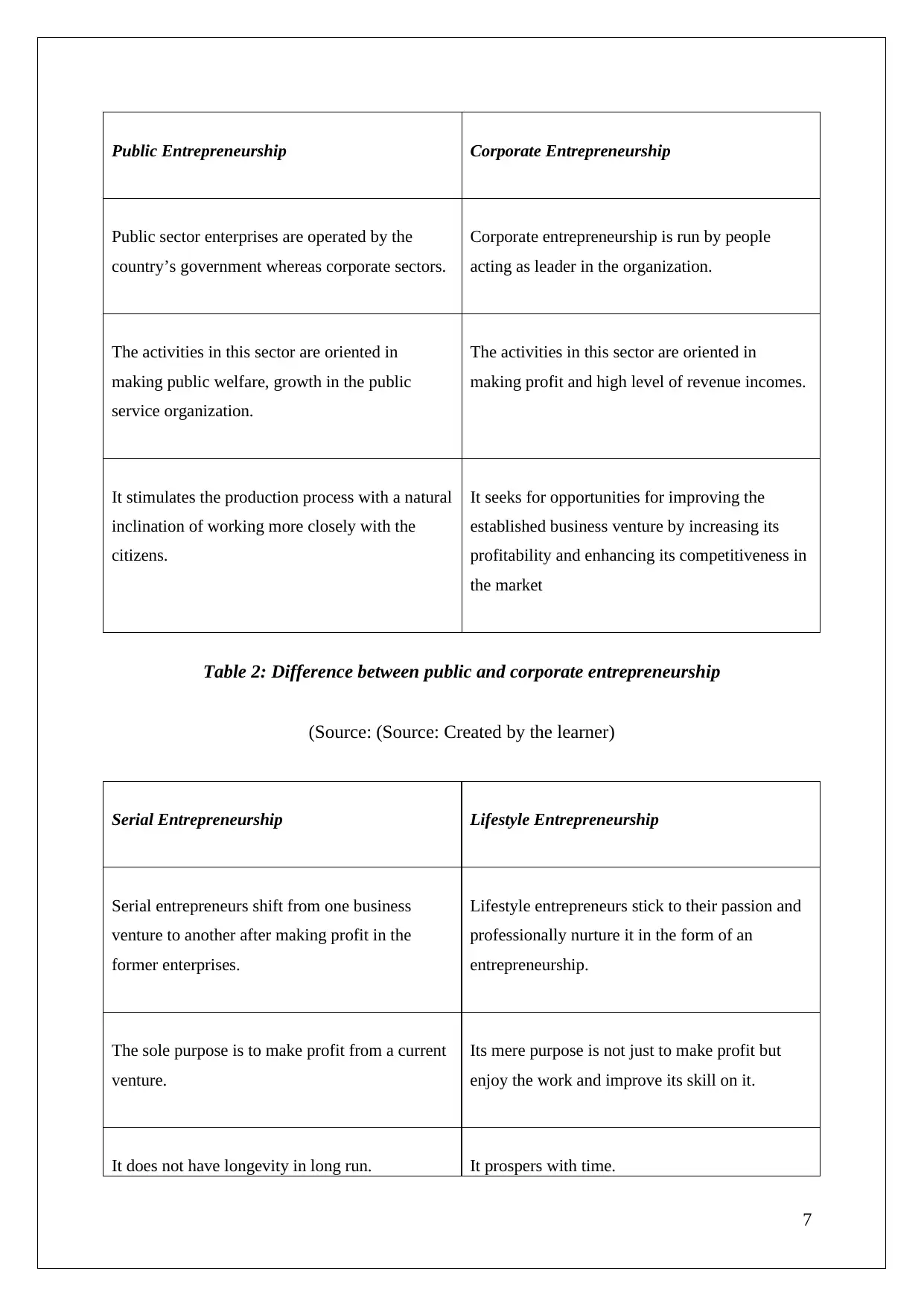
Public Entrepreneurship Corporate Entrepreneurship
Public sector enterprises are operated by the
country’s government whereas corporate sectors.
Corporate entrepreneurship is run by people
acting as leader in the organization.
The activities in this sector are oriented in
making public welfare, growth in the public
service organization.
The activities in this sector are oriented in
making profit and high level of revenue incomes.
It stimulates the production process with a natural
inclination of working more closely with the
citizens.
It seeks for opportunities for improving the
established business venture by increasing its
profitability and enhancing its competitiveness in
the market
Table 2: Difference between public and corporate entrepreneurship
(Source: (Source: Created by the learner)
Serial Entrepreneurship Lifestyle Entrepreneurship
Serial entrepreneurs shift from one business
venture to another after making profit in the
former enterprises.
Lifestyle entrepreneurs stick to their passion and
professionally nurture it in the form of an
entrepreneurship.
The sole purpose is to make profit from a current
venture.
Its mere purpose is not just to make profit but
enjoy the work and improve its skill on it.
It does not have longevity in long run. It prospers with time.
7
Public sector enterprises are operated by the
country’s government whereas corporate sectors.
Corporate entrepreneurship is run by people
acting as leader in the organization.
The activities in this sector are oriented in
making public welfare, growth in the public
service organization.
The activities in this sector are oriented in
making profit and high level of revenue incomes.
It stimulates the production process with a natural
inclination of working more closely with the
citizens.
It seeks for opportunities for improving the
established business venture by increasing its
profitability and enhancing its competitiveness in
the market
Table 2: Difference between public and corporate entrepreneurship
(Source: (Source: Created by the learner)
Serial Entrepreneurship Lifestyle Entrepreneurship
Serial entrepreneurs shift from one business
venture to another after making profit in the
former enterprises.
Lifestyle entrepreneurs stick to their passion and
professionally nurture it in the form of an
entrepreneurship.
The sole purpose is to make profit from a current
venture.
Its mere purpose is not just to make profit but
enjoy the work and improve its skill on it.
It does not have longevity in long run. It prospers with time.
7
Paraphrase This Document
Need a fresh take? Get an instant paraphrase of this document with our AI Paraphraser

Table 3: Difference between serial and lifestyle entrepreneurship
(Source: Created by the learner)
8
(Source: Created by the learner)
8
Task 2 - Assess the impact of small businesses on the economy
P3: Interpret and assess relevant data and statistics to illustrate how micro and small
businesses impact on the economy.
The micro and small-scale industries are perhaps not the household names of the UK market
but act as the backbone entrepreneurs of the UK economy. According to a survey done by a
briefing paper in House of Commons, based on small-scale industries in UK, it was found
that the small-scale industries are alone responsible for 33% of employment and 19%
turnover. The SME’s and micro entrepreneurship business in the United Kingdom are
booming with less than 10 employees working for them. It is flourishing in every field of
innovative trading. In the case of micro enterprises it is expanding in every petty field of
trade and commerce with gradual rise. There are above five million SMEs and micro
enterprises in the United Kingdom. The market of such enterprises is booming in the country
leaving behind the expansion of the large corporate houses. According to the Forum of
Private Business, i.e. a business group representing the small-scale enterprises in the United
Nations, the small business organizations in the nation are responsible for over 15.2 million
employments. There has been a boom of 3.5 million in small-scale enterprises in the year
2000, marking its growth and expansion over the period and are being called the backbone of
economy of the United Kingdom. In the contrary the growth of other industries in the United
Kingdom had only a marginal expansion or witnessed no growth at all. In many cases it was
noticed the larger scale industries in the United Kingdom has rather fallen in number instead
of having a raise in its expansion. Researchers are of the view that a minimal number of
small-scale enterprises have failed to succeed in their ventures. The SMEs have better scale
of growth and development in the economy of the United Kingdom.
According to the statistics produced by the Organization for Economic Co-operation and
Development, the high growth small-scale enterprises are growing at rate of more than 20%,
largely contributing to the fiscal revenue of the United Kingdom (Accounting blog covering
small business and accountants, 2018).The impact of SMEs are vast ranging in the British
markets as has gradually proved its position as the lifeblood of UK economy. Many of the
English economists are of the view that small-scale enterprises must be encouraged to
flourish in the country as it will hold the stability of the economy in the United Kingdom in
9
P3: Interpret and assess relevant data and statistics to illustrate how micro and small
businesses impact on the economy.
The micro and small-scale industries are perhaps not the household names of the UK market
but act as the backbone entrepreneurs of the UK economy. According to a survey done by a
briefing paper in House of Commons, based on small-scale industries in UK, it was found
that the small-scale industries are alone responsible for 33% of employment and 19%
turnover. The SME’s and micro entrepreneurship business in the United Kingdom are
booming with less than 10 employees working for them. It is flourishing in every field of
innovative trading. In the case of micro enterprises it is expanding in every petty field of
trade and commerce with gradual rise. There are above five million SMEs and micro
enterprises in the United Kingdom. The market of such enterprises is booming in the country
leaving behind the expansion of the large corporate houses. According to the Forum of
Private Business, i.e. a business group representing the small-scale enterprises in the United
Nations, the small business organizations in the nation are responsible for over 15.2 million
employments. There has been a boom of 3.5 million in small-scale enterprises in the year
2000, marking its growth and expansion over the period and are being called the backbone of
economy of the United Kingdom. In the contrary the growth of other industries in the United
Kingdom had only a marginal expansion or witnessed no growth at all. In many cases it was
noticed the larger scale industries in the United Kingdom has rather fallen in number instead
of having a raise in its expansion. Researchers are of the view that a minimal number of
small-scale enterprises have failed to succeed in their ventures. The SMEs have better scale
of growth and development in the economy of the United Kingdom.
According to the statistics produced by the Organization for Economic Co-operation and
Development, the high growth small-scale enterprises are growing at rate of more than 20%,
largely contributing to the fiscal revenue of the United Kingdom (Accounting blog covering
small business and accountants, 2018).The impact of SMEs are vast ranging in the British
markets as has gradually proved its position as the lifeblood of UK economy. Many of the
English economists are of the view that small-scale enterprises must be encouraged to
flourish in the country as it will hold the stability of the economy in the United Kingdom in
9
⊘ This is a preview!⊘
Do you want full access?
Subscribe today to unlock all pages.
Trusted by 1+ million students worldwide
the period of crisis. However, the SMEs will have to face challenges in the longer run,
irrespective of the fact that it is the current pillar of the economy in United Kingdom, such as
access to finance and prohibitive regulations (Small Business, 2018). Almost all the UK
businesses in recent days are small-scale. Two third of the SMEs are run by single
individuals. Approximately 90% employment is produced by employing an average of 6
people in one enterprise (LLP, 2018).
P4: Explain the importance of small businesses and business start-ups to the growth of
the social economy.
An important segment of Europe's economy is determined to make profits for people other
than financiers or proprietors. Such business that contributes towards the society in direct
ways is known as the social economy. It incorporates mutual societies, cooperatives, non-
profit associations and social enterprises. The SMEs operate a vast amount of trade and
commercial activities along with the production of a wide range of goods and services across
the market of Europe. Social enterprises are also known as the engine for communal
innovation (Growth, 2018).
Cultivating the development of SMEs require an enabling structure that comprises of a
regulatory and legal framework, access to markets and tailored financial instruments.
Building this productive structure in SMEs will need to raise the awareness of the
environmental and social impacts of the enterprises, and constructing the capacity of
municipal authorities, social entrepreneurships and convince investors to collaborate in a
common beneficial way (Oecd.org, 2018).
There has been a substantial growth of small business in the regional areas of UK since the
year 1970 (Keeble et al., 2016). This business relatively helped the unemployment in Britain
during the year of 1980. These businesses enabled the accurate charting of trade and
commerce during the tragic period of 1990 to 1995, when Britain experienced high recession
and slow recovery.
The impact of small-scale business in local areas has seen the most growth in the past
decade of the economic history of the United Kingdom (Storey et al., 2016). Many
10
irrespective of the fact that it is the current pillar of the economy in United Kingdom, such as
access to finance and prohibitive regulations (Small Business, 2018). Almost all the UK
businesses in recent days are small-scale. Two third of the SMEs are run by single
individuals. Approximately 90% employment is produced by employing an average of 6
people in one enterprise (LLP, 2018).
P4: Explain the importance of small businesses and business start-ups to the growth of
the social economy.
An important segment of Europe's economy is determined to make profits for people other
than financiers or proprietors. Such business that contributes towards the society in direct
ways is known as the social economy. It incorporates mutual societies, cooperatives, non-
profit associations and social enterprises. The SMEs operate a vast amount of trade and
commercial activities along with the production of a wide range of goods and services across
the market of Europe. Social enterprises are also known as the engine for communal
innovation (Growth, 2018).
Cultivating the development of SMEs require an enabling structure that comprises of a
regulatory and legal framework, access to markets and tailored financial instruments.
Building this productive structure in SMEs will need to raise the awareness of the
environmental and social impacts of the enterprises, and constructing the capacity of
municipal authorities, social entrepreneurships and convince investors to collaborate in a
common beneficial way (Oecd.org, 2018).
There has been a substantial growth of small business in the regional areas of UK since the
year 1970 (Keeble et al., 2016). This business relatively helped the unemployment in Britain
during the year of 1980. These businesses enabled the accurate charting of trade and
commerce during the tragic period of 1990 to 1995, when Britain experienced high recession
and slow recovery.
The impact of small-scale business in local areas has seen the most growth in the past
decade of the economic history of the United Kingdom (Storey et al., 2016). Many
10
Paraphrase This Document
Need a fresh take? Get an instant paraphrase of this document with our AI Paraphraser
businesses are run by families in a small-scale contributing to the rise of employment rate in
UK.
The entrepreneurial approach of the SMEs in order to create an increasing number of social
economic welfare is developing rapidly around the world. Measuring the small-scale
businesses in both at national and international levels is a challenging task; present
evidences convey that they are vivacious agents that assist national economic growth and
contributing to comprehensive development and shared opulence through employment
creation, environmental sustainability, recreational help to vulnerable individuals etc.
Employment generation: The SMEs are an important source of employment in the United
Kingdom. Over 2.5 million workers in UK are self employed. This contribution is made by
the small scale business in the United Kingdom.
SMEs set a composition of a skilled workforce by giving training in accordance to the nature
of trade and commerce conducted by the small business. Every small scale industry has an
average of 6 to 8 workers under them and there are millions of such in UK. This means that it
produces millions of skilled labour to the market of UK economy
Innovation is the key factor in the success rate of small scale business in UK. A business,
which is already in existence and primitive in nature, will not be able to cooperate in the rapid
changing fiscal market of the country. Hence, the small-scale industries come up with
multiple innovative ideas of different business structure and launch them in the market.
New market creation is another important aspect of small scale business. After it has
established a legit structure of trade it is carried out in the market. This provides the economy
with a new market creation for conducting that particular business.
11
UK.
The entrepreneurial approach of the SMEs in order to create an increasing number of social
economic welfare is developing rapidly around the world. Measuring the small-scale
businesses in both at national and international levels is a challenging task; present
evidences convey that they are vivacious agents that assist national economic growth and
contributing to comprehensive development and shared opulence through employment
creation, environmental sustainability, recreational help to vulnerable individuals etc.
Employment generation: The SMEs are an important source of employment in the United
Kingdom. Over 2.5 million workers in UK are self employed. This contribution is made by
the small scale business in the United Kingdom.
SMEs set a composition of a skilled workforce by giving training in accordance to the nature
of trade and commerce conducted by the small business. Every small scale industry has an
average of 6 to 8 workers under them and there are millions of such in UK. This means that it
produces millions of skilled labour to the market of UK economy
Innovation is the key factor in the success rate of small scale business in UK. A business,
which is already in existence and primitive in nature, will not be able to cooperate in the rapid
changing fiscal market of the country. Hence, the small-scale industries come up with
multiple innovative ideas of different business structure and launch them in the market.
New market creation is another important aspect of small scale business. After it has
established a legit structure of trade it is carried out in the market. This provides the economy
with a new market creation for conducting that particular business.
11
Task 3
Determine and assess the key aspects of an entrepreneurial mindset
P5: Determine the characteristic traits and skills of successful entrepreneurs that
differentiate them from other business managers (M3, D3).
The entrepreneurs are visionaries who wish to contribute to the world of business and
establish themselves as well as their companies or organizations in the market. They are
usually people who are driven by dream to achieve big. The innovative nature, daring
attitude and focus on improvement of the organization are the traits that differentiate
efficiently between a manager and entrepreneurs (Odia and Odia, 2013).
The entrepreneurs are determined individuals, who possess full confidence on their work and
ideas and are not afraid to pave the ventures. The entrepreneurs set out distinct goals for
achievement, while considering the requirements and the policies of the organization
(Leutner et al., 2014). This helps in the growth and development of the company as well as
helps it get established in the market. Henry Ford, the pioneer in the field of automobiles,
can be denoted as a significant example of a determined entrepreneur who set out to establish
a company dedicated for the manufacture of cheap automobiles, at a time when cars came in
exchange of fortunes.
The entrepreneurs are creative individuals and they are efficient in identifying the existent
gap in the demand and supply of the services or products to the consumers. The entrepreneurs
then venture to bridge the existent gaps in the market. One example of such a creative
entrepreneur is Madam CJ Walker aka Sarah Breedlove. She started her own business of hair
and beauty products especially designed and developed for meeting the requirements of
women with black complexion or of African origin, after identifying the problem that there
were hardly any companies that sold beauty products for black women.
The entrepreneurs, unlike the business managers, are not afraid of failures. They believe that
failures paves way to success. Many visionary leaders like Henry Ford, Jack Ma and Bill
Gates are examples of such entrepreneurs who have tasted defeat several times before being
12
Determine and assess the key aspects of an entrepreneurial mindset
P5: Determine the characteristic traits and skills of successful entrepreneurs that
differentiate them from other business managers (M3, D3).
The entrepreneurs are visionaries who wish to contribute to the world of business and
establish themselves as well as their companies or organizations in the market. They are
usually people who are driven by dream to achieve big. The innovative nature, daring
attitude and focus on improvement of the organization are the traits that differentiate
efficiently between a manager and entrepreneurs (Odia and Odia, 2013).
The entrepreneurs are determined individuals, who possess full confidence on their work and
ideas and are not afraid to pave the ventures. The entrepreneurs set out distinct goals for
achievement, while considering the requirements and the policies of the organization
(Leutner et al., 2014). This helps in the growth and development of the company as well as
helps it get established in the market. Henry Ford, the pioneer in the field of automobiles,
can be denoted as a significant example of a determined entrepreneur who set out to establish
a company dedicated for the manufacture of cheap automobiles, at a time when cars came in
exchange of fortunes.
The entrepreneurs are creative individuals and they are efficient in identifying the existent
gap in the demand and supply of the services or products to the consumers. The entrepreneurs
then venture to bridge the existent gaps in the market. One example of such a creative
entrepreneur is Madam CJ Walker aka Sarah Breedlove. She started her own business of hair
and beauty products especially designed and developed for meeting the requirements of
women with black complexion or of African origin, after identifying the problem that there
were hardly any companies that sold beauty products for black women.
The entrepreneurs, unlike the business managers, are not afraid of failures. They believe that
failures paves way to success. Many visionary leaders like Henry Ford, Jack Ma and Bill
Gates are examples of such entrepreneurs who have tasted defeat several times before being
12
⊘ This is a preview!⊘
Do you want full access?
Subscribe today to unlock all pages.
Trusted by 1+ million students worldwide

1 out of 21


Related Documents


Your All-in-One AI-Powered Toolkit for Academic Success.
+13062052269
info@desklib.com
Available 24*7 on WhatsApp / Email
![[object Object]](/_next/static/media/star-bottom.7253800d.svg)
Unlock your academic potential
Copyright © 2020–2026 A2Z Services. All Rights Reserved. Developed and managed by ZUCOL.