Report on Entrepreneurship and Small Business Management - FSB
VerifiedAdded on 2024/04/25
|19
|5128
|172
Report
AI Summary
This report provides an overview of entrepreneurship and small business management, highlighting their importance and impact on the economy. It begins by examining different types of entrepreneurial ventures, including corporate, private, public, social, and academic entrepreneurship, and differentiates between entrepreneurs and intrapreneurs. The report then explores the similarities and differences between public, private, and social enterprises, focusing on their roles, characteristics, and objectives. Furthermore, it presents and assesses data and statistics to illustrate the significant impact of micro and small businesses on the economy, emphasizing their contribution to employment, income generation, and overall economic development. The report concludes by underscoring the crucial role of these enterprises in both rural and urban areas and their contribution to the country's financial stability through tax payments.
Entrepreneurship and Small Business Management
1 | P a g e
1 | P a g e

Paraphrase This Document
Need a fresh take? Get an instant paraphrase of this document with our AI Paraphraser

Table of Contents
Introduction........................................................................................................................3
Part 1.................................................................................................................................4
P1.......................................................................................................................................4
P2.......................................................................................................................................7
P3.......................................................................................................................................9
P4.....................................................................................................................................10
Part 2...............................................................................................................................12
P5.....................................................................................................................................12
P6.....................................................................................................................................13
P7.....................................................................................................................................14
Conclusion.......................................................................................................................17
Reference List..................................................................................................................18
2 | P a g e
Introduction........................................................................................................................3
Part 1.................................................................................................................................4
P1.......................................................................................................................................4
P2.......................................................................................................................................7
P3.......................................................................................................................................9
P4.....................................................................................................................................10
Part 2...............................................................................................................................12
P5.....................................................................................................................................12
P6.....................................................................................................................................13
P7.....................................................................................................................................14
Conclusion.......................................................................................................................17
Reference List..................................................................................................................18
2 | P a g e
Introduction
Entrepreneurs are considered to be assets of the nation that should be remunerated,
motivated and cultivated to the maximum possible extent. The way in which people
work and live are changed because of entrepreneurs because of their innovations.
Entrepreneurs are renowned for creating and successfully growing their entrepreneurial
ventures, which creates jobs, adds to the wealth of the economy, improves standard of
living and leads to the creation of a prosperous society. The importance of small
business organisations and entrepreneurship is being realised by all countries and
various initiatives are being taken to promote it. This report is being created to detail
ways in which entrepreneurship can be positively promoted in the local area by the
Federation of Small Businesses (FSB). Different types of entrepreneurs and ventures
will be analysed in the report along with understanding the type of environment in which
entrepreneurship is encouraged or discouraged.
3 | P a g e
Entrepreneurs are considered to be assets of the nation that should be remunerated,
motivated and cultivated to the maximum possible extent. The way in which people
work and live are changed because of entrepreneurs because of their innovations.
Entrepreneurs are renowned for creating and successfully growing their entrepreneurial
ventures, which creates jobs, adds to the wealth of the economy, improves standard of
living and leads to the creation of a prosperous society. The importance of small
business organisations and entrepreneurship is being realised by all countries and
various initiatives are being taken to promote it. This report is being created to detail
ways in which entrepreneurship can be positively promoted in the local area by the
Federation of Small Businesses (FSB). Different types of entrepreneurs and ventures
will be analysed in the report along with understanding the type of environment in which
entrepreneurship is encouraged or discouraged.
3 | P a g e
⊘ This is a preview!⊘
Do you want full access?
Subscribe today to unlock all pages.

Trusted by 1+ million students worldwide
Part 1
P1: Provide an introduction to the report by examining different types of
entrepreneurial ventures and explaining how they relate to the typology (different
types) of entrepreneurship.
Entrepreneurship refers to the risk-taking behaviour and strategic thinking that
motivates organisations and/or individuals to create new opportunities.
Entrepreneurship is not just limited to creating and running a new business venture, it
refers to the mindset that people have while creating a new business (Schaper et al.,
2014). The way in which entrepreneurs act and think for solving problems in a unique
manner and create value constitutes the core of entrepreneurship. Entrepreneurs are
those individuals that have self-confidence and high need for achievement. They are not
satisfied after achieving their goals and their action orientation and passion keeps them
motivated to set newer goals for further development. Due to the nature of
entrepreneurs and the importance being given by the government towards
entrepreneurial ventures, entrepreneurship has a tremendous scope.
Types of entrepreneurship
Corporate entrepreneurship –This refers to the entrepreneurial activities that are
undertaken by large business organisations for expanding or diversifying their
operations. Established or large businesses develop new ideas for different reasons,
which include improving the profitability of the company, strategically renewing the
existing business, or enhancing the competitive position.
Independent/ private entrepreneurship – This is the most popular entrepreneurship
type, in which independent or private firms are started for undertaking entrepreneurial
ventures. Private entrepreneurship process constitutes of new business opportunity
identification, setting-up the company and developing the company by enhancing its
performance. Most of the micro, small and medium scale business organisations belong
in this category of entrepreneurship.
4 | P a g e
P1: Provide an introduction to the report by examining different types of
entrepreneurial ventures and explaining how they relate to the typology (different
types) of entrepreneurship.
Entrepreneurship refers to the risk-taking behaviour and strategic thinking that
motivates organisations and/or individuals to create new opportunities.
Entrepreneurship is not just limited to creating and running a new business venture, it
refers to the mindset that people have while creating a new business (Schaper et al.,
2014). The way in which entrepreneurs act and think for solving problems in a unique
manner and create value constitutes the core of entrepreneurship. Entrepreneurs are
those individuals that have self-confidence and high need for achievement. They are not
satisfied after achieving their goals and their action orientation and passion keeps them
motivated to set newer goals for further development. Due to the nature of
entrepreneurs and the importance being given by the government towards
entrepreneurial ventures, entrepreneurship has a tremendous scope.
Types of entrepreneurship
Corporate entrepreneurship –This refers to the entrepreneurial activities that are
undertaken by large business organisations for expanding or diversifying their
operations. Established or large businesses develop new ideas for different reasons,
which include improving the profitability of the company, strategically renewing the
existing business, or enhancing the competitive position.
Independent/ private entrepreneurship – This is the most popular entrepreneurship
type, in which independent or private firms are started for undertaking entrepreneurial
ventures. Private entrepreneurship process constitutes of new business opportunity
identification, setting-up the company and developing the company by enhancing its
performance. Most of the micro, small and medium scale business organisations belong
in this category of entrepreneurship.
4 | P a g e
Paraphrase This Document
Need a fresh take? Get an instant paraphrase of this document with our AI Paraphraser
Public sector entrepreneurship – The entrepreneurial activities that have been
undertaken by organisations owned by the state or those companies that are linked to
the government constitute of public sector entrepreneurship (Dana, 2016). These
organisations are typically formed for improving the services and facilities provided to
people.
Social entrepreneurship – Various charitable organisations, NGOs and social
enterprises undertake entrepreneurial activities, which constitutes of social
entrepreneurship. It includes recognising a social problem and organising, creating and
managing an entrepreneurial venture for solving the problem.
Academic entrepreneurship – Different research and academic institutions undertake
entrepreneurial activities for carrying out research related to finding new, innovative
products, whose intellectual rights are obtained by them and sold to business
organisations for commercialisation.
Apart from this, there are other variants of entrepreneurs, which include serial
entrepreneurs, lifestyle entrepreneurs, necessity entrepreneurs, nascent entrepreneurs,
edupreneurs, infopreneurs, agripreneurs, and technopreneurs.
Difference between entrepreneurs and intrapreneurs
Basis of
difference
Entrepreneurs Intrapreneurs
Meaning Entrepreneurs are those
individuals that use a new
concept or idea for starting their
own business.
Intrapreneurs are those
individuals that are already
working in an organisation, who
are responsible for innovating
the process or services and
products sold by the company.
Funds All the funds required for the
enterprise are raised by the
entrepreneur or they use their
Intrapreneur is not responsible
for raising funds and uses the
resources provided by business
5 | P a g e
undertaken by organisations owned by the state or those companies that are linked to
the government constitute of public sector entrepreneurship (Dana, 2016). These
organisations are typically formed for improving the services and facilities provided to
people.
Social entrepreneurship – Various charitable organisations, NGOs and social
enterprises undertake entrepreneurial activities, which constitutes of social
entrepreneurship. It includes recognising a social problem and organising, creating and
managing an entrepreneurial venture for solving the problem.
Academic entrepreneurship – Different research and academic institutions undertake
entrepreneurial activities for carrying out research related to finding new, innovative
products, whose intellectual rights are obtained by them and sold to business
organisations for commercialisation.
Apart from this, there are other variants of entrepreneurs, which include serial
entrepreneurs, lifestyle entrepreneurs, necessity entrepreneurs, nascent entrepreneurs,
edupreneurs, infopreneurs, agripreneurs, and technopreneurs.
Difference between entrepreneurs and intrapreneurs
Basis of
difference
Entrepreneurs Intrapreneurs
Meaning Entrepreneurs are those
individuals that use a new
concept or idea for starting their
own business.
Intrapreneurs are those
individuals that are already
working in an organisation, who
are responsible for innovating
the process or services and
products sold by the company.
Funds All the funds required for the
enterprise are raised by the
entrepreneur or they use their
Intrapreneur is not responsible
for raising funds and uses the
resources provided by business
5 | P a g e
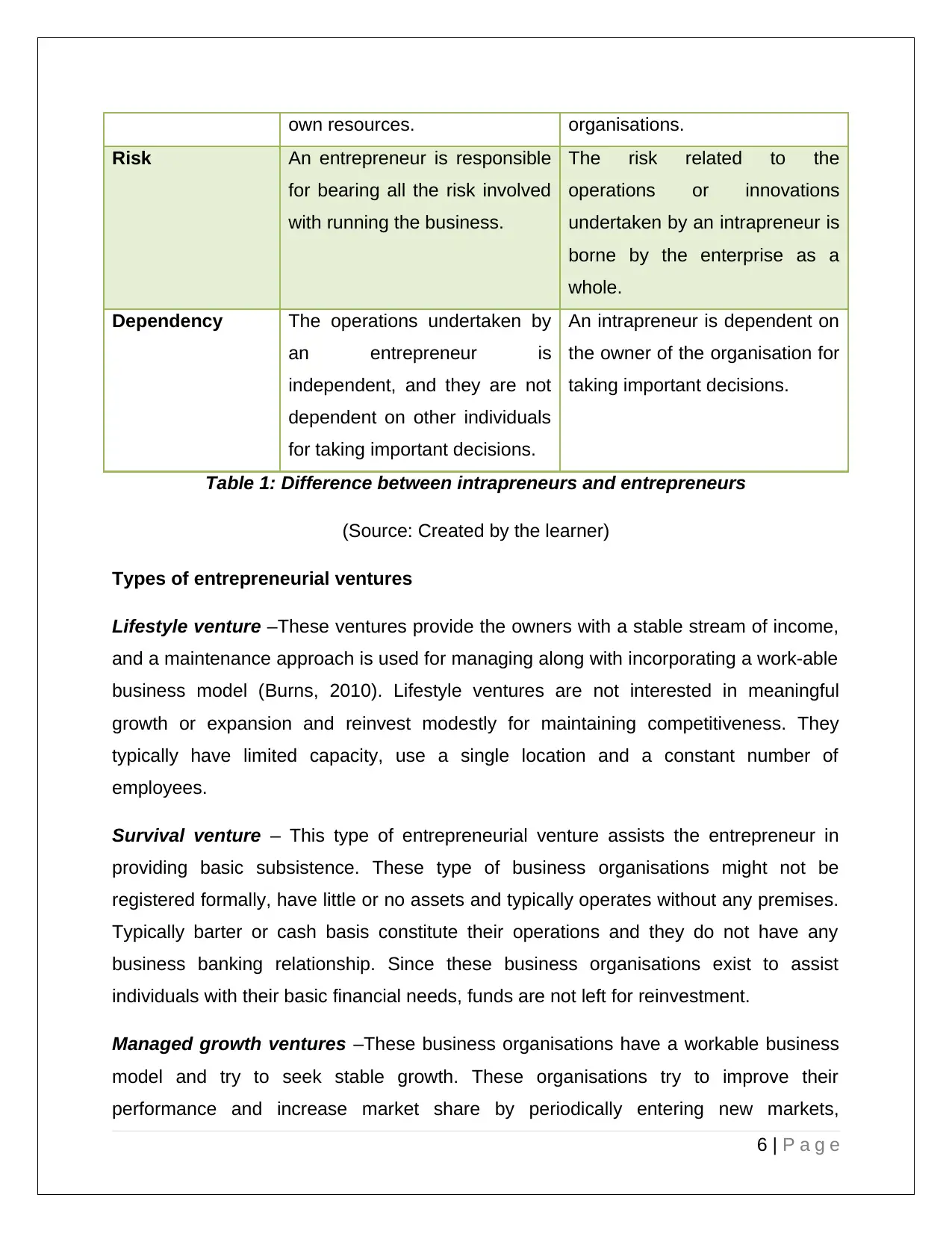
own resources. organisations.
Risk An entrepreneur is responsible
for bearing all the risk involved
with running the business.
The risk related to the
operations or innovations
undertaken by an intrapreneur is
borne by the enterprise as a
whole.
Dependency The operations undertaken by
an entrepreneur is
independent, and they are not
dependent on other individuals
for taking important decisions.
An intrapreneur is dependent on
the owner of the organisation for
taking important decisions.
Table 1: Difference between intrapreneurs and entrepreneurs
(Source: Created by the learner)
Types of entrepreneurial ventures
Lifestyle venture –These ventures provide the owners with a stable stream of income,
and a maintenance approach is used for managing along with incorporating a work-able
business model (Burns, 2010). Lifestyle ventures are not interested in meaningful
growth or expansion and reinvest modestly for maintaining competitiveness. They
typically have limited capacity, use a single location and a constant number of
employees.
Survival venture – This type of entrepreneurial venture assists the entrepreneur in
providing basic subsistence. These type of business organisations might not be
registered formally, have little or no assets and typically operates without any premises.
Typically barter or cash basis constitute their operations and they do not have any
business banking relationship. Since these business organisations exist to assist
individuals with their basic financial needs, funds are not left for reinvestment.
Managed growth ventures –These business organisations have a workable business
model and try to seek stable growth. These organisations try to improve their
performance and increase market share by periodically entering new markets,
6 | P a g e
Risk An entrepreneur is responsible
for bearing all the risk involved
with running the business.
The risk related to the
operations or innovations
undertaken by an intrapreneur is
borne by the enterprise as a
whole.
Dependency The operations undertaken by
an entrepreneur is
independent, and they are not
dependent on other individuals
for taking important decisions.
An intrapreneur is dependent on
the owner of the organisation for
taking important decisions.
Table 1: Difference between intrapreneurs and entrepreneurs
(Source: Created by the learner)
Types of entrepreneurial ventures
Lifestyle venture –These ventures provide the owners with a stable stream of income,
and a maintenance approach is used for managing along with incorporating a work-able
business model (Burns, 2010). Lifestyle ventures are not interested in meaningful
growth or expansion and reinvest modestly for maintaining competitiveness. They
typically have limited capacity, use a single location and a constant number of
employees.
Survival venture – This type of entrepreneurial venture assists the entrepreneur in
providing basic subsistence. These type of business organisations might not be
registered formally, have little or no assets and typically operates without any premises.
Typically barter or cash basis constitute their operations and they do not have any
business banking relationship. Since these business organisations exist to assist
individuals with their basic financial needs, funds are not left for reinvestment.
Managed growth ventures –These business organisations have a workable business
model and try to seek stable growth. These organisations try to improve their
performance and increase market share by periodically entering new markets,
6 | P a g e
⊘ This is a preview!⊘
Do you want full access?
Subscribe today to unlock all pages.
Trusted by 1+ million students worldwide
launching new products occasionally, and steadily expanding staff, locations and
facilities. Managed growth ventures invest continuously for developing a strong regional
and local brand.
Aggressive growth venture –These business enterprises are typically technology-
based and are referred to as gazelles because of their robust innovation capabilities.
The operations of these business organisations are funded with the help of equity
capital and exponential growth is sought by them. These organisations are driven by
opportunity and they focus on both national and international markets.
P2: Building on the different types of entrepreneurial ventures explored in P1, you
are now required to explore the similarities and differences between each.
As discussed above, there are different types of entrepreneurial ventures and
entrepreneurs. Differentiation between them is done based on the type of operations
conducted by them and the way in which they undertake business activities. The
differences between public, private and social enterprises have been discussed below.
Basis of
difference
Social enterprise Public enterprise Private enterprise
Roles Their role is to find the
problems that are
affecting the society
and use the
entrepreneurial
approach to identify a
way through which
the social objectives
can be met.
New enterprises are
started by the
government or they
partner with private
firms for improving the
service that is provided
to the citizens of the
country.
Business
opportunities are
identified by these
types of
enterprises, and
new products or
services are
created with the
aim of improving
the standard of
living and creating
7 | P a g e
facilities. Managed growth ventures invest continuously for developing a strong regional
and local brand.
Aggressive growth venture –These business enterprises are typically technology-
based and are referred to as gazelles because of their robust innovation capabilities.
The operations of these business organisations are funded with the help of equity
capital and exponential growth is sought by them. These organisations are driven by
opportunity and they focus on both national and international markets.
P2: Building on the different types of entrepreneurial ventures explored in P1, you
are now required to explore the similarities and differences between each.
As discussed above, there are different types of entrepreneurial ventures and
entrepreneurs. Differentiation between them is done based on the type of operations
conducted by them and the way in which they undertake business activities. The
differences between public, private and social enterprises have been discussed below.
Basis of
difference
Social enterprise Public enterprise Private enterprise
Roles Their role is to find the
problems that are
affecting the society
and use the
entrepreneurial
approach to identify a
way through which
the social objectives
can be met.
New enterprises are
started by the
government or they
partner with private
firms for improving the
service that is provided
to the citizens of the
country.
Business
opportunities are
identified by these
types of
enterprises, and
new products or
services are
created with the
aim of improving
the standard of
living and creating
7 | P a g e
Paraphrase This Document
Need a fresh take? Get an instant paraphrase of this document with our AI Paraphraser
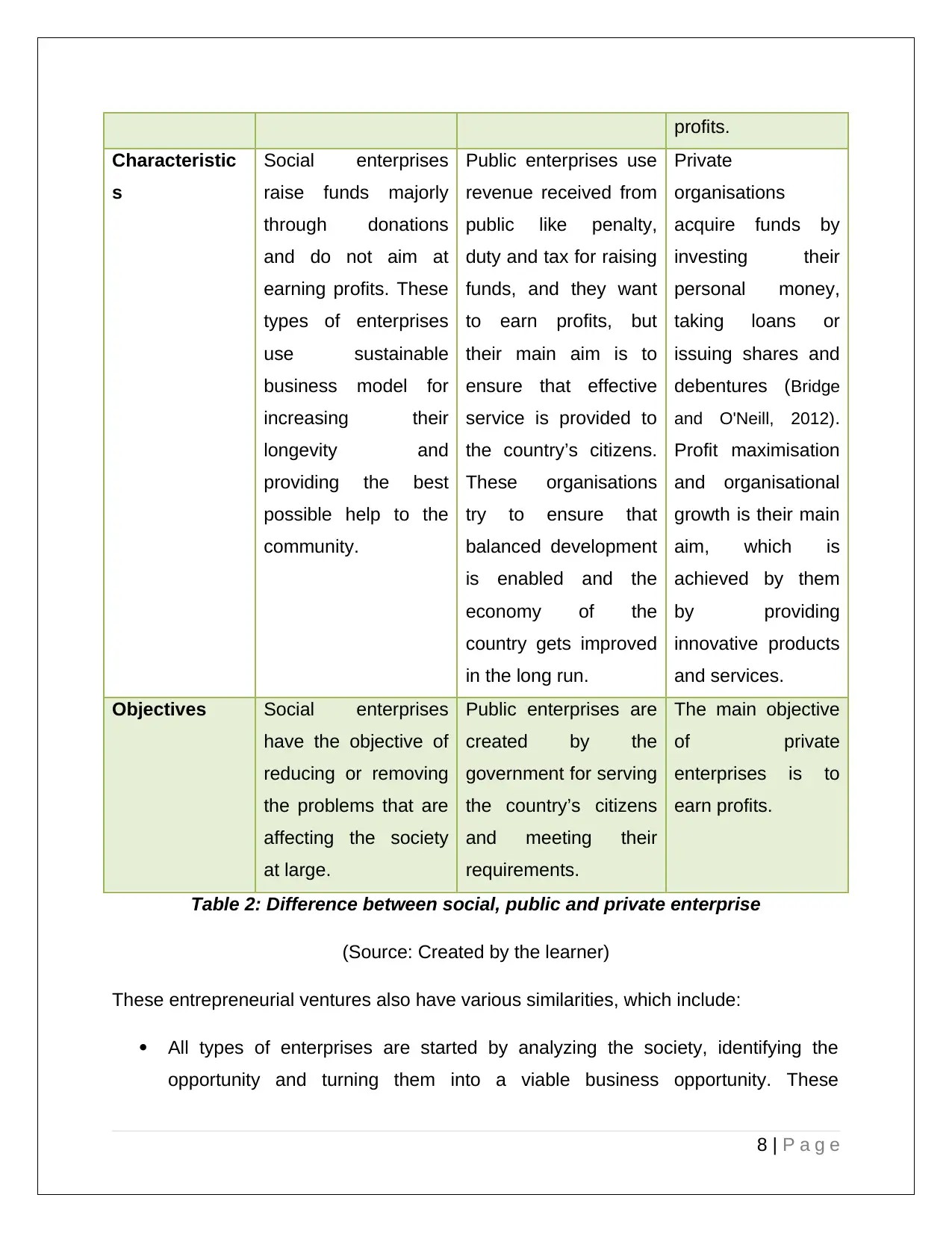
profits.
Characteristic
s
Social enterprises
raise funds majorly
through donations
and do not aim at
earning profits. These
types of enterprises
use sustainable
business model for
increasing their
longevity and
providing the best
possible help to the
community.
Public enterprises use
revenue received from
public like penalty,
duty and tax for raising
funds, and they want
to earn profits, but
their main aim is to
ensure that effective
service is provided to
the country’s citizens.
These organisations
try to ensure that
balanced development
is enabled and the
economy of the
country gets improved
in the long run.
Private
organisations
acquire funds by
investing their
personal money,
taking loans or
issuing shares and
debentures (Bridge
and O'Neill, 2012).
Profit maximisation
and organisational
growth is their main
aim, which is
achieved by them
by providing
innovative products
and services.
Objectives Social enterprises
have the objective of
reducing or removing
the problems that are
affecting the society
at large.
Public enterprises are
created by the
government for serving
the country’s citizens
and meeting their
requirements.
The main objective
of private
enterprises is to
earn profits.
Table 2: Difference between social, public and private enterprise
(Source: Created by the learner)
These entrepreneurial ventures also have various similarities, which include:
All types of enterprises are started by analyzing the society, identifying the
opportunity and turning them into a viable business opportunity. These
8 | P a g e
Characteristic
s
Social enterprises
raise funds majorly
through donations
and do not aim at
earning profits. These
types of enterprises
use sustainable
business model for
increasing their
longevity and
providing the best
possible help to the
community.
Public enterprises use
revenue received from
public like penalty,
duty and tax for raising
funds, and they want
to earn profits, but
their main aim is to
ensure that effective
service is provided to
the country’s citizens.
These organisations
try to ensure that
balanced development
is enabled and the
economy of the
country gets improved
in the long run.
Private
organisations
acquire funds by
investing their
personal money,
taking loans or
issuing shares and
debentures (Bridge
and O'Neill, 2012).
Profit maximisation
and organisational
growth is their main
aim, which is
achieved by them
by providing
innovative products
and services.
Objectives Social enterprises
have the objective of
reducing or removing
the problems that are
affecting the society
at large.
Public enterprises are
created by the
government for serving
the country’s citizens
and meeting their
requirements.
The main objective
of private
enterprises is to
earn profits.
Table 2: Difference between social, public and private enterprise
(Source: Created by the learner)
These entrepreneurial ventures also have various similarities, which include:
All types of enterprises are started by analyzing the society, identifying the
opportunity and turning them into a viable business opportunity. These
8 | P a g e
enterprises try to eliminate the problems being faced by people by starting an
entrepreneurial venture.
These enterprises are risk takers because the products and services that are
provided by them are innovative, and there are high chances of consumers not
accepting them.
Motivation and passion drives these enterprises, and these visionary
organizations aim at bringing about change by bring an end to age old practices.
Their commitment and effective planning ensures that the enterprises grow
steadily instead of staying stagnant.
All types of entrepreneurial ventures have high scope of development and
growth, because of the innovative approach used by them and the
encouragement provided by government (Storey and Greene, 2010).
However, all types of enterprises have different sizes; depending on their scale of
operations, the enterprises are divided into micro, small, medium and large scale
companies. Most of the entrepreneurial ventures start out as micro enterprises due to
lack of resources, which has a maximum of ten employees. Small enterprises have a
larger customer base and employ a maximum of fifty employees. Medium scale
enterprises employ a maximum of 250 people and their customer base is not limited to
the local region.
P3: Present, interpret and assess relevant data and statistic to illustrate the
impact micro and small business have on the economy.
Micro and small business organisations are extremely important for the growth and
development of a country’s economy as well as the global economy. These enterprises
are typically private entrepreneurial ventures and private individuals or groups of people
operate them independently (Ligthelm, 2010). Even though these organisations do not
employ a large number of individuals, a substantial number of micro and small scale
enterprises are operating in the country. According to the statistics provided by the
United Kingdom government, there are more than 5.5 million business organisations
operating in the private sector, out of which 99.3 per cent businesses constitute of micro
9 | P a g e
entrepreneurial venture.
These enterprises are risk takers because the products and services that are
provided by them are innovative, and there are high chances of consumers not
accepting them.
Motivation and passion drives these enterprises, and these visionary
organizations aim at bringing about change by bring an end to age old practices.
Their commitment and effective planning ensures that the enterprises grow
steadily instead of staying stagnant.
All types of entrepreneurial ventures have high scope of development and
growth, because of the innovative approach used by them and the
encouragement provided by government (Storey and Greene, 2010).
However, all types of enterprises have different sizes; depending on their scale of
operations, the enterprises are divided into micro, small, medium and large scale
companies. Most of the entrepreneurial ventures start out as micro enterprises due to
lack of resources, which has a maximum of ten employees. Small enterprises have a
larger customer base and employ a maximum of fifty employees. Medium scale
enterprises employ a maximum of 250 people and their customer base is not limited to
the local region.
P3: Present, interpret and assess relevant data and statistic to illustrate the
impact micro and small business have on the economy.
Micro and small business organisations are extremely important for the growth and
development of a country’s economy as well as the global economy. These enterprises
are typically private entrepreneurial ventures and private individuals or groups of people
operate them independently (Ligthelm, 2010). Even though these organisations do not
employ a large number of individuals, a substantial number of micro and small scale
enterprises are operating in the country. According to the statistics provided by the
United Kingdom government, there are more than 5.5 million business organisations
operating in the private sector, out of which 99.3 per cent businesses constitute of micro
9 | P a g e
⊘ This is a preview!⊘
Do you want full access?
Subscribe today to unlock all pages.
Trusted by 1+ million students worldwide
and small scale enterprises. These business organisations are extremely important for
the growth and development of the United Kingdom and its economy because their
combined annual income consists of £1.8 trillion. Approximately forty-seven per cent
turnover obtained from the private sector was because of the micro and small scale
enterprises operating in the country.
These organisations lead to the development of the country because of the level
employment provided by these organisations (Naudé, 2013). The micro and small scale
business enterprises operate in both rural and urban areas and numerous people are
employed by them, even though the rate of employability of individual organisations is
low. More than 15.7 million people, which constitutes of sixty per cent of total private
sector employment in the United Kingdom, have been employed by these organisations.
This will lead to the development of the country’s economy as more people are finding
jobs, resulting in lower poverty and higher income generation. Moreover, these
organisations also operate in the rural area, where most of the medium and large scale
organisations do not operate, because of which people residing in these areas also find
employment opportunities. This leads to the development of rural areas as well, leading
to balanced development of the country.
These organisations are highly beneficial for the local and national economy, because
out of 5.5 million business organisations, 2.5 million, which constitutes approximately
245 per cent, have been registered for PAYE or VAT (gov.uk, 2018). The current
threshold in the United Kingdom for VAT registration is £85,000, which shows that a
substantial number of companies operating in the country are operating profitably and
pay taxes. This increases the flow of money in the economy along with leading to higher
GDP of the country. Higher GDP not only leads to better development of the national
economy, it also results in the development of world economy.
P4: Building on the information you provided for P3, you must explain the
importance that small businesses and business start-ups on the growth of the
social economy.
10 | P a g e
the growth and development of the United Kingdom and its economy because their
combined annual income consists of £1.8 trillion. Approximately forty-seven per cent
turnover obtained from the private sector was because of the micro and small scale
enterprises operating in the country.
These organisations lead to the development of the country because of the level
employment provided by these organisations (Naudé, 2013). The micro and small scale
business enterprises operate in both rural and urban areas and numerous people are
employed by them, even though the rate of employability of individual organisations is
low. More than 15.7 million people, which constitutes of sixty per cent of total private
sector employment in the United Kingdom, have been employed by these organisations.
This will lead to the development of the country’s economy as more people are finding
jobs, resulting in lower poverty and higher income generation. Moreover, these
organisations also operate in the rural area, where most of the medium and large scale
organisations do not operate, because of which people residing in these areas also find
employment opportunities. This leads to the development of rural areas as well, leading
to balanced development of the country.
These organisations are highly beneficial for the local and national economy, because
out of 5.5 million business organisations, 2.5 million, which constitutes approximately
245 per cent, have been registered for PAYE or VAT (gov.uk, 2018). The current
threshold in the United Kingdom for VAT registration is £85,000, which shows that a
substantial number of companies operating in the country are operating profitably and
pay taxes. This increases the flow of money in the economy along with leading to higher
GDP of the country. Higher GDP not only leads to better development of the national
economy, it also results in the development of world economy.
P4: Building on the information you provided for P3, you must explain the
importance that small businesses and business start-ups on the growth of the
social economy.
10 | P a g e
Paraphrase This Document
Need a fresh take? Get an instant paraphrase of this document with our AI Paraphraser
Social economy consists of diverse types of social enterprises, foundations, non-profit
associations, mutual societies and cooperatives that aim at making profit for or bringing
about change for other individuals instead of the owners or investors. Many individuals
start a new micro or small scale company for alleviating the social problems that affect
the society, and aim at impacting the society in a positive manner (Ackermann, 2012).
However, other small, medium and large scale business organisations, whose main
motive is to earn profits, also undertake activities for the development of the society.
There are various micro and small scale business enterprises that identify the
environmental, economic or social issues affecting the community and build products or
provide services for solving the problem and satisfying the needs of individuals that the
public and private sectors have fulfilled inadequately or ignored.
The initiatives taken by these start-ups and small businesses to make a difference in the
society, has resulted in the growth of the social economy. These enterprises identify the
problems that have been plaguing the society and develop products and services that
the citizens of the country require. Moreover, all business organisations have started
understanding the importance of creating an inclusive, profitable, sustainable and strong
society. Different types of CSR initiatives are taken by the small business and start-ups
to assist in social development. For example, a brewing company, which is one of the
Chivas’s ‘Venture’ finalists, give a part of their profits to Prostate Cancer UK. Similarly,
other initiatives are taken by start-ups, like providing employment to individuals who
have been ill for a long time and disabled, providing food to homeless people, and
banning the use of plastic among others. According to statistics, more than one out of
five business organisations in the United Kingdom undertake social missions and
approximately £55 billion are contributed by the social enterprises to the country’s
economy (gov.uk, 2018). Increased social finance, social investment and social
enterprises have resulted in the growth of UK’s social economy.
11 | P a g e
associations, mutual societies and cooperatives that aim at making profit for or bringing
about change for other individuals instead of the owners or investors. Many individuals
start a new micro or small scale company for alleviating the social problems that affect
the society, and aim at impacting the society in a positive manner (Ackermann, 2012).
However, other small, medium and large scale business organisations, whose main
motive is to earn profits, also undertake activities for the development of the society.
There are various micro and small scale business enterprises that identify the
environmental, economic or social issues affecting the community and build products or
provide services for solving the problem and satisfying the needs of individuals that the
public and private sectors have fulfilled inadequately or ignored.
The initiatives taken by these start-ups and small businesses to make a difference in the
society, has resulted in the growth of the social economy. These enterprises identify the
problems that have been plaguing the society and develop products and services that
the citizens of the country require. Moreover, all business organisations have started
understanding the importance of creating an inclusive, profitable, sustainable and strong
society. Different types of CSR initiatives are taken by the small business and start-ups
to assist in social development. For example, a brewing company, which is one of the
Chivas’s ‘Venture’ finalists, give a part of their profits to Prostate Cancer UK. Similarly,
other initiatives are taken by start-ups, like providing employment to individuals who
have been ill for a long time and disabled, providing food to homeless people, and
banning the use of plastic among others. According to statistics, more than one out of
five business organisations in the United Kingdom undertake social missions and
approximately £55 billion are contributed by the social enterprises to the country’s
economy (gov.uk, 2018). Increased social finance, social investment and social
enterprises have resulted in the growth of UK’s social economy.
11 | P a g e
Part 2
P5: Determine what makes a successful entrepreneur.
Successful entrepreneurs like Richard Branson, Mark Zuckerberg and Bill Gates, all
have particular characteristic traits and skills that set them apart from other individuals.
Due to their intellectual, innovation and creativity level, they give an impression that
entrepreneurship is embedded in their DNA’s; however, that is not the case and all
entrepreneurs have these skills, traits and attributes (Gorgievski et al., 2011).
Skills possessed by all entrepreneurs
Communication – Business organizations can go from good to bad quickly if impact,
clarity and purpose are not present in communication. All entrepreneurs are good
communicators and this skill is used by them for revolutionizing an idea and making
their firms successful. Steve Jobs is one of the most powerful communicators, which
can be seen from the marketing tag lines used by Apple and keynote speeches given by
him.
Teamwork and interpersonal skills – Entrepreneurs have good teamwork and
interpersonal skills because they understand that the entire company cannot be run by
them alone and the employees play an integral role in its success. Along with working
effectively with other members of the company, entrepreneurs ensure that good relation
is maintained with them and they lead and motivate them to give their best
performance.
Planning and managing – Entrepreneurs plan before taking important decisions, and
they hire talented individuals by analyzing the personnel requirement. They understand
the importance of having the right people in the organization, and train and manage
them effectively to keep them motivated and increase the retention rate. Moreover,
entrepreneurs do not lose hope or get devastated after a failure; they take steps to
manage them effectively so that the damage can be reduced (Welter, 2011).
Characteristic traits possessed by all entrepreneurs
12 | P a g e
P5: Determine what makes a successful entrepreneur.
Successful entrepreneurs like Richard Branson, Mark Zuckerberg and Bill Gates, all
have particular characteristic traits and skills that set them apart from other individuals.
Due to their intellectual, innovation and creativity level, they give an impression that
entrepreneurship is embedded in their DNA’s; however, that is not the case and all
entrepreneurs have these skills, traits and attributes (Gorgievski et al., 2011).
Skills possessed by all entrepreneurs
Communication – Business organizations can go from good to bad quickly if impact,
clarity and purpose are not present in communication. All entrepreneurs are good
communicators and this skill is used by them for revolutionizing an idea and making
their firms successful. Steve Jobs is one of the most powerful communicators, which
can be seen from the marketing tag lines used by Apple and keynote speeches given by
him.
Teamwork and interpersonal skills – Entrepreneurs have good teamwork and
interpersonal skills because they understand that the entire company cannot be run by
them alone and the employees play an integral role in its success. Along with working
effectively with other members of the company, entrepreneurs ensure that good relation
is maintained with them and they lead and motivate them to give their best
performance.
Planning and managing – Entrepreneurs plan before taking important decisions, and
they hire talented individuals by analyzing the personnel requirement. They understand
the importance of having the right people in the organization, and train and manage
them effectively to keep them motivated and increase the retention rate. Moreover,
entrepreneurs do not lose hope or get devastated after a failure; they take steps to
manage them effectively so that the damage can be reduced (Welter, 2011).
Characteristic traits possessed by all entrepreneurs
12 | P a g e
⊘ This is a preview!⊘
Do you want full access?
Subscribe today to unlock all pages.
Trusted by 1+ million students worldwide

1 out of 19


Related Documents


Your All-in-One AI-Powered Toolkit for Academic Success.
+13062052269
info@desklib.com
Available 24*7 on WhatsApp / Email
![[object Object]](/_next/static/media/star-bottom.7253800d.svg)
Unlock your academic potential
Copyright © 2020–2026 A2Z Services. All Rights Reserved. Developed and managed by ZUCOL.