ENT301 - Entrepreneurship and Small Business Management Report, UK
VerifiedAdded on 2020/10/23
|16
|5213
|291
Report
AI Summary
This report provides a detailed analysis of entrepreneurship and small business management. It begins by examining different types of entrepreneurs, including small business, large company, and social entrepreneurs, along with their typologies. The report then differentiates between entrepreneurs, intrapreneurs, and own managers, highlighting their similarities and dissimilarities. The public and corporate sectors are defined, and the scope, development, and growth of entrepreneurial ventures are explored. The second part interprets data and statistics to assess the impact of micro and macro businesses on the UK economy, defining the social economy and the role of small businesses in its growth. It further examines the differences between small, medium, and large businesses and their impact on the economy at various levels. The third part identifies the characteristic traits and skills of successful entrepreneurs, contrasting them with business managers. It assesses the aspects of entrepreneurial personality, motivation, and mindset, including the drivers of success and the backgrounds and experiences that influence entrepreneurship. The report concludes with an evaluation of the entrepreneurial environment and its effects on economic development.
Entrepreneurship and Small
Business Management
Business Management

Paraphrase This Document
Need a fresh take? Get an instant paraphrase of this document with our AI Paraphraser
Table of Contents
INTRODUCTION...........................................................................................................................3
PART 1............................................................................................................................................3
1. Examining the different types of entrepreneur and their typologies within the businesses....3
2. Explaining the difference between entrepreneurs along with similarities and dissimilarities.
.....................................................................................................................................................4
3. Defining the public and corporate sectors...............................................................................5
4. Examining the scope, development and growth of entrepreneurial ventures.........................6
PART 2............................................................................................................................................7
1. Interpret the data and statistics to understand the micro and macro businesses' significance
impact on UK..............................................................................................................................7
2. Define social economy and explains importance of small business in growth and
development to social economy of UK. .....................................................................................9
3. Differences small, medium and large business make to the economy at different level......10
4. Critically examine how small businesses have an impact on different levels of the economy
in a local, regional, national and international context.............................................................11
PART 3 .........................................................................................................................................12
1. Determining the characteristic traits and skill of successful entrepreneur and differentiate
them with business managers....................................................................................................12
2. Assessing the aspects of the entrepreneurial personality reflect his entrepreneur motivation
and mindset...............................................................................................................................13
3 Motivation drivers of successful entrepreneur.......................................................................13
4. Examining and evaluate the different background and experience that foster hinder
entrepreneurship........................................................................................................................13
CONCLUSION .............................................................................................................................14
REFERENCES .............................................................................................................................15
INTRODUCTION
INTRODUCTION...........................................................................................................................3
PART 1............................................................................................................................................3
1. Examining the different types of entrepreneur and their typologies within the businesses....3
2. Explaining the difference between entrepreneurs along with similarities and dissimilarities.
.....................................................................................................................................................4
3. Defining the public and corporate sectors...............................................................................5
4. Examining the scope, development and growth of entrepreneurial ventures.........................6
PART 2............................................................................................................................................7
1. Interpret the data and statistics to understand the micro and macro businesses' significance
impact on UK..............................................................................................................................7
2. Define social economy and explains importance of small business in growth and
development to social economy of UK. .....................................................................................9
3. Differences small, medium and large business make to the economy at different level......10
4. Critically examine how small businesses have an impact on different levels of the economy
in a local, regional, national and international context.............................................................11
PART 3 .........................................................................................................................................12
1. Determining the characteristic traits and skill of successful entrepreneur and differentiate
them with business managers....................................................................................................12
2. Assessing the aspects of the entrepreneurial personality reflect his entrepreneur motivation
and mindset...............................................................................................................................13
3 Motivation drivers of successful entrepreneur.......................................................................13
4. Examining and evaluate the different background and experience that foster hinder
entrepreneurship........................................................................................................................13
CONCLUSION .............................................................................................................................14
REFERENCES .............................................................................................................................15
INTRODUCTION
Entrepreneurship and small business development are the areas that are constantly
evolving, requiring creative minds and risk taking ability to grow the venture. Every large
organisation started their business by an entrepreneur. Present study based on Entrepreneur and
small businesses with having aim to explore the opportunity and growth of the businesses. So
further in the study will be explaining the concept of entrepreneurial venture with types and
difference between entrepreneurs and intrapreneurs and own managers. Overall, study will
explain the deep understanding of the concept of entrepreneur by explaining the meaning and
differentiate with other ventures.
However, in the next segment of the report will briefly describe about the micro and
macro business and their significant relationship with UK economy. In the third segment of the
assignment will be explaining the two leaders who become a successful and powerful
entrepreneur in their filed. Overall study will be evaluating the different environment of
entrepreneurs and their impact on the economic development.
PART 1
1. Examining the different types of entrepreneur and their typologies within the businesses.
Entrepreneurship is the kind of business which created on the basis of unique concept.
This is the one person company who originate the company who is known as entrepreneur.
Entrepreneur is an individual who develops a business mode, acquires the necessary physical and
human capital to start a new venture.
Small Business Entrepreneurship : Small business types of entrepreneur are based on
small scale such as grocery stores, hairdressers, consultants, travel agents, carpenters, plumbers
etc (Amato and et.al., 2017). Small entrepreneurship are barely profitable because of less
investment and limited scope. The main purpose of small owners is to feed the needs of their
family members.
Large Company entrepreneurship: Large entrepreneurs are bigger than small
entrepreneurs. Big entrepreneurs mainly deal with innovation and offering new kind of product
or services to earn profit and build reputation in the market. The main purpose of these
entrepreneurs are to change the customer taste, advanced technologies. Tesco, Unilever, British
Airways etc.
evolving, requiring creative minds and risk taking ability to grow the venture. Every large
organisation started their business by an entrepreneur. Present study based on Entrepreneur and
small businesses with having aim to explore the opportunity and growth of the businesses. So
further in the study will be explaining the concept of entrepreneurial venture with types and
difference between entrepreneurs and intrapreneurs and own managers. Overall, study will
explain the deep understanding of the concept of entrepreneur by explaining the meaning and
differentiate with other ventures.
However, in the next segment of the report will briefly describe about the micro and
macro business and their significant relationship with UK economy. In the third segment of the
assignment will be explaining the two leaders who become a successful and powerful
entrepreneur in their filed. Overall study will be evaluating the different environment of
entrepreneurs and their impact on the economic development.
PART 1
1. Examining the different types of entrepreneur and their typologies within the businesses.
Entrepreneurship is the kind of business which created on the basis of unique concept.
This is the one person company who originate the company who is known as entrepreneur.
Entrepreneur is an individual who develops a business mode, acquires the necessary physical and
human capital to start a new venture.
Small Business Entrepreneurship : Small business types of entrepreneur are based on
small scale such as grocery stores, hairdressers, consultants, travel agents, carpenters, plumbers
etc (Amato and et.al., 2017). Small entrepreneurship are barely profitable because of less
investment and limited scope. The main purpose of small owners is to feed the needs of their
family members.
Large Company entrepreneurship: Large entrepreneurs are bigger than small
entrepreneurs. Big entrepreneurs mainly deal with innovation and offering new kind of product
or services to earn profit and build reputation in the market. The main purpose of these
entrepreneurs are to change the customer taste, advanced technologies. Tesco, Unilever, British
Airways etc.
⊘ This is a preview!⊘
Do you want full access?
Subscribe today to unlock all pages.

Trusted by 1+ million students worldwide
Social Entrepreneurship: Social entrepreneur venture basically focus on social welfare
who provides basic needs to vulnerable people. They collect charity and donation from big firms
to create better place for them. This is non-profit entrepreneur venture.
Typologies
Each type of entrepreneur having their unique identity to create business and run in
profitable market. For example : Lifestyle business entrepreneur which is type of small
entrepreneur for example freelancers. Its main purpose is to build a long terms growth, earn
income. On the same side, Scalable innovators or entrepreneurs which aim is to build or generate
significant wealth for founder and investors (Armanios and et.al., 2017). There are some other
examples of different entrepreneurs are women entrepreneur, serial entrepreneurs, entrepreneurs
and owner managers. Like Serial entrepreneur are those who invent new unique product or
services and then handover to someone else and move on to the next project. Own managers are
the individuals who own manage their company on its own liabilities for instance Bill gates. On
the other side, Women entrepreneur where women are collectively work for a single purpose.
2. Explaining the difference between entrepreneurs along with similarities and dissimilarities.
Difference Between Entrepreneurs
Basis Serial Entrepreneur Intrapreneurs Own Managers
Meaning Serial Entrepreneur is
the kind of
entrepreneur who
always come up with
new ideas and
innovation. These
kinds of entrepreneurs
give responsibility to
someone else and then
move on to other
innovations.
Intrapreneurs are the
leaders who originated
by the entrepreneurs
within the firm.
Intrapreneurs are the
employee working in
the company but
having capabilities to
become an
entrepreneur.
Own managers are
individual who
manage the work
responsibility within
their own company.
Purpose Its main purpose is to
create something new
Main objective of
intrapreneurs are to
Own managers are
mainly focused on the
who provides basic needs to vulnerable people. They collect charity and donation from big firms
to create better place for them. This is non-profit entrepreneur venture.
Typologies
Each type of entrepreneur having their unique identity to create business and run in
profitable market. For example : Lifestyle business entrepreneur which is type of small
entrepreneur for example freelancers. Its main purpose is to build a long terms growth, earn
income. On the same side, Scalable innovators or entrepreneurs which aim is to build or generate
significant wealth for founder and investors (Armanios and et.al., 2017). There are some other
examples of different entrepreneurs are women entrepreneur, serial entrepreneurs, entrepreneurs
and owner managers. Like Serial entrepreneur are those who invent new unique product or
services and then handover to someone else and move on to the next project. Own managers are
the individuals who own manage their company on its own liabilities for instance Bill gates. On
the other side, Women entrepreneur where women are collectively work for a single purpose.
2. Explaining the difference between entrepreneurs along with similarities and dissimilarities.
Difference Between Entrepreneurs
Basis Serial Entrepreneur Intrapreneurs Own Managers
Meaning Serial Entrepreneur is
the kind of
entrepreneur who
always come up with
new ideas and
innovation. These
kinds of entrepreneurs
give responsibility to
someone else and then
move on to other
innovations.
Intrapreneurs are the
leaders who originated
by the entrepreneurs
within the firm.
Intrapreneurs are the
employee working in
the company but
having capabilities to
become an
entrepreneur.
Own managers are
individual who
manage the work
responsibility within
their own company.
Purpose Its main purpose is to
create something new
Main objective of
intrapreneurs are to
Own managers are
mainly focused on the
Paraphrase This Document
Need a fresh take? Get an instant paraphrase of this document with our AI Paraphraser
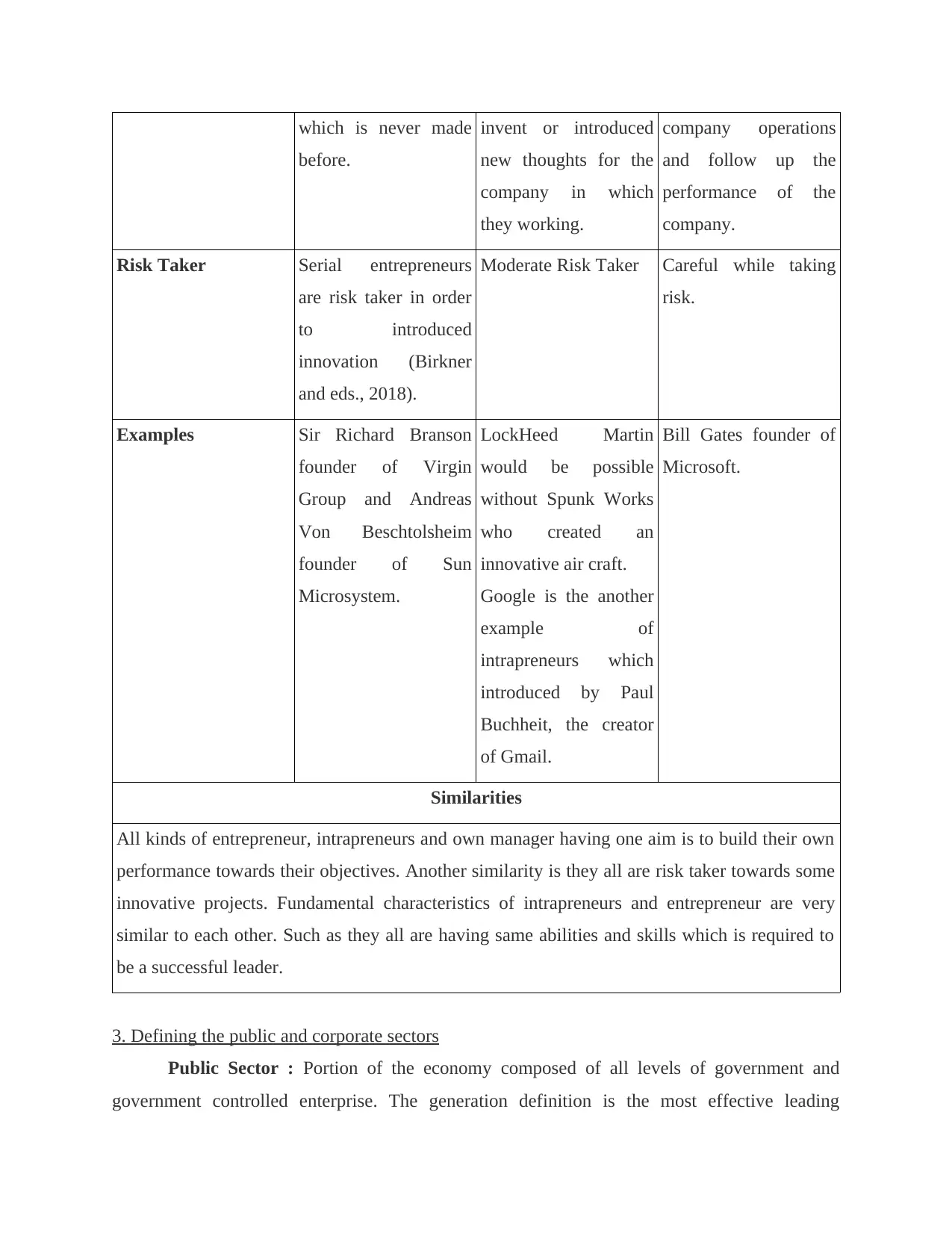
which is never made
before.
invent or introduced
new thoughts for the
company in which
they working.
company operations
and follow up the
performance of the
company.
Risk Taker Serial entrepreneurs
are risk taker in order
to introduced
innovation (Birkner
and eds., 2018).
Moderate Risk Taker Careful while taking
risk.
Examples Sir Richard Branson
founder of Virgin
Group and Andreas
Von Beschtolsheim
founder of Sun
Microsystem.
LockHeed Martin
would be possible
without Spunk Works
who created an
innovative air craft.
Google is the another
example of
intrapreneurs which
introduced by Paul
Buchheit, the creator
of Gmail.
Bill Gates founder of
Microsoft.
Similarities
All kinds of entrepreneur, intrapreneurs and own manager having one aim is to build their own
performance towards their objectives. Another similarity is they all are risk taker towards some
innovative projects. Fundamental characteristics of intrapreneurs and entrepreneur are very
similar to each other. Such as they all are having same abilities and skills which is required to
be a successful leader.
3. Defining the public and corporate sectors
Public Sector : Portion of the economy composed of all levels of government and
government controlled enterprise. The generation definition is the most effective leading
before.
invent or introduced
new thoughts for the
company in which
they working.
company operations
and follow up the
performance of the
company.
Risk Taker Serial entrepreneurs
are risk taker in order
to introduced
innovation (Birkner
and eds., 2018).
Moderate Risk Taker Careful while taking
risk.
Examples Sir Richard Branson
founder of Virgin
Group and Andreas
Von Beschtolsheim
founder of Sun
Microsystem.
LockHeed Martin
would be possible
without Spunk Works
who created an
innovative air craft.
Google is the another
example of
intrapreneurs which
introduced by Paul
Buchheit, the creator
of Gmail.
Bill Gates founder of
Microsoft.
Similarities
All kinds of entrepreneur, intrapreneurs and own manager having one aim is to build their own
performance towards their objectives. Another similarity is they all are risk taker towards some
innovative projects. Fundamental characteristics of intrapreneurs and entrepreneur are very
similar to each other. Such as they all are having same abilities and skills which is required to
be a successful leader.
3. Defining the public and corporate sectors
Public Sector : Portion of the economy composed of all levels of government and
government controlled enterprise. The generation definition is the most effective leading
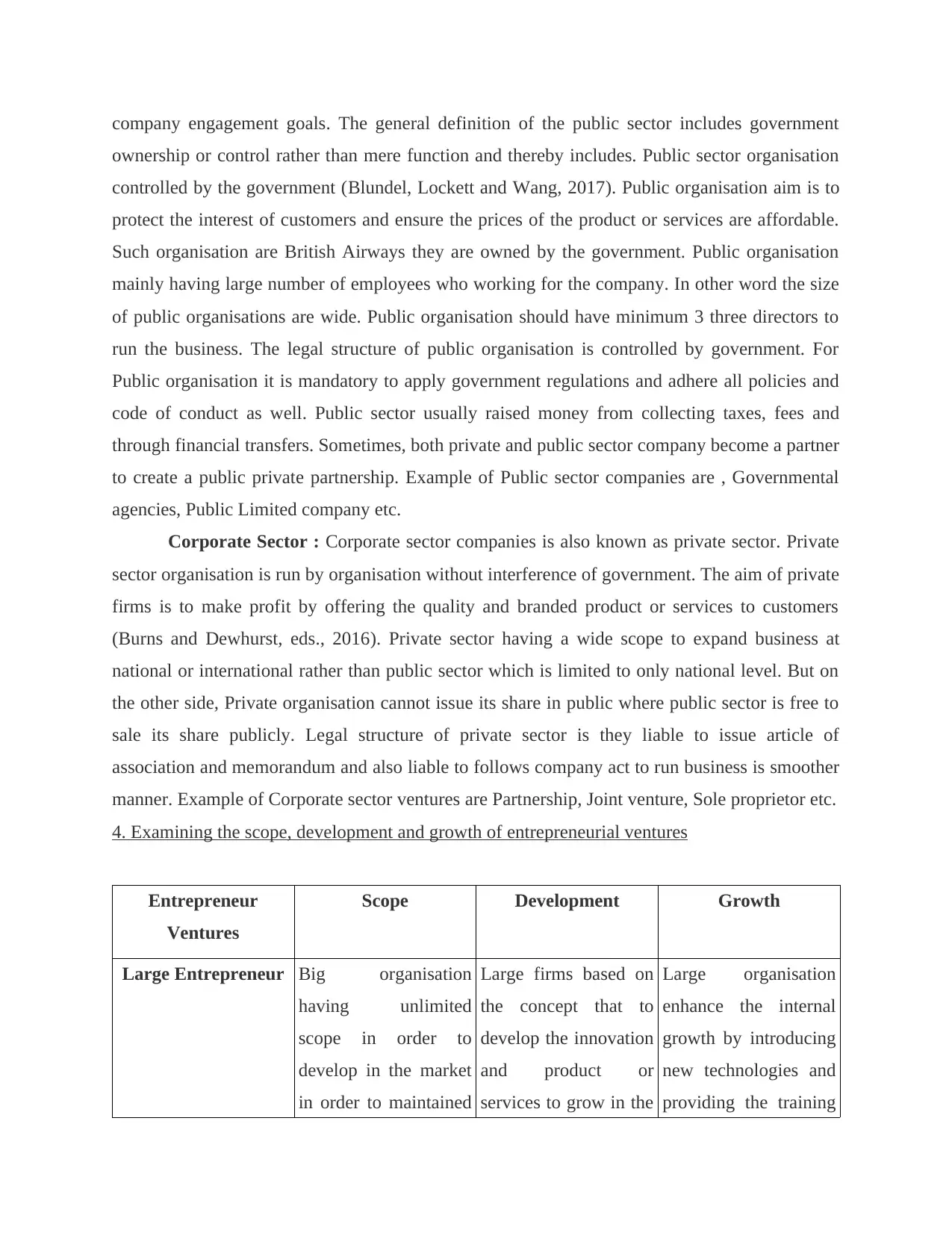
company engagement goals. The general definition of the public sector includes government
ownership or control rather than mere function and thereby includes. Public sector organisation
controlled by the government (Blundel, Lockett and Wang, 2017). Public organisation aim is to
protect the interest of customers and ensure the prices of the product or services are affordable.
Such organisation are British Airways they are owned by the government. Public organisation
mainly having large number of employees who working for the company. In other word the size
of public organisations are wide. Public organisation should have minimum 3 three directors to
run the business. The legal structure of public organisation is controlled by government. For
Public organisation it is mandatory to apply government regulations and adhere all policies and
code of conduct as well. Public sector usually raised money from collecting taxes, fees and
through financial transfers. Sometimes, both private and public sector company become a partner
to create a public private partnership. Example of Public sector companies are , Governmental
agencies, Public Limited company etc.
Corporate Sector : Corporate sector companies is also known as private sector. Private
sector organisation is run by organisation without interference of government. The aim of private
firms is to make profit by offering the quality and branded product or services to customers
(Burns and Dewhurst, eds., 2016). Private sector having a wide scope to expand business at
national or international rather than public sector which is limited to only national level. But on
the other side, Private organisation cannot issue its share in public where public sector is free to
sale its share publicly. Legal structure of private sector is they liable to issue article of
association and memorandum and also liable to follows company act to run business is smoother
manner. Example of Corporate sector ventures are Partnership, Joint venture, Sole proprietor etc.
4. Examining the scope, development and growth of entrepreneurial ventures
Entrepreneur
Ventures
Scope Development Growth
Large Entrepreneur Big organisation
having unlimited
scope in order to
develop in the market
in order to maintained
Large firms based on
the concept that to
develop the innovation
and product or
services to grow in the
Large organisation
enhance the internal
growth by introducing
new technologies and
providing the training
ownership or control rather than mere function and thereby includes. Public sector organisation
controlled by the government (Blundel, Lockett and Wang, 2017). Public organisation aim is to
protect the interest of customers and ensure the prices of the product or services are affordable.
Such organisation are British Airways they are owned by the government. Public organisation
mainly having large number of employees who working for the company. In other word the size
of public organisations are wide. Public organisation should have minimum 3 three directors to
run the business. The legal structure of public organisation is controlled by government. For
Public organisation it is mandatory to apply government regulations and adhere all policies and
code of conduct as well. Public sector usually raised money from collecting taxes, fees and
through financial transfers. Sometimes, both private and public sector company become a partner
to create a public private partnership. Example of Public sector companies are , Governmental
agencies, Public Limited company etc.
Corporate Sector : Corporate sector companies is also known as private sector. Private
sector organisation is run by organisation without interference of government. The aim of private
firms is to make profit by offering the quality and branded product or services to customers
(Burns and Dewhurst, eds., 2016). Private sector having a wide scope to expand business at
national or international rather than public sector which is limited to only national level. But on
the other side, Private organisation cannot issue its share in public where public sector is free to
sale its share publicly. Legal structure of private sector is they liable to issue article of
association and memorandum and also liable to follows company act to run business is smoother
manner. Example of Corporate sector ventures are Partnership, Joint venture, Sole proprietor etc.
4. Examining the scope, development and growth of entrepreneurial ventures
Entrepreneur
Ventures
Scope Development Growth
Large Entrepreneur Big organisation
having unlimited
scope in order to
develop in the market
in order to maintained
Large firms based on
the concept that to
develop the innovation
and product or
services to grow in the
Large organisation
enhance the internal
growth by introducing
new technologies and
providing the training
⊘ This is a preview!⊘
Do you want full access?
Subscribe today to unlock all pages.
Trusted by 1+ million students worldwide
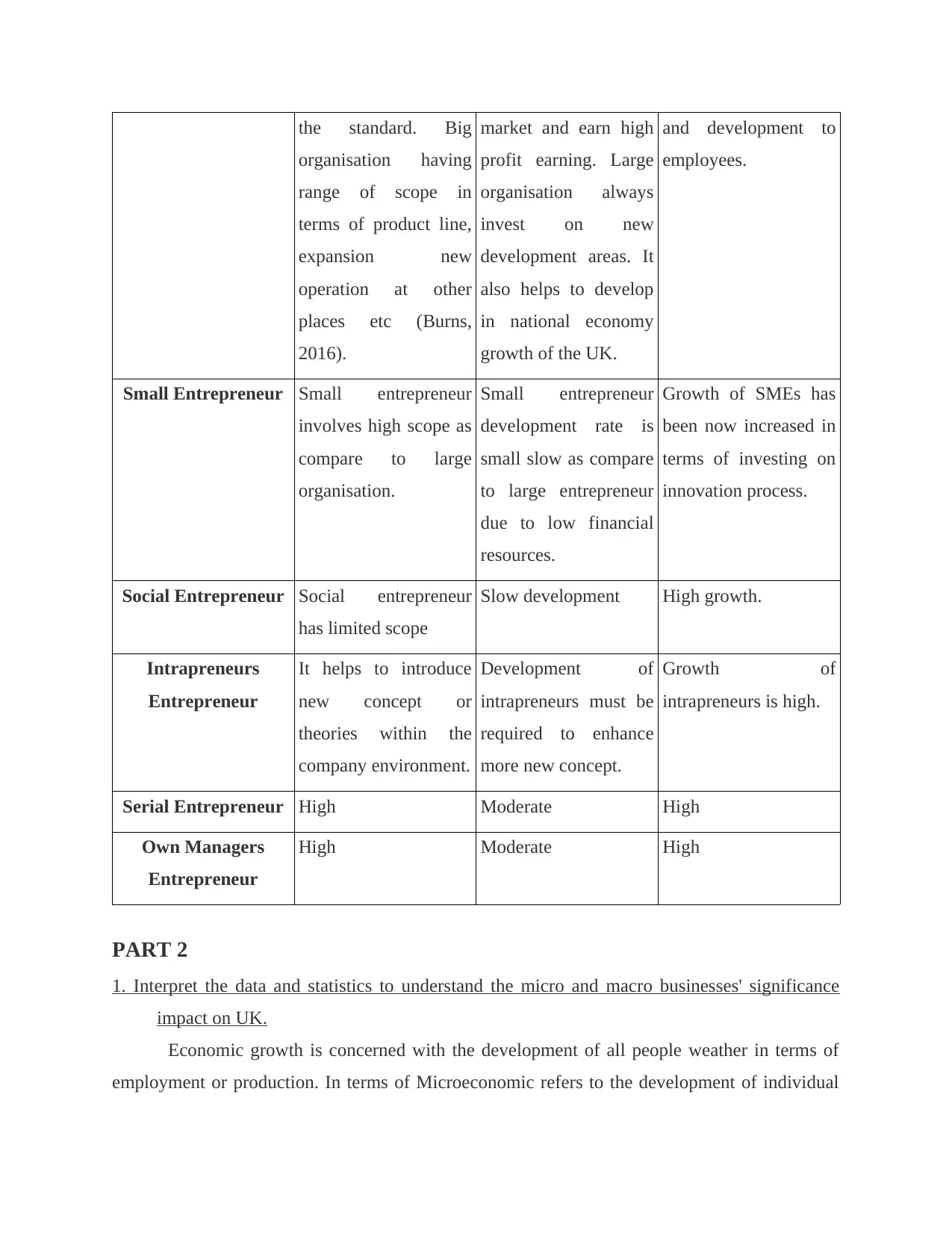
the standard. Big
organisation having
range of scope in
terms of product line,
expansion new
operation at other
places etc (Burns,
2016).
market and earn high
profit earning. Large
organisation always
invest on new
development areas. It
also helps to develop
in national economy
growth of the UK.
and development to
employees.
Small Entrepreneur Small entrepreneur
involves high scope as
compare to large
organisation.
Small entrepreneur
development rate is
small slow as compare
to large entrepreneur
due to low financial
resources.
Growth of SMEs has
been now increased in
terms of investing on
innovation process.
Social Entrepreneur Social entrepreneur
has limited scope
Slow development High growth.
Intrapreneurs
Entrepreneur
It helps to introduce
new concept or
theories within the
company environment.
Development of
intrapreneurs must be
required to enhance
more new concept.
Growth of
intrapreneurs is high.
Serial Entrepreneur High Moderate High
Own Managers
Entrepreneur
High Moderate High
PART 2
1. Interpret the data and statistics to understand the micro and macro businesses' significance
impact on UK.
Economic growth is concerned with the development of all people weather in terms of
employment or production. In terms of Microeconomic refers to the development of individual
organisation having
range of scope in
terms of product line,
expansion new
operation at other
places etc (Burns,
2016).
market and earn high
profit earning. Large
organisation always
invest on new
development areas. It
also helps to develop
in national economy
growth of the UK.
and development to
employees.
Small Entrepreneur Small entrepreneur
involves high scope as
compare to large
organisation.
Small entrepreneur
development rate is
small slow as compare
to large entrepreneur
due to low financial
resources.
Growth of SMEs has
been now increased in
terms of investing on
innovation process.
Social Entrepreneur Social entrepreneur
has limited scope
Slow development High growth.
Intrapreneurs
Entrepreneur
It helps to introduce
new concept or
theories within the
company environment.
Development of
intrapreneurs must be
required to enhance
more new concept.
Growth of
intrapreneurs is high.
Serial Entrepreneur High Moderate High
Own Managers
Entrepreneur
High Moderate High
PART 2
1. Interpret the data and statistics to understand the micro and macro businesses' significance
impact on UK.
Economic growth is concerned with the development of all people weather in terms of
employment or production. In terms of Microeconomic refers to the development of individual
Paraphrase This Document
Need a fresh take? Get an instant paraphrase of this document with our AI Paraphraser
agent with the economy (Dechezleprêtre and Sato, 2017). On the other side, Macro Economics
looks at the economy as whole. Brexit has the potential power to fundamentally rewrite the rules
how UK businesses supposed to run business, which become the serious issue in the UK. Brexit
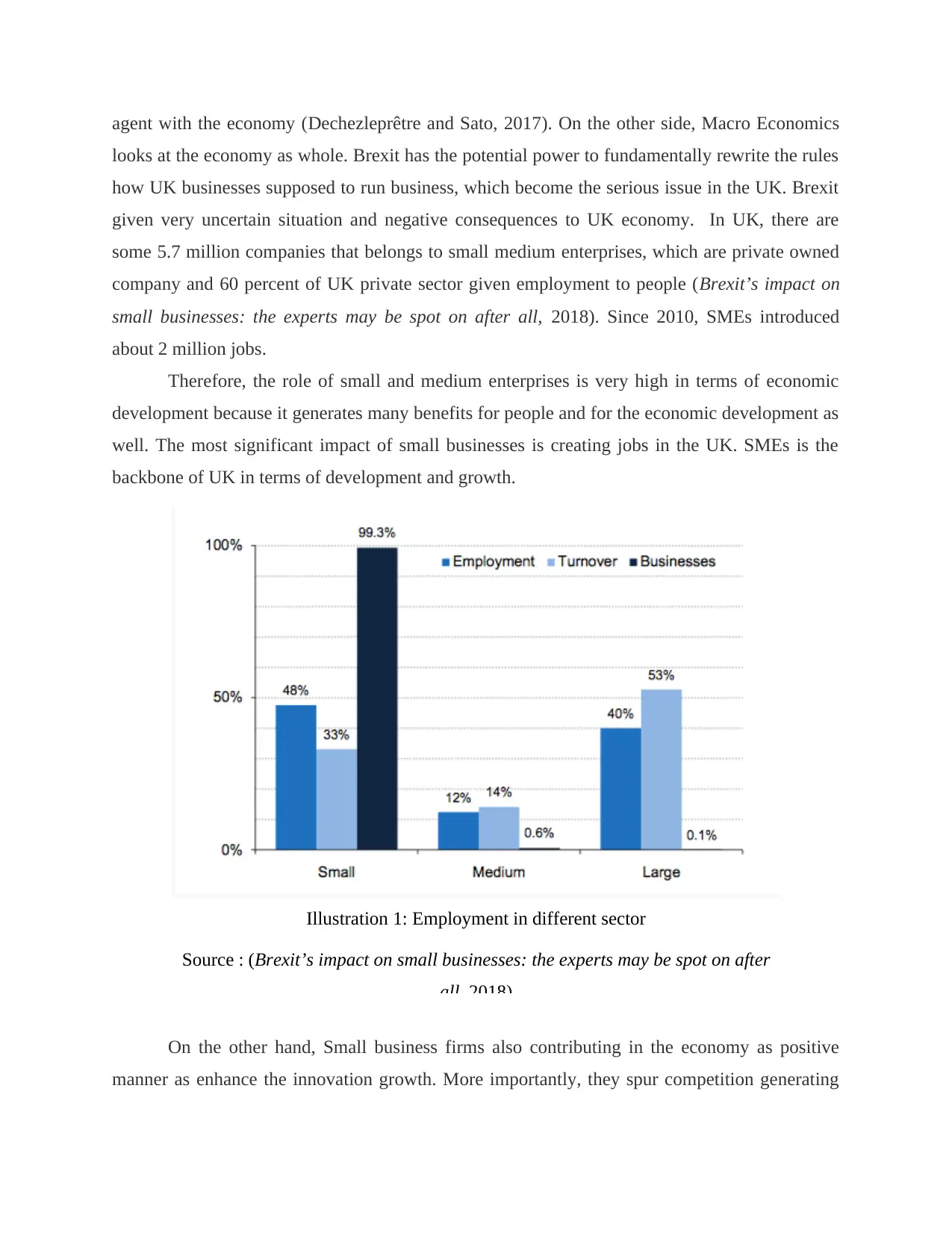
given very uncertain situation and negative consequences to UK economy. In UK, there are
some 5.7 million companies that belongs to small medium enterprises, which are private owned
company and 60 percent of UK private sector given employment to people (Brexit’s impact on
small businesses: the experts may be spot on after all, 2018). Since 2010, SMEs introduced
about 2 million jobs.
Therefore, the role of small and medium enterprises is very high in terms of economic
development because it generates many benefits for people and for the economic development as
well. The most significant impact of small businesses is creating jobs in the UK. SMEs is the
backbone of UK in terms of development and growth.
On the other hand, Small business firms also contributing in the economy as positive
manner as enhance the innovation growth. More importantly, they spur competition generating
Illustration 1: Employment in different sector
Source : (Brexit’s impact on small businesses: the experts may be spot on after
all, 2018)
looks at the economy as whole. Brexit has the potential power to fundamentally rewrite the rules
how UK businesses supposed to run business, which become the serious issue in the UK. Brexit
given very uncertain situation and negative consequences to UK economy. In UK, there are
some 5.7 million companies that belongs to small medium enterprises, which are private owned
company and 60 percent of UK private sector given employment to people (Brexit’s impact on
small businesses: the experts may be spot on after all, 2018). Since 2010, SMEs introduced
about 2 million jobs.
Therefore, the role of small and medium enterprises is very high in terms of economic
development because it generates many benefits for people and for the economic development as
well. The most significant impact of small businesses is creating jobs in the UK. SMEs is the
backbone of UK in terms of development and growth.
On the other hand, Small business firms also contributing in the economy as positive
manner as enhance the innovation growth. More importantly, they spur competition generating
Illustration 1: Employment in different sector
Source : (Brexit’s impact on small businesses: the experts may be spot on after
all, 2018)
new metrics of doing business (Driffield and Karoglou, 2019). Some major examples of
innovations are Uber, Airbndb, Funding Circle who creates respective and created new groups
for creating competition level.
In terms of customer satisfaction, small businesses are more understanding the needs and
wants of the customer. That helps to generate the customer satisfaction and increasing the
standard of living. Government bodies often use tax breaks to encourage the new start-ups and
small businesses. They provide opportunity for people to take initiative towards the star ups with
innovative idea. Government bodies provides several opportunities for small businesses to
motivate them towards the new growth.
On the other sides, SMEs also contribute towards the development of society as well.
Like retired people whose age is above 60 or 65 is also started their own business in order to
contribute their share in the business (Hatten, 2015).
2. Define social economy and explains importance of small business in growth and development
to social economy of UK.
Social economy is formed by a rich diversity of enterprises and organisation, such as
cooperative mutual, association, foundation etc. Social economy provides great benefits and
development opportunity to the country in better performance. Such as voluntary and open
membership. Social economy has been shown to promote the inclusive growth by creating jobs,
strengthening skills and employability and building diversified local economies.
Social enterprises have been given positive impact on the UK economy in terms of
maintaining the social development growth in longer term manner. SMEs provides many
services and opportunity in social development where people are not able to afford high priced
services or products (Henry, Hill and Leitch, 2017). In UK, SMEs offering affordable range of
product or services to the people and helps them to maintained the standard of living in more
appropriate manner. In other word it helps to grow in the economic development in other words,
it also helps to achieve the economic growth of the county as well. SMEs also provides
innovation and invention that helps to create more development opportunity such as Uber was
the new concept of cab services which provides services to travellers who need a cab services for
covering the distance at minimum price. This start up helps to those people who can't afford to
buy a car but with the help of cab facilities they feel the same as owner while book a cab.
innovations are Uber, Airbndb, Funding Circle who creates respective and created new groups
for creating competition level.
In terms of customer satisfaction, small businesses are more understanding the needs and
wants of the customer. That helps to generate the customer satisfaction and increasing the
standard of living. Government bodies often use tax breaks to encourage the new start-ups and
small businesses. They provide opportunity for people to take initiative towards the star ups with
innovative idea. Government bodies provides several opportunities for small businesses to
motivate them towards the new growth.
On the other sides, SMEs also contribute towards the development of society as well.
Like retired people whose age is above 60 or 65 is also started their own business in order to
contribute their share in the business (Hatten, 2015).
2. Define social economy and explains importance of small business in growth and development
to social economy of UK.
Social economy is formed by a rich diversity of enterprises and organisation, such as
cooperative mutual, association, foundation etc. Social economy provides great benefits and
development opportunity to the country in better performance. Such as voluntary and open
membership. Social economy has been shown to promote the inclusive growth by creating jobs,
strengthening skills and employability and building diversified local economies.
Social enterprises have been given positive impact on the UK economy in terms of
maintaining the social development growth in longer term manner. SMEs provides many
services and opportunity in social development where people are not able to afford high priced
services or products (Henry, Hill and Leitch, 2017). In UK, SMEs offering affordable range of
product or services to the people and helps them to maintained the standard of living in more
appropriate manner. In other word it helps to grow in the economic development in other words,
it also helps to achieve the economic growth of the county as well. SMEs also provides
innovation and invention that helps to create more development opportunity such as Uber was
the new concept of cab services which provides services to travellers who need a cab services for
covering the distance at minimum price. This start up helps to those people who can't afford to
buy a car but with the help of cab facilities they feel the same as owner while book a cab.
⊘ This is a preview!⊘
Do you want full access?
Subscribe today to unlock all pages.
Trusted by 1+ million students worldwide
Social Enterprises UK is a founding member and convenor of the social economy
alliance, a group drawn from across the social economy. These organisations include social
enterprise, cooperative society, housing association and social investors. Apart from that, it
discovers. Apart from that, it manages the development growth in order to effective manner of
things and task (Mugler, 2017).
3. Differences small, medium and large business make to the economy at different level
Different levels Small Businesses Medium Businesses Large Businesses
Local level Small business
enterprises impact
positively on the
development of local
areas. Such it provides
job opportunity,
different range of
product services,
standard of living,
local place location
environmental
benefits, increased
ability to compete for
major, stronger retail
sales etc.
Medium scale
businesses introduces
innovation and
facilities for the local
consumers. It also
helps to grow the area
popularity and
infrastructure.
Large organisation
having several benefits
in terms of making
profit and innovation.
At local level, large
organisation has
contributing several
benefits such as big
retail store to purchase
product or services,
luxurious product or
services, meet the
customer needs,
increasing level of
standard. Etc.
National Level SMEs also plays a
most significant role in
the development of
national economy by
enhancing the
employment
opportunity, reduced
the rate of poverty due
Medium scale business
is wider than small
businesses (Murray,
Skene and Haynes,
2017). It contributes
services towards the
national level in terms
of employment,
National level it
becomes the best and
leading working task
in order to meet out
the development areas
and growth.
alliance, a group drawn from across the social economy. These organisations include social
enterprise, cooperative society, housing association and social investors. Apart from that, it
discovers. Apart from that, it manages the development growth in order to effective manner of
things and task (Mugler, 2017).
3. Differences small, medium and large business make to the economy at different level
Different levels Small Businesses Medium Businesses Large Businesses
Local level Small business
enterprises impact
positively on the
development of local
areas. Such it provides
job opportunity,
different range of
product services,
standard of living,
local place location
environmental
benefits, increased
ability to compete for
major, stronger retail
sales etc.
Medium scale
businesses introduces
innovation and
facilities for the local
consumers. It also
helps to grow the area
popularity and
infrastructure.
Large organisation
having several benefits
in terms of making
profit and innovation.
At local level, large
organisation has
contributing several
benefits such as big
retail store to purchase
product or services,
luxurious product or
services, meet the
customer needs,
increasing level of
standard. Etc.
National Level SMEs also plays a
most significant role in
the development of
national economy by
enhancing the
employment
opportunity, reduced
the rate of poverty due
Medium scale business
is wider than small
businesses (Murray,
Skene and Haynes,
2017). It contributes
services towards the
national level in terms
of employment,
National level it
becomes the best and
leading working task
in order to meet out
the development areas
and growth.
Paraphrase This Document
Need a fresh take? Get an instant paraphrase of this document with our AI Paraphraser
to unemployment etc. product services.
Medium scale business
provides job to
unemployed people.
Regional Level Small businesses
affect the business and
effective learning
outcomes in order to
meet out the social
development needs.
Regional level.
Regional level
benefited to handle the
business target and
opportunity goal in
order to make the most
leading and
development target.
At regional level it
helps to contribute at
standard of living of
the people in order to
upgrade the better
environmental growth.
Regional level is the
another major
contributory part
which generate new
working styles and
motivation level
performance.
4. Critically examine how small businesses have an impact on different levels of the economy in
a local, regional, national and international context.
Small enterprises have been given the huge impact on the overall development of
national, global level in order to generate the national income and different opportunity for the
development. Small enterprises have also contributed higher levels of output in order to enhance
the national, regional or local standards (Pauwels and et.al., 2016). Social enterprises create new
businesses and new goods and services, it result in new employment which can reduce a
cascading effects or virtuous circle in the economy. It is the best way of doing the business and
motivating the best leading task and new working styles and growth. Entrepreneurs Create new
business and bring long term task in order to enhance the better developing results in the overall
development.
Medium scale business
provides job to
unemployed people.
Regional Level Small businesses
affect the business and
effective learning
outcomes in order to
meet out the social
development needs.
Regional level.
Regional level
benefited to handle the
business target and
opportunity goal in
order to make the most
leading and
development target.
At regional level it
helps to contribute at
standard of living of
the people in order to
upgrade the better
environmental growth.
Regional level is the
another major
contributory part
which generate new
working styles and
motivation level
performance.
4. Critically examine how small businesses have an impact on different levels of the economy in
a local, regional, national and international context.
Small enterprises have been given the huge impact on the overall development of
national, global level in order to generate the national income and different opportunity for the
development. Small enterprises have also contributed higher levels of output in order to enhance
the national, regional or local standards (Pauwels and et.al., 2016). Social enterprises create new
businesses and new goods and services, it result in new employment which can reduce a
cascading effects or virtuous circle in the economy. It is the best way of doing the business and
motivating the best leading task and new working styles and growth. Entrepreneurs Create new
business and bring long term task in order to enhance the better developing results in the overall
development.
This is the foremost benefit that enterprises provide at all levels. Another, impact of small
businesses on regional level is to maintain the balanced regional development growth.
Entrepreneurs setting up the new businesses and industrial units which help with regional
growth.
It also increases the GDP and per capita income of the UK as well. On the other side,
small business also having scope to expand their business at new place that helps to open export
services (Reijonen, Tammi and Saastamoinen, 2016). Community development doesn't always
translate into community development by providing different services. But on the same side,
small businesses having limited growth in terms of lack financial resources and uncertainty.
Besides, due to large organisation and high competition level it brings lost of dissatisfaction
among buyers.
PART 3
1. Determining the characteristic traits and skill of successful entrepreneur and differentiate them
with business managers.
Like Alan Sugar is known as business magnate or media personality who are advisor as
well as politician. On the other side, Richard Branson who is a founder of Virgin group (Rodan,
2016). Both entrepreneur is the most powerful and successfully entrepreneur who achieved
success with their own capabilities and skills.
Characteristic traits and skills of successful entrepreneur
Disciplined : All successful entrepreneur are disciplined and followed a proper code of
conduct to get the success in the business. Disciplined grow the strength and power of an
individual to control uncertain situation. Richard Branson is very calm and disciplined people
who well understand the market situation and forecasting the uncertainties.
Motivator : A successful entrepreneur be always motivated and give motivation to their
teammates. This skill is the most efficient to become a successful leader or entrepreneur. Such as
Alan Sugar who is known for its business skill and motivation.
Determination and Hard worker : Human being never get anything without self -
determination and hard work. In order to get something high, individual should have to
contribute 100% capabilities towards that goals (Scarborough, 2016). Like Richard Branson they
originated different other groups of the company make Virgin Worlds leading company with the
help of his determination.
businesses on regional level is to maintain the balanced regional development growth.
Entrepreneurs setting up the new businesses and industrial units which help with regional
growth.
It also increases the GDP and per capita income of the UK as well. On the other side,
small business also having scope to expand their business at new place that helps to open export
services (Reijonen, Tammi and Saastamoinen, 2016). Community development doesn't always
translate into community development by providing different services. But on the same side,
small businesses having limited growth in terms of lack financial resources and uncertainty.
Besides, due to large organisation and high competition level it brings lost of dissatisfaction
among buyers.
PART 3
1. Determining the characteristic traits and skill of successful entrepreneur and differentiate them
with business managers.
Like Alan Sugar is known as business magnate or media personality who are advisor as
well as politician. On the other side, Richard Branson who is a founder of Virgin group (Rodan,
2016). Both entrepreneur is the most powerful and successfully entrepreneur who achieved
success with their own capabilities and skills.
Characteristic traits and skills of successful entrepreneur
Disciplined : All successful entrepreneur are disciplined and followed a proper code of
conduct to get the success in the business. Disciplined grow the strength and power of an
individual to control uncertain situation. Richard Branson is very calm and disciplined people
who well understand the market situation and forecasting the uncertainties.
Motivator : A successful entrepreneur be always motivated and give motivation to their
teammates. This skill is the most efficient to become a successful leader or entrepreneur. Such as
Alan Sugar who is known for its business skill and motivation.
Determination and Hard worker : Human being never get anything without self -
determination and hard work. In order to get something high, individual should have to
contribute 100% capabilities towards that goals (Scarborough, 2016). Like Richard Branson they
originated different other groups of the company make Virgin Worlds leading company with the
help of his determination.
⊘ This is a preview!⊘
Do you want full access?
Subscribe today to unlock all pages.
Trusted by 1+ million students worldwide

1 out of 16


Related Documents


Your All-in-One AI-Powered Toolkit for Academic Success.
+13062052269
info@desklib.com
Available 24*7 on WhatsApp / Email
![[object Object]](/_next/static/media/star-bottom.7253800d.svg)
Unlock your academic potential
Copyright © 2020–2026 A2Z Services. All Rights Reserved. Developed and managed by ZUCOL.