Entrepreneurship & Small Business Management: Venture Analysis UK
VerifiedAdded on 2020/11/23
|16
|3957
|131
Report
AI Summary
This report provides a comprehensive analysis of entrepreneurship and small business management, examining various entrepreneurial ventures such as small, medium, and large businesses, and highlighting their similarities and differences. It investigates the impact of small businesses on different levels of the UK economy, including local, regional, national, and international contexts. The report also explores the characteristics and skills of successful entrepreneurs using the OCEAN model, and evaluates the environments that foster or hinder entrepreneurship. Furthermore, it delves into the interpretation of data and statistics related to small and micro businesses and their economic impact, defines the social economy and its importance in business start-ups, and critically examines the influence of small businesses at different economic levels.
Entrepreneurship and small
business management
business management

Paraphrase This Document
Need a fresh take? Get an instant paraphrase of this document with our AI Paraphraser
Table of Contents
INTRODUCTION...........................................................................................................................1
PART 1............................................................................................................................................1
P1. Types of entrepreneur ventures.............................................................................................1
P2. Similarities and difference between entrepreneurial ventures..............................................2
D1. Public sector organisation and corporate sector and demonstrate and investigate their
entrepreneur ventures..................................................................................................................3
M1. Scope, development and growth of the entrepreneur ventures............................................4
PART 2 ...........................................................................................................................................4
P3. Interpretation of data and statistics of small and micro businesses and its impact on the
UK economy with the help of examples.....................................................................................4
P4. Definition of social economy and its importance in small businesses and business start-
ups...............................................................................................................................................5
M2. Evaluation of businesses on different levels of the economy..............................................6
D2. Critical examination of impact of small businesses on different levels of an economy......6
PART 3............................................................................................................................................6
P5. Characteristics and skills of successful entrepreneur ...........................................................6
P6. How entrepreneur personality reflect his entrepreneurial motivation and mind set.............8
D3. Analysis of characteristics, traits, skills and motivational drivers in order to be a
successful entrepreneur...............................................................................................................8
LO4. Examination and evaluation of different environments that has fostered and hindered the
entrepreneurship..........................................................................................................................9
CONCLUSION................................................................................................................................9
REFERENCE.................................................................................................................................11
UK SME Data, Stats & Charts. 2018. [online]. Available through:
<https://www.merchantsavvy.co.uk/uk-sme-data-stats-charts/>...................................................12
INTRODUCTION...........................................................................................................................1
PART 1............................................................................................................................................1
P1. Types of entrepreneur ventures.............................................................................................1
P2. Similarities and difference between entrepreneurial ventures..............................................2
D1. Public sector organisation and corporate sector and demonstrate and investigate their
entrepreneur ventures..................................................................................................................3
M1. Scope, development and growth of the entrepreneur ventures............................................4
PART 2 ...........................................................................................................................................4
P3. Interpretation of data and statistics of small and micro businesses and its impact on the
UK economy with the help of examples.....................................................................................4
P4. Definition of social economy and its importance in small businesses and business start-
ups...............................................................................................................................................5
M2. Evaluation of businesses on different levels of the economy..............................................6
D2. Critical examination of impact of small businesses on different levels of an economy......6
PART 3............................................................................................................................................6
P5. Characteristics and skills of successful entrepreneur ...........................................................6
P6. How entrepreneur personality reflect his entrepreneurial motivation and mind set.............8
D3. Analysis of characteristics, traits, skills and motivational drivers in order to be a
successful entrepreneur...............................................................................................................8
LO4. Examination and evaluation of different environments that has fostered and hindered the
entrepreneurship..........................................................................................................................9
CONCLUSION................................................................................................................................9
REFERENCE.................................................................................................................................11
UK SME Data, Stats & Charts. 2018. [online]. Available through:
<https://www.merchantsavvy.co.uk/uk-sme-data-stats-charts/>...................................................12

⊘ This is a preview!⊘
Do you want full access?
Subscribe today to unlock all pages.

Trusted by 1+ million students worldwide
INTRODUCTION
Entrepreneurship is the important factor of every successful organisation because it is the
heart of the every enterprise. It plays an important role in the small business by designing,
launching and running a new business. Entrepreneurship set the business step by step to earn
profit. This report present the different type entrepreneurship ventures such as small, medium
and large and also defines the considers among them in terms of their similarities and
differences. This study also identify the impact of small business on different level of economy
such as local, regional, national and international context. In this report we will also discuss the
characteristics and skills of successful entrepreneur through Ocean model (Ayandibu and
Houghton, 2017). This study also evaluates the different environments which affect the
entrepreneurship.
PART 1
P1. Types of entrepreneur ventures
Entrepreneur ventures includes three type of ventures such as small, medium and large
business. All of these ventures have different objective towards their business.
Small entrepreneur venture
It includes small business which produce products and services which are already
established in the market. The purpose of this company is to slowly grow with earning profit by
providing services to their local customers. For example general store shop which provides the
day to day grocery items to their local community.
Medium entrepreneur venture
Medium level business aim is to maximise production and profitability through providing
the services to their cEntrepreneurship and Small Business Managementustomer freely. It is
independent business which includes fewer number of employees in their company. For example
marketing services which provides the services to the other firms in terms of increasing brand of
image.
Large entrepreneur venture
It involves the large scale business, the main purpose of large business is to build a brand
image in the global market through gaining competitive advantages from market
places(Brustbauer, 2016).
1
Entrepreneurship is the important factor of every successful organisation because it is the
heart of the every enterprise. It plays an important role in the small business by designing,
launching and running a new business. Entrepreneurship set the business step by step to earn
profit. This report present the different type entrepreneurship ventures such as small, medium
and large and also defines the considers among them in terms of their similarities and
differences. This study also identify the impact of small business on different level of economy
such as local, regional, national and international context. In this report we will also discuss the
characteristics and skills of successful entrepreneur through Ocean model (Ayandibu and
Houghton, 2017). This study also evaluates the different environments which affect the
entrepreneurship.
PART 1
P1. Types of entrepreneur ventures
Entrepreneur ventures includes three type of ventures such as small, medium and large
business. All of these ventures have different objective towards their business.
Small entrepreneur venture
It includes small business which produce products and services which are already
established in the market. The purpose of this company is to slowly grow with earning profit by
providing services to their local customers. For example general store shop which provides the
day to day grocery items to their local community.
Medium entrepreneur venture
Medium level business aim is to maximise production and profitability through providing
the services to their cEntrepreneurship and Small Business Managementustomer freely. It is
independent business which includes fewer number of employees in their company. For example
marketing services which provides the services to the other firms in terms of increasing brand of
image.
Large entrepreneur venture
It involves the large scale business, the main purpose of large business is to build a brand
image in the global market through gaining competitive advantages from market
places(Brustbauer, 2016).
1
Paraphrase This Document
Need a fresh take? Get an instant paraphrase of this document with our AI Paraphraser
Typologies of Entrepreneurship
It involves various type of typology's such as small business entrepreneurship, scalable
start up, large company and social entrepreneurship.
Small business entrepreneurship
It includes the small businesses such general stores, travel agents and carpenters. The
small entrepreneur and typology of entrepreneurship is related because typology
entrepreneurship helps the organisation to grow through an idea of offering a innovative product
process for producing attractive goods to customers.
Scalable start-up entrepreneurship
In this entrepreneur view a company from day first that their vision can change the world.
It relates to the medium scale business because it attracts the investors towards the company for
increasing financial funding of the firm(Bryson and Daniels, 2015). For examples market
analysis companies which helps the other enterprises to increase their brand image by market
surveys.
Large company entrepreneurship
This typology related with the large business enterprises and this typology helps the
company to grow in the global market through sustaining innovations and market analysis for
encouraging interest of consumers towards the company which increase the brand loyalty. For
examples MacDonald provides the delicious foods with better facility services to their customers
for increasing their brand image.
Social entrepreneurship
This entrepreneurship related with large skill organisation as well as small business
organisation which has focused on solving social issues and also providing the goods and
services to the public at the reasonable price which results in increasing productivity of both the
types of organisation.
P2. Similarities and difference between entrepreneurial ventures
differences Small business Medium scale Large scale
Meaning This type of business
is operates and owned
privately.
It refers to those firms
which are owned and
operates by 2 or more
It refers to those
business which
performs n number of
2
It involves various type of typology's such as small business entrepreneurship, scalable
start up, large company and social entrepreneurship.
Small business entrepreneurship
It includes the small businesses such general stores, travel agents and carpenters. The
small entrepreneur and typology of entrepreneurship is related because typology
entrepreneurship helps the organisation to grow through an idea of offering a innovative product
process for producing attractive goods to customers.
Scalable start-up entrepreneurship
In this entrepreneur view a company from day first that their vision can change the world.
It relates to the medium scale business because it attracts the investors towards the company for
increasing financial funding of the firm(Bryson and Daniels, 2015). For examples market
analysis companies which helps the other enterprises to increase their brand image by market
surveys.
Large company entrepreneurship
This typology related with the large business enterprises and this typology helps the
company to grow in the global market through sustaining innovations and market analysis for
encouraging interest of consumers towards the company which increase the brand loyalty. For
examples MacDonald provides the delicious foods with better facility services to their customers
for increasing their brand image.
Social entrepreneurship
This entrepreneurship related with large skill organisation as well as small business
organisation which has focused on solving social issues and also providing the goods and
services to the public at the reasonable price which results in increasing productivity of both the
types of organisation.
P2. Similarities and difference between entrepreneurial ventures
differences Small business Medium scale Large scale
Meaning This type of business
is operates and owned
privately.
It refers to those firms
which are owned and
operates by 2 or more
It refers to those
business which
performs n number of
2
people in terms of
partnership business
firms.
orations daily for
maximising their
profitability.
Purpose The purpose of this
type firms is to
provide the services to
consumers for
fulfilling their day to
day requirement and
earn some profit for
the survival of the
company.
The purpose of
medium scale firms is
to improve their
business in terms of
high productivity and
profit.
The main objective of
this type of
organisation is to
expand their business
in global market as
well gaining
competitive
advantages.
Number of employees Small business
organisation includes
the employees
between 1 to 40.
This type business
includes employees
more than 2 or less
than 200 in their
enterprise.
This types
organisation consist of
large scale of
employee which is
more than 500.
Similarities between small, medium and large business organisation
All of these organisations are different in terms of their purpose, size and number of
employees but they have also has some similarities such as all of business are run to earn
profit(Burns and Dewhurst, 2016).
The objective of all the organisation is to provide better goods and services to customer's
they all are focusing upon expansion of their businesses
they all are contributed to the economy of the nation
D1. Public sector organisation and corporate sector and demonstrate and investigate their
entrepreneur ventures
Public sector organisation
It refers to those organisations which are owned and operates by the governments with
the aim of providing goods and services to their local communities at reasonable price.
3
partnership business
firms.
orations daily for
maximising their
profitability.
Purpose The purpose of this
type firms is to
provide the services to
consumers for
fulfilling their day to
day requirement and
earn some profit for
the survival of the
company.
The purpose of
medium scale firms is
to improve their
business in terms of
high productivity and
profit.
The main objective of
this type of
organisation is to
expand their business
in global market as
well gaining
competitive
advantages.
Number of employees Small business
organisation includes
the employees
between 1 to 40.
This type business
includes employees
more than 2 or less
than 200 in their
enterprise.
This types
organisation consist of
large scale of
employee which is
more than 500.
Similarities between small, medium and large business organisation
All of these organisations are different in terms of their purpose, size and number of
employees but they have also has some similarities such as all of business are run to earn
profit(Burns and Dewhurst, 2016).
The objective of all the organisation is to provide better goods and services to customer's
they all are focusing upon expansion of their businesses
they all are contributed to the economy of the nation
D1. Public sector organisation and corporate sector and demonstrate and investigate their
entrepreneur ventures
Public sector organisation
It refers to those organisations which are owned and operates by the governments with
the aim of providing goods and services to their local communities at reasonable price.
3
⊘ This is a preview!⊘
Do you want full access?
Subscribe today to unlock all pages.
Trusted by 1+ million students worldwide
According to the study of different entrepreneur ventures it includes large business enterprises
for example national health service organisation and various schools and hospital services.
Corporate sector organisation
It includes all the private sector organisation and the objective of this type of organisation
is to gain and maximise profitability through providing goods and services. By understanding all
the entrepreneur ventures this type of organisation includes the medium level business which
expand their business in global market through innovations. For example McDonald who expand
their business globally through innovation in terms of providing delicious foods with good
seating facility(Burns, 2016).
M1. Scope, development and growth of the entrepreneur ventures
Public sector organisation includes the various business such as national health service, it
has limited scope in the United kingdom's economy and the growth development of the NHS is
slow as compared to the private sector organisation because it is non profit organisation which
provides the health services to the peoples.
Corporate sector organisation cover the companies with the aim of maximising
profitability of the enterprise. The scope of this type organisations such MacDonald is very huge
across the world and the growth and development of this organisation is comparatively very high
in the global market.
PART 2
P3. Interpretation of data and statistics of small and micro businesses and its impact on the UK
economy with the help of examples.
Interpretation of data and statistics and its impact on the UK economy is as follows:
Micro businesses – these are those businesses which operate on a very low level. They
have a strong impact on the UK economy because around 96% of private sector companies
operate on a micro level that is they give employment to less than 10 people. A research was
carried out by the department of business, energy and industrial strategy in November 2018,
through which it was found that micro businesses occupy around 20.1 % business, around 15.4
% of employment and around 13.8 % turnover towards the UK economy. For example, critics
claim that micro businesses does not have huge impact on national productivity and their
4
for example national health service organisation and various schools and hospital services.
Corporate sector organisation
It includes all the private sector organisation and the objective of this type of organisation
is to gain and maximise profitability through providing goods and services. By understanding all
the entrepreneur ventures this type of organisation includes the medium level business which
expand their business in global market through innovations. For example McDonald who expand
their business globally through innovation in terms of providing delicious foods with good
seating facility(Burns, 2016).
M1. Scope, development and growth of the entrepreneur ventures
Public sector organisation includes the various business such as national health service, it
has limited scope in the United kingdom's economy and the growth development of the NHS is
slow as compared to the private sector organisation because it is non profit organisation which
provides the health services to the peoples.
Corporate sector organisation cover the companies with the aim of maximising
profitability of the enterprise. The scope of this type organisations such MacDonald is very huge
across the world and the growth and development of this organisation is comparatively very high
in the global market.
PART 2
P3. Interpretation of data and statistics of small and micro businesses and its impact on the UK
economy with the help of examples.
Interpretation of data and statistics and its impact on the UK economy is as follows:
Micro businesses – these are those businesses which operate on a very low level. They
have a strong impact on the UK economy because around 96% of private sector companies
operate on a micro level that is they give employment to less than 10 people. A research was
carried out by the department of business, energy and industrial strategy in November 2018,
through which it was found that micro businesses occupy around 20.1 % business, around 15.4
% of employment and around 13.8 % turnover towards the UK economy. For example, critics
claim that micro businesses does not have huge impact on national productivity and their
4
Paraphrase This Document
Need a fresh take? Get an instant paraphrase of this document with our AI Paraphraser
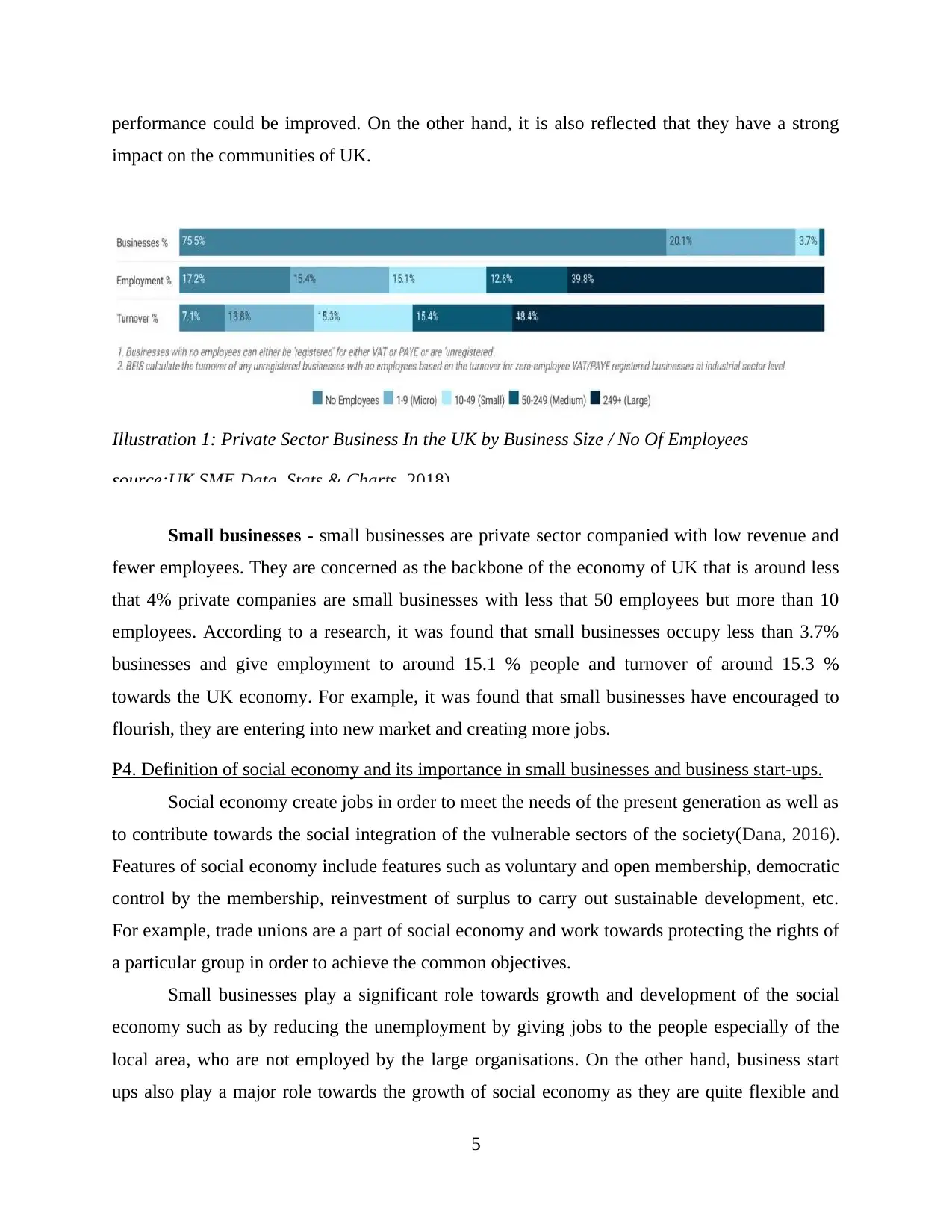
performance could be improved. On the other hand, it is also reflected that they have a strong
impact on the communities of UK.
Small businesses - small businesses are private sector companied with low revenue and
fewer employees. They are concerned as the backbone of the economy of UK that is around less
that 4% private companies are small businesses with less that 50 employees but more than 10
employees. According to a research, it was found that small businesses occupy less than 3.7%
businesses and give employment to around 15.1 % people and turnover of around 15.3 %
towards the UK economy. For example, it was found that small businesses have encouraged to
flourish, they are entering into new market and creating more jobs.
P4. Definition of social economy and its importance in small businesses and business start-ups.
Social economy create jobs in order to meet the needs of the present generation as well as
to contribute towards the social integration of the vulnerable sectors of the society(Dana, 2016).
Features of social economy include features such as voluntary and open membership, democratic
control by the membership, reinvestment of surplus to carry out sustainable development, etc.
For example, trade unions are a part of social economy and work towards protecting the rights of
a particular group in order to achieve the common objectives.
Small businesses play a significant role towards growth and development of the social
economy such as by reducing the unemployment by giving jobs to the people especially of the
local area, who are not employed by the large organisations. On the other hand, business start
ups also play a major role towards the growth of social economy as they are quite flexible and
5
Illustration 1: Private Sector Business In the UK by Business Size / No Of Employees
source:UK SME Data, Stats & Charts, 2018)
impact on the communities of UK.
Small businesses - small businesses are private sector companied with low revenue and
fewer employees. They are concerned as the backbone of the economy of UK that is around less
that 4% private companies are small businesses with less that 50 employees but more than 10
employees. According to a research, it was found that small businesses occupy less than 3.7%
businesses and give employment to around 15.1 % people and turnover of around 15.3 %
towards the UK economy. For example, it was found that small businesses have encouraged to
flourish, they are entering into new market and creating more jobs.
P4. Definition of social economy and its importance in small businesses and business start-ups.
Social economy create jobs in order to meet the needs of the present generation as well as
to contribute towards the social integration of the vulnerable sectors of the society(Dana, 2016).
Features of social economy include features such as voluntary and open membership, democratic
control by the membership, reinvestment of surplus to carry out sustainable development, etc.
For example, trade unions are a part of social economy and work towards protecting the rights of
a particular group in order to achieve the common objectives.
Small businesses play a significant role towards growth and development of the social
economy such as by reducing the unemployment by giving jobs to the people especially of the
local area, who are not employed by the large organisations. On the other hand, business start
ups also play a major role towards the growth of social economy as they are quite flexible and
5
Illustration 1: Private Sector Business In the UK by Business Size / No Of Employees
source:UK SME Data, Stats & Charts, 2018)
could be started by anywhere and anyone. This helps in improving the diversity in the form of
various cultures and dynamic functions and this in turn contributes towards the growth of the
social economy(Mariotti and Glackin, 2015).
Many small business and start ups fails and this gives the society an opportunity to learn,
rebuild and recover in long run.
M2. Evaluation of businesses on different levels of the economy
Evaluation of businesses at different levels of economy is as follows:
Local level – small businesses have the major impact at the local level of an economy in
terms employment as well as other factors. Though middle enterprises also have impact at the
local level of economy but less that small businesses. The least affecting enterprises are large
enterprises when it comes to local level of an economy.
Regional level – when it comes to regional level, enterprises operating at middle level
play a major role towards generation of income, employment, etc; as compared to small and
large enterprises(Millsteed, Redmond and Walker, 2016).
National level – large enterprises fit best towards operating the economy at national level
as it not only operate at national level but also supports trade at international level through
import and export which small and medium enterprises are not capable of doing.
D2. Critical examination of impact of small businesses on different levels of an economy.
Small businesses have a major impact at the local level as it helps in growth of the people
of local area by improving their standard of living through providing them an opportunity to
generate income by giving them employment as well as contributing in some or the other way
towards the welfare of the local people. On the other hand, small business impact the people and
economy at regional level by bringing flexibility in working as well as diversity by employing
people from various cultures and regions. Apart from this, small business also help in generation
of income for the economy but experience difficulty to operate at national level but they are not
capable to operate at international level because of low financial status and less number of
employees(Ramadani and et.al., 2017).
6
various cultures and dynamic functions and this in turn contributes towards the growth of the
social economy(Mariotti and Glackin, 2015).
Many small business and start ups fails and this gives the society an opportunity to learn,
rebuild and recover in long run.
M2. Evaluation of businesses on different levels of the economy
Evaluation of businesses at different levels of economy is as follows:
Local level – small businesses have the major impact at the local level of an economy in
terms employment as well as other factors. Though middle enterprises also have impact at the
local level of economy but less that small businesses. The least affecting enterprises are large
enterprises when it comes to local level of an economy.
Regional level – when it comes to regional level, enterprises operating at middle level
play a major role towards generation of income, employment, etc; as compared to small and
large enterprises(Millsteed, Redmond and Walker, 2016).
National level – large enterprises fit best towards operating the economy at national level
as it not only operate at national level but also supports trade at international level through
import and export which small and medium enterprises are not capable of doing.
D2. Critical examination of impact of small businesses on different levels of an economy.
Small businesses have a major impact at the local level as it helps in growth of the people
of local area by improving their standard of living through providing them an opportunity to
generate income by giving them employment as well as contributing in some or the other way
towards the welfare of the local people. On the other hand, small business impact the people and
economy at regional level by bringing flexibility in working as well as diversity by employing
people from various cultures and regions. Apart from this, small business also help in generation
of income for the economy but experience difficulty to operate at national level but they are not
capable to operate at international level because of low financial status and less number of
employees(Ramadani and et.al., 2017).
6
⊘ This is a preview!⊘
Do you want full access?
Subscribe today to unlock all pages.
Trusted by 1+ million students worldwide
PART 3
P5. Characteristics and skills of successful entrepreneur
There are various successful entrepreneurs in the world and they develop their business at
global market environment.
Most successful entrepreneur is Alan sugar, it is British business magnate and the advisor
of media personality, politician and politics. In 2016 it becomes 95th richest person in united
Kingdom.
Characteristic traits and skills of Alan sugar
Alan sugar is a creative person and with this characteristic they can implement various
innovative ideas for effective performance. Having this characteristic started out firstly
cig grate lighters.
The second important characteristics of sir Alan sugar is leadership qualities with the
help of this they can demonstrate and understand the other employee and guide for doing
better work(Ribeiro-Soriano, 2017).
Alan sugar have the ability to build positive relationship with other employees. This has
been challenge for the many of the entrepreneurs but they have this skill to maintain
healthy working environment in the organisation.
The main skill and characteristic trait of Alan sugar is intelligence and they prove himself
as a mathematical whizz.
Characteristic traits and skills of Richard Branson
Richard Branson is an English business magnate, investor and author(Scarborough,
2016). He is the first business venture at the age of sixteen and also become a successful business
entrepreneur.
They build a strong team and delegate effectively, according to Branson it is important
for your organisational success that you learn to hand off those think can not do well by
you.
They have the Excellent communication skills which is essential for every successful
entrepreneur which facilitated the way to interact with human beings and allows us to
learn and grow.
7
P5. Characteristics and skills of successful entrepreneur
There are various successful entrepreneurs in the world and they develop their business at
global market environment.
Most successful entrepreneur is Alan sugar, it is British business magnate and the advisor
of media personality, politician and politics. In 2016 it becomes 95th richest person in united
Kingdom.
Characteristic traits and skills of Alan sugar
Alan sugar is a creative person and with this characteristic they can implement various
innovative ideas for effective performance. Having this characteristic started out firstly
cig grate lighters.
The second important characteristics of sir Alan sugar is leadership qualities with the
help of this they can demonstrate and understand the other employee and guide for doing
better work(Ribeiro-Soriano, 2017).
Alan sugar have the ability to build positive relationship with other employees. This has
been challenge for the many of the entrepreneurs but they have this skill to maintain
healthy working environment in the organisation.
The main skill and characteristic trait of Alan sugar is intelligence and they prove himself
as a mathematical whizz.
Characteristic traits and skills of Richard Branson
Richard Branson is an English business magnate, investor and author(Scarborough,
2016). He is the first business venture at the age of sixteen and also become a successful business
entrepreneur.
They build a strong team and delegate effectively, according to Branson it is important
for your organisational success that you learn to hand off those think can not do well by
you.
They have the Excellent communication skills which is essential for every successful
entrepreneur which facilitated the way to interact with human beings and allows us to
learn and grow.
7
Paraphrase This Document
Need a fresh take? Get an instant paraphrase of this document with our AI Paraphraser
They have also capability to embrace failure and they think that no one can get
everything at first time and we have to learn continuously from our mistakes.
In comparison to Alan sugar they have the skills to take the necessary risk which can
open the door to change and to get success.
P6. How entrepreneur personality reflect his entrepreneurial motivation and mind set
The ocean model can be reflected the entrepreneur personality of Alan sugar because this
model set a goal for the entrepreneur to boost their performance for to creating a sustainable
wealth over the long term(Storey, 2016). It is important for a successful entrepreneur to have an
excellent communication skills for interacting with others effectively. This skill make him as a
good speaker in front of other.
Entrepreneur mind set and motivation contributes to their success. Entrepreneur
personality of Alan Sugar reflect the motivation and mind set because they have the creative
thinking capability which improve the mind set of employers to drive their business in the
successful manner and also improve the production process for producing attractive goods which
encourage customers towards the enterprises.
Motivation of Alan sugar includes ability to build strong relationship with others where
ha was recognized as a good leader to guide and encourages the employees towards doing good
work for the success of enterprises. On the basis of ocean model Alan sugar is the creative
person who did not go to college for education and he lefts from secondary schools and started
their business with selling out the cig-grate lighters(Welsh, Tullar and Nemati, 2016).
D3. Analysis of characteristics, traits, skills and motivational drivers in order to be a successful
entrepreneur.
Alan sugar, a British entrepreneur has a wonderful personality which is very different
from others and this was the major reason behind his success. He possesses unique
characteristics, traits and skills which are the basic reason behind him being one of the richest
person of UK. Alan sugar is very conscious regarding his health which assist him to work hard
for long hours in order to achieve his objectives. Another important trait possessed by him is that
he is very creative in its thinking and generate new and innovative ideas which helps him to take
his business to new heights.
8
everything at first time and we have to learn continuously from our mistakes.
In comparison to Alan sugar they have the skills to take the necessary risk which can
open the door to change and to get success.
P6. How entrepreneur personality reflect his entrepreneurial motivation and mind set
The ocean model can be reflected the entrepreneur personality of Alan sugar because this
model set a goal for the entrepreneur to boost their performance for to creating a sustainable
wealth over the long term(Storey, 2016). It is important for a successful entrepreneur to have an
excellent communication skills for interacting with others effectively. This skill make him as a
good speaker in front of other.
Entrepreneur mind set and motivation contributes to their success. Entrepreneur
personality of Alan Sugar reflect the motivation and mind set because they have the creative
thinking capability which improve the mind set of employers to drive their business in the
successful manner and also improve the production process for producing attractive goods which
encourage customers towards the enterprises.
Motivation of Alan sugar includes ability to build strong relationship with others where
ha was recognized as a good leader to guide and encourages the employees towards doing good
work for the success of enterprises. On the basis of ocean model Alan sugar is the creative
person who did not go to college for education and he lefts from secondary schools and started
their business with selling out the cig-grate lighters(Welsh, Tullar and Nemati, 2016).
D3. Analysis of characteristics, traits, skills and motivational drivers in order to be a successful
entrepreneur.
Alan sugar, a British entrepreneur has a wonderful personality which is very different
from others and this was the major reason behind his success. He possesses unique
characteristics, traits and skills which are the basic reason behind him being one of the richest
person of UK. Alan sugar is very conscious regarding his health which assist him to work hard
for long hours in order to achieve his objectives. Another important trait possessed by him is that
he is very creative in its thinking and generate new and innovative ideas which helps him to take
his business to new heights.
8
Richard Branson, another famous young entrepreneur, holds the belief to save the money which
could be used in future for some economic purposes as well as he thinks before what he acts, so
as to minimise conflicts. Furthermore, he is a person who is of optimistic nature, fosters team
work, generous in nature as well as emotional and vulnerable at the same time.
Motivational drivers for Alan sugar was to keep yourself health and fit in order to grow
and be a successful entrepreneur. On the other hand, motivational drivers for Richard Branson
was due to repulsion towards failure and desire to win and be successful.
LO4. Examination and evaluation of different environments that has fostered and hindered the
entrepreneurship.
Alan sugar, who is a rich British entrepreneur became a billionaire in 2015. He didn't
have a rich financial background as his father was a tailor in a tailor industry. He went to school
but also started working for part-time jobs and made money which he saved, so that he could use
it in the future(Management - Entrepreneurship & Small Business Management, 2019). He was
very conscious person regarding his health which assisted him to work hard towards the
achievement of his objectives. He founded Amstrad, the first manufacturing venture and worked
on it to achieve economies of scale by reducing the cost of manufacturing which fostered his to
increase the profits. He then founded and owned many other companies. All these things helped
him in fostering entrepreneurship. On the other hand, his outdated behaviour towards women
encouraged various kinds of controversies and hindered the entrepreneurship.
Richard Branson, another rich English entrepreneur and the founder of virgin group. His
mother was an entrepreneur and had a supportive nature which somewhere helped his in
becoming successful because when it comes to academics, Richard was found as a poor
performer. He started his carrier by growing and selling Christmas trees but he failed so he
started to ran student magazine which gave him an opportunity to interview prominent
personalities. This was the turning point of his life, after which he grew successful and
somewhere this failure and running a student magazine fostered him in becoming a young rich
entrepreneur.
CONCLUSION
From the above study, it has been summarised that the small enterprises play a vital role
towards the growth of economy by providing employment to the people as well as in generation
9
could be used in future for some economic purposes as well as he thinks before what he acts, so
as to minimise conflicts. Furthermore, he is a person who is of optimistic nature, fosters team
work, generous in nature as well as emotional and vulnerable at the same time.
Motivational drivers for Alan sugar was to keep yourself health and fit in order to grow
and be a successful entrepreneur. On the other hand, motivational drivers for Richard Branson
was due to repulsion towards failure and desire to win and be successful.
LO4. Examination and evaluation of different environments that has fostered and hindered the
entrepreneurship.
Alan sugar, who is a rich British entrepreneur became a billionaire in 2015. He didn't
have a rich financial background as his father was a tailor in a tailor industry. He went to school
but also started working for part-time jobs and made money which he saved, so that he could use
it in the future(Management - Entrepreneurship & Small Business Management, 2019). He was
very conscious person regarding his health which assisted him to work hard towards the
achievement of his objectives. He founded Amstrad, the first manufacturing venture and worked
on it to achieve economies of scale by reducing the cost of manufacturing which fostered his to
increase the profits. He then founded and owned many other companies. All these things helped
him in fostering entrepreneurship. On the other hand, his outdated behaviour towards women
encouraged various kinds of controversies and hindered the entrepreneurship.
Richard Branson, another rich English entrepreneur and the founder of virgin group. His
mother was an entrepreneur and had a supportive nature which somewhere helped his in
becoming successful because when it comes to academics, Richard was found as a poor
performer. He started his carrier by growing and selling Christmas trees but he failed so he
started to ran student magazine which gave him an opportunity to interview prominent
personalities. This was the turning point of his life, after which he grew successful and
somewhere this failure and running a student magazine fostered him in becoming a young rich
entrepreneur.
CONCLUSION
From the above study, it has been summarised that the small enterprises play a vital role
towards the growth of economy by providing employment to the people as well as in generation
9
⊘ This is a preview!⊘
Do you want full access?
Subscribe today to unlock all pages.
Trusted by 1+ million students worldwide

1 out of 16


Related Documents


Your All-in-One AI-Powered Toolkit for Academic Success.
+13062052269
info@desklib.com
Available 24*7 on WhatsApp / Email
![[object Object]](/_next/static/media/star-bottom.7253800d.svg)
Unlock your academic potential
Copyright © 2020–2026 A2Z Services. All Rights Reserved. Developed and managed by ZUCOL.