Higher National Diploma: Entrepreneurial Ventures and Report
VerifiedAdded on 2023/01/10
|21
|6465
|1
Report
AI Summary
This report provides a comprehensive overview of entrepreneurship and small business management. It begins by defining entrepreneurship and explores various types of entrepreneurial ventures, including large businesses, scalable startups, social enterprises, and small businesses, along with their typologies. The report delves into the similarities and differences between these ventures, analyzing their objectives and operational characteristics. It then investigates entrepreneurial ventures in both the public and corporate sectors, examining their scope, development, and growth. A significant portion of the report focuses on the impact of micro and small businesses on the economy, supported by relevant data and statistics. The analysis extends to the characteristics, traits, and skills of successful entrepreneurs, differentiating them from business managers. The report also explores the role of entrepreneurial personality traits, drawing on the OCEAN model, and assesses how background and experience influence entrepreneurial motivation and mindset. Finally, the report concludes with a synthesis of the key findings and insights related to entrepreneurship and small business management.

ESBM

Paraphrase This Document
Need a fresh take? Get an instant paraphrase of this document with our AI Paraphraser
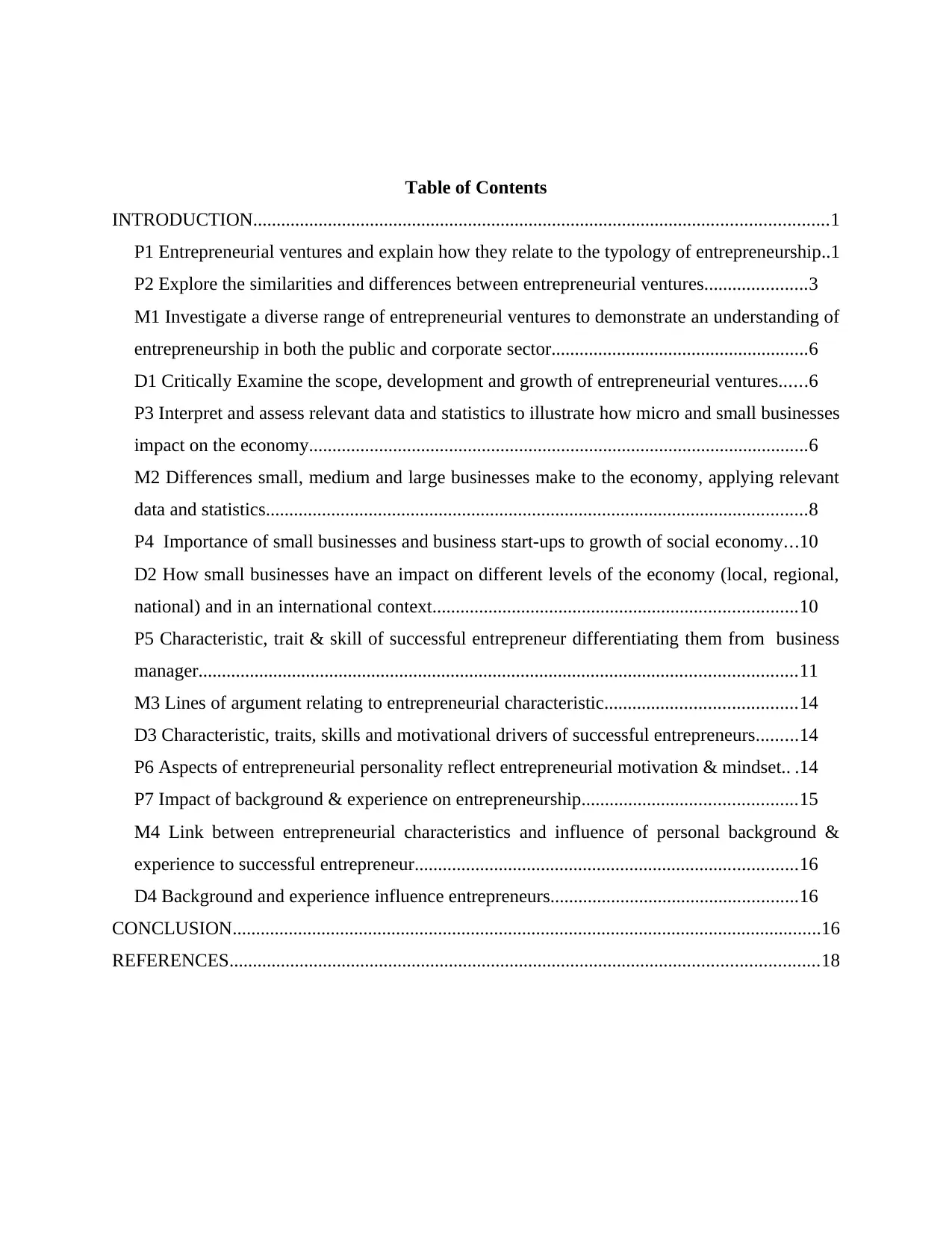
Table of Contents
INTRODUCTION...........................................................................................................................1
P1 Entrepreneurial ventures and explain how they relate to the typology of entrepreneurship..1
P2 Explore the similarities and differences between entrepreneurial ventures......................3
M1 Investigate a diverse range of entrepreneurial ventures to demonstrate an understanding of
entrepreneurship in both the public and corporate sector.......................................................6
D1 Critically Examine the scope, development and growth of entrepreneurial ventures......6
P3 Interpret and assess relevant data and statistics to illustrate how micro and small businesses
impact on the economy...........................................................................................................6
M2 Differences small, medium and large businesses make to the economy, applying relevant
data and statistics....................................................................................................................8
P4 Importance of small businesses and business start-ups to growth of social economy...10
D2 How small businesses have an impact on different levels of the economy (local, regional,
national) and in an international context..............................................................................10
P5 Characteristic, trait & skill of successful entrepreneur differentiating them from business
manager................................................................................................................................11
M3 Lines of argument relating to entrepreneurial characteristic.........................................14
D3 Characteristic, traits, skills and motivational drivers of successful entrepreneurs.........14
P6 Aspects of entrepreneurial personality reflect entrepreneurial motivation & mindset.. .14
P7 Impact of background & experience on entrepreneurship..............................................15
M4 Link between entrepreneurial characteristics and influence of personal background &
experience to successful entrepreneur..................................................................................16
D4 Background and experience influence entrepreneurs.....................................................16
CONCLUSION..............................................................................................................................16
REFERENCES..............................................................................................................................18
INTRODUCTION...........................................................................................................................1
P1 Entrepreneurial ventures and explain how they relate to the typology of entrepreneurship..1
P2 Explore the similarities and differences between entrepreneurial ventures......................3
M1 Investigate a diverse range of entrepreneurial ventures to demonstrate an understanding of
entrepreneurship in both the public and corporate sector.......................................................6
D1 Critically Examine the scope, development and growth of entrepreneurial ventures......6
P3 Interpret and assess relevant data and statistics to illustrate how micro and small businesses
impact on the economy...........................................................................................................6
M2 Differences small, medium and large businesses make to the economy, applying relevant
data and statistics....................................................................................................................8
P4 Importance of small businesses and business start-ups to growth of social economy...10
D2 How small businesses have an impact on different levels of the economy (local, regional,
national) and in an international context..............................................................................10
P5 Characteristic, trait & skill of successful entrepreneur differentiating them from business
manager................................................................................................................................11
M3 Lines of argument relating to entrepreneurial characteristic.........................................14
D3 Characteristic, traits, skills and motivational drivers of successful entrepreneurs.........14
P6 Aspects of entrepreneurial personality reflect entrepreneurial motivation & mindset.. .14
P7 Impact of background & experience on entrepreneurship..............................................15
M4 Link between entrepreneurial characteristics and influence of personal background &
experience to successful entrepreneur..................................................................................16
D4 Background and experience influence entrepreneurs.....................................................16
CONCLUSION..............................................................................................................................16
REFERENCES..............................................................................................................................18
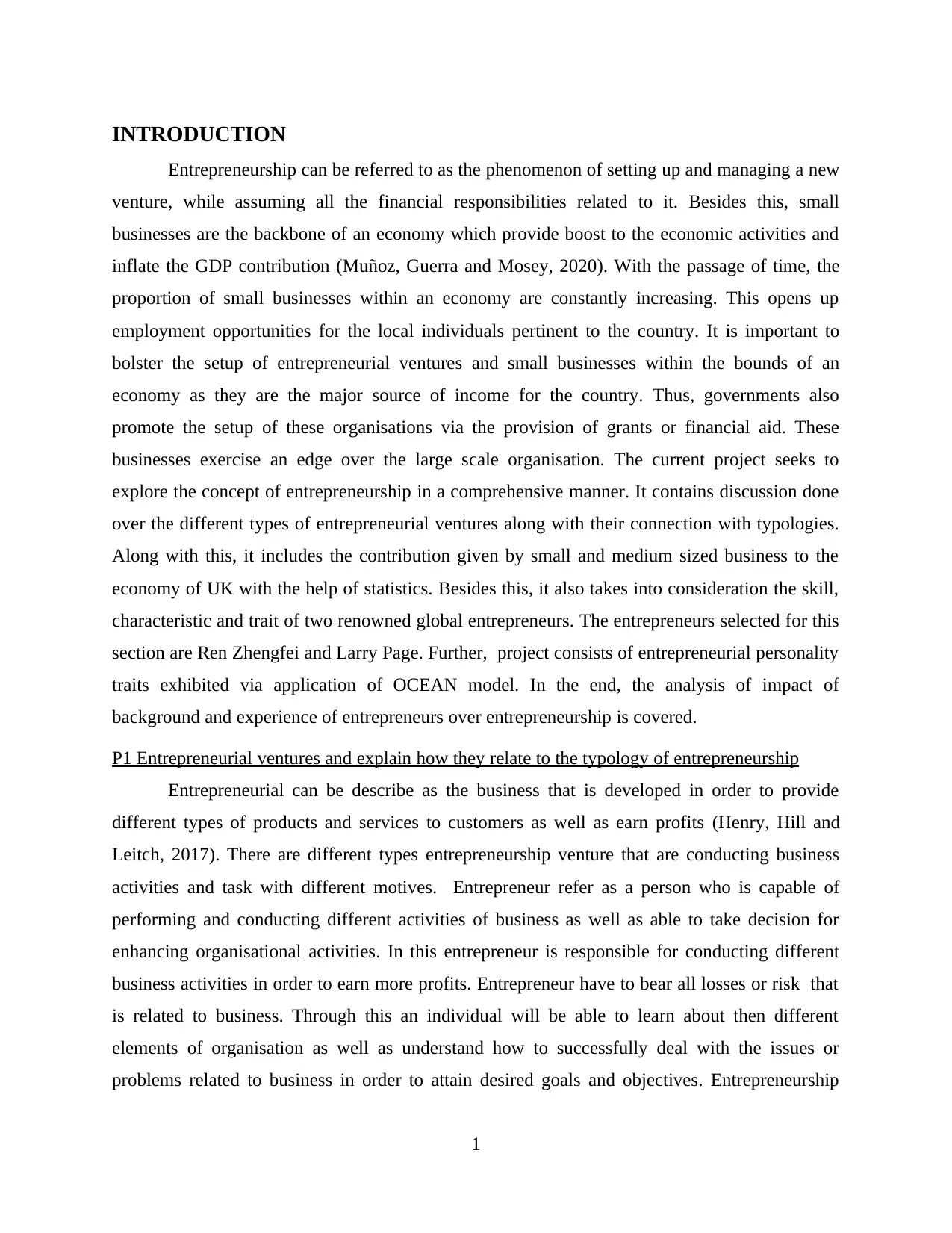
INTRODUCTION
Entrepreneurship can be referred to as the phenomenon of setting up and managing a new
venture, while assuming all the financial responsibilities related to it. Besides this, small
businesses are the backbone of an economy which provide boost to the economic activities and
inflate the GDP contribution (Muñoz, Guerra and Mosey, 2020). With the passage of time, the
proportion of small businesses within an economy are constantly increasing. This opens up
employment opportunities for the local individuals pertinent to the country. It is important to
bolster the setup of entrepreneurial ventures and small businesses within the bounds of an
economy as they are the major source of income for the country. Thus, governments also
promote the setup of these organisations via the provision of grants or financial aid. These
businesses exercise an edge over the large scale organisation. The current project seeks to
explore the concept of entrepreneurship in a comprehensive manner. It contains discussion done
over the different types of entrepreneurial ventures along with their connection with typologies.
Along with this, it includes the contribution given by small and medium sized business to the
economy of UK with the help of statistics. Besides this, it also takes into consideration the skill,
characteristic and trait of two renowned global entrepreneurs. The entrepreneurs selected for this
section are Ren Zhengfei and Larry Page. Further, project consists of entrepreneurial personality
traits exhibited via application of OCEAN model. In the end, the analysis of impact of
background and experience of entrepreneurs over entrepreneurship is covered.
P1 Entrepreneurial ventures and explain how they relate to the typology of entrepreneurship
Entrepreneurial can be describe as the business that is developed in order to provide
different types of products and services to customers as well as earn profits (Henry, Hill and
Leitch, 2017). There are different types entrepreneurship venture that are conducting business
activities and task with different motives. Entrepreneur refer as a person who is capable of
performing and conducting different activities of business as well as able to take decision for
enhancing organisational activities. In this entrepreneur is responsible for conducting different
business activities in order to earn more profits. Entrepreneur have to bear all losses or risk that
is related to business. Through this an individual will be able to learn about then different
elements of organisation as well as understand how to successfully deal with the issues or
problems related to business in order to attain desired goals and objectives. Entrepreneurship
1
Entrepreneurship can be referred to as the phenomenon of setting up and managing a new
venture, while assuming all the financial responsibilities related to it. Besides this, small
businesses are the backbone of an economy which provide boost to the economic activities and
inflate the GDP contribution (Muñoz, Guerra and Mosey, 2020). With the passage of time, the
proportion of small businesses within an economy are constantly increasing. This opens up
employment opportunities for the local individuals pertinent to the country. It is important to
bolster the setup of entrepreneurial ventures and small businesses within the bounds of an
economy as they are the major source of income for the country. Thus, governments also
promote the setup of these organisations via the provision of grants or financial aid. These
businesses exercise an edge over the large scale organisation. The current project seeks to
explore the concept of entrepreneurship in a comprehensive manner. It contains discussion done
over the different types of entrepreneurial ventures along with their connection with typologies.
Along with this, it includes the contribution given by small and medium sized business to the
economy of UK with the help of statistics. Besides this, it also takes into consideration the skill,
characteristic and trait of two renowned global entrepreneurs. The entrepreneurs selected for this
section are Ren Zhengfei and Larry Page. Further, project consists of entrepreneurial personality
traits exhibited via application of OCEAN model. In the end, the analysis of impact of
background and experience of entrepreneurs over entrepreneurship is covered.
P1 Entrepreneurial ventures and explain how they relate to the typology of entrepreneurship
Entrepreneurial can be describe as the business that is developed in order to provide
different types of products and services to customers as well as earn profits (Henry, Hill and
Leitch, 2017). There are different types entrepreneurship venture that are conducting business
activities and task with different motives. Entrepreneur refer as a person who is capable of
performing and conducting different activities of business as well as able to take decision for
enhancing organisational activities. In this entrepreneur is responsible for conducting different
business activities in order to earn more profits. Entrepreneur have to bear all losses or risk that
is related to business. Through this an individual will be able to learn about then different
elements of organisation as well as understand how to successfully deal with the issues or
problems related to business in order to attain desired goals and objectives. Entrepreneurship
1
⊘ This is a preview!⊘
Do you want full access?
Subscribe today to unlock all pages.

Trusted by 1+ million students worldwide
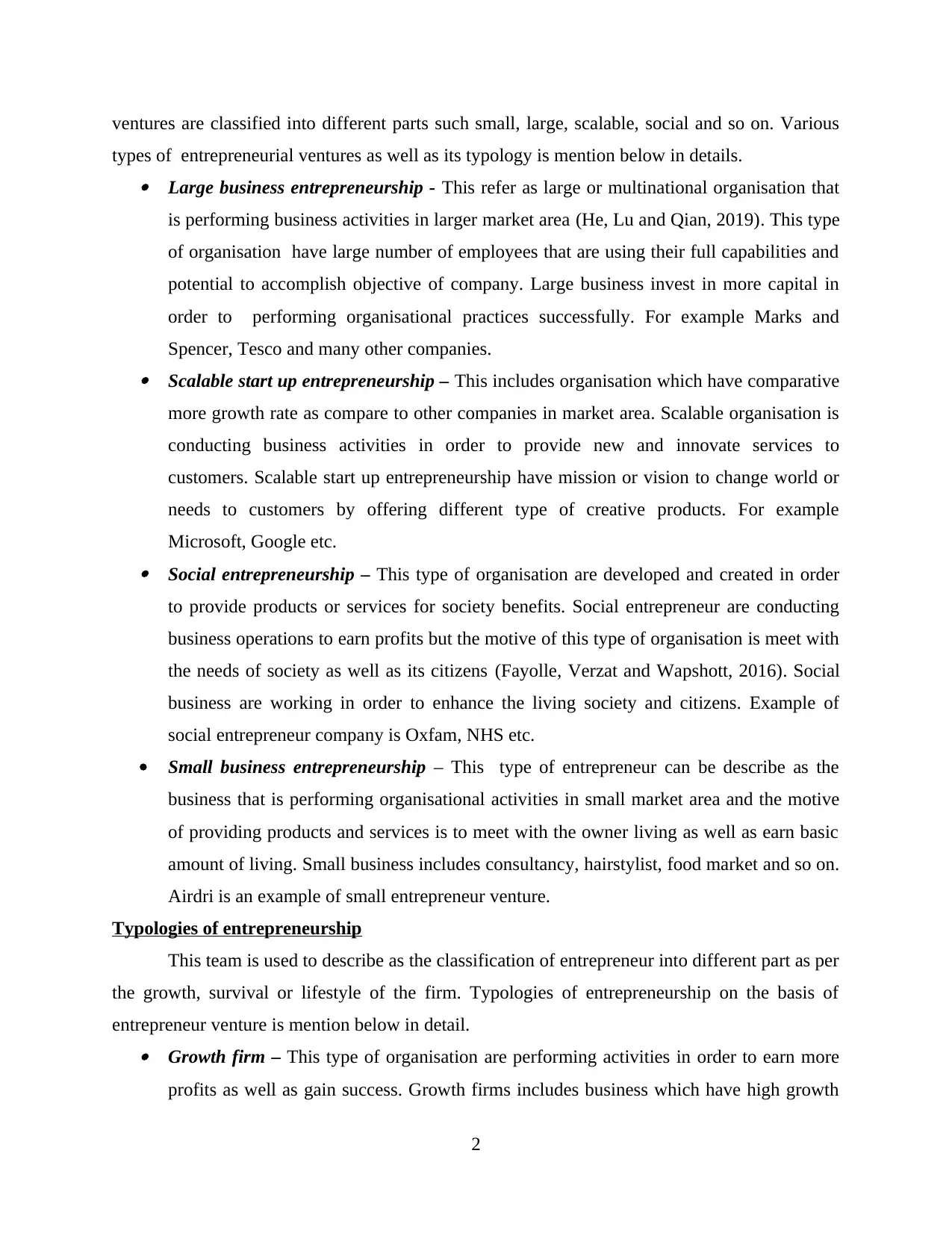
ventures are classified into different parts such small, large, scalable, social and so on. Various
types of entrepreneurial ventures as well as its typology is mention below in details. Large business entrepreneurship - This refer as large or multinational organisation that
is performing business activities in larger market area (He, Lu and Qian, 2019). This type
of organisation have large number of employees that are using their full capabilities and
potential to accomplish objective of company. Large business invest in more capital in
order to performing organisational practices successfully. For example Marks and
Spencer, Tesco and many other companies. Scalable start up entrepreneurship – This includes organisation which have comparative
more growth rate as compare to other companies in market area. Scalable organisation is
conducting business activities in order to provide new and innovate services to
customers. Scalable start up entrepreneurship have mission or vision to change world or
needs to customers by offering different type of creative products. For example
Microsoft, Google etc. Social entrepreneurship – This type of organisation are developed and created in order
to provide products or services for society benefits. Social entrepreneur are conducting
business operations to earn profits but the motive of this type of organisation is meet with
the needs of society as well as its citizens (Fayolle, Verzat and Wapshott, 2016). Social
business are working in order to enhance the living society and citizens. Example of
social entrepreneur company is Oxfam, NHS etc.
Small business entrepreneurship – This type of entrepreneur can be describe as the
business that is performing organisational activities in small market area and the motive
of providing products and services is to meet with the owner living as well as earn basic
amount of living. Small business includes consultancy, hairstylist, food market and so on.
Airdri is an example of small entrepreneur venture.
Typologies of entrepreneurship
This team is used to describe as the classification of entrepreneur into different part as per
the growth, survival or lifestyle of the firm. Typologies of entrepreneurship on the basis of
entrepreneur venture is mention below in detail. Growth firm – This type of organisation are performing activities in order to earn more
profits as well as gain success. Growth firms includes business which have high growth
2
types of entrepreneurial ventures as well as its typology is mention below in details. Large business entrepreneurship - This refer as large or multinational organisation that
is performing business activities in larger market area (He, Lu and Qian, 2019). This type
of organisation have large number of employees that are using their full capabilities and
potential to accomplish objective of company. Large business invest in more capital in
order to performing organisational practices successfully. For example Marks and
Spencer, Tesco and many other companies. Scalable start up entrepreneurship – This includes organisation which have comparative
more growth rate as compare to other companies in market area. Scalable organisation is
conducting business activities in order to provide new and innovate services to
customers. Scalable start up entrepreneurship have mission or vision to change world or
needs to customers by offering different type of creative products. For example
Microsoft, Google etc. Social entrepreneurship – This type of organisation are developed and created in order
to provide products or services for society benefits. Social entrepreneur are conducting
business operations to earn profits but the motive of this type of organisation is meet with
the needs of society as well as its citizens (Fayolle, Verzat and Wapshott, 2016). Social
business are working in order to enhance the living society and citizens. Example of
social entrepreneur company is Oxfam, NHS etc.
Small business entrepreneurship – This type of entrepreneur can be describe as the
business that is performing organisational activities in small market area and the motive
of providing products and services is to meet with the owner living as well as earn basic
amount of living. Small business includes consultancy, hairstylist, food market and so on.
Airdri is an example of small entrepreneur venture.
Typologies of entrepreneurship
This team is used to describe as the classification of entrepreneur into different part as per
the growth, survival or lifestyle of the firm. Typologies of entrepreneurship on the basis of
entrepreneur venture is mention below in detail. Growth firm – This type of organisation are performing activities in order to earn more
profits as well as gain success. Growth firms includes business which have high growth
2
Paraphrase This Document
Need a fresh take? Get an instant paraphrase of this document with our AI Paraphraser
rate as compare to other companies in industry. These firms are focusing on providing
products and services which is able to meet with the needs of customers in order to grow
market area as well as enhance customer base by satisfying requirements of potential
customers. Lifestyle enterprises – Business under this category are performing organisation practices
and providing different job opportunities with the motive of enhance revenues of
individual (Devece, Peris-Ortiz and Rueda-Armengot, 2016). This type of organisation
focusing in increasing the standard of lifestyle of society or citizens. Lifestyle
organisation are conducting business activities in order to increase the prestige, status as
well as esteem of individual in order to live a better life.
Survival firms – The main motive of this type of organisation is to earn basic amount for
living as well as survival of individuals. Survival firms are basically new or small
ventures that is majorly focusing on increasing the goodwill or image of organisation in
order to survive for the longer time in market area.
Therefore, it has been determine that there are number of organisation which can be
classified into different part as per the aim or purpose of organisation. Entrepreneur venture and
typologies are significant in dividing various type of organisation and determining their motive
of performing organisation task. Large organisation are conducting business activities for growth
or development in order to earn more profits. Where as small companies are more focused on its
maintenance or survival in market area. Scalable organisations or social enterprise are
conducting organisation practices in order to enhance the lifestyle or living of individuals or
society.
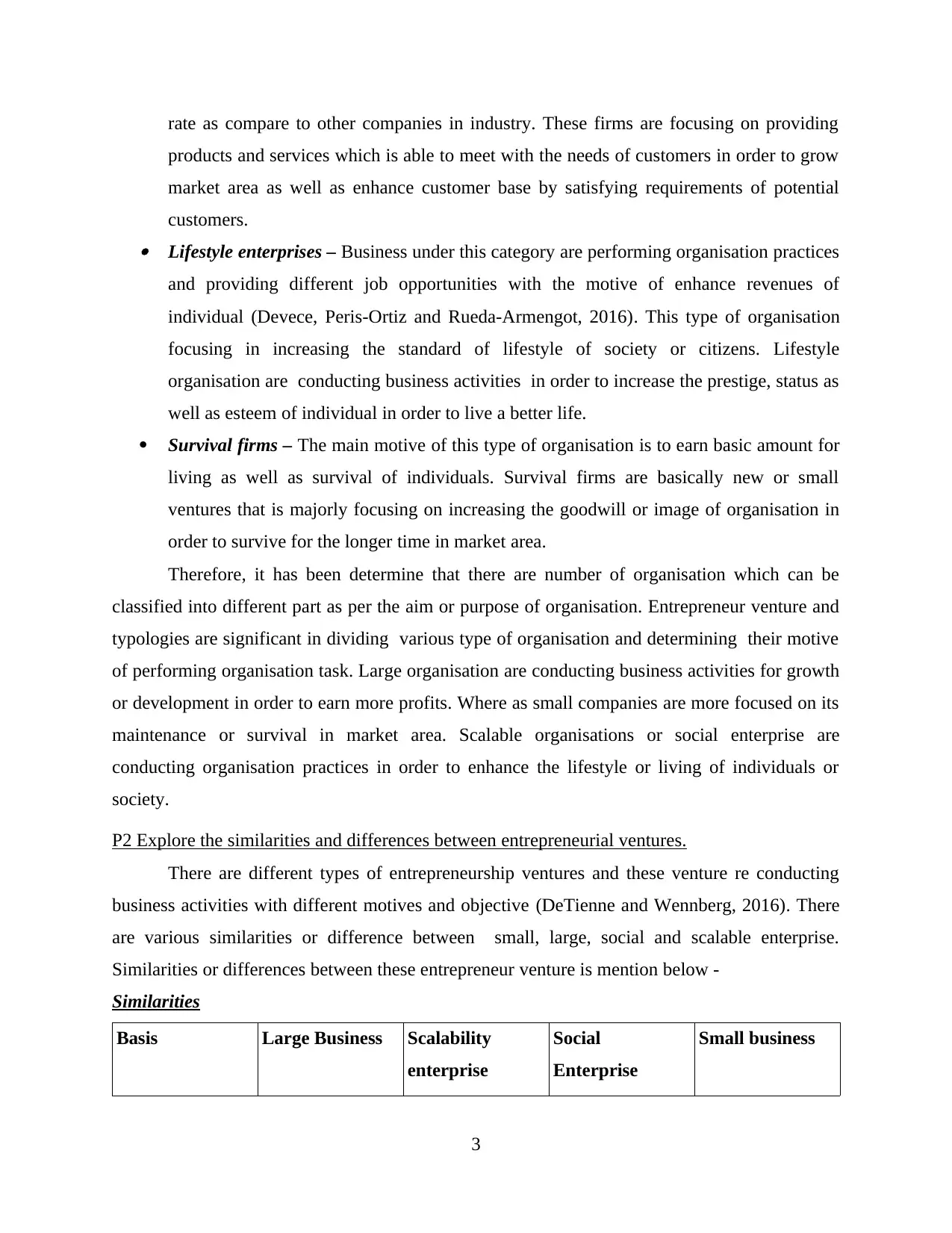
P2 Explore the similarities and differences between entrepreneurial ventures.
There are different types of entrepreneurship ventures and these venture re conducting
business activities with different motives and objective (DeTienne and Wennberg, 2016). There
are various similarities or difference between small, large, social and scalable enterprise.
Similarities or differences between these entrepreneur venture is mention below -
Similarities
Basis Large Business Scalability
enterprise
Social
Enterprise
Small business
3
products and services which is able to meet with the needs of customers in order to grow
market area as well as enhance customer base by satisfying requirements of potential
customers. Lifestyle enterprises – Business under this category are performing organisation practices
and providing different job opportunities with the motive of enhance revenues of
individual (Devece, Peris-Ortiz and Rueda-Armengot, 2016). This type of organisation
focusing in increasing the standard of lifestyle of society or citizens. Lifestyle
organisation are conducting business activities in order to increase the prestige, status as
well as esteem of individual in order to live a better life.
Survival firms – The main motive of this type of organisation is to earn basic amount for
living as well as survival of individuals. Survival firms are basically new or small
ventures that is majorly focusing on increasing the goodwill or image of organisation in
order to survive for the longer time in market area.
Therefore, it has been determine that there are number of organisation which can be
classified into different part as per the aim or purpose of organisation. Entrepreneur venture and
typologies are significant in dividing various type of organisation and determining their motive
of performing organisation task. Large organisation are conducting business activities for growth
or development in order to earn more profits. Where as small companies are more focused on its
maintenance or survival in market area. Scalable organisations or social enterprise are
conducting organisation practices in order to enhance the lifestyle or living of individuals or
society.
P2 Explore the similarities and differences between entrepreneurial ventures.
There are different types of entrepreneurship ventures and these venture re conducting
business activities with different motives and objective (DeTienne and Wennberg, 2016). There
are various similarities or difference between small, large, social and scalable enterprise.
Similarities or differences between these entrepreneur venture is mention below -
Similarities
Basis Large Business Scalability
enterprise
Social
Enterprise
Small business
3
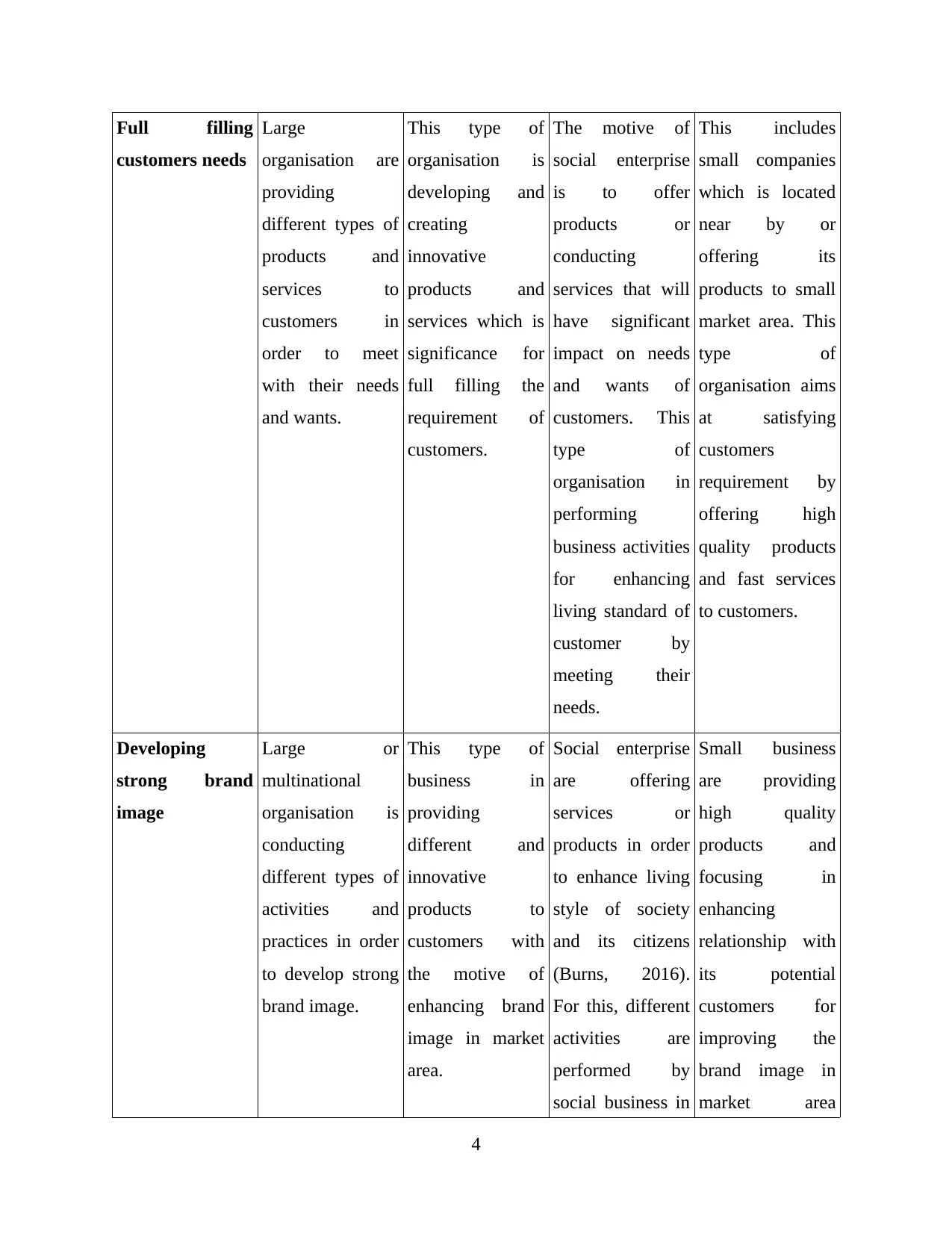
Full filling
customers needs
Large
organisation are
providing
different types of
products and
services to
customers in
order to meet
with their needs
and wants.
This type of
organisation is
developing and
creating
innovative
products and
services which is
significance for
full filling the
requirement of
customers.
The motive of
social enterprise
is to offer
products or
conducting
services that will
have significant
impact on needs
and wants of
customers. This
type of
organisation in
performing
business activities
for enhancing
living standard of
customer by
meeting their
needs.
This includes
small companies
which is located
near by or
offering its
products to small
market area. This
type of
organisation aims
at satisfying
customers
requirement by
offering high
quality products
and fast services
to customers.
Developing
strong brand
image
Large or
multinational
organisation is
conducting
different types of
activities and
practices in order
to develop strong
brand image.
This type of
business in
providing
different and
innovative
products to
customers with
the motive of
enhancing brand
image in market
area.
Social enterprise
are offering
services or
products in order
to enhance living
style of society
and its citizens
(Burns, 2016).
For this, different
activities are
performed by
social business in
Small business
are providing
high quality
products and
focusing in
enhancing
relationship with
its potential
customers for
improving the
brand image in
market area
4
customers needs
Large
organisation are
providing
different types of
products and
services to
customers in
order to meet
with their needs
and wants.
This type of
organisation is
developing and
creating
innovative
products and
services which is
significance for
full filling the
requirement of
customers.
The motive of
social enterprise
is to offer
products or
conducting
services that will
have significant
impact on needs
and wants of
customers. This
type of
organisation in
performing
business activities
for enhancing
living standard of
customer by
meeting their
needs.
This includes
small companies
which is located
near by or
offering its
products to small
market area. This
type of
organisation aims
at satisfying
customers
requirement by
offering high
quality products
and fast services
to customers.
Developing
strong brand
image
Large or
multinational
organisation is
conducting
different types of
activities and
practices in order
to develop strong
brand image.
This type of
business in
providing
different and
innovative
products to
customers with
the motive of
enhancing brand
image in market
area.
Social enterprise
are offering
services or
products in order
to enhance living
style of society
and its citizens
(Burns, 2016).
For this, different
activities are
performed by
social business in
Small business
are providing
high quality
products and
focusing in
enhancing
relationship with
its potential
customers for
improving the
brand image in
market area
4
⊘ This is a preview!⊘
Do you want full access?
Subscribe today to unlock all pages.
Trusted by 1+ million students worldwide
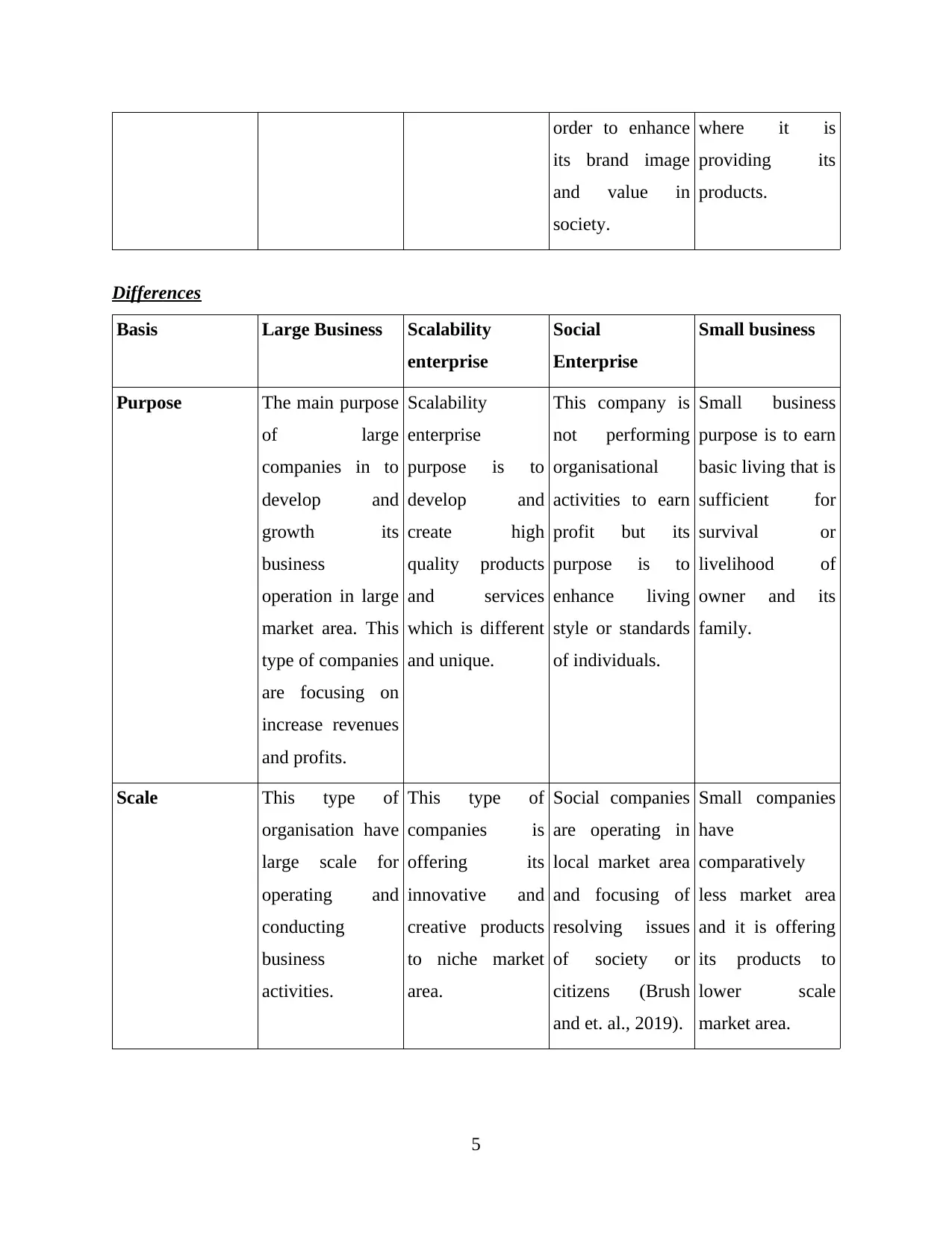
order to enhance
its brand image
and value in
society.
where it is
providing its
products.
Differences
Basis Large Business Scalability
enterprise
Social
Enterprise
Small business
Purpose The main purpose
of large
companies in to
develop and
growth its
business
operation in large
market area. This
type of companies
are focusing on
increase revenues
and profits.
Scalability
enterprise
purpose is to
develop and
create high
quality products
and services
which is different
and unique.
This company is
not performing
organisational
activities to earn
profit but its
purpose is to
enhance living
style or standards
of individuals.
Small business
purpose is to earn
basic living that is
sufficient for
survival or
livelihood of
owner and its
family.
Scale This type of
organisation have
large scale for
operating and
conducting
business
activities.
This type of
companies is
offering its
innovative and
creative products
to niche market
area.
Social companies
are operating in
local market area
and focusing of
resolving issues
of society or
citizens (Brush
and et. al., 2019).
Small companies
have
comparatively
less market area
and it is offering
its products to
lower scale
market area.
5
its brand image
and value in
society.
where it is
providing its
products.
Differences
Basis Large Business Scalability
enterprise
Social
Enterprise
Small business
Purpose The main purpose
of large
companies in to
develop and
growth its
business
operation in large
market area. This
type of companies
are focusing on
increase revenues
and profits.
Scalability
enterprise
purpose is to
develop and
create high
quality products
and services
which is different
and unique.
This company is
not performing
organisational
activities to earn
profit but its
purpose is to
enhance living
style or standards
of individuals.
Small business
purpose is to earn
basic living that is
sufficient for
survival or
livelihood of
owner and its
family.
Scale This type of
organisation have
large scale for
operating and
conducting
business
activities.
This type of
companies is
offering its
innovative and
creative products
to niche market
area.
Social companies
are operating in
local market area
and focusing of
resolving issues
of society or
citizens (Brush
and et. al., 2019).
Small companies
have
comparatively
less market area
and it is offering
its products to
lower scale
market area.
5
Paraphrase This Document
Need a fresh take? Get an instant paraphrase of this document with our AI Paraphraser
M1 Investigate a diverse range of entrepreneurial ventures to demonstrate an understanding of
entrepreneurship in both the public and corporate sector.
Public and corporation sector entrepreneurial ventures are performing business activities
with different motives and aims. Public sector organisation includes all those companies which is
controlled and managed by government authority. These organisation are providing function for
the benefits of nation and reach of services is limited to particular country. For example BBC
organisation is dealing in public sector organisation. Where as corporate sector includes
companies that is owned and managed by individual or group of people. In this type of
organisation have more scope of developing and it can offer its services to large market area. For
example Marks and Spencer organisation.
D1 Critically Examine the scope, development and growth of entrepreneurial ventures.
Entrepreneur venture are developed and created with different aims and motives. This
will lead to have direct impact in scope, growth or developing of venture. Entrepreneurial
venture can increase the scope of business by providing high quality products and services to
customers (Belz and Binder, 2017). It can enhance market area as well as customer base by
offering its products and services. Business can grow and develop by expansion of commerce
practices as well as integration with economic growth. This will have significant impact over
enhance market area by promotion of society or citizen welfare.
P3 Interpret and assess relevant data and statistics to illustrate how micro and small businesses
impact on the economy
This has been evaluate that small and micro business plays crucial role in United
Kingdom economy, organisations within this sector acts as backbone of country as they have
major contribution in employment generation and GDP growth of nation. According to the report
evaluation of the Department of Business, Innovation and Skills (DBIS) this has been identified
that small and micro segment have contributed estimated 15.6 million job opportunities that not
increase country overall per capita income growth but also enhanced individual standard of
living in a well defined and effective manner (The Role of Start-ups and Small Businesses in
Today’s Economy. 2018). Further this has been determined that, micro and small scale entities
have significant contribution in United Kingdom growth and innovation that increases nation
economic sustainability in international marketplace.
6
entrepreneurship in both the public and corporate sector.
Public and corporation sector entrepreneurial ventures are performing business activities
with different motives and aims. Public sector organisation includes all those companies which is
controlled and managed by government authority. These organisation are providing function for
the benefits of nation and reach of services is limited to particular country. For example BBC
organisation is dealing in public sector organisation. Where as corporate sector includes
companies that is owned and managed by individual or group of people. In this type of
organisation have more scope of developing and it can offer its services to large market area. For
example Marks and Spencer organisation.
D1 Critically Examine the scope, development and growth of entrepreneurial ventures.
Entrepreneur venture are developed and created with different aims and motives. This
will lead to have direct impact in scope, growth or developing of venture. Entrepreneurial
venture can increase the scope of business by providing high quality products and services to
customers (Belz and Binder, 2017). It can enhance market area as well as customer base by
offering its products and services. Business can grow and develop by expansion of commerce
practices as well as integration with economic growth. This will have significant impact over
enhance market area by promotion of society or citizen welfare.
P3 Interpret and assess relevant data and statistics to illustrate how micro and small businesses
impact on the economy
This has been evaluate that small and micro business plays crucial role in United
Kingdom economy, organisations within this sector acts as backbone of country as they have
major contribution in employment generation and GDP growth of nation. According to the report
evaluation of the Department of Business, Innovation and Skills (DBIS) this has been identified
that small and micro segment have contributed estimated 15.6 million job opportunities that not
increase country overall per capita income growth but also enhanced individual standard of
living in a well defined and effective manner (The Role of Start-ups and Small Businesses in
Today’s Economy. 2018). Further this has been determined that, micro and small scale entities
have significant contribution in United Kingdom growth and innovation that increases nation
economic sustainability in international marketplace.
6
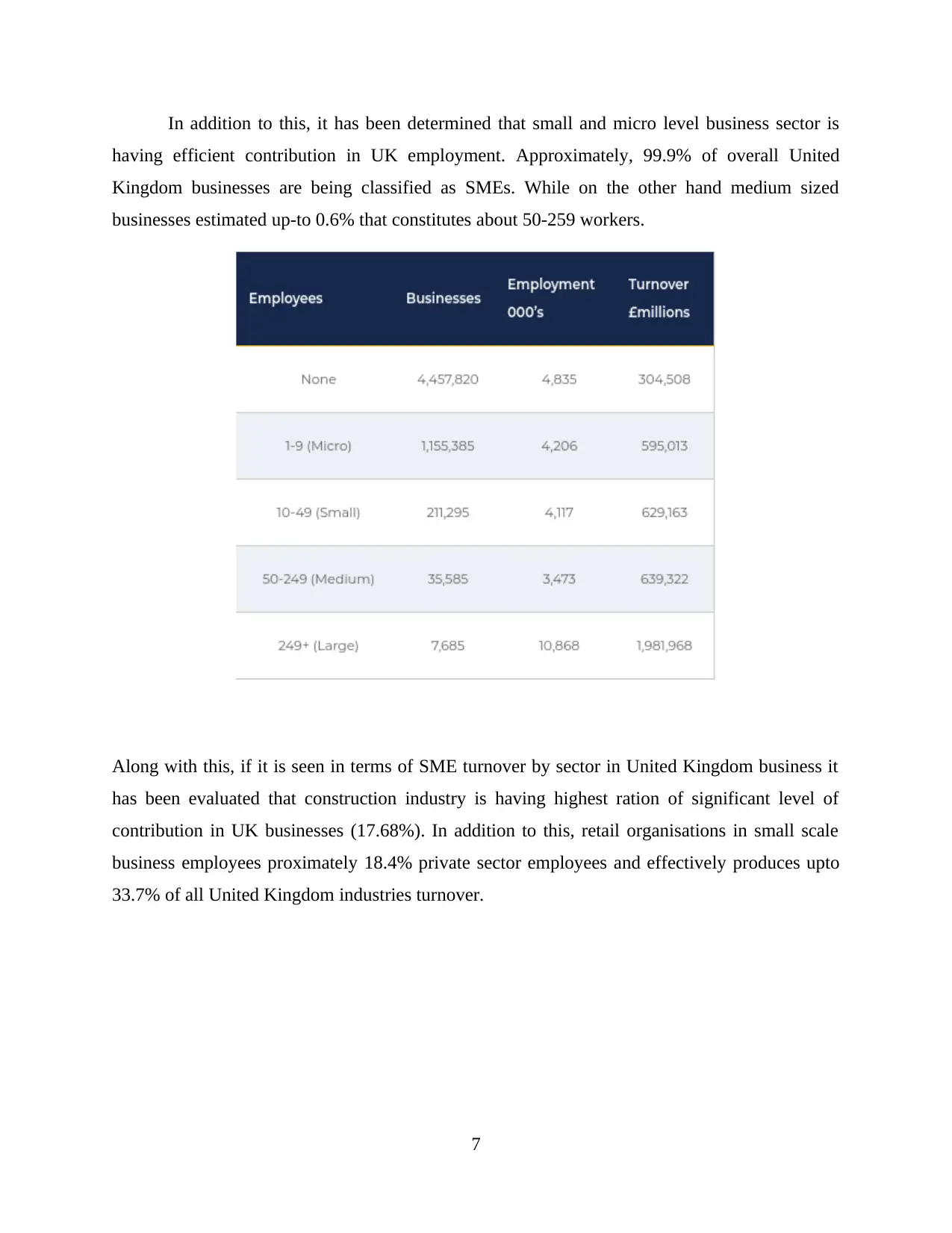
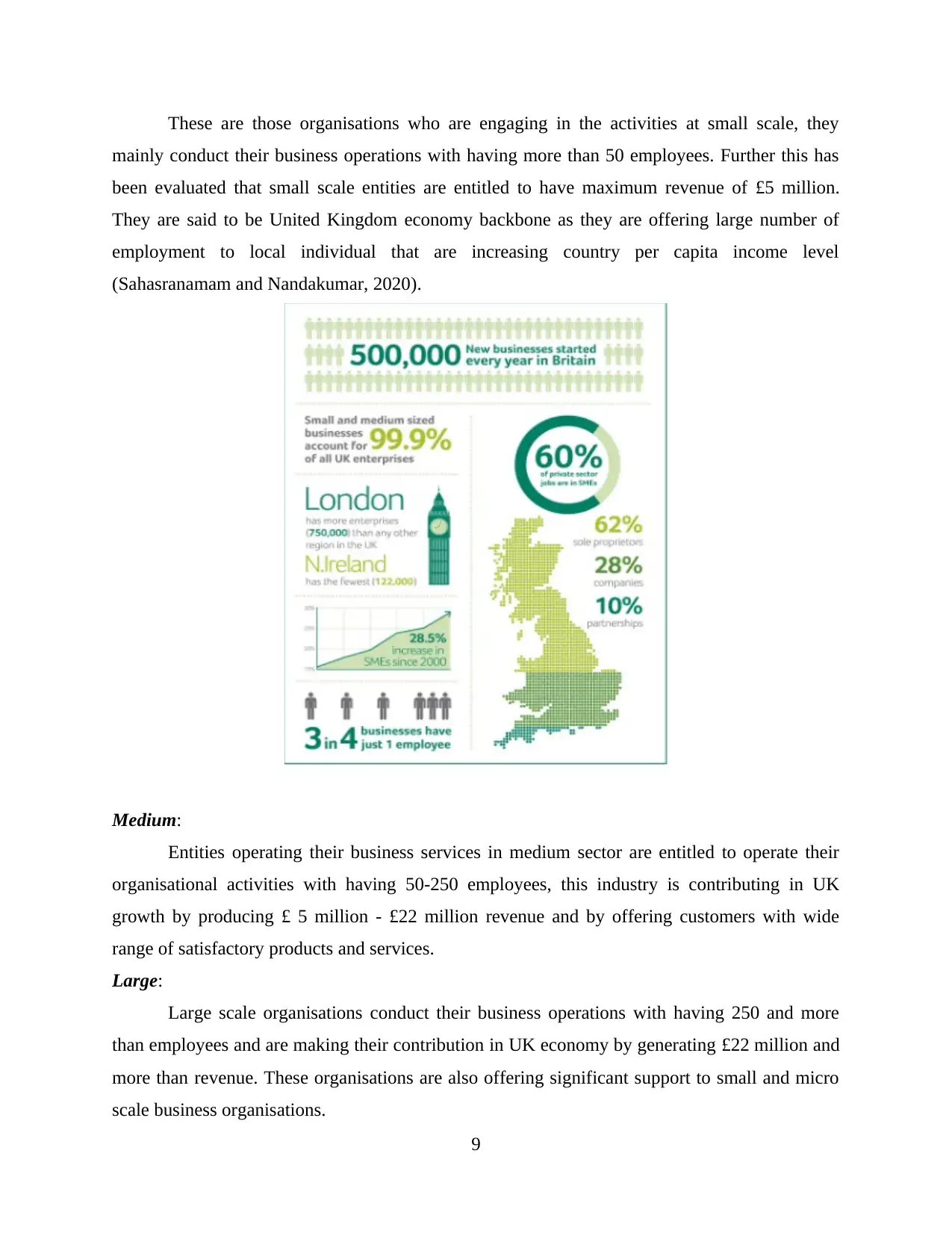
In addition to this, it has been determined that small and micro level business sector is
having efficient contribution in UK employment. Approximately, 99.9% of overall United
Kingdom businesses are being classified as SMEs. While on the other hand medium sized
businesses estimated up-to 0.6% that constitutes about 50-259 workers.
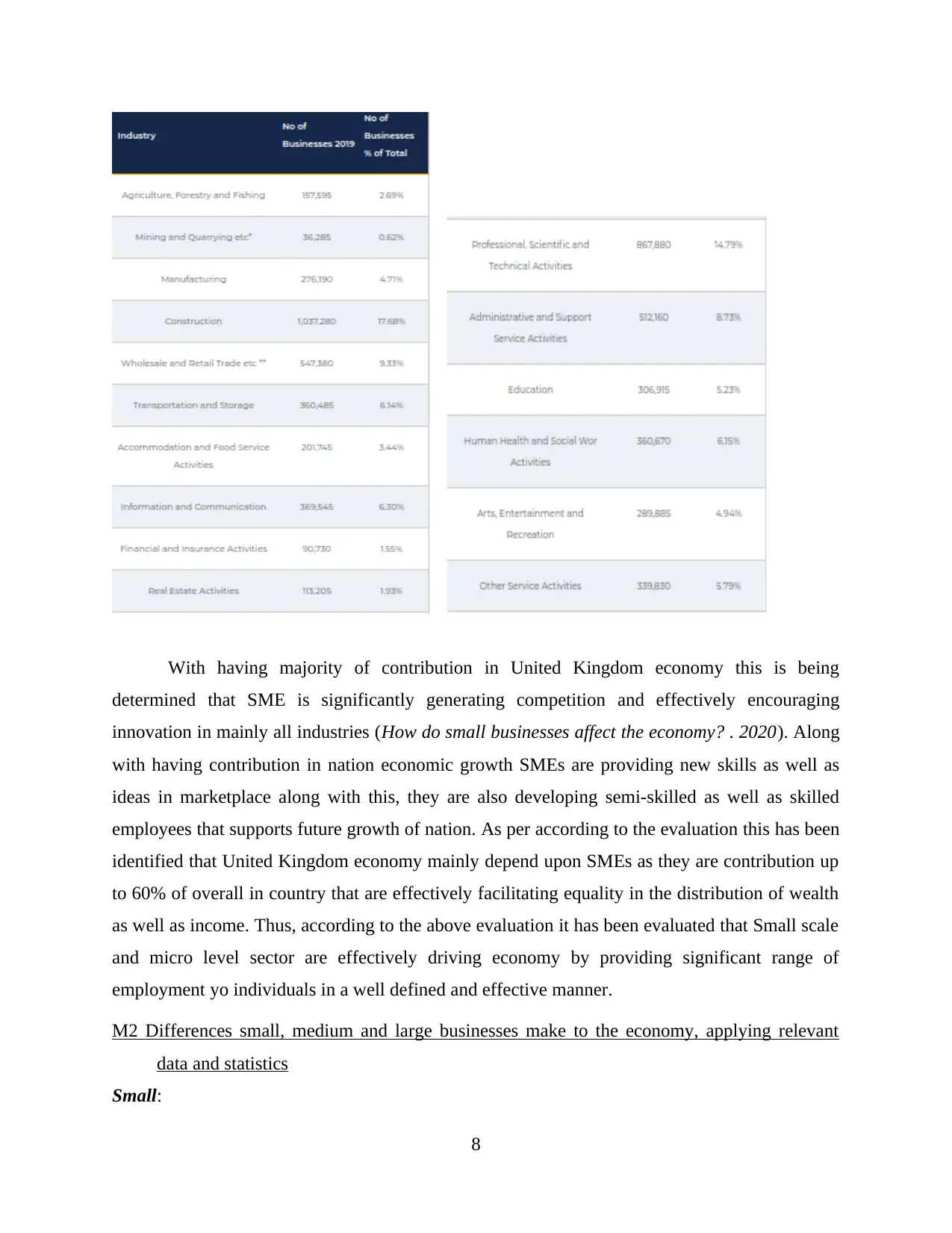
Along with this, if it is seen in terms of SME turnover by sector in United Kingdom business it
has been evaluated that construction industry is having highest ration of significant level of
contribution in UK businesses (17.68%). In addition to this, retail organisations in small scale
business employees proximately 18.4% private sector employees and effectively produces upto
33.7% of all United Kingdom industries turnover.
7
having efficient contribution in UK employment. Approximately, 99.9% of overall United
Kingdom businesses are being classified as SMEs. While on the other hand medium sized
businesses estimated up-to 0.6% that constitutes about 50-259 workers.
Along with this, if it is seen in terms of SME turnover by sector in United Kingdom business it
has been evaluated that construction industry is having highest ration of significant level of
contribution in UK businesses (17.68%). In addition to this, retail organisations in small scale
business employees proximately 18.4% private sector employees and effectively produces upto
33.7% of all United Kingdom industries turnover.
7
⊘ This is a preview!⊘
Do you want full access?
Subscribe today to unlock all pages.
Trusted by 1+ million students worldwide
With having majority of contribution in United Kingdom economy this is being
determined that SME is significantly generating competition and effectively encouraging
innovation in mainly all industries (How do small businesses affect the economy? . 2020). Along
with having contribution in nation economic growth SMEs are providing new skills as well as
ideas in marketplace along with this, they are also developing semi-skilled as well as skilled
employees that supports future growth of nation. As per according to the evaluation this has been
identified that United Kingdom economy mainly depend upon SMEs as they are contribution up
to 60% of overall in country that are effectively facilitating equality in the distribution of wealth
as well as income. Thus, according to the above evaluation it has been evaluated that Small scale
and micro level sector are effectively driving economy by providing significant range of
employment yo individuals in a well defined and effective manner.
M2 Differences small, medium and large businesses make to the economy, applying relevant
data and statistics
Small:
8
determined that SME is significantly generating competition and effectively encouraging
innovation in mainly all industries (How do small businesses affect the economy? . 2020). Along
with having contribution in nation economic growth SMEs are providing new skills as well as
ideas in marketplace along with this, they are also developing semi-skilled as well as skilled
employees that supports future growth of nation. As per according to the evaluation this has been
identified that United Kingdom economy mainly depend upon SMEs as they are contribution up
to 60% of overall in country that are effectively facilitating equality in the distribution of wealth
as well as income. Thus, according to the above evaluation it has been evaluated that Small scale
and micro level sector are effectively driving economy by providing significant range of
employment yo individuals in a well defined and effective manner.
M2 Differences small, medium and large businesses make to the economy, applying relevant
data and statistics
Small:
8
Paraphrase This Document
Need a fresh take? Get an instant paraphrase of this document with our AI Paraphraser
These are those organisations who are engaging in the activities at small scale, they
mainly conduct their business operations with having more than 50 employees. Further this has
been evaluated that small scale entities are entitled to have maximum revenue of £5 million.
They are said to be United Kingdom economy backbone as they are offering large number of
employment to local individual that are increasing country per capita income level
(Sahasranamam and Nandakumar, 2020).
Medium:
Entities operating their business services in medium sector are entitled to operate their
organisational activities with having 50-250 employees, this industry is contributing in UK
growth by producing £ 5 million - £22 million revenue and by offering customers with wide
range of satisfactory products and services.
Large:
Large scale organisations conduct their business operations with having 250 and more
than employees and are making their contribution in UK economy by generating £22 million and
more than revenue. These organisations are also offering significant support to small and micro
scale business organisations.
9
mainly conduct their business operations with having more than 50 employees. Further this has
been evaluated that small scale entities are entitled to have maximum revenue of £5 million.
They are said to be United Kingdom economy backbone as they are offering large number of
employment to local individual that are increasing country per capita income level
(Sahasranamam and Nandakumar, 2020).
Medium:
Entities operating their business services in medium sector are entitled to operate their
organisational activities with having 50-250 employees, this industry is contributing in UK
growth by producing £ 5 million - £22 million revenue and by offering customers with wide
range of satisfactory products and services.
Large:
Large scale organisations conduct their business operations with having 250 and more
than employees and are making their contribution in UK economy by generating £22 million and
more than revenue. These organisations are also offering significant support to small and micro
scale business organisations.
9
P4 Importance of small businesses and business start-ups to growth of social economy
Small business and business starts-ups are most important element of United Kingdom
economic growth as they are generating maximum number of employment opportunities for
individual that lead towards automatic increase in living standards of individuals (Brown, Rocha
and Cowling, 2020). Mentioned below there are some certain aspects in which small-business
and businesses starts-ups are playing most important role in a well defined and effective manner:
Job creation:
It has been evaluated that there are different types of industries that are operating their
business operating in small businesses and businesses starts-ups (5 ways that startups are
important to the UK economy, 2016). All these are associatively providing significant level of
job employment opportunities to large base of individuals that acts as important element for UK
individual economic growth, it automatically enhances social economy growth in best effective
manner.
Improve living standard:
By offering effective amount of employment opportunities small businesses and
businesses starts-ups are making significant improvement in individuals living standards. As it
has been evaluated that UK is having 99.9% businesses operating as SMEs that are efficiently
generating 51% of country turnover. It duly increases living standards by increasing per capita
income level.
D2 How small businesses have an impact on different levels of the economy (local, regional,
national) and in an international context
Impact of SME on economy
Local impact:
SMEs are impacting upon regional level of economy by fulfilling consumers needs and
demand at local level at by offering them immense level of satisfaction. Further this has been
determined that SMEs are also offering employment job opportunities local individual that
effectively enhances UK economic growth.
10
Small business and business starts-ups are most important element of United Kingdom
economic growth as they are generating maximum number of employment opportunities for
individual that lead towards automatic increase in living standards of individuals (Brown, Rocha
and Cowling, 2020). Mentioned below there are some certain aspects in which small-business
and businesses starts-ups are playing most important role in a well defined and effective manner:
Job creation:
It has been evaluated that there are different types of industries that are operating their
business operating in small businesses and businesses starts-ups (5 ways that startups are
important to the UK economy, 2016). All these are associatively providing significant level of
job employment opportunities to large base of individuals that acts as important element for UK
individual economic growth, it automatically enhances social economy growth in best effective
manner.
Improve living standard:
By offering effective amount of employment opportunities small businesses and
businesses starts-ups are making significant improvement in individuals living standards. As it
has been evaluated that UK is having 99.9% businesses operating as SMEs that are efficiently
generating 51% of country turnover. It duly increases living standards by increasing per capita
income level.
D2 How small businesses have an impact on different levels of the economy (local, regional,
national) and in an international context
Impact of SME on economy
Local impact:
SMEs are impacting upon regional level of economy by fulfilling consumers needs and
demand at local level at by offering them immense level of satisfaction. Further this has been
determined that SMEs are also offering employment job opportunities local individual that
effectively enhances UK economic growth.
10
⊘ This is a preview!⊘
Do you want full access?
Subscribe today to unlock all pages.
Trusted by 1+ million students worldwide

1 out of 21


Related Documents


Your All-in-One AI-Powered Toolkit for Academic Success.
+13062052269
info@desklib.com
Available 24*7 on WhatsApp / Email
![[object Object]](/_next/static/media/star-bottom.7253800d.svg)
Unlock your academic potential
Copyright © 2020–2026 A2Z Services. All Rights Reserved. Developed and managed by ZUCOL.