Types of Entrepreneurial Ventures and Economic Contributions Report
VerifiedAdded on 2023/02/01
|16
|4104
|21
Report
AI Summary
This report provides a detailed analysis of entrepreneurial ventures, exploring various types such as small businesses, lifestyle businesses, social good businesses, and large businesses. It examines the similarities and differences between these ventures, focusing on their financial goals, risk profiles, and financing strategies. The report further investigates entrepreneurship in both the public and corporate sectors, highlighting their unique characteristics and objectives. It also interprets data and statistics to illustrate the impact of micro and small businesses on the economy, including their contributions to employment, poverty reduction, income distribution, and economic growth. The importance of small businesses and business start-ups in fostering social and economic growth is emphasized, including their role in job creation and innovation. The report includes an examination of how entrepreneurial ventures interrelate with the typology of entrepreneurship and how they contribute to the overall economic landscape.

Entrepreneurship and Small
Business Management
Business Management

Paraphrase This Document
Need a fresh take? Get an instant paraphrase of this document with our AI Paraphraser
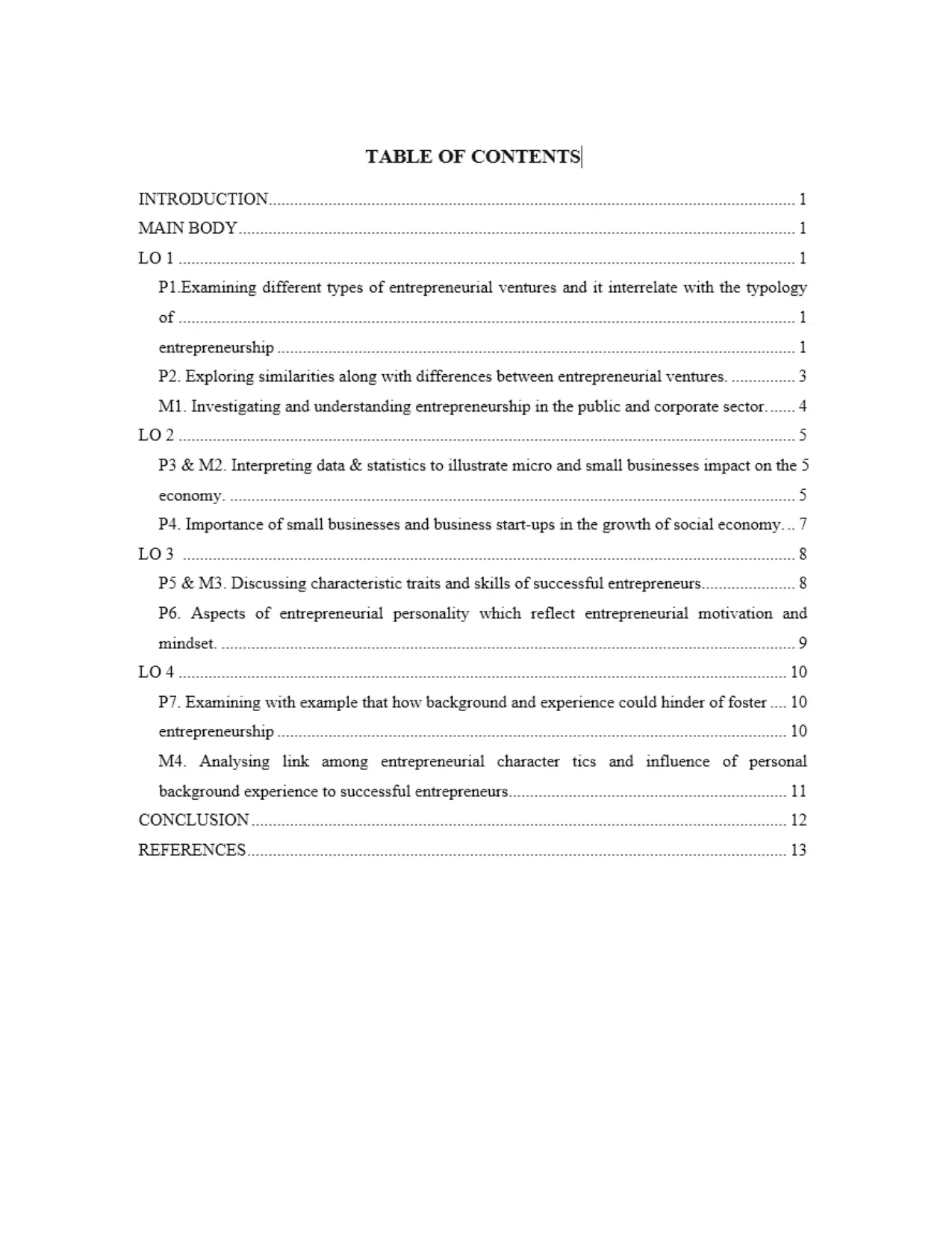
INTRODUCTION
Entrepreneurship is defined as process of running a new business with new ideas. People
creating such business are called entrepreneurs. Entrepreneurship is thus described as willingness
to organize and manage the business along with risk associated so as to make profit. The
instruction related to the small business management is concerned with the development of
entrepreneur knowledge of the economic principles and with the decision-making process. With
the help of business management, company can mitigate and eliminate risk factor associated with
it. The report will discuss about the entrepreneurial venture, its types, similarities and
differences. It will also evaluate differences which small, medium and large businesses makes to
the economy. Also, explanation related to characteristic different traits and skills of the
successful entrepreneurs which differentiate them from other business managers. Further, the
report will shed light on different environmental factors which fosters and hinder the business of
entrepreneurship.
MAIN BODY
LO 1
P1.Examining different types of entrepreneurial ventures and it interrelate with the typology of
entrepreneurship
The term entrepreneurial venture is defined as those business organisation whose
principal goals and objectives are profit earning and growth of business operations.
Entrepreneurial ventures are created by entrepreneurs, are those business organizations which
actively pursue business opportunities and advantages having growth and profitability as their
main goal which are characterised by new and better improved, innovative practises and methods
(Kirzner, 2015). Different type entrepreneurial ventures are follows:
1. Small Business – considered as an independently owned and operated business
enterprises that work for profit which is not a dominant in its field. The aim is to grow
and convert in long term business having both profitable and sustainable development.
Such kind of business enterprises are engaged in the business of restaurants, retail stores,
and agriculture sector etc. Funds and money requirements of small business are fulfilled
by micro loans, bank loans, revenue, family and personal funds. Are capable of
generating payroll taxes and job opportunities but are not large employers. Provide
1
Entrepreneurship is defined as process of running a new business with new ideas. People
creating such business are called entrepreneurs. Entrepreneurship is thus described as willingness
to organize and manage the business along with risk associated so as to make profit. The
instruction related to the small business management is concerned with the development of
entrepreneur knowledge of the economic principles and with the decision-making process. With
the help of business management, company can mitigate and eliminate risk factor associated with
it. The report will discuss about the entrepreneurial venture, its types, similarities and
differences. It will also evaluate differences which small, medium and large businesses makes to
the economy. Also, explanation related to characteristic different traits and skills of the
successful entrepreneurs which differentiate them from other business managers. Further, the
report will shed light on different environmental factors which fosters and hinder the business of
entrepreneurship.
MAIN BODY
LO 1
P1.Examining different types of entrepreneurial ventures and it interrelate with the typology of
entrepreneurship
The term entrepreneurial venture is defined as those business organisation whose
principal goals and objectives are profit earning and growth of business operations.
Entrepreneurial ventures are created by entrepreneurs, are those business organizations which
actively pursue business opportunities and advantages having growth and profitability as their
main goal which are characterised by new and better improved, innovative practises and methods
(Kirzner, 2015). Different type entrepreneurial ventures are follows:
1. Small Business – considered as an independently owned and operated business
enterprises that work for profit which is not a dominant in its field. The aim is to grow
and convert in long term business having both profitable and sustainable development.
Such kind of business enterprises are engaged in the business of restaurants, retail stores,
and agriculture sector etc. Funds and money requirements of small business are fulfilled
by micro loans, bank loans, revenue, family and personal funds. Are capable of
generating payroll taxes and job opportunities but are not large employers. Provide
1
⊘ This is a preview!⊘
Do you want full access?
Subscribe today to unlock all pages.

Trusted by 1+ million students worldwide
products and services which are defined as basic parts of the city’s infrastructure as well
as leisure goods and retail. Example -
2. Lifestyle Business – Includes Micro enterprises and Freelancers. It is a profit making
enterprise in which combining all the skills, concepts and passions of the founder is the
primary motivator. It focuses on earning long-term as well as residual income by
engaging passion and expertise knowledge of founder (Burns and Dewhurst, 2016). It is
basically a type of self employed individuals, on person company or a very small
operations. Are not job creators but they provide an amount of income to the founders
with the help of services and goods which helps in enhancing the quality of life.
3. Social Good Business – Are those business develop on innovative solutions and with
desire of making the whole world a better workplace. It aims at maximizing impact in a
better effective and sustainable manner. This kind of company performs its business
operations to solve the health issues at global level, specific problems faced by
developing countries. This business enterprises can procure fund requirement depending
on type and size of company which is required for creating social impact and improve
living standards.
4. Large business – The large business enterprises are those established firm or
corporations which mostly employs at least 500 people for conducting its business
operations with a goal of generating profit for both the company and its shareholders.
These firms enjoy benefits in form of tax credits, subsidiaries etc.
Interrelation of the entrepreneurial ventures with typology of entrepreneurship are as
follows: An entrepreneur is an individual person who have an idea to starts and runs the business
and its operation with the limited amount of resources available with proper planning. The risks
and rewards associated with such business is bear by the entrepreneur itself. The idea for
conducting business is of a launching of new product and service instead of modifying the
existing business model (DeTienne, McKelvie and Chandler, 2015). Typology is used with
purpose of understanding the nature of relationship and connection between the type of
enterprise and its subject or deals with the understanding between the type and its object matter.
The typology of an entrepreneur is a business model which is based on the previous occupational
2
as leisure goods and retail. Example -
2. Lifestyle Business – Includes Micro enterprises and Freelancers. It is a profit making
enterprise in which combining all the skills, concepts and passions of the founder is the
primary motivator. It focuses on earning long-term as well as residual income by
engaging passion and expertise knowledge of founder (Burns and Dewhurst, 2016). It is
basically a type of self employed individuals, on person company or a very small
operations. Are not job creators but they provide an amount of income to the founders
with the help of services and goods which helps in enhancing the quality of life.
3. Social Good Business – Are those business develop on innovative solutions and with
desire of making the whole world a better workplace. It aims at maximizing impact in a
better effective and sustainable manner. This kind of company performs its business
operations to solve the health issues at global level, specific problems faced by
developing countries. This business enterprises can procure fund requirement depending
on type and size of company which is required for creating social impact and improve
living standards.
4. Large business – The large business enterprises are those established firm or
corporations which mostly employs at least 500 people for conducting its business
operations with a goal of generating profit for both the company and its shareholders.
These firms enjoy benefits in form of tax credits, subsidiaries etc.
Interrelation of the entrepreneurial ventures with typology of entrepreneurship are as
follows: An entrepreneur is an individual person who have an idea to starts and runs the business
and its operation with the limited amount of resources available with proper planning. The risks
and rewards associated with such business is bear by the entrepreneur itself. The idea for
conducting business is of a launching of new product and service instead of modifying the
existing business model (DeTienne, McKelvie and Chandler, 2015). Typology is used with
purpose of understanding the nature of relationship and connection between the type of
enterprise and its subject or deals with the understanding between the type and its object matter.
The typology of an entrepreneur is a business model which is based on the previous occupational
2
Paraphrase This Document
Need a fresh take? Get an instant paraphrase of this document with our AI Paraphraser
background and helps in examining the previous research related top the organizational
backgrounds from where entrepreneurs have emerged an idea to form new ventures.
P2. Defining similarities along with differences of entrepreneurial ventures.
Every entrepreneurial ventures work with same goals and objectives which are to be
achieved in the set defined time period in a very cost effective manner. Similarities among
different entrepreneurial ventures are as follows:
1. Financial Goals and objectives – Many small business entrepreneurs aims at achieving the
financial independence with the help of a profitable business which pay regular income (Read
and et.al., 2016). The goal of small business entrepreneur is to generate income whereas high
profile entrepreneur goal is to wealth creation.
2. Risk profile – Every business enterprise has to face risk factor which is inherent and can't be
eliminated from the business operations. It is the role of business manager to make some
preventive measures to mitigate these risk by framing sound and effective business strategies and
plans.
3. Financing strategies – Every entrepreneur venture firm should develop a sound and proper
financing strategies for meeting both short as well as long term requirements of its business
operations & other obligations. The financing strategy should be a combination of lower risk
factor, moderate or high return and decrease in the level of wealth creation which helps in
limiting the dilution of ownership of business.
On the other hand entrepreneurial ventures have some difference among its way of
conducting business which are discussed below:
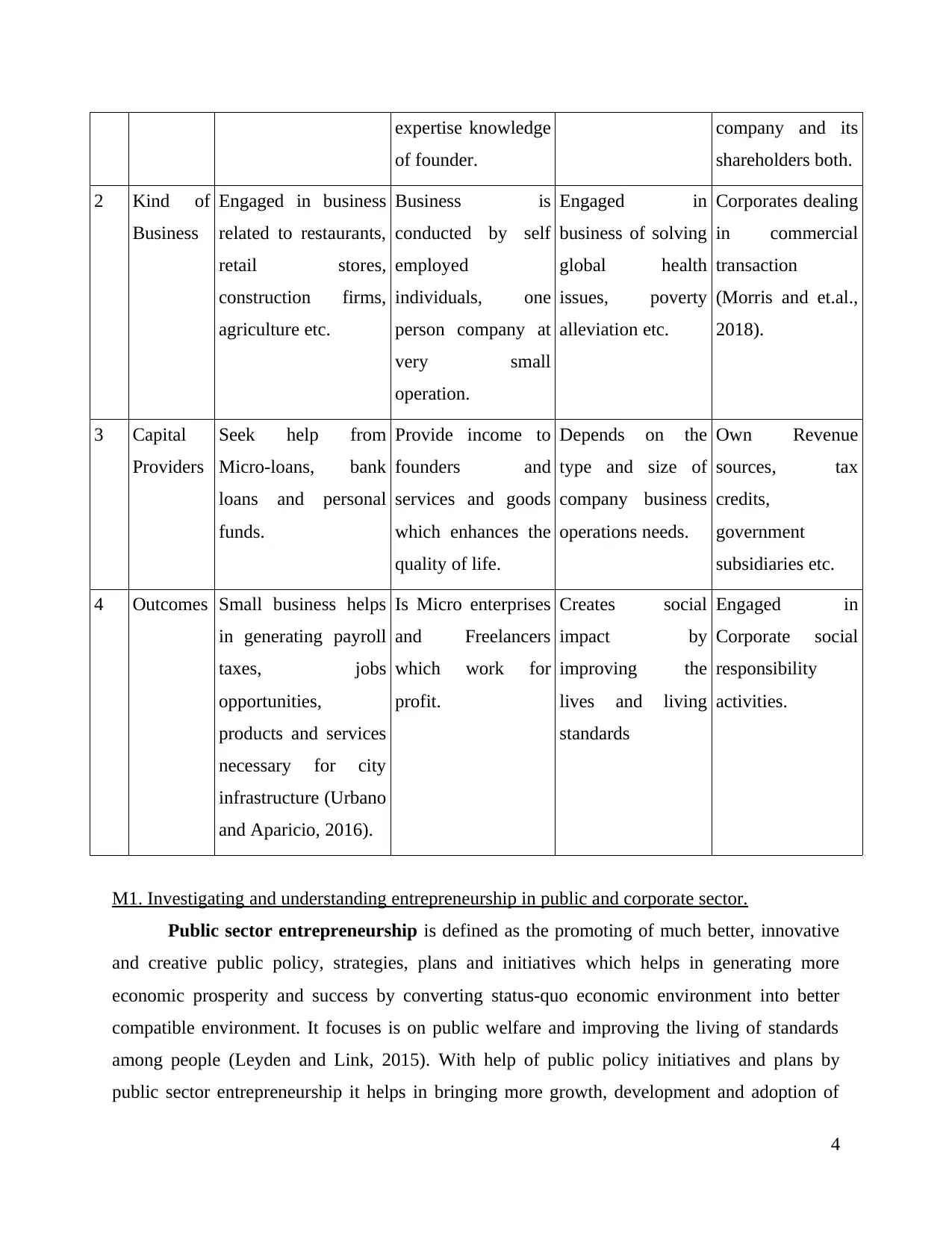
S.
No. Basis Small Business Lifestyle Business Social Good
Business Large business
1 Goal To grow into a long
term profitable and
sustainable business.
To earn long term
profits, benefits,
income with the
help of self directed
business engaging in
passion and
Is to maximize the
impact of profits in
a sustainable way.
To create human
well fare.
These companies
focus is on
generating large
revenue and profit
amount for the
benefit of
3
backgrounds from where entrepreneurs have emerged an idea to form new ventures.
P2. Defining similarities along with differences of entrepreneurial ventures.
Every entrepreneurial ventures work with same goals and objectives which are to be
achieved in the set defined time period in a very cost effective manner. Similarities among
different entrepreneurial ventures are as follows:
1. Financial Goals and objectives – Many small business entrepreneurs aims at achieving the
financial independence with the help of a profitable business which pay regular income (Read
and et.al., 2016). The goal of small business entrepreneur is to generate income whereas high
profile entrepreneur goal is to wealth creation.
2. Risk profile – Every business enterprise has to face risk factor which is inherent and can't be
eliminated from the business operations. It is the role of business manager to make some
preventive measures to mitigate these risk by framing sound and effective business strategies and
plans.
3. Financing strategies – Every entrepreneur venture firm should develop a sound and proper
financing strategies for meeting both short as well as long term requirements of its business
operations & other obligations. The financing strategy should be a combination of lower risk
factor, moderate or high return and decrease in the level of wealth creation which helps in
limiting the dilution of ownership of business.
On the other hand entrepreneurial ventures have some difference among its way of
conducting business which are discussed below:
S.
No. Basis Small Business Lifestyle Business Social Good
Business Large business
1 Goal To grow into a long
term profitable and
sustainable business.
To earn long term
profits, benefits,
income with the
help of self directed
business engaging in
passion and
Is to maximize the
impact of profits in
a sustainable way.
To create human
well fare.
These companies
focus is on
generating large
revenue and profit
amount for the
benefit of
3
expertise knowledge
of founder.
company and its
shareholders both.
2 Kind of
Business
Engaged in business
related to restaurants,
retail stores,
construction firms,
agriculture etc.
Business is
conducted by self
employed
individuals, one
person company at
very small
operation.
Engaged in
business of solving
global health
issues, poverty
alleviation etc.
Corporates dealing
in commercial
transaction
(Morris and et.al.,
2018).
3 Capital
Providers
Seek help from
Micro-loans, bank
loans and personal
funds.
Provide income to
founders and
services and goods
which enhances the
quality of life.
Depends on the
type and size of
company business
operations needs.
Own Revenue
sources, tax
credits,
government
subsidiaries etc.
4 Outcomes Small business helps
in generating payroll
taxes, jobs
opportunities,
products and services
necessary for city
infrastructure (Urbano
and Aparicio, 2016).
Is Micro enterprises
and Freelancers
which work for
profit.
Creates social
impact by
improving the
lives and living
standards
Engaged in
Corporate social
responsibility
activities.
M1. Investigating and understanding entrepreneurship in public and corporate sector.
Public sector entrepreneurship is defined as the promoting of much better, innovative
and creative public policy, strategies, plans and initiatives which helps in generating more
economic prosperity and success by converting status-quo economic environment into better
compatible environment. It focuses is on public welfare and improving the living of standards
among people (Leyden and Link, 2015). With help of public policy initiatives and plans by
public sector entrepreneurship it helps in bringing more growth, development and adoption of
4
of founder.
company and its
shareholders both.
2 Kind of
Business
Engaged in business
related to restaurants,
retail stores,
construction firms,
agriculture etc.
Business is
conducted by self
employed
individuals, one
person company at
very small
operation.
Engaged in
business of solving
global health
issues, poverty
alleviation etc.
Corporates dealing
in commercial
transaction
(Morris and et.al.,
2018).
3 Capital
Providers
Seek help from
Micro-loans, bank
loans and personal
funds.
Provide income to
founders and
services and goods
which enhances the
quality of life.
Depends on the
type and size of
company business
operations needs.
Own Revenue
sources, tax
credits,
government
subsidiaries etc.
4 Outcomes Small business helps
in generating payroll
taxes, jobs
opportunities,
products and services
necessary for city
infrastructure (Urbano
and Aparicio, 2016).
Is Micro enterprises
and Freelancers
which work for
profit.
Creates social
impact by
improving the
lives and living
standards
Engaged in
Corporate social
responsibility
activities.
M1. Investigating and understanding entrepreneurship in public and corporate sector.
Public sector entrepreneurship is defined as the promoting of much better, innovative
and creative public policy, strategies, plans and initiatives which helps in generating more
economic prosperity and success by converting status-quo economic environment into better
compatible environment. It focuses is on public welfare and improving the living of standards
among people (Leyden and Link, 2015). With help of public policy initiatives and plans by
public sector entrepreneurship it helps in bringing more growth, development and adoption of
4
⊘ This is a preview!⊘
Do you want full access?
Subscribe today to unlock all pages.
Trusted by 1+ million students worldwide

new technology and methods to support innovation throughout the economy. Public
entrepreneurship business basically involves innovations of factors by combining both the public
and private resources with the aim of achieving social as well as business objectives. The public
sector entrepreneur also deals with the issue related to institutional change, rights in the field of
legal and property, innovations and changes which create value or destroy value or lead to value
appropriation.
Corporate Entrepreneurship is defined as the process which is used for developing
new business operations, products, services, methods or processes within the existing business
organization (Bierwerth and et.al., 2015). It helps in creating value and norms so as to generate
more and more new revenue along with the growth factor by implementing entrepreneurial
thoughts, ideas and actions. It includes three components viz people, process and place.
LO 2
P3 & M2. Interpreting data & statistics illustrating micro and small businesses impact on the
economy.
5
entrepreneurship business basically involves innovations of factors by combining both the public
and private resources with the aim of achieving social as well as business objectives. The public
sector entrepreneur also deals with the issue related to institutional change, rights in the field of
legal and property, innovations and changes which create value or destroy value or lead to value
appropriation.
Corporate Entrepreneurship is defined as the process which is used for developing
new business operations, products, services, methods or processes within the existing business
organization (Bierwerth and et.al., 2015). It helps in creating value and norms so as to generate
more and more new revenue along with the growth factor by implementing entrepreneurial
thoughts, ideas and actions. It includes three components viz people, process and place.
LO 2
P3 & M2. Interpreting data & statistics illustrating micro and small businesses impact on the
economy.
5
Paraphrase This Document
Need a fresh take? Get an instant paraphrase of this document with our AI Paraphraser
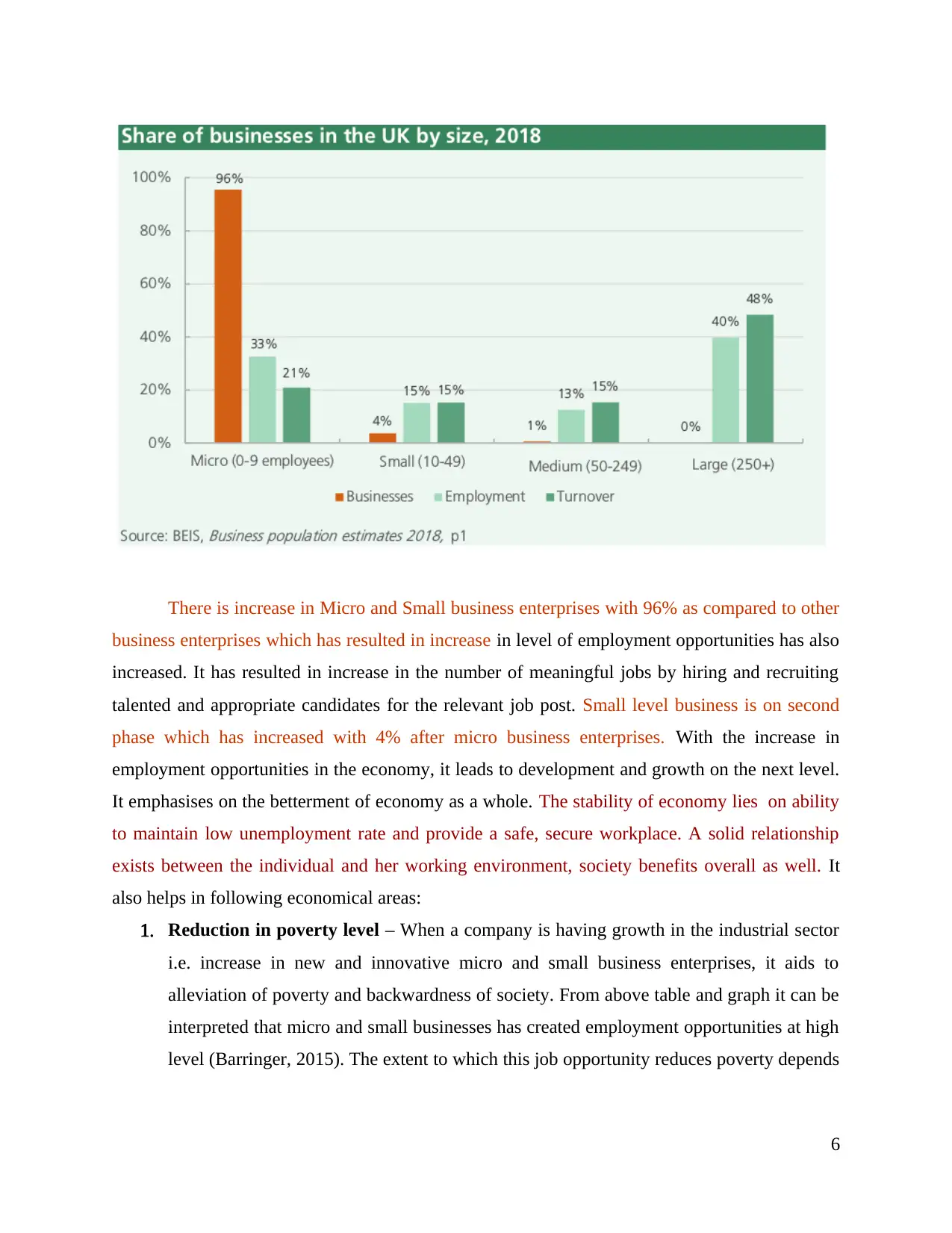
There is increase in Micro and Small business enterprises with 96% as compared to other
business enterprises which has resulted in increase in level of employment opportunities has also
increased. It has resulted in increase in the number of meaningful jobs by hiring and recruiting
talented and appropriate candidates for the relevant job post. Small level business is on second
phase which has increased with 4% after micro business enterprises. With the increase in
employment opportunities in the economy, it leads to development and growth on the next level.
It emphasises on the betterment of economy as a whole. The stability of economy lies on ability
to maintain low unemployment rate and provide a safe, secure workplace. A solid relationship
exists between the individual and her working environment, society benefits overall as well. It
also helps in following economical areas:
1. Reduction in poverty level – When a company is having growth in the industrial sector
i.e. increase in new and innovative micro and small business enterprises, it aids to
alleviation of poverty and backwardness of society. From above table and graph it can be
interpreted that micro and small businesses has created employment opportunities at high
level (Barringer, 2015). The extent to which this job opportunity reduces poverty depends
6
business enterprises which has resulted in increase in level of employment opportunities has also
increased. It has resulted in increase in the number of meaningful jobs by hiring and recruiting
talented and appropriate candidates for the relevant job post. Small level business is on second
phase which has increased with 4% after micro business enterprises. With the increase in
employment opportunities in the economy, it leads to development and growth on the next level.
It emphasises on the betterment of economy as a whole. The stability of economy lies on ability
to maintain low unemployment rate and provide a safe, secure workplace. A solid relationship
exists between the individual and her working environment, society benefits overall as well. It
also helps in following economical areas:
1. Reduction in poverty level – When a company is having growth in the industrial sector
i.e. increase in new and innovative micro and small business enterprises, it aids to
alleviation of poverty and backwardness of society. From above table and graph it can be
interpreted that micro and small businesses has created employment opportunities at high
level (Barringer, 2015). The extent to which this job opportunity reduces poverty depends
6
on the level to which the poor employees participates in the business operations & growth
process.
2. Equal distribution of income and wealth – To alleviate poverty from economy of the
country, micro and small business has emphasises on creating more job opportunities and
advantages for the unemployed people of the country. This has also focused on equal
distribution of income among people to improve their living status. From the above table
it can assess that Small and Medium Enterprise is having the highest turnover over other
business enterprises.
3. Raising of living of standard – Once the unemployed person get employed in any
meaningful job which yield proper and sufficient income in return, it helps in raising
standard of living of such people by improving quality of life.
4. Economic growth – It helps in economic growth by creating higher tax revenues, high
income distribution etc. Thus, economic growth helps in reducing the government
borrowing, lowering of deficit balance and increase in the GDP level (Tobing and et.al.,
2019). The above graph has shown that micro business sector is providing high rate of
employment opportunities among all.
Micro businesses imparts more employment with number 5415 as compared to small medium
and large imparts viz. 210, 35 and 8 in 000s number. But turnover is more in case of large
business firms.
P4. Importance of small businesses and business start-ups in the growth of social economy.
Small business is defined as any company or business firm which provides employment
to less than 500 employees or falls under an industry specific annual receipts cap. Are those
privately owned corporations, partnerships, sole proprietorship business having fewer employees
and less annual revenue as compared to big business organisation and corporation (Barringer,
2015). Start ups business refers to the new business which is having intention to grow beyond
founder expectation, having high employees and intend to grow large & successful business
organisation. Start ups business is a company initiated by individual founders or entrepreneurs
for making search for the most repeatable and scalable business model. Importance is as follows:
1. Creating meaning jobs and local hiring - Small business helps in stimulating the
economic growth by creating employment opportunities for people which are not been
7
process.
2. Equal distribution of income and wealth – To alleviate poverty from economy of the
country, micro and small business has emphasises on creating more job opportunities and
advantages for the unemployed people of the country. This has also focused on equal
distribution of income among people to improve their living status. From the above table
it can assess that Small and Medium Enterprise is having the highest turnover over other
business enterprises.
3. Raising of living of standard – Once the unemployed person get employed in any
meaningful job which yield proper and sufficient income in return, it helps in raising
standard of living of such people by improving quality of life.
4. Economic growth – It helps in economic growth by creating higher tax revenues, high
income distribution etc. Thus, economic growth helps in reducing the government
borrowing, lowering of deficit balance and increase in the GDP level (Tobing and et.al.,
2019). The above graph has shown that micro business sector is providing high rate of
employment opportunities among all.
Micro businesses imparts more employment with number 5415 as compared to small medium
and large imparts viz. 210, 35 and 8 in 000s number. But turnover is more in case of large
business firms.
P4. Importance of small businesses and business start-ups in the growth of social economy.
Small business is defined as any company or business firm which provides employment
to less than 500 employees or falls under an industry specific annual receipts cap. Are those
privately owned corporations, partnerships, sole proprietorship business having fewer employees
and less annual revenue as compared to big business organisation and corporation (Barringer,
2015). Start ups business refers to the new business which is having intention to grow beyond
founder expectation, having high employees and intend to grow large & successful business
organisation. Start ups business is a company initiated by individual founders or entrepreneurs
for making search for the most repeatable and scalable business model. Importance is as follows:
1. Creating meaning jobs and local hiring - Small business helps in stimulating the
economic growth by creating employment opportunities for people which are not been
7
⊘ This is a preview!⊘
Do you want full access?
Subscribe today to unlock all pages.
Trusted by 1+ million students worldwide
able to employ by larger corporations. These business enterprises attract employees who
are having talent of inventing or creating new products or implement new solutions for
existing ideas.
2. Diversity factor - Small as well as Start ups business are easy and more flexible that can
be started and operated by any individual person. Such flexibility brings in more diversity
in the form, function, culture, and operational potential as compared to those of large
business organisation. This helps the economy in growing in much easier manner and
make economy capable of facing tough and adverse conditions.
3. Competition – When individuals starts some small business, it leads to injection of new
competition into previously stale and current market areas. This creates more competitive
opportunities and advantages for other business enterprises which in turn creates high
competition (Ewens and Marx, 2017). Start up business by bringing innovation and new
technology which is much faster than a bulky and out dated one forcing changes in the
thinking and behavioural attitude.
Social economy is related with the concept of performing business activities and operations for
the welfare and betterment of the society and general public at large. This in turn brings
improvement in employment level and helps in raising economic condition as well as standard of
living too.
LO 3
P5 & M3. Discussing characteristic traits and skills of successful entrepreneurs.
Mr. Simon Cowell, is one of the successful entrepreneur who is working in English
television, music and talent show judge, A&R executive, businessman, talent manager, television
producer. This entrepreneur is confident, optimistic and disciplined. He is open to new ideas for
becoming successful entrepreneur, individual should possesses following characteristic, traits
and skills:
1. Disciplined – The entrepreneur individuals should be focused on making their business
operations, functions, work more effective. They should emphasizes on eliminating all
the risk, hindrances or errors which are coming in way of achieving business goals
(Block and et.al., 2015). Proper business strategies helps in outline tactics to accomplish
8
are having talent of inventing or creating new products or implement new solutions for
existing ideas.
2. Diversity factor - Small as well as Start ups business are easy and more flexible that can
be started and operated by any individual person. Such flexibility brings in more diversity
in the form, function, culture, and operational potential as compared to those of large
business organisation. This helps the economy in growing in much easier manner and
make economy capable of facing tough and adverse conditions.
3. Competition – When individuals starts some small business, it leads to injection of new
competition into previously stale and current market areas. This creates more competitive
opportunities and advantages for other business enterprises which in turn creates high
competition (Ewens and Marx, 2017). Start up business by bringing innovation and new
technology which is much faster than a bulky and out dated one forcing changes in the
thinking and behavioural attitude.
Social economy is related with the concept of performing business activities and operations for
the welfare and betterment of the society and general public at large. This in turn brings
improvement in employment level and helps in raising economic condition as well as standard of
living too.
LO 3
P5 & M3. Discussing characteristic traits and skills of successful entrepreneurs.
Mr. Simon Cowell, is one of the successful entrepreneur who is working in English
television, music and talent show judge, A&R executive, businessman, talent manager, television
producer. This entrepreneur is confident, optimistic and disciplined. He is open to new ideas for
becoming successful entrepreneur, individual should possesses following characteristic, traits
and skills:
1. Disciplined – The entrepreneur individuals should be focused on making their business
operations, functions, work more effective. They should emphasizes on eliminating all
the risk, hindrances or errors which are coming in way of achieving business goals
(Block and et.al., 2015). Proper business strategies helps in outline tactics to accomplish
8
Paraphrase This Document
Need a fresh take? Get an instant paraphrase of this document with our AI Paraphraser
these goals in a cost effective manner. Successful entrepreneur is required to be self
disciplined toward achievement of their objectives.
2. Confidence – One of important characteristics is that they never have doubtful thought in
mind or any ask questions about whether they can succeed or are worthy of success. They
are should be confident enough with the available knowledge and skills that they will be
able to succeed their business by exuding confidence in every business operations and
activities they do.
3. Open Minded – For entrepreneurs every moment, event is business opportunity which
helps in seeking competitive advantages on time. Ideas and thoughts should be constantly
generated related to the business operations' efficiency, people skills and new businesses.
They have the ability to look at every activity of business taking place around them and
focus it toward attainment of goals.4. Creativity - One facet of creativity is that entrepreneur should be able to make
connections between unrelated events, activities or situations. Entrepreneurs should have
creative ideas and thoughts for the solutions (Fouzdar and Sachdev, 2017). They should
be capable of reinventing same product or service to market & new industries.
Argument – For becoming successful entrepreneur, the individual should possesses
characteristics such as self discipline, creativity, strong work ethics, confident. All these
characteristics are sometime not enough for becoming successful entrepreneur.
Mr. Simon Cowell focused on making their business operations, functions, work more
effective. Is always eager to make connections between unrelated events, activities or situations.
Also having the ability to look at every activity of business taking place around them and focus it
toward attainment of goals.
P6. Aspects of entrepreneurial personality which reflect entrepreneurial motivation and mindset.
Entrepreneurial personality traits includes personal characteristics, abilities, motives,
attitudes, behaviours helps in shaping the individual experiences and actions plan. The aspects of
entrepreneurial personality which reflect entrepreneurial motivation and mindset are as follows:
1. Passion – One of important personality trait which every entrepreneur should possesses
is Passionate. If an individual is having passion for doing something or for attaining some
set desire goal, then he will be able to achieve it within short time with high profit and
9
disciplined toward achievement of their objectives.
2. Confidence – One of important characteristics is that they never have doubtful thought in
mind or any ask questions about whether they can succeed or are worthy of success. They
are should be confident enough with the available knowledge and skills that they will be
able to succeed their business by exuding confidence in every business operations and
activities they do.
3. Open Minded – For entrepreneurs every moment, event is business opportunity which
helps in seeking competitive advantages on time. Ideas and thoughts should be constantly
generated related to the business operations' efficiency, people skills and new businesses.
They have the ability to look at every activity of business taking place around them and
focus it toward attainment of goals.4. Creativity - One facet of creativity is that entrepreneur should be able to make
connections between unrelated events, activities or situations. Entrepreneurs should have
creative ideas and thoughts for the solutions (Fouzdar and Sachdev, 2017). They should
be capable of reinventing same product or service to market & new industries.
Argument – For becoming successful entrepreneur, the individual should possesses
characteristics such as self discipline, creativity, strong work ethics, confident. All these
characteristics are sometime not enough for becoming successful entrepreneur.
Mr. Simon Cowell focused on making their business operations, functions, work more
effective. Is always eager to make connections between unrelated events, activities or situations.
Also having the ability to look at every activity of business taking place around them and focus it
toward attainment of goals.
P6. Aspects of entrepreneurial personality which reflect entrepreneurial motivation and mindset.
Entrepreneurial personality traits includes personal characteristics, abilities, motives,
attitudes, behaviours helps in shaping the individual experiences and actions plan. The aspects of
entrepreneurial personality which reflect entrepreneurial motivation and mindset are as follows:
1. Passion – One of important personality trait which every entrepreneur should possesses
is Passionate. If an individual is having passion for doing something or for attaining some
set desire goal, then he will be able to achieve it within short time with high profit and
9
minimum cost factor. Mr. Simon Cowell is one of the successful entrepreneur having
passion and excitement related to business growth.
2. Optimism – Every entrepreneur should be optimistic in nature and had a vision and
mission statement for its business (Staniewski, Janowski and Awruk, 2016). Vision helps
in seeing things invisible. Entrepreneurs should have a proper and clear vision which they
should share with its employees. Once the team member understands what are the goals
and vision they will perform for the goal attainment.
3. Risk-Takers – Every business entrepreneur including Mr. Simon Cowell should be
capable of taking risk factor as a positive business opportunity and use it as one of the
advantage in the business. Also, business strategies and plans should be made for
mitigating and eliminating risk associated with business operations at a large level.
4. Flexibility – Another important trait of entrepreneur is flexibility which is possesses by
Mr. Simon Cowell . They should be able to adapt to changes and challenges which is
crucial for business success (Stephan and Drencheva, 2017). Entrepreneurs should be
flexible enough to make the changes and adjustments in the idea to make that idea more
feasible. Entrepreneurs are always prepared and willing to modify their ideas and plan
whenever they got some new and fruitful information.
LO 4
P7. Examining with example that background and experience could hinder of foster
entrepreneurship
Entrepreneurship is influenced through numerous factors such as culture, economic and
technological development and education. The conditions might give both good and bad impact
on its emergence as positive influence facilitate and conducive conditions. The negative impact
inhibit milieu to entrepreneurship emergence. In this aspect, background and experience could
directly prevent and foster entrepreneurship. The particular approach of every entrepreneur is not
similar when it is case of business and decision making process. These variations are due to
numerous personality attribute which are acquired through time and actual experiences. On basis
of forming individual personality, life experience and education is a greater analyst, and similar
to entrepreneurs as well. The traits are self management, coordination and self motivation is
significant for entrepreneur and derived with factor like life experience and education. This helps
individual to surpass the challenges.
10
passion and excitement related to business growth.
2. Optimism – Every entrepreneur should be optimistic in nature and had a vision and
mission statement for its business (Staniewski, Janowski and Awruk, 2016). Vision helps
in seeing things invisible. Entrepreneurs should have a proper and clear vision which they
should share with its employees. Once the team member understands what are the goals
and vision they will perform for the goal attainment.
3. Risk-Takers – Every business entrepreneur including Mr. Simon Cowell should be
capable of taking risk factor as a positive business opportunity and use it as one of the
advantage in the business. Also, business strategies and plans should be made for
mitigating and eliminating risk associated with business operations at a large level.
4. Flexibility – Another important trait of entrepreneur is flexibility which is possesses by
Mr. Simon Cowell . They should be able to adapt to changes and challenges which is
crucial for business success (Stephan and Drencheva, 2017). Entrepreneurs should be
flexible enough to make the changes and adjustments in the idea to make that idea more
feasible. Entrepreneurs are always prepared and willing to modify their ideas and plan
whenever they got some new and fruitful information.
LO 4
P7. Examining with example that background and experience could hinder of foster
entrepreneurship
Entrepreneurship is influenced through numerous factors such as culture, economic and
technological development and education. The conditions might give both good and bad impact
on its emergence as positive influence facilitate and conducive conditions. The negative impact
inhibit milieu to entrepreneurship emergence. In this aspect, background and experience could
directly prevent and foster entrepreneurship. The particular approach of every entrepreneur is not
similar when it is case of business and decision making process. These variations are due to
numerous personality attribute which are acquired through time and actual experiences. On basis
of forming individual personality, life experience and education is a greater analyst, and similar
to entrepreneurs as well. The traits are self management, coordination and self motivation is
significant for entrepreneur and derived with factor like life experience and education. This helps
individual to surpass the challenges.
10
⊘ This is a preview!⊘
Do you want full access?
Subscribe today to unlock all pages.
Trusted by 1+ million students worldwide

1 out of 16


Related Documents


Your All-in-One AI-Powered Toolkit for Academic Success.
+13062052269
info@desklib.com
Available 24*7 on WhatsApp / Email
![[object Object]](/_next/static/media/star-bottom.7253800d.svg)
Unlock your academic potential
Copyright © 2020–2026 A2Z Services. All Rights Reserved. Developed and managed by ZUCOL.