Entrepreneurship Report: Business Ventures, Brexit Impact, and Skills
VerifiedAdded on 2020/06/06
|11
|4444
|44
Report
AI Summary
This report provides a comprehensive overview of entrepreneurship, exploring various types of entrepreneurial ventures, including small businesses, large-scale organizations, and startups. It examines the relationship between different venture types and entrepreneurial typologies, such as female and social entrepreneurs. The report delves into the impact of micro and small-scale businesses on the economy, highlighting their contribution to GDP and employment. It analyzes the importance of small businesses and startups in society's growth, particularly in the context of Brexit, and discusses government measures to support these businesses. Furthermore, the report investigates the characteristics, traits, and skills of successful entrepreneurs, including aspects of entrepreneurial personality that reflect motivation and mindset. It also addresses the background and experience that can either hinder or foster entrepreneurship, providing a well-rounded understanding of the entrepreneurial landscape.

ENTERPRENEURSHIP

Paraphrase This Document
Need a fresh take? Get an instant paraphrase of this document with our AI Paraphraser
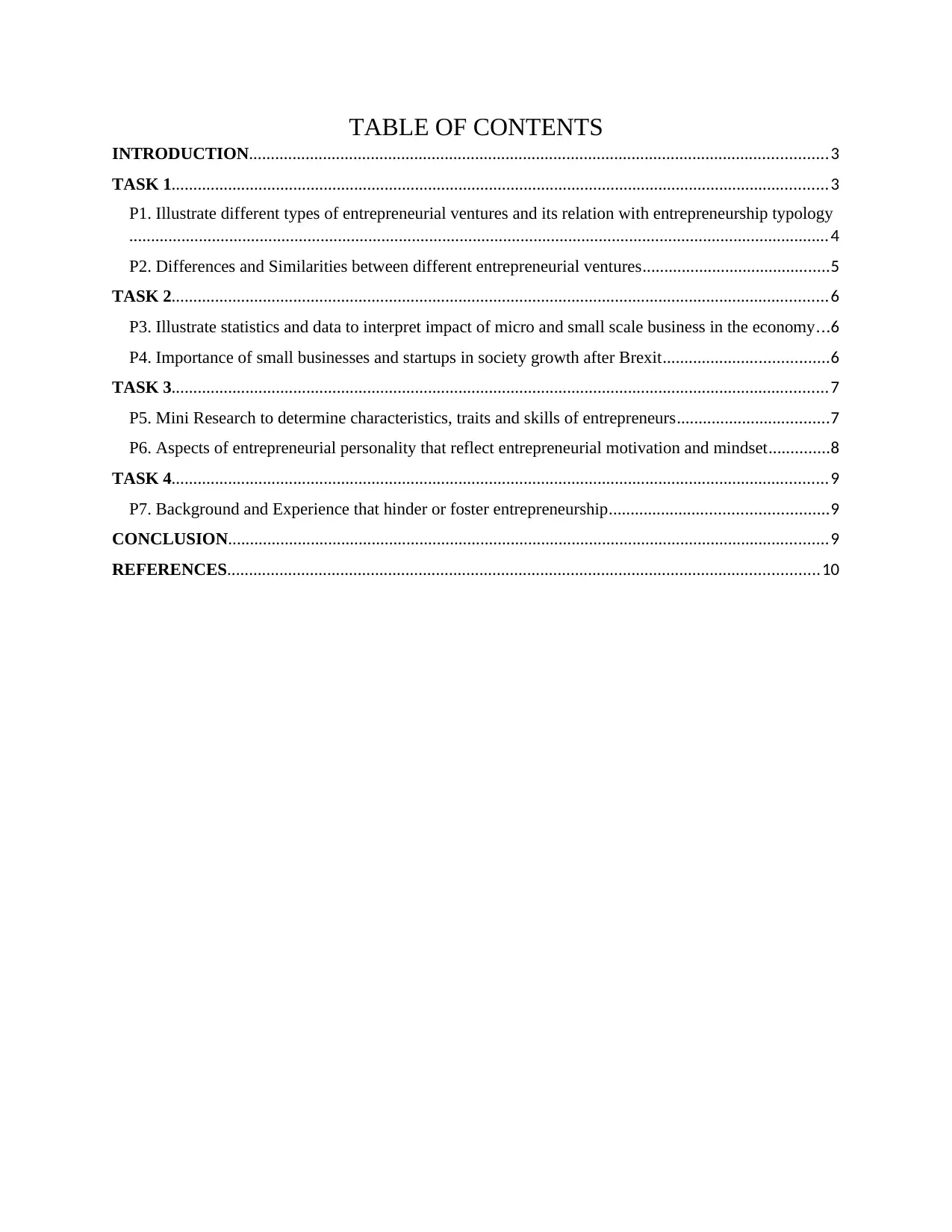
TABLE OF CONTENTS
INTRODUCTION.....................................................................................................................................3
TASK 1.......................................................................................................................................................3
P1. Illustrate different types of entrepreneurial ventures and its relation with entrepreneurship typology
.................................................................................................................................................................4
P2. Differences and Similarities between different entrepreneurial ventures...........................................5
TASK 2.......................................................................................................................................................6
P3. Illustrate statistics and data to interpret impact of micro and small scale business in the economy...6
P4. Importance of small businesses and startups in society growth after Brexit......................................6
TASK 3.......................................................................................................................................................7
P5. Mini Research to determine characteristics, traits and skills of entrepreneurs...................................7
P6. Aspects of entrepreneurial personality that reflect entrepreneurial motivation and mindset..............8
TASK 4.......................................................................................................................................................9
P7. Background and Experience that hinder or foster entrepreneurship..................................................9
CONCLUSION..........................................................................................................................................9
REFERENCES........................................................................................................................................10
INTRODUCTION.....................................................................................................................................3
TASK 1.......................................................................................................................................................3
P1. Illustrate different types of entrepreneurial ventures and its relation with entrepreneurship typology
.................................................................................................................................................................4
P2. Differences and Similarities between different entrepreneurial ventures...........................................5
TASK 2.......................................................................................................................................................6
P3. Illustrate statistics and data to interpret impact of micro and small scale business in the economy...6
P4. Importance of small businesses and startups in society growth after Brexit......................................6
TASK 3.......................................................................................................................................................7
P5. Mini Research to determine characteristics, traits and skills of entrepreneurs...................................7
P6. Aspects of entrepreneurial personality that reflect entrepreneurial motivation and mindset..............8
TASK 4.......................................................................................................................................................9
P7. Background and Experience that hinder or foster entrepreneurship..................................................9
CONCLUSION..........................................................................................................................................9
REFERENCES........................................................................................................................................10
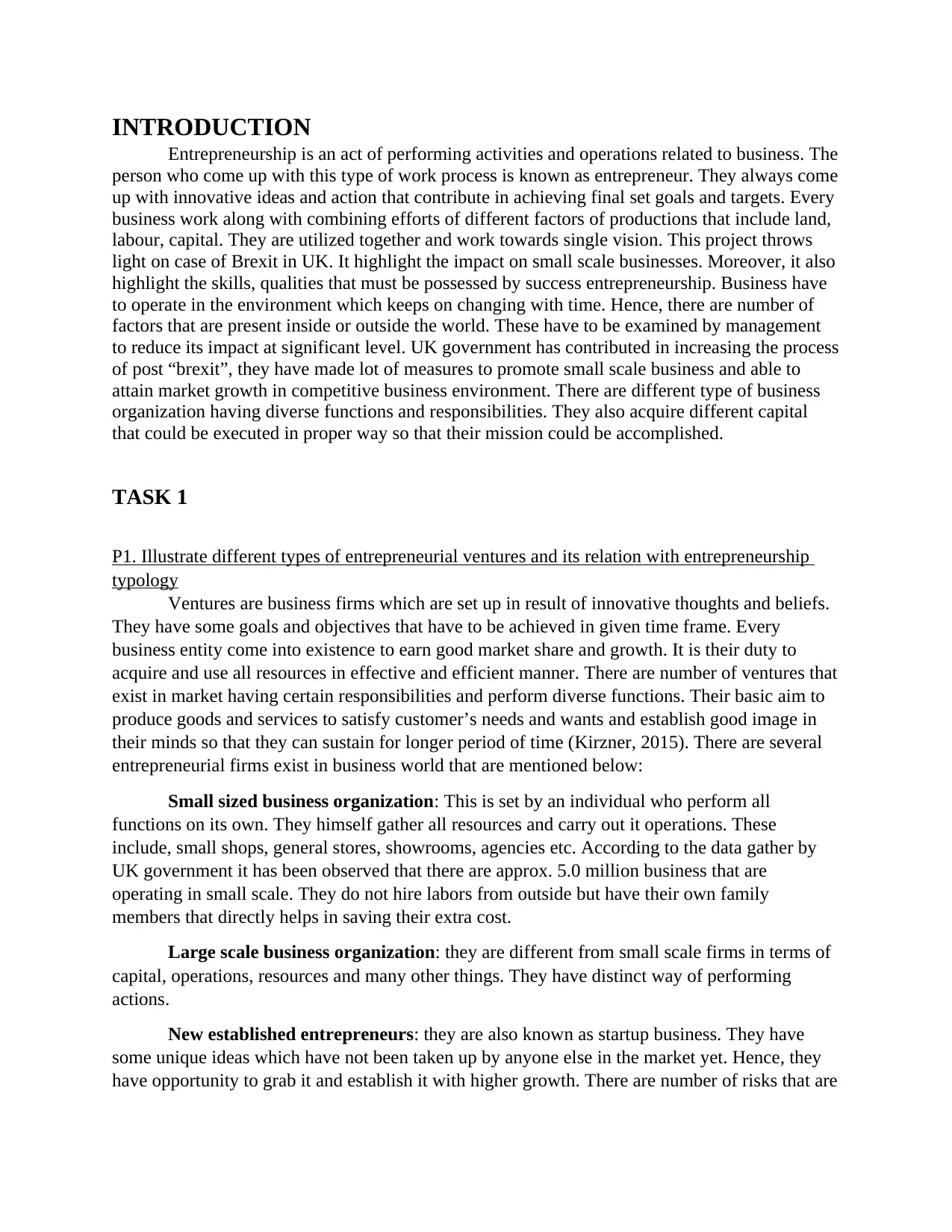
INTRODUCTION
Entrepreneurship is an act of performing activities and operations related to business. The
person who come up with this type of work process is known as entrepreneur. They always come
up with innovative ideas and action that contribute in achieving final set goals and targets. Every
business work along with combining efforts of different factors of productions that include land,
labour, capital. They are utilized together and work towards single vision. This project throws
light on case of Brexit in UK. It highlight the impact on small scale businesses. Moreover, it also
highlight the skills, qualities that must be possessed by success entrepreneurship. Business have
to operate in the environment which keeps on changing with time. Hence, there are number of
factors that are present inside or outside the world. These have to be examined by management
to reduce its impact at significant level. UK government has contributed in increasing the process
of post “brexit”, they have made lot of measures to promote small scale business and able to
attain market growth in competitive business environment. There are different type of business
organization having diverse functions and responsibilities. They also acquire different capital
that could be executed in proper way so that their mission could be accomplished.
TASK 1
P1. Illustrate different types of entrepreneurial ventures and its relation with entrepreneurship
typology
Ventures are business firms which are set up in result of innovative thoughts and beliefs.
They have some goals and objectives that have to be achieved in given time frame. Every
business entity come into existence to earn good market share and growth. It is their duty to
acquire and use all resources in effective and efficient manner. There are number of ventures that
exist in market having certain responsibilities and perform diverse functions. Their basic aim to
produce goods and services to satisfy customer’s needs and wants and establish good image in
their minds so that they can sustain for longer period of time (Kirzner, 2015). There are several
entrepreneurial firms exist in business world that are mentioned below:
Small sized business organization: This is set by an individual who perform all
functions on its own. They himself gather all resources and carry out it operations. These
include, small shops, general stores, showrooms, agencies etc. According to the data gather by
UK government it has been observed that there are approx. 5.0 million business that are
operating in small scale. They do not hire labors from outside but have their own family
members that directly helps in saving their extra cost.
Large scale business organization: they are different from small scale firms in terms of
capital, operations, resources and many other things. They have distinct way of performing
actions.
New established entrepreneurs: they are also known as startup business. They have
some unique ideas which have not been taken up by anyone else in the market yet. Hence, they
have opportunity to grab it and establish it with higher growth. There are number of risks that are
Entrepreneurship is an act of performing activities and operations related to business. The
person who come up with this type of work process is known as entrepreneur. They always come
up with innovative ideas and action that contribute in achieving final set goals and targets. Every
business work along with combining efforts of different factors of productions that include land,
labour, capital. They are utilized together and work towards single vision. This project throws
light on case of Brexit in UK. It highlight the impact on small scale businesses. Moreover, it also
highlight the skills, qualities that must be possessed by success entrepreneurship. Business have
to operate in the environment which keeps on changing with time. Hence, there are number of
factors that are present inside or outside the world. These have to be examined by management
to reduce its impact at significant level. UK government has contributed in increasing the process
of post “brexit”, they have made lot of measures to promote small scale business and able to
attain market growth in competitive business environment. There are different type of business
organization having diverse functions and responsibilities. They also acquire different capital
that could be executed in proper way so that their mission could be accomplished.
TASK 1
P1. Illustrate different types of entrepreneurial ventures and its relation with entrepreneurship
typology
Ventures are business firms which are set up in result of innovative thoughts and beliefs.
They have some goals and objectives that have to be achieved in given time frame. Every
business entity come into existence to earn good market share and growth. It is their duty to
acquire and use all resources in effective and efficient manner. There are number of ventures that
exist in market having certain responsibilities and perform diverse functions. Their basic aim to
produce goods and services to satisfy customer’s needs and wants and establish good image in
their minds so that they can sustain for longer period of time (Kirzner, 2015). There are several
entrepreneurial firms exist in business world that are mentioned below:
Small sized business organization: This is set by an individual who perform all
functions on its own. They himself gather all resources and carry out it operations. These
include, small shops, general stores, showrooms, agencies etc. According to the data gather by
UK government it has been observed that there are approx. 5.0 million business that are
operating in small scale. They do not hire labors from outside but have their own family
members that directly helps in saving their extra cost.
Large scale business organization: they are different from small scale firms in terms of
capital, operations, resources and many other things. They have distinct way of performing
actions.
New established entrepreneurs: they are also known as startup business. They have
some unique ideas which have not been taken up by anyone else in the market yet. Hence, they
have opportunity to grab it and establish it with higher growth. There are number of risks that are
⊘ This is a preview!⊘
Do you want full access?
Subscribe today to unlock all pages.

Trusted by 1+ million students worldwide
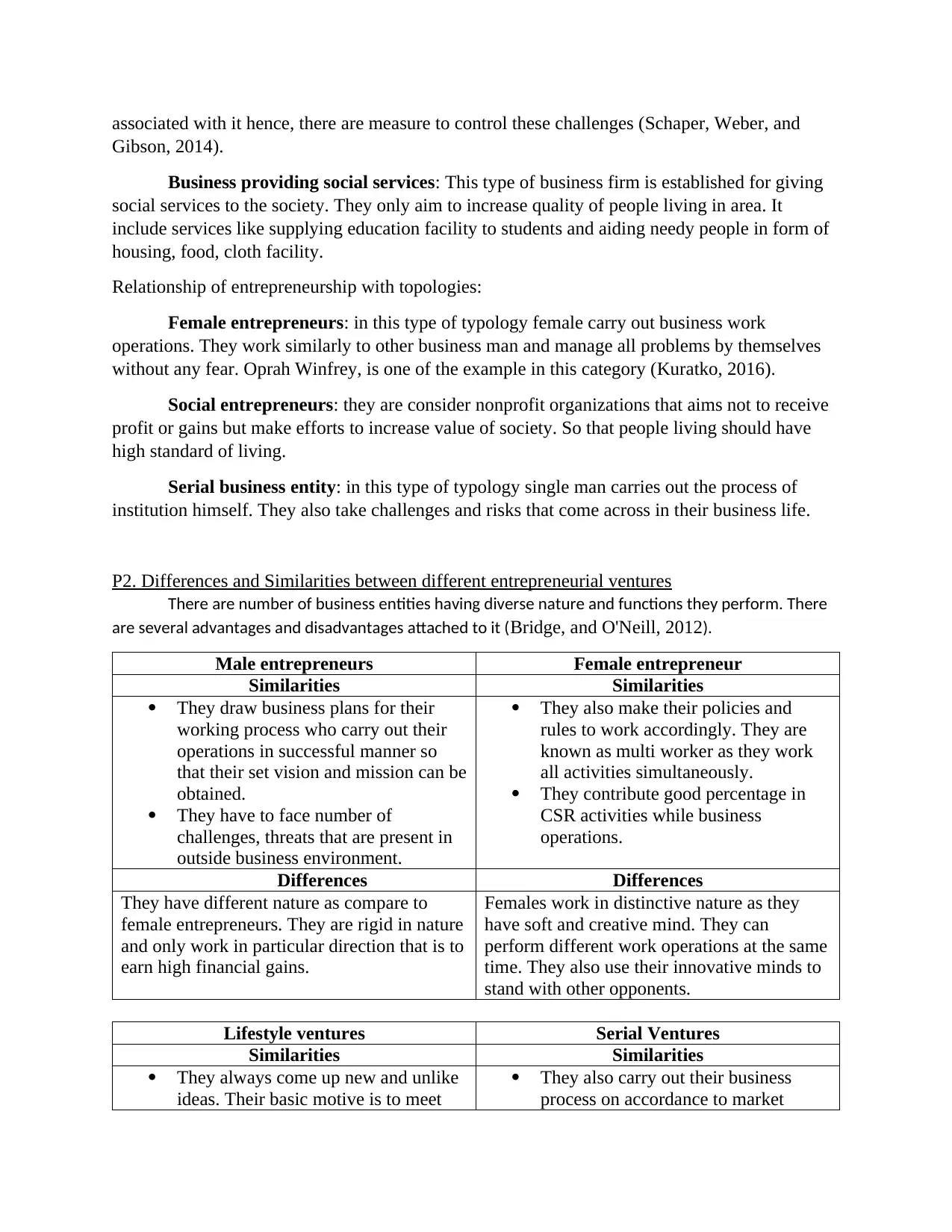
associated with it hence, there are measure to control these challenges (Schaper, Weber, and
Gibson, 2014).
Business providing social services: This type of business firm is established for giving
social services to the society. They only aim to increase quality of people living in area. It
include services like supplying education facility to students and aiding needy people in form of
housing, food, cloth facility.
Relationship of entrepreneurship with topologies:
Female entrepreneurs: in this type of typology female carry out business work
operations. They work similarly to other business man and manage all problems by themselves
without any fear. Oprah Winfrey, is one of the example in this category (Kuratko, 2016).
Social entrepreneurs: they are consider nonprofit organizations that aims not to receive
profit or gains but make efforts to increase value of society. So that people living should have
high standard of living.
Serial business entity: in this type of typology single man carries out the process of
institution himself. They also take challenges and risks that come across in their business life.
P2. Differences and Similarities between different entrepreneurial ventures
There are number of business entities having diverse nature and functions they perform. There
are several advantages and disadvantages attached to it (Bridge, and O'Neill, 2012).
Male entrepreneurs Female entrepreneur
Similarities Similarities
They draw business plans for their
working process who carry out their
operations in successful manner so
that their set vision and mission can be
obtained.
They have to face number of
challenges, threats that are present in
outside business environment.
They also make their policies and
rules to work accordingly. They are
known as multi worker as they work
all activities simultaneously.
They contribute good percentage in
CSR activities while business
operations.
Differences Differences
They have different nature as compare to
female entrepreneurs. They are rigid in nature
and only work in particular direction that is to
earn high financial gains.
Females work in distinctive nature as they
have soft and creative mind. They can
perform different work operations at the same
time. They also use their innovative minds to
stand with other opponents.
Lifestyle ventures Serial Ventures
Similarities Similarities
They always come up new and unlike
ideas. Their basic motive is to meet
They also carry out their business
process on accordance to market
Gibson, 2014).
Business providing social services: This type of business firm is established for giving
social services to the society. They only aim to increase quality of people living in area. It
include services like supplying education facility to students and aiding needy people in form of
housing, food, cloth facility.
Relationship of entrepreneurship with topologies:
Female entrepreneurs: in this type of typology female carry out business work
operations. They work similarly to other business man and manage all problems by themselves
without any fear. Oprah Winfrey, is one of the example in this category (Kuratko, 2016).
Social entrepreneurs: they are consider nonprofit organizations that aims not to receive
profit or gains but make efforts to increase value of society. So that people living should have
high standard of living.
Serial business entity: in this type of typology single man carries out the process of
institution himself. They also take challenges and risks that come across in their business life.
P2. Differences and Similarities between different entrepreneurial ventures
There are number of business entities having diverse nature and functions they perform. There
are several advantages and disadvantages attached to it (Bridge, and O'Neill, 2012).
Male entrepreneurs Female entrepreneur
Similarities Similarities
They draw business plans for their
working process who carry out their
operations in successful manner so
that their set vision and mission can be
obtained.
They have to face number of
challenges, threats that are present in
outside business environment.
They also make their policies and
rules to work accordingly. They are
known as multi worker as they work
all activities simultaneously.
They contribute good percentage in
CSR activities while business
operations.
Differences Differences
They have different nature as compare to
female entrepreneurs. They are rigid in nature
and only work in particular direction that is to
earn high financial gains.
Females work in distinctive nature as they
have soft and creative mind. They can
perform different work operations at the same
time. They also use their innovative minds to
stand with other opponents.
Lifestyle ventures Serial Ventures
Similarities Similarities
They always come up new and unlike
ideas. Their basic motive is to meet
They also carry out their business
process on accordance to market
Paraphrase This Document
Need a fresh take? Get an instant paraphrase of this document with our AI Paraphraser
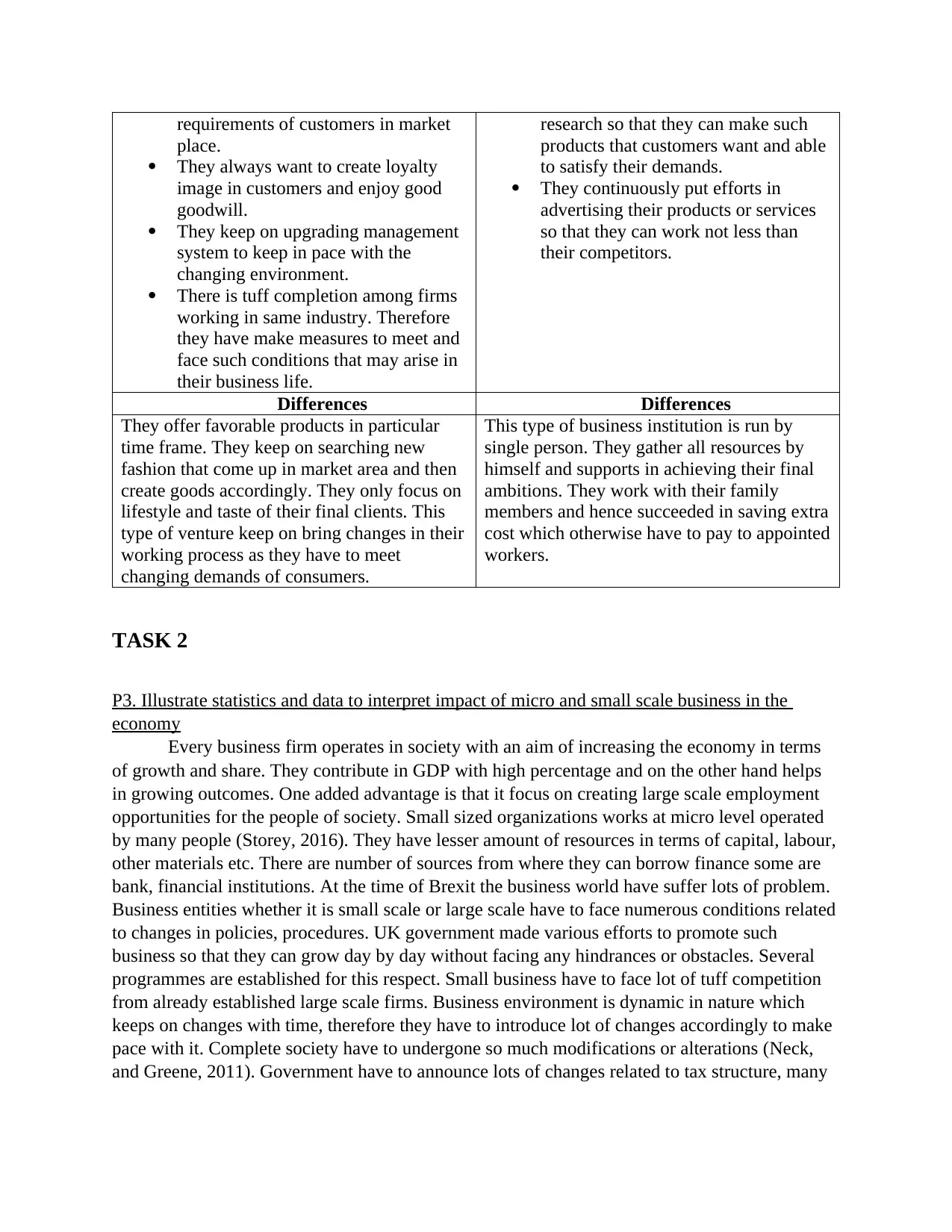
requirements of customers in market
place.
They always want to create loyalty
image in customers and enjoy good
goodwill.
They keep on upgrading management
system to keep in pace with the
changing environment.
There is tuff completion among firms
working in same industry. Therefore
they have make measures to meet and
face such conditions that may arise in
their business life.
research so that they can make such
products that customers want and able
to satisfy their demands.
They continuously put efforts in
advertising their products or services
so that they can work not less than
their competitors.
Differences Differences
They offer favorable products in particular
time frame. They keep on searching new
fashion that come up in market area and then
create goods accordingly. They only focus on
lifestyle and taste of their final clients. This
type of venture keep on bring changes in their
working process as they have to meet
changing demands of consumers.
This type of business institution is run by
single person. They gather all resources by
himself and supports in achieving their final
ambitions. They work with their family
members and hence succeeded in saving extra
cost which otherwise have to pay to appointed
workers.
TASK 2
P3. Illustrate statistics and data to interpret impact of micro and small scale business in the
economy
Every business firm operates in society with an aim of increasing the economy in terms
of growth and share. They contribute in GDP with high percentage and on the other hand helps
in growing outcomes. One added advantage is that it focus on creating large scale employment
opportunities for the people of society. Small sized organizations works at micro level operated
by many people (Storey, 2016). They have lesser amount of resources in terms of capital, labour,
other materials etc. There are number of sources from where they can borrow finance some are
bank, financial institutions. At the time of Brexit the business world have suffer lots of problem.
Business entities whether it is small scale or large scale have to face numerous conditions related
to changes in policies, procedures. UK government made various efforts to promote such
business so that they can grow day by day without facing any hindrances or obstacles. Several
programmes are established for this respect. Small business have to face lot of tuff competition
from already established large scale firms. Business environment is dynamic in nature which
keeps on changes with time, therefore they have to introduce lot of changes accordingly to make
pace with it. Complete society have to undergone so much modifications or alterations (Neck,
and Greene, 2011). Government have to announce lots of changes related to tax structure, many
place.
They always want to create loyalty
image in customers and enjoy good
goodwill.
They keep on upgrading management
system to keep in pace with the
changing environment.
There is tuff completion among firms
working in same industry. Therefore
they have make measures to meet and
face such conditions that may arise in
their business life.
research so that they can make such
products that customers want and able
to satisfy their demands.
They continuously put efforts in
advertising their products or services
so that they can work not less than
their competitors.
Differences Differences
They offer favorable products in particular
time frame. They keep on searching new
fashion that come up in market area and then
create goods accordingly. They only focus on
lifestyle and taste of their final clients. This
type of venture keep on bring changes in their
working process as they have to meet
changing demands of consumers.
This type of business institution is run by
single person. They gather all resources by
himself and supports in achieving their final
ambitions. They work with their family
members and hence succeeded in saving extra
cost which otherwise have to pay to appointed
workers.
TASK 2
P3. Illustrate statistics and data to interpret impact of micro and small scale business in the
economy
Every business firm operates in society with an aim of increasing the economy in terms
of growth and share. They contribute in GDP with high percentage and on the other hand helps
in growing outcomes. One added advantage is that it focus on creating large scale employment
opportunities for the people of society. Small sized organizations works at micro level operated
by many people (Storey, 2016). They have lesser amount of resources in terms of capital, labour,
other materials etc. There are number of sources from where they can borrow finance some are
bank, financial institutions. At the time of Brexit the business world have suffer lots of problem.
Business entities whether it is small scale or large scale have to face numerous conditions related
to changes in policies, procedures. UK government made various efforts to promote such
business so that they can grow day by day without facing any hindrances or obstacles. Several
programmes are established for this respect. Small business have to face lot of tuff competition
from already established large scale firms. Business environment is dynamic in nature which
keeps on changes with time, therefore they have to introduce lot of changes accordingly to make
pace with it. Complete society have to undergone so much modifications or alterations (Neck,
and Greene, 2011). Government have to announce lots of changes related to tax structure, many
legal actions. There are several constituents that impact small scale business some are illustrated
below:
Economy is modified: As small scale business work to add value to the respective
economy where they are working. For instance they have certain contribution in overall national
income of country. There are several elements attached to it like export- import rules, custom
and excise duties etc (Jennings, and Brush, 2013).
Local society changes: It involve constructing structures in correct and smooth manner
so that it does not cause any harmful effects to local society. It assists in increasing the living
standard of local people by giving them employment opportunities to them which give them
work to earn their livelihood.
Changes in nation: small scale business firm aids in upliftment of the area in where they
are carrying out their operations or process. They produce products and services for the people
living there to fulfill customer’s unlimited wants and needs. Hence, directly or indirectly they
have become indispensable element for society or nation where they are working.
P4. Importance of small businesses and startups in society growth after Brexit
To enable the growth of small scale enterprises, UK government provided full support to the
business entities. There are number of problems which were faced by newly established firms
during Brexit. Business persons were very confused to take decision whether to expand their
business or not. They had to think twice before taking any decision due to continuous changes in
their plans and decisions (Kiss, Danis, and Cavusgil, 2012). To handle such situation, the
Government of UK had laid down some rules to help the entrepreneurs in growth of their
business. Small business set-ups play a vital role in the development of an economy. It helps in
enhancing the standard of living of people and the quality of society. For a developing economy,
startups are generally considered as an important part of it due to their rate of growth and success
in the future. Therefore, government too, provide their full support to them in rising to a
significant level. Hassel-free arrangement of required resources had been made for the all-round-
development of the business. Some of the measures taken by the government in economic
growth are discussed below:
Issuance of number of plan of actions and steps in order to develop small businesses so
that they work to best of their abilities and add value to nation.
Creating more and more job opportunities by developing small and medium scale
enterprises.
Promoting healthy competition in the market by establishing new small businesses. It also helps
in building healthy and supportive environment in various areas. Business firms had to be more
instinctive in order to grab opportunities from the dynamic business environment (Gedajlovic,
2013).
Making a clean and pollution free environment and to provide a healthy atmosphere for
the coming future generation
below:
Economy is modified: As small scale business work to add value to the respective
economy where they are working. For instance they have certain contribution in overall national
income of country. There are several elements attached to it like export- import rules, custom
and excise duties etc (Jennings, and Brush, 2013).
Local society changes: It involve constructing structures in correct and smooth manner
so that it does not cause any harmful effects to local society. It assists in increasing the living
standard of local people by giving them employment opportunities to them which give them
work to earn their livelihood.
Changes in nation: small scale business firm aids in upliftment of the area in where they
are carrying out their operations or process. They produce products and services for the people
living there to fulfill customer’s unlimited wants and needs. Hence, directly or indirectly they
have become indispensable element for society or nation where they are working.
P4. Importance of small businesses and startups in society growth after Brexit
To enable the growth of small scale enterprises, UK government provided full support to the
business entities. There are number of problems which were faced by newly established firms
during Brexit. Business persons were very confused to take decision whether to expand their
business or not. They had to think twice before taking any decision due to continuous changes in
their plans and decisions (Kiss, Danis, and Cavusgil, 2012). To handle such situation, the
Government of UK had laid down some rules to help the entrepreneurs in growth of their
business. Small business set-ups play a vital role in the development of an economy. It helps in
enhancing the standard of living of people and the quality of society. For a developing economy,
startups are generally considered as an important part of it due to their rate of growth and success
in the future. Therefore, government too, provide their full support to them in rising to a
significant level. Hassel-free arrangement of required resources had been made for the all-round-
development of the business. Some of the measures taken by the government in economic
growth are discussed below:
Issuance of number of plan of actions and steps in order to develop small businesses so
that they work to best of their abilities and add value to nation.
Creating more and more job opportunities by developing small and medium scale
enterprises.
Promoting healthy competition in the market by establishing new small businesses. It also helps
in building healthy and supportive environment in various areas. Business firms had to be more
instinctive in order to grab opportunities from the dynamic business environment (Gedajlovic,
2013).
Making a clean and pollution free environment and to provide a healthy atmosphere for
the coming future generation
⊘ This is a preview!⊘
Do you want full access?
Subscribe today to unlock all pages.
Trusted by 1+ million students worldwide
Many cross-country institutions also helped the SME’s. These institutions help SMEs
innovate by providing and funding a number of technical services such as access to the
latest equipment and laboratories that SMEs could not otherwise afford as well as
technical advice, analysis and testing services to ensure product quality and compliance
with international standards, workforce training required for the introduction of new
technologies and guidance to access innovation funds.
Government started giving public contracts to specialized small scale enterprises in order to
encourage small business persons (Clarysse, Tartari, and Salter, 2011).
Government also supported women entrepreneurs in order to bring equality in the
business economy. They want to make a nation of equality by eliminating inequality from
the society. Male and female entrepreneurs are free to exchange their business ideas.
Utilization of business resources in the most efficient manner because resources are
scarce. Government took necessary steps to ensure that these scarce resources are used in
a wise manner so that it leads to fulfilment of their set targets or outcomes.
TASK 3
P5. Mini Research to determine characteristics, traits and skills of entrepreneurs
In order to be a successful entrepreneur, a person must possess certain skills and qualities of a
successful entrepreneur. People who lack such characteristics cannot become successful in their
life. Everybody has to face number of difficulties and problems in business life and it is not an
easy task. As every coin has two faces, similarly business too has two aspects. One who is a
successful business man is operating at a bigger level and one who is not successful has to close
their business. There are no other options (Hall, 2012). Therefore it is of the utmost importance
to possess specific skills and qualities to be a successful entrepreneur and everyone cannot
possess such characteristics in them. Certain learning skills and learning abilities are required to
develop such qualities. Few examples of successful leaders are given below who started from
bottom and now they are at the top of the world:
Bill gates: Bill Gates is the richest person of the world. He is among one of those persons
who brought technological transformation in the world. He is the co-founder of Microsoft
Company, which is one of the biggest software companies across the world. Microsoft’s turnover
is higher than some of the economies of the world. Bill Gates himself had started from the
bottom and now he is the richest person of the world. He is a perfect example of a successful
entrepreneur.
Steve Jobs: Steve Jobs was the man who owned the company “Apple Inc.”. He is the co-
founder of the company. In his early days of life, he was dropped out from the college. He
struggled so much because he belongs to a normal family. But he worked very hard and
established his name across the world. His company Apple is the biggest brand of mobile phones
in the business world. Steve Jobs possess such qualities and skill which made him one of the
most successful entrepreneurs of the world (Bruton, Ketchen and Ireland, 2013).
innovate by providing and funding a number of technical services such as access to the
latest equipment and laboratories that SMEs could not otherwise afford as well as
technical advice, analysis and testing services to ensure product quality and compliance
with international standards, workforce training required for the introduction of new
technologies and guidance to access innovation funds.
Government started giving public contracts to specialized small scale enterprises in order to
encourage small business persons (Clarysse, Tartari, and Salter, 2011).
Government also supported women entrepreneurs in order to bring equality in the
business economy. They want to make a nation of equality by eliminating inequality from
the society. Male and female entrepreneurs are free to exchange their business ideas.
Utilization of business resources in the most efficient manner because resources are
scarce. Government took necessary steps to ensure that these scarce resources are used in
a wise manner so that it leads to fulfilment of their set targets or outcomes.
TASK 3
P5. Mini Research to determine characteristics, traits and skills of entrepreneurs
In order to be a successful entrepreneur, a person must possess certain skills and qualities of a
successful entrepreneur. People who lack such characteristics cannot become successful in their
life. Everybody has to face number of difficulties and problems in business life and it is not an
easy task. As every coin has two faces, similarly business too has two aspects. One who is a
successful business man is operating at a bigger level and one who is not successful has to close
their business. There are no other options (Hall, 2012). Therefore it is of the utmost importance
to possess specific skills and qualities to be a successful entrepreneur and everyone cannot
possess such characteristics in them. Certain learning skills and learning abilities are required to
develop such qualities. Few examples of successful leaders are given below who started from
bottom and now they are at the top of the world:
Bill gates: Bill Gates is the richest person of the world. He is among one of those persons
who brought technological transformation in the world. He is the co-founder of Microsoft
Company, which is one of the biggest software companies across the world. Microsoft’s turnover
is higher than some of the economies of the world. Bill Gates himself had started from the
bottom and now he is the richest person of the world. He is a perfect example of a successful
entrepreneur.
Steve Jobs: Steve Jobs was the man who owned the company “Apple Inc.”. He is the co-
founder of the company. In his early days of life, he was dropped out from the college. He
struggled so much because he belongs to a normal family. But he worked very hard and
established his name across the world. His company Apple is the biggest brand of mobile phones
in the business world. Steve Jobs possess such qualities and skill which made him one of the
most successful entrepreneurs of the world (Bruton, Ketchen and Ireland, 2013).
Paraphrase This Document
Need a fresh take? Get an instant paraphrase of this document with our AI Paraphraser
What above examples state that no one is born successful? Everybody have to work hard to reach
that height. Everybody have to develop themselves to succeed in life. Some characteristics of a
successful businessman are discussed below:
Innovator: Innovativeness is the prime characteristic of every business entrepreneur. If
he is not innovative in his ideas, he could not be able to stand apart from his competitors and
customers always want some innovation in their product. So it becomes very necessary for an
entrepreneur to be innovative (Nambisan, and Baron, 2013).
Hard working: If a person is a hard worker, one day he will become successful because
hard work always pays. A businessman should be a hard-worker otherwise he will be going to
fail in near future. Business brings so many challenges with itself but hard work done with pure
dedication always helps to attain the final objective and goal successfully. Therefore, this maker
because of dynamic nature of business environment. Business Decisions must be flexible enough
to change with characteristic should be possessed by every individual.
Adopting Risks: “Higher the risk factor, Higher will be the profits” is a very common
saying in business. An entrepreneur must be a healthy risk-taker in order to grow. Risk can be
reduced but it cannot be eliminated from the business as it is the part and parcel of the business.
Flexible decision making: Business Entrepreneur must be a flexible decision- the
change in environment (Marlow, S. and McAdam, M., 2013).
P6. Aspects of entrepreneurial personality that reflect entrepreneurial motivation and mindset
Every individual has a distinct ability that is different from other individual. There are
different personalities that affect minds of other and motivate them to perform efficiently. Some
of those qualities are discussed below which an entrepreneur must possess:
Out Spoken: To share the thoughts and ideas with other people, business person need to
be outspoken. If he can speak out the thoughts than only he can influence the other person and
can grab the available opportunities in the market. It will help him to increase his sales volume as
well as the profit percentage of the business. In a nutshell, we can say that the communication
system between the entrepreneur and the customer needs to be very effective so that each and
every issue must be communicated to the customer in the best possible manner (Desa, 2012).
Focused: The prime focus of every business is to achieve the final goal and objectives.
So the business man needs to be focused in order to achieve this goal. He must have that
capability which encourages other personnel also to establish good relations with him. So,
business man must follow proper direction and path which helps him to remain focused on his
work and achieve the ultimate objective in the most efficient way.
Experience holder: Without experience, skill is of less importance. Experience helps in
applying the skill in the most productive manner. It makes them proficient in their work and
contributes in their abilities. Also, there are many internal and external factors of business which
are to be handled by a businessman with lots of experience. So experience counts so much when
it comes to handle a business.
Influential: Entrepreneur must be an influential personality who impacts the behavior of
customers and other business associates. It is the duty of entrepreneur to influence behavior of
customer and other people (Falck, Heblich, and Luedemann, 2012).
that height. Everybody have to develop themselves to succeed in life. Some characteristics of a
successful businessman are discussed below:
Innovator: Innovativeness is the prime characteristic of every business entrepreneur. If
he is not innovative in his ideas, he could not be able to stand apart from his competitors and
customers always want some innovation in their product. So it becomes very necessary for an
entrepreneur to be innovative (Nambisan, and Baron, 2013).
Hard working: If a person is a hard worker, one day he will become successful because
hard work always pays. A businessman should be a hard-worker otherwise he will be going to
fail in near future. Business brings so many challenges with itself but hard work done with pure
dedication always helps to attain the final objective and goal successfully. Therefore, this maker
because of dynamic nature of business environment. Business Decisions must be flexible enough
to change with characteristic should be possessed by every individual.
Adopting Risks: “Higher the risk factor, Higher will be the profits” is a very common
saying in business. An entrepreneur must be a healthy risk-taker in order to grow. Risk can be
reduced but it cannot be eliminated from the business as it is the part and parcel of the business.
Flexible decision making: Business Entrepreneur must be a flexible decision- the
change in environment (Marlow, S. and McAdam, M., 2013).
P6. Aspects of entrepreneurial personality that reflect entrepreneurial motivation and mindset
Every individual has a distinct ability that is different from other individual. There are
different personalities that affect minds of other and motivate them to perform efficiently. Some
of those qualities are discussed below which an entrepreneur must possess:
Out Spoken: To share the thoughts and ideas with other people, business person need to
be outspoken. If he can speak out the thoughts than only he can influence the other person and
can grab the available opportunities in the market. It will help him to increase his sales volume as
well as the profit percentage of the business. In a nutshell, we can say that the communication
system between the entrepreneur and the customer needs to be very effective so that each and
every issue must be communicated to the customer in the best possible manner (Desa, 2012).
Focused: The prime focus of every business is to achieve the final goal and objectives.
So the business man needs to be focused in order to achieve this goal. He must have that
capability which encourages other personnel also to establish good relations with him. So,
business man must follow proper direction and path which helps him to remain focused on his
work and achieve the ultimate objective in the most efficient way.
Experience holder: Without experience, skill is of less importance. Experience helps in
applying the skill in the most productive manner. It makes them proficient in their work and
contributes in their abilities. Also, there are many internal and external factors of business which
are to be handled by a businessman with lots of experience. So experience counts so much when
it comes to handle a business.
Influential: Entrepreneur must be an influential personality who impacts the behavior of
customers and other business associates. It is the duty of entrepreneur to influence behavior of
customer and other people (Falck, Heblich, and Luedemann, 2012).
Agreeableness: Entrepreneur must be a good-natured, cooperative and trustful person.
On the other hand, he must be a self-centered and hard bargain person. He has to switch his
personality as per the requirement of the situation.
Openness to experience: It describes a person who is characterized by seeking new
experience, exploring ideas, being creative and innovative. Business entrepreneur must be
intellectual, imaginative, independent and open-minded.
Extraversion or Surgency: It is related to aspects such as being energetic, sociable and
seeking a leadership role. Entrepreneur must possess the ability to develop social networks. He
must be talkative, assertive and energetic to attract customers.
Conscientiousness: Conscientiousness means a person who is achievement oriented,
efficient and dutiful. Businessman must possess this quality in order to be orderly, responsible
and dependable.
Emotionally Stable: Entrepreneur must have enough self-confidence, tolerance level and
being positive. If he has these qualities, he can face the worst situation of the business very
positively.
TASK 4
P7. Background and Experience that hinder or foster entrepreneurship
There are number of hindrances or problems which are faced by a new establishment in the initial stage
of the business. It is mandatory for an entrepreneur to act smartly at the starting stage of a new
venture. All the hindrances must be underlined properly so that proper attention can be given to these
problems. He must take proper steps to avoid these problems so that the ultimate objective of the
business can be achieved. There are number of obstacles that are faced by businessman to carry
out their operations successfully (Datta, and Gailey, 2012).
The other concept is learning process which include entrepreneurs learning from their
past experience. They become aware of several things which will helps them to carry out
operations effectively. Hence, these aids in fostering the entrepreneurial activities.
CONCLUSION
It is concluded form the presented report that entrepreneurship in a creative action
performed by entrepreneur. They contain various characteristics in order to carry out operations
and transactions in operative and effectual way. Their basic aim is earn huge gains and
productivity to remain in competitive market area. This report also underline several types of
entrepreneur operating together. On the other hand condition of brexit is also highlighted where
small scale firms have to face number of challenges. UK government have numerous efforts to
increase their condition by rendering them financial aids. There are some aspects which
determine personality of entrepreneurs which contribute successfully in achieving their final and
set targets or vision. There are number of factors that affect the performance of running business
institution that include past experiences or learning that contribute in positive or negative phases.
There are several dimension that have to focus upon to be stable in competitive market.
On the other hand, he must be a self-centered and hard bargain person. He has to switch his
personality as per the requirement of the situation.
Openness to experience: It describes a person who is characterized by seeking new
experience, exploring ideas, being creative and innovative. Business entrepreneur must be
intellectual, imaginative, independent and open-minded.
Extraversion or Surgency: It is related to aspects such as being energetic, sociable and
seeking a leadership role. Entrepreneur must possess the ability to develop social networks. He
must be talkative, assertive and energetic to attract customers.
Conscientiousness: Conscientiousness means a person who is achievement oriented,
efficient and dutiful. Businessman must possess this quality in order to be orderly, responsible
and dependable.
Emotionally Stable: Entrepreneur must have enough self-confidence, tolerance level and
being positive. If he has these qualities, he can face the worst situation of the business very
positively.
TASK 4
P7. Background and Experience that hinder or foster entrepreneurship
There are number of hindrances or problems which are faced by a new establishment in the initial stage
of the business. It is mandatory for an entrepreneur to act smartly at the starting stage of a new
venture. All the hindrances must be underlined properly so that proper attention can be given to these
problems. He must take proper steps to avoid these problems so that the ultimate objective of the
business can be achieved. There are number of obstacles that are faced by businessman to carry
out their operations successfully (Datta, and Gailey, 2012).
The other concept is learning process which include entrepreneurs learning from their
past experience. They become aware of several things which will helps them to carry out
operations effectively. Hence, these aids in fostering the entrepreneurial activities.
CONCLUSION
It is concluded form the presented report that entrepreneurship in a creative action
performed by entrepreneur. They contain various characteristics in order to carry out operations
and transactions in operative and effectual way. Their basic aim is earn huge gains and
productivity to remain in competitive market area. This report also underline several types of
entrepreneur operating together. On the other hand condition of brexit is also highlighted where
small scale firms have to face number of challenges. UK government have numerous efforts to
increase their condition by rendering them financial aids. There are some aspects which
determine personality of entrepreneurs which contribute successfully in achieving their final and
set targets or vision. There are number of factors that affect the performance of running business
institution that include past experiences or learning that contribute in positive or negative phases.
There are several dimension that have to focus upon to be stable in competitive market.
⊘ This is a preview!⊘
Do you want full access?
Subscribe today to unlock all pages.
Trusted by 1+ million students worldwide
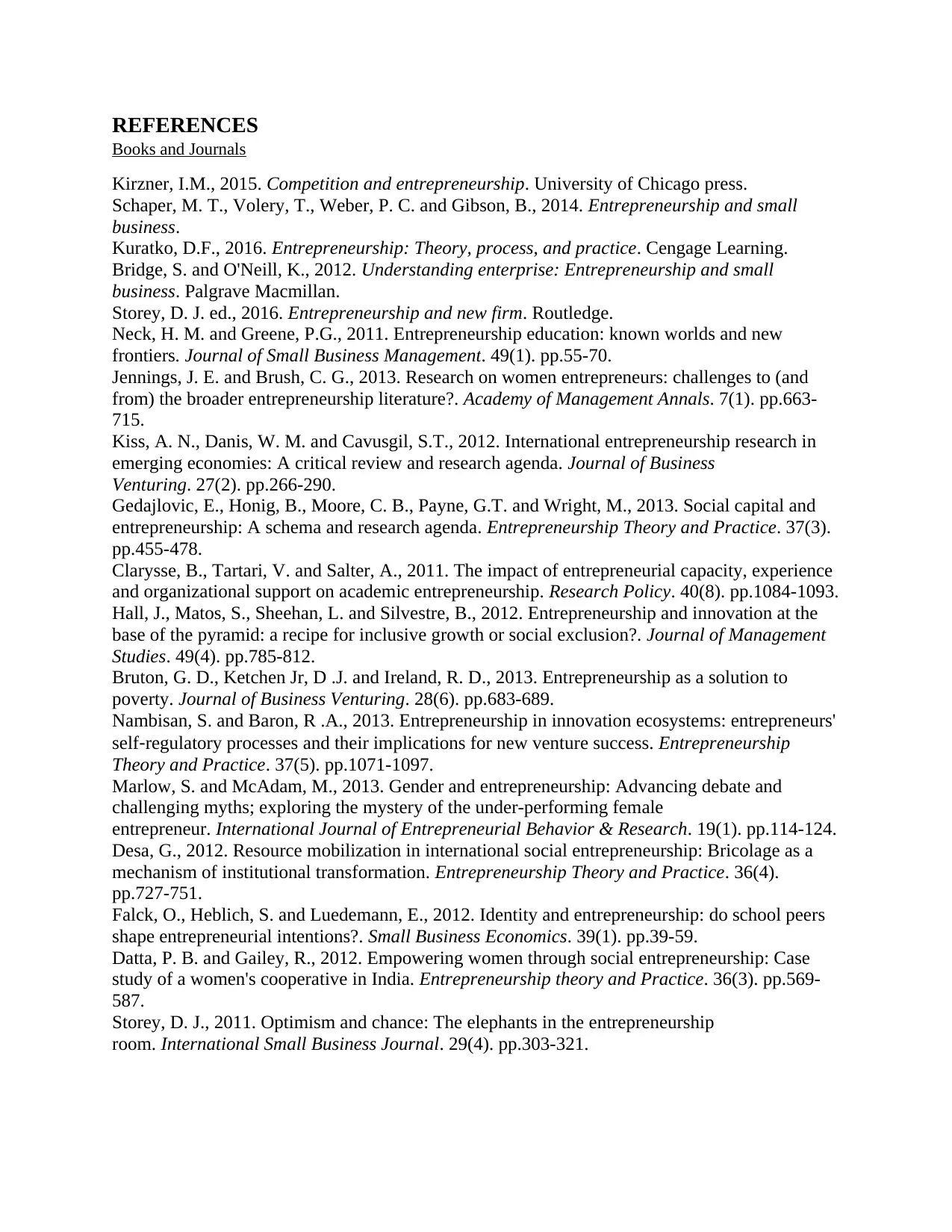
REFERENCES
Books and Journals
Kirzner, I.M., 2015. Competition and entrepreneurship. University of Chicago press.
Schaper, M. T., Volery, T., Weber, P. C. and Gibson, B., 2014. Entrepreneurship and small
business.
Kuratko, D.F., 2016. Entrepreneurship: Theory, process, and practice. Cengage Learning.
Bridge, S. and O'Neill, K., 2012. Understanding enterprise: Entrepreneurship and small
business. Palgrave Macmillan.
Storey, D. J. ed., 2016. Entrepreneurship and new firm. Routledge.
Neck, H. M. and Greene, P.G., 2011. Entrepreneurship education: known worlds and new
frontiers. Journal of Small Business Management. 49(1). pp.55-70.
Jennings, J. E. and Brush, C. G., 2013. Research on women entrepreneurs: challenges to (and
from) the broader entrepreneurship literature?. Academy of Management Annals. 7(1). pp.663-
715.
Kiss, A. N., Danis, W. M. and Cavusgil, S.T., 2012. International entrepreneurship research in
emerging economies: A critical review and research agenda. Journal of Business
Venturing. 27(2). pp.266-290.
Gedajlovic, E., Honig, B., Moore, C. B., Payne, G.T. and Wright, M., 2013. Social capital and
entrepreneurship: A schema and research agenda. Entrepreneurship Theory and Practice. 37(3).
pp.455-478.
Clarysse, B., Tartari, V. and Salter, A., 2011. The impact of entrepreneurial capacity, experience
and organizational support on academic entrepreneurship. Research Policy. 40(8). pp.1084-1093.
Hall, J., Matos, S., Sheehan, L. and Silvestre, B., 2012. Entrepreneurship and innovation at the
base of the pyramid: a recipe for inclusive growth or social exclusion?. Journal of Management
Studies. 49(4). pp.785-812.
Bruton, G. D., Ketchen Jr, D .J. and Ireland, R. D., 2013. Entrepreneurship as a solution to
poverty. Journal of Business Venturing. 28(6). pp.683-689.
Nambisan, S. and Baron, R .A., 2013. Entrepreneurship in innovation ecosystems: entrepreneurs'
self‐regulatory processes and their implications for new venture success. Entrepreneurship
Theory and Practice. 37(5). pp.1071-1097.
Marlow, S. and McAdam, M., 2013. Gender and entrepreneurship: Advancing debate and
challenging myths; exploring the mystery of the under-performing female
entrepreneur. International Journal of Entrepreneurial Behavior & Research. 19(1). pp.114-124.
Desa, G., 2012. Resource mobilization in international social entrepreneurship: Bricolage as a
mechanism of institutional transformation. Entrepreneurship Theory and Practice. 36(4).
pp.727-751.
Falck, O., Heblich, S. and Luedemann, E., 2012. Identity and entrepreneurship: do school peers
shape entrepreneurial intentions?. Small Business Economics. 39(1). pp.39-59.
Datta, P. B. and Gailey, R., 2012. Empowering women through social entrepreneurship: Case
study of a women's cooperative in India. Entrepreneurship theory and Practice. 36(3). pp.569-
587.
Storey, D. J., 2011. Optimism and chance: The elephants in the entrepreneurship
room. International Small Business Journal. 29(4). pp.303-321.
Books and Journals
Kirzner, I.M., 2015. Competition and entrepreneurship. University of Chicago press.
Schaper, M. T., Volery, T., Weber, P. C. and Gibson, B., 2014. Entrepreneurship and small
business.
Kuratko, D.F., 2016. Entrepreneurship: Theory, process, and practice. Cengage Learning.
Bridge, S. and O'Neill, K., 2012. Understanding enterprise: Entrepreneurship and small
business. Palgrave Macmillan.
Storey, D. J. ed., 2016. Entrepreneurship and new firm. Routledge.
Neck, H. M. and Greene, P.G., 2011. Entrepreneurship education: known worlds and new
frontiers. Journal of Small Business Management. 49(1). pp.55-70.
Jennings, J. E. and Brush, C. G., 2013. Research on women entrepreneurs: challenges to (and
from) the broader entrepreneurship literature?. Academy of Management Annals. 7(1). pp.663-
715.
Kiss, A. N., Danis, W. M. and Cavusgil, S.T., 2012. International entrepreneurship research in
emerging economies: A critical review and research agenda. Journal of Business
Venturing. 27(2). pp.266-290.
Gedajlovic, E., Honig, B., Moore, C. B., Payne, G.T. and Wright, M., 2013. Social capital and
entrepreneurship: A schema and research agenda. Entrepreneurship Theory and Practice. 37(3).
pp.455-478.
Clarysse, B., Tartari, V. and Salter, A., 2011. The impact of entrepreneurial capacity, experience
and organizational support on academic entrepreneurship. Research Policy. 40(8). pp.1084-1093.
Hall, J., Matos, S., Sheehan, L. and Silvestre, B., 2012. Entrepreneurship and innovation at the
base of the pyramid: a recipe for inclusive growth or social exclusion?. Journal of Management
Studies. 49(4). pp.785-812.
Bruton, G. D., Ketchen Jr, D .J. and Ireland, R. D., 2013. Entrepreneurship as a solution to
poverty. Journal of Business Venturing. 28(6). pp.683-689.
Nambisan, S. and Baron, R .A., 2013. Entrepreneurship in innovation ecosystems: entrepreneurs'
self‐regulatory processes and their implications for new venture success. Entrepreneurship
Theory and Practice. 37(5). pp.1071-1097.
Marlow, S. and McAdam, M., 2013. Gender and entrepreneurship: Advancing debate and
challenging myths; exploring the mystery of the under-performing female
entrepreneur. International Journal of Entrepreneurial Behavior & Research. 19(1). pp.114-124.
Desa, G., 2012. Resource mobilization in international social entrepreneurship: Bricolage as a
mechanism of institutional transformation. Entrepreneurship Theory and Practice. 36(4).
pp.727-751.
Falck, O., Heblich, S. and Luedemann, E., 2012. Identity and entrepreneurship: do school peers
shape entrepreneurial intentions?. Small Business Economics. 39(1). pp.39-59.
Datta, P. B. and Gailey, R., 2012. Empowering women through social entrepreneurship: Case
study of a women's cooperative in India. Entrepreneurship theory and Practice. 36(3). pp.569-
587.
Storey, D. J., 2011. Optimism and chance: The elephants in the entrepreneurship
room. International Small Business Journal. 29(4). pp.303-321.
Paraphrase This Document
Need a fresh take? Get an instant paraphrase of this document with our AI Paraphraser


1 out of 11


Related Documents


Your All-in-One AI-Powered Toolkit for Academic Success.
+13062052269
info@desklib.com
Available 24*7 on WhatsApp / Email
![[object Object]](/_next/static/media/star-bottom.7253800d.svg)
Unlock your academic potential
Copyright © 2020–2025 A2Z Services. All Rights Reserved. Developed and managed by ZUCOL.