Entrepreneurship Report: Venture Types, SME Impact, and Entrepreneurs

Verified

Added on  2020/07/23

|18
|3418
|44
Report
AI Summary
This report delves into the multifaceted world of entrepreneurship, exploring various venture types and their relationship to entrepreneurial typologies. It examines the similarities and differences between entrepreneurial ventures, with a particular focus on the impact of micro and small businesses on the economy and society. The report highlights the significant contributions of SMEs to both economic growth and societal well-being, discussing factors that foster entrepreneurship. Furthermore, it analyzes the characteristics, traits, and skills of successful entrepreneurs like Bill Gates and Mark Zuckerberg, shedding light on their entrepreneurial personalities, motivations, and the role of experience in shaping their ventures. The report also includes an executive summary and recommendations, concluding with a comprehensive list of references.

Document Page
Entrepreneurship
tabler-icon-diamond-filled.svg

Paraphrase This Document

Need a fresh take? Get an instant paraphrase of this document with our AI Paraphraser
Document Page
Table of Contents
INTRODUCTION...........................................................................................................................1
TASK 1............................................................................................................................................2
P1. Different types of entrepreneurial ventures and the way they relate to entrepreneurship
typologies....................................................................................................................................2
P2 Similarities and Differences between Entrepreneurial Ventures...........................................4
TASK 2............................................................................................................................................7
P3 Impact of micro and small businesses on the economy.........................................................7
P4 Importance of contribution by SME towards the society and Economy...............................9
REFERENCES .............................................................................................................................10
P5 Determining the characteristics, traits and skills of two successful entrepreneurs..............12
P6 Entrepreneurial personality striking their state of mind and motivation.............................13
TASK 3..........................................................................................................................................14
P7 Experience and background can surrogate and obstruct entrepreneurship..........................14
CONCLUSION ............................................................................................................................14
REFERENCES..............................................................................................................................15
Document Page
INTRODUCTION
In the modern era, when an individual or group of people has the will and capability to
start a new venture or a business as well as share out the risks and profits attached with is said to
be entrepreneurship. The basic example of entrepreneurship is starting up a new business
process. From the point of view of economics, entrepreneurship contains many elements like
resources, land and manpower which help in running operations (Drucker, 2014). There is a
saying that “More the Risk, More will be the Profit” especially when it comes to start up a
business with a fresh concept. This report contains the important elements like range of venture
types which may be considered as entrepreneurial. Moreover, the impacts of small business on
social and economic factors will be briefed. Apart from that, various environmental factors will
be described which will foster the entrepreneurship so that advantages can be taken in an
effective manner.
TASK 1
P1. Different types of entrepreneurial ventures and the way they relate to entrepreneurship
typologies
Document Page
tabler-icon-diamond-filled.svg

Paraphrase This Document

Need a fresh take? Get an instant paraphrase of this document with our AI Paraphraser
Document Page
Document Page
P2 Similarities and Differences between Entrepreneurial Ventures
Document Page
tabler-icon-diamond-filled.svg

Paraphrase This Document

Need a fresh take? Get an instant paraphrase of this document with our AI Paraphraser
Document Page
Document Page
TASK 2
Executive Summary
Entrepreneurship can be defined as business which is started with a motive and new
concept in order to achieve the goals and objectives which has been forecasted for the
development of personnel and economy. There are various purpose on which the new business
are being started like for survival, growth, going global and economical development. In this, it
has been discussed about the impacts of the small business enterprise on the economical and
social development.
P3 Impact of micro and small businesses on the economy
From the aspect of development of country, small business enterprise plays a major role
as they contain the large market share and are the major concern for the Govt. of UK.
Environment of small business enterprise affects the elements of country in both positive and
negative manner and some important elements are GDP rate, export Import rate, unemployment
and many others. On the economy of UK Govt. there has been various impacts of small
business like in 2016, there were about 6.5 million business which was running on the small
scale. There are about 94% business which are running on small scale and has been contributing
in economy and employability. In year 2000 there were about 3.5 million small scale business
which are just half of the 7 million business which are currently running in year 2017. In order
to define a small scale business there is no particular index or any definition but there are some
condition which needs to be fulfilled in order to get the appropriate indexation of the business
process. Things are much more complex and to resolve that basic need of determination are
described below: Micro Business: In order to get security through finance, micro business is being
established and it is being operated on very small scale. It mainly consist of 10-12
employees who work on common goal and objectives. Turnover of micro business is
approx $2 million. They mainly focus on generating revenue and gaining growth and
success. This kind of business is mainly owned and run by single body and that can be
sated as sole proprietorship as it does not require high funding and the required one can
be arranged from personal savings or granting loan from bank. Micro business generally
consist of shops, carpenters, garages, cafe and many others.
Document Page
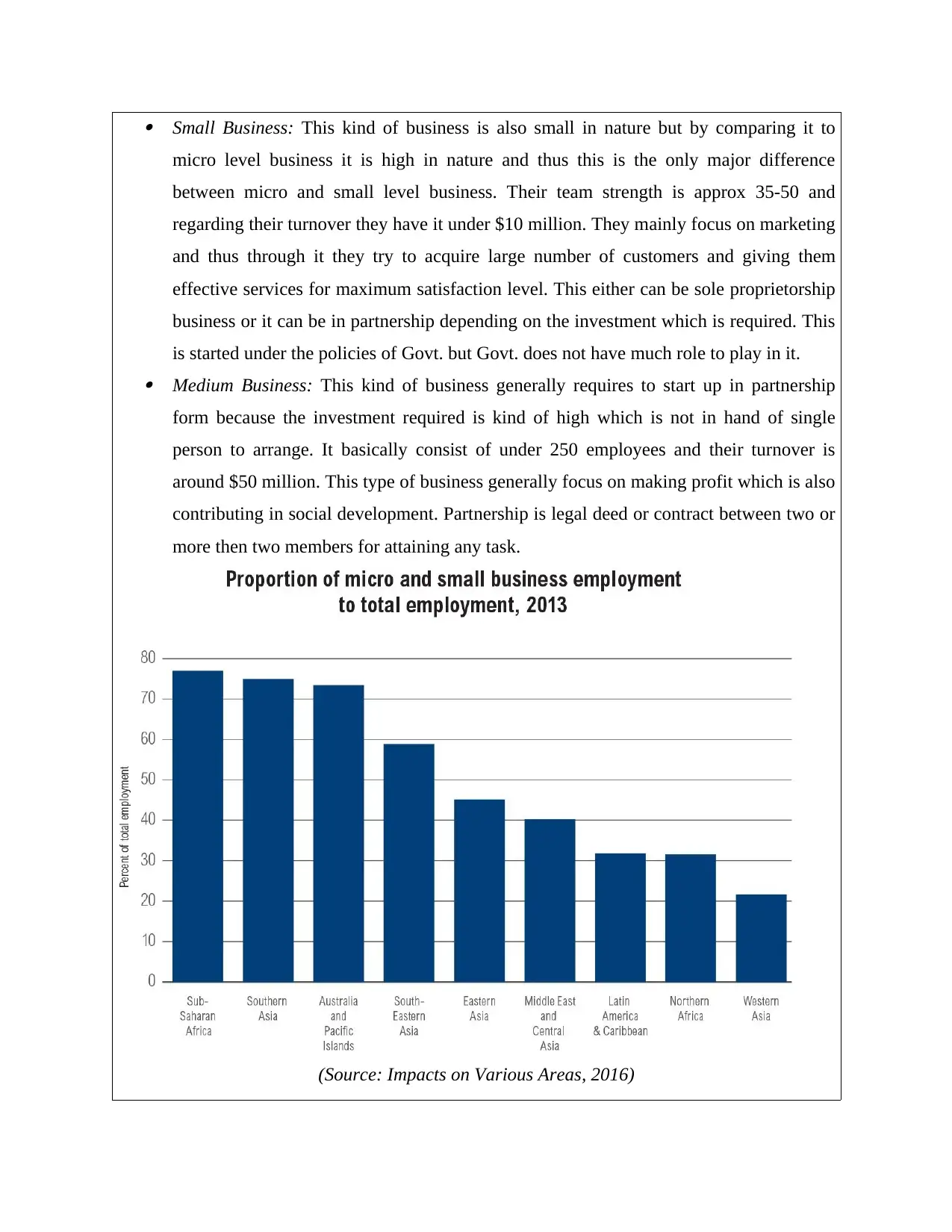
Small Business: This kind of business is also small in nature but by comparing it to
micro level business it is high in nature and thus this is the only major difference
between micro and small level business. Their team strength is approx 35-50 and
regarding their turnover they have it under $10 million. They mainly focus on marketing
and thus through it they try to acquire large number of customers and giving them
effective services for maximum satisfaction level. This either can be sole proprietorship
business or it can be in partnership depending on the investment which is required. This
is started under the policies of Govt. but Govt. does not have much role to play in it. Medium Business: This kind of business generally requires to start up in partnership
form because the investment required is kind of high which is not in hand of single
person to arrange. It basically consist of under 250 employees and their turnover is
around $50 million. This type of business generally focus on making profit which is also
contributing in social development. Partnership is legal deed or contract between two or
more then two members for attaining any task.
(Source: Impacts on Various Areas, 2016)
tabler-icon-diamond-filled.svg

Paraphrase This Document

Need a fresh take? Get an instant paraphrase of this document with our AI Paraphraser
Document Page
There are certain tasks and activities of the economy which will affect the SME'S: Employment: SME majorly contains the 90% of the business activities which takes place
in market place so that it can provide jobs to non Govt. workers employment. This in
turn provide a platform of opportunities for the unemployed people and thus reduce the
rate of unemployment and develops the society.
Foreign Direct Investment: It is kind of investment made by the company in to another
country with the purpose so starting a new business with a new concept and contributing
towards the economy of the country.
P4 Importance of contribution by SME towards the society and Economy
Brexit is all about United kingdom withdrawal from the European Union. On 23rd June
2016, about 52% of the participating UK electorate voted for UK to leave. The Govt. of British
enforced article 50 of the Treaty on the European Union on 29th March, 2017 so this made UK
to leave European Union on 29th March, 2019 . Below is the shown importance of small
business to the economics and they are:
Contributions: Small business can be define as a business which have 50 staff
members of less than that. As per As per the U. S small business Administration
99.7% of all employer firms are being engaged. Since 1995, 64% of jobs are being
introduced. So this can be said as major contribution of small business towards the
economical development.
Economic Growth: Small business brings growth and success and that is their major
contribution towards the society and economy of the country. Moreover it helps in
providing employability to the people who do not have much skills and knowledge
about the education. Small business attracts the candidate who have high skills and
knowledge and can bring the innovation in products. Business who are working on
large scale often outsource their work because it becomes difficult to manage all the
operations so the small business can manage their outsourced work.
Adaptability to Changing Climates: Market and economical situation changes with
time and taste of the people and in case of small business enterprise it becomes easy
to adopt the changes and capture the nature of being flexible. There is an advantage
for the small business that there are certain customers who remain loyal to the small
business products and services even in the middle of crisis and this loyalty can state
Document Page
that small business are often able to survive during crisis which can further strong the
economy of an country and moreover their investment is low so they have lower loss
to bear.
Schools and Local Government Offices: when a small-business is growing and
achieving success, their money eventually comes to them and thus it can be applied to
the welfare of the society. The more will be growth of small business more will be the
taxation which will be paid by the company and that in turn will generate revenue for
the economy and will rise the standard of people.
Future Growth: Small business do not stay small for ever. Even the big business once
were small scale like Nike, Google, Microsoft and many others. One of the most
effective example can be of Microsoft which was started under small roof but nobody
thought that it would change the world completely and now it is the leading company
in whole world and also it is giving huge contribution in the economy of whole world.
Recommendations
From the above article it has been concluded that small business are the most essential part
of the economy. Their growth and success affects the local economy in positive manner, so0 it
would be suggested that small business should adopt effective tools and techniques so that their
growth and success can develop the economy and also provide employment to the unemployed
person.
REFERENCES
Books and Journal
Rasmussen, E., 2011. Understanding academic entrepreneurship: Exploring the emergence of
university spin-off ventures using process theories. International Small Business
Journal. 29(5). pp.448-471.
Slavec, A. and Drnovsek, M., 2012. A perspective on scale development in entrepreneurship
research. Economic and Business Review for Central and South-Eastern Europe.
14(1). p.39.
Stewart, A. and Cotton, J., 2013. Making sense of entrepreneurship journals: Journal rankings
and policy choices. International Journal of Entrepreneurial Behavior & Research.
19(3). pp.303-323.
Vanevenhoven, J. and Liguori, E., 2013. The impact of entrepreneurship education: Introducing
the entrepreneurship education project. Journal of small business management. 51(3).
pp.315-328.
chevron_up_icon
1 out of 18
circle_padding
hide_on_mobile
zoom_out_icon
[object Object]