CSG Ltd: Analyzing Leadership and HRM Challenges and Solutions Report
VerifiedAdded on 2023/01/16
|12
|3529
|41
Report
AI Summary
This report focuses on addressing the challenges faced by CSG Ltd, a company experiencing profitability decline due to leadership and human resource management issues. Building upon previous analyses using SWOT, PESTLE, and VRIO frameworks, the report delves into the specific challenges of leadership commitment and workforce coordination within a diverse environment. It examines relevant leadership and HRM theories, including strategic, descriptive, and normative approaches, to identify applicable solutions. The report explores models such as the Harvard analytical framework, matching model, and various leadership styles, including situational leadership, to formulate recommendations for improvement. The study also covers industry and company research, analyzing strengths, weaknesses, opportunities, and threats. The report recommends strategies for leadership alignment, team coordination, and the implementation of ethical work practices to enhance organizational performance. The report concludes with recommendations aimed at improving CSG Ltd's strategic capabilities, fostering a cohesive work environment, and achieving sustainable competitive advantages.
environment of a contemporary business
Addressing Challenges
MAY 3, 2019
Addressing Challenges
MAY 3, 2019

Paraphrase This Document
Need a fresh take? Get an instant paraphrase of this document with our AI Paraphraser
Executive Summary
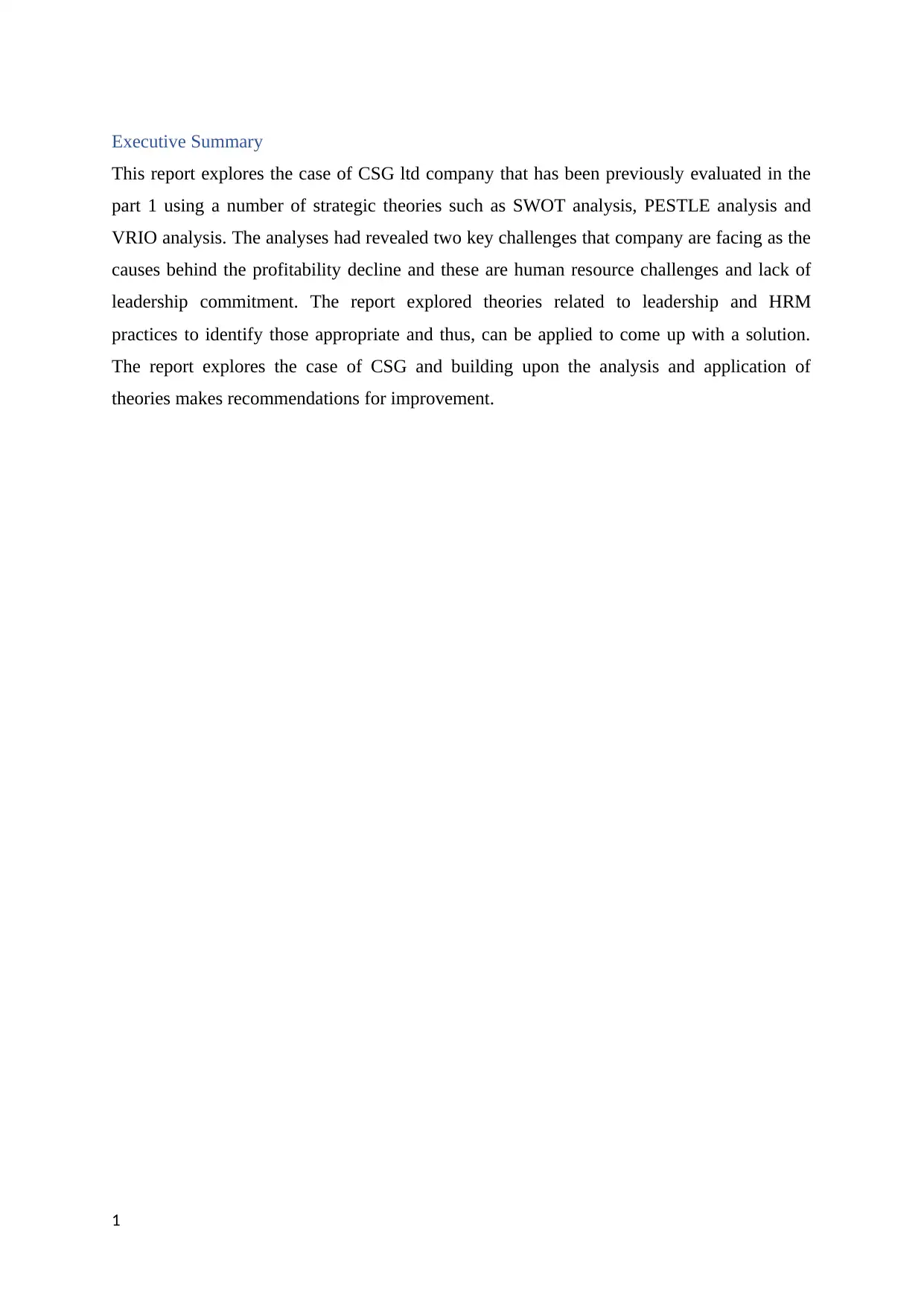
This report explores the case of CSG ltd company that has been previously evaluated in the
part 1 using a number of strategic theories such as SWOT analysis, PESTLE analysis and
VRIO analysis. The analyses had revealed two key challenges that company are facing as the
causes behind the profitability decline and these are human resource challenges and lack of
leadership commitment. The report explored theories related to leadership and HRM
practices to identify those appropriate and thus, can be applied to come up with a solution.
The report explores the case of CSG and building upon the analysis and application of
theories makes recommendations for improvement.
1
This report explores the case of CSG ltd company that has been previously evaluated in the
part 1 using a number of strategic theories such as SWOT analysis, PESTLE analysis and
VRIO analysis. The analyses had revealed two key challenges that company are facing as the
causes behind the profitability decline and these are human resource challenges and lack of
leadership commitment. The report explored theories related to leadership and HRM
practices to identify those appropriate and thus, can be applied to come up with a solution.
The report explores the case of CSG and building upon the analysis and application of
theories makes recommendations for improvement.
1
Contents
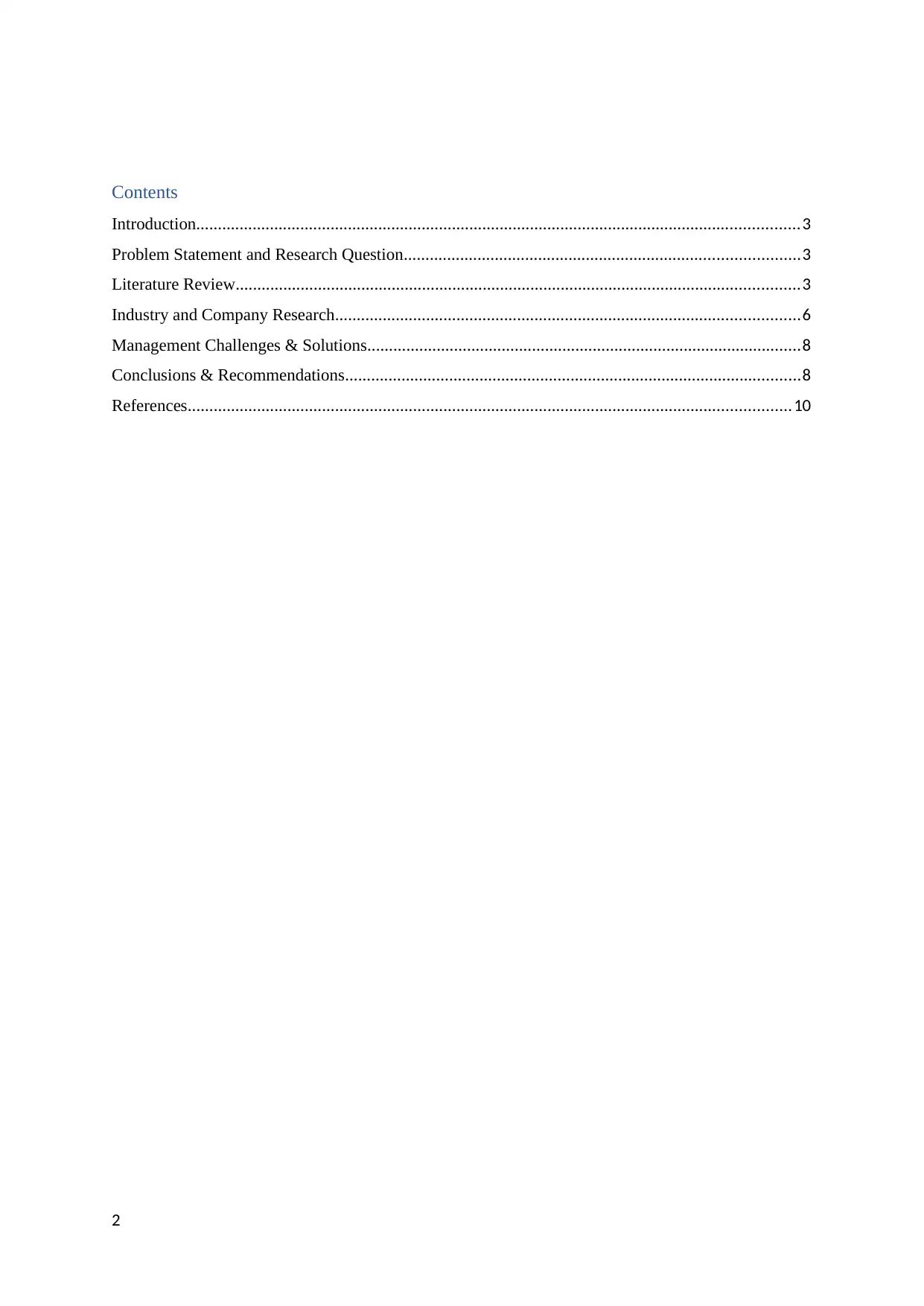
Introduction...........................................................................................................................................3
Problem Statement and Research Question...........................................................................................3
Literature Review..................................................................................................................................3
Industry and Company Research...........................................................................................................6
Management Challenges & Solutions....................................................................................................8
Conclusions & Recommendations.........................................................................................................8
References...........................................................................................................................................10
2
Introduction...........................................................................................................................................3
Problem Statement and Research Question...........................................................................................3
Literature Review..................................................................................................................................3
Industry and Company Research...........................................................................................................6
Management Challenges & Solutions....................................................................................................8
Conclusions & Recommendations.........................................................................................................8
References...........................................................................................................................................10
2
⊘ This is a preview!⊘
Do you want full access?
Subscribe today to unlock all pages.

Trusted by 1+ million students worldwide
Introduction
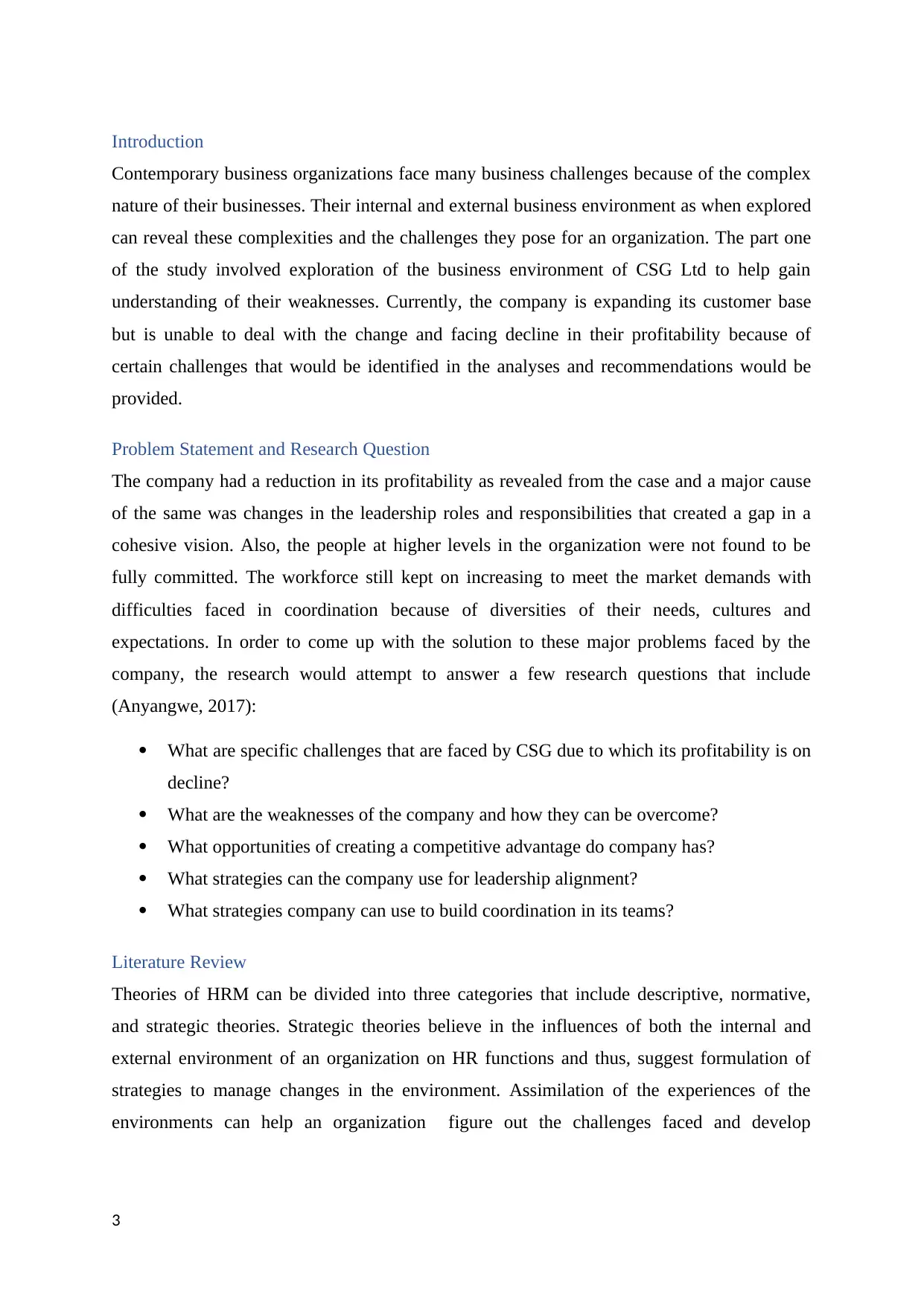
Contemporary business organizations face many business challenges because of the complex
nature of their businesses. Their internal and external business environment as when explored
can reveal these complexities and the challenges they pose for an organization. The part one
of the study involved exploration of the business environment of CSG Ltd to help gain
understanding of their weaknesses. Currently, the company is expanding its customer base
but is unable to deal with the change and facing decline in their profitability because of
certain challenges that would be identified in the analyses and recommendations would be
provided.
Problem Statement and Research Question
The company had a reduction in its profitability as revealed from the case and a major cause
of the same was changes in the leadership roles and responsibilities that created a gap in a
cohesive vision. Also, the people at higher levels in the organization were not found to be
fully committed. The workforce still kept on increasing to meet the market demands with
difficulties faced in coordination because of diversities of their needs, cultures and
expectations. In order to come up with the solution to these major problems faced by the
company, the research would attempt to answer a few research questions that include
(Anyangwe, 2017):
What are specific challenges that are faced by CSG due to which its profitability is on
decline?
What are the weaknesses of the company and how they can be overcome?
What opportunities of creating a competitive advantage do company has?
What strategies can the company use for leadership alignment?
What strategies company can use to build coordination in its teams?
Literature Review
Theories of HRM can be divided into three categories that include descriptive, normative,
and strategic theories. Strategic theories believe in the influences of both the internal and
external environment of an organization on HR functions and thus, suggest formulation of
strategies to manage changes in the environment. Assimilation of the experiences of the
environments can help an organization figure out the challenges faced and develop
3
Contemporary business organizations face many business challenges because of the complex
nature of their businesses. Their internal and external business environment as when explored
can reveal these complexities and the challenges they pose for an organization. The part one
of the study involved exploration of the business environment of CSG Ltd to help gain
understanding of their weaknesses. Currently, the company is expanding its customer base
but is unable to deal with the change and facing decline in their profitability because of
certain challenges that would be identified in the analyses and recommendations would be
provided.
Problem Statement and Research Question
The company had a reduction in its profitability as revealed from the case and a major cause
of the same was changes in the leadership roles and responsibilities that created a gap in a
cohesive vision. Also, the people at higher levels in the organization were not found to be
fully committed. The workforce still kept on increasing to meet the market demands with
difficulties faced in coordination because of diversities of their needs, cultures and
expectations. In order to come up with the solution to these major problems faced by the
company, the research would attempt to answer a few research questions that include
(Anyangwe, 2017):
What are specific challenges that are faced by CSG due to which its profitability is on
decline?
What are the weaknesses of the company and how they can be overcome?
What opportunities of creating a competitive advantage do company has?
What strategies can the company use for leadership alignment?
What strategies company can use to build coordination in its teams?
Literature Review
Theories of HRM can be divided into three categories that include descriptive, normative,
and strategic theories. Strategic theories believe in the influences of both the internal and
external environment of an organization on HR functions and thus, suggest formulation of
strategies to manage changes in the environment. Assimilation of the experiences of the
environments can help an organization figure out the challenges faced and develop
3
Paraphrase This Document
Need a fresh take? Get an instant paraphrase of this document with our AI Paraphraser
contingencies to tackle them. The Harvard analytical framework for HRM is an example of a
strategic theory.
The analytical framework of human resource management system is defined by Harvard
which identified stakeholder interests and situational factors as the influencers that assist in
creation of a a human resource policy. Appropriate policies bring respective outcomes that
have long-term consequences on an organisation. The workforce characteristics and interests
determine the ideal HR policy that a company must have. An HR policy would state the flow
of communication, employee reward system, work systems, choices and influences on
employees (Luthra & Dahiya, 2015). With the use of appropriate HRM strategies, an
organization can achieve competence, congruence, commitment and cost effectiveness from
its human resources (Miller & Turner, 2010). Key qualities or characteristics of this
framework are stakeholder perspective, mutual cooperation, commitment, and employee
influence. The framework suggests that line managers should take responsibility for aligning
competitive strategies of an organization to achieve strategic goals and should commit to
ensure that the workforce follows the policies (Agyepong, 2010).
Another HRM model called matching model identifies five major functions of HR that
include selection, performance, appraisal, rewards, and development. As per this model, the
HRM processes are dependent on programs and procedures used by an organization. This
model is an example of a descriptive theory of HRM as it identifies HRM aspects as
ingredients of the organization that are aimed to achieve a common objective.
Normative theories take more of a prescriptive approach which explores principles and
perspectives and suggest policies that are mutually promoted by people in the organization.
These theories follow ethical principles of attitude and behaviour that people should have in
order to have a successful human resource management practice. The theories can be
universal, configurational or contingency. The universal approach involves identification of
best practices that are proven to be successful globally and thus are seen as effective. The
universal theories also define standard metrics for measuring organisational performance
such as market share and profits. A number of best practices have been identified by Pfeffer
including employment security, high wages, selective recruitment, employee empowerment,
employee ownership, incentives, information sharing, skill development, cross-functional
utilization, , wage compression and so on. These practices can be used by any organization
4
strategic theory.
The analytical framework of human resource management system is defined by Harvard
which identified stakeholder interests and situational factors as the influencers that assist in
creation of a a human resource policy. Appropriate policies bring respective outcomes that
have long-term consequences on an organisation. The workforce characteristics and interests
determine the ideal HR policy that a company must have. An HR policy would state the flow
of communication, employee reward system, work systems, choices and influences on
employees (Luthra & Dahiya, 2015). With the use of appropriate HRM strategies, an
organization can achieve competence, congruence, commitment and cost effectiveness from
its human resources (Miller & Turner, 2010). Key qualities or characteristics of this
framework are stakeholder perspective, mutual cooperation, commitment, and employee
influence. The framework suggests that line managers should take responsibility for aligning
competitive strategies of an organization to achieve strategic goals and should commit to
ensure that the workforce follows the policies (Agyepong, 2010).
Another HRM model called matching model identifies five major functions of HR that
include selection, performance, appraisal, rewards, and development. As per this model, the
HRM processes are dependent on programs and procedures used by an organization. This
model is an example of a descriptive theory of HRM as it identifies HRM aspects as
ingredients of the organization that are aimed to achieve a common objective.
Normative theories take more of a prescriptive approach which explores principles and
perspectives and suggest policies that are mutually promoted by people in the organization.
These theories follow ethical principles of attitude and behaviour that people should have in
order to have a successful human resource management practice. The theories can be
universal, configurational or contingency. The universal approach involves identification of
best practices that are proven to be successful globally and thus are seen as effective. The
universal theories also define standard metrics for measuring organisational performance
such as market share and profits. A number of best practices have been identified by Pfeffer
including employment security, high wages, selective recruitment, employee empowerment,
employee ownership, incentives, information sharing, skill development, cross-functional
utilization, , wage compression and so on. These practices can be used by any organization
4
and they do not carry the biases of culture, behaviour or environment and thus, are seen as
universal principles (McMahon, 2013).
However, not all companies are same nor do they operate in the same environment. The
contingency theory recognizes this fact and underlines the differences between companies in
terms of their size, age, technology adoption, industry, location, and ownership. The theory
believes in the existence of a complex interaction that happens between different human
resource variables that can influence its performance. Contingency theory suggests creation
of a best fit between the organizational capabilities and the environment it operates in. Any
circumstantial challenges faced by an organization are thus considered while building a
contingency plan to deal with the changes.
A configuration theory integrates multiple perspectives coming from different theories to
gain a combined intelligence which can help an organization achieve a greater level of
performance in its operations. Thus, it combines the practices and perspectives of classical,
behavioural, scientific, and contingency theories. An example of such an integrated theory is
called Vroom’s theory which describes motivation as the outcome of combination of valence
of rewards, performance expectancy, and instrumentality of receiving award. However, this
theory failed to have organizational considerations. Another integrated theory by Lawler's
states that the motivation in people can be achieved at three different levels that include
individual, interactions, and psychological. At individual level, a person motivates oneself
and at the interaction level, the role of the person within the organization creates an influence
on the person. Psychological level of influence is achieved when an individual has multiple
interactions with oneself and the organizational environment (FLOCY, 2017).
Human resource management models can be both hard and soft. Hard models identify tight
control and economic value of workforce while soft models focus on cohesion and
commitment from employees. Hard model takes more traditional view and sees humans as
the economic resources who can be controlled through rules, regulations, and disciplinary
actions. On the contrary, the soft model emphasises on motivation and inspiration that can
create valued assets from the workforce and help an organization achieve a competitive
advantage through the practice of high performance, high commitment, high skills, and
adaptability in the human resource (Ihuah., 2014). Key features of a soft HRM model are
flexibility, team building, and culture management. If this theory has to be taken as the base
for the development of the HR policies then the employees would be expected to work in a
5
universal principles (McMahon, 2013).
However, not all companies are same nor do they operate in the same environment. The
contingency theory recognizes this fact and underlines the differences between companies in
terms of their size, age, technology adoption, industry, location, and ownership. The theory
believes in the existence of a complex interaction that happens between different human
resource variables that can influence its performance. Contingency theory suggests creation
of a best fit between the organizational capabilities and the environment it operates in. Any
circumstantial challenges faced by an organization are thus considered while building a
contingency plan to deal with the changes.
A configuration theory integrates multiple perspectives coming from different theories to
gain a combined intelligence which can help an organization achieve a greater level of
performance in its operations. Thus, it combines the practices and perspectives of classical,
behavioural, scientific, and contingency theories. An example of such an integrated theory is
called Vroom’s theory which describes motivation as the outcome of combination of valence
of rewards, performance expectancy, and instrumentality of receiving award. However, this
theory failed to have organizational considerations. Another integrated theory by Lawler's
states that the motivation in people can be achieved at three different levels that include
individual, interactions, and psychological. At individual level, a person motivates oneself
and at the interaction level, the role of the person within the organization creates an influence
on the person. Psychological level of influence is achieved when an individual has multiple
interactions with oneself and the organizational environment (FLOCY, 2017).
Human resource management models can be both hard and soft. Hard models identify tight
control and economic value of workforce while soft models focus on cohesion and
commitment from employees. Hard model takes more traditional view and sees humans as
the economic resources who can be controlled through rules, regulations, and disciplinary
actions. On the contrary, the soft model emphasises on motivation and inspiration that can
create valued assets from the workforce and help an organization achieve a competitive
advantage through the practice of high performance, high commitment, high skills, and
adaptability in the human resource (Ihuah., 2014). Key features of a soft HRM model are
flexibility, team building, and culture management. If this theory has to be taken as the base
for the development of the HR policies then the employees would be expected to work in a
5
⊘ This is a preview!⊘
Do you want full access?
Subscribe today to unlock all pages.
Trusted by 1+ million students worldwide
self-guided environment and there would not be any major supervisory control over them
(Percy, 2018).
A resource based theory defined by Armstrong recognize the role of the resources in creating
strategic capabilities for an organization. Through proper learning and development of the
workforce, companies can create strong competitive advantages which is a sustained use
practices and strategies that are not easy to imitate for competition and thus, gives
sustainability (GLA, 2017).
A systems theory is another integrated theory which believes in existence of sub-systems
within an organization and the relationships between them. A system can be open allowing
companies to interact with its external environment or closed in which they are not. Some key
ingredients of this system can be identified for an organization such as goals, interactions,
processes and communications. This theory can be very useful in understanding and working
on challenges related to structure, relationships, and interdependence between people.
HR discipline can also work on the principles of ethics such as respect for people, procedural
fairness, and transparency. A work ethic system can be designed accordingly and manners or
qualities of behaviour can be defined for the workforce. Stakeholder approach is another way
to see HRM practice in which an organization is seen as a community that consists of a
combination of multiple interests of stakeholders such as employees, customers,
shareholders, and authorities. Effective cooperation and coordination can be achieved through
appropriate use of communication methods.
Industry and Company Research
In the previous part of the research, a number of tools and techniques were used to analyse
the case of CSG that helped discover key causes and patterns of problems and challenges.
The SWOT analysis revealed some weaknesses of the company such as culturally diverse
staff, limited market presence, and lower brand identity. With VRIO analysis conducted on
its resources, it was found that the company had a competitive advantage in the areas of
technology and brand value. The analyses had revealed that workforce diversity and business
environment changes are two major challenges that the company needs to work on. The
analyses had also revealed some opportunities for improvement such as adoption of ethical
work practices, enhancing sustainability of the business, stakeholder involvement, and
leadership alignment (Copeland, 2014).
6
(Percy, 2018).
A resource based theory defined by Armstrong recognize the role of the resources in creating
strategic capabilities for an organization. Through proper learning and development of the
workforce, companies can create strong competitive advantages which is a sustained use
practices and strategies that are not easy to imitate for competition and thus, gives
sustainability (GLA, 2017).
A systems theory is another integrated theory which believes in existence of sub-systems
within an organization and the relationships between them. A system can be open allowing
companies to interact with its external environment or closed in which they are not. Some key
ingredients of this system can be identified for an organization such as goals, interactions,
processes and communications. This theory can be very useful in understanding and working
on challenges related to structure, relationships, and interdependence between people.
HR discipline can also work on the principles of ethics such as respect for people, procedural
fairness, and transparency. A work ethic system can be designed accordingly and manners or
qualities of behaviour can be defined for the workforce. Stakeholder approach is another way
to see HRM practice in which an organization is seen as a community that consists of a
combination of multiple interests of stakeholders such as employees, customers,
shareholders, and authorities. Effective cooperation and coordination can be achieved through
appropriate use of communication methods.
Industry and Company Research
In the previous part of the research, a number of tools and techniques were used to analyse
the case of CSG that helped discover key causes and patterns of problems and challenges.
The SWOT analysis revealed some weaknesses of the company such as culturally diverse
staff, limited market presence, and lower brand identity. With VRIO analysis conducted on
its resources, it was found that the company had a competitive advantage in the areas of
technology and brand value. The analyses had revealed that workforce diversity and business
environment changes are two major challenges that the company needs to work on. The
analyses had also revealed some opportunities for improvement such as adoption of ethical
work practices, enhancing sustainability of the business, stakeholder involvement, and
leadership alignment (Copeland, 2014).
6
Paraphrase This Document
Need a fresh take? Get an instant paraphrase of this document with our AI Paraphraser
While there are many HRM theories that can guide the actions and policies for the company
to resolve its challenges of workforce alignment, the company is also facing a major
difficulty in achieving alignment and commitment from leadership positions. Thus, it is
important to also explore the leadership theories that can help gain this alignment to enhance
organizational performance (Lloyd Walker & Walker, 2011).
There can be three types of leaders including authoritative, constructive and situational as per
common theories of leadership. Authoritative leaders are control oriented and take decisions
on their own which are then propagated as the agenda to follow in the workforce. This type of
leadership was used by traditional organizations that have hierarchical structures carry strong
position. This leadership idea works on fear and thus, is not motivational which is a dominant
weakness of this style. Constructive leaders are supportive and take views of their
subordinates when taking decisions. These leaders are only appropriate for managing a
workforce that is highly goal oriented and self-directed. However, no single form of
leadership would suffice the needs of all kinds of human resources and thus, a situational
leadership can be used which provides flexibility to the leader for choosing an appropriate
style of leadership depending on the situation (Andersson & Thylin, 2009). Situational
leadership has given rise to many flexible theories of leadership that identify different ways
human resource and organization can be managed by leaders based on different situations and
environments of the organization (Burke & Barron, 2012).
As per Jung’s theory, a leadership can be defined as a combination of four logics that include
production, administration, development, and integration. Different leadership styles can be
assumed to achieve excellence in each of these areas between a team of leaders in an
organization. An organization can have a team of revitalizers, creators, productivity
managers, and growth managers. Revitalizers believe in shared participation and cohesion.
These leaders are understanding of people and are sensitive to their needs which makes them
supportive and have the capability to motivate people. They have good aptitude for
negotiation, conceptual abilities, and building consensus. This leadership position is most
effective in a stable environment which is subjected to change (C, 2009).
Creators or builders rely on innovation and creativity. They are fast movers who take
decisions quickly and are guided by the shared vision of an organization. It is most
appropriate leadership style when an organization is going through turbulent times and
involves high technical knowledge in the leader. Productivity managers believe in analysis
7
to resolve its challenges of workforce alignment, the company is also facing a major
difficulty in achieving alignment and commitment from leadership positions. Thus, it is
important to also explore the leadership theories that can help gain this alignment to enhance
organizational performance (Lloyd Walker & Walker, 2011).
There can be three types of leaders including authoritative, constructive and situational as per
common theories of leadership. Authoritative leaders are control oriented and take decisions
on their own which are then propagated as the agenda to follow in the workforce. This type of
leadership was used by traditional organizations that have hierarchical structures carry strong
position. This leadership idea works on fear and thus, is not motivational which is a dominant
weakness of this style. Constructive leaders are supportive and take views of their
subordinates when taking decisions. These leaders are only appropriate for managing a
workforce that is highly goal oriented and self-directed. However, no single form of
leadership would suffice the needs of all kinds of human resources and thus, a situational
leadership can be used which provides flexibility to the leader for choosing an appropriate
style of leadership depending on the situation (Andersson & Thylin, 2009). Situational
leadership has given rise to many flexible theories of leadership that identify different ways
human resource and organization can be managed by leaders based on different situations and
environments of the organization (Burke & Barron, 2012).
As per Jung’s theory, a leadership can be defined as a combination of four logics that include
production, administration, development, and integration. Different leadership styles can be
assumed to achieve excellence in each of these areas between a team of leaders in an
organization. An organization can have a team of revitalizers, creators, productivity
managers, and growth managers. Revitalizers believe in shared participation and cohesion.
These leaders are understanding of people and are sensitive to their needs which makes them
supportive and have the capability to motivate people. They have good aptitude for
negotiation, conceptual abilities, and building consensus. This leadership position is most
effective in a stable environment which is subjected to change (C, 2009).
Creators or builders rely on innovation and creativity. They are fast movers who take
decisions quickly and are guided by the shared vision of an organization. It is most
appropriate leadership style when an organization is going through turbulent times and
involves high technical knowledge in the leader. Productivity managers believe in analysis
7
and establishing of control. Teams handled by such leaders are logical and analytical. Thus,
one needs to have the aptitude for analytics and logic. This strategy is often used in
organizations that are mature and have pressured margins that have to be improved. Typical
strategies that a leader would use to manage challenges at this stage include consolidation and
fine tuning of strategies. Growth managers are the drivers of organizational objectives who
have high knack for marketing and sales. These leaders can help company settle down in a
highly competitive environment and are most influential when the company is focused on
increasing the market share and getting more customers (Kriger & Zhovtobryukh, 2016).
Management Challenges & Solutions
There are two key challenges that are faced by the organization and these include lack of
human resource productivity that is also affecting the profitability of the organization and
lack of commitment and alignment from the leaders. Various theories that were discussed on
HRM and on leadership styles could help identify solutions to these problems for the
company. The exploration of HRM theories revealed that there can be certain best practices
that can be used by the organization and can be made as the standard practices include in the
HRM policies that serve as the guidelines for the workforce to follow them for performance.
Soft theories of HRM suggest that it is important that human resources are seen as assets that
need motivation and training instead of treating them as economic units that are used to
generate profits. Benefits of this theory are that it allows a leader to take a more supportive
role and a self-guided environment can be created for the employees to enhance their
motivation and remain ethical. The company can also have defined HRM policies that are
targeted to achieve high levels of productivity and motivation through the application of best
practices, ethical principles and strategies for motivation.
The company would not succeed in achieving its strategic goals without the support from the
senior management that serves the organization as leaders and thus, it is important to have a
proper alignment from leaders. As per the Jung’s theory, different leadership styles could be
identified that can fit into specific situations. The strength of this tool is that it allows a leader
to be flexible and choose appropriate style as per the demand of the workforce.
As the company in consideration is already mature and is going through the major phase of
change and is struggling to gain more revenues through enhancement of profits and increase
in the market share, the company can have leadership profiles like productivity managers and
8
one needs to have the aptitude for analytics and logic. This strategy is often used in
organizations that are mature and have pressured margins that have to be improved. Typical
strategies that a leader would use to manage challenges at this stage include consolidation and
fine tuning of strategies. Growth managers are the drivers of organizational objectives who
have high knack for marketing and sales. These leaders can help company settle down in a
highly competitive environment and are most influential when the company is focused on
increasing the market share and getting more customers (Kriger & Zhovtobryukh, 2016).
Management Challenges & Solutions
There are two key challenges that are faced by the organization and these include lack of
human resource productivity that is also affecting the profitability of the organization and
lack of commitment and alignment from the leaders. Various theories that were discussed on
HRM and on leadership styles could help identify solutions to these problems for the
company. The exploration of HRM theories revealed that there can be certain best practices
that can be used by the organization and can be made as the standard practices include in the
HRM policies that serve as the guidelines for the workforce to follow them for performance.
Soft theories of HRM suggest that it is important that human resources are seen as assets that
need motivation and training instead of treating them as economic units that are used to
generate profits. Benefits of this theory are that it allows a leader to take a more supportive
role and a self-guided environment can be created for the employees to enhance their
motivation and remain ethical. The company can also have defined HRM policies that are
targeted to achieve high levels of productivity and motivation through the application of best
practices, ethical principles and strategies for motivation.
The company would not succeed in achieving its strategic goals without the support from the
senior management that serves the organization as leaders and thus, it is important to have a
proper alignment from leaders. As per the Jung’s theory, different leadership styles could be
identified that can fit into specific situations. The strength of this tool is that it allows a leader
to be flexible and choose appropriate style as per the demand of the workforce.
As the company in consideration is already mature and is going through the major phase of
change and is struggling to gain more revenues through enhancement of profits and increase
in the market share, the company can have leadership profiles like productivity managers and
8
⊘ This is a preview!⊘
Do you want full access?
Subscribe today to unlock all pages.
Trusted by 1+ million students worldwide
growth managers. Productivity managers would be able to help the company improve its
profits while growth managers would help it gain more market share.
Conclusions & Recommendations
This research explored the case of CSG Ltd which is facing a decline in the profitability and
sales of the organization. A number of analysis models were used to identify challenges and
causes of problems in the company. It was found that the major problems faced by companies
were due to lack of human resource productivity and lack of leadership commitment and
alignment (Wick, 2017). A number of human resource and leadership theories were then
explored to understand the intricacies of such issues and to identify solutions. Two key
strategy sets were identified that were focused on improvement human resource assets and
leadership capabilities ion the organization. Based on this understanding, certain
recommendations can be made for the organisation that would help it in achieving its
strategic objectives and resolve problems it is currently facing (Kolzow, 2014). These
include:
A situational leadership can be used by the senior management of the company in
which some people would be acting as productivity managers while others could
become growth drivers so that multiple objectives of the organization can be
achieved.
The workforce can be made more active and self-directed through inculcating
principles and providing them proper training on processes and systems so that they
can take their own decisions
The company can formulate a sound HR policy that is supportive to the needs of
employees as the stakeholders of the company and also takes care of the objectives of
the organization that need to be achieved.
9
profits while growth managers would help it gain more market share.
Conclusions & Recommendations
This research explored the case of CSG Ltd which is facing a decline in the profitability and
sales of the organization. A number of analysis models were used to identify challenges and
causes of problems in the company. It was found that the major problems faced by companies
were due to lack of human resource productivity and lack of leadership commitment and
alignment (Wick, 2017). A number of human resource and leadership theories were then
explored to understand the intricacies of such issues and to identify solutions. Two key
strategy sets were identified that were focused on improvement human resource assets and
leadership capabilities ion the organization. Based on this understanding, certain
recommendations can be made for the organisation that would help it in achieving its
strategic objectives and resolve problems it is currently facing (Kolzow, 2014). These
include:
A situational leadership can be used by the senior management of the company in
which some people would be acting as productivity managers while others could
become growth drivers so that multiple objectives of the organization can be
achieved.
The workforce can be made more active and self-directed through inculcating
principles and providing them proper training on processes and systems so that they
can take their own decisions
The company can formulate a sound HR policy that is supportive to the needs of
employees as the stakeholders of the company and also takes care of the objectives of
the organization that need to be achieved.
9
Paraphrase This Document
Need a fresh take? Get an instant paraphrase of this document with our AI Paraphraser
References
Agyepong, S. A., 2010. The applicability of the Harvard and Warwick models in the
development of human resource management policies of large construction companies in
Ghana, s.l.: Loughborough University.
Andersson, M. & Thylin, K., 2009. Leadership in situations of uncertainty. s.l.:University of
Gothenburg.
Anyangwe, X., 2017. STRATEGIC HUMAN RESOURCE MANAGEMENT:A Cross-Cultural
Managerial Approach, s.l.: CENTRIA UNIVERSITY OF APPLIED SCIENCES.
Burke, R. & Barron, S., 2012. Leadership Theories and Styles. s.l., Wileys.
Copeland, M. K., 2014. The Emerging Significance of Values Based Leadership: A
Literature Review, s.l.: St. John Fisher College.
C, S., 2009. Human Resource Management Functions: Managerial, Operative and Advisory
Function, s.l.: Your Article Library.
FLOCY, J., 2017. Responsible leadership: A behavioural perspective, s.l.: Singapore
Management University.
GLA, 2017. Professional Development Plan: SET YOUR DIRECTION, s.l.: Global
Leadership Acceleration.
Ihuah., P. W., 2014. A review of soft and hard approaches of human resource management
and the success of real estate development in Nigeria, Ihuah, PW: Salford University.
Kolzow, D. R., 2014. Leading from Within: Building Organizational Leadership Capacity.
s.l.:IED.
Kriger, M. & Zhovtobryukh, Y., 2016. Strategic Leadership for Turbulent Times.
s.l.:Springer.
Lloyd Walker, B. & Walker, D., 2011. Authentic Leadership for 21st Century Project
Delivery. International Journal of Project Management, 29(4), pp. 383-395.
Luthra, A. & Dahiya, R., 2015. Effective Leadership is all About Communicating
Effectively: Connecting Leadership and Communication. IJMBS, 5(3), pp. 43-48.
10
Agyepong, S. A., 2010. The applicability of the Harvard and Warwick models in the
development of human resource management policies of large construction companies in
Ghana, s.l.: Loughborough University.
Andersson, M. & Thylin, K., 2009. Leadership in situations of uncertainty. s.l.:University of
Gothenburg.
Anyangwe, X., 2017. STRATEGIC HUMAN RESOURCE MANAGEMENT:A Cross-Cultural
Managerial Approach, s.l.: CENTRIA UNIVERSITY OF APPLIED SCIENCES.
Burke, R. & Barron, S., 2012. Leadership Theories and Styles. s.l., Wileys.
Copeland, M. K., 2014. The Emerging Significance of Values Based Leadership: A
Literature Review, s.l.: St. John Fisher College.
C, S., 2009. Human Resource Management Functions: Managerial, Operative and Advisory
Function, s.l.: Your Article Library.
FLOCY, J., 2017. Responsible leadership: A behavioural perspective, s.l.: Singapore
Management University.
GLA, 2017. Professional Development Plan: SET YOUR DIRECTION, s.l.: Global
Leadership Acceleration.
Ihuah., P. W., 2014. A review of soft and hard approaches of human resource management
and the success of real estate development in Nigeria, Ihuah, PW: Salford University.
Kolzow, D. R., 2014. Leading from Within: Building Organizational Leadership Capacity.
s.l.:IED.
Kriger, M. & Zhovtobryukh, Y., 2016. Strategic Leadership for Turbulent Times.
s.l.:Springer.
Lloyd Walker, B. & Walker, D., 2011. Authentic Leadership for 21st Century Project
Delivery. International Journal of Project Management, 29(4), pp. 383-395.
Luthra, A. & Dahiya, R., 2015. Effective Leadership is all About Communicating
Effectively: Connecting Leadership and Communication. IJMBS, 5(3), pp. 43-48.
10
McMahon, G., 2013. Performance Management: Chapter 7 in Human Resource
Management, s.l.: Dublin Institute of Technology.
Miller, R. & Turner, R., 2010. Leadership Competency Profiles of Success Project Managers.
International Journal of Project Management, 28(5), pp. 437-448.
Percy, S., 2018. The Top Three Business Priorities For Leaders Over The Next Three Years.
[Online]
Available at: https://www.forbes.com/sites/sallypercy/2018/11/27/the-top-three-business-
priorities-for-leaders-over-the-next-three-years/#34a75d304ec9
[Accessed 9 February 2019].
Wick, D. A., 2017. Leadership Harmony – 5 Dysfunctions of a Team – Conflict Resolution
Model, s.l.: Positioning Systems.
11
Management, s.l.: Dublin Institute of Technology.
Miller, R. & Turner, R., 2010. Leadership Competency Profiles of Success Project Managers.
International Journal of Project Management, 28(5), pp. 437-448.
Percy, S., 2018. The Top Three Business Priorities For Leaders Over The Next Three Years.
[Online]
Available at: https://www.forbes.com/sites/sallypercy/2018/11/27/the-top-three-business-
priorities-for-leaders-over-the-next-three-years/#34a75d304ec9
[Accessed 9 February 2019].
Wick, D. A., 2017. Leadership Harmony – 5 Dysfunctions of a Team – Conflict Resolution
Model, s.l.: Positioning Systems.
11
⊘ This is a preview!⊘
Do you want full access?
Subscribe today to unlock all pages.
Trusted by 1+ million students worldwide

1 out of 12


Related Documents


Your All-in-One AI-Powered Toolkit for Academic Success.
+13062052269
info@desklib.com
Available 24*7 on WhatsApp / Email
![[object Object]](/_next/static/media/star-bottom.7253800d.svg)
Unlock your academic potential
Copyright © 2020–2026 A2Z Services. All Rights Reserved. Developed and managed by ZUCOL.