Analyzing Human Impact: An Environmental Assessment Case Study
VerifiedAdded on 2023/06/03
|12
|3212
|104
Case Study
AI Summary
This case study provides an environmental impact assessment of Australia, focusing on the significant problem of global warming and its consequences. It highlights the human impacts on the environment, including the effects on local ecosystems like the Great Barrier Reef, and the increasing risks to native species and rainfall patterns. The study discusses the effects of global warming, such as rising sea levels, coral bleaching, and alterations in rainfall, which affect agriculture and human settlements. Furthermore, it outlines the steps taken to address these issues, including reducing net emissions, balancing the carbon budget, and implementing renewable energy projects. The conclusion emphasizes the urgent need for continued and stricter actions to mitigate global warming to protect Australia's environment and its inhabitants. Desklib offers a platform to explore similar case studies and assignments.
Environmental Impact Assessment

Paraphrase This Document
Need a fresh take? Get an instant paraphrase of this document with our AI Paraphraser
1 | P a g e
Table of Contents
Introduction...........................................................................................................................................2
Human Impacts on the Environment.....................................................................................................2
The problem..........................................................................................................................................2
Impact on the local environment..........................................................................................................3
Effects of global warming......................................................................................................................3
Steps taken to address the problem......................................................................................................5
Conclusion.............................................................................................................................................6
References.............................................................................................................................................7
Table of Contents
Introduction...........................................................................................................................................2
Human Impacts on the Environment.....................................................................................................2
The problem..........................................................................................................................................2
Impact on the local environment..........................................................................................................3
Effects of global warming......................................................................................................................3
Steps taken to address the problem......................................................................................................5
Conclusion.............................................................................................................................................6
References.............................................................................................................................................7
2 | P a g e
Introduction
Environmental impact assessment is an evaluation that is carried out to find the
environmental consequences. It helps in identifying both positive and negative impact by
making up the plans and policies so that decisions could be taken accordingly. The term
environmental impact assessment is used to analyse a particular problem in an area. Once
the problem is identified, set of plans and policies are proposed so that improvement could
be done. It can be set of government rules or procedures that are taken to resolve the
environmental issue (Wei, Wei and Western, 2017). The purpose of carrying out this
assessment is identifying, predicating, evaluating and then mitigating the concern. The case
study of Australian environmental concerns is carried out in this report. Environment
assessments are important as it prevents the country from future risk. It is a unique way
through which environmental outcomes can be improved. They are making better decisions
so that an environmental value is improved. In this report, the concern of global warming is
increased in Australia. The human impact on the environment and the problem that is faced
in Australia due to global warming is listed below (Seeley and Romps, 2015). The impact
and effects that are caused due to global warming is also discussed. To overcome such
issues, various steps are undertaken so that this problem can be addressed.
Human Impacts on the Environment
Australia is a huge island located in the South Pacific. It covers more than 7,741,220
sq. km area and is considered as the sixth largest country. There are various environmental
issues that are faced in Australia due to climactic changes. Most of the land is covered by the
desert area, thus this is one of the reason due to which country is hit by many natural hazards
and harsh environmental conditions (Wei, Wei and Western, 2017). There are various
hazards that have hit the country in last few years like cyclones, forest fire, droughts and
floods. It is one of the wealthy countries that have many diverse natural resources. Most of
the industrial sectors are busy in mining activities (Molinos, et.al, 2016). The environmental
issues that are faced in Australia are mostly due to large amount mining and environmental
practices. Thus one of the environmental concerns faced by the country will be discussed in
this report. The major concern that was highlighted in the news limelight recently was about
the degrees of division that was faced due to climate change (Molinos, et.al, 2016).
Introduction
Environmental impact assessment is an evaluation that is carried out to find the
environmental consequences. It helps in identifying both positive and negative impact by
making up the plans and policies so that decisions could be taken accordingly. The term
environmental impact assessment is used to analyse a particular problem in an area. Once
the problem is identified, set of plans and policies are proposed so that improvement could
be done. It can be set of government rules or procedures that are taken to resolve the
environmental issue (Wei, Wei and Western, 2017). The purpose of carrying out this
assessment is identifying, predicating, evaluating and then mitigating the concern. The case
study of Australian environmental concerns is carried out in this report. Environment
assessments are important as it prevents the country from future risk. It is a unique way
through which environmental outcomes can be improved. They are making better decisions
so that an environmental value is improved. In this report, the concern of global warming is
increased in Australia. The human impact on the environment and the problem that is faced
in Australia due to global warming is listed below (Seeley and Romps, 2015). The impact
and effects that are caused due to global warming is also discussed. To overcome such
issues, various steps are undertaken so that this problem can be addressed.
Human Impacts on the Environment
Australia is a huge island located in the South Pacific. It covers more than 7,741,220
sq. km area and is considered as the sixth largest country. There are various environmental
issues that are faced in Australia due to climactic changes. Most of the land is covered by the
desert area, thus this is one of the reason due to which country is hit by many natural hazards
and harsh environmental conditions (Wei, Wei and Western, 2017). There are various
hazards that have hit the country in last few years like cyclones, forest fire, droughts and
floods. It is one of the wealthy countries that have many diverse natural resources. Most of
the industrial sectors are busy in mining activities (Molinos, et.al, 2016). The environmental
issues that are faced in Australia are mostly due to large amount mining and environmental
practices. Thus one of the environmental concerns faced by the country will be discussed in
this report. The major concern that was highlighted in the news limelight recently was about
the degrees of division that was faced due to climate change (Molinos, et.al, 2016).
⊘ This is a preview!⊘
Do you want full access?
Subscribe today to unlock all pages.

Trusted by 1+ million students worldwide
3 | P a g e
The problem
The major problem that is being faced in Australia is global warming. In this report, the
problem that is considered is increase in global warming consequences. The effect of global
warming has impacted Australia and the reason behind this is extensive arid and semi-arid
areas. The uncertainty in degree also impact other climatic conditions can increases the
impact (Miller, Shemer and Semiat, 2015). It has impacted humans in many ways. The
increasing temperature has led to melting of glaciers which in turn have increased the sea
level that is a life threatening thing for the people of Australia living in the coastal cities
(Hughes, et. at, 2017).
Impact on the local environment
It is true that global warming has affected life of people in Australia and it has also impacted
the local environment (Hughes, et. at, 2017).
The ecosystem of the country is also affected due to the rise in temperature this has
future increases the chances of threats. One such natural icon of Australia that was
recently affected by global warming is Great Barrier Reef(Kumar, Zwiers,
Dirmeyer, Lawrence, Shrestha and Werner, 2016).
The natural species of Australia are also in risk due to the increasing temperature
because of global warming. This has impacted the life of birds and animals as they
are looking for a place where they could move(Kumar, Zwiers, Dirmeyer,
Lawrence, Shrestha and Werner, 2016) . The changes are so quick that it becomes
difficult for the species to adapt to the environmental conditions.
It has also affected the rainfall patterns by increasing the chances of droughts and
heat waves. Thus, it has become difficult for the local farmers to graze their livestock
and produce quality food products(Hatfield-Dodds,et. al, 2015) . Additionally,
reduced rainfall and progressively severe droughts may lead to water shortages.
The rising temperature has also impacted the acidity ratio of seas and oceans that has
caused coral bleaching events. In 2016 this event has destroyed many Great Barrier
Reef(Hatfield-Dodds,et. al, 2015) .
The problem
The major problem that is being faced in Australia is global warming. In this report, the
problem that is considered is increase in global warming consequences. The effect of global
warming has impacted Australia and the reason behind this is extensive arid and semi-arid
areas. The uncertainty in degree also impact other climatic conditions can increases the
impact (Miller, Shemer and Semiat, 2015). It has impacted humans in many ways. The
increasing temperature has led to melting of glaciers which in turn have increased the sea
level that is a life threatening thing for the people of Australia living in the coastal cities
(Hughes, et. at, 2017).
Impact on the local environment
It is true that global warming has affected life of people in Australia and it has also impacted
the local environment (Hughes, et. at, 2017).
The ecosystem of the country is also affected due to the rise in temperature this has
future increases the chances of threats. One such natural icon of Australia that was
recently affected by global warming is Great Barrier Reef(Kumar, Zwiers,
Dirmeyer, Lawrence, Shrestha and Werner, 2016).
The natural species of Australia are also in risk due to the increasing temperature
because of global warming. This has impacted the life of birds and animals as they
are looking for a place where they could move(Kumar, Zwiers, Dirmeyer,
Lawrence, Shrestha and Werner, 2016) . The changes are so quick that it becomes
difficult for the species to adapt to the environmental conditions.
It has also affected the rainfall patterns by increasing the chances of droughts and
heat waves. Thus, it has become difficult for the local farmers to graze their livestock
and produce quality food products(Hatfield-Dodds,et. al, 2015) . Additionally,
reduced rainfall and progressively severe droughts may lead to water shortages.
The rising temperature has also impacted the acidity ratio of seas and oceans that has
caused coral bleaching events. In 2016 this event has destroyed many Great Barrier
Reef(Hatfield-Dodds,et. al, 2015) .
Paraphrase This Document
Need a fresh take? Get an instant paraphrase of this document with our AI Paraphraser
4 | P a g e
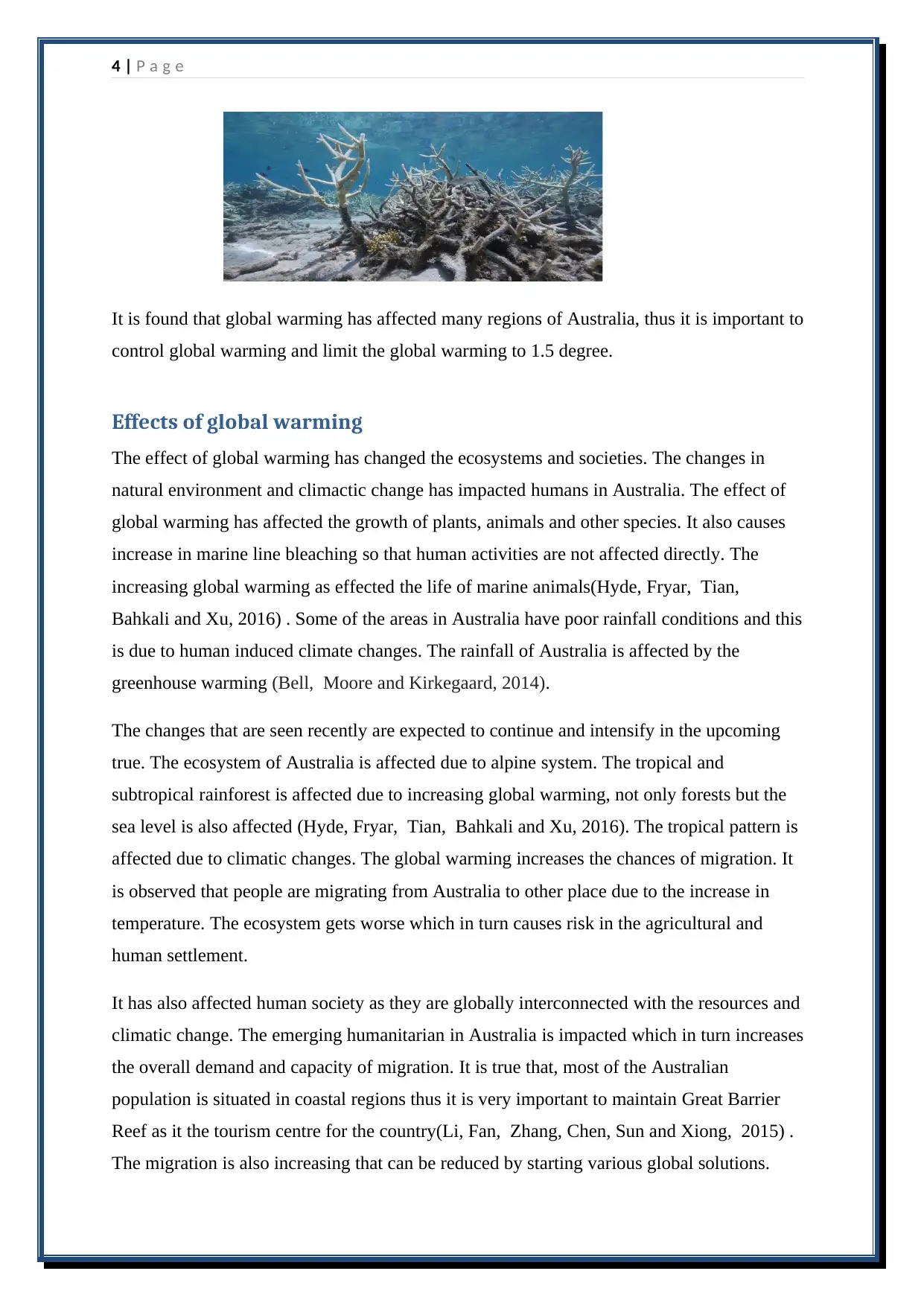
It is found that global warming has affected many regions of Australia, thus it is important to
control global warming and limit the global warming to 1.5 degree.
Effects of global warming
The effect of global warming has changed the ecosystems and societies. The changes in
natural environment and climactic change has impacted humans in Australia. The effect of
global warming has affected the growth of plants, animals and other species. It also causes
increase in marine line bleaching so that human activities are not affected directly. The
increasing global warming as effected the life of marine animals(Hyde, Fryar, Tian,
Bahkali and Xu, 2016) . Some of the areas in Australia have poor rainfall conditions and this
is due to human induced climate changes. The rainfall of Australia is affected by the
greenhouse warming (Bell, Moore and Kirkegaard, 2014).
The changes that are seen recently are expected to continue and intensify in the upcoming
true. The ecosystem of Australia is affected due to alpine system. The tropical and
subtropical rainforest is affected due to increasing global warming, not only forests but the
sea level is also affected (Hyde, Fryar, Tian, Bahkali and Xu, 2016). The tropical pattern is
affected due to climatic changes. The global warming increases the chances of migration. It
is observed that people are migrating from Australia to other place due to the increase in
temperature. The ecosystem gets worse which in turn causes risk in the agricultural and
human settlement.
It has also affected human society as they are globally interconnected with the resources and
climatic change. The emerging humanitarian in Australia is impacted which in turn increases
the overall demand and capacity of migration. It is true that, most of the Australian
population is situated in coastal regions thus it is very important to maintain Great Barrier
Reef as it the tourism centre for the country(Li, Fan, Zhang, Chen, Sun and Xiong, 2015) .
The migration is also increasing that can be reduced by starting various global solutions.
It is found that global warming has affected many regions of Australia, thus it is important to
control global warming and limit the global warming to 1.5 degree.
Effects of global warming
The effect of global warming has changed the ecosystems and societies. The changes in
natural environment and climactic change has impacted humans in Australia. The effect of
global warming has affected the growth of plants, animals and other species. It also causes
increase in marine line bleaching so that human activities are not affected directly. The
increasing global warming as effected the life of marine animals(Hyde, Fryar, Tian,
Bahkali and Xu, 2016) . Some of the areas in Australia have poor rainfall conditions and this
is due to human induced climate changes. The rainfall of Australia is affected by the
greenhouse warming (Bell, Moore and Kirkegaard, 2014).
The changes that are seen recently are expected to continue and intensify in the upcoming
true. The ecosystem of Australia is affected due to alpine system. The tropical and
subtropical rainforest is affected due to increasing global warming, not only forests but the
sea level is also affected (Hyde, Fryar, Tian, Bahkali and Xu, 2016). The tropical pattern is
affected due to climatic changes. The global warming increases the chances of migration. It
is observed that people are migrating from Australia to other place due to the increase in
temperature. The ecosystem gets worse which in turn causes risk in the agricultural and
human settlement.
It has also affected human society as they are globally interconnected with the resources and
climatic change. The emerging humanitarian in Australia is impacted which in turn increases
the overall demand and capacity of migration. It is true that, most of the Australian
population is situated in coastal regions thus it is very important to maintain Great Barrier
Reef as it the tourism centre for the country(Li, Fan, Zhang, Chen, Sun and Xiong, 2015) .
The migration is also increasing that can be reduced by starting various global solutions.
5 | P a g e
The global warming concern cannot be ignored in Australia as it has caused lost to 3 trillion
tonnes of ice since 1992 (Wanderer and Herle, 2015). It is seen that due to increase in
global warming the sea level has been increased in the recent years. From the new analysis
through satellite it was found that there are many remote areas but the changes that are seen
in Australia can have consequences for the entire planet (Li, Fan, Zhang, Chen, Sun and
Xiong, 2015). The extreme conditions in Australia have adverse effect on all the areas.
Climatic policy is one of the major reasons behind the problems that are faced by the
country. The major issues that have affected Australia recently are increase in
temperature(Fernando, Costa, Barbosa, Monti and Rettenmaier, 2018) .
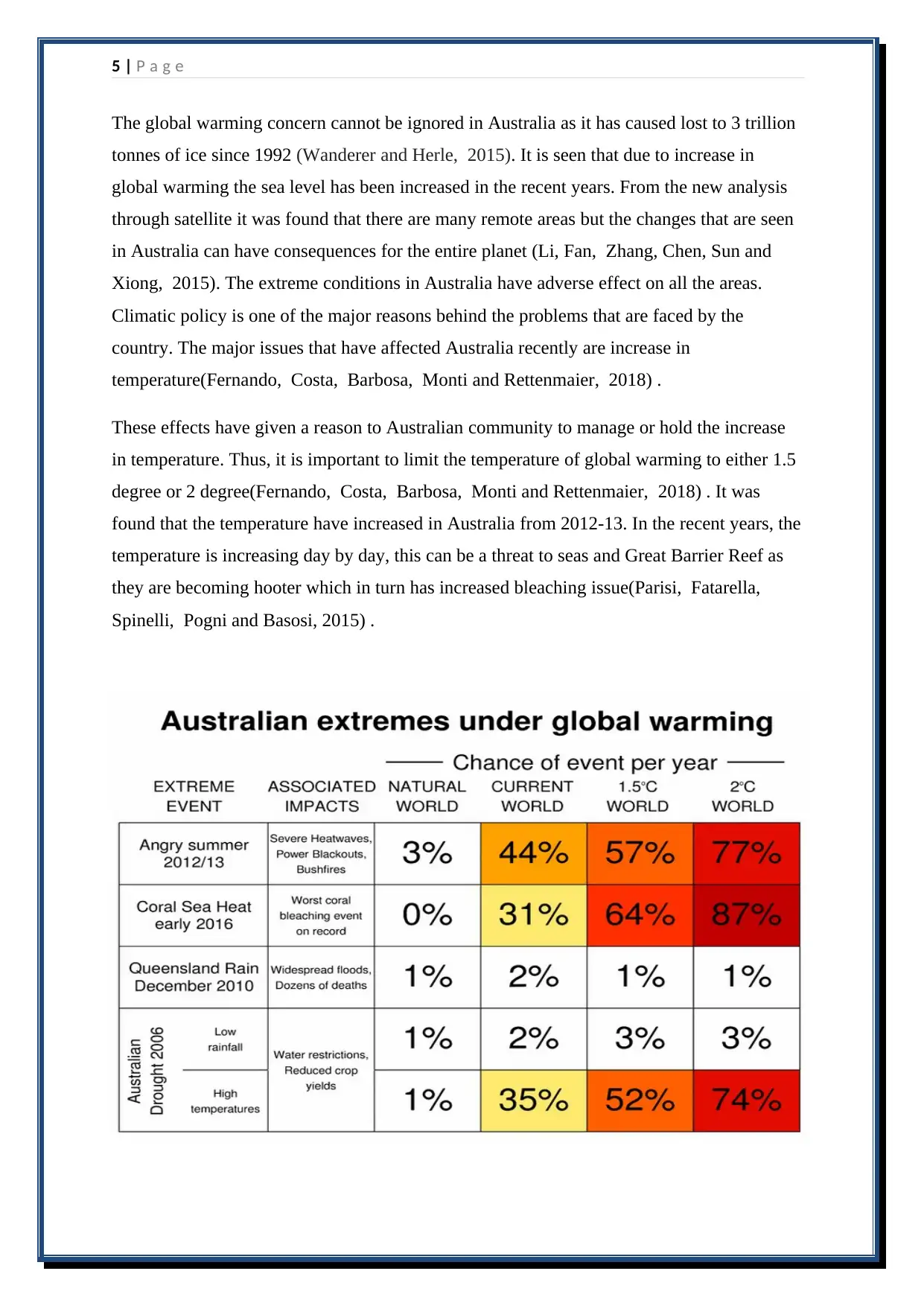
These effects have given a reason to Australian community to manage or hold the increase
in temperature. Thus, it is important to limit the temperature of global warming to either 1.5
degree or 2 degree(Fernando, Costa, Barbosa, Monti and Rettenmaier, 2018) . It was
found that the temperature have increased in Australia from 2012-13. In the recent years, the
temperature is increasing day by day, this can be a threat to seas and Great Barrier Reef as
they are becoming hooter which in turn has increased bleaching issue(Parisi, Fatarella,
Spinelli, Pogni and Basosi, 2015) .
The global warming concern cannot be ignored in Australia as it has caused lost to 3 trillion
tonnes of ice since 1992 (Wanderer and Herle, 2015). It is seen that due to increase in
global warming the sea level has been increased in the recent years. From the new analysis
through satellite it was found that there are many remote areas but the changes that are seen
in Australia can have consequences for the entire planet (Li, Fan, Zhang, Chen, Sun and
Xiong, 2015). The extreme conditions in Australia have adverse effect on all the areas.
Climatic policy is one of the major reasons behind the problems that are faced by the
country. The major issues that have affected Australia recently are increase in
temperature(Fernando, Costa, Barbosa, Monti and Rettenmaier, 2018) .
These effects have given a reason to Australian community to manage or hold the increase
in temperature. Thus, it is important to limit the temperature of global warming to either 1.5
degree or 2 degree(Fernando, Costa, Barbosa, Monti and Rettenmaier, 2018) . It was
found that the temperature have increased in Australia from 2012-13. In the recent years, the
temperature is increasing day by day, this can be a threat to seas and Great Barrier Reef as
they are becoming hooter which in turn has increased bleaching issue(Parisi, Fatarella,
Spinelli, Pogni and Basosi, 2015) .
⊘ This is a preview!⊘
Do you want full access?
Subscribe today to unlock all pages.
Trusted by 1+ million students worldwide
6 | P a g e
(Wanderer and Herle, 2015)
In the recent years, it is observed that temperature is increasing day by day. It is predicated
that in the future the temperature will increase more that will cause extreme hot summer’s ad
more frequent marine heat waves in Australia (Gunderson and Stillman, 2015). The global
warming needs to be reduced so that emission of greenhouse gases can be controlled. In the
news reports, it was estimated that the temperature of Australia will raise more that 5C by
the end of century (Gunderson and Stillman, 2015).
If comparing the scenario from past years, it can be said that the temperature has already
increased by 0.9C with the number of heat records increasing (Sheffield, 2014). These
changes will have overshadowed effects such as rising numbers of deaths due to heat waves.
It also causes water resource challenges that may impact the farmers indulged in agriculture
(Deng, Hu, Deng and Mahadevan, 2014). It also risks the coastal infrastructure along with
that it has impacted the water stress, shrinking glaciers, and disturbance in rainfall patter and
increasing sea level. The impact has also contributed in emission of global warming in
various regions (Cook, Smerdon, Seager and Coats, 2014).
Steps taken to address the problem
Various steps are taken to avoid the chances of global warming in Australia. It was found
that it is important to reduce the net emission so that temperature could be limited. The
budget is also increased so that emission of Co2 can be controlled (Deng, Hu, Deng and
Mahadevan, 2014). Thus, it is important to balance the carbon budget so that emissions
could be reduced and increasing temperature could be monitored. It is important to take
proper actions because Australia is one of the largest countries that is affected by per capita
global warming emission rate.
A national renewable electricity standard is developed so that global warming emission
could be reduced. The other step that is taken is undertaking projects so that carbon capture
could be maintained and coal burning power plants are implemented (Cook, Smerdon,
Seager and Coats, 2014). The projects are initiated so that carbon capture could be reduced
and storage technology is used to that emission of coal could be controlled. Various steps are
taken so that carbon emission could be controlled. Some of the government related policy
that is taken is CORS that is carbon pollution reduction scheme that act as a proposal for
controlling the emission. It is established to improve the market trends of greenhouse gas
(Wanderer and Herle, 2015)
In the recent years, it is observed that temperature is increasing day by day. It is predicated
that in the future the temperature will increase more that will cause extreme hot summer’s ad
more frequent marine heat waves in Australia (Gunderson and Stillman, 2015). The global
warming needs to be reduced so that emission of greenhouse gases can be controlled. In the
news reports, it was estimated that the temperature of Australia will raise more that 5C by
the end of century (Gunderson and Stillman, 2015).
If comparing the scenario from past years, it can be said that the temperature has already
increased by 0.9C with the number of heat records increasing (Sheffield, 2014). These
changes will have overshadowed effects such as rising numbers of deaths due to heat waves.
It also causes water resource challenges that may impact the farmers indulged in agriculture
(Deng, Hu, Deng and Mahadevan, 2014). It also risks the coastal infrastructure along with
that it has impacted the water stress, shrinking glaciers, and disturbance in rainfall patter and
increasing sea level. The impact has also contributed in emission of global warming in
various regions (Cook, Smerdon, Seager and Coats, 2014).
Steps taken to address the problem
Various steps are taken to avoid the chances of global warming in Australia. It was found
that it is important to reduce the net emission so that temperature could be limited. The
budget is also increased so that emission of Co2 can be controlled (Deng, Hu, Deng and
Mahadevan, 2014). Thus, it is important to balance the carbon budget so that emissions
could be reduced and increasing temperature could be monitored. It is important to take
proper actions because Australia is one of the largest countries that is affected by per capita
global warming emission rate.
A national renewable electricity standard is developed so that global warming emission
could be reduced. The other step that is taken is undertaking projects so that carbon capture
could be maintained and coal burning power plants are implemented (Cook, Smerdon,
Seager and Coats, 2014). The projects are initiated so that carbon capture could be reduced
and storage technology is used to that emission of coal could be controlled. Various steps are
taken so that carbon emission could be controlled. Some of the government related policy
that is taken is CORS that is carbon pollution reduction scheme that act as a proposal for
controlling the emission. It is established to improve the market trends of greenhouse gas
Paraphrase This Document
Need a fresh take? Get an instant paraphrase of this document with our AI Paraphraser
7 | P a g e
permits (Donelson and Munday, 2015). The renewable energy targets are also improved and
more investment is done on technologies that promote renewable energy. Various other
actions are taken so that efficiency of energy is controlled (Chaichan and Al-Asadi, 2015).
Success of these steps
These steps have somewhere proven to reduce global warming but strict actions need to be
taken. Otherwise, it will hit Australia and other countries (Sheffield, 2014). From the science
agency it was predicated if these actions are not executed the temperature will rise to 5.1C
by 2090. These programs have also have controlled the issue of rising temperature otherwise
it may result in a greater number of days with severe fire danger (Chaichan and Al-Asadi,
2015). It has also resolved the issue of soil moisture that is faced by the southern part of
southern Australia.
permits (Donelson and Munday, 2015). The renewable energy targets are also improved and
more investment is done on technologies that promote renewable energy. Various other
actions are taken so that efficiency of energy is controlled (Chaichan and Al-Asadi, 2015).
Success of these steps
These steps have somewhere proven to reduce global warming but strict actions need to be
taken. Otherwise, it will hit Australia and other countries (Sheffield, 2014). From the science
agency it was predicated if these actions are not executed the temperature will rise to 5.1C
by 2090. These programs have also have controlled the issue of rising temperature otherwise
it may result in a greater number of days with severe fire danger (Chaichan and Al-Asadi,
2015). It has also resolved the issue of soil moisture that is faced by the southern part of
southern Australia.
8 | P a g e
Conclusion
It can be concluded that global warming is one of the concern faced in Australia.
This issue is increasing in the recent times. The environmental concerns directly affect the
humans and the ecosystem of that area. The impact on the local environment due to global
warming is listed and the steps that are taken to address the problem are listed. Global
warming is one of the major environmental problems faced these days. Thus, a detail
analysis out this topic is carried out. The local place that is considered from the discussion is
Australia. These days the concern of global warming is also reported in the news. Thus,
various steps that are taken to control environmental consequences are discussed above.
Conclusion
It can be concluded that global warming is one of the concern faced in Australia.
This issue is increasing in the recent times. The environmental concerns directly affect the
humans and the ecosystem of that area. The impact on the local environment due to global
warming is listed and the steps that are taken to address the problem are listed. Global
warming is one of the major environmental problems faced these days. Thus, a detail
analysis out this topic is carried out. The local place that is considered from the discussion is
Australia. These days the concern of global warming is also reported in the news. Thus,
various steps that are taken to control environmental consequences are discussed above.
⊘ This is a preview!⊘
Do you want full access?
Subscribe today to unlock all pages.
Trusted by 1+ million students worldwide
9 | P a g e
References
Bell, L.W., Moore, A.D. and Kirkegaard, J.A., 2014. Evolution in crop–livestock integration
systems that improve farm productivity and environmental performance in
Australia. European Journal of Agronomy, 57, pp.10-20.
Chaichan, M.T. and Al-Asadi, K.A., 2015. Environmental Impact Assessment of Some
Vehicles Pollutants in Sohar, Oman. Int. J. Sci. Eng. Res, 6(7), pp.493-496.
Cook, B.I., Smerdon, J.E., Seager, R. and Coats, S., 2014. Global warming and 21 st century
drying. Climate Dynamics, 43(9-10), pp.2607-2627.
Deng, X., Hu, Y., Deng, Y. and Mahadevan, S., 2014. Environmental impact assessment
based on D numbers. Expert Systems with Applications, 41(2), pp.635-643.
Donelson, J.M. and Munday, P.L., 2015. Transgenerational plasticity mitigates the impact of
global warming to offspring sex ratios. Global change biology, 21(8), pp.2954-2962.
Fernando, A.L., Costa, J., Barbosa, B., Monti, A. and Rettenmaier, N., 2018. Environmental
impact assessment of perennial crops cultivation on marginal soils in the Mediterranean
Region. Biomass and Bioenergy, 111, pp.174-186.
Gunderson, A.R. and Stillman, J.H., 2015. Plasticity in thermal tolerance has limited
potential to buffer ectotherms from global warming. Proc. R. Soc. B, 282(1808),
p.20150401.
Hatfield-Dodds, S., Schandl, H., Adams, P.D., Baynes, T.M., Brinsmead, T.S., Bryan, B.A.,
Chiew, F.H., Graham, P.W., Grundy, M., Harwood, T. and McCallum, R., 2015. Australia is
‘free to choose’economic growth and falling environmental pressures. Nature, 527(7576),
p.49.
Hughes, T.P., Kerry, J.T., Álvarez-Noriega, M., Álvarez-Romero, J.G., Anderson, K.D.,
Baird, A.H., Babcock, R.C., Beger, M., Bellwood, D.R., Berkelmans, R. and Bridge, T.C.,
2017. Global warming and recurrent mass bleaching of corals. Nature, 543(7645), p.373.
Hyde, K.D., Fryar, S., Tian, Q., Bahkali, A.H. and Xu, J., 2016. Lignicolous freshwater
fungi along a north–south latitudinal gradient in the Asian/Australian region; can we predict
References
Bell, L.W., Moore, A.D. and Kirkegaard, J.A., 2014. Evolution in crop–livestock integration
systems that improve farm productivity and environmental performance in
Australia. European Journal of Agronomy, 57, pp.10-20.
Chaichan, M.T. and Al-Asadi, K.A., 2015. Environmental Impact Assessment of Some
Vehicles Pollutants in Sohar, Oman. Int. J. Sci. Eng. Res, 6(7), pp.493-496.
Cook, B.I., Smerdon, J.E., Seager, R. and Coats, S., 2014. Global warming and 21 st century
drying. Climate Dynamics, 43(9-10), pp.2607-2627.
Deng, X., Hu, Y., Deng, Y. and Mahadevan, S., 2014. Environmental impact assessment
based on D numbers. Expert Systems with Applications, 41(2), pp.635-643.
Donelson, J.M. and Munday, P.L., 2015. Transgenerational plasticity mitigates the impact of
global warming to offspring sex ratios. Global change biology, 21(8), pp.2954-2962.
Fernando, A.L., Costa, J., Barbosa, B., Monti, A. and Rettenmaier, N., 2018. Environmental
impact assessment of perennial crops cultivation on marginal soils in the Mediterranean
Region. Biomass and Bioenergy, 111, pp.174-186.
Gunderson, A.R. and Stillman, J.H., 2015. Plasticity in thermal tolerance has limited
potential to buffer ectotherms from global warming. Proc. R. Soc. B, 282(1808),
p.20150401.
Hatfield-Dodds, S., Schandl, H., Adams, P.D., Baynes, T.M., Brinsmead, T.S., Bryan, B.A.,
Chiew, F.H., Graham, P.W., Grundy, M., Harwood, T. and McCallum, R., 2015. Australia is
‘free to choose’economic growth and falling environmental pressures. Nature, 527(7576),
p.49.
Hughes, T.P., Kerry, J.T., Álvarez-Noriega, M., Álvarez-Romero, J.G., Anderson, K.D.,
Baird, A.H., Babcock, R.C., Beger, M., Bellwood, D.R., Berkelmans, R. and Bridge, T.C.,
2017. Global warming and recurrent mass bleaching of corals. Nature, 543(7645), p.373.
Hyde, K.D., Fryar, S., Tian, Q., Bahkali, A.H. and Xu, J., 2016. Lignicolous freshwater
fungi along a north–south latitudinal gradient in the Asian/Australian region; can we predict
Paraphrase This Document
Need a fresh take? Get an instant paraphrase of this document with our AI Paraphraser
10 | P a g e
the impact of global warming on biodiversity and function?. Fungal ecology, 19, pp.190-
200.
Kumar, S., Zwiers, F., Dirmeyer, P.A., Lawrence, D.M., Shrestha, R. and Werner, A.T.,
2016. Terrestrial contribution to the heterogeneity in hydrological changes under global
warming. Water Resources Research, 52(4), pp.3127-3142.
Li, B., Fan, C.H., Zhang, H., Chen, Z.Z., Sun, L.Y. and Xiong, Z.Q., 2015. Combined
effects of nitrogen fertilization and biochar on the net global warming potential, greenhouse
gas intensity and net ecosystem economic budget in intensive vegetable agriculture in
southeastern China. Atmospheric Environment, 100, pp.10-19.
Miller, S., Shemer, H. and Semiat, R., 2015. Energy and environmental issues in
desalination. Desalination, 366, pp.2-8.
Molinos, J.G., Halpern, B.S., Schoeman, D.S., Brown, C.J., Kiessling, W., Moore, P.J.,
Pandolfi, J.M., Poloczanska, E.S., Richardson, A.J. and Burrows, M.T., 2016. Climate
velocity and the future global redistribution of marine biodiversity. Nature Climate
Change, 6(1), p.83.
Parisi, M.L., Fatarella, E., Spinelli, D., Pogni, R. and Basosi, R., 2015. Environmental
impact assessment of an eco-efficient production for coloured textiles. Journal of Cleaner
Production, 108, pp.514-524.
Seeley, J.T. and Romps, D.M., 2015. The effect of global warming on severe thunderstorms
in the United States. Journal of Climate, 28(6), pp.2443-2458.
Trenberth, K.E., Dai, A., Van Der Schrier, G., Jones, P.D., Barichivich, J., Briffa, K.R. and
Sheffield, J., 2014. Global warming and changes in drought. Nature Climate Change, 4(1),
p.17.
Wanderer, T. and Herle, S., 2015. Creating a spatial multi-criteria decision support system
for energy related integrated environmental impact assessment. Environmental impact
assessment review, 52, pp.2-8.
Wei, J., Wei, Y. and Western, A., 2017. Evolution of the societal value of water resources
for economic development versus environmental sustainability in Australia from 1843 to
2011. Global environmental change, 42, pp.82-92.
the impact of global warming on biodiversity and function?. Fungal ecology, 19, pp.190-
200.
Kumar, S., Zwiers, F., Dirmeyer, P.A., Lawrence, D.M., Shrestha, R. and Werner, A.T.,
2016. Terrestrial contribution to the heterogeneity in hydrological changes under global
warming. Water Resources Research, 52(4), pp.3127-3142.
Li, B., Fan, C.H., Zhang, H., Chen, Z.Z., Sun, L.Y. and Xiong, Z.Q., 2015. Combined
effects of nitrogen fertilization and biochar on the net global warming potential, greenhouse
gas intensity and net ecosystem economic budget in intensive vegetable agriculture in
southeastern China. Atmospheric Environment, 100, pp.10-19.
Miller, S., Shemer, H. and Semiat, R., 2015. Energy and environmental issues in
desalination. Desalination, 366, pp.2-8.
Molinos, J.G., Halpern, B.S., Schoeman, D.S., Brown, C.J., Kiessling, W., Moore, P.J.,
Pandolfi, J.M., Poloczanska, E.S., Richardson, A.J. and Burrows, M.T., 2016. Climate
velocity and the future global redistribution of marine biodiversity. Nature Climate
Change, 6(1), p.83.
Parisi, M.L., Fatarella, E., Spinelli, D., Pogni, R. and Basosi, R., 2015. Environmental
impact assessment of an eco-efficient production for coloured textiles. Journal of Cleaner
Production, 108, pp.514-524.
Seeley, J.T. and Romps, D.M., 2015. The effect of global warming on severe thunderstorms
in the United States. Journal of Climate, 28(6), pp.2443-2458.
Trenberth, K.E., Dai, A., Van Der Schrier, G., Jones, P.D., Barichivich, J., Briffa, K.R. and
Sheffield, J., 2014. Global warming and changes in drought. Nature Climate Change, 4(1),
p.17.
Wanderer, T. and Herle, S., 2015. Creating a spatial multi-criteria decision support system
for energy related integrated environmental impact assessment. Environmental impact
assessment review, 52, pp.2-8.
Wei, J., Wei, Y. and Western, A., 2017. Evolution of the societal value of water resources
for economic development versus environmental sustainability in Australia from 1843 to
2011. Global environmental change, 42, pp.82-92.

11 | P a g e
⊘ This is a preview!⊘
Do you want full access?
Subscribe today to unlock all pages.
Trusted by 1+ million students worldwide

1 out of 12


Related Documents


Your All-in-One AI-Powered Toolkit for Academic Success.
+13062052269
info@desklib.com
Available 24*7 on WhatsApp / Email
![[object Object]](/_next/static/media/star-bottom.7253800d.svg)
Unlock your academic potential
Copyright © 2020–2025 A2Z Services. All Rights Reserved. Developed and managed by ZUCOL.