Public Health Report: Lyme Disease Testing and Vaccine Effectiveness
VerifiedAdded on 2022/12/28
|11
|2738
|94
Report
AI Summary
This report provides an overview of Lyme disease, Leptospirosis, and vaccine effectiveness, drawing on the provided text. It details the complexities of Lyme disease testing, including the two-tiered system involving ELISA and Western blot, and discusses the importance of considering the timing of testing in relation to antibody development. The report also examines Leptospirosis, focusing on its epidemiology in Brazil and the challenges of diagnosis due to overlapping symptoms with other diseases. Additionally, the report explores the effectiveness of various vaccines, including those for influenza and Rotavirus, highlighting the variability in efficacy across different populations and time periods. The report concludes by emphasizing the importance of vaccination programs in combating infectious diseases and improving public health outcomes.

Title
EPIDEMIOLOGY
EPIDEMIOLOGY

Paraphrase This Document
Need a fresh take? Get an instant paraphrase of this document with our AI Paraphraser

TABLE OF CONTENTS
REFERENCES..............................................................................................................................10
REFERENCES..............................................................................................................................10
1. Lyme disease is basically the common tick-borne disease or illness mostly found in
Europe and United States. The tests for the disease are mainly the antibody test in which
it is checked that the patient is having antibodies in his body or not. At the initial level,
the serologic test is done but most of the people are found negative in this test. Therefore,
the specificity of this test is to be improved. This is done by using a sensitive enzyme
immunoassay (EIA) and sometimes the IFA which stands for indirect
immunofluorescence assay is used (Schutzer and et.al., 2019). If this test comes to be
negative then there is no need of further testing but if it found to be positive, then IgG test
is done. The sensitivity of igG test is more than the IgM Western Blot and this is why it is
preferred. The IgG tests proves to be the most sensitive but the exception is that it is
mostly absent or diminished in those patients who receive antimicrobial therapy in the
early stages of disease. But the patients in the first week or third week must have done
iIgG test as its specificity and sensitivity is higher than any other tests.
2. Lyme disease is considered as the vector-borne disease which is caused by the pathogen
Borrelia burgdorferi sensu strict which is also known as B burgdorferi. The serologic
testing for this disease mainly follows a two-tiered system or an algorithm in which the
first step is an enzyme-linked immunosorbent assay known as ELISA and the second step
is the supplemental Western immunoblots. The second step is done only when the first
test is found to be positive. It is observed that in the Lyme ELISA test, the sensitivity is
98% and the specificity is 95%. If 10,000 individuals are tested by ELISA then, it could
give almost 1700 positive results which is 17% of the total individuals as these will have
an index value >=1.0. Among all these, 1683 (99%) will be tested for supplemental
Western blots. The median patient age could be 10.5 years which is between 7.1 to 14.4
years. Lyme tests will be ordered for 118 children (7% of the total tests sent) with EM
rash, 353 (21%) will be suspected with early disseminated disease, 976 (58%) will be
suspected with late disease and 253 (14%) will be found with non-specific symptoms and
signs (Petzke and et.al., 2020). This means that ELISA test is proved to be an efficient
test at the early or initial stages with fewer symptoms. It will give the results positive of
942 individuals which is 56% of the total people tested and are ready for the second test
of supplement Western Blot.
3
Europe and United States. The tests for the disease are mainly the antibody test in which
it is checked that the patient is having antibodies in his body or not. At the initial level,
the serologic test is done but most of the people are found negative in this test. Therefore,
the specificity of this test is to be improved. This is done by using a sensitive enzyme
immunoassay (EIA) and sometimes the IFA which stands for indirect
immunofluorescence assay is used (Schutzer and et.al., 2019). If this test comes to be
negative then there is no need of further testing but if it found to be positive, then IgG test
is done. The sensitivity of igG test is more than the IgM Western Blot and this is why it is
preferred. The IgG tests proves to be the most sensitive but the exception is that it is
mostly absent or diminished in those patients who receive antimicrobial therapy in the
early stages of disease. But the patients in the first week or third week must have done
iIgG test as its specificity and sensitivity is higher than any other tests.
2. Lyme disease is considered as the vector-borne disease which is caused by the pathogen
Borrelia burgdorferi sensu strict which is also known as B burgdorferi. The serologic
testing for this disease mainly follows a two-tiered system or an algorithm in which the
first step is an enzyme-linked immunosorbent assay known as ELISA and the second step
is the supplemental Western immunoblots. The second step is done only when the first
test is found to be positive. It is observed that in the Lyme ELISA test, the sensitivity is
98% and the specificity is 95%. If 10,000 individuals are tested by ELISA then, it could
give almost 1700 positive results which is 17% of the total individuals as these will have
an index value >=1.0. Among all these, 1683 (99%) will be tested for supplemental
Western blots. The median patient age could be 10.5 years which is between 7.1 to 14.4
years. Lyme tests will be ordered for 118 children (7% of the total tests sent) with EM
rash, 353 (21%) will be suspected with early disseminated disease, 976 (58%) will be
suspected with late disease and 253 (14%) will be found with non-specific symptoms and
signs (Petzke and et.al., 2020). This means that ELISA test is proved to be an efficient
test at the early or initial stages with fewer symptoms. It will give the results positive of
942 individuals which is 56% of the total people tested and are ready for the second test
of supplement Western Blot.
3
⊘ This is a preview!⊘
Do you want full access?
Subscribe today to unlock all pages.

Trusted by 1+ million students worldwide
3. Lyme disease is a multistage and multisystem infection which is caused by three species
of tick-borne spirochetes. The direct method for testing this disease is not much sensitive
which has become the challenge for the practitioners in the laboratory diagnosis of Lyme
disease. They could prove helpful but are not able to diagnose the disease properly. This
is why specific antibody test is done to check the presence of antibodies in the body of
the patient. For this, two tiered system is used known as serologic testing which is
initiated by the initial enzyme immunoassay which is known as EIA and is followed by
the IgM and IgG testing. This can also be done by performing the ELISA at the initial
levels and then if the tests come to be true then only the second test is done which is
supplemental Western Immunoblots (Schutzer and et.al., 2019). The individuals who
were passed the cut point of 1.00 Lyme Elisa were 1683 in number and among which the
942 (56%) individuals can be found to be having Lyme disease and among the people
with not Lyme disease, 690 (41%) will be found with Negative Western blot and only
(3%) will be found to have Positive Western Blot.
4. This is known that the 2-tiered serologic testing of Lyme disease combined a sensitive
ELISA with the certain specific supplemental Western Immunoblot. This was observed
that if the decision needs to be taken only on the basis of the ELISA test without
performing the supplement Western immunoblot then for this, the high Lyme ELISA
index value is required then only the clinical decisions can be taken by solely depending
upon the results of ELISA test. But this also has some limitations associated with it. This
can be evaluated that the tests of the Lyme ELISA having an index value >=1.0 will be
confirmed for the Western blots but this cannot help in calculating the sensitivity and
specificity of the Lyme ELISA (Arumugam and et.al., 2019). If the single Lyme ELISA
is performed then there will be no relationship of it with the antibody of the pathogen
causing Lyme disease. Also, the positive ELISA may be falsely positive if the symptoms
of the patient are present for more than 1 month. But the false positives are only in case
when the Lyme ELISA cut point is less than 1.0 but in this case the cut point was decided
as 1.0 which will not result in false positives. If any false positives also exist, then these
can less than 1% or 2%.
4
of tick-borne spirochetes. The direct method for testing this disease is not much sensitive
which has become the challenge for the practitioners in the laboratory diagnosis of Lyme
disease. They could prove helpful but are not able to diagnose the disease properly. This
is why specific antibody test is done to check the presence of antibodies in the body of
the patient. For this, two tiered system is used known as serologic testing which is
initiated by the initial enzyme immunoassay which is known as EIA and is followed by
the IgM and IgG testing. This can also be done by performing the ELISA at the initial
levels and then if the tests come to be true then only the second test is done which is
supplemental Western Immunoblots (Schutzer and et.al., 2019). The individuals who
were passed the cut point of 1.00 Lyme Elisa were 1683 in number and among which the
942 (56%) individuals can be found to be having Lyme disease and among the people
with not Lyme disease, 690 (41%) will be found with Negative Western blot and only
(3%) will be found to have Positive Western Blot.
4. This is known that the 2-tiered serologic testing of Lyme disease combined a sensitive
ELISA with the certain specific supplemental Western Immunoblot. This was observed
that if the decision needs to be taken only on the basis of the ELISA test without
performing the supplement Western immunoblot then for this, the high Lyme ELISA
index value is required then only the clinical decisions can be taken by solely depending
upon the results of ELISA test. But this also has some limitations associated with it. This
can be evaluated that the tests of the Lyme ELISA having an index value >=1.0 will be
confirmed for the Western blots but this cannot help in calculating the sensitivity and
specificity of the Lyme ELISA (Arumugam and et.al., 2019). If the single Lyme ELISA
is performed then there will be no relationship of it with the antibody of the pathogen
causing Lyme disease. Also, the positive ELISA may be falsely positive if the symptoms
of the patient are present for more than 1 month. But the false positives are only in case
when the Lyme ELISA cut point is less than 1.0 but in this case the cut point was decided
as 1.0 which will not result in false positives. If any false positives also exist, then these
can less than 1% or 2%.
4
Paraphrase This Document
Need a fresh take? Get an instant paraphrase of this document with our AI Paraphraser
5. IN most of the cases, the testing for Lyme disease is done after analysing the symptoms
such as fever, fatigue, headache, swollen lymph nodes, chills, EM rash etc. This is also
the possibility that the symptoms could be due to any other reasons also as there are
various symptoms which can be found in many other diseases. So, even if the testing is
done on healthy individual then the tests can proved to be efficient in diagnosing the
disease if any. If there are no symptoms, then the medical history can also contribute in
the diagnosis. The ELISA test which is the primary test for detecting the antibodies
which can help in fighting with the bacteria. But these tests are proved to be more
efficient and reliable after few weeks of infection when the body is able to develop
antibodies. The ELISA test is used for detecting the Lyme disease and the antibodies to
B. burgdorferi but sometimes false positives and negatives are obtained so this is not
considered as the sole basis for diagnosis. The same false results can be found when the
test is done on the healthy people because the presence of antibodies is tested in the same.
The false positives will be found when the Lyme ELISA cut point will be less than 1.0
and that too in very less number (Joung and et.al., 2019). Then, in order to remove those
false positives, the Western blot test is performed for confirming the diagnosis. This two
tiered approach helps in detecting the antibodies to proteins of B. burgdorferi.
6. Leptospirosis is basically an infection in blood which is caused by bacteria named
Leptospira and affects humans & animals. The symptoms of this disease can be none to
mild which includes muscle pains, headaches, fevers etc and sometimes also leads to
severe symptoms including the bleeding in lungs or meningitis. This is mostly spread by
rodents and is also considered as the hazard for the people who work in outdoors or
comes in contact with animals. These include the farmers, veterinarians, dairy farmers,
animal caretakers, mine workers etc. This was observed that this infection is associated
with the heavy rainfall and flooding events. Salvador is the urban tropical setting and the
maximum cases of this disease are found in Brazil due to the heavy rainfall. The
cumulative incidence of this infection is around 2% to 9% per year (Silveira, Hartwig and
McBride, 2020). In all over Brazil there are 5000 cases in the year related to this
5
such as fever, fatigue, headache, swollen lymph nodes, chills, EM rash etc. This is also
the possibility that the symptoms could be due to any other reasons also as there are
various symptoms which can be found in many other diseases. So, even if the testing is
done on healthy individual then the tests can proved to be efficient in diagnosing the
disease if any. If there are no symptoms, then the medical history can also contribute in
the diagnosis. The ELISA test which is the primary test for detecting the antibodies
which can help in fighting with the bacteria. But these tests are proved to be more
efficient and reliable after few weeks of infection when the body is able to develop
antibodies. The ELISA test is used for detecting the Lyme disease and the antibodies to
B. burgdorferi but sometimes false positives and negatives are obtained so this is not
considered as the sole basis for diagnosis. The same false results can be found when the
test is done on the healthy people because the presence of antibodies is tested in the same.
The false positives will be found when the Lyme ELISA cut point will be less than 1.0
and that too in very less number (Joung and et.al., 2019). Then, in order to remove those
false positives, the Western blot test is performed for confirming the diagnosis. This two
tiered approach helps in detecting the antibodies to proteins of B. burgdorferi.
6. Leptospirosis is basically an infection in blood which is caused by bacteria named
Leptospira and affects humans & animals. The symptoms of this disease can be none to
mild which includes muscle pains, headaches, fevers etc and sometimes also leads to
severe symptoms including the bleeding in lungs or meningitis. This is mostly spread by
rodents and is also considered as the hazard for the people who work in outdoors or
comes in contact with animals. These include the farmers, veterinarians, dairy farmers,
animal caretakers, mine workers etc. This was observed that this infection is associated
with the heavy rainfall and flooding events. Salvador is the urban tropical setting and the
maximum cases of this disease are found in Brazil due to the heavy rainfall. The
cumulative incidence of this infection is around 2% to 9% per year (Silveira, Hartwig and
McBride, 2020). In all over Brazil there are 5000 cases in the year related to this
5
infection. This epidemic of leptospirosis has become the major health problem in Brazil
leading to high mortality. The annual risk of infection of lepistorosis was found to be
10.5 per 100,000 population.
7. Leptospirosis has now become the sporadic rural disease for which Salvador can be
considered as the area with large urban outbreak of this infection. When the surveillance
was done in an infectious-disease referral hospital in Salvador Brazil at the time of heavy
rainfall from March to September. In this surveillance the patients having the symptoms
of this case were selected as the participants and are recruited for the same. The diagnosis
was done through microagglutination test for identifying the leptospires in the urine or
blood. 326 cases were identified among which 193 which are 59% of the total were
confirmed through the laboratory and 60 were the probable cases. They were all given the
proper treatment as the complications could be due to the other diseases like jaundice,
anaemia and others. But after the proper treatment also, 50 cases died which can be the
highest proportion of the total cases (Baquero and Machado, 2018). This is how, it can be
said that Salvador is the community where there is the highest force of leptospirosis
infection as it is increasing the mortality rate in the community of Brazil.
8. This can be possible as the symptoms of leptospirosis infection are sometimes obtained
due to other diseases also such as dengue, anaemia, oliguria etc. This is why, the people
living in urban communities like Salvador believe that they are having the infection of
leptospirosis. But when the microagglutination test is done then it is found that most of
the cases are of other diseases and not leptospirosis. The ARI estimate says that there are
less cases of this infection but the observation due to symptoms states that there are
highest cases of this infection in Salvador community of Brazil.
9. The effectiveness of the vaccine is different in all the age groups. This varies from age to
age and time to time. But this is also observed that the flu vaccination can help in
reducing the flu illness by almost 40% to 60% in all the overall populations during
different seasons when there is a match between the flu vaccine and the most circulating
6
leading to high mortality. The annual risk of infection of lepistorosis was found to be
10.5 per 100,000 population.
7. Leptospirosis has now become the sporadic rural disease for which Salvador can be
considered as the area with large urban outbreak of this infection. When the surveillance
was done in an infectious-disease referral hospital in Salvador Brazil at the time of heavy
rainfall from March to September. In this surveillance the patients having the symptoms
of this case were selected as the participants and are recruited for the same. The diagnosis
was done through microagglutination test for identifying the leptospires in the urine or
blood. 326 cases were identified among which 193 which are 59% of the total were
confirmed through the laboratory and 60 were the probable cases. They were all given the
proper treatment as the complications could be due to the other diseases like jaundice,
anaemia and others. But after the proper treatment also, 50 cases died which can be the
highest proportion of the total cases (Baquero and Machado, 2018). This is how, it can be
said that Salvador is the community where there is the highest force of leptospirosis
infection as it is increasing the mortality rate in the community of Brazil.
8. This can be possible as the symptoms of leptospirosis infection are sometimes obtained
due to other diseases also such as dengue, anaemia, oliguria etc. This is why, the people
living in urban communities like Salvador believe that they are having the infection of
leptospirosis. But when the microagglutination test is done then it is found that most of
the cases are of other diseases and not leptospirosis. The ARI estimate says that there are
less cases of this infection but the observation due to symptoms states that there are
highest cases of this infection in Salvador community of Brazil.
9. The effectiveness of the vaccine is different in all the age groups. This varies from age to
age and time to time. But this is also observed that the flu vaccination can help in
reducing the flu illness by almost 40% to 60% in all the overall populations during
different seasons when there is a match between the flu vaccine and the most circulating
6
⊘ This is a preview!⊘
Do you want full access?
Subscribe today to unlock all pages.
Trusted by 1+ million students worldwide
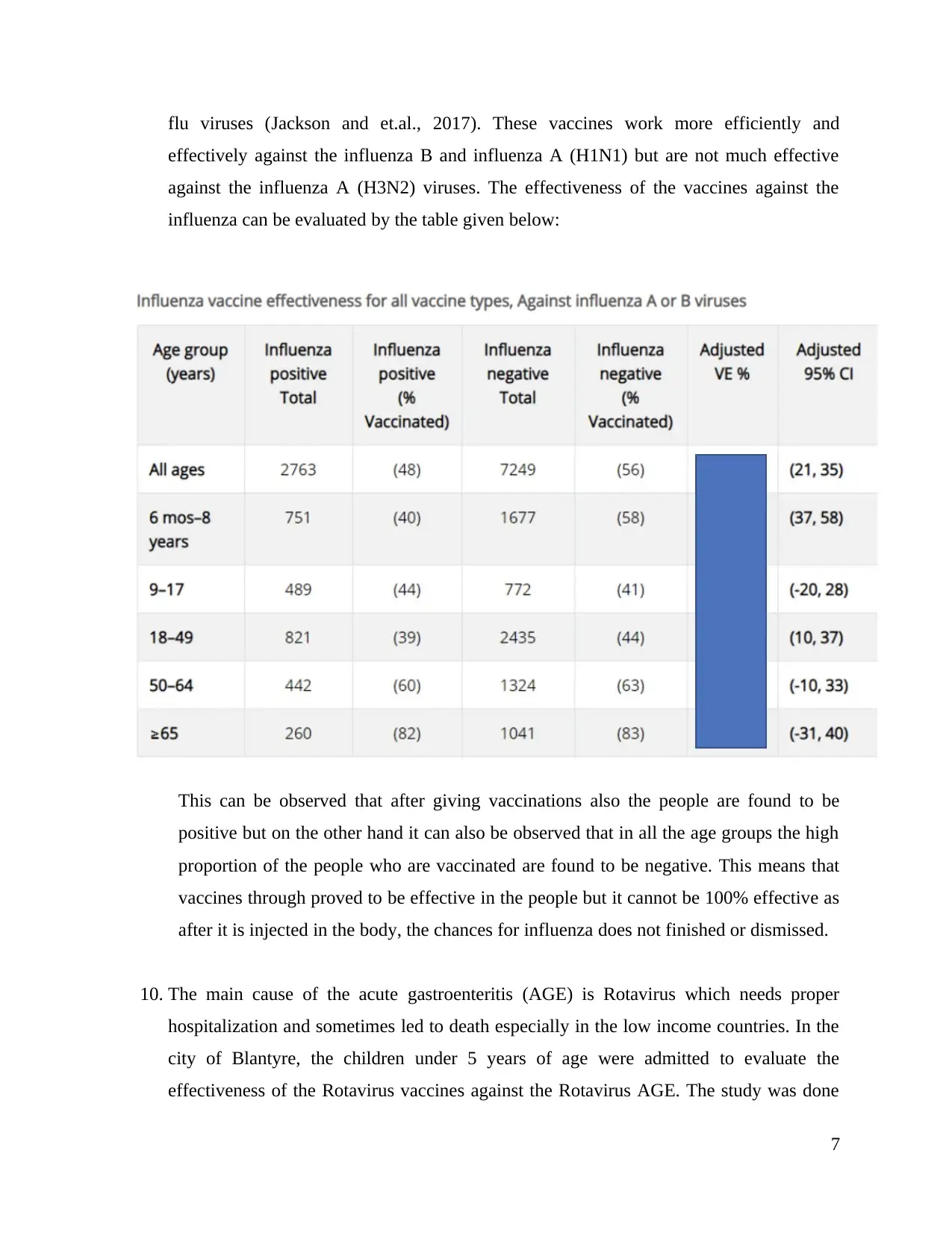
flu viruses (Jackson and et.al., 2017). These vaccines work more efficiently and
effectively against the influenza B and influenza A (H1N1) but are not much effective
against the influenza A (H3N2) viruses. The effectiveness of the vaccines against the
influenza can be evaluated by the table given below:
This can be observed that after giving vaccinations also the people are found to be
positive but on the other hand it can also be observed that in all the age groups the high
proportion of the people who are vaccinated are found to be negative. This means that
vaccines through proved to be effective in the people but it cannot be 100% effective as
after it is injected in the body, the chances for influenza does not finished or dismissed.
10. The main cause of the acute gastroenteritis (AGE) is Rotavirus which needs proper
hospitalization and sometimes led to death especially in the low income countries. In the
city of Blantyre, the children under 5 years of age were admitted to evaluate the
effectiveness of the Rotavirus vaccines against the Rotavirus AGE. The study was done
7
effectively against the influenza B and influenza A (H1N1) but are not much effective
against the influenza A (H3N2) viruses. The effectiveness of the vaccines against the
influenza can be evaluated by the table given below:
This can be observed that after giving vaccinations also the people are found to be
positive but on the other hand it can also be observed that in all the age groups the high
proportion of the people who are vaccinated are found to be negative. This means that
vaccines through proved to be effective in the people but it cannot be 100% effective as
after it is injected in the body, the chances for influenza does not finished or dismissed.
10. The main cause of the acute gastroenteritis (AGE) is Rotavirus which needs proper
hospitalization and sometimes led to death especially in the low income countries. In the
city of Blantyre, the children under 5 years of age were admitted to evaluate the
effectiveness of the Rotavirus vaccines against the Rotavirus AGE. The study was done
7
Paraphrase This Document
Need a fresh take? Get an instant paraphrase of this document with our AI Paraphraser
on 4000 children. Before the vaccination was given to the children, 600 individuals were
found to be positive for this disease as they are hospitalized for AGE rotavirus and after
injecting the vaccine; there are only 40 children which are found to be positive for this
disease. This is clearly interpreted from the results that before vaccination 30% children
were found to be positive and after the vaccination only 2% were found to be positive.
Therefore, the vaccination against the rotavirus AGE is quite effective for fighting
against the disease (Desselberger, 2017).
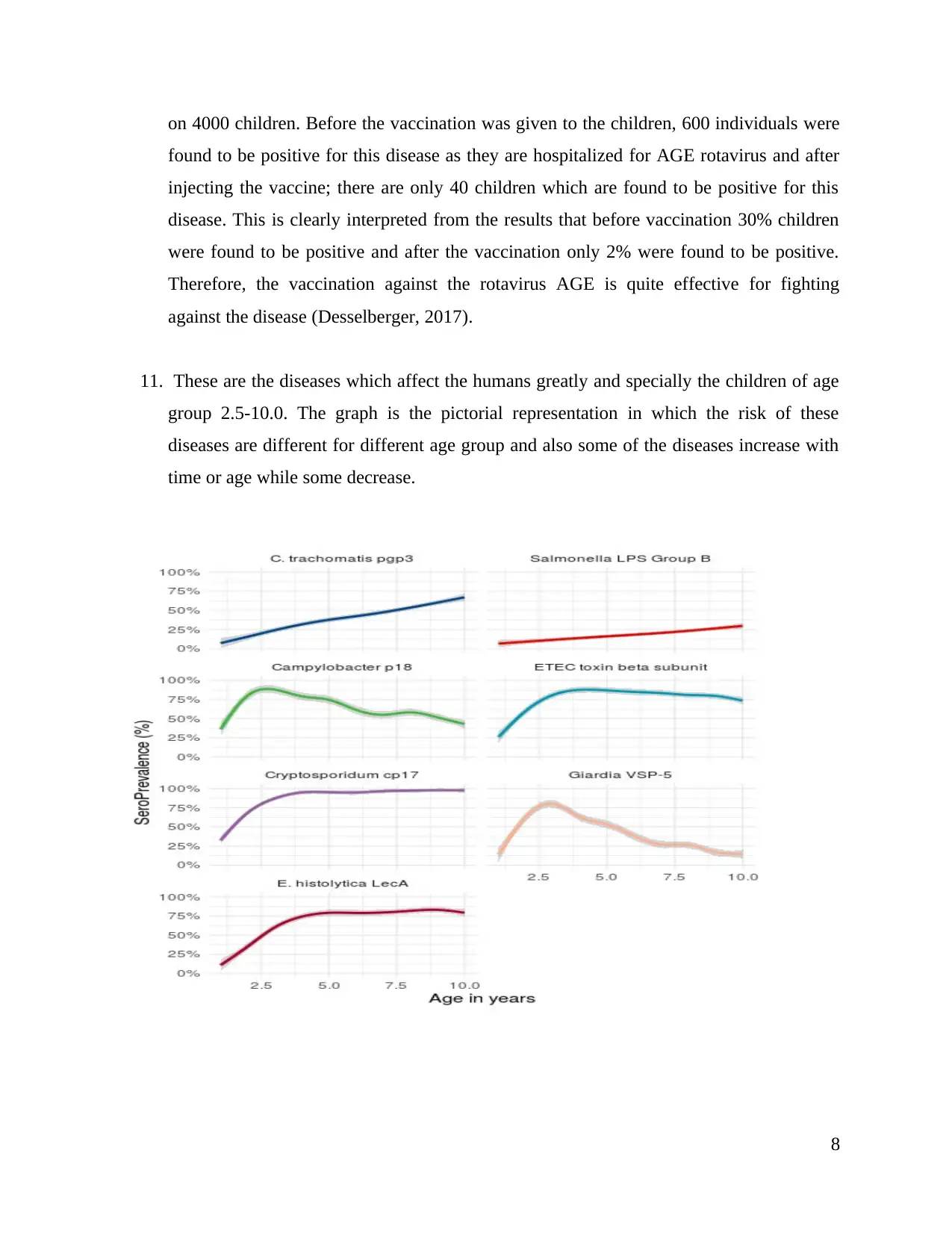
11. These are the diseases which affect the humans greatly and specially the children of age
group 2.5-10.0. The graph is the pictorial representation in which the risk of these
diseases are different for different age group and also some of the diseases increase with
time or age while some decrease.
8
found to be positive for this disease as they are hospitalized for AGE rotavirus and after
injecting the vaccine; there are only 40 children which are found to be positive for this
disease. This is clearly interpreted from the results that before vaccination 30% children
were found to be positive and after the vaccination only 2% were found to be positive.
Therefore, the vaccination against the rotavirus AGE is quite effective for fighting
against the disease (Desselberger, 2017).
11. These are the diseases which affect the humans greatly and specially the children of age
group 2.5-10.0. The graph is the pictorial representation in which the risk of these
diseases are different for different age group and also some of the diseases increase with
time or age while some decrease.
8
Interpretation from the graph:
The trachomatis pgp3 is increasing linearly with the age from 2.5 to 10. It starts increasing
from the early age when the child is born. As the age is increasing, the risk of the disease also
increases linearly from 0 to 50%. The campylobacter p18 is a disease which increases till 100%
till the age of 2.5 then later decreases after this age and keeps decreasing irregularly but reaches
at the age of 10 at the level where which it was at the time of birth. The histolyteca LecA
increase till the age of 5 then remains same at 75% neither decrease or increase. The
cryptosporidium cp17 also increases till the age of 4 then later becomes constant and remains
same at 100% for the later ages till 10. Salmonella LPS Group B also increases but very slowly
and do not reach the maximum level but just to 25%. The ETEC toxin beta subunit increases till
teh age of 4 then decreases to 90% at slow rate. Giardia VSP-5 increases till the age of 2.5 then
decreases to 0 till the age of 10.0. This is how; graph is completely interpreted on the basis of the
diseases and the age. The estimation is done in terms of the SeroPrevalence.
9
The trachomatis pgp3 is increasing linearly with the age from 2.5 to 10. It starts increasing
from the early age when the child is born. As the age is increasing, the risk of the disease also
increases linearly from 0 to 50%. The campylobacter p18 is a disease which increases till 100%
till the age of 2.5 then later decreases after this age and keeps decreasing irregularly but reaches
at the age of 10 at the level where which it was at the time of birth. The histolyteca LecA
increase till the age of 5 then remains same at 75% neither decrease or increase. The
cryptosporidium cp17 also increases till the age of 4 then later becomes constant and remains
same at 100% for the later ages till 10. Salmonella LPS Group B also increases but very slowly
and do not reach the maximum level but just to 25%. The ETEC toxin beta subunit increases till
teh age of 4 then decreases to 90% at slow rate. Giardia VSP-5 increases till the age of 2.5 then
decreases to 0 till the age of 10.0. This is how; graph is completely interpreted on the basis of the
diseases and the age. The estimation is done in terms of the SeroPrevalence.
9
⊘ This is a preview!⊘
Do you want full access?
Subscribe today to unlock all pages.
Trusted by 1+ million students worldwide
REFERENCES
Books and Journals
Arumugam, S. and et.al., 2019. A multiplexed serologic test for diagnosis of Lyme disease for
point-of-care use. Journal of clinical microbiology. 57(12).
Baquero, O.S. and Machado, G., 2018. Spatiotemporal dynamics and risk factors for human
Leptospirosis in Brazil. Scientific reports. 8(1). pp.1-14.
Desselberger, U., 2017. Differences of rotavirus vaccine effectiveness by country: likely causes
and contributing factors. Pathogens. 6(4). p.65.
Jackson, M.L. and et.al., 2017. Influenza vaccine effectiveness in the United States during the
2015–2016 season. New England Journal of Medicine. 377(6). pp.534-543.
Joung, H.A. and et.al., 2019. Point-of-care serodiagnostic test for early-stage lyme disease using
a multiplexed paper-based immunoassay and machine learning. ACS nano. 14(1).
pp.229-240.
Petzke, M.M. and et.al., 2020. Global transcriptome analysis identifies a diagnostic signature for
early disseminated Lyme disease and its resolution. Mbio. 11(2).
Schutzer, S.E. and et.al., 2019. Direct diagnostic tests for Lyme disease. Clinical Infectious
Diseases. 68(6). pp.1052-1057.
Silveira, M.M., Hartwig, F.P. and McBride, A., 2020. Incidence analysis of human leptospirosis
in Brazil. VITTALLE-Revista de Ciências da Saúde. 32(1). pp.81-92.
10
Books and Journals
Arumugam, S. and et.al., 2019. A multiplexed serologic test for diagnosis of Lyme disease for
point-of-care use. Journal of clinical microbiology. 57(12).
Baquero, O.S. and Machado, G., 2018. Spatiotemporal dynamics and risk factors for human
Leptospirosis in Brazil. Scientific reports. 8(1). pp.1-14.
Desselberger, U., 2017. Differences of rotavirus vaccine effectiveness by country: likely causes
and contributing factors. Pathogens. 6(4). p.65.
Jackson, M.L. and et.al., 2017. Influenza vaccine effectiveness in the United States during the
2015–2016 season. New England Journal of Medicine. 377(6). pp.534-543.
Joung, H.A. and et.al., 2019. Point-of-care serodiagnostic test for early-stage lyme disease using
a multiplexed paper-based immunoassay and machine learning. ACS nano. 14(1).
pp.229-240.
Petzke, M.M. and et.al., 2020. Global transcriptome analysis identifies a diagnostic signature for
early disseminated Lyme disease and its resolution. Mbio. 11(2).
Schutzer, S.E. and et.al., 2019. Direct diagnostic tests for Lyme disease. Clinical Infectious
Diseases. 68(6). pp.1052-1057.
Silveira, M.M., Hartwig, F.P. and McBride, A., 2020. Incidence analysis of human leptospirosis
in Brazil. VITTALLE-Revista de Ciências da Saúde. 32(1). pp.81-92.
10
Paraphrase This Document
Need a fresh take? Get an instant paraphrase of this document with our AI Paraphraser

Online
11
11

1 out of 11


Your All-in-One AI-Powered Toolkit for Academic Success.
+13062052269
info@desklib.com
Available 24*7 on WhatsApp / Email
![[object Object]](/_next/static/media/star-bottom.7253800d.svg)
Unlock your academic potential
Copyright © 2020–2026 A2Z Services. All Rights Reserved. Developed and managed by ZUCOL.