Exopolysaccharide Production by Co-culturing: Victoria Uni. Thesis

Verified

Added on  2023/06/12

|5
|753
|481
Thesis and Dissertation
AI Summary
This thesis investigates the impact of co-culturing Streptococcus thermophilus and Lactobacillus delbrueckii ssp. bulgaricus on exopolysaccharide (EPS) production, aiming to enhance EPS yield in low-fat yogurt. The study examines the effects of supplementation with lactose and whey protein, along with varying fermentation conditions, on EPS production. Results indicate that co-culturing in reconstituted skim milk media (RSM) promotes EPS production due to cooperative behaviors between the two LAB cultures. The research also observes the influence of different supplements on the growth of individual cultures and their mixtures, noting that lactose can sometimes retard the growth of Lactobacillus. The control experiments, conducted over 30 hours, reveal that EPS growth initially increases but slows down after 12 hours, with pH maintained at a consistent level. This thesis, submitted to Victoria University's College of Health and Biomedicine, contributes to understanding how co-culturing and supplementation strategies can optimize EPS production in food applications.
Document Page
1
Exopolysaccharide (EPS) Production
under Various Conditions
Student Name: Student ID:
Unit Name: Unit ID:
Date Due: Professor Name:
tabler-icon-diamond-filled.svg

Paraphrase This Document

Need a fresh take? Get an instant paraphrase of this document with our AI Paraphraser
Document Page
2
EPS production was observed in laboratory for four experimental conditions. The growth of
Exopolysaccharide was observed on Streptococcus thermophilus (St), Reconstituted skim milk
media (RSM), Lactobacillus delbrucckii (LB) and mixture of St and LB.
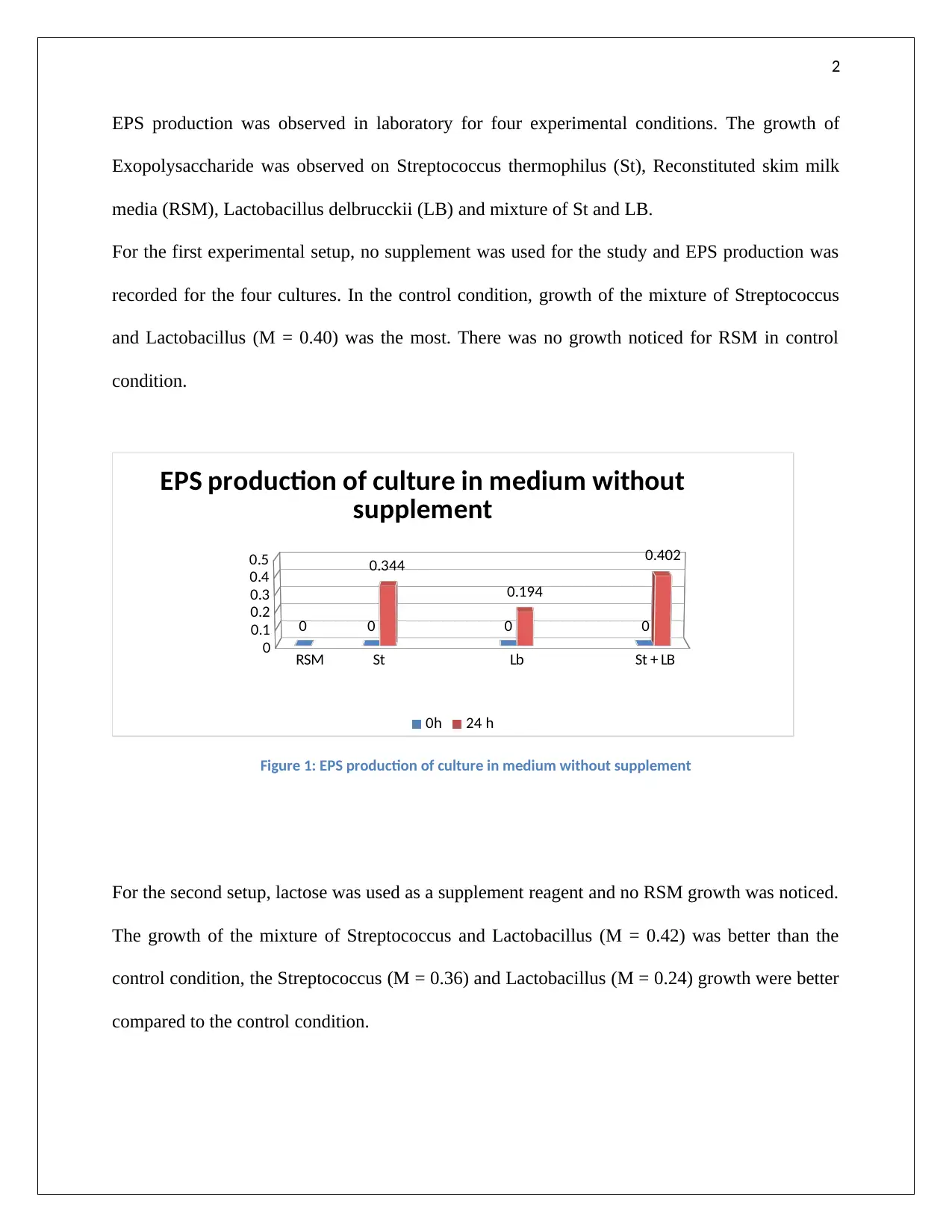
For the first experimental setup, no supplement was used for the study and EPS production was
recorded for the four cultures. In the control condition, growth of the mixture of Streptococcus
and Lactobacillus (M = 0.40) was the most. There was no growth noticed for RSM in control
condition.
RSM St Lb St + LB
0
0.1
0.2
0.3
0.4
0.5
0 0 0 0
0.344
0.194
0.402
EPS production of culture in medium without
supplement
0h 24 h
Figure 1: EPS production of culture in medium without supplement
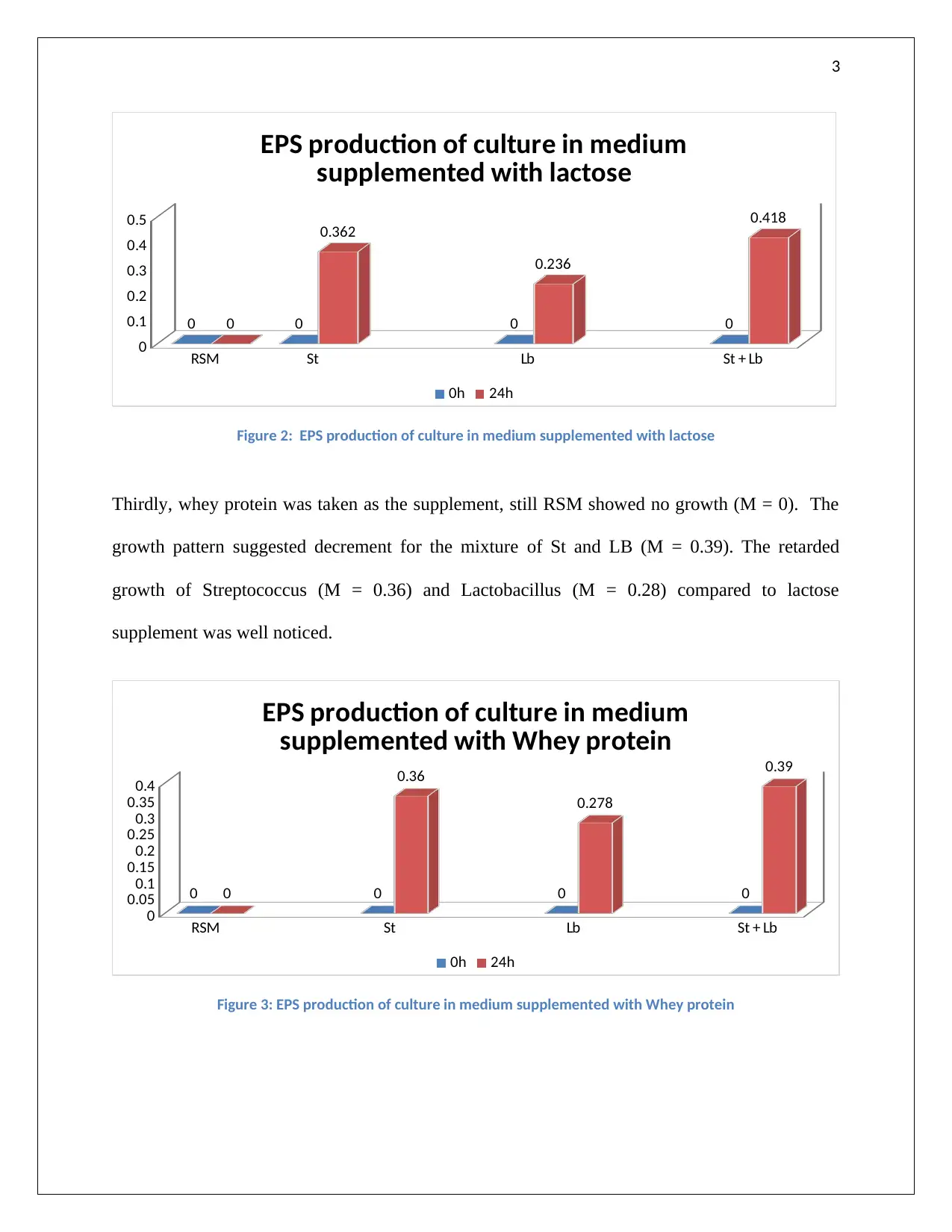
For the second setup, lactose was used as a supplement reagent and no RSM growth was noticed.
The growth of the mixture of Streptococcus and Lactobacillus (M = 0.42) was better than the
control condition, the Streptococcus (M = 0.36) and Lactobacillus (M = 0.24) growth were better
compared to the control condition.
Document Page
3
RSM St Lb St + Lb
0
0.1
0.2
0.3
0.4
0.5
0 0 0 00
0.362
0.236
0.418
EPS production of culture in medium
supplemented with lactose
0h 24h
Figure 2: EPS production of culture in medium supplemented with lactose
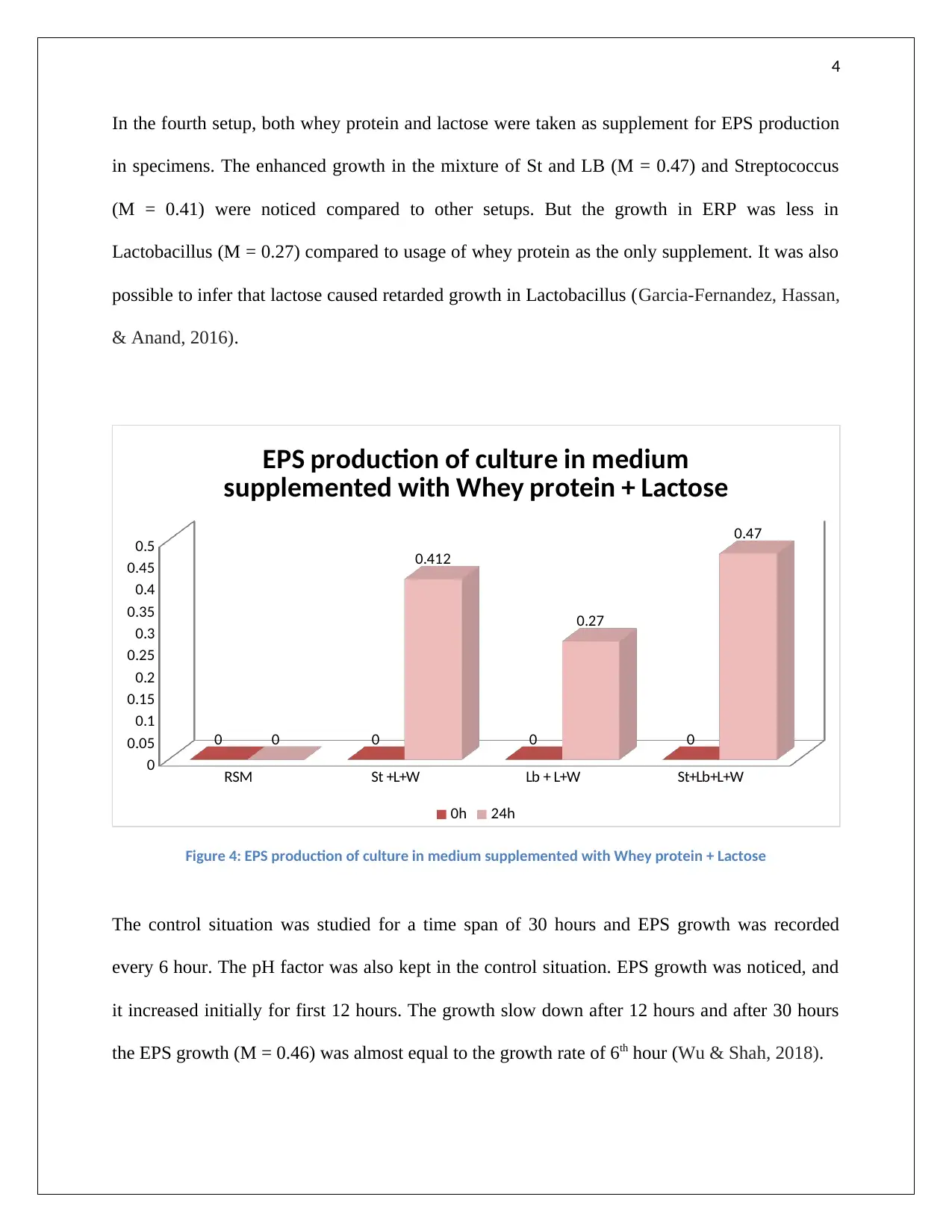
Thirdly, whey protein was taken as the supplement, still RSM showed no growth (M = 0). The
growth pattern suggested decrement for the mixture of St and LB (M = 0.39). The retarded
growth of Streptococcus (M = 0.36) and Lactobacillus (M = 0.28) compared to lactose
supplement was well noticed.
RSM St Lb St + Lb
0
0.05
0.1
0.15
0.2
0.25
0.3
0.35
0.4
0 0 0 00
0.36
0.278
0.39
EPS production of culture in medium
supplemented with Whey protein
0h 24h
Figure 3: EPS production of culture in medium supplemented with Whey protein
Document Page
4
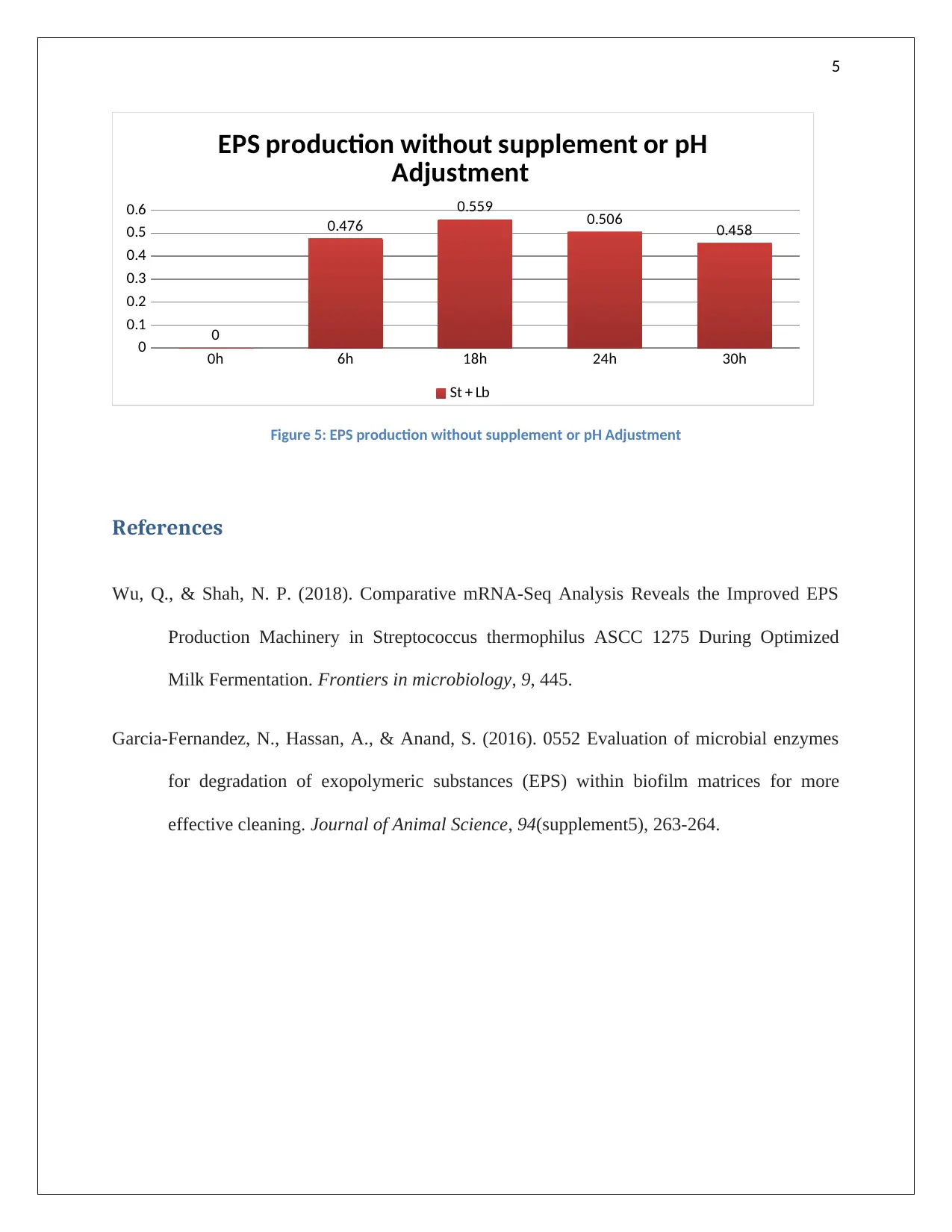
In the fourth setup, both whey protein and lactose were taken as supplement for EPS production
in specimens. The enhanced growth in the mixture of St and LB (M = 0.47) and Streptococcus
(M = 0.41) were noticed compared to other setups. But the growth in ERP was less in
Lactobacillus (M = 0.27) compared to usage of whey protein as the only supplement. It was also
possible to infer that lactose caused retarded growth in Lactobacillus (Garcia-Fernandez, Hassan,
& Anand, 2016).
RSM St +L+W Lb + L+W St+Lb+L+W
0
0.05
0.1
0.15
0.2
0.25
0.3
0.35
0.4
0.45
0.5
0 0 0 00
0.412
0.27
0.47
EPS production of culture in medium
supplemented with Whey protein + Lactose
0h 24h
Figure 4: EPS production of culture in medium supplemented with Whey protein + Lactose
The control situation was studied for a time span of 30 hours and EPS growth was recorded
every 6 hour. The pH factor was also kept in the control situation. EPS growth was noticed, and
it increased initially for first 12 hours. The growth slow down after 12 hours and after 30 hours
the EPS growth (M = 0.46) was almost equal to the growth rate of 6th hour (Wu & Shah, 2018).
tabler-icon-diamond-filled.svg

Paraphrase This Document

Need a fresh take? Get an instant paraphrase of this document with our AI Paraphraser
Document Page
5
0h 6h 18h 24h 30h
0
0.1
0.2
0.3
0.4
0.5
0.6
0
0.476
0.559 0.506 0.458
EPS production without supplement or pH
Adjustment
St + Lb
Figure 5: EPS production without supplement or pH Adjustment
References
Wu, Q., & Shah, N. P. (2018). Comparative mRNA-Seq Analysis Reveals the Improved EPS
Production Machinery in Streptococcus thermophilus ASCC 1275 During Optimized
Milk Fermentation. Frontiers in microbiology, 9, 445.
Garcia-Fernandez, N., Hassan, A., & Anand, S. (2016). 0552 Evaluation of microbial enzymes
for degradation of exopolymeric substances (EPS) within biofilm matrices for more
effective cleaning. Journal of Animal Science, 94(supplement5), 263-264.
chevron_up_icon
1 out of 5
circle_padding
hide_on_mobile
zoom_out_icon
[object Object]