Equifax Data Breach Analysis and Facebook Target Price Valuation

Verified

Added on  2020/05/28

|5
|1384
|319
Report
AI Summary
This report provides a comprehensive analysis of the Equifax data breach, examining the psychological factors contributing to the security failure and the application of conceptual frameworks for risk management. It identifies key issues such as excessive optimism in planning and information sharing, confirmation bias, and overconfidence. The report further delves into the financial analysis of Facebook, utilizing the Discounted Cash Flow (DCF) technique to determine a target price. It outlines the methodology, assumptions, and calculations, including the perpetual growth rate, enterprise value, and equity value per share. The report also incorporates the context of Facebook's growth, valuation, and the impact of significant events like acquisitions and stock performance, providing a detailed financial perspective.
Document Page
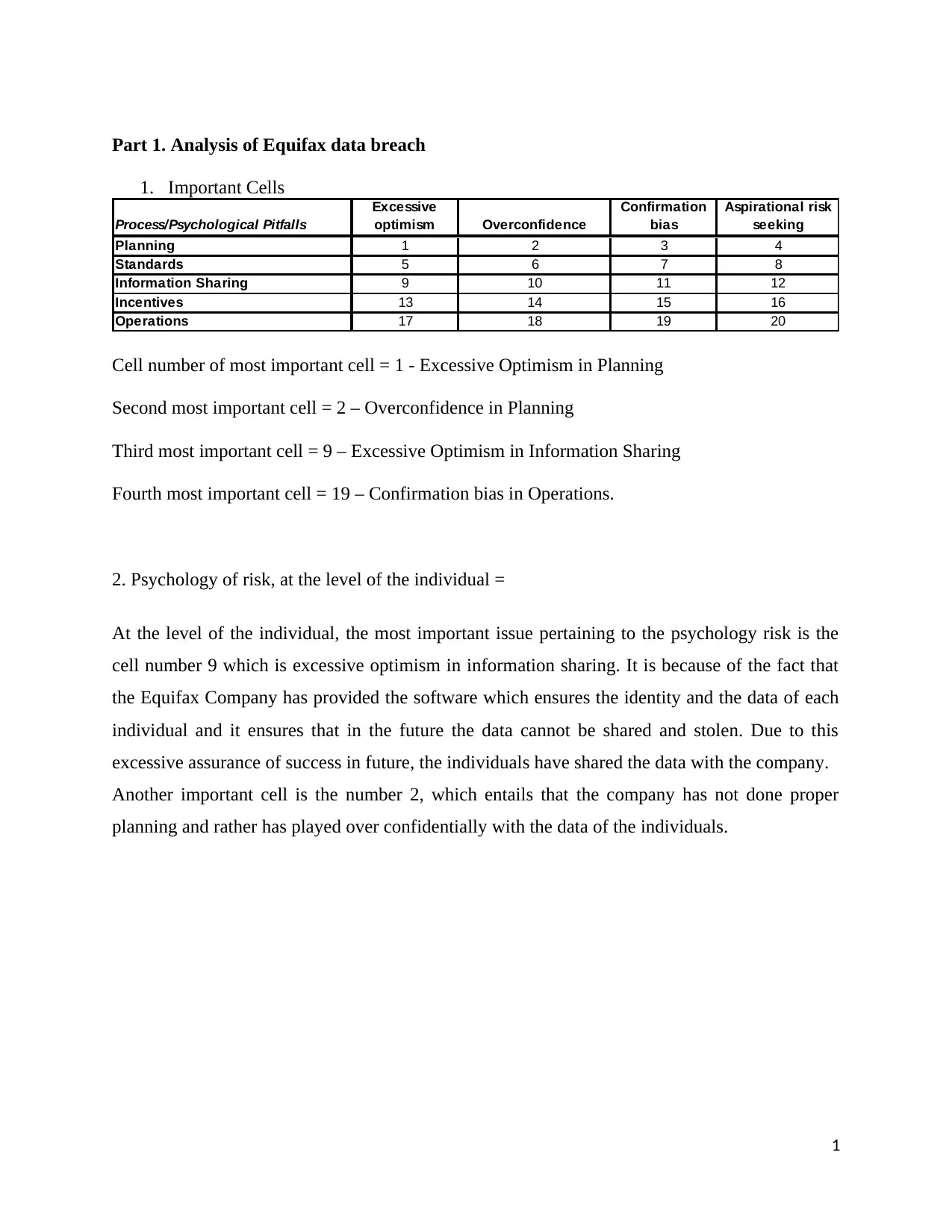
Part 1. Analysis of Equifax data breach
1. Important Cells
Process/Psychological Pitfalls
Excessive
optimism Overconfidence
Confirmation
bias
Aspirational risk
seeking
Planning 1 2 3 4
Standards 5 6 7 8
Information Sharing 9 10 11 12
Incentives 13 14 15 16
Operations 17 18 19 20
Cell number of most important cell = 1 - Excessive Optimism in Planning
Second most important cell = 2 – Overconfidence in Planning
Third most important cell = 9 – Excessive Optimism in Information Sharing
Fourth most important cell = 19 – Confirmation bias in Operations.
2. Psychology of risk, at the level of the individual =
At the level of the individual, the most important issue pertaining to the psychology risk is the
cell number 9 which is excessive optimism in information sharing. It is because of the fact that
the Equifax Company has provided the software which ensures the identity and the data of each
individual and it ensures that in the future the data cannot be shared and stolen. Due to this
excessive assurance of success in future, the individuals have shared the data with the company.
Another important cell is the number 2, which entails that the company has not done proper
planning and rather has played over confidentially with the data of the individuals.
1
tabler-icon-diamond-filled.svg

Paraphrase This Document

Need a fresh take? Get an instant paraphrase of this document with our AI Paraphraser
Document Page
3. Heuristics and biases, at the level of the individual =
The main cell pertaining to the heuristic and biases is the excessive optimism in planning. In the
given case, the company in order to solve the problem has declared that the data has been lost or
the breach has been occurred at the level of one employee. The company has come to know
about the fact of the data breach one month ago but they have not disclosed to the customers and
also have not followed any technique to detect the risks and vulnerabilities present in the current
Information Technology Framework. Secondly the company’s management has not considered
the data breach as important to solve it at early or disclose to the customers despite of receiving
the notice from the Cyber security authority to update the technologies and framework. Thus, the
company is totally biased for its own survival and has not adopted true technology for correction.
4. Risk styles, at the level of the individual =
The cell number 9 – excessive optimism in information sharing has attributed to the risk style at
the level of the individual. As other credit bureaus, Equifax also stores the personal information
of the people. Board of directors of the company has informed that the company maintains the
confidentiality of data with its own identity software and will not be harmed in case of
information sharing. But this careless or insufficient curious attitude of the board has led the
individuals into risk of financial loss in the future months to come.
5. Two other important conceptual frameworks,for group and organizational decision issues =
One conceptual framework that shall be developed is where the nominating and the governance
committee of the company meet once in a year with chief executive officer of the company. This
meeting shall mainly focus on the management issues, operations issues and other regulatory
issues that the company shall focus in next year so as to overcome any difficulty. For instance,
the company shall have taken due measures to remove the possibilities of data breach. From
discussion, twenty four topics will be picked and the monthly journal will be issued to all the
board members covering two topics on monthly basis.
Second framework shall be developed where the regular rotation of the members of board of
directors shall be made and during the time of crisis no top management official can do the
insider trading.
2
Document Page
Part 2. Target Price for Facebook
Analysis of DCF
Facebook Company has been growing at the increasing pace. Every year the revenue of the
company has been increasing by at least 40% to 45 % the previous year. As on date, the
valuation of the Facebook is $435 billion. Out of the value of $435 billion, $200 billion pertains
to the valuation of the Instagram which the Facebook has acquired in the year of 2012.
The stock prices of the Facebook has been considerably falling due to which the company has
faced the time where the stock have been sold by the major shareholders of the company just
three days prior to Initial Public Offering in order to issue more shares but no material effect has
been seen on the figures of the shareholder. Morgan Stanley in its current valuation has stated
that they have followed the same procedures for the Facebook at with the other companies and
these are in compliance with the relevant rules and regulations. It has allotted the “overweight”
rating to the company and giving the price target of $200 and quoting the share price to $24.70
per share from $38 per share in the year of 2011. The company has two classes of share as per
the report. One is Class A in which the investor carries one vote for one share and other is Class
B in which the investor carries ten votes for one share and the founder of the company have the
Class B shares at maximum so as to have the hold over the company comprising the share of
more than 50%.
The valuation has been done by using the financial management technique called Discounted
Cash Flow Technique. Under this technique the cash flows for the future years are estimated and
the present value is identified using the cost of capital percentage as the factor. The valuation is
equal to the present value of all cash inflows less the cash outflows if any during the future years.
The report has contained five methods of valuation. These are:
- Earnings Method Discounted Cash Flow
- Cash Flow Method Discounted Cash Flow
- Time Variations Earnings Discounted Cash Flow
- Time Variations Cash Discounted Cash Flow
- Market Transaction Method
3
Document Page
For the purpose of this task, cash flow method has been used. The cash flows have been defined
on the basis of 30% and the discounting factor that has been used in the calculation is equal to
the cost of capital of the company which has been turned out to 11%.
1. Facebook’s perpetual growth rate, earn cost of capital exactly during the terminal horizon =
Terminal value is equal to the discounting of the forecasted cash flows at the capitalization rate.
For calculating the free cash flows and the net present value, discounted cash flow technique has
been used with the assumption that the Earnings before Interest Depreciation, Tax and
Amortization (EBITDA) have been used as the proxy. EBIDTA after 5 years of projections have
been assumed as 6065956546 and capitalization rate is the 11% and accordingly the terminal
value will be 6065956546 divided by capitalization rate which comes out as 55145059509.
The perpetual growth rate associated with the terminal horizon which will induce the company to
reach at the cost of capital is 30% is 10.78%. The formula and calculations have been provided at
the end.
2.
PV of FCF $45773668443
NPV of terminal value $32725835566
Enterprise value $5183.74 billion
(-) Debt 57.67 billion
(+) Cash 89.03 billion
Equity value $5215.10 billion
Fully Diluted Shares (for valuation) 29.25 billion
Equity value per share $179.46
Show calculations below
1. Perpetual Growth Rate
Terminal value = {FCF X (1+g)} / (WACC-g)
55145059509 = {1000000000 X (1+g)} / (11-g)
4
tabler-icon-diamond-filled.svg

Paraphrase This Document

Need a fresh take? Get an instant paraphrase of this document with our AI Paraphraser
Document Page
Growth Rate = 10.78%
2. Enterprise Value
Market Capitalization + Total Debt – Cash and Cash Equivalents
Market Capitalization = $179.46 X 2906 million shares = 5215.10 billion
Enterprise Value = 5215.10 billion + 57.67 billion – 89.03 billion
Enterprise Value = 5183.74 billion
3. Equity Value Per Share
Equity Value / Number of Equity Shares Outstanding
= $5215.10 billion / 29.06 billion
= $179.46
5
chevron_up_icon
1 out of 5
circle_padding
hide_on_mobile
zoom_out_icon
[object Object]