Analysis of Equilibrium Speed in Vehicle Dynamics Project

Verified

Added on  2020/04/15

|6
|746
|86
Project
AI Summary
This project delves into the analysis of equilibrium speed in vehicle dynamics, exploring the factors that influence it, such as the controlling forces of a centrifugal governor. It calculates equilibrium speed using provided data and equations, considering parameters like velocity, time, and displacement. The project then examines optimized car behavior, including circular motion and acceleration calculations. Furthermore, it addresses the implications of mixed car scenarios, comparing the behaviors of traditional and self-driving cars, including the impact of adaptive cruise control and the challenges of integrating both types of vehicles on the road. The project uses equations to find the value of velocity and equilibrium speed, and also considers the circumference and motion of cars in a circular road.

Document Page
project
tabler-icon-diamond-filled.svg

Paraphrase This Document

Need a fresh take? Get an instant paraphrase of this document with our AI Paraphraser
Document Page
Table of Contents
1. Equilibrium speed........................................................................................................................2
2. Optimized behaviour...................................................................................................................3
3. Mixed cars....................................................................................................................................4
References........................................................................................................................................5
Document Page
1. Equilibrium speed
The equilibrium speed is defined as the controlling force on each ball of a centrifugal
governor by the arms, spring, etc.
Stability:
A stability is defined as each radius of rotation and this speed increases with the
radius, and it also one of the equilibrium speed parameters.
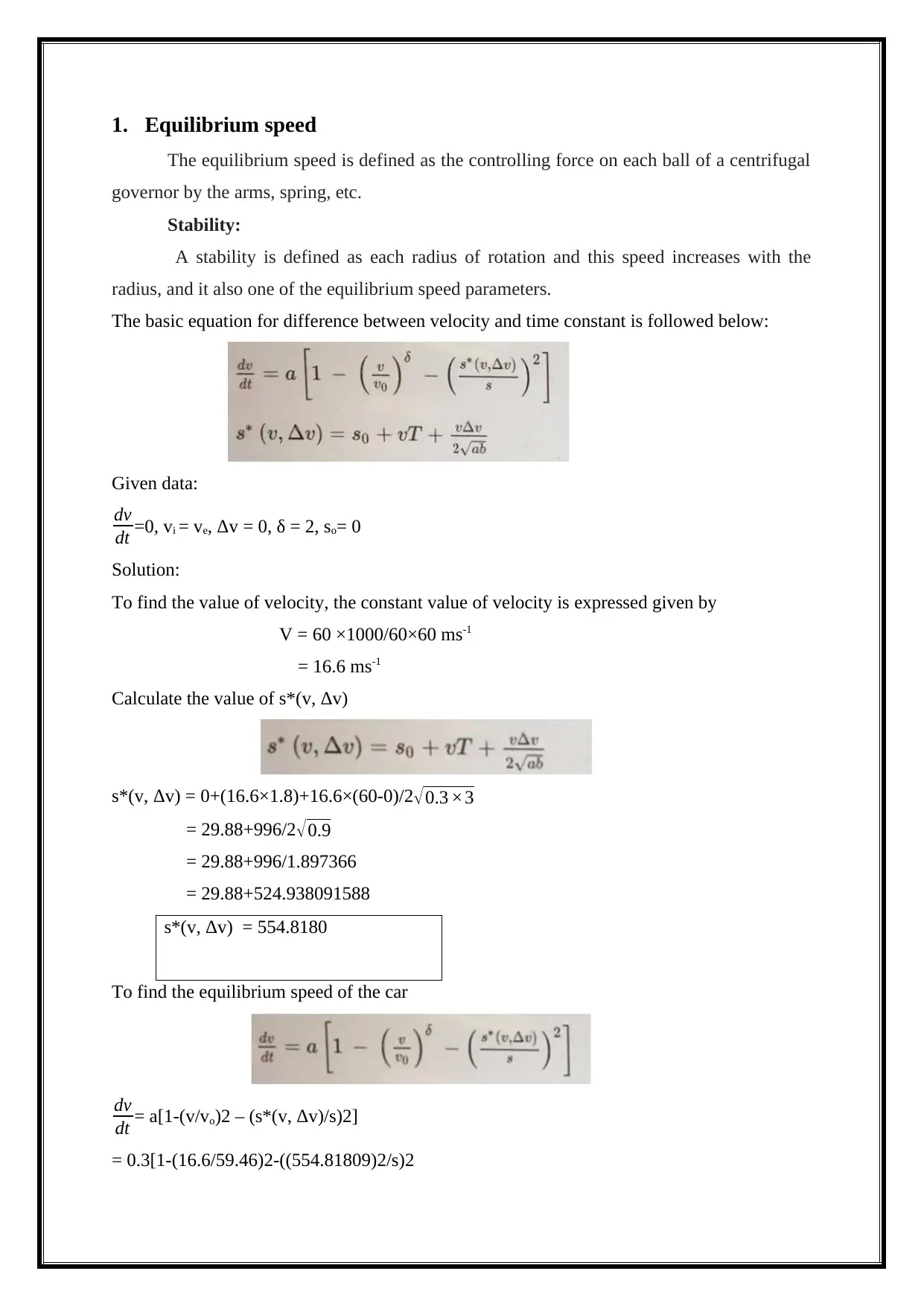
The basic equation for difference between velocity and time constant is followed below:
Given data:
dv
dt =0, vi = ve, Δv = 0, δ = 2, so= 0
Solution:
To find the value of velocity, the constant value of velocity is expressed given by
V = 60 ×1000/60×60 ms-1
= 16.6 ms-1
Calculate the value of s*(v, Δv)
s*(v, Δv) = 0+(16.6×1.8)+16.6×(60-0)/20.3 ×3
= 29.88+996/2 0.9
= 29.88+996/1.897366
= 29.88+524.938091588
s*(v, Δv) = 554.8180
To find the equilibrium speed of the car
dv
dt = a[1-(v/vo)2 – (s*(v, Δv)/s)2]
= 0.3[1-(16.6/59.46)2-((554.81809)2/s)2
Document Page
= 0.3[1-(0.279179)2-(307823.112/s)]
S2= 0.3(0.922059-307823.112)
S2= -92346.6569
S = 303.88
The equilibrium speed is Ve= S = 303.88
1.1 Determination of parameter
The equilibrium speed of parameter is determined by Ve.
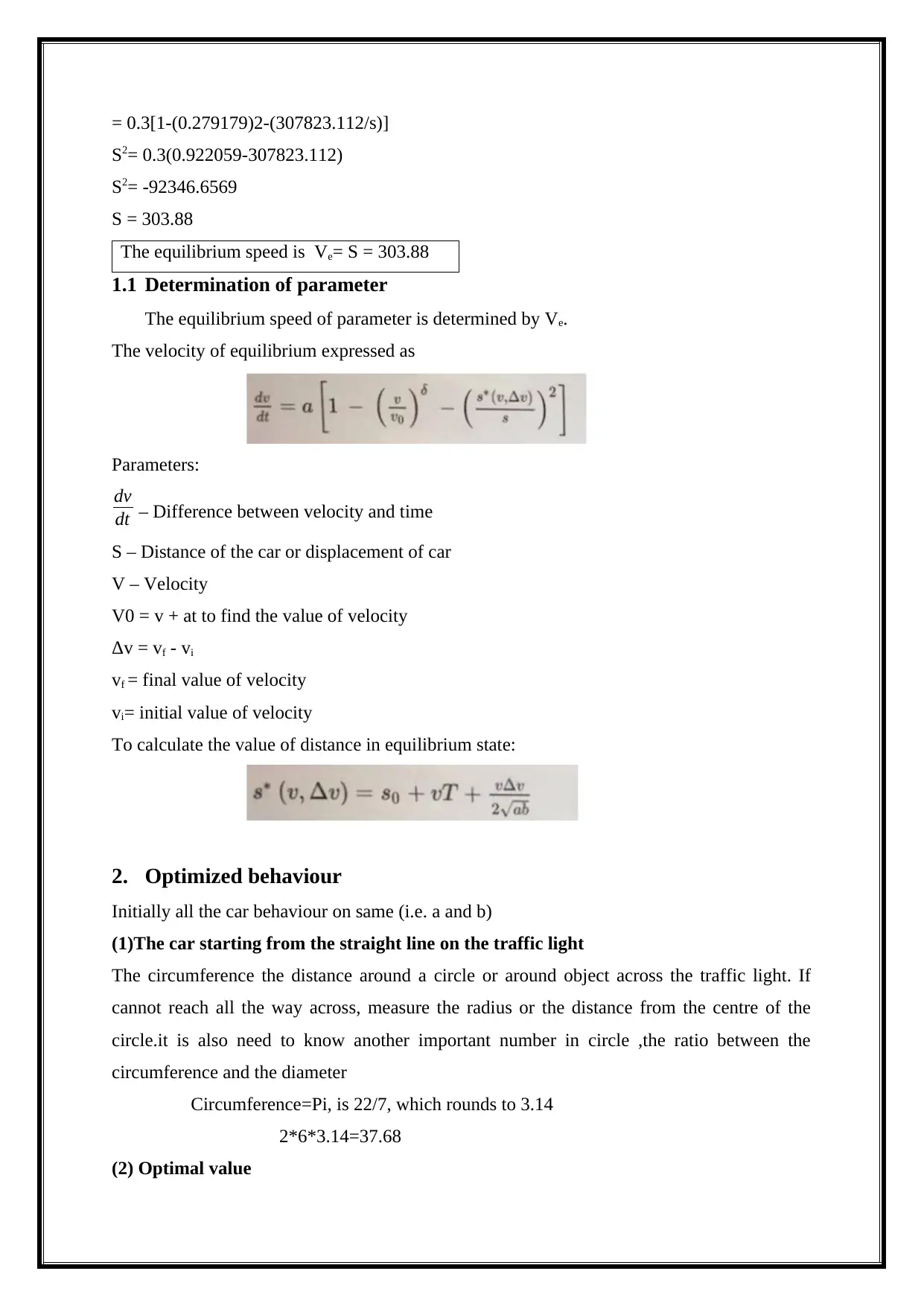
The velocity of equilibrium expressed as
Parameters:
dv
dt – Difference between velocity and time
S – Distance of the car or displacement of car
V – Velocity
V0 = v + at to find the value of velocity
Δv = vf - vi
vf = final value of velocity
vi= initial value of velocity
To calculate the value of distance in equilibrium state:
2. Optimized behaviour
Initially all the car behaviour on same (i.e. a and b)
(1)The car starting from the straight line on the traffic light
The circumference the distance around a circle or around object across the traffic light. If
cannot reach all the way across, measure the radius or the distance from the centre of the
circle.it is also need to know another important number in circle ,the ratio between the
circumference and the diameter
Circumference=Pi, is 22/7, which rounds to 3.14
2*6*3.14=37.68
(2) Optimal value
tabler-icon-diamond-filled.svg

Paraphrase This Document

Need a fresh take? Get an instant paraphrase of this document with our AI Paraphraser
Document Page
Moving around a car in circular ring road,
The circular motion w =v/r
Since r=37.5cm=0.375m (constant value)
W=v/r
=16.6/0.375
=44.26
The motion of circle in road is 44.26
The acceleration of is (a) = r
=37.5×44.26
=16.59
The car acceleration is performing is calculated in motion when the car is not in motion
(0mph- steadily from rest), until the amount of moving time taken to reach velocity of
60miles around the ring. If a and b and t is denoted as initial state is zero and moving state is
start from velocity and time taken to complete the circle(26.82)
3. Mixed cars
Now a and b are now arrays with value specified for each cars. Also a and b are not
same for all cars. Suppose human drivers have values that tends to create a traffic jam but
self-driving car have optimized values. The fully autonomous car is full of potholes, It will
create short-term pains of unexpected ways.
The advanced self-driving technology such as adaptive cruise control. It automatically
keeps cars a safe distance apart, despite changes in speed. It also ready to take over if
necessary will cut congestion as they allow more cars to fit on the road. The decades of traffic
delays until international standards on self-driving cars are agreed upon by manufacturers. In
many of whom spending billions developing their own autonomous systems. It will create a
complicated by a mix of traditional and self-driving cars sharing the road at the same time.
Document Page
References
Ferrucci, Francesco. Pro-Active Dynamic Vehicle Routing. Berlin, Physica-Verlag, 2013,.
Gormley, Amelia C. Acceleration. [United States], [}Bcreatespace], 2012,.
Meywerk, Martin. Vehicle Dynamics.
Nicastro, Nicholas. Circumference.
chevron_up_icon
1 out of 6
circle_padding
hide_on_mobile
zoom_out_icon
[object Object]