FIN5EQS - Equity Research Report: Australian Healthcare Analysis

Verified

Added on  2023/03/20

|8
|1942
|88
Report
AI Summary
This equity research report, prepared by a student, analyzes two companies within the Australian healthcare sector: Sonic Healthcare (SHL) and Ramsay Healthcare (RHL). The report begins with SWOT and PESTLE analyses for each company, evaluating their strengths, weaknesses, opportunities, threats, and the political, economic, social, technological, legal, and environmental factors influencing their operations. A detailed financial analysis follows, focusing on profitability, liquidity, working capital, leverage, and growth ratios, comparing the performance of both companies. The analysis includes specific financial data and ratios from 2014 to 2019, offering a comparative perspective on their financial health and operational efficiency. The report provides forecasts for revenue, costs, and balance sheet items. It culminates in a comparative assessment and likely concludes with an investment recommendation (buy, sell, or hold) based on the financial performance and market analysis.

Document Page
Last Name 1
Name of analysts in your team
Firm name (MAIN firm) & exchange
Ticker: SHL & RHL
Healthcare Industry
10/05/2019
tabler-icon-diamond-filled.svg

Paraphrase This Document

Need a fresh take? Get an instant paraphrase of this document with our AI Paraphraser
Document Page
Last Name 2
Investment Risk
SWOT Analysis
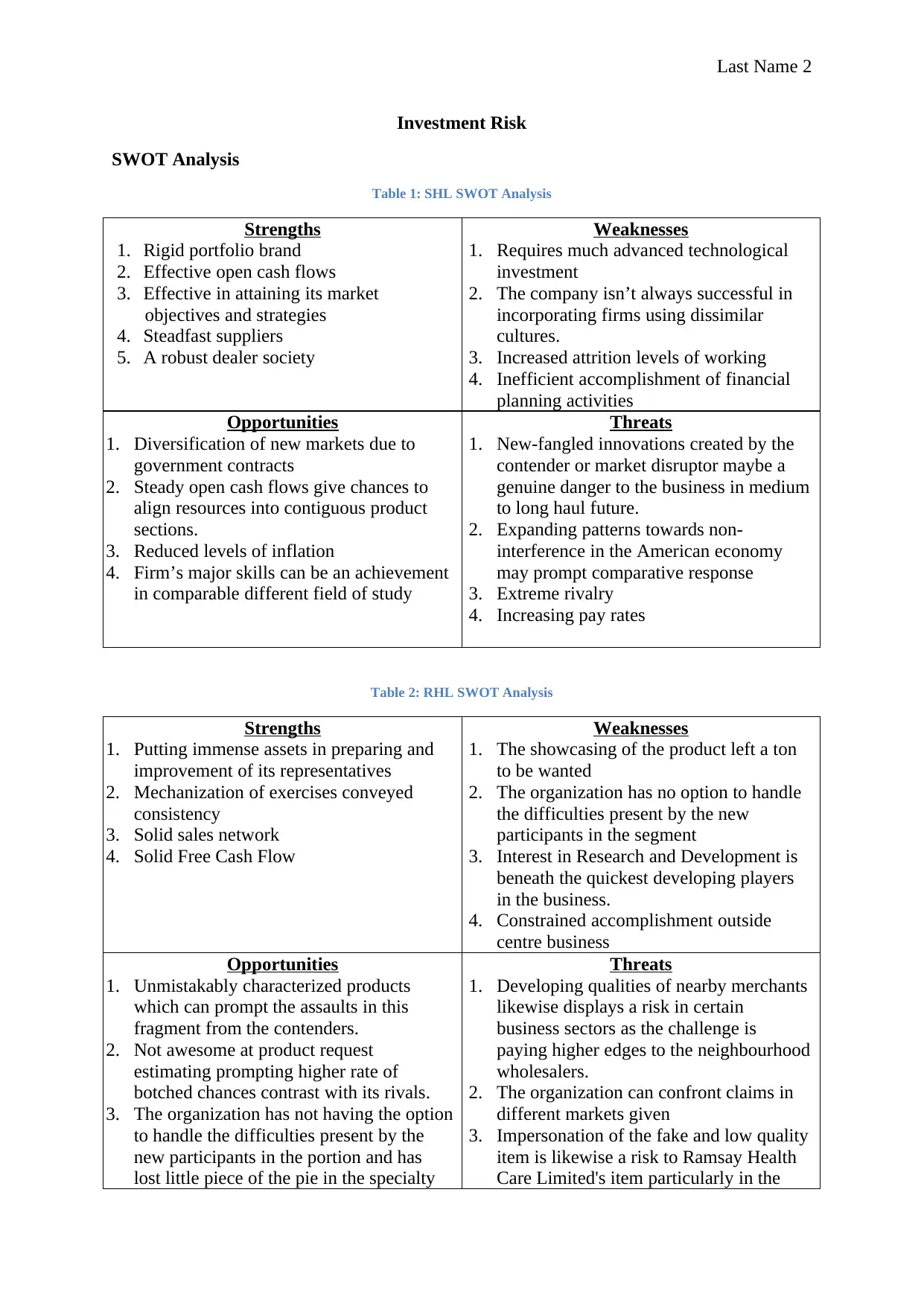
Table 1: SHL SWOT Analysis
Strengths
1. Rigid portfolio brand
2. Effective open cash flows
3. Effective in attaining its market
objectives and strategies
4. Steadfast suppliers
5. A robust dealer society
Weaknesses
1. Requires much advanced technological
investment
2. The company isn’t always successful in
incorporating firms using dissimilar
cultures.
3. Increased attrition levels of working
4. Inefficient accomplishment of financial
planning activities
Opportunities
1. Diversification of new markets due to
government contracts
2. Steady open cash flows give chances to
align resources into contiguous product
sections.
3. Reduced levels of inflation
4. Firm’s major skills can be an achievement
in comparable different field of study
Threats
1. New-fangled innovations created by the
contender or market disruptor maybe a
genuine danger to the business in medium
to long haul future.
2. Expanding patterns towards non-
interference in the American economy
may prompt comparative response
3. Extreme rivalry
4. Increasing pay rates
Table 2: RHL SWOT Analysis
Strengths
1. Putting immense assets in preparing and
improvement of its representatives
2. Mechanization of exercises conveyed
consistency
3. Solid sales network
4. Solid Free Cash Flow
Weaknesses
1. The showcasing of the product left a ton
to be wanted
2. The organization has no option to handle
the difficulties present by the new
participants in the segment
3. Interest in Research and Development is
beneath the quickest developing players
in the business.
4. Constrained accomplishment outside
centre business
Opportunities
1. Unmistakably characterized products
which can prompt the assaults in this
fragment from the contenders.
2. Not awesome at product request
estimating prompting higher rate of
botched chances contrast with its rivals.
3. The organization has not having the option
to handle the difficulties present by the
new participants in the portion and has
lost little piece of the pie in the specialty
Threats
1. Developing qualities of nearby merchants
likewise displays a risk in certain
business sectors as the challenge is
paying higher edges to the neighbourhood
wholesalers.
2. The organization can confront claims in
different markets given
3. Impersonation of the fake and low quality
item is likewise a risk to Ramsay Health
Care Limited's item particularly in the
Document Page
Last Name 3
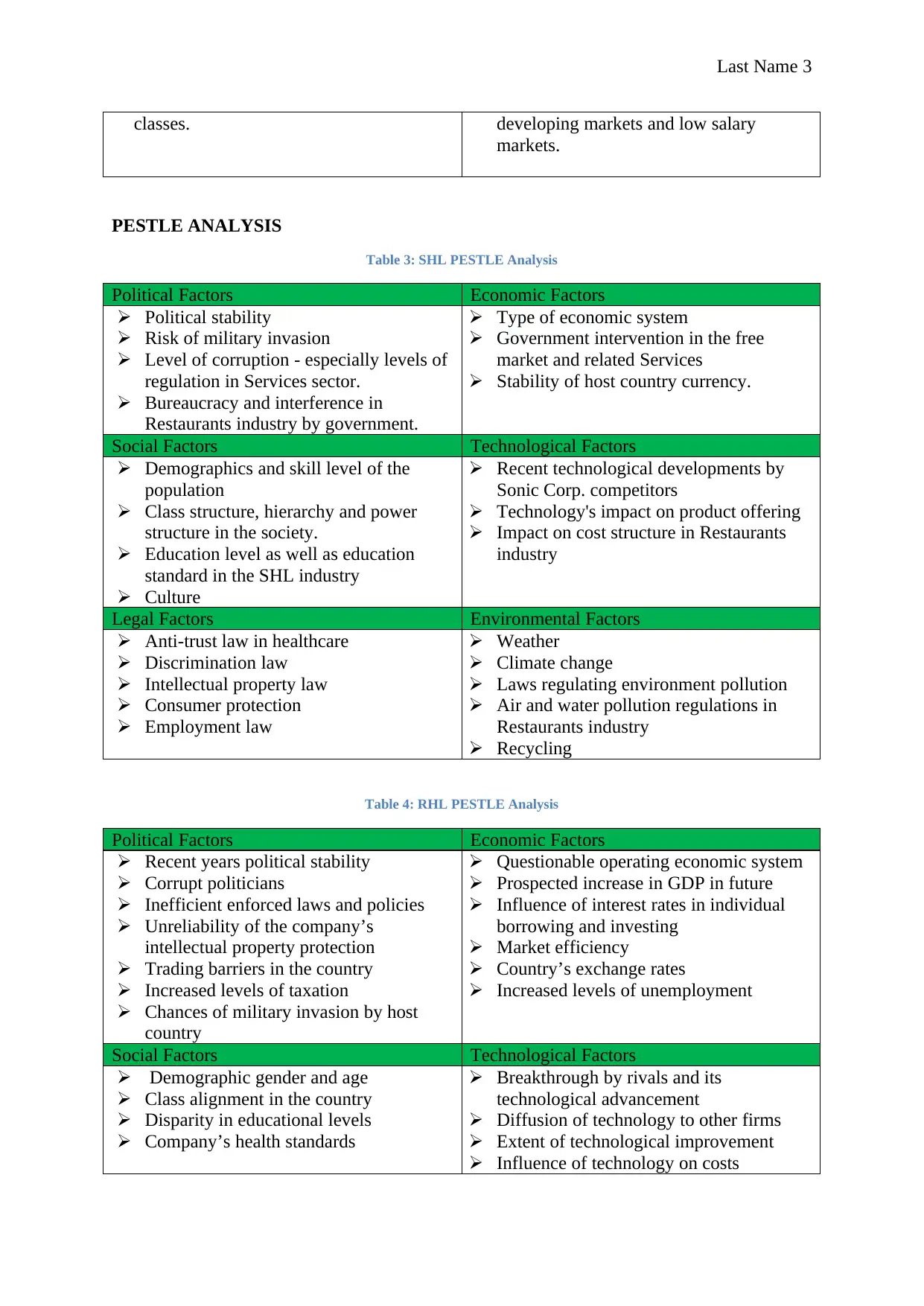
classes. developing markets and low salary
markets.
PESTLE ANALYSIS
Table 3: SHL PESTLE Analysis
Political Factors Economic Factors
Political stability
Risk of military invasion
Level of corruption - especially levels of
regulation in Services sector.
Bureaucracy and interference in
Restaurants industry by government.
Type of economic system
Government intervention in the free
market and related Services
Stability of host country currency.
Social Factors Technological Factors
Demographics and skill level of the
population
Class structure, hierarchy and power
structure in the society.
Education level as well as education
standard in the SHL industry
Culture
Recent technological developments by
Sonic Corp. competitors
Technology's impact on product offering
Impact on cost structure in Restaurants
industry
Legal Factors Environmental Factors
Anti-trust law in healthcare
Discrimination law
Intellectual property law
Consumer protection
Employment law
Weather
Climate change
Laws regulating environment pollution
Air and water pollution regulations in
Restaurants industry
Recycling
Table 4: RHL PESTLE Analysis
Political Factors Economic Factors
Recent years political stability
Corrupt politicians
Inefficient enforced laws and policies
Unreliability of the company’s
intellectual property protection
Trading barriers in the country
Increased levels of taxation
Chances of military invasion by host
country
Questionable operating economic system
Prospected increase in GDP in future
Influence of interest rates in individual
borrowing and investing
Market efficiency
Country’s exchange rates
Increased levels of unemployment
Social Factors Technological Factors
Demographic gender and age
Class alignment in the country
Disparity in educational levels
Company’s health standards
Breakthrough by rivals and its
technological advancement
Diffusion of technology to other firms
Extent of technological improvement
Influence of technology on costs
Document Page
Last Name 4
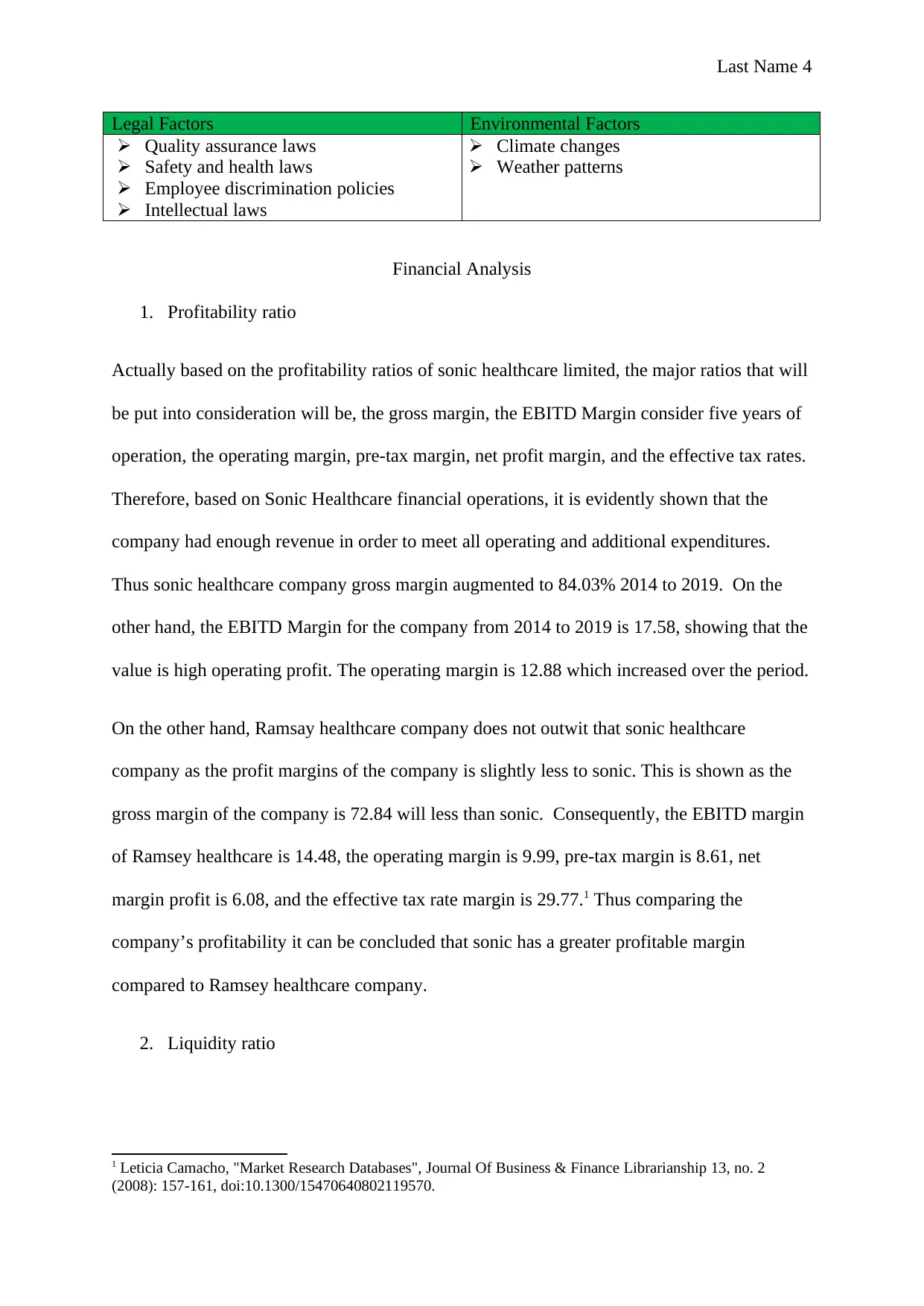
Legal Factors Environmental Factors
Quality assurance laws
Safety and health laws
Employee discrimination policies
Intellectual laws
Climate changes
Weather patterns
Financial Analysis
1. Profitability ratio
Actually based on the profitability ratios of sonic healthcare limited, the major ratios that will
be put into consideration will be, the gross margin, the EBITD Margin consider five years of
operation, the operating margin, pre-tax margin, net profit margin, and the effective tax rates.
Therefore, based on Sonic Healthcare financial operations, it is evidently shown that the
company had enough revenue in order to meet all operating and additional expenditures.
Thus sonic healthcare company gross margin augmented to 84.03% 2014 to 2019. On the
other hand, the EBITD Margin for the company from 2014 to 2019 is 17.58, showing that the
value is high operating profit. The operating margin is 12.88 which increased over the period.
On the other hand, Ramsay healthcare company does not outwit that sonic healthcare
company as the profit margins of the company is slightly less to sonic. This is shown as the
gross margin of the company is 72.84 will less than sonic. Consequently, the EBITD margin
of Ramsey healthcare is 14.48, the operating margin is 9.99, pre-tax margin is 8.61, net
margin profit is 6.08, and the effective tax rate margin is 29.77.1 Thus comparing the
company’s profitability it can be concluded that sonic has a greater profitable margin
compared to Ramsey healthcare company.
2. Liquidity ratio
1 Leticia Camacho, "Market Research Databases", Journal Of Business & Finance Librarianship 13, no. 2
(2008): 157-161, doi:10.1300/15470640802119570.
tabler-icon-diamond-filled.svg

Paraphrase This Document

Need a fresh take? Get an instant paraphrase of this document with our AI Paraphraser
Document Page
Last Name 5
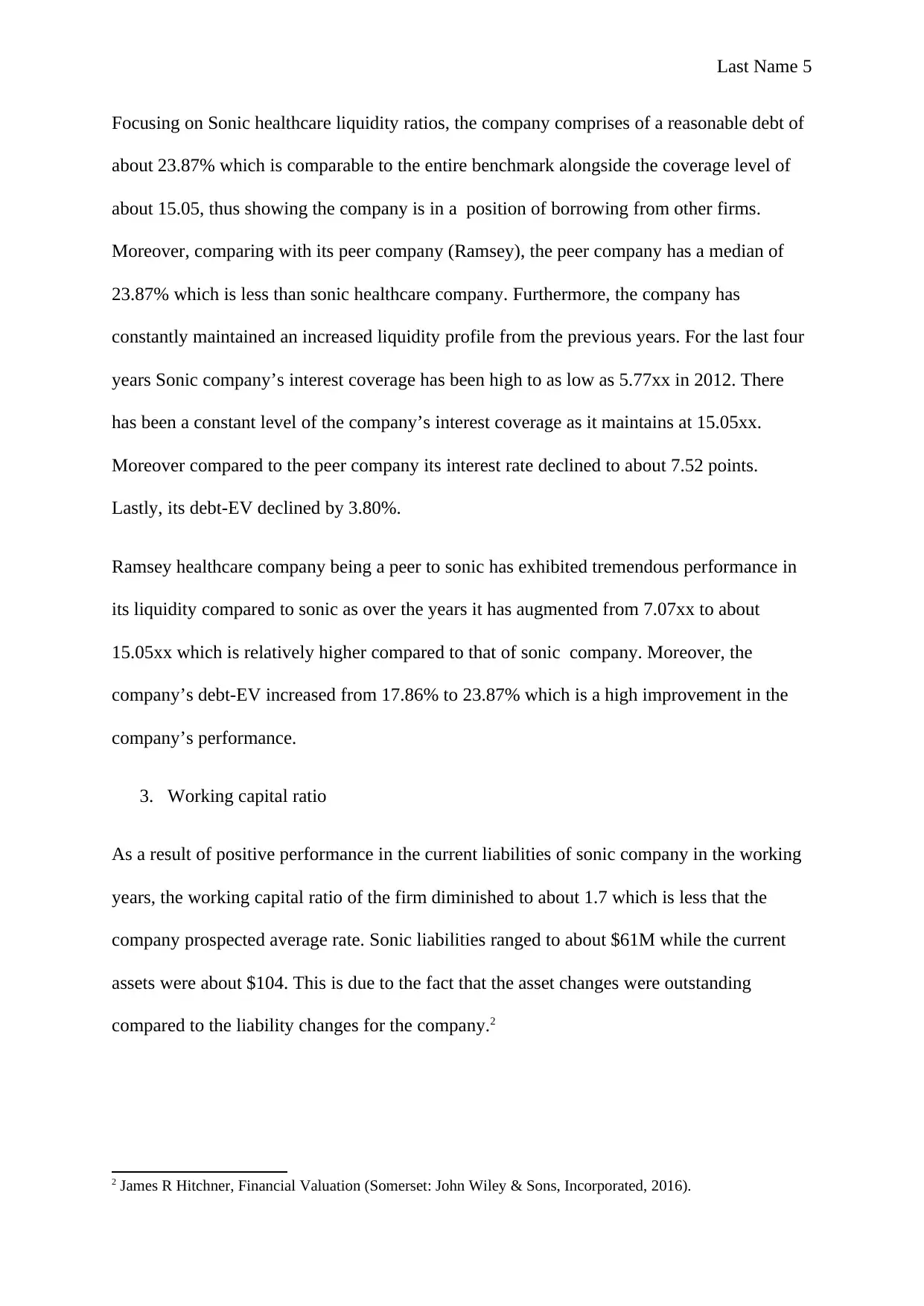
Focusing on Sonic healthcare liquidity ratios, the company comprises of a reasonable debt of
about 23.87% which is comparable to the entire benchmark alongside the coverage level of
about 15.05, thus showing the company is in a position of borrowing from other firms.
Moreover, comparing with its peer company (Ramsey), the peer company has a median of
23.87% which is less than sonic healthcare company. Furthermore, the company has
constantly maintained an increased liquidity profile from the previous years. For the last four
years Sonic company’s interest coverage has been high to as low as 5.77xx in 2012. There
has been a constant level of the company’s interest coverage as it maintains at 15.05xx.
Moreover compared to the peer company its interest rate declined to about 7.52 points.
Lastly, its debt-EV declined by 3.80%.
Ramsey healthcare company being a peer to sonic has exhibited tremendous performance in
its liquidity compared to sonic as over the years it has augmented from 7.07xx to about
15.05xx which is relatively higher compared to that of sonic company. Moreover, the
company’s debt-EV increased from 17.86% to 23.87% which is a high improvement in the
company’s performance.
3. Working capital ratio
As a result of positive performance in the current liabilities of sonic company in the working
years, the working capital ratio of the firm diminished to about 1.7 which is less that the
company prospected average rate. Sonic liabilities ranged to about $61M while the current
assets were about $104. This is due to the fact that the asset changes were outstanding
compared to the liability changes for the company.2
2 James R Hitchner, Financial Valuation (Somerset: John Wiley & Sons, Incorporated, 2016).
Document Page
Last Name 6
However, Ramsey, Sonic’s peer acquired a large working capital ratio than sonic healthcare
company in 2018. As the overall ranking persisted unchanged relating to the other years of
operation.
4. Leverage ratio
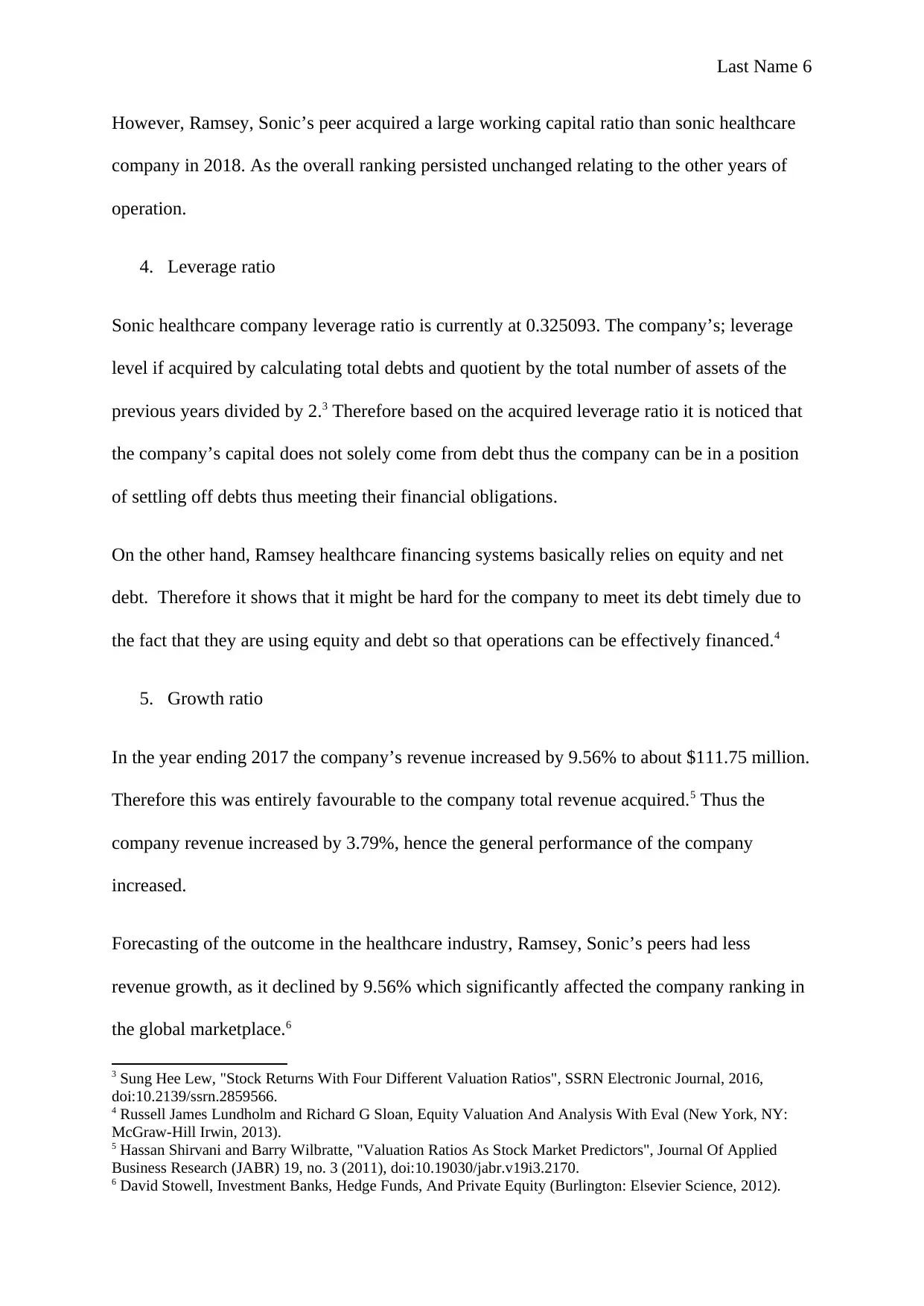
Sonic healthcare company leverage ratio is currently at 0.325093. The company’s; leverage
level if acquired by calculating total debts and quotient by the total number of assets of the
previous years divided by 2.3 Therefore based on the acquired leverage ratio it is noticed that
the company’s capital does not solely come from debt thus the company can be in a position
of settling off debts thus meeting their financial obligations.
On the other hand, Ramsey healthcare financing systems basically relies on equity and net
debt. Therefore it shows that it might be hard for the company to meet its debt timely due to
the fact that they are using equity and debt so that operations can be effectively financed.4
5. Growth ratio
In the year ending 2017 the company’s revenue increased by 9.56% to about $111.75 million.
Therefore this was entirely favourable to the company total revenue acquired.5 Thus the
company revenue increased by 3.79%, hence the general performance of the company
increased.
Forecasting of the outcome in the healthcare industry, Ramsey, Sonic’s peers had less
revenue growth, as it declined by 9.56% which significantly affected the company ranking in
the global marketplace.6
3 Sung Hee Lew, "Stock Returns With Four Different Valuation Ratios", SSRN Electronic Journal, 2016,
doi:10.2139/ssrn.2859566.
4 Russell James Lundholm and Richard G Sloan, Equity Valuation And Analysis With Eval (New York, NY:
McGraw-Hill Irwin, 2013).
5 Hassan Shirvani and Barry Wilbratte, "Valuation Ratios As Stock Market Predictors", Journal Of Applied
Business Research (JABR) 19, no. 3 (2011), doi:10.19030/jabr.v19i3.2170.
6 David Stowell, Investment Banks, Hedge Funds, And Private Equity (Burlington: Elsevier Science, 2012).
Document Page
Last Name 7
Bibliography
Arvanitis, Alexios, and Alexandra Hantzi. "Equity Theory Ratios As Causal Schemas".
Frontiers In Psychology 7 (2016). doi:10.3389/fpsyg.2016.01257.
tabler-icon-diamond-filled.svg

Paraphrase This Document

Need a fresh take? Get an instant paraphrase of this document with our AI Paraphraser
Document Page
Last Name 8
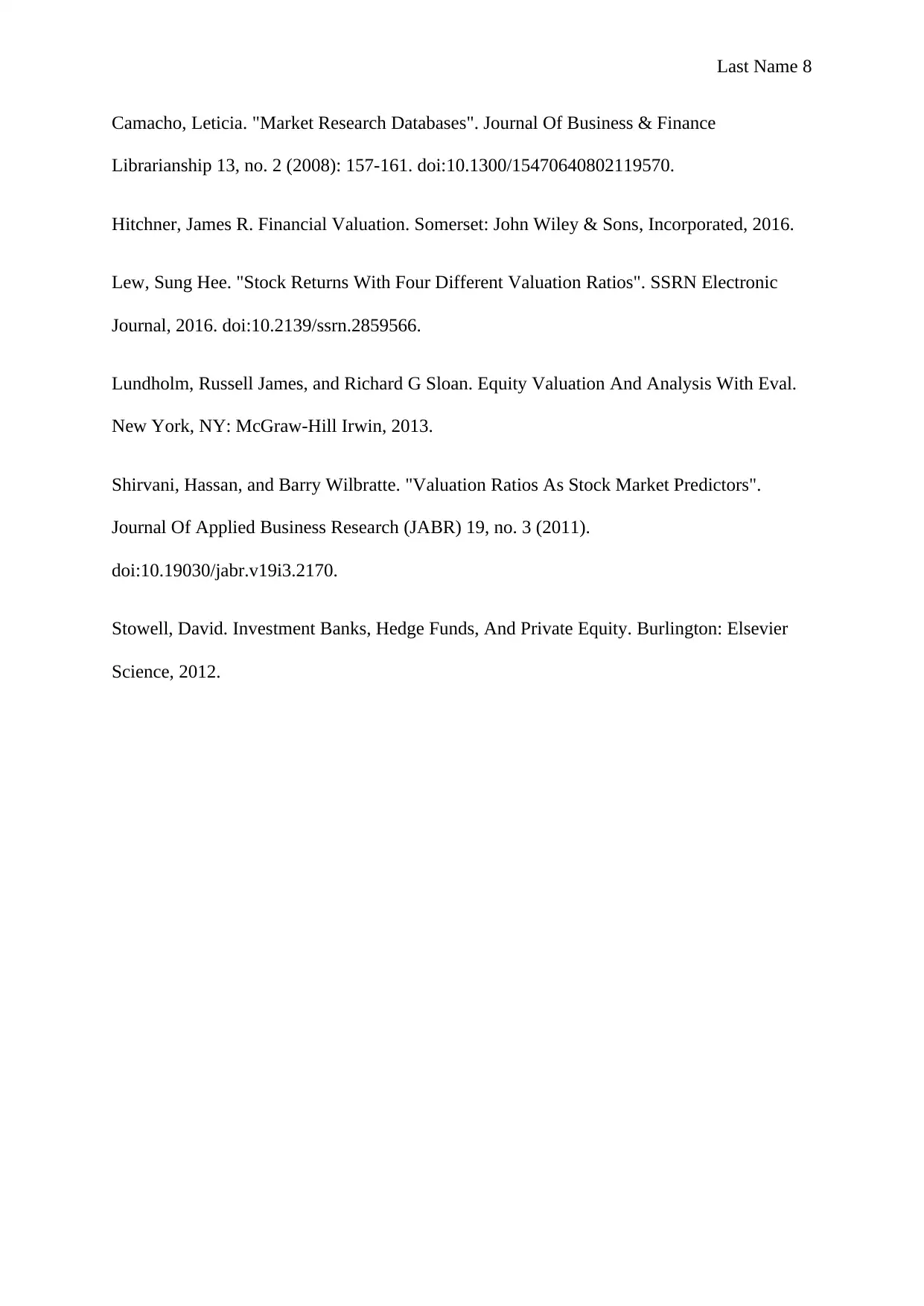
Camacho, Leticia. "Market Research Databases". Journal Of Business & Finance
Librarianship 13, no. 2 (2008): 157-161. doi:10.1300/15470640802119570.
Hitchner, James R. Financial Valuation. Somerset: John Wiley & Sons, Incorporated, 2016.
Lew, Sung Hee. "Stock Returns With Four Different Valuation Ratios". SSRN Electronic
Journal, 2016. doi:10.2139/ssrn.2859566.
Lundholm, Russell James, and Richard G Sloan. Equity Valuation And Analysis With Eval.
New York, NY: McGraw-Hill Irwin, 2013.
Shirvani, Hassan, and Barry Wilbratte. "Valuation Ratios As Stock Market Predictors".
Journal Of Applied Business Research (JABR) 19, no. 3 (2011).
doi:10.19030/jabr.v19i3.2170.
Stowell, David. Investment Banks, Hedge Funds, And Private Equity. Burlington: Elsevier
Science, 2012.
chevron_up_icon
1 out of 8
circle_padding
hide_on_mobile
zoom_out_icon
[object Object]